Disclosure: Some links in this post are affiliate links. As an Amazon Associate I earn from qualifying purchases, at no extra cost to you. Learn more
Specs are compiled from manufacturer listings and verified buyer reviews and can change over time — please confirm the key details on the product page before buying.
You want a column array speaker that fills the room evenly, packs into a car, and does not wobble or hiss through the gig. The honest answer: buy for coverage and weight first, watts last. A tall thin array spreads sound across the crowd instead of blasting the front row, so even a modestly powered column can beat a big box speaker for speeches, acoustic sets and smaller rooms. This guide ranks eleven column arrays from budget combos to premium towers, explains what each one actually does well, and points you to the right one for your venue size, your car boot, and how much setup you are willing to do.
This guide is built by comparing the manufacturers’ published specifications and the patterns across verified customer reviews, so you get each pick’s real strengths and trade-offs instead of marketing spin.
Below are eleven column arrays ranked by what they genuinely do well, from budget party combos to premium touring towers, so you can match one to your venue and your vehicle. Each pick below earns its place on coverage, weight or onboard mixing.
Top Picks


How To Choose The Best Column Array Speakers
A column array is a stack of small drivers in a tall, narrow line. That shape is the whole point. Instead of a cone blasting sound in a wide fan from waist height, the column sends sound forward in a tall, thin sheet that reaches the back of the room at nearly the same volume as the front. That even spread is why a single column can sound clearer at the back of a bar than a bigger box speaker parked on a stand.
Match the sub to the room, not to the spec sheet
The subwoofer under the column is what you actually feel. An 8-inch sub suits a small bar or a cafe set where the bass just needs to support vocals. A 12-inch sub gives you real low end for DJ work and dance floors. A 15-inch or 18-inch sub is a two-person lift and belongs in bigger rooms or outdoors. Pick the sub size you can realistically carry and the room can use.
Read coverage before you read wattage
A number like 120° horizontal coverage tells you how wide the sound throws across the room. Wider coverage means fewer dead spots on the sides. High peak wattage figures look impressive, but a column with good dispersion and a well-matched sub will often sound more even than a higher-wattage box. Treat watts as one clue, not the deciding one.
Side-by-Side Comparison
| Model | Best For | Subwoofer Size | Rated Power | Setup Style | Amazon |
|---|---|---|---|---|---|
| PRORECK Club 4000★ Best Overall | Band and backyard parties | 18 inches | 4000W P.M.P.O | Tripod-mounted array | Amazon |
| LD Systems Maui 5Featherweight Pick | Small bars and solo acts | 8 inches | 800W peak | Column on sub | Amazon |
| PRORECK Club 6000Twin Sub | Karaoke and wedding DJs | Dual 15 inches | 6000W P.M.P.O | Column on sub | Amazon |
| ALTO TS112C | Performers who want an all-in-one | 12 inches | 1200W | Column on sub | Amazon |
| JBL IRX ONE | Small venues and acoustic sets | 8 inches | 1300W | Column on sub | Amazon |
| Electro-Voice Evolve 30M | Weddings and flexible events | 10 inches | 1000W | Column on sub with pole | Amazon |
| Yamaha STAGEPAS 1K MKII | Clubs and wine bars | — | 1000W | Column on sub | Amazon |
| Bose L1 Pro8 | Cafes and coffee shops | 7 x 13 inch Racetrack | — | Column on sub | Amazon |
| Electro-Voice Evolve 50 | Gigging musicians | 8.9 centimeters driver | — | Column on sub | Amazon |
| JBL PRX ONE | DJs and large parties | 12 inches | 2000W peak | Column on sub | Amazon |
| Bose L1 Pro16 | Small-to-medium clubs | 10 x 18 inch Racetrack | — | Column on sub | Amazon |
Detailed Reviews
1. PRORECK Club 4000 18-inch Speaker System
Our pick — 4.5+★ from 600+ verified ratings; the strongest balance of quality and price.
An 18-inch sub paired with four array tops — a full band rig for the price of one speaker.
The thing that wins people over here is sound quality, and the sub is the reason. An 18-inch active subwoofer — the big powered box that handles all the deep bass — anchors the whole set, and the four 6-inch line array speakers sit on tripods above it. The array part is what spreads your vocals and guitars evenly across the room instead of pinning them to the front table. The supplied telescoping tripod stands adjust from 65 inches to 89 inches, so you can lift the array above the crowd’s heads in a packed room.
Where this beats a lot of cheaper combos is the sheer room it fills. Musicians who run this as a five-piece report it handles guitar, keys, vocals, bass and four drum mics, with the line and master sitting at roughly fifty percent to cover a hundred-person bar. The bass stays loud and the sound stays mostly clean even at max volume. The 18-inch sub also dwarfs the 8-inch one under the LD Systems Maui 5 — a two-and-a-half-times jump in cone size — which is why this one carries low end that a tiny column simply cannot. For backyard parties, the neighbours may start asking when you are playing again.
The honest catch is weight, and it is not small. The sub is a two-person lift, and the go-to fix owners suggest is fitting caster wheels on the back rather than carrying it. Assembly runs about an hour and a quarter from boxes to Bluetooth playback, and a wrench helps with the nuts. The lineup is worth treating as a package: 66-foot Bluetooth range, XLR and 6.35mm combo inputs, two mic channels, plus USB and SD card playback.
What earns it the top spot
- 18-inch active subwoofer delivers deep, usable bass for a full band
- Four 6-inch line array speakers give even coverage across a room
- Runs a whole five-piece setup at fifty percent line and master
- Inputs include stereo RCA, 3.5mm AUX and 6.35mm/XLR combo
- Remote control and 66-foot Bluetooth pairing for phone playback
Where it asks for effort
- The sub is a two-person lift — casters are a smart add-on
- Bluetooth range runs a touch short in live use
- Setup takes roughly an hour and a quarter
- Live bands still need an external mixing board
The fit: A five-piece band, a karaoke host or a backyard party host who wants a full rig with a real 18-inch sub in one bundle.
The limit: Budget for a second set of hands on the sub every time you move it.
2. LD Systems Maui 5 Portable PA System, Black
Twenty-five pounds, an 8-inch sub, and a four-channel mixer you can carry in one hand.
If the barrier between you and actually gigging is lifting the gear, this is the pick. The whole column and sub weigh 25 pounds, which means one person can carry it, set it up and get out. Sound quality is what the reviews come back to — a clear, even, warm tone that spreads widely enough that the system can be audible two blocks away while people nearby still talk at normal volume. The class D amplifier runs 800W peak through a single 8-inch sub and four 3-inch mid-high drivers.
Where the Maui 5 clearly falls short of the PRORECK Club 4000 is scale: it holds an 8-inch sub against the PRORECK’s 18-inch, so a big room stays out of reach. Where it wins is what you do with it. One unit suits a small bar under 1,500 square feet, and pairing two makes a fuller stereo field. A common pairing is a six-channel external mixer, since the four-channel built-in mixer is lean and the onboard EQ is minimal. If your act needs reverb or detailed tone shaping, budget for a mixer.
What’s crisp: The highs and mids stay warm and clear, and the controls for sub level and treble boost do real work for a solo or duo act.
What to plan around: Bags and covers sell separately, the tower takes a bit of play when both extensions are fitted, and there are no daisy-chain outputs for linking more cabs.
Best suited to: A solo singer, duo or bar performer who needs the lightest viable column with genuine LD sound.
Think twice for: Large rooms or acts that need onboard effects — you will want an outboard mixer.
3. PRORECK Club 6000 15-inch Speaker System
Two 15-inch subs and four array tops for a room that has to dance.
Where the PRORECK Club 4000 anchors on one 18-inch sub, this Club 6000 splits the low end across two 15-inch subs and adds four 6-inch line array speakers on top. That higher-rated 6000W P.M.P.O figure — peak music power, the biggest burst the system can hit rather than sustained output — is paired with a class D amplifier inside the active sub. The array speakers sit on pole mounts, and the system covers a stated 50 Hz to 20 kHz range. If you are hosting a wedding or a DJ set, the extra sub gives the sound more headroom when the room is full.
The reviews say this is a karaoke and pool-party machine. At half volume it is already very loud with crisp highs and strong bass, and a musician family called it the ultimate sound system for their setup. It is compact and light enough to move as a unit. The honest note is the midrange: the highs and lows carry the sound, the mids sit a little thin, though an external mixer fixes that at a medium venue. One cabinet can arrive dented, so open the three boxes and check before the event.
What it brings to a party: Bluetooth that half a room can confirm pairs in seconds, USB and SD playback, two mic channels and balanced XLR out — a genuinely turnkey karaoke and DJ combo.
The trade-off to know: If the built-in amp ever fails, the boxes can still run as passive speakers, but you will need outboard amplification.
Reach for this if: You host pool parties, weddings or karaoke nights and want dual 15-inch subs instead of a single sub.
Look elsewhere if: You need a flat midrange straight from the start without adding a mixer.
4. ALTO TS112C 1200W Powered Column Array PA Speaker
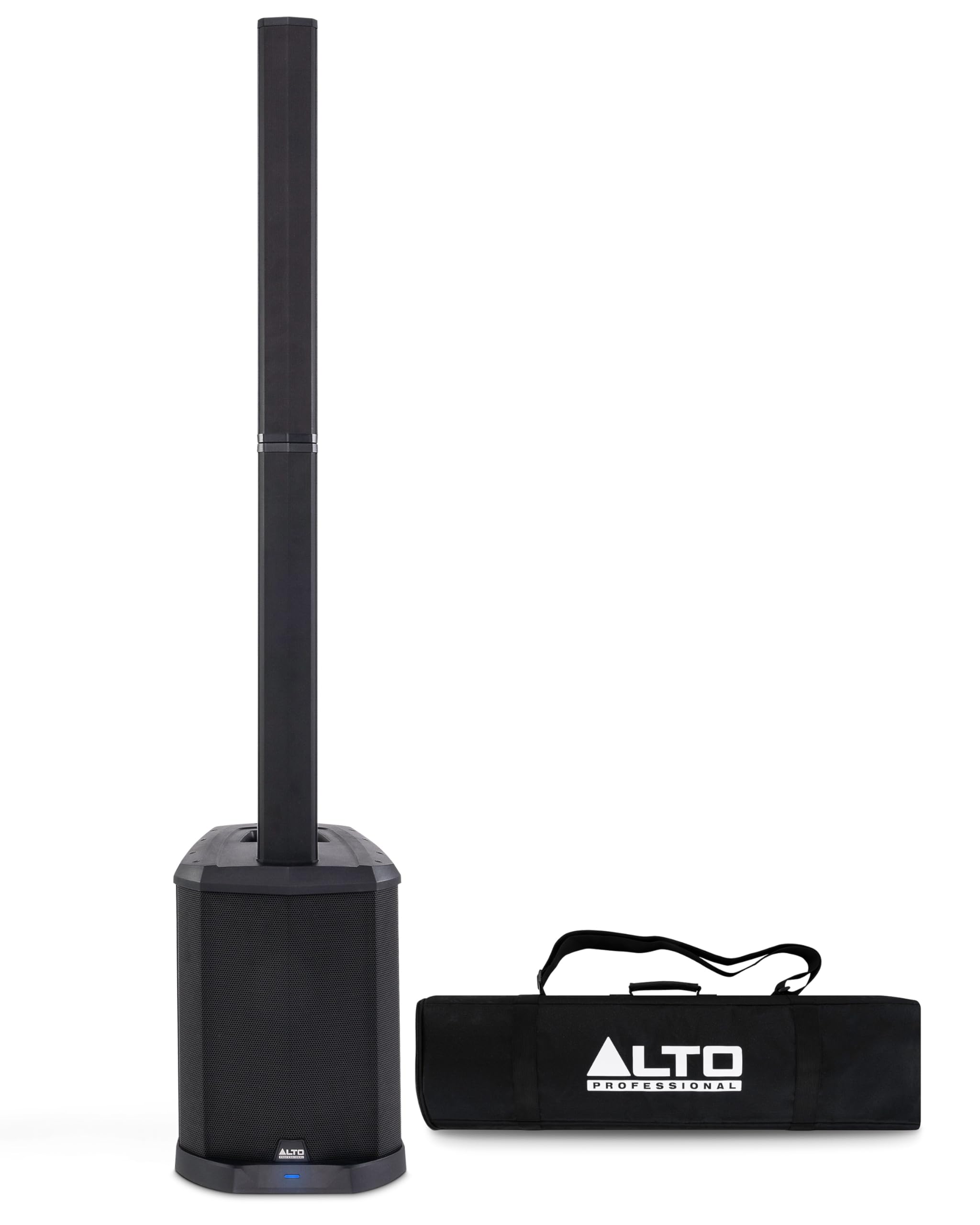
Everything in one speaker — column, 12-inch sub, mixer and reverb, and one cable to run it.
The TS112C is built for the performer who does not want to argue with setup. An 8 x 2.75-inch column array sits on a 12-inch subwoofer, and the whole thing runs off a single cable. The five-channel digital mixer includes reverb, and there is Bluetooth streaming plus balanced XLR out for linking a second speaker. The 1200W amplifier is matched to a broad 120° x 30° coverage pattern — wide across the room, tall front to back. The package includes a carrying bag for the column and an integrated handle on the sub.
What stands out in real rooms is sound quality, especially the bass from the 12-inch sub. In a straight comparison against a column costing twice as much, a decade-long studio engineer could hear little difference, and called the Alto response flatter — the pricier unit pushed mids and highs harder. A DJ who chose it over a bigger name gets plenty of bass and clear array output, and a karaoke host at a pub finds it gets very loud on demand. For a singer or acoustic act, the coverage is generous and the bass stays controlled rather than boomy.
Set expectations on scale. A singer and saxophonist who pairs a TS-series unit with an external mixer reports it suits solo acts, weddings, dinners and backyard gigs of 50-80 guests, reaches its ceiling quickly for full DJ sets, and runs about ten minutes to set up. Low-level hiss is audible at idle but disappears at volume. An app handles deeper settings, and it takes some learning.
The quick read: A flat, honest response and a real 12-inch sub, with the mixer and effects already inside — ideal for solo and small-ensemble work.
Right for: Soloists, duos and small event hosts who value one-cable setup and built-in reverb over maximum output.
Not your fit if: You are running hard DJ sets in big rooms — it tops out before a full dance floor is satisfied.
5. JBL Professional IRX ONE Powered Column PA Speaker System

The one built for a talking head — automatic feedback suppression and a phantom-powered mixer.
The IRX ONE earns its place on features aimed at presenters more than DJs. Its C-shaped array of six 2-inch high-frequency drivers is tuned for clarity across a room, and an 8-inch woofer reaches down to 40 Hz for the low end. The three-channel mixer takes ¼-inch and XLR inputs with 48V phantom power — that is the voltage a condenser microphone needs to run — so a solo speaker or acoustic act can plug straight in. Then there is dbx automatic feedback suppression, which catches the squeal before the audience does. Bluetooth 5.0 handles wireless playback.
Sound quality is where this one splits the crowd. Some owners call it clean, crisp and very loud, and one picked it up specifically for karaoke at the local pub and found it well constructed. Others find the output fine but not remarkable, and the compact 8-inch sub and small array mean it does not hit like a full DJ rig. Volume stays to be managed rather than abused.
One more practical limit: the Bluetooth on a single unit does not link into a stereo pair on its own. If you have an Android phone with dual Bluetooth connectivity, you can run two together; otherwise plan around single-unit use.
Why a presenter would pick it
- dbx automatic feedback suppression keeps speech squeal-free
- 3-channel mixer with 48V phantom power for condenser mics
- Compact frame that packs easily between gigs
What it will not do
- An 8-inch sub and small array limit DJ punch
- Bluetooth does not pair two units into stereo by default
Suits: Speakers, acoustic acts and small-venue hosts who want feedback control and phantom power built in.
Not the one for: DJs chasing floor-shaking bass from a compact column.
6. Electro Voice Evolve 30M Column Speaker

A wedding-ready column with a full DSP brain and a phone app that mixes from the crowd.
Why this one holds up at events is the flexibility baked into the electronics. The Evolve 30M runs a 10-inch sub and a column that packs down into a backpack, and the two-piece pole connector keeps the array locked in place. Industry-leading QuickSmart DSP — the digital processing that shapes EQ, dynamics and tone — gets adjusted from the control panel or from the QuickSmart app across the room over Bluetooth Low Energy. That is the feature that lets a host walk the floor and still trim the mix mid-speech.
What wins people over here is sound quality, and it holds up under real scrutiny. Owners who have run Bose, JBL, Mackie, Samson, TurboSound and Fender column arrays call this the cleanest of the bunch. The 10-inch wooden-enclosure sub keeps the lows clear and punchy, and the mids and highs stay clean at volume. Covering up to 200 people in a small-to-medium room is realistic, and pairing two makes a full stereo setup. Setup and breakdown fit in two trips, and the app makes the onboard controls feel slow by comparison.
The one gap worth naming: this system appears to have had some buyers report it randomly shuts down. In most cases it performs well when it works. If you are gigging for money, keep a warranty and a backup plan in mind, and expect to run the app rather than the panel to get the most out of it.
What the pros like: A dedicated delay feature for back-fill, a 16-channel mixer when two units link, and a carry bag that actually protects the column.
What still needs a mixer: Four inputs go far, but a full band plus backing music will want more; the system takes an external board cleanly.
Built for: Wedding hosts, event pros and solo-to-trio acts who want deep DSP and app mixing in a portable column.
Weigh it against: Anyone who needs reliability proven over years should buy with warranty support in mind.
7. Yamaha Portable PA System Stagepas 1k MKII

Yamaha’s column hits 125dB SPL — enough to fill a room and stay clear while doing it.
The number that holds this one up is 125dB SPL — 125 decibels of sound pressure at maximum, the loudest rating in this round-up. That comes from 1000W of power pushing a tall column array. The digital mixer brings versatile inputs and a Priority Ducker, which automatically lowers background music when a mic is used, so speeches stay on top. A four-band EQ and the ducker are both reachable through the STAGEPAS App. The system ships with a dedicated cover.
In real rooms, this sounds like a Yamaha. Reviews call it clear, powerful and sturdy, and one owner says it outperformed QSC K12.2s outdoors. A professional keyboardist-singer uses it in clubs and wine bars, praises the setup time and the app control that lets a partner adjust volume from the audience, and finds it cheaper than name brands with no feedback issues. For a duo act, one unit covers the performance. Set expectations early: the single-knob EQ and mode knob have a learning curve, and there is no 48V phantom power for condenser mics — that needs an external mixer.
The compact superpower: 125dB SPL and a 1000W amp in a column that blends into a room rather than dominating it.
The catch to check: No onboard phantom power, so a condenser mic buyer will need a small outboard preamp or mixer.
Ideal if: You want Yamaha sound and serious output in one column for clubs, wine bars and outdoor sets.
Skip the single unit if: Your rig runs on condenser microphones without an external preamp.
8. Bose L1 Pro8 Portable PA System

The smallest L1 that still sounds like a Bose, with a Racetrack woofer that beats its size.
This is the “get in, set up, perform” end of the Bose line. A C-shape extended-frequency array of eight articulated 2-inch neodymium drivers spreads a wide 180-degree horizontal pattern — about as broad a throw as you will find in a compact column. The bass comes from a 7 x 13-inch high-excursion Racetrack driver, the woofer tech that gets deep low end out of a narrow sub cabinet. There is a built-in three-channel mixer, app control and Bluetooth streaming. The system packs into carry bags that come with the kit.
Sound quality is the headline, and the bass in particular gets called out. A singer-songwriter runs it with an acoustic guitar and vocals on two input channels and never pushed past 50% volume in coffee shops and wineries, with the stereo mixer output and matched reverb shaping the sound well. The rig sets up in minutes, and the included bags make the move from vehicle to venue a single trip. Its portability is the other recurring plus — easy to pack, easy to carry, easy to assemble.
Two honest footnotes. The array column has a wobble that feels less locked-in than earlier Bose designs, so a stable base matters. And there is no travel cover for the sub base itself, which leaves it exposed in transit — that cover is not in the box.
Why small-venue acts like it
- 180-degree horizontal coverage fills a cafe evenly
- 7 x 13-inch Racetrack woofer gives bass the sub usually cannot
- Built-in 3-channel mixer with app control and Bluetooth
- Lightweight, one-trip setup with included carry bags
Where it asks for care
- The array column wobbles more than earlier designs
- No travel cover for the sub base in the box
For the coffee-shop set: Solo and duo acts who need a light column with even 180-degree coverage and real bass for its size.
Look into a case: If your load-in is bumpy, factor in a cover for the sub base.
9. Electro-Voice EVOLVE 50 Column Speaker System

The column that gigging musicians keep reaching for, nine months in and still singing its praises.
This is the EVOLVE 50 — column speaker plus powered subwoofer in one portable system, with Bluetooth and a full band of drivers. Where it earns trust is on the gigging calendar. One player has been running this setup for nine months of shows and calls the quality excellent enough to buy again. Another describes the sound as exceptionally clear and powerful, a straight 10 out of 10. The system also handles the comparison game well against the market leader: owners who run both Bose and this column say the EV has a sound of its own that holds its ground.
The one thing to plan for is the mixer. There is no built-in mixer here, so the musicians who love it built their setup around an external board. That is where it differs from the Evolve 30M — same family, but the 30M brings its own mixer and app while this one leans on your outboard gear. If you already own a mixer and just want the cleanest column EV makes, that trade-off works. If you want an all-in-one, look up the list.
What owners keep coming back to: A clean, powerful column with a proper powered sub — the kind of core system a working musician trusts to show up.
Where to plan ahead: No onboard mixer means your external mixer travels with the system.
The player it suits: A working musician with a mixer already in the rack who wants a clean, powerful column and sub.
Not the simplest: If you want to arrive with one box and no outboard gear, the 30M is the easier call.
10. JBL Professional PRX ONE Powered Column PA Speaker System
A 2000W tower with a 12-inch sub and a full mixer — built for the dance floor.
This is the top of the JBL column ladder. A 2000W peak Class-D amplifier drives a 12-inch subwoofer, and twelve 2.5-inch high-frequency drivers give a stated frequency range from 35 Hz to 20 kHz with 130dB SPL output. On top of that sits a seven-channel digital mixer with dual-operating mode, plus Lexicon and dbx effects, dbx DriveRack AFS Pro feedback suppression, and one-touch ducking by Soundcraft that keeps speech on top of music. There is Bluetooth and a touch control panel.
In real use it is loud and clean. A professional DJ calls it powerful, clear and portable, with rich lows, crisp highs, balanced mids and 2000 watts of peak power without distortion. Another DJ ran 200 people through it and says the bass was more than enough. The 12-inch sub keeps low end substantial and the seven-channel mixer gives the kind of input control that a Bose or QSC column does not. It looks and feels like serious kit, and a top-panel display accelerates the workflow.
The one recurring snag is the app. On iOS it is feature-rich but takes learning. On Android, owners mention it can fail to change levels, break after a firmware update and leave support unresponsive — so go in expecting to mix at the panel. There is another quirk: at close range the array can overload a small room with low and mid energy, so leave yourself room to place it.
The DJ-grade case
- 2000W peak through a 12-inch sub and twelve 2.5-inch drivers
- 7-channel digital mixer with Lexicon and dbx effects
- dbx AFS Pro automatic feedback suppression and one-touch ducking
- 130dB SPL output with 35 Hz to 20 kHz range
The real-world snag
- Android app support is weak; mixing at the panel works better
- Bluetooth mixes L/R rather than true stereo
- Close-range placement can overwhelm a small room
Pick this when: You DJ dance floors and want 2000W, a 12-inch sub and a full onboard mixer in one portable tower.
Pass if: You rely on an Android app for every mix move.
11. Bose L1 Pro16 Portable PA System

The L1 that grew up — sixteen drivers, a 10 x 18-inch woofer, and grip for a mid-size club.
This is the step up from the Pro8. A J-shape line array of sixteen 2-inch neodymium drivers spreads 180-degree horizontal coverage, and under it sits a 10 x 18-inch high-excursion neodymium Racetrack woofer — the woofer design that delivers deep bass from a narrow cabinet. The three-channel mixer, app control and Bluetooth streaming carry over. The system carries its own bags and packs down for the vehicle-to-venue trip.
Where the Pro16 really shows its teeth is bass and coverage. Owners single out the lows, the highs and the 180-degree spread, and one call it the most powerful and best-sounding of the Bose line, with clean sound even at low volume. A DJ has run it for a year of gigs and reports the sound quality draws compliments from the crowd, and it can shake a house when you want it to. For a small-to-medium club or bar, it has enough headroom without forcing you into a full PA.
The parts that fluctuate in the reviews are the build detailing and the linked app behavior — some find it the best-built column out there, and a few find the construction detail less consistent. Treat it as a superb sound-per-pound column rather than an armored touring box, and check the array joint on arrival.
The sound story: Sixteen drivers and a 10 x 18-inch Racetrack woofer keep the tonal balance consistent while the low end hits harder than a compact column should.
Where to be picky: Give the array and sub joints a careful look at unboxing, since fit detail is the main variable.
Reach for it if: You fill small-to-medium clubs and bars and want a lighter, wide-coverage column with real low end.
Go bigger only if: Your room outgrows 180-degree coverage or your load-in demands touring-grade armor.
Know the Specs
Subwoofer Size And What You Hear
The sub under a column array is the part you can feel — the low, chesty punch that makes a room feel alive. Cone size is the quickest read. An 8-inch sub suits a small bar or a cafe where bass supports vocals; a 12-inch sub gives real weight for DJ work; a 15-inch or 18-inch sub is a big-room, two-person lift. Bigger does not always mean better for your use — the bigger the sub, the more carrying effort it demands at load-in.
Peak Wattage And Dispersion
Peak watt figures — like 1200W or 2000W peak — describe the biggest burst the amplifier can push, not a continuous output, so treat them as one clue, not a scoreboard. Coverage tells a more useful story. A 120° or 180° horizontal coverage number means how wide the column throws sound across a room, so wider coverage fills a room with fewer dead spots. A column with good dispersion and a well-matched sub often sounds clearer across a full room than a higher-wattage box.
Common Questions
Do I need one column array or two for a small bar?
How heavy is a column array to carry and set up?
Can a column array replace a regular speaker on a stand?
Do column array speakers work for outdoor gigs?
What is the difference between a column array and a line array?
Will a column array feedback with a microphone?
Can I connect a mixer or extra microphones to these systems?
Do I need phantom power for a condenser microphone?
Is a bigger subwoofer always better for a column array?
How many people can one column array cover?
Are column array speakers worth it over a cheaper PA package?
The Bottom Line
The winner here is the column array speakers pick with the biggest gain-per-setup: the PRORECK Club 4000, because its 18-inch active sub and four 6-inch array tops let a five-piece band cover a hundred-person room without adding anything but a mixing board. If your priority is carrying one light system in a single trip, take the LD Systems Maui 5 at 25 pounds. And for a portable column that fills a mid-size club while keeping its low end clean, reach for the Bose L1 Pro16.
One last nudge before you commit: pick the sub size you can actually lift and the coverage that matches your room. A column array that fits your load-in makes setup a warm-up instead of a workout.
How we choose
We do not accept paid placement. Every pick is matched to a real buyer and a real use-case; we do not hands-on test units.
Sources
Specifications: manufacturer listings and product documentation. Review insights: verified customer reviews, as of October 2026. Pricing: not shown on this page (it changes often); check the current price via the retailer link.
As an Amazon Associate, Aappliancez earns from qualifying purchases. This does not affect which products we feature.