Disclosure: Some links in this post are affiliate links. As an Amazon Associate I earn from qualifying purchases, at no extra cost to you. Learn more
Specs are compiled from manufacturer listings and verified buyer reviews and can change over time — please confirm the key details on the product page before buying.
Most people shopping for a home light therapy unit get stuck on one question: pad, wand, or panel? The answer depends on where you hurt. A wide pad covers a whole lower back in one session. A wand reaches the knuckles and the side of a knee. A panel covers the face and chest at once. The nine devices below split cleanly along those lines, and each pick is here because its wavelength mix, power level, and real-world handling suit a specific job.
This guide is built by comparing the manufacturers’ published specifications and the patterns across verified customer reviews, so you get each pick’s real strengths and trade-offs instead of marketing spin.
You will learn which wavelength pair does what, why 660nm and 850nm show up on almost every spec sheet, and how much power actually matters. Every pick below is a device you can run at home without a clinic appointment — the practical shortlist for a cold laser therapy device for home use.
Top Picks

How To Choose The Best Cold Laser Therapy Device for Home Use
Start with the body part you want to treat, not the spec sheet. A device that cannot reach your sore spot in a comfortable position will sit in a drawer. A device that covers it easily gets used every night.
Match the shape to the joint
Small joints like fingers, wrists, and the side of a knee need a handheld unit you can rest right on the skin. A wand that weighs very little and fits in a small hand works here. Wide areas — a full lower back, both shoulders, the abdomen — need a panel or a wrap pad with a large surface. A wrap pad can also fold small enough to travel in a suitcase, which a fixed panel cannot.
Read the wavelength pair, not just the count
Almost every device here lists two numbers: 650nm or 660nm for red light, and 808nm or 850nm for near-infrared. The red wavelength works on the surface layer, and the near-infrared wavelength reaches deeper into muscle and joint tissue. That second wavelength is invisible to your eye, so the lamp can look dark while it is still working. If a listing only mentions red light, you are getting the surface wavelength only.
Decide if you want corded or battery power
A plug-in pad or panel gives steady output for as long as you leave it on, with no charging routine to remember. A rechargeable wand or handheld unit frees you from a cord, which matters if you want to treat a shoulder while walking around. The catch with battery units is that charge cycles and cell health become part of ownership. A standard replaceable cell sidesteps that, while a built-in cell means the whole device depends on one battery.
Check the timer and the setup before you buy
Most sessions run 10 to 20 minutes, so a built-in timer with an auto shut-off saves you from clock-watching. A hands-free stand is worth more than it sounds if you are treating a shoulder or a knee and want to read or watch TV during the session. Also check what is in the box: eye protection glasses and a charger should be included, not sold separately.
Side-by-Side Comparison
| Model | Best For | Light Source | Wavelengths | Power Source | Amazon |
|---|---|---|---|---|---|
| Hooga PRO300 Panel★ Best Overall | Full back, face, and chest coverage | 60 dual-chip LEDs | 660nm + 850nm | Plug-in, 300 watts | Amazon |
| CAREMRR HandheldBest for Travel | Wrists, knees, travel bag | Multi-diode handheld head | 650nm + 808nm | Rechargeable lithium-ion | Amazon |
| Comfytemp Red Light PadBest Coverage | Back, waist, legs, and hips | 320 lamp beads | 660nm + 850nm | Plug-in, up to 48W | Amazon |
| Toponechoice Handheld | Elbows, knees, hands, pets | 4 x 808nm + 16 x 650nm | 650nm + 808nm | Rechargeable, 5-7 days | Amazon |
| DGXINJUN Belt | Wearable back and joint wrap | SMD LED array | Red + infrared LED | Plug-in, 15 ft cord | Amazon |
| SINORIKO Shoulder Unit | Shoulder, knee, and hand sessions | 13 x 650nm + 3 x 808nm | 650nm + 808nm | Rechargeable, 4-5 hr charge | Amazon |
| LifePro BioLux | Spot treatment and pet use | Triple-wavelength LED wand | 650nm + 670nm + NIR | Rechargeable, 3-4 hr charge | Amazon |
| TENDLITE Pro | Directed spot treatment on one joint | High-power LED head | Red + infrared | Rechargeable INR18650 3.5Ah | Amazon |
| iRestore Elite | Scalp coverage and hair thinning | 500 lasers and LEDs, 2500 mW | 625 / 655 / 680nm | Hands-free cap | Amazon |
Detailed Reviews
1. Hooga Red Light Therapy Panel for Body & Face, PRO300
Our pick — 4.5+★ from 750+ verified ratings; the strongest balance of quality and price.
Sixty dual-chip LEDs that fire both wavelengths at once, aimed at a whole back at a time.
One device covers your face, chest, and full lower back without you moving it around — that is why this panel is the strongest all-round answer here. Each of the 60 LEDs carries both a 660nm red chip (visible red light) and an 850nm near-infrared chip (invisible light that goes deeper), so you never switch heads or buy a second panel to get the deeper wavelength. A 60-degree beam angle (how wide the light spreads out) throws light across the whole panel face instead of firing in tight spots — exactly what you want when you stand in front of it rather than pressing it against one knee.
What wins people over most is how well it slots into a bedtime routine. It runs on 300 watts from the wall, with internal cooling fans and a built-in digital timer, and the independent red and near-infrared controls let you run one wavelength or both. The warmth it gives off during a session is part of the appeal — owners describe the heat as relaxing rather than harsh, and it is one reason the panel gets used nightly instead of gathering dust. A 3-year manufacturer warranty backs it, and the adjustable tabletop stand holds its position well once set.
The honest limit is physical reach. At 4.3 kg, this is a device that stays where you put it — the stand is designed for a tabletop, not for carrying room to room. And compared with the CAREMRR handheld at 1.63 pounds, this panel is not something you balance on a wrist. Owners do note the stand feels a little less premium than the panel itself, though it holds fine. For the crowd favorite of this list, 4.5+ stars across 700+ ratings is a strong signal that the trade-off is one most buyers happily accept.
Where this panel earns its keep
- Every one of the 60 LEDs carries both 660nm red and 850nm near-infrared, so one pass works the surface and the deeper tissue
- Independent wavelength controls plus a built-in digital timer mean you can run red-only, infrared-only, or both in a single session
- Internal cooling fans and flicker-free LEDs keep a long session comfortable instead of strobing in your peripheral vision
- Connects to other PRO Series panels if you later want a larger wall setup, and the 3-year warranty covers the whole unit
The trade-offs you should know
- At 4.3 kg it is a fixture, not a portable — you treat yourself in front of it, not the other way around
- The stand is functional rather than luxurious, and side-mounted touch controls can be brushed by accident while adjusting the panel angle
Buy this one if: you want face, chest, and back coverage from a single plug-in panel with both wavelengths running together and a 3-year warranty behind it.
Think twice if: your sore spot is a wrist, a finger, or a knee you need light on while sitting on the sofa — a handheld wand will serve you better.
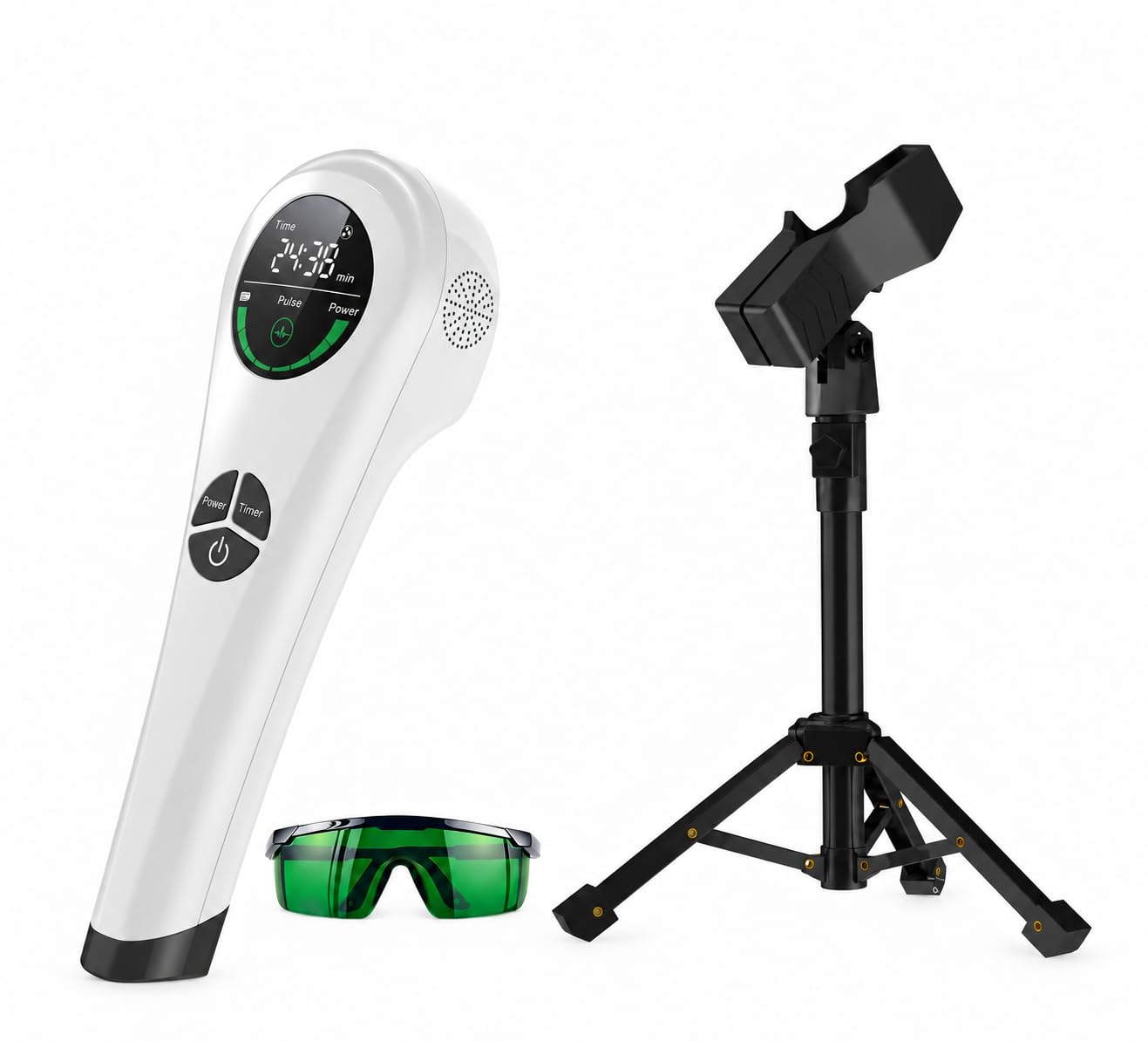
2. CAREMRR Handheld Light Device, Rechargeable
A 1.63-pound wand with a tripod stand, built for wrists and knees you cannot reach behind a panel.
The case for this one is simple: it is the smallest, lightest way on this list to hit a wrist or the inside of a knee. The rechargeable battery means no cord trailing across the sofa, there are four intensity levels and an adjustable timer, and the display is clear enough to dial in a session without reading the manual twice. Sessions feel gentle — no heat to speak of — and the steady and pulsing modes give you two different texture options for the same 10 or 20 minutes.
What makes it genuinely useful is the included tripod. Free-standing, it lets you park the light over a knee and use your hands for something else. Buyers who upgraded from plain handheld devices single out exactly that: the stand frees their hands, and on this unit the diode count steps up too, with more 808nm and 650nm emitters than their older wand had.
Where it stumbles is the tripod’s balance. It is stable once set, but top-heavy while you are positioning it, so it takes a moment to settle. There is also no audible beep when the timer runs out, which means you need to keep one eye on the large timer display. And because this is the cheapest handheld here at 1.63 pounds against the 2.2-pound Comfytemp pad, it is the travel pick rather than the one for a whole back.
Who it suits: someone with wrist, neck, or knee stiffness who wants a cordless unit to use in the car, on a trip, or at the kitchen table.
The catch: the tripod is top-heavy during setup and there is no timer beep — you watch the display or you lose track of the session.
Your move: grab it if portability is the deciding factor and you want the stand thrown in.
Walk away if: you need wide coverage over a back or hip, where a pad does the job in one pass.
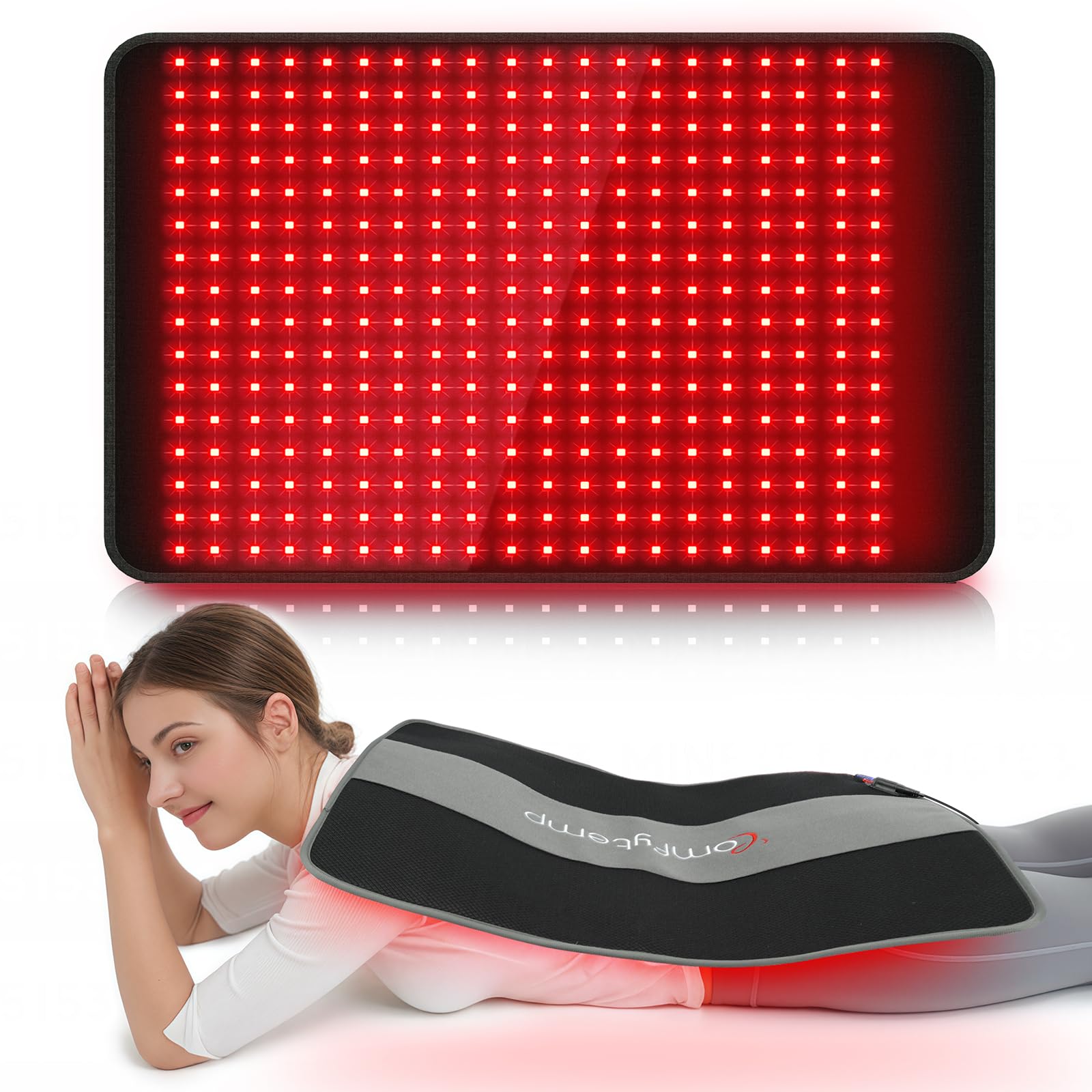
3. Comfytemp Red Light Pad for Body, 24” x 17”
A 24 by 17 inch pad with 320 lamp beads, sized to drape over a whole back or hip.
Treating a wide area gets easier with 320 lamp beads, each one carrying both visible 660nm red and invisible 850nm near-infrared. The 660nm works the surface, the 850nm reaches deeper into muscle and joint, and because the whole 24-inch by 17-inch mat is studded with them, you drape it over a back, waist, abdomen, shoulders, hips, legs, knees, or feet and cover the area in one go. It runs up to 48W (watts, a measure of light power) with four light modes and three power levels, and you simply plug it in and press the power button.
What buyers come back for is how little it asks of them. Sessions are 20 minutes, folding it into a small suitcase is easy, and the settings on the cord are easier to read and adjust than those on larger pads. Owners use it on hands and feet as readily as on the back, and it has worked as a stand-in for a full home panel over a three-week stretch. At 2.2 pounds against the 1.63-pound CAREMRR handheld, it folds and travels without much bulk.
Plan around one trade-off: heat. This pad can get warmer than you expect during a long session, so check it against your skin, avoid pressing your full weight onto one spot, and put a thin cloth between the pad and bare skin if you are sensitive. The surface plastic is also a little firm to lie on, though it softens once you settle. Neither point spoils the device — it is simply a pad that rewards a little attention.
The coverage win: 320 beads across a 24-inch by 17-inch surface means one session covers a lower back and both hips without repositioning.
Handle with a little care: heat builds during longer sessions, so use a cloth barrier and keep an eye on skin contact.
Reach for this if: your sore area is wide — back, hips, both thighs — and you want to lie down or lean back with it on.
Look elsewhere if: you want something for a single knuckle or wrist, where a small wand fits the shape of the joint better.
4. Red Light Therapy Device, 4x808nm 16x650nm

Twenty diodes split between surface red and deep infrared, in a body that also works on a dog.
If you are in this for muscle and joint aches and you want the same unit to work on a pet, this handheld earns a look. The head carries 4 emitters at 808nm for deep tissue and 16 at 650nm for the skin surface, and the 808nm wavelength is invisible to your eye even though it is doing the deeper work. A full charge is rated to last 5-7 days, and the manufacturer suggests one or two sessions a day of 20 minutes across a four-week stretch, with glasses included in the box for eye protection.
The build gets plenty of praise for how it feels in the hand, and the included glasses are a small but real courtesy at this tier. The 60-day service window is worth knowing about too, because support is clearly the route to a fix if yours acts up. Buyers who had a unit fail found the company responsive, with a replacement sent rather than a fight.
Reliability is the knob on this pick. Some units arrive working perfectly for years, but there are enough reports of a unit or a replacement set of LEDs failing early that you should treat the 60-day coverage as part of your plan — open it, run it daily for a few weeks, and make sure every diode (the small light emitter) fires before the window closes. Eye protection is the other must: the included blue lenses block 650nm but not the 808nm infrared, so if you are treating near the face, spec your own goggles rated for both wavelengths.
Nice in the hand: a compact 1.61-pound body with a real mix of surface and deep diodes, plus a charger and safety glasses in the box.
Test it early: run it daily during the first weeks so any early diode fault surfaces inside the 60-day service window.
Pick it when: you want a hand-held you can also point at a stiff dog or cat, with both wavelengths on the same head.
skip it if: you would rather not think about service windows, in which case a plug-in panel with a longer warranty is the calmer buy.
5. DGXINJUN Red Infrared Light Therapy Belt

A wrap you wear rather than hold, with a cord long enough to roam the room.
The reason to choose a belt over a pad or a wand is movement. This one is a wearable wrap, and the large internal space is sized to fit most bodies. The 15-foot power cord is the standout detail — it is long enough to let you move around the room during a session instead of being pinned beside the outlet. It runs on wide voltage AC 100-240 V with a DC 12 V input, so it travels between countries without a converter, and it is built for pain relief and muscle relaxation, with a 20-minute auto shut-off.
The flattened SMD-style lamp beads are a thoughtful upgrade — the emitters sit flatter against the body, which makes lying or sitting against the wrap more comfortable than slabbier LED panels. A 20-minute auto shut-off means a session ends without you having to remember, and a separate time controller lets you run a custom length when you want one. A full one-year warranty covers the whole product.
Quality is the part to weigh. This is a mixed picture — some owners are plainly delighted and report real comfort from their sessions, while others feel let down by fit and finish. The wild card is body fit: a wrap that conforms well on one frame may bunch or gap on another. Because the internal space is sized for most people rather than custom-molded, try it on over light clothing before your first full session and check the emitters sit where you want them.
Why a belt: a 15-foot cord plus a 20-minute auto shut-off makes it the easiest pick to use while moving around or sitting at a desk.
Fit is personal: durability and finish are a mixed bag, so wear it over clothing first and confirm the wrap sits flat on your frame.
It fits you if: you want to strap a light wrap on your back or hip and keep doing other things for 20 minutes.
Otherwise: if you would rather have a proven long-warranty panel that never moves, the Hooga above is the safer buy.
6. Red Light Therapy Device

Sixteen diodes and four timer steps, with a double-press safety lock and a stand included.
You get precise dose control from sixteen diodes — 13 at 650nm and 3 at 808nm — packed into a 1.74-pound handheld body. The controls are the reason to look at this one closely: four timer settings of 5, 10, 15, or 20 minutes, and four power levels from L1 to L4, so you can dial in exactly the dose you want. A twice-press protection stops accidental emission, and a long-press of the on/off button turns the unit on with the screen lit. It charges fully in 4-5 hours and, importantly, will not turn on while the cable is connected — so pull the charger out before you start.
Both hands stay free for a shoulder session thanks to the included adjustable stand, which lands squarely in the useful column. Pain relief is what this pick does best of all — knees, a meniscus and ACL tear, carpal tunnel, a dog’s stiff joints, and a teenager with cerebral palsy all show up in the feedback. Owners describe the light as soothing and quiet, and the build is reported strong after a year of heavy use.
Battery life is the recurring grumble. Some units stop charging after a while, and durability gets a mixed verdict — a small number of units have failed around the nine-month mark, in which case support has offered a replacement rather than a battle. Treat it as a device you charge methodically and watch, not one you trust to hold charge indefinitely.
Reasons this earns a spot
- Four timer settings (5/10/15/20 min) and four power levels let you start light and build up without guessing
- A twice-press safety lock and screen-lit display make it beginner-friendly and hard to trigger by accident
- 16 diodes across 650nm and 808nm cover surface and deeper tissue in one pass
- Hands-free adjustable stand and a 1.74-pound body make it easy to use on a shoulder or knee
Where it asks patience
- Charge cycles are the weak point — battery complaints are the most common issue, and a full charge takes 4-5 hours
- It refuses to power on while plugged in, which trips up plenty of first sessions
the balance: strong pain-relief feedback and the best timer control set in this group, for shoulder, knee, and hand sessions.
The honest caveat: keep the charger handy and plan for the battery to be the first part to age.
7. LifePro BioLux Infrared & Red Light Therapy Wand

A 6.4-ounce wand that runs three wavelengths and recharges roughly once a month.
For a device you will hold in one hand, weight is the whole game — and at 6.4 ounces, this is by far the lightest unit here. It is a wand, not a pad or a panel, so you point it at a knee, a sore neck, a hand injury, or a dog’s hip and hold it there. The three wavelengths give you 650nm and 670nm red plus near-infrared in the same head, and a full charge takes about 3-4 hours from empty.
What owners rave about most is how easily it becomes a habit. A two-minute setup, a padded case, a charger, dark glasses, and a small tripod are all in the box, which is why it ends up in an evening TV routine or packed for travel. It charges so seldom that owners notice when it does. The tripod’s clamp design lifts the wand above the area you are treating, so you can sit back with it while your hands are empty.
The controls are where it needs patience. One button handles both power and duration, which is efficient but easy to misread, and finding out how much time is left means pressing the on/off button — there is no continuous countdown on show. The light warms slightly during a session, a mixed point for sensitive skin. None of that stops the routine; it just means the first few sessions involve a little fiddling to learn the button logic.
A habit device: 6.4 ounces, three wavelengths, a padded case and a tripod, and battery life measured in weeks rather than hours.
Learn the buttons: power and timer share one button and remaining time is only visible on demand — expect a session or two of fiddling.
Try it if: you have small hands and want a true spot treatment for a single joint while watching TV.
Try the panel instead if: you want a face-and-chest session finished in one pass, because a wand covers a small area at a time.
8. TENDLITE Pro Red & Infrared LED Light Therapy
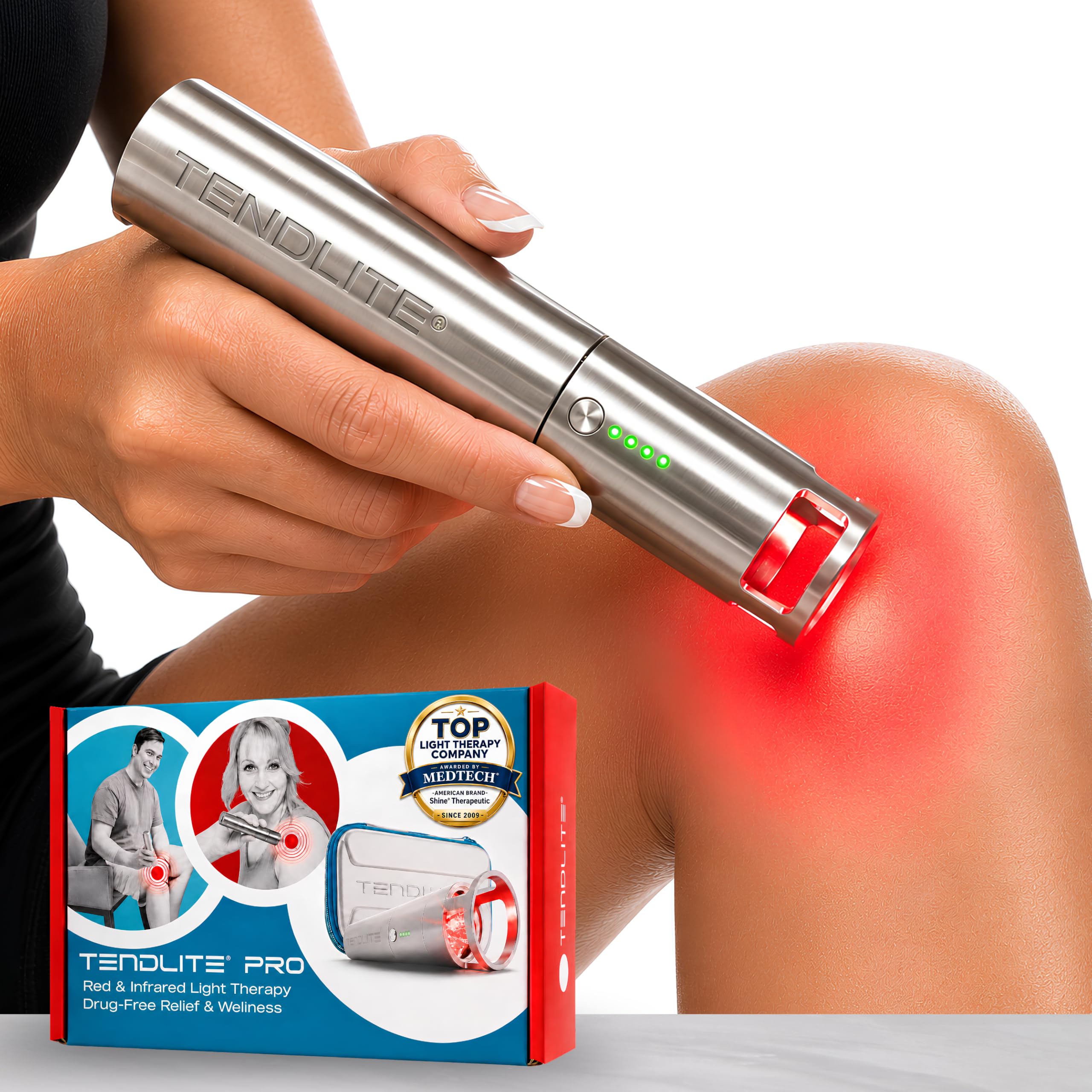
A single high-power head aimed at one joint — and a battery you can swap yourself.
You get the closest thing to a clinic-style spot device on the list. It concentrates its output on a small area — about an inch of treatment — rather than spreading soft light across a panel. That focus is why experienced users of professional cold laser equipment like it: you can put the full dose exactly where the pain is, on an ankle ligament or a heel, without treating everything around it. It runs on a standard INR18650 3.5Ah battery (a common rechargeable cell rated at 3.5 amp-hours of capacity), which is the detail that separates it from every sealed-battery wand here — when the cell ages, you replace the cell, not the device.
Pain relief is the quality owners praise most in this focused-beam wand. Buyers report it eased a back and improved sleep, reduced a split-ligament ankle problem within days, calmed heel and foot tendonitis, and helped a senior cat’s arthritis at four minutes per joint. The body is solidly built with a protective holder, and the charge goes a long way on three-times-daily use.
The other side of that focused beam is care. It is heavier than you likely expect, shaped like a lightsaber rather than a compact grip, and the laser is active while on — face away or wear protective glasses, and never stare into the head. Lifespan is the concern to note: a small number of units have given out around the 1.5-year mark. The good news is the replaceable cell removes the most common failure point, and the included back-to-front kit is the simplest long-term ownership story here.
Dose where it counts: a one-inch focused treatment area and a user-swappable INR18650 cell give it a real edge for anyone treating one specific joint.
Respect the beam: active laser, heavier-than-expected body, and a lifespan some owners mention as short — treat it as a tool, not a toy.
Worth it for: a single stubborn joint, or anyone who prefers a focused hit over a broad wash of light.
Not for you if: you want wide coverage, in which case a panel or pad will finish the job in a fraction of the sessions.
9. iRestore Elite Laser Hair Growth System
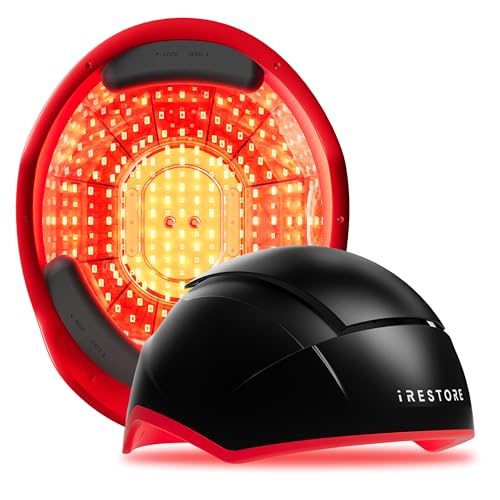
A hands-free cap with 500 lasers and LEDs, aimed at the crown, temples, and hairline.
This one is a different job entirely: it is built for the scalp, not a knee. The cap packs 500 lasers and LEDs totaling 2500 mW of power, with three wavelengths — 625nm, 655nm, and 680nm — reaching follicles across the top of the head. Unlike a laser comb or brush that you drag through the hair, it sits on your head hands-free for 12 minutes a day, and the medical-grade padding is ventilated so it stays comfortable. The VCSEL lasers reach the hairline, temples, sides, and lower crown that a comb tends to miss.
What customers note is a schedule that becomes second nature. Twelve minutes while cooking, watching TV, or cleaning is easy to keep up with, and the results show up for those who stay consistent for six months or more. This is genuinely a long-game device — the maker’s own timeline is visible improvements in 3-6 months, and feedback clusters around the six-month mark, with users describing thicker, more resilient hair and new growth on the crown. A carrying case makes it travel-friendly, and build quality and comfort both get high marks.
The value question is the one to weigh, because it is the priciest pick here by a wide margin and that is a mixed point among buyers. Shedding can also continue for some users even as new growth starts, so patience is non-negotiable. And a rare report of scalp sensitivity points to a fit check, not a defect — start shorter and watch how your skin reacts before committing to the full 12 minutes daily.
Why scalp-focused users pick it
- 500 lasers and LEDs at 2500 mW with three wavelengths spread across crown, temple, and hairline
- Hands-free 12-minute sessions fit around cooking, TV, or cleaning, which makes consistency easier
- Ventilated medical-grade padding and a carrying case make it comfortable and travel-ready
- Delivers visible results for owners who keep up 12 minutes a day for six months or more
Where to set expectations
- The most expensive pick on this list, and value for money draws mixed feedback
- Results are slow and shedding can continue at first, so it rewards patience over a quick fix
The long-game pick: hands-free scalp coverage for thinning hair at the crown and hairline, if you can commit to 12 minutes a day for months.
The honest limit: it will not show anything quickly, and it is the biggest outlay here — treat it as a six-month commitment before you judge it.
Know the Specs
Wavelengths: 660nm and 850nm, and what they do
A wavelength measured in nanometers tells you how deep light is likely to travel. The 650nm to 680nm range is red light — visible, and working on the surface layer of skin. The 800nm-plus range is near-infrared — invisible, and reaches deeper into muscle and joint. That is why the dual-wavelength pads and panels list both numbers, and why a device that only names a red wavelength is doing a surface job. When a spec says the 808nm beam is invisible, that is literal: the lamp may look dim while still emitting.
Power: watts versus milliwatts
A panel rated in the hundreds of watts is measured by how much electricity it draws, while a handheld wand is rated in milliwatts of light output. Those are not comparable numbers, so do not read a big figure on a panel and a small one on a wand as a simple ranking. What matters for a spot device is the dose per unit area — a focused head concentrates its output, while a panel spreads it over a large face. Match the power style to the body area you are treating.
Dual-chip versus single LEDs
A dual-chip LED contains both a red chip and a near-infrared chip in one housing. A 60-LED panel that is dual-chip therefore delivers both wavelengths from every point on its face, so you are not alternating sessions. On a single-wavelength device, you run one wavelength and then the other if you want both. Check whether the emitter count you are reading is per wavelength or per LED.
Battery: sealed versus replaceable
A built-in rechargeable battery gives a clean, cordless body, but its cell is the first part to age. A device that uses a standard replaceable cell lets you swap the battery and keep the light head. For a long-term device, replaceable cells take one large risk off the table. For a travel wand, a sealed cell is often the price of a slim body.
Common Questions
Is a pad or a panel better for treating a bad lower back?
Do I need eye protection when the 808nm infrared is invisible?
How long before I notice anything from a home unit?
Is more power always better for a handheld device?
Can I use these devices on a dog or cat?
Why does a rechargeable unit refuse to turn on while it is charging?
Are 650nm and 660nm meaningfully different?
What is a dual-chip LED and why does it matter?
Is a laser cap for hair the same as a body light device?
Should I keep my device plugged in for every session?
The Bottom Line
For most people, the winner for a cold laser therapy device for home use is the Hooga PRO300 panel because its 60 dual-chip LEDs deliver both 660nm and 850nm at once across a whole back, face, or chest, and the 3-year warranty plus independent controls make it the easiest long-term buy. If you want a wide body area covered while you lie down, grab the Comfytemp pad with its 320 beads. And for a single stubborn joint you need to reach while sitting on the sofa, the TENDLITE Pro is the one to reach for — a focused one-inch beam and a replaceable INR18650 cell that outlasts any sealed battery. Whichever way you go, pick the shape that matches where you hurt. The device you actually keep using is the one that fits your nightly routine without a setup you have to rearrange. Routine fit decides more than any spec sheet ever will.
How we choose
We do not accept paid placement. Every pick is matched to a real buyer and a real use-case; we do not hands-on test units.
Sources
Specifications: manufacturer listings and product documentation. Review insights: verified customer reviews, as of October 2026. Pricing: not shown on this page (it changes often); check the current price via the retailer link.
As an Amazon Associate, Aappliancez earns from qualifying purchases. This does not affect which products we feature.