Disclosure: Some links in this post are affiliate links. As an Amazon Associate I earn from qualifying purchases, at no extra cost to you. Learn more
Specs are compiled from manufacturer listings and verified buyer reviews and can change over time — please confirm the key details on the product page before buying.
You want a phone your older parent can answer without help. That means buttons big enough to see, a ringer loud enough to cut through a TV, and an interface that does not punish a shaky hand. That fit between the phone and the person’s hands, eyes and hearing is what separates a phone they use daily from one that sits in a drawer. Below are nine real options, from simple flip phones to a locked-down tablet-and-phone combo, with plain words on what each one does for the person holding it.
This guide is built by comparing the manufacturers’ published specifications and the patterns across verified customer reviews, so you get each pick’s real strengths and trade-offs instead of marketing spin.
You will see why screen size, button size, ringer volume and hearing-aid support matter far more than camera megapixels here, and which carrier each phone actually works on before you buy.
Top Picks

How To Choose The Best Cell Phones for Seniors
The mistake most families make is buying the newest smartphone and assuming a big screen makes it easier. In practice, a bright touchscreen with tiny on-screen icons can be harder to operate than a flip phone with real raised keys. Start with the person’s hands, eyes, hearing and memory, then match the phone to those four things.
Buttons and screen size come first
Large physical keys let someone dial by feel, without hunting for a spot on glass. Look for a phone that lists a large-button dialer or oversized keys — the Serene Innovations HD40P goes further with nine large picture speed-dial buttons, so a single press reaches a family member. A bigger display helps too, but only if the icons on it are also enlarged.
Ringer volume in decibels matters more than you think
Ringer loudness is measured in decibels (dB), a unit for how loud a sound is. A home phone that rings at 85 dB is roughly as loud as a lawn mower, which is what the Serene Innovations HD40P is rated for. The Swissvoice 3355 lets you push its ringer up to 90 dB. If your parent misses calls because they cannot hear the ring, this number is the one to check.
Hearing aids and amplified earpieces
Hearing-aid compatibility means the phone’s earpiece is designed to work with a hearing aid’s telecoil without squealing feedback. The Swissvoice 3355 lists hearing-aid compatibility directly. On other phones, look for an adjustable tone or boost control so the person can raise the voice without raising the whole room.
Check the carrier before anything else
An open up phone is only open up for certain networks. The 4G Flip Phone here works on AT&T and T-Mobile but is not compatible with Verizon or its smaller partner networks. The Nokia G60 5G supports T-Mobile but not AT&T. Confirm the network your family already uses before you open the box — a phone that will not connect is no bargain.
Side-by-Side Comparison
| Model | Best For | Display | Battery | Key Extras | Amazon |
|---|---|---|---|---|---|
| Apple iPhone 11 Pro Max (Renewed)★ Best Overall | Seniors ready for a familiar smartphone | 6.5-inch OLED | Lithium-Ion (renewed) | 512GB storage, Face Recognition | Amazon |
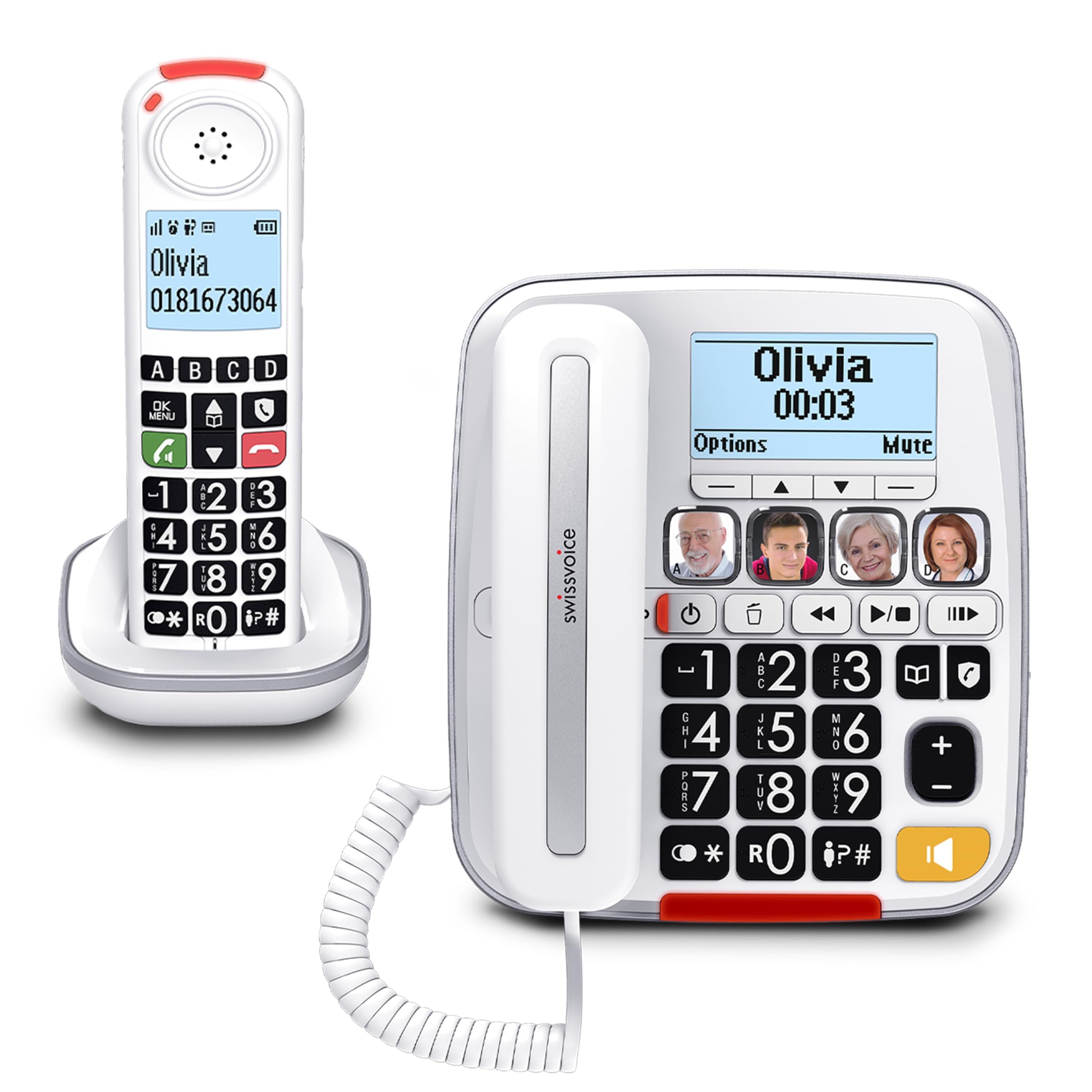
| SWISSVOICE 3355 Big Button PhoneLoudest Ring | Hearing-impaired users at home | Large button home phone | Line-powered base | 90 dB ringer, dual handsets | Amazon |
| 4G Flip Phone open up (KaiOS)Budget Flip | Simple travel and first phone | 3.2-inch + 2.0-inch dual | 2000 mAh | KaiOS apps, Wi-Fi, GPS | Amazon |
| Serene Innovations HD40P | Dementia and low-vision users | Large picture-button phone | Line-powered | 85 dB ringer, 9 photo buttons | Amazon |
| Kyocera DuraXV Extreme (Renewed) | Rugged flip phone use | Flip phone display | 1770 mAh | Rugged build, Verizon LTE | Amazon |
| Nokia G60 5G | Budget-minded smartphone users | 6.58-inch FHD+ 120 Hz | 4500 mAh | 6GB/128GB, 50MP camera | Amazon |
| GrandPad Tablet & Phone | Families wanting a managed device | 1920 x 1200 LCD | 4550 mAh | Private network, family apps | Amazon |
| Samsung Galaxy Z Flip 6 (Renewed) | Tech-comfortable seniors | 6.7-inch folding AMOLED | 3700 mAh | 512GB, 12GB RAM, Snapdragon 8 Gen 3 | Amazon |
| Samsung Galaxy A56 5G Bundle | Big-screen all-day use | 6.7-inch AMOLED | 5000 mAh | 256GB, Galaxy Buds 3 FE included | Amazon |
Detailed Reviews
1. Apple iPhone 11 Pro Max 512GB
Our pick — 4.0+★ from 18,000+ verified ratings; the strongest balance of quality and price.
The biggest draw here is screen size, not camera specs — a 6.5-inch Super Retina XDR OLED panel that lives up to the “Max” name.
If your parent has used an iPhone for years, this is the pick that keeps that muscle memory intact. The 6.5-inch Super Retina XDR OLED display (a screen type known for deep blacks and sharp text) gives you room for large text and bold icons, so menus stay easy to read. Face Recognition (open up with a glance instead of a PIN) means no passcode to type with a shaky hand. Anyone who has typed the same passcode a thousand times will appreciate that.
The storage is the headline spec that lasts. There is 512GB of internal space on board, enough that a lifetime of family photos and video calls does not hit a storage warning in year two. Renewed units vary in condition, and that is the honest catch here. The one to get is a unit with strong battery health; buyers report one arriving at 97% health with no replaced parts and perfect operation. Others have opened a box to a weak battery, so inspect it the day it lands and lean on the 90-day warranty if something is off.
Unlike the flip phones and landline options here, this is a full smartphone — so it needs a GSM carrier and a SIM card. The listing explicitly excludes a SIM card from the box, and it comes with a generic charger rather than Apple’s own. Budget for those two extras before checkout.
What earns its keep
- 6.5-inch Super Retina XDR OLED screen makes large-text mode genuinely readable
- 512GB of storage means no storage warnings for years of photo sharing
- Face Recognition open up without typing a passcode
- IP68 water and dust resistance to 4 meters for up to 30 minutes
- 4.0+ stars across 18,000+ owners — the crowd favorite of the smartphone picks
The fine print to read
- Renewed battery health varies — check it on arrival and use the 90-day warranty
- Needs a GSM carrier and a SIM card, which is not included
- Comes with a generic charger, not Apple’s original
Reach for this if: your parent already knows an iPhone and wants a familiar, roomy screen with tons of storage.
Look elsewhere if: a flip phone’s raised keys are easier than glass icons, or you need a Verizon-compatible handset.
2. SWISSVOICE Premium 3355
A home phone you can actually hear from the next room, with a ringer that climbs all the way to 90 dB.
A ringer rated to 90 dB is roughly the loudness of a blender running on the counter, and that is the whole point of the Swissvoice 3355. The dialing keys and four photo memory buttons are oversized, and one of those buttons is a dedicated SOS key, so a grandparent can see who they are calling before they press. It ships with two handsets — one corded on the base plus a cordless one — and each base can take up to three additional handsets.
Where this phone wins over a plain landset is the listening end. It carries hearing-aid compatibility as a listed feature, and the ringer volume is adjustable rather than fixed. What wins people over is not the loudness but the built-in answering machine and call-block feature, which cuts down on the robocalls that dominate a home line.
The caveat here is setup friction. Several owners find the menus harder than expected, and one described the layout as “convoluted” enough that every task takes a walk through the whole phone. If a family member can sit down for twenty minutes with the manual and program those photo buttons first, this phone shines. Buy it as a gift and hand it over unprogrammed, and the learning curve could overshadow the good parts.
What families tell you: the large photo keys and clear screen earn steady praise from relatives buying for a vision-impaired loved one, with the big-number dialing and one-touch shortcuts singled out as genuinely useful.
Best matched to: a household where the phone sits in a fixed spot and a family member can pre-program it before handing it over.
Know going in: the menu system is the weak spot — plan on being the person who sets it up.
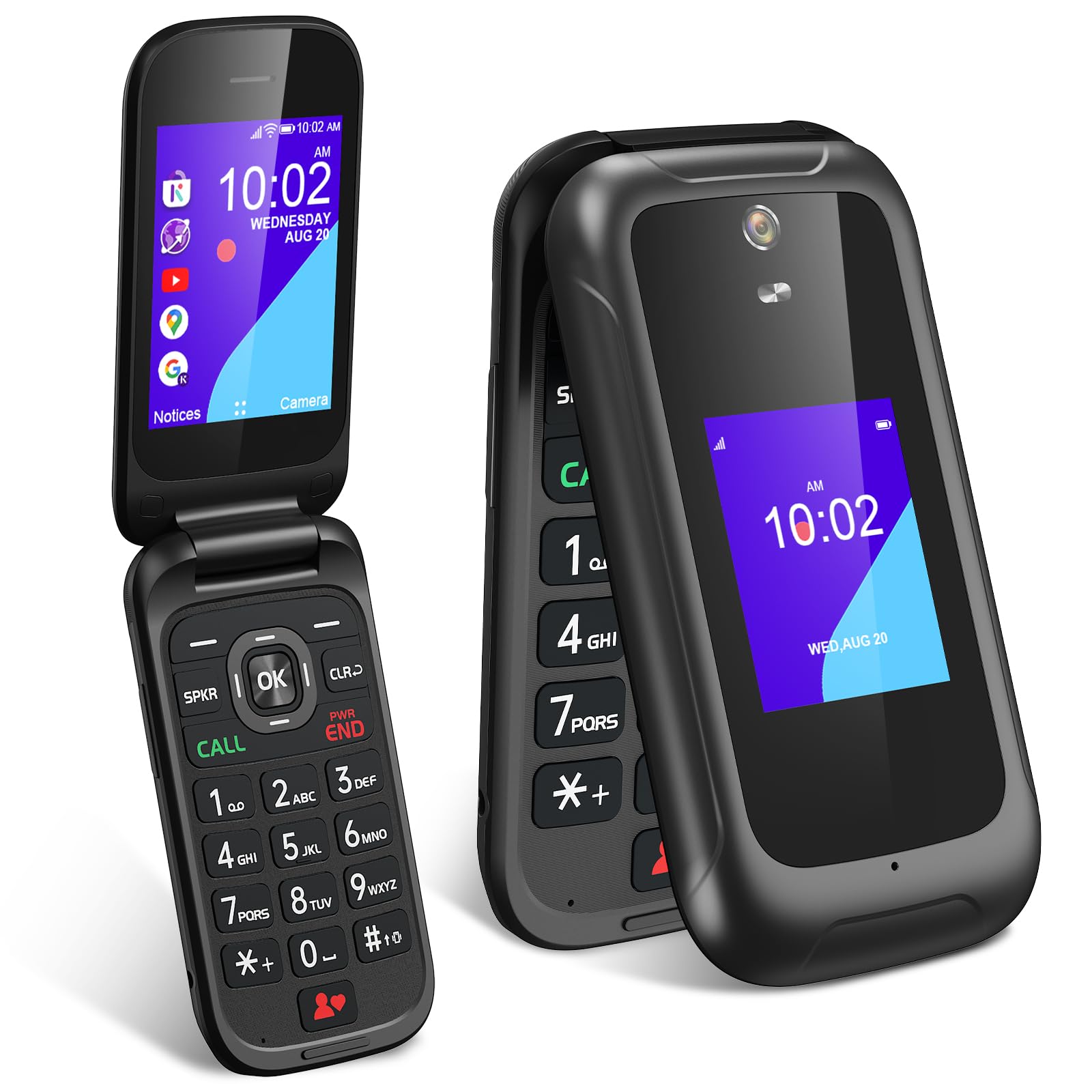
3. 4G Flip Phone KaiOS
A folding flip phone with real buttons, a 2000 mAh battery, and just enough internet to feel modern without the overwhelm.
This phone solves the “smartphone is too much” problem without making your parent feel left behind. A 3.2-inch main screen plus a 2.0-inch outside screen means time and caller ID are visible before you open it. The physical keypad is paired with big fonts and predictive text, so texting stays workable. Inside runs KaiOS, a light operating system that supports a modest app store, voice assistant, weather, YouTube, Google Maps and the browser while keeping the home screen simple.
The battery is your buffer against forgetting the charger. It holds a 2000 mAh removable battery, and day-to-day reports land at several days of normal use. It also has Wi-Fi, Bluetooth 4.2, GPS and a 5MP rear camera, plus 8GB of storage and 1GB of RAM, with a micro SD slot that accepts up to 32GB in the listing’s own wording. Speed-dial shortcuts can be set from 2 to 9 keys.
The honest limit is reliability. This is the cheapest-feeling unit of the group, and the mixed reports center on the phone not working from the start or having no printed or online manual with live company support. The four top-carrier note is firm too: AT&T and T-Mobile work, Verizon and its partner brands do not. Power it on and place a test call the day it arrives; if it is dead from the start, return it inside the return window.
Why it earns the slot
- Large physical keypad with big fonts and predictive text
- 2000 mAh removable battery holds several days of normal use
- Dual screens show time and caller ID without opening the phone
- Speed dial set from 2 to 9 for instant calls to family
Where it gets tricky
- Not compatible with Verizon or its partner networks
- Reliability is inconsistent — some units arrive defective
- No printed or online manual with live company support
Right for: a first phone, a backup travel phone, or someone who wants a foldable with just a taste of the internet.
Test it fast: power it on and make a call the day it arrives — that is the earliest clear test of quality.
4. Serene Innovations Amplified Big Button

Nine big buttons you load with family faces — press the photo, and the call goes through.
For someone with memory loss or failing eyesight, knowing which button to press is the whole game. This phone gives you nine large speed-dial buttons, each ready to hold a portrait photo, so a single press reaches a specific son, daughter or doctor. The ringer runs at 85 dB — about the noise of a lawn mower, per the maker — to cut through a turned-up TV. It also runs straight off the phone line, so a power outage does not put it out of service the way it knocks out a cordless base.
Owners mention that the picture dialing fits dementia care especially well. One family set it up for a 90-year-old mother with Alzheimer’s who kept muting and hanging up a cordless handset; the familiar shape of this receiver and her named buttons gave her back the ability to call on her own. Another household relied on the flash when it rings and the raised dimples on the 911 key to help a blind parent find it by touch. Volume and tone are adjustable, so a hearing loss can be worked around without shouting into the receiver.
The honest snag is the handset cradle. The receiver has to sit fully in place on the base or the line does not hang up, and getting it seated takes a steady hand. That is a small physical quirk worth rehearsing with your parent once, not a reason to pass on an otherwise well-designed care phone.
Why care teams notice it: the picture-button layout gets named again and again as the feature that lets a memory-impaired user call without help, and the line-powered design keeps the phone working when the lights go out.
Picture this pick for: a parent or grandparent whose memory or vision makes remembering phone numbers unrealistic, especially if they live on their own.
One physical habit to build: press the receiver firmly into the cradle after every call so the line disconnects.
5. Kyocera DuraXV Extreme E4810

Built to survive a drop, a toss and the occasional chew toy, with the familiar flip-phone call experience inside.
what separates it from the delicate cheap flip phone in this guide is the durability-first build. The one thing to watch is battery care. Reports on this unit point to the battery as the weak spot over time, with some units losing charge after a couple of months. So if the chargers and the charging port are working fine, treat it as a keeper, and plan on eventually replacing the battery rather than the whole phone.
There is also a software-side quirk families mention: a speaker or software glitch has turned up on repeat units for one long-time user, who kept coming back anyway. Owners keep buying it because the thick-shell build survives drops that crack cheaper flip phones. Just make sure the buyer is on Verizon before ordering.
The rough-and-tumble case: the build quality is the clear draw — a refurbished unit arriving like new is common, and owners treat its thick-shell design as permission to stop babying it.
Hand it to: a parent who works outdoors, drops things, or simply wants a flip phone that does not need a case.
Pause first if: you are not on Verizon, or if a multi-year battery is a firm requirement.
6. Nokia G60 5G 6/128GB

A big 6.58-inch screen that refreshes 120 times a second, running a clean Android that is easy to enlarge.
If your parent wants a modern phone, screen readability often decides it, and this one has a 6.58-inch FHD+ panel (a sharp full-HD screen) that refreshes at 120 Hz (a fast refresh rate that keeps scrolling smooth and text stable to the eye). Inside is a Snapdragon 695 5G processor (the chip that runs the phone), 6GB of RAM and 128GB of storage, plus a 50MP triple camera for family photos and video calls. Nokia also promises 3 years of OS upgrades and monthly security updates, so the phone stays supported long enough to hand down.
Battery is a strong point of the spec sheet: a 4500 mAh battery, with a listed 36 hours of average use and 12 hours of talk time, refilling in about 2 hours. That is a full day plus a cushion between charges. The clean Android build is also easy to enlarge — big text, big icons, high contrast — which is what most seniors actually need from a touchscreen.
The catch is carrier compatibility. This unit supports T-Mobile but explicitly does not support AT&T or its subsidiaries, and connectivity complaints from a family who signed up on a listed carrier are on the record. Call your carrier with the model before buying. If your network matches, this is the balanced option for a parent who wants a touchscreen without paying premium-tier rates.
The wins
- 6.58-inch 120 Hz screen keeps large text crisp and scrolling smooth
- 4500 mAh battery with 36 hours of average use and 12 hours talk time
- 6GB RAM and 128GB storage, plus a 50MP camera
- 3 years of OS upgrades and monthly security updates
The catches
- Works with T-Mobile but not AT&T or its subsidiaries
- Some buyers hit network drop issues on a “compatible” carrier
- Takes about 2 hours to reach a full charge
Good fit for: a T-Mobile household that wants a well-supported Android phone with a genuinely big, smooth screen.
Confirm before you click: the model has to match your carrier, or the phone will not connect no matter how good the spec sheet looks.
7. GrandPad Easy to Use Tablet & Phone for Seniors

The tablet-and-phone hybrid that runs on its own closed network, so family is a tap away and spam is blocked at the door.
GrandPad is less a phone than a managed life line. The display is an LCD panel resolving 1920 x 1200 pixels at a 60 Hz refresh, with large icons and simple navigation on top. It runs on a 4550 mAh lithium-ion battery rated for 8 hours of average use. The phone side of the device carries 4G cellular, Wi-Fi and Bluetooth, plus a rear camera and a wide-view front camera for face-to-face calls.
What families really pay for is the private network the maker runs behind it: it blocks spam and scams, and there is U.S.-based customer care. Family members install the companion app on Android or iOS to push photos, videos and memories straight to the tablet, plus multiplayer games and curated music. That closed network and the family photo and video-call features draw the strongest praise in its reviews.
Now the part you cannot skip: this device requires an activation plan, sold separately through six monthly or annual tiers, and it does not work with Consumer Cellular or other wireless carriers. Without a plan it has limited functionality. Ownership also stays with the plan. There is no resale value built in, so some families see the ongoing cost as a sunk cost — a fair trade if the person uses it daily and a poor one if they do not. Set it up and use it together the first week to make the subscription worth its keep.
Why it lives on nightstands: the simplified connection to family photos and video calls is the reason this device gets recommended so warmly. Relatives on the companion app say it turns a lonely week into a social one.
The pick when: the senior will use video calls, family photos and messages daily and the family wants the spam blocking handled for them.
Consider the cost structure: it is plan-only, carrier-locked and has no resale value — the value is in daily use or not at all.
8. Samsung Galaxy Z Flip 6 5G 512GB

A folding phone for the senior who wants a big screen that still closes down to pocket size.
This is the pick for a tech-comfortable parent who wants the latest thing. The 6.7-inch Dynamic AMOLED 2X folding main display adjusts its refresh rate from 1 to 120 Hz (a fast refresh rate that keeps scrolling smooth), so the screen dims efficiently when still. A Snapdragon 8 Gen 3 “for Galaxy” processor (the chip that runs the phone) pairs with 12GB of RAM to keep 5G apps and AI features snappy. There are dual rear cameras — 50MP wide with optical image stabilization (a shake-correcting feature) plus a 12MP ultra-wide — along with a 10MP front camera.
The outside has a 3.4-inch Super AMOLED FlexWindow cover screen for notifications, widgets and camera controls without opening the phone, and the body is water-resistant to IP48 with an Armor Aluminum hinge and Gorilla Glass Victus 2. That combination is the most durable spec sheet of any touchscreen here — but a folding screen lives by different rules. Reports are honest about both sides: it arrives pristine and runs beautifully, and separately, screens have failed or frozen after only months of use. Battery life is rated for 22 hours of average use from a 3700 mAh cell.
There is a practical fold to know about. The closed phone is thicker than expected, which some owners say makes a tight fit in a pocket and blocks using the cover-screen version of Google Maps in a car mount. If your parent has steady hands and reads one-handed, the 6.7-inch inner screen is the reason to pick it. If they want a screen that will not develop a fold crease, the A56 below is the safer bet.
The tech-forward side: the fold-and-go design and the huge inner screen make this the most phone for the money in features, and the camera is described as a big upgrade over older Samsung models.
Shortlist it if: your parent enjoys new tech and wants a big reading screen that folds into a smaller package.
Pause for: the folding screen’s long-term reliability record and the thicker closed profile when pocketed.
9. Samsung Galaxy A56 256GB 5G
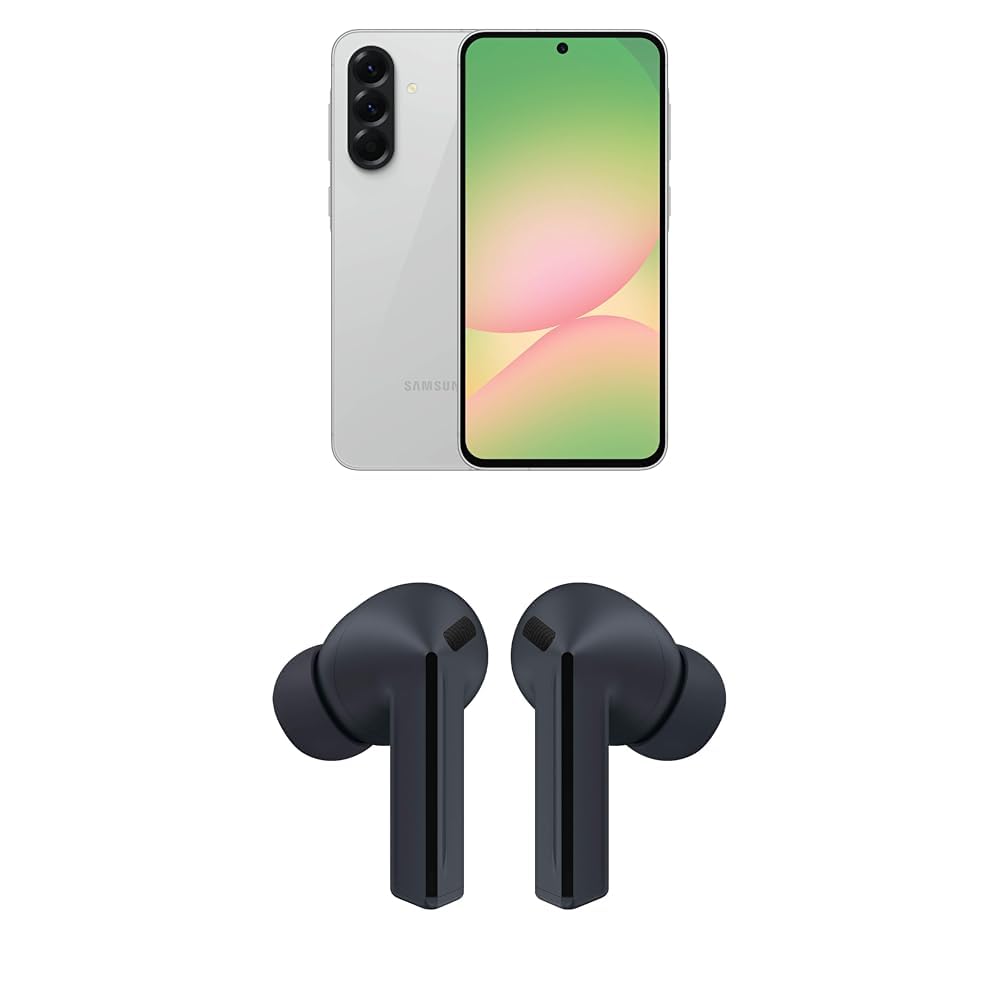
A massive 6.7-inch AMOLED screen, a 5000 mAh battery, and a pair of wireless earbuds in the box.
Most grandparents ask for screen size and battery life first, and the Galaxy A56 5G delivers both. It has a 6.7-inch AMOLED display resolving 1080 x 2400 (a sharp, bright picture), so text stays easy to read. The 5000 mAh battery is the largest in this guide, and it pairs with 45W Super Fast Charging 2.0 to refill faster. Storage is 256GB, and a 12MP front camera plus a triple-lens rear setup cover family photos and video calls.
The bundle adds Galaxy Buds 3 FE, wireless earbuds with enhanced Active Noise Cancellation and 360 Audio, which pair straight to the A56 for calls and movies. For a senior who watches shows at full volume, the earbuds are a way to hear clearly without turning the living room into a theater. On the phone itself, the in-screen fingerprint reader open up the phone by touch and supports both physical SIM and eSIM.
Two things are notably missing: there is no microSD card slot, and the phone is not wireless-charging capable. A full charge takes about an hour, so a nightly cable is the routine. With heavy use the battery holds a full day. This is the sensible premium-adjacent pick for a home that wants a big-screen Samsung with all the everyday features intact.
What stands out: the efficient AMOLED screen balances brightness with battery endurance, and owners describe the camera as close to what the pricier brands deliver while staying on the affordable end of the range.
Buy this one for: a parent who wants a large, bright Samsung screen with all-day battery and a set of earbuds thrown in.
Decide against it if: expandable storage or wireless charging are dealbreakers — neither is here.
Know the Specs
mAh (milliamp-hours)
Battery capacity, written as mAh, is a measure of how much charge a battery holds. A 2000 mAh battery in a flip phone tends to last several days on light calls. A 4500 mAh or 5000 mAh battery in a smartphone is aimed at a full day of heavier use. Bigger is not always better if the phone is heavier to hold, so balance capacity against how the person actually uses the handset.
dB (decibels) and ringing volume
The ringer on a home phone is measured in decibels, the unit for sound loudness. A phone rated at 85 dB or 90 dB rings louder than the ordinary house phone, which helps anyone with hearing loss or a TV running in the next room. Pair a loud ringer with an amplified earpiece and hearing-aid compatibility, and the person can both hear the call coming and follow the conversation.
Hearing-aid compatibility
This means the phone’s earpiece is built to work with a hearing aid instead of whistling into it. It matters most for anyone who wears a hearing aid daily and takes calls at home. On phones without that support, look for an adjustable tone or boost control so the volume can be raised for the person listening without straining.
Carrier compatibility and open up phones
An open up phone is not universal. It only works on the networks its radios support. Some flip phones list AT&T and T-Mobile support while excluding Verizon and its partner networks; some smartphones include T-Mobile but not AT&T. Always match the phone to the carrier the person already pays for, and check coverage in their home before you switch providers over a handset.
Common Questions
Will a hearing aid work with one of these phones?
Does the Nokia G60 5G work on AT&T?
Can the 4G Flip Phone work on Verizon?
Do I need a separate plan for the GrandPad?
Is a picture-button phone good for someone with dementia?
How long does the battery last on a flip phone?
Is a renewed iPhone safe to buy for a parent?
Which phone is best for someone who only wants to call and text?
Do these phones work during a power outage?
Can a senior learn to use the Galaxy A56 5G?
The Bottom Line
The right cell phones for seniors pick is the one your parent can use without help. For a familiar face and a large screen, the Apple iPhone 11 Pro Max carries the highest-rated smartphone rating in this guide at 4.0+ stars across 18,000+ owners. If your parent lives with memory loss or vision trouble, the picture-button design of the Serene Innovations HD40P is the more thoughtful choice. And for a first step into smartphones with a big screen and long battery, the Samsung Galaxy A56 5G is the easiest to hand over. Match the phone to how your parent actually lives, then program the speed-dial buttons together before you leave.
How we choose
We do not accept paid placement. Every pick is matched to a real buyer and a real use-case; we do not hands-on test units.
Sources
Specifications: manufacturer listings and product documentation. Review insights: verified customer reviews, as of October 2026. Pricing: not shown on this page (it changes often); check the current price via the retailer link.
As an Amazon Associate, Aappliancez earns from qualifying purchases. This does not affect which products we feature.