Disclosure: Some links in this post are affiliate links. As an Amazon Associate I earn from qualifying purchases, at no extra cost to you. Learn more
Specs are compiled from manufacturer listings and verified buyer reviews and can change over time — please confirm the key details on the product page before buying.
When you’re choosing boxing head gear, you’re balancing two things that pull against each other: how much padding sits between your nose and a stray hook, and how much of that hook you can still see coming. The best pick here is the Ringside Competition-Like Boxing Headgear with Cheeks, because it keeps a real leather shell, a curved cheek guard and a lace-up fit in one package without fogging your vision. Below you get nine head guards sorted by how each one actually behaves in the gym.
This guide is built by comparing the manufacturers’ published specifications and the patterns across verified customer reviews, so you get each pick’s real strengths and trade-offs instead of marketing spin.
Cheek coverage, strap layout and shell material decide whether a head guard survives a full camp. That is why every pick below is judged on those three things, in a buying guide to the best boxing head gear.
Top Picks


How To Choose The Best Boxing Head Gear
Start with the shape of the guard, not the brand on the box. A head guard with cheek protection wraps padding down past your cheekbones, so it blocks hooks that would otherwise land clean on the jaw. An open-face guard leaves that area bare but gives you a wider field of view for drills and pad work. Neither one is wrong — they just answer different questions.
Cheek coverage versus an open face
Cheek guards trade a slice of your peripheral view for extra real estate over the jaw and nose. If you spar hard and eat hooks, that trade is worth taking. If you mostly drill technique and want to see everything, an open-face design keeps your head on a swivel. The Cleto Reyes model here goes further, using thick cheek pads to shield the nose without adding a face bar, which is a design choice you notice the first time you get clipped.
The closure system decides whether it stays put
Look for two adjustment zones instead of one. Top lacing fine-tunes the crown, while a rear hook-and-loop panel or lace tie locks in the back of the skull. Add an adjustable chin strap and you have three points of contact holding the shell steady. A guard with only a rear strap will creep upward during a clinch, and you will spend the round pushing it back down instead of working.
Shell material and how long it lasts
Genuine leather shells hold their shape through repeated sweat and wipe-downs better than most synthetic options, which is why so many competition-grade guards use it. A thick leather shell paired with thick stitching tells you the guard was built for a full camp, not one season. Synthetic leathers and PVC are lighter and cheaper to replace, and for a beginner logging two sessions a week they hold up fine.
Weight matters more than you think
A heavy guard wears on your neck by round eight of sparring, and a very light one can feel like it is barely there. Worth knowing: the Ringside guard here weighs 10.56 ounces, and the LEONE 1947 weighs 2 ounces — a real gap you feel in the last rounds. Heavier builds tend to mean more padding; featherweight builds favor movement.
Side-by-Side Comparison
| Model | Best For | Shell Material | Weight | Cheek Protection | Amazon |
|---|---|---|---|---|---|
| Ringside Competition-Like Boxing Headgear with Cheeks★ Best Overall | Hard sparring with maximum coverage | Leather inside and out | 10.56 ounces | Extended curved cheek guard | Amazon |
| LEONE 1947, Training HeadgearFeatherweight Pick | Light technical drills and pad work | Polyurethane (PU) inner | 2 ounces | Open-face design | Amazon |
| FIGHTR Boxing HeadgearBest Value | Beginners who want quick on-off | Polycarbonate (PC) outer | — | Slim-fit guard | Amazon |
| TITLE Boxing Leather Sparring Headgear | All-leather gym workhorse | Leather outer, suede-leather liner | 2.9 pounds | International style cheek protectors | Amazon |
| Contender Fight Sports Competition Boxing Headgear | Gym sparring and amateur competition | Leather outer, synthetic lining | 11.2 ounces | Cheek protection | Amazon |
| TITLE Boxing Classic USA Competition Headgear | USA Boxing sanctioned competition | Polyvinyl Chloride (PVC) | 2.9 pounds | No — ear air channels instead | Amazon |
| Venum Elite Iron Headgear | Nose protection with a face bar | High-density foam | — | Front shield and face bar | Amazon |
| Hayabusa T3 Adjustable MMA Headgear | Compact MMA and kickboxing sparring | Vylar engineered leather | 6.88 ounces | Added cheek protection | Amazon |
| CLETO REYES Boxing Headgear with Cheek Protection | Advanced boxers in competition | Genuine leather, latex foam padding | 1.5 pounds | Thick cheek pads, no face bar | Amazon |
Detailed Reviews
1. Ringside Competition-Like Boxing Headgear with Cheeks
Our pick — 4.5+★ from 850+ verified ratings; the strongest balance of quality and price.
An all-leather guard that four fighters wore through nine Muay Thai tournament bouts without a single shift.
The leather build is the reason this one sits at the top. High-quality leather inside and out means the shell keeps its shape after weeks of sweat instead of going floppy, and the extended curved cheek guard wraps padding down past the cheekbone to cover the front, sides and back of the head in one piece. Buyers report it held through nine Muay Thai tournament bouts across four fighters in different weight classes, with no movement on blows or in the clinch once adjusted.
Fitting is a three-part job here — lace top, hook-and-loop rear closure and a sturdy buckle chin strap — so you can dial the crown, the back of the skull and the jaw separately. That matters for anyone with a fuller head shape, and buyers with a super heavyweight build and thick hair reported zero issues with chin strap length or closure. The whole thing weighs in at a surprisingly manageable 10.56 ounces for an all-leather shell — considerably heftier than the LEONE 1947 at 2 ounces, but that is exactly where the extra padding lives.
The trade-off: this is a sparring and training guard, and a small group of buyers have questioned the leather itself, while the majority rate it as genuine material well worth the spend. The fit is the clear strong point here — it is what owners bring up more than anything else, followed by the protection it delivers. It holds the higher score at 4.5+ stars, and while its review pool is deeper than some picks here, it still trails the biggest guard on this list, so don’t mistake volume for the only signal.
What Keeps This Guard In Place
- Extended curved cheek guard covers front, sides and back of the head in one shell.
- Full leather inside and out, so the padding holds its shape through a long camp.
- Three-point adjustment: top lacing, hook-and-loop rear closure and a buckle chin strap.
- 10.56 ounces for an all-leather guard, manageable through a full sparring session.
Where It Asks A Little Of You
- Material quality draws mixed feedback — a portion of buyers question the leather feel.
- Heavier than the LEONE 1947 at 2 ounces, so it moves less like a second skin.
- You need to adjust three separate points before it seats properly.
Pick this when: you spar hard in boxing, MMA or Muay Thai and want maximum covered area from a leather shell.
Think again if: you want a barely-there guard for light drills — the LEONE weighs 2 ounces and disappears on your head.
2. LEONE 1947, Training Headgear
Two ounces of Italian padding that vanishes on your head and still guards the forehead, cheeks and ears.
If the Ringside guard feels like putting on a helmet, this one feels like almost nothing. At 2 ounces it is the lightest head guard on this list by a wide margin, and that is not the only number that shrinks — its footprint is 9.84 x 8.27 x 7.87 inches against the Ringside’s 10.01 x 10.51 x 7.51 inches, so it packs down easier in a gym bag and sits lower on the head.
What you get for that featherweight build is a wide facial opening. The open-face design keeps your vision clear, which is exactly what you want for sparring, technical drills and partner exercises where reading your partner matters more than eating shots. Padded coverage still runs around the forehead, cheeks, ears and back of the head, and the cushioned interior uses a polyurethane (PU) inner layer to soak up impact. Top lacing plus an adjustable rear fastening system let you pull it tight in two places.
Boxing veterans with 35 years in the sport call it the best headguard they have worn, and buyers consistently praise the stitching and design. Just be honest with yourself about what it is not: it is built for training, and any full-contact gym instructor would allow it in that role, but it is not a competition model. Buyers looking for a hard-sparring shell with heavier padding should stack it against the Ringside — 2 ounces versus 10.56 ounces tells you most of what you need to know.
The honest limit: this is a training-layer guard, and owners openly describe it as a training version rather than a competition piece. If your rounds are heavy and your partners swing through, the thin build will not absorb what a leather shell does.
Right for you if: you drill technique, work pads and spar light, and want your head weightless with a full field of view.
Step past it if: you need a guard for full-contact rounds — the padding here is deliberately minimal.
3. FIGHTR Boxing Headgear
A slim, quick-release guard built for beginners who want to gear up in seconds, not minutes.
Getting this guard on takes one motion. The quick-release fastener combined with extra soft inner material means you are ready for your next sparring session almost immediately, and that matters most when you are a beginner logging rounds at a busy gym. The polycarbonate outer shell adds durability on top of the foam padding, and the slim, snug fit is deliberately harder for a partner to catch — which also makes fast head movement easier.
Fitting is the one thing to get right before you order, and this is the guard’s most-discussed topic. Buyers land on both sides of it, with some reporting it stays put and others finding the sizing runs big — a standard size here reads closer to a small/medium, so check the chart before you commit. A father who bought a size L for his 15-year-old son reported it fit well and that the back fastener is thick enough to hold strong.
The protection side earns its own credit. Padding and shock absorption hold up to regular sparring, and the German startup behind it stands behind the product with a replacement-or-refund policy and a promise to respond within 24 hours. As a value pick for Muay Thai, kickboxing and MMA newcomers, it does the job at the entry end of the range — just measure your head first, because a poorly chosen size here is the single most common complaint.
Why Beginners Warm To It
- Quick-release fastener and soft inner material make it fast to put on.
- Slim fit is harder to hit and lets you move your head quickly.
- Polycarbonate outer shell for durability at the entry end of the range.
- Replacement-or-refund policy with a 24-hour response promise.
The Size Question
- Sizing runs large for a chunk of buyers — a standard size reads closer to small/medium.
- No warranty listed, so the replacement promise is your main coverage.
Reach for this if: you are new to Muay Thai, kickboxing or MMA and want fast on-off at a starter price.
Look elsewhere if: you are between sizes — this is the one guard on the list where buyers consistently flag the fit running big.
4. TITLE Boxing Leather Sparring Headgear

A plush suede-lined leather guard that absorbs shots without swallowing your view of the ring.
Three layers of padding sit inside this one — polyurethane, foam rubber and low-density foam stacked together — wrapped in a form-fitting anatomical shell that follows the curve of your head rather than sitting on top of it. The result is extended coverage across the front, sides and back, with international style cheek protectors adding jaw coverage and advanced lace-tie adjustment at both the back and the top of the head. A genuine leather chin strap with a steel buckle closure locks the whole thing down.
The inside is where this guard separates from cheaper leather options. A plush suede-leather liner feels soft against the skin, wicks moisture and helps the unit stay firm and snug through a full session, so you are not constantly tugging it back into position. The shell is all-leather outside, so it wipes clean and holds shape rather than going slick with sweat. Buyers describe it as well-made and covering what it needs to without impeding their view, and many find it lighter and less annoying than other guards they have worn.
One honest detail: the white lining on the inside of some versions shows blood stains after hard rounds, which is expected in a sparring guard but worth knowing before you buy. Everything else lands positive — build quality and shot absorption carry the highest marks, with comfort, fit and value all following behind.
What owners keep coming back to: the suede liner and the anatomical wrap. It stays snug without the constant readjusting that plagues stiffer shells, which is why it holds its spot for regular gym work.
Suits you if: you want an all-leather guard with a soft liner for daily sparring and Muay Thai sessions.
Pass if: you dislike a white interior — it discolors with blood over time.
5. Contender Fight Sports Competition Boxing Headgear
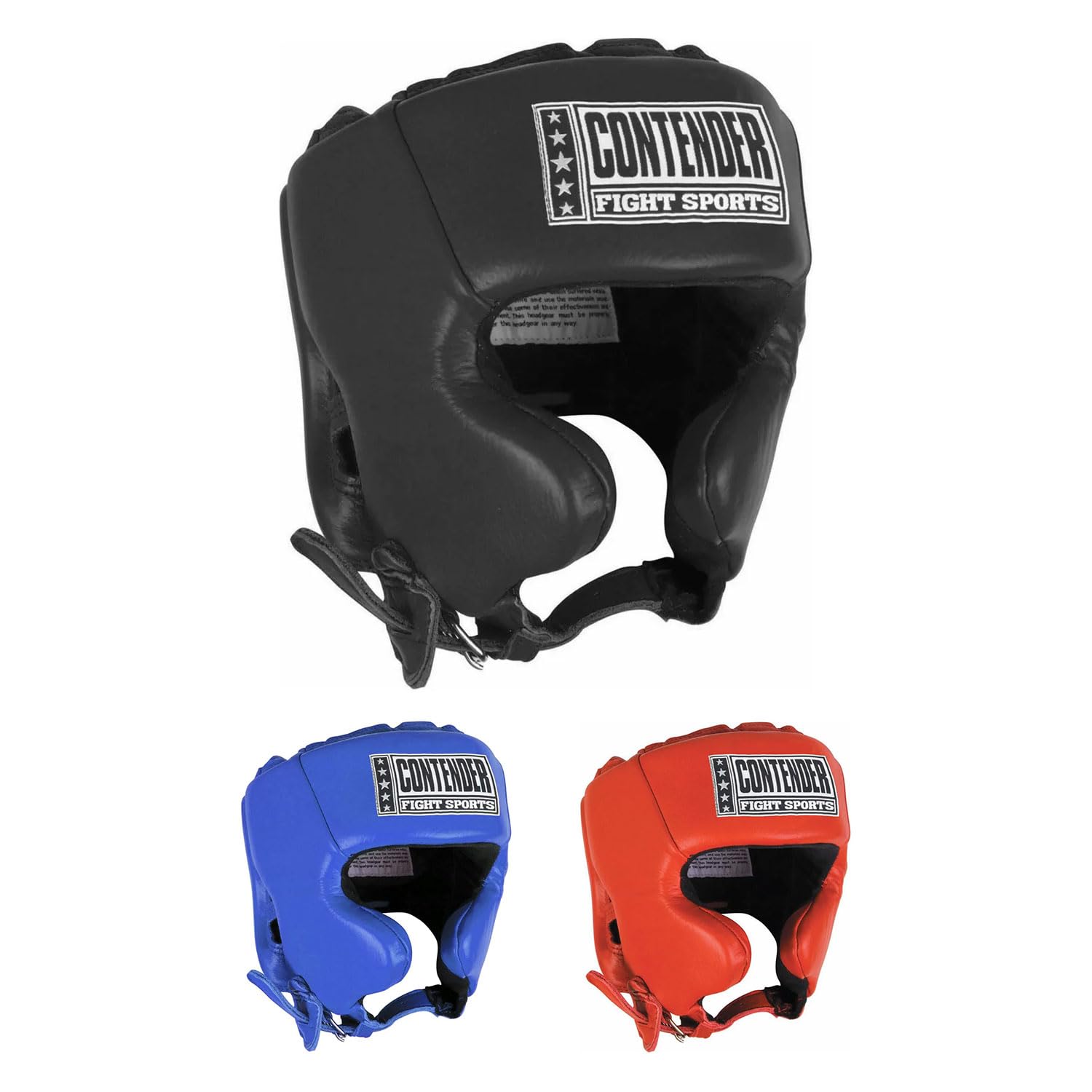
Two lace zones plus a buckle chin strap, tuned for fighters counting down to a sanctioned bout.
This guard is built around three touchpoints that hold it in place: top and back lace closures let you dial the crown and skull independently, and the adjustable buckle chin strap takes up the slack at the jaw. Multi-layer impact-dispersing padding handles routine training impacts, and the cheek protection adds facial coverage without dramatically limiting your forward vision — so you keep your eyes on your opponent instead of losing the read on their jab.
The outer shell is leather paired with a synthetic lining, and the combination is chosen to stop the guard from sliding during movement while still wiping clean after a session. At 11.2 ounces it lands in the middle of the weight range here — heavier than the 2-ounce LEONE 1947 and the 6.88-ounce Hayabusa T3, but lighter than the all-leather TITLE guards at 2.9 pounds. It also carries a USA Boxing league designation in its spec sheet, so if you compete in that framework, the paperwork lines up.
One caveat worth weighing: this model launched with no buyer review data yet on Amazon, so what you are judging is the spec sheet and the build rather than a track record. The padding spec, the double-lace layout and the leather outer all suggest a competent competition shell, but for pure confidence in the numbers, stack it against the TITLE Boxing Classic USA competition guard, which shares the USA Boxing label.
What stands out: the top-and-back lace layout with a buckle chin strap gives you three adjustment points, which is the setup you want if your head shape has never sat well in one-size guards.
What to weigh: there is no review history to lean on, so buy on spec. The leather outer and multi-layer padding read well; only your first sparring session will confirm how the fit settles.
Best for: amateur boxers preparing for competition and gym sparring who want a leather shell with cheek coverage.
Look past if: you want proven feedback before you buy — this one has no buyer track record yet.
6. TITLE Boxing Classic USA Competition Headgear

Four laminated foam layers and a clean competition cut — no cheek pads, just what the sanctioning body wants.
The headline build detail here is the padding: four layers of foam laminated together with high- and low-density sections, which is how this guard gets shock absorption and impact resistance into a shell that still passes as competition-legal. A PVC outer wraps the whole thing, and integrated side ear air channels add coverage over the ears without the bulky add-ons you would feel on a heavier leather guard.
Adjustment runs on a fully laced system across the top and back, with an adjustable chin strap rounding out the hold. The lacing lets you pull a no-slip form fit across the crown, which is the part that keeps a competition shell legal and steady through three rounds. Buyers who use it for light sparring report it works well and has held up, while others praise the fit, the material and the way it protects in harder sessions.
The one thing to know before ordering: the listing describes cheekbone coverage, but the actual unit does not include it — this is the open-face style, with ear coverage standing in for the cheeks. Fighters who want jaw protection should look at the TITLE Leather Sparring model above or the Ringside guard at the top of this list, both of which carry cheek protection. If your framework checks for the USA Boxing approval, though, this is the TITLE guard with the paperwork to match.
Why Competitors Choose It
- USA Boxing approval and a 4-layer foam laminated padding build.
- Fully laced top and back adjustment for a no-slip, form fit.
- Integrated side ear air channels for extra coverage without bulk.
- Users report it holds up through light sparring and harder rounds alike.
Read The Description Carefully
- No cheekbone coverage despite the listing’s wording — buyers have flagged the mismatch.
- PVC outer rather than the leather on most other guards here.
Choose this when: you compete under USA Boxing rules and need an approved, cheekless competition shell.
Choose differently if: you rely on cheek protection — this one trades it for ear coverage.
7. Venum Elite Iron Headgear

The guard you buy when your nose keeps finding your partner’s glove — a face bar plus dense foam.
High-density foam sits throughout this shell, and its standout feature is a face bar that runs across the front to shield the nose. For anyone who has taken a straight shot to the face one too many times, that bar is the reason to look at this guard. Lace tightening runs over the head for support, with a hook-and-loop adjustment at the back of the skull to fine-tune the fit. The overall profile stays low enough that owners note it does not give you a bubble-head look.
Sparring partners swing harder than you expect, and that is exactly where the face bar earns its keep — the head padding works alongside it to soften the impact when an aggressive partner lands flush. Quality and impact protection are what owners mention they got, and the materials and design draw plenty of praise from people who have tried other guards first.
Here is the honest catch: the front shield space runs small for some head shapes. A 165-pound buyer standing 5’7″ with a 22-inch head reported the bar tilted back into the nose because the fit could not tighten down enough, and another buyer flagged that it is tough to see through and needs extra securing. Worth knowing if you have a larger head and a prominent nose — sizing is not offered in the traditional small/medium/large split here, which is why some buyers end up switching to a version that does.
Where it wins: a sturdy face saver and dense foam that absorbs punches well, in a shape that does not look like a bubble. For nose protection specifically, few guards on this list come close.
For you if: your priority is a face bar protecting your nose and you have a head size that matches the one-size build.
Look past if: you have a larger head or a prominent nose — the front shield space is tight and buyers with bigger shapes report it tilting.
8. Hayabusa T3 Adjustable MMA Headgear

A compact shell with a patented T-Cross closure that keeps your sightlines clear and your head cool.
Hayabusa’s T3 stops shifting with a T-Cross closure that locks the fit where you set it, and everything about the shape is designed around movement. It is noticeably lighter than the heavy leather guards here — 6.88 ounces against the 2.9-pound TITLE leather models — and the slimmer build keeps an ultra-wide field of view without adding bulk. Mesh ear coverings and an open-top vent heat, so you are not cooking inside your own padding mid-round.
The exterior uses Hayabusa’s Vylar engineered leather and the interior is lined in soft polyester, with added cheek protection to reduce the risk of direct impacts and scratches while sparring. One size fits most is the sizing story here, so there is no guessing between a medium and a large the way there is with the LEONE and FIGHTR guards. It is built for kickboxing, MMA, Muay Thai, taekwondo and martial arts training.
What buyers keep coming back to is the protection and the way the padding absorbs shock — face coverage in particular gets strong reports, and it holds up through intense sparring without blocking your view. The recurring gripe is heat and peripheral vision at the outer edges: some find it runs hot like a wool hat and takes a bite out of what you can see off to the side. Neither stops it from being a favorite for hard sparring, and owners who tried cheaper helmets first call this one the quality step up.
Why It Stays Put
- Patented T-Cross closure minimizes shifting at the back of your head.
- 6.88 ounces with a compact, streamlined build.
- Mesh ear coverings and open-top vent heat during long sessions.
- Vylar engineered leather exterior and polyester lining for durability and comfort.
Trade-offs To Know
- Can run hot during heavy rounds despite the vented mesh.
- Peripheral visibility takes a hit for some wearers — a closed-in feel at the edges.
- One size fits most, which will not suit every head shape.
This suits: kickboxers and MMA fighters who want a light, compact guard that locks down against shifting during fast exchanges.
skip it if: you run hot easily — the closed fit and extra padding make this one of the warmest on the list.
9. CLETO REYES Boxing Headgear
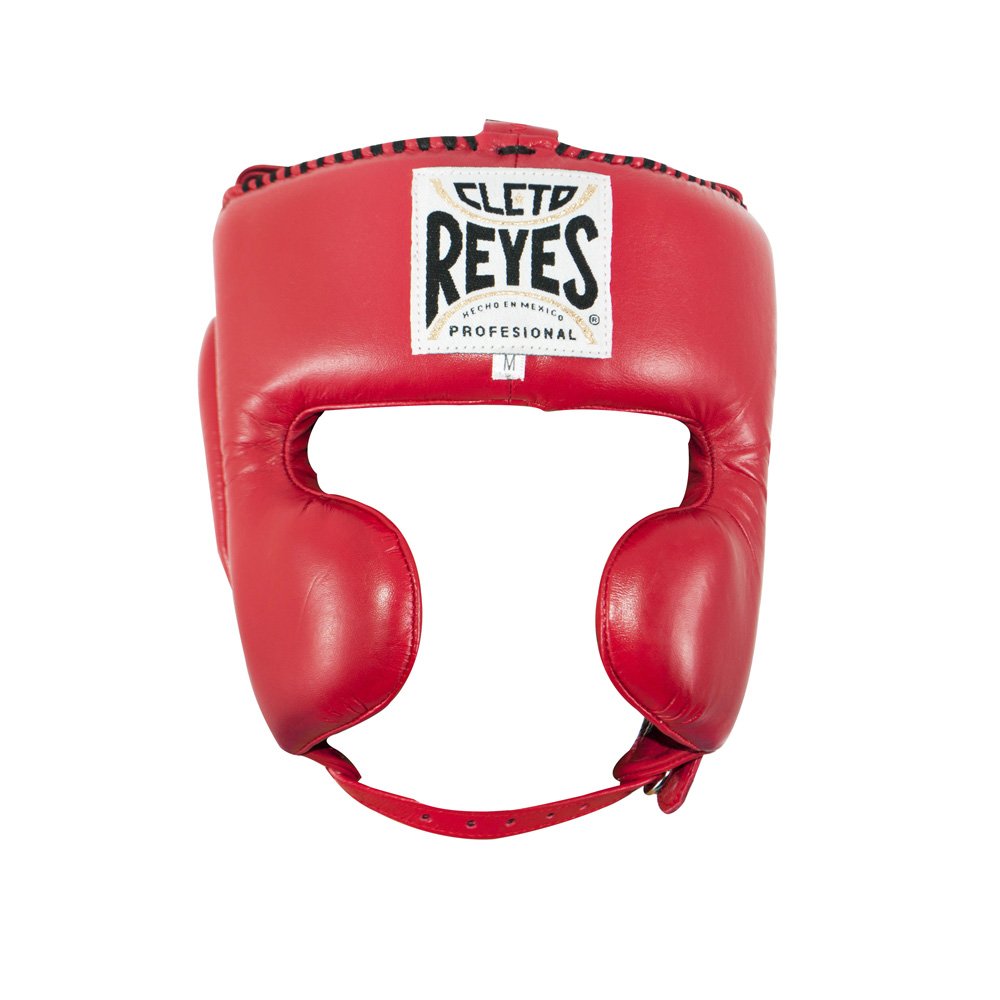
Handmade Mexican leather with thick cheek pads that guard the nose without resorting to a face bar.
This is the guard at the top of the price ladder, and the build explains why. Genuine leather, latex foam padding and a 3-point anatomical design are put together by hand in Mexico, and the result is a shell that fits close to the head without bunching into your forehead. The cheek pads are deliberately thick, and their job is to protect the nose without adding a faceguard — a different approach from the Venum’s face bar, and one that keeps a wider view of the ring.
Sizing is actually spelled out here, which is rare in this category: small fits up to 21 inches, medium covers 21 to 22 inches, and large handles 22.1 inches and up. So you measure your head before you order and skip the guessing game that comes with one-size-fits-most guards. Adjustability runs from the top and rear with a hook-and-loop closure, plus an adjustable chin strap for the jaw. At 1.5 pounds it is a serious leather shell — heavier than the Hayabusa T3 at 6.88 ounces, lighter than the 2.9-pound TITLE leather guards.
What wins buyers over is exactly what you would expect from this brand: solidly made construction, full protection with particular attention to the cheek area, and a fit that settles perfectly once all the straps are adjusted. It is easy to put on and take off, and it holds up to a twice-weekly sparring schedule. For advanced boxers and competitions, this is the craftsmanship pick — provided you measure carefully and know that skin sensitivities are the buyer’s responsibility to check before use.
Why it costs more: handmade construction, genuine leather and latex foam padding — the materials and labor are visible in the stitching and the way the shell holds its shape.
Before you order: measure your head and choose between the three sizes using the stated measurements. If your head measures near a boundary, size up and use the strap to take up the slack.
Best for: advanced boxers and competitors who want handmade leather, thick cheek pads and no face bar blocking the view.
Not for you if: you have sensitive skin and have not checked the materials first — the maker puts that responsibility on the buyer.
Know the Specs
Cheek Protection vs Open Face
Cheek protection means the padding extends down past the cheekbones to cover the jaw. It is the difference between eating a clean hook and glancing it off a padded surface. The Ringside and Cleto Reyes guards take this approach. An open-face design skips that coverage and leaves the face wider open — the LEONE 1947 is the clearest example here, and the TITLE Classic USA guard sits in this camp too. Pick cheek coverage when you are taking heavy shots; pick open-face when vision and movement matter more than jaw padding.
Closure Systems And Fit
The closure system is what keeps the guard on your head when a shot lands. Look for two or three adjustment points: top lacing or a top strap, a rear closure (hook-and-loop, lace-tie or T-Cross), and a chin strap with a buckle. Three-point setups let you tune the crown, the back of the skull and the jaw independently, which matters most if your head shape falls between sizes. A single rear strap is the cheapest to make and the most likely to creep upward during a clinch. The Contender uses top and back lacing with a buckle chin strap; the Cleto Reyes uses a top and rear hook-and-loop closure with an adjustable chin strap.
Shell Materials: Leather, Synthetic And PVC
Genuine leather holds its shape through sweat and repeated wipe-downs, which is why competition-grade guards use it — the Ringside, TITLE Leather Sparring and Cleto Reyes guards all use leather shells. Polycarbonate and PVC shells are lighter and cheaper, and for beginners logging light sessions they work fine. Synthetic leathers like Hayabusa’s Vylar aim for the same durability in a lighter package. Whichever you choose, the shell is what determines how long the padding stays where the maker put it.
Weight And Padding Thickness
Weight is a rough signal of how much padding sits between you and a glove. A heavier guard usually means more layers. The range here runs wide: the LEONE 1947 comes in at 2 ounces, the Contender at 11.2 ounces, and the TITLE leather guards at 2.9 pounds. Heavier guards protect more but wear on your neck in later rounds; lighter guards keep your head moving but pad less. Match the weight to how hard you actually spar, not to how hard you plan to spar.
Common Questions
How do I measure my head for boxing head gear?
Will a boxing head guard protect my nose during sparring?
What is the difference between cheek protection and open-face head gear?
How long does boxing head gear last before it needs replacing?
Can I use boxing head gear for MMA and Muay Thai too?
Should I choose a lighter or heavier head guard for sparring?
Do boxing head guards run small or large in sizing?
What is a lace-up closure versus a hook-and-loop closure on head gear?
Can I spar hard in a training head guard?
How do I keep my boxing head gear from smelling after training?
Will a boxing head guard fit under a mouthguard and headgear combo?
The Bottom Line
For most fighters, the boxing head gear pick that covers the most ground is the Ringside Competition-Like Boxing Headgear with Cheeks, because an all-leather shell, an extended curved cheek guard and three separate adjustment points handle both hard sparring and tournament work without fogging your view.
If you want the lightest possible guard for drills and pad work, reach for the LEONE 1947, Training Headgear — at 2 ounces it disappears on your head, and 35-year boxing veterans call it the best headguard they have worn.
And if nose protection is your whole reason for buying, the Venum Elite Iron Headgear face bar is the specialist answer, provided your head shape suits the front shield space.
One last thing worth knowing: the Ringside guard carries the strongest combination of overall score and feedback depth on this list, so if you only want to buy one and be done with it, start there and size carefully.
How we choose
We do not accept paid placement. Every pick is matched to a real buyer and a real use-case; we do not hands-on test units.
Sources
Specifications: manufacturer listings and product documentation. Review insights: verified customer reviews, as of October 2026. Pricing: not shown on this page (it changes often); check the current price via the retailer link.
As an Amazon Associate, Aappliancez earns from qualifying purchases. This does not affect which products we feature.