Disclosure: Some links in this post are affiliate links. As an Amazon Associate I earn from qualifying purchases, at no extra cost to you. Learn more
Specs are compiled from manufacturer listings and verified buyer reviews and can change over time — please confirm the key details on the product page before buying.
If a wrench slips across your battery terminals, the spark can weld metal, melt a ring, or kill a fuse in a heartbeat. A battery cable cover is the cheap rubber boot that stops that from happening — it wraps the post and the cable lug so nothing conductive can bridge them. The five picks below cover military-style clamps, marine 3/8 studs, 4/0 cable, and ordinary round car posts.
This guide is built by comparing the manufacturers’ published specifications and the patterns across verified customer reviews, so you get each pick’s real strengths and trade-offs instead of marketing spin.
You will see which boot swallows thick cable, which one fits a stock post, and where an oversized cover becomes a nuisance. The wrong opening size wastes your money, so check your terminal shape and cable gauge before you buy.
Top Picks
How To Choose The Best Battery Cable Cover
The first thing to settle is what kind of terminal you actually have. A stock car battery has a round lead post you clamp a cable end onto. A military-spec terminal is a flat clamp with a bolt through the top. A marine terminal is a stud with a nut holding the cable ring. Each shape needs a different boot opening, and a cover built for one will not sit right on another.
Match the opening to your cable size, not your battery size
The opening is the hole the cable slides through. Wire is measured in AWG (American Wire Gauge), and here is the trap: a smaller AWG number means a thicker cable. So 4/0 AWG is a very fat cable, 1/0 AWG is thick, and 4 AWG is modest. A cover rated for 1/0 to 4/0 AWG will swallow big cable and can feel loose on thin wire. A cover with a large open end lets several cables share one boot.
Decide if you want insulation or looks
Every cover here does the same core job: it puts a non-conductive layer between the live metal and anything that could touch it. Red and black color coding is a bonus that helps you and the next person identify polarity at a glance. Thicker walls and softer materials resist cracking when a cable is pulled and re-routed, which matters more on a boat or an off-road rig than on a parked sedan.
Side-by-Side Comparison
| Model | Best For | Quantity | Cable Range | Material | Amazon |
|---|---|---|---|---|---|
| 12 Pieces Battery Terminal Covers★ Best Overall | Stock car and truck posts | 12 pieces (6 red, 6 black) | 2 AWG with compression lugs | PVC plastic | Amazon |
| MGI SpeedWare Military Spec CoversBig Cable Choice | Thick 4/0 lithium bank cable | 1 pair (red and black) | Up to 4/0 AWG | Flexible insulator | Amazon |
| Fastronix Military Spec Covers | Multiple wires on one terminal | 1 red and 1 black | Multiple lugs, large open end | Silicone | Amazon |
| Fastronix Marine Terminal Cover Set | Marine studs on boats and RVs | 1 set (red and black) | 3/8 stud | Plastic | Amazon |
Detailed Reviews
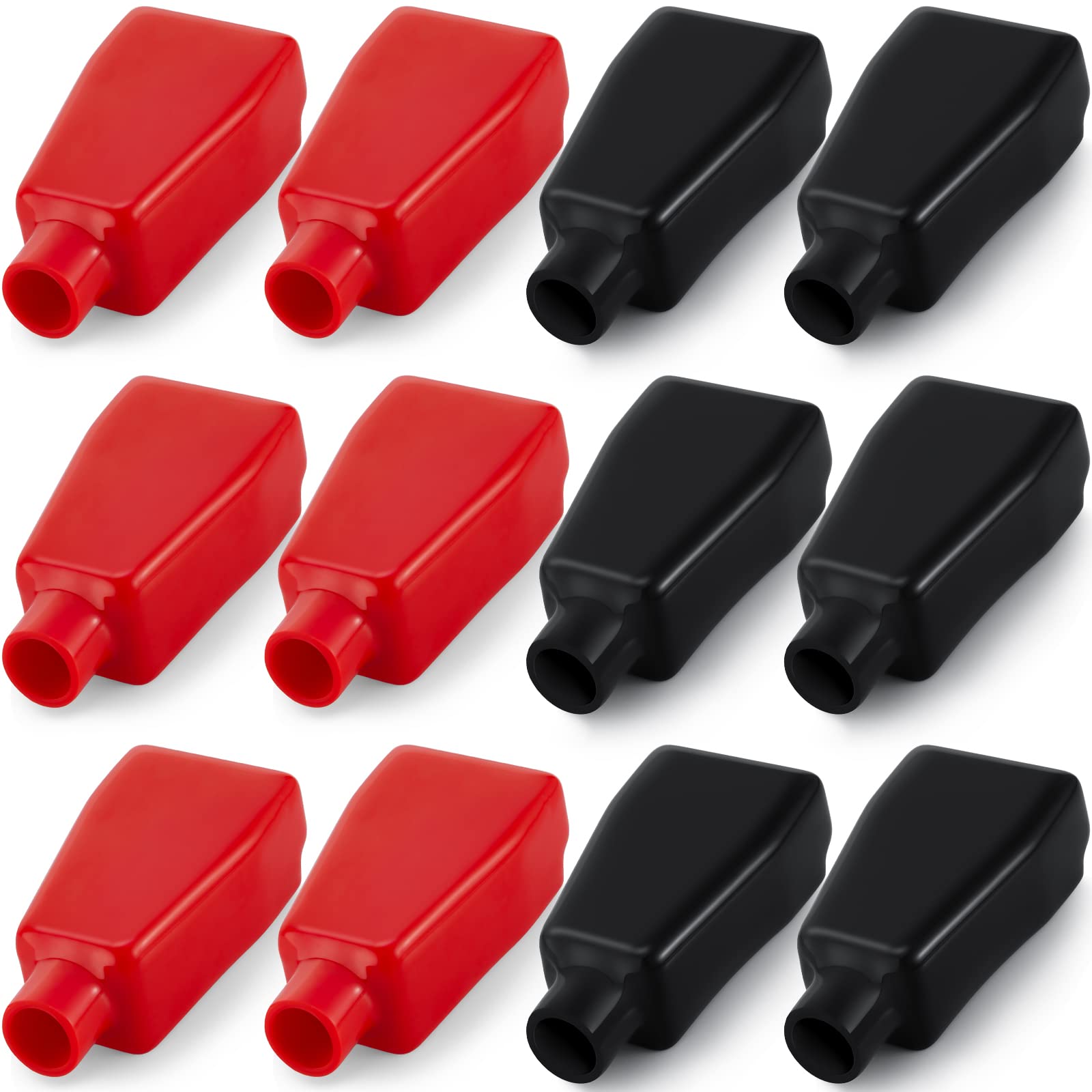
1. 12 Pieces Battery Terminal Covers
Our pick — 4.5+★ from 550+ verified ratings; the strongest balance of quality and price.
Twelve boots in one bag, so every battery in the garage gets covered the same afternoon.
If you have a driveway with two cars, a mower, and a boat trailer, buying covers one pair at a time gets old fast. This pack hands you 12 pieces in total — 6 black covers and 6 red covers — which is enough to dress six batteries with color coding on both posts. The PVC plastic (a firm, non-conductive type of plastic) holds its shape and insulates, so the live terminal cannot touch a dropped wrench. At 4.5+ stars across 500+ ratings, it earns its keep by covering the terminal and the lug, not just the post.
Coverage is what wins people over. Buyers report these sleeves slide over 2 AWG cable with compression lugs and enclose the terminal and the lug together, which is exactly the spot where a stray tool does damage. Beyond batteries, the same boot works on communication equipment, household appliances, and motorcycle wiring, so the extras in the bag do not go to waste. The red and black pairing is also a quiet safety win — you can see polarity without tracing a wire.
The honest catch is sizing. These are roomy, and a few buyers found them far bigger than expected on a small post — one called the design “strange” before deciding they did the job fine. Frienda also warns that a small number of cars cannot fit them, so measure your terminal before you commit. Expect a range of fit rather than a custom mold, and measure your post before ordering.
What earns its keep
- 12 covers total — 6 black and 6 red — so a whole fleet of batteries gets protected in one buy
- PVC insulation guards against accidental shorting and terminal corrosion
- Fits 2 AWG cable with compression lugs and covers the lug, not just the post
- Color coding makes positive and negative obvious at a glance
Where it can trip you up
- Runs large — smaller terminals can swim inside the boot
- A small share of vehicles reportedly cannot fit them at all, so check your post first
Reach for this if: you have several batteries to cover and want one bag to do all of them with polarity colors built in.
Measure first if: your battery posts are on the small side, since these sleeves are sized generously.
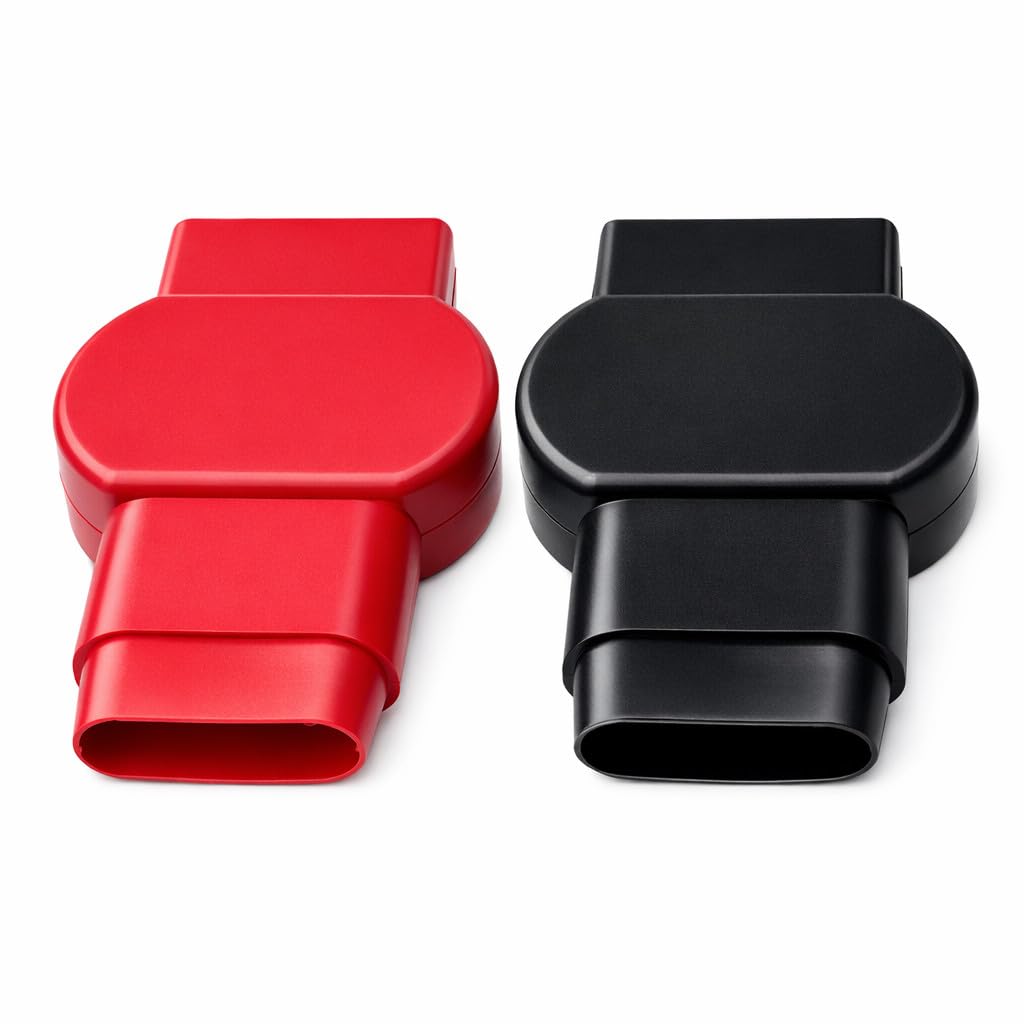
2. MGI SpeedWare Battery Terminal Covers (4/0 AWG)
Built for the fat cable on a lithium bank, not the skinny wire on a lawn tractor.
Solar and overland builds run cable thick enough that ordinary boots will not stretch over it. This pair is rated for cable up to 4/0 AWG — the heaviest gauge most home installs use — and it is cut low-profile at 1 inch in height so it does not foul a battery box lid. Owners running 200 amp lithium batteries with 4/0 cable report both cables fit into the opening, with the covers flexing flat against the terminal. That flex is the whole point: the boot bends where the cable bends instead of fighting it.
These only make sense on military-spec terminals, the flat clamp style with a bolt through the top. If you have a standard round post, look at the 12-piece set above instead. The trade-off is honest and physical — at 2.82 ounces for the pair, these are thin, and the material has a little give to it. One buyer wished they were 2 to 3 millimeters thicker, then added that the covers still feel like a real improvement when working around live terminals. Thick cable is what they are shaped for, so they sit roomy on small wire.
Made in the USA and sold as one red and one black boot, with terminals not included. At 4.0+ stars they are a specialist pick rather than a universal one, and that is fine — for a 4/0 run they are the right shape and the right size.
Why the size is right: a 4/0 AWG opening is the spec that matters on a big lithium or inverter bank, and this cover is built around it instead of being stretched to reach it.
The honest limit: thin walls and a military-spec-only fit mean a round-post owner gets no benefit at all from this pair.
Right call for: anyone cabling a lithium or solar bank with 4/0 wire who wants a low, flat boot that clears the lid.
Wrong shape for: standard round battery posts, since these are cut for the flat military clamp.
3. Fastronix Military Spec Battery Terminal Covers

One boot, several lugs — the fix for a terminal buried under a stack of ring connectors.
Picture a boat or a 4×4 where four separate wires all land on the same post. A small cover will not swallow that bundle. This Fastronix pair opens wide at a 2.6″ x 2.3″ terminal opening, and the soft silicone stretches to take multiple lugs at once. Owners regularly fit three 4 AWG cables plus one 2 AWG cable inside a single cover. It also pulls back easily for terminal access after installation, so you can check a connection without cutting the boot off.
That gives you a direct contrast with the MGI pair above: where the MGI is built to accept one enormous 4/0 cable, this cover is built to accept a crowd of smaller ones. Fit is the thing everyone raves about, and the silicone is the reason — it gives where a stiffer plastic would split. At 2.39 ounces for the pair it is light in the hand, and at 10.08 x 4.45 x 1.06 inches for the package it ships flat and stores in a toolbox drawer.
The trade-off is that same width. On a small quick-release terminal, owners mention the fit is snug but tight when you push cables through and connect up, and one called the cover “too big for my use.” The 12-volt rating (a standard voltage for car wiring) is normal for automotive work, so that is not a limit. Treat the wide opening as a plus for stacked lugs and a hassle for a single thin wire.
Why owners keep buying it
- Wide 2.6″ x 2.3″ terminal opening takes multiple cables at once
- Soft silicone stretches instead of splitting and pulls back for access
- Sold as one red and one black cover for polarity clarity
- Fits military-spec clamps without removing them from the wire
Before you order
- Oversized for a single thin cable or a compact terminal
- Pushing several lugs through the opening takes some patience
Best used when: your terminal carries two or more ring connectors and you want all of them insulated under one boot.
Think twice if: you are covering one small wire, because the wide opening will hang loose.
4. Fastronix Marine Battery Terminal Cover Set

The stud-and-nut boot for trolling motors, campervans, and anything that lives near water.
Marine terminals use a 3/8 stud with a nut clamping the cable ring down, and that nut is a bare live point. This cover set slides over the whole stud assembly and shields it. Owners fit it to trolling motor batteries, campervan batteries, and RV starter connections, and it puts a flexible plastic layer between the terminal and anything that brushes past. Made in the USA. The material is plastic and the connector type is stud, so it is designed for that specific fitting rather than a universal post.
What people notice is how much easier it makes working around a live battery. One review put it plainly: the cover “eliminates almost all chances of accidental shorting.” Another liked that it stays flexible enough to install and remove in tight spaces, which matters in a crowded battery box. Where the Fastronix military-spec cover above is built for stacked lugs on a clamp, this one is aimed squarely at a single stud and nut, and it does that one job cleanly.
The finite gripe is size. One buyer thought it was way too big compared with the listing photo and felt it should have been about half the size. That is a fair caution if your stud is small, so check your terminal. For a marine or RV stud, the extra room is room to work.
What it does well: shields a 3/8 stud and its nut so a wrench cannot arc across them, and stays flexible in tight boxes.
The one caution: it runs large, so a compact stud may swim inside it — measure before ordering.
Go here for: marine stud terminals on boats, RVs, and campervan builds where a nut is sitting exposed.
Skip the guesswork: confirm your stud is 3/8 before you buy, because this set is cut for that fitting.
5. RVBOATPAT 12 Pack Silicone Battery Terminal Cover
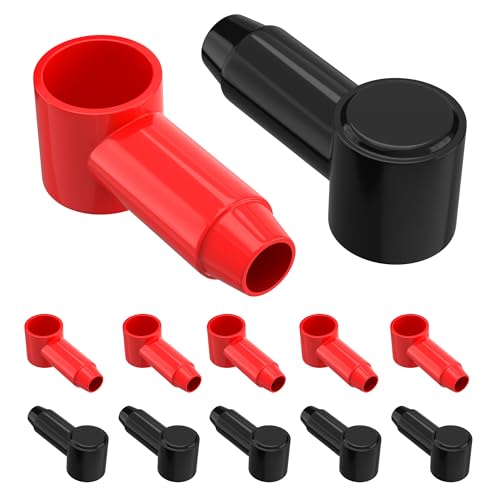
A dozen thick silicone boots that trim to fit and shrug off a hot, heavy cable.
Where rubber covers tend to stiffen and crack, these boots are made of silicone — a rubber-like material that stays stretchy and returns to shape after it is pulled. The maker rates them for voltages up to 2000V and for wire from 1/0 AWG to 4/0 AWG, so they cover the nuts on a terminal, not just the post. A full 12 pieces come in the bag, which suits a solar junction block or a bank of batteries where you want every live stud dressed the same.
The silicone is not just a material choice — it changes how you install them. Because the boots are thick and can be trimmed with scissors, owners notch them to overlap a circuit breaker body on a LiFePo4 feed stud, then seat them flat. One buyer even cautions that “too-large” complaints usually come from a misunderstanding of AWG, since a smaller number means a bigger cable. That is a useful reminder when you are matching a boot to a 1/0 or 4/0 run.
The size is the honest caveat. Over 1/0 AWG these sit snug enough not to slide but loose enough to reposition, and they can be zip-tied for extra hold. Over 4/0 they get tight. If your wire is thin, expect a roomy fit; if you want a trim, exact look, these are designed to be trimmed.
The silicone advantage
- Thick silicone stays elastic and returns to shape after stretching
- Rated to 2000V and sized for 1/0 to 4/0 AWG wire
- Covers the terminal nuts for fuller protection
- Can be trimmed and notched with scissors for a custom seat
- 12 pieces in the bag for a whole bank or junction block
Fit to expect
- Roomy on thin 1/0 wire and tight over 4/0
- Not a tailored look — they are made to be cut and fit by hand
Pick this when: you are cabling a solar or lithium setup with 1/0 to 4/0 wire and want boots you can trim to a neat seat.
Consider the alternative if: you want a snug out-of-bag fit on small cable, since these are generous by design.
Know the Specs
AWG and cable size
AWG (American Wire Gauge) is the standard for wire thickness, and it runs backward: a smaller number means a thicker cable. So 4/0 AWG is far heavier than 4 AWG, and 1/0 AWG sits in between. A cover rated 1/0 to 4/0 AWG is built for heavy power cable and will feel loose on thin wire. Match the boot opening to your cable, then confirm the terminal shape.
Insulation material: PVC vs silicone
PVC plastic is firm and holds its shape, which makes it a tidy cover for a standard post. Silicone is softer and stretches and returns to shape, so it fits over stacked lugs and multiple cables without splitting. For a hot, heavy cable or a bundle of connectors, silicone tolerates the strain better. Both do the core job: keep live metal away from anything conductive.
Common Questions
Will a battery cable cover fit my standard car battery post?
What does 4/0 AWG mean and is it bigger than 4 AWG?
Can these covers prevent accidental shorting?
Should I pick silicone or PVC for a battery cable cover?
Do these covers work on a marine or RV battery?
Will multiple wires fit under one cover?
Can I trim a silicone battery boot to fit?
Do I need covers on both the positive and negative terminals?
How tight should a battery terminal cover fit?
Are these covers reusable if I swap a battery?
The Bottom Line
For a typical garage, the 12 Pieces Battery Terminal Covers make the most sense, because one bag of red and black boots protects six batteries and covers the lug as well as the post. Running heavy 4/0 cable (very thick wire) on a lithium or solar bank? The MGI SpeedWare Military Spec Covers have a 4/0-rated opening built for that. For a single terminal buried under several lugs, reach for the Fastronix Military Spec Covers and their wide 2.6″ x 2.3″ opening. Match the opening to your terminal and your cable, and match the opening to your terminal and cable, and a few dollars of rubber buys real confidence.
How we choose
We do not accept paid placement. Every pick is matched to a real buyer and a real use-case; we do not hands-on test units.
Sources
Specifications: manufacturer listings and product documentation. Review insights: verified customer reviews, as of October 2026. Pricing: not shown on this page (it changes often); check the current price via the retailer link.
As an Amazon Associate, Aappliancez earns from qualifying purchases. This does not affect which products we feature.