Disclosure: Some links in this post are affiliate links. As an Amazon Associate I earn from qualifying purchases, at no extra cost to you. Learn more
Specs are compiled from manufacturer listings and verified buyer reviews and can change over time — please confirm the key details on the product page before buying.
If your room sounds hollow — a TV that echoes off the back wall, a home office where every call bounces — the fix is a slatted panel with real depth behind it, not a thin sticker. The short answer: buy the thickest felt-backed slat panel your wall and budget allow, because the felt layer is what actually swallows sound, and the wood slats are what make it look deliberate. Everything below is sorted by that logic.
This guide is built by comparing the manufacturers’ published specifications and the patterns across verified customer reviews, so you get each pick’s real strengths and trade-offs instead of marketing spin.
You will see coverage per box, panel thickness, and whether the backing is felt or bare veneer — the three things that decide whether a wall looks custom or looks like a mistake. Below is a straight read on the acoustic wood wall panels worth your wall space.
Top Picks

How To Choose The Best Acoustic Wood Wall Panels
Most people buy these for one of two reasons: the room looks flat and boring, or the room sounds like a gymnasium. The best panels do both: the wood slats supply the visual rhythm, and the felt layer behind them absorbs the echo. Choose the slat finish you want first, then confirm the felt backing is at least 0.7 inches thick before you call it acoustic.
Thickness and backing decide the sound result
On a fluted panel, the felt layer behind the slats does the sound work — the slats only add depth. The Art3d panels run 0.83 inches thick, and the TONOR self-adhesive set runs 0.72 inches — both carry enough felt to do real work on echo. A thin wood-look sheet with a paper-thin backing mostly changes how the wall looks, not how it sounds.
Do the coverage math before you order
Coverage is quoted in square feet per box, and the number varies a lot between brands. The NeatiEase four-pack covers about 33 sq.ft., the Art3d four-pack covers about 21 sq.ft., and the TONOR 47.2 x 23.6 four-pack reaches 31 sq.ft. Measure your wall in feet, multiply width by height, then divide by the per-box figure and round up. Buy one box extra if you plan diagonal cuts or outlet cutouts.
Real slats versus wood-look veneer
Some listings sell individual fluted slats on a felt base; others sell a flat sheet with a wood-grain veneer printed or bonded onto polyester fiber. The flat sheet is more bendable and easier to cut, but it will not give you the shadow lines and depth of separate slats. Decide between fluted slats and a flat veneer sheet before you compare coverage or price.
How you plan to mount it
Adhesive tape suits rentals and painted drywall. Screws or nails suit permanent accent walls and heavier panels. Several picks here ship with screws included, and one is fully self-adhesive with a peel-and-stick back. Choose the mount by wall type: screws or nails for textured block and fresh paint, tape only on smooth, cured drywall.
Side-by-Side Comparison
| Model | Best For | Coverage | Thickness | Panel Size | Amazon |
|---|---|---|---|---|---|
| Art3d 4-Pack Walnut Slat Panels★ Best Overall | Balanced acoustic and visual upgrade | ~21 sq.ft. | 0.83 in | 94.5″L x 7.9″W | Amazon |
| TONOR 4-Pack Wood Wall PanelsBest Coverage | Wide coverage on a tight budget | ~31 sq.ft. | 0.4 in | 47.2″L x 23.6″W | Amazon |
| TONOR Oak 4-Pack Panels | Warmer oak tone walls | 31 sq.ft. | 0.4 in | 47.2″L x 23.6″W | Amazon |
| 6 Pack Wood-Look Sound Panels | Big box count for large walls | — | — | 47.2″ x 23.6″ | Amazon |
| TONOR Dual-Layer Self-Adhesive 4-Pack | Rentals and tool-free installs | ~1107.92 sq.in. per panel | 0.72 in | 47.2″L x 23.6″W | Amazon |
| NeatiEase 96″ Teak Slat Panels | Floor-to-ceiling accent walls | ~33 sq.ft. | — | 96″ x 12.6″ | Amazon |
| Avana Dark Walnut 4-Pack | Premium heavy-panel builds | 33.04 sq.ft. | — | 93.2″ x 11.25″ | Amazon |
Detailed Reviews
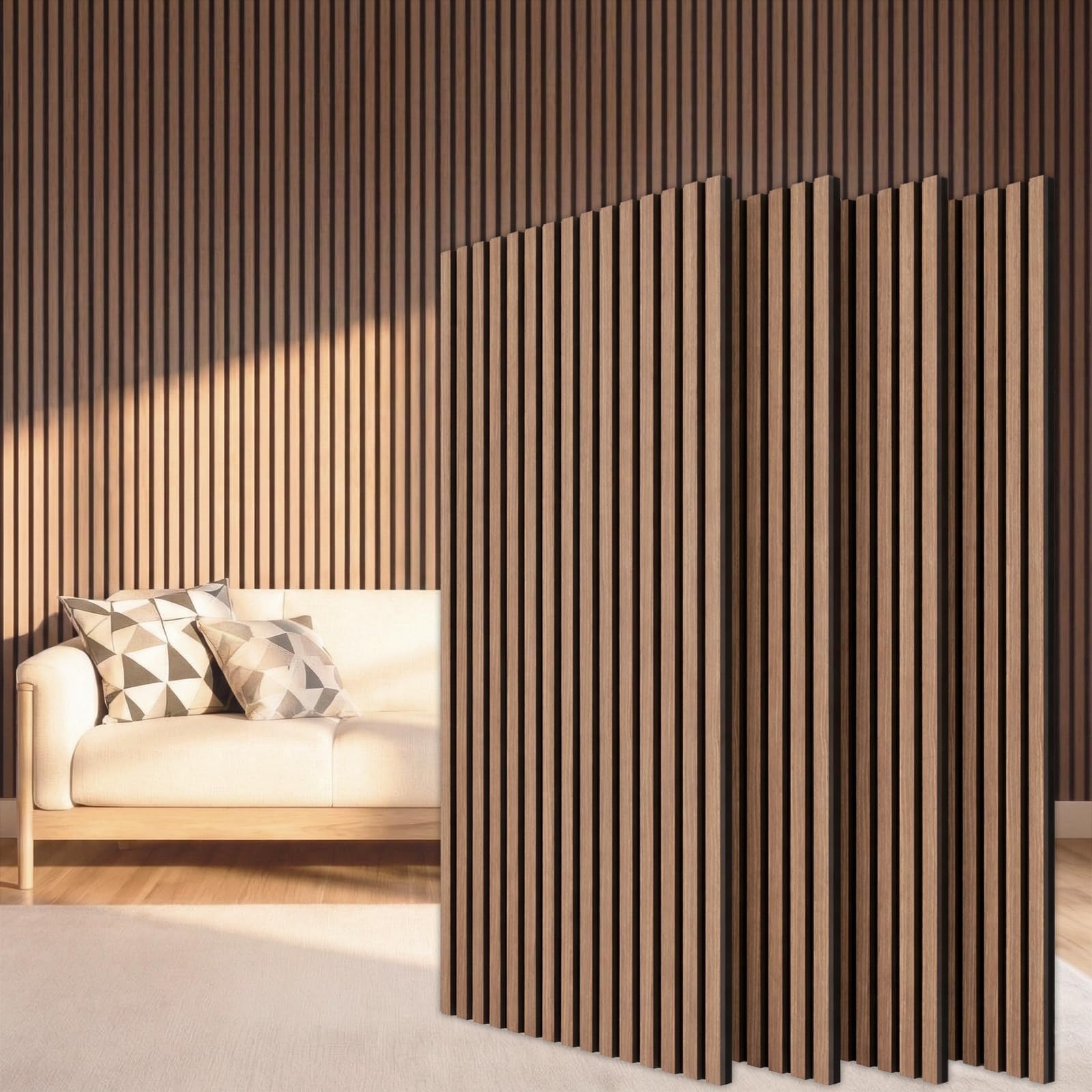
1. Art3d 4-Pack Wood Slat Wall Panels
Our pick — 4.5+★ from 850+ verified ratings; the strongest balance of quality and price.
Four tall walnut slats with real felt depth — the pick that sounds as good as it looks.
The Art3d four-pack gives you individual fluted slats at 94.5 inches long and 7.9 inches wide, with 0.83 inches of thickness behind each face. That thickness is the whole story: it is a genuine absorbent layer under real wood grain, so it dampens echo while it decorates. Together the four panels cover about 21 sq.ft.
Compare it with the TONOR 47.2 x 23.6 four-pack and the trade-offs are clear. The TONOR panels are 23.6 inches wide to Art3d’s 7.9 inches, so the TONOR covers more wall with fewer boards. But the Art3d is more than twice as thick — 0.83 in against 0.4 in — and twice as long at 94.5 inches versus 47.2 inches. If you want the slat look with full-height lines, this is the one.
What wins people over is the finish and the build together: buyers report “1 box of 6 panels covers approx 4 feet across,” which is the practical way to plan your run. The recurring gripe is the cut edge — once trimmed, the edges turn sharp, so sand them before you mount. One more thing to know: value for money gets a mixed read because 21 sq.ft. per four-pack is a modest footprint. Measure twice before ordering.
What Earns Its Place On The Wall
- 0.83 inches of thickness — the deepest felt backing in this lineup.
- 94.5-inch slats run from floor to ceiling with no horizontal seam.
- Walnut wood grain finish reads natural and warm, not printed.
- MDF and high-density polyester fiber core, low TVOC levels stated.
Where You Should Slow Down
- Only about 21 sq.ft. per box, so a full accent wall needs several packs.
- Trimmed edges arrive sharp — sand them before install.
- Thin 7.9-inch slats mean more boards to line up than a wide panel.
Go with this if: you want a floor-to-ceiling slat wall that actually quiets the room, and you don’t mind installing narrow boards.
Hold off if: you need one box to cover a big wall — 21 sq.ft. goes fast.
2. TONOR Wood Wall Panels 4 Pack 47.2″ x 23.6″
Wide boards, thirty-one square feet, and screws in the box — coverage without the guessing.
This is the panel you buy when the wall is large and the patience is short. Four boards at 47.2 by 23.6 inches add up to 31 sq.ft. of coverage — ten more square feet than the Art3d four-pack — and the set ships with 35 screws for a two-panel build. The core is high-density polyester fiber under MDF with a solid wood veneer on top, which is what gives it the warmth and the sound damping.
Walnut is the color here; the same family comes in oak in the next entry. Thin at 0.4 inches, so treat this as a look-and-soften layer first and a heavy sound barrier second. Because it is wide, you can cover a doorway-width wall with fewer seams — a real advantage if you are chasing straight vertical lines. Owners mention the install is “Easy 10-min drill install or tape-mount; lightweight, beautiful wood finish, sturdy black backing.”
The honest catch: the color runs lighter than the listing photos for some, and a handful of units carry a wood scent from the start that fades with airing. Neither one blocks installation. For a rental where you cannot drill, the panels can hang on tape; for a permanent wall, use the included screws.
The coverage argument: 31 sq.ft. from one box is the practical headline — it beats the Art3d four-pack’s 21 sq.ft. and it gets you a finished wall with fewer boxes on the floor.
The caution: at 0.4 inches it leans decorative — great for echo, not a substitute for a dedicated acoustic wall.
Reach for this if: your wall is wide and you want the biggest footprint per box with hardware included.
Look elsewhere if: you want deep slats with heavy acoustic backing — this one is the thin end of the lineup.
3. TONOR Wood Wall Panels 4 Pack 47.2″ x 23.6″ (Oak)
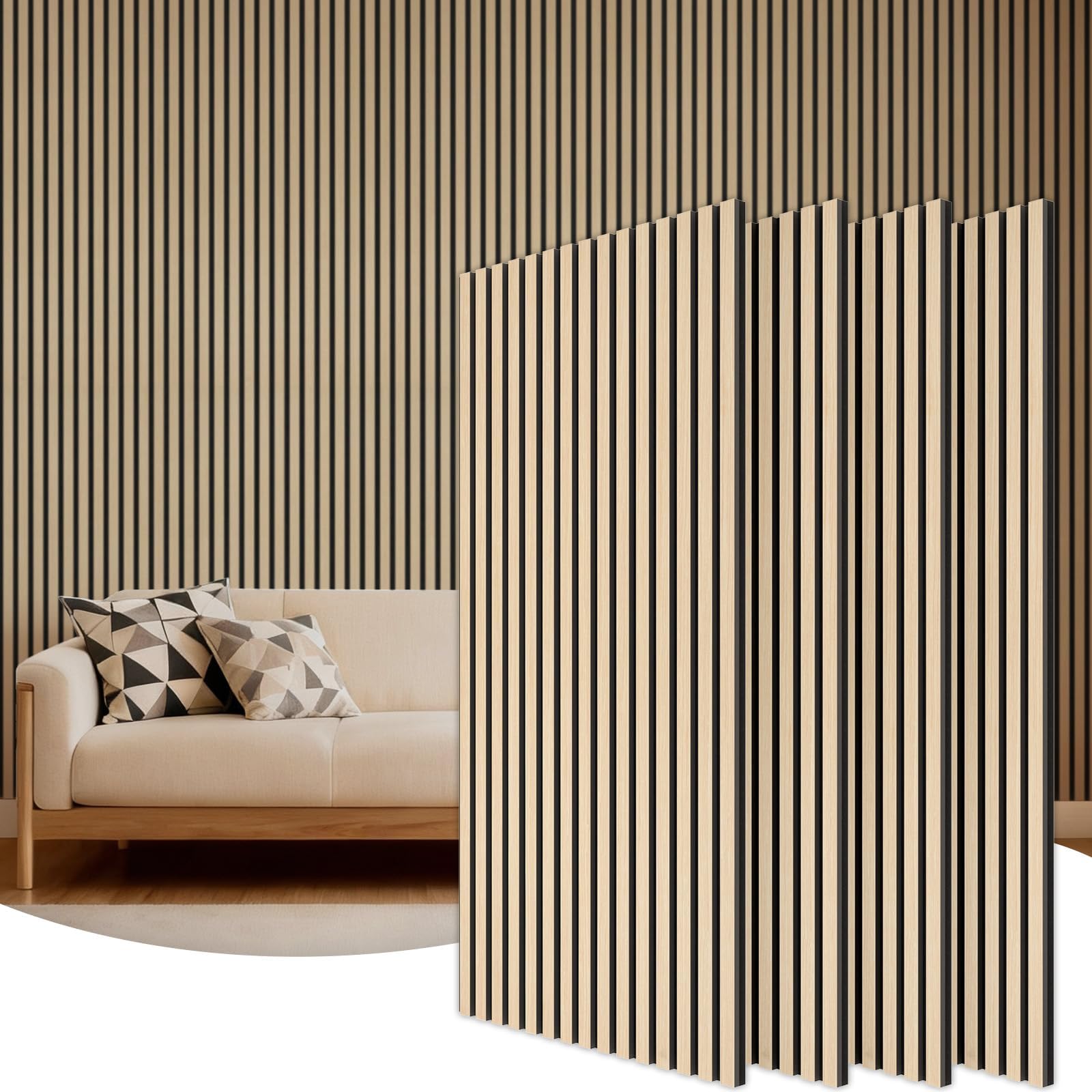
Same board, brighter finish — oak for rooms where walnut feels too dark.
If the walnut version above matches your floor but not your light, this is the identical 47.2 by 23.6 inch four-pack in oak. Coverage stays at 31 sq.ft., the core is the same MDF and polyester fiber build, and the set includes 70 screws for a four-panel install. Nothing about the acoustic behavior changes — you swap tone, not performance.
Oak is a chameleon finish and it is the one buyers tinker with. Some find the tone paler in person than the product photos suggest and stain the boards darker before hanging, which is worth knowing if you have a specific wood tone in mind. Customers note it plainly: the oak “was extremely light for what I thought it was going to be in comparison to the pictures so I stained them darker.”
The installation story matches its sibling — mark the line, tape it, cut along the tape for clean edges. First-time cutters using a drill-mounted blade end up with slightly wavy ends, so a proper saw pays for itself. For a wall that needs to feel light and airy rather than moody, this is the cleaner choice of the two TONOR boards.
Where it fits: oak suits south-facing rooms, pale furniture, and kids’ bedrooms where a dark slat wall would swallow the light.
The reality check: that same light oak is the part most likely to surprise you on arrival — plan on a stain if you want it richer.
This one wins if: the room already has dark wood and you want contrast instead of more of it.
Different pick if: you want a finish that needs zero work before it hangs.
4. 6 Pack Acoustic Panels 47.2″ x 23.6″ Walnut
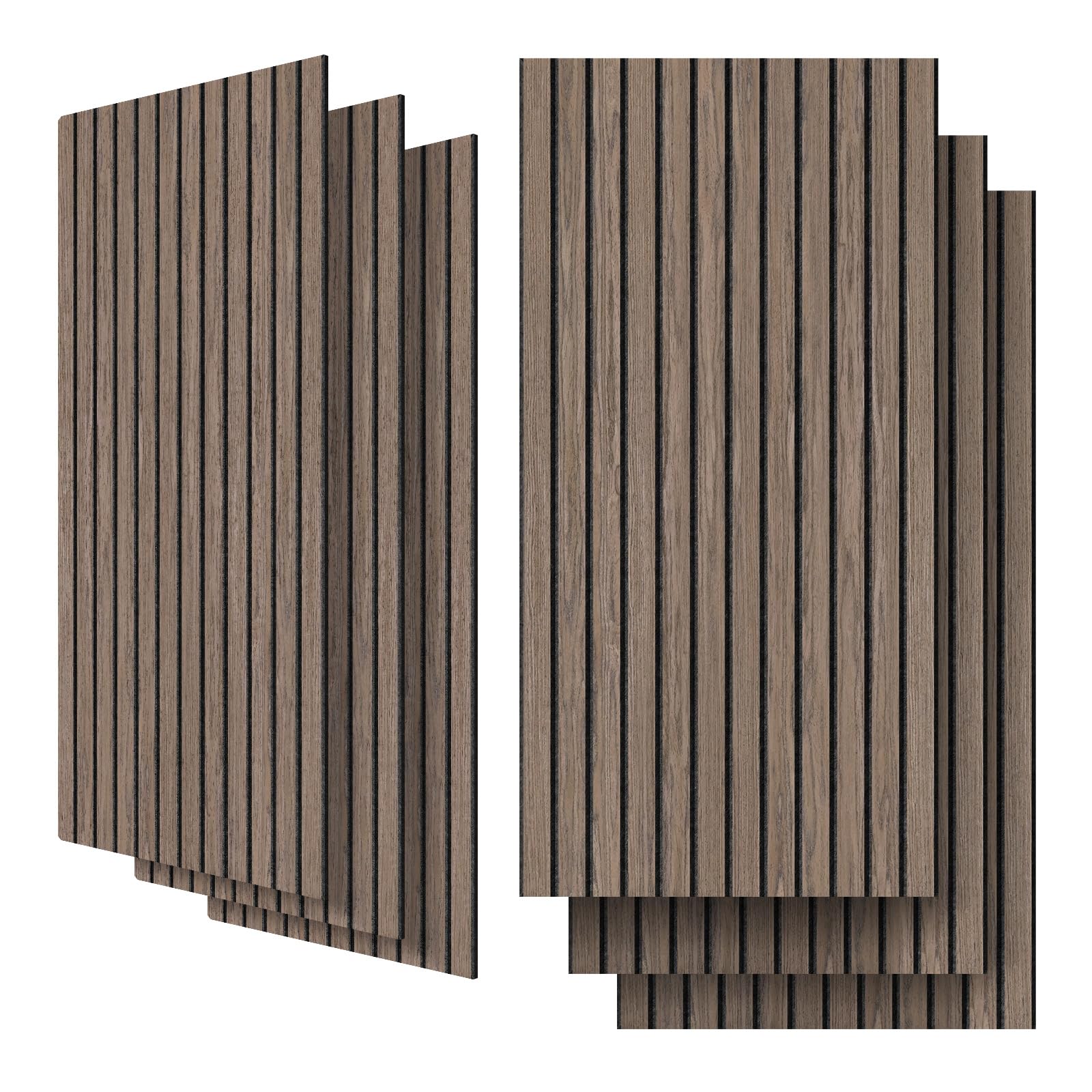
Six wide panels of bendable wood-look fiber — the fastest route to a full wall.
Six boards at 47.2 by 23.6 inches makes this the biggest single box in the group. Read the listing carefully though: this is a wood-looking veneer bonded to 100% polyester fiber, not separate wood slats. That construction is why it bends around corners and cuts with a utility knife. For a curved wall or an awkward alcove, that flexibility is a genuine problem-solver.
Sound-wise, it does what a fiber panel does — soaks up echo. The consensus is that it clears reverberation in small rooms well and takes the edge off larger spaces. Do not expect a soundproof wall; expect a room that stops ringing. Reviewers point out one church install where the panels “removed the echo,” which is exactly the job this material is built for.
The part that trips people is the finish. The veneer reads as a flat wood-look sheet rather than fluted slats, and that gap between expectation and reality is the main complaint. There is also felt dust and splinters kicking off the edges when you cut — take it outside and keep the vacuum handy. One thing in its favor: the surface wipes clean, which matters in a house with small hands.
Best use case: a large wall or a room with an awkward curve, where six bendable boards beat three stiff ones.
The honest limit: it is decor with acoustic benefits, not a slat wall — shoppers say wanting “actual wood slats” and getting veneer.
Buy it if: you want maximum boards per box and a surface you can shape around corners.
Skip the box if: fluted slat shadow lines are the whole reason you are shopping.
5. TONOR Dual-Layer Thickened Acoustic Wood Wall Panels

Peel the backing, press, done — no drill, no screws, no landlord conversation.
Two-layer polyester fiber, 0.72 inches thick, with a strong adhesive already on the back. That is the entire pitch, and for a rented flat it is a compelling one: no hardware, no wall damage to patch later. At 47.2 by 23.6 inches per panel, each board covers roughly 1107.92 square inches. The stripe pattern keeps the slat look, and the fiber core carries no wood veneer to splinter.
Here is where it earns scrutiny rather than cheers. The adhesive is the technical weak point of any peel-and-stick panel, and the friction shows up in the long run. One blunt report described a panel lifting off the wall after four weeks. Meanwhile, textured or freshly painted surfaces are the recurring weak spot — drywall screws or picture-hanging nails into the felt are the workaround. On a smooth, properly prepared wall, the stick holds. On a bumpy one, plan on the backup.
What earns its place is the look and the ease. The appearance wins the most praise here, with the adhesive close behind — people genuinely like how it photographs. If you want a slat wall in a weekend without touching a drill, this is the pick. Just budget for a plan B on the mounting.
The install story: zero tools, zero screws — peel the film and press, and you can pull the room together in an afternoon.
Where it needs backup: the adhesive is the variable — textured and painted walls need screws or nails as insurance.
Made for you if: you rent, you cannot drill, and you want the look this month.
Not your pick if: your wall is textured or freshly painted and you want a mount you never think about again.
6. NeatiEase Wood Panels 4-Piece 96″ x 12.6″

Ninety-six inches of teak slat — one long board, no seam halfway up your wall.
Most panels here stop around four feet, so you splice them and live with a horizontal join. This set runs 96 inches long and 12.6 inches wide, four to a box, covering about 33 sq.ft. Run it vertically and you get a single unbroken line from floor to ceiling. Run it horizontally and you get long bands of grain. It mounts with screws or superglue on walls or ceilings, and the core is MDF with high-density polyester fiber at low TVOC levels.
The teak finish is richer than a standard walnut — a cherry-leaning red-orange that reads warm in daylight. Buyers report it “looks pricier than cost,” and that tracks. The felt backing is thick and firm, and the veneer cuts without chipping if you keep the blade away from the staple rows. Cutting is dusty work, so take it outdoors.
Two practical snags to plan for. The smell is the one that lingers — a strong scent that fades over roughly a month, which matters in a bedroom. And mounting over outlets means box extenders. Neither is a reason to walk away; both are reasons to unpack it early and air the room.
Why the length matters: at 96 inches you skip the seam that every 47-inch board forces on you — the wall reads as one massive panel instead of a stack.
The smell note: set it out to air before hanging it in a sleeping space; the scent fades but it is there at first.
Choose it if: your ceiling height calls for a single continuous slat and you want the richest wood tone in this group.
Think again if: you are paneling a nursery or bedroom and cannot air the boards out first.
7. Avana Acoustic Wood Wall Panels 93.2 x 11.25 Inch
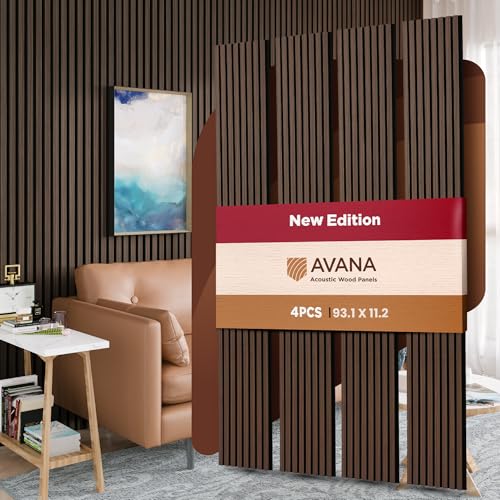
A dense, dark-walnut panel built for walls you want to keep for years.
Four boards at 93.2 by 11.25 inches, 33.04 square feet of coverage, built from MDF and polyester fiber with a technical wood veneer on the face. This is the heaviest build in the lineup — and that weight is the point. Owners mention it is “too heavy to double tape,” which is the honest warning here: this one wants screws, staples, or wall glue, and it will not cooperate with mounting tape.
What that density buys you is real echo control. The consensus from owners is strong — the panels noticeably quiet a room and look more expensive than they are. The dark walnut tone hides neutral wall clutter and gives a living room a finished feel it did not have before. If your goal is a permanent, architectural accent wall, weight is a feature, not a bug.
Two things to plan around. Dark walnut panels can arrive with a slight color variance between boards — one off-tone piece in a run is a real risk, so open every box and lay out the panels before you commit to placement. And the box itself is heavy enough that you should have a second person for the unload. Get past those and the wall holds beautifully.
The weight advantage: dense backing and a screwed-in mount mean no sagging and steady echo absorption — the wall looks the same three months in.
The color caveat: inspect the boards side by side on the floor first; a mismatched panel is much easier to hide before it is on the wall.
This suits you if: you are doing a permanent accent wall and want the densest panel and the darkest finish here.
Different path if: you need a tape-mount install or you want every board from every box to match exactly.
Know the Specs
Coverage Per Box
The number of square feet one box actually panels. Coverage varies widely — 21 sq.ft. for the Art3d four-pack versus 33 sq.ft. for the NeatiEase set — so always divide your wall square footage by the per-box figure. Buy a spare box for diagonal cuts, outlet cutouts, and mistakes; the same board is much easier to add before it is discontinued than after your wall is half done.
Panel Thickness
How deep the felt or fiber layer sits behind the face. Thicker panels — 0.83 inches for Art3d, 0.72 inches for the TONOR self-adhesive set — absorb more echo than a thin 0.4-inch board. A thicker panel also sits proud of the wall, so measure your door swings and outlet clearance before you commit to full-height coverage.
Slat Width And Length
Narrow slats (7.9 inches wide) give a fine, dense vertical rhythm; wide slats (23.6 inches) cover more wall with fewer pieces. Length matters most for ceilings and full-height walls — a 96-inch board avoids a mid-wall seam, while a 47.2-inch board needs a splice unless you are paneling a half-wall.
Wood Slat Versus Wood-Look Veneer
A slat panel has separate profiles that create real shadow lines and depth. A wood-look veneer is a flat face bonded to a fiber board; it bends, cuts easily, and weighs less, but it will not give you the fluted relief. Both absorb sound — pick your construction based on how much shadow and texture you want on the wall.
Common Questions
Do acoustic wood wall panels actually reduce noise?
How many boxes do I need for an accent wall?
Can these panels go on a ceiling?
Will adhesive tape hold on textured or freshly painted walls?
How do I cut panels around outlets and corners?
What is the difference between wood slats and a wood-look veneer?
Do these panels give off a smell after unboxing?
Can I mount these over brick or cinderblock?
Are the panels safe to keep in a bedroom?
The Bottom Line
The strongest all-round choice is the Art3d 4-Pack Walnut Slat Panels, because 0.83 inches of thick felt behind real walnut slats does both jobs at once: it gives the room a designed look and it takes the ring out of the walls. If you are covering a wide wall and want the biggest footprint per box, the TONOR 47.2 x 23.6 four-pack covers 31 sq.ft. with screws in the box. For a floor-to-ceiling run without a mid-wall seam, the NeatiEase 96-inch panels are the ones to reach for — and if you cannot drill at all, the peel-and-stick TONOR self-adhesive set gets you a slat wall in an afternoon. Measure the wall, divide by per-box coverage, round up, and add one spare box for cuts and outlet cutouts.
How we choose
We do not accept paid placement. Every pick is matched to a real buyer and a real use-case; we do not hands-on test units.
Sources
Specifications: manufacturer listings and product documentation. Review insights: verified customer reviews, as of October 2026. Pricing: not shown on this page (it changes often); check the current price via the retailer link.
As an Amazon Associate, Aappliancez earns from qualifying purchases. This does not affect which products we feature.