Disclosure: Some links in this post are affiliate links. As an Amazon Associate I earn from qualifying purchases, at no extra cost to you. Learn more
Specs are compiled from manufacturer listings and verified buyer reviews and can change over time — please confirm the key details on the product page before buying.
Buying a first acoustic guitar is where most people quietly give up on learning — not because they lack talent, but because the instrument fights them. A neck that is too wide makes chords ache, action set too high turns practice into finger torture, and tuning that slips every ten minutes kills the joy before it starts. You do not have to spend a fortune to avoid all three. Every pick below sits in the value and mid-range bracket, and each one solves a different version of that first-year problem.
This guide is built by comparing the manufacturers’ published specifications and the patterns across verified customer reviews, so you get each pick’s real strengths and trade-offs instead of marketing spin.
Some guitars here favor comfort, others favor a bigger voice or built-in electronics, so the right answer depends on your hands and where you plan to play. Below are the best acoustic guitars under $200 for your situation.
Top Picks


How To Choose The Best Acoustic Guitar Under $200
It only responds to how it is built, and a handful of build decisions decide whether a beginner sticks with it or leaves a dusty instrument in a closet. Focus on these four things and you will pick well.
Neck width and profile
Your fretting hand wraps around this every single day, so the neck is the first thing to judge. A wider nut — the slotted strip at the top of the neck that sets the string spacing — spreads the strings further apart, which can be hard on small hands. A “C”-shaped carve, meanwhile, fills the palm gently and cuts fatigue during long practice sessions. If you have small hands, look closely at the stated nut width before you buy.
String action and setup
If your fingertips ache after ten minutes of playing, string height is usually the culprit. That height is called the action — the distance between the strings and the fretboard. When it is set too high, every chord feels like pressing down on wire; set sensibly low, notes ring cleanly with a light touch. Many budget guitars ship with action a touch high and benefit from a quick adjustment. That is why a built-in truss rod — the metal rod running through the neck that lets you fine-tune that height — is a genuinely useful feature at this level.
Soundboard materials
The top, or soundboard, is the panel the strings vibrate against, and it does most of the tonal work. A solid spruce top moves more freely than a laminate one and tends to open up and sound fuller over time. Laminate tops are more stable in changing humidity but stay roughly the same from day one. Both are fine to learn on; just know which one you are paying for.
Body size, cutaway, and electronics
A full-size dreadnought gives you the biggest, deepest voice, while a smaller concert body is easier to wrap your arm around while seated. A cutaway — a scoop carved out where the neck meets the body — makes the highest frets reachable. And if you ever plan to plug into an amp, a PA, or a recording interface, an onboard pickup and EQ saves you from buying a separate microphone later.
Side-by-Side Comparison
| Model | Best For | Body Size | Top / Body Material | Electronics | Amazon |
|---|---|---|---|---|---|
| WINZZ AF227A★ Best Overall | First-time players who want a full kit | 39 inches (concert) | — | None | Amazon |
| Best Choice Products 41in Beginner SetBudget Champion | Budget-minded beginners wanting a full-size guitar | 41 inches (full-size) | Laminate / Popular Wood back | None | Amazon |
| Ashthorpe Dreadnought Cutaway | Plugged-in songwriting and open-mic nights | 41 inches (dreadnought, 4.5″ thick) | A-grade Spruce top / Basswood body | 4-band pickup/EQ | Amazon |
| Vangoa Sitka Spruce Top Kit | Practice sessions that run long | Full size (dreadnought cutaway) | Sitka Spruce top / Sapele back and sides | None | Amazon |
| Vangoa Acoustic Electric Bundle | Beginners who want to gig straight away | Full size (dreadnought cutaway) | Spruce top / Mahogany back and sides | 4-Band EQ with volume | Amazon |
| Rosen Solid Top G11 | Players chasing a solid-top tone | 41 inches (dreadnought cutaway) | Grade-A solid Spruce top / Sapele back and sides | None | Amazon |
| Fender California Debut Redondo CE | Learners who want a stage-ready name brand | Dreadnought cutaway | Laminate / Basswood body | Piezoelectric under-saddle pickup and built-in tuner | Amazon |
Detailed Reviews
1. WINZZ AF227A 39 Inches Concert Acoustic Guitar
The smaller concert body that small-framed beginners keep reaching for instead of fighting.
If a full-size guitar made your shoulder ache the last time you tried one, this is the pick that fixes it. That 39-inch concert body sits closer to your ribs, so your fretting hand stops reaching and your strumming arm stops craning. The payoff is a tighter, more articulate voice that suits fingerpicking and solo practice better than big strum-along chords. Owners consistently describe it as the instrument that made practice feel possible.
What you get in the box is the real argument here: a seven-piece starter set covering a one-month online lesson pass, a water-proof padded gig bag, a clip-on electronic tuner, a capo, a wall hanger, a string winder, a strap, three picks, and a cleaning cloth. That is the entire first-six-months shopping list handled in one purchase. Several players note the finish and graphics look far better in person than the listing suggests.
The honest catch is durability in transit. Every brand in this bracket has the occasional unit arrive damaged, and this one is no exception — a few buyers have reported cracks from the start, so open it the day it lands and check the body before you settle in. As buyers report, one player put it plainly: “First guitar bought Dec 2022, still playing 3.5 yrs later.” The strength here is the sound and value, not the shipping armor. The thrift-store price makes the risk easy to weigh.
What Wins People Over
- The 39-inch concert shape is far easier for a beginner to hold than a full dreadnought
- The seven-piece kit includes a tuner, capo, gig bag, and lesson access — no extra shopping needed
- Tight, focused tone that suits fingerstyle and solo playing better than brash strumming
Before You Commit
- A handful of units arrive cracked — inspect the body the day it lands
- The included gig bag is thin, so treat it as storage rather than armor
Reach for this if: you are starting from zero and want the smallest, easiest guitar to hold, plus every accessory already in the box.
Look elsewhere if: you need a full 41-inch dreadnought voice or want to plug into an amp.
2. Best Choice Products 41in Full Size Acoustic Guitar
A full-size dreadnought body a beginner can grow into rather than out of.
Most cheap starter guitars make you choose between a size you can handle and a sound you actually want. This one bets on the bigger body from the start. The 41-inch scale, natural all-wood finish, and 21-fret fingerboard give you the same playing footprint as the guitars you will see on stage, so nothing feels alien when you eventually upgrade. The natural finish with its detailed markings has a classic look that photographs well.
Build matters more than styling at this level, and quality sits clearly ahead of everything else in the feedback on this guitar. Beginners pick it specifically because it arrives ready to play with no assembly, which means you can be strumming within minutes of opening the box. The included pick, adhesive pickguard, capo, shoulder strap, replacement strings, cleaning rag, and foam-padded nylon gig bag also save you a separate accessories order.
The tuning question: keeping pitch is the split here — plenty of players say it holds tune fine, while others find it drifts and needs checking before each session.
This is the set to choose if you want the standard full-size acoustic rather than a compact one, and the low price means you are not risking much. One note on the comparison: visually it is a substantial instrument — the manufacturer lists it at 41 x 16 x 4.25 inches, so it takes up real space in a small room, unlike the compact WINZZ above.
The short version: the best full-size guitar here if you want a familiar dreadnought feel for a beginner’s budget.
Think twice if: a 41-inch body at this size feels too big for your frame.
3. Ashthorpe Full-Size Dreadnought Cutaway Acoustic-Electric Guitar

Plug-and-play acoustic that carries a small room without breaking a beginner’s budget.
Here is where this bundle pulls ahead of the plain acoustics above and below it: an onboard 4-band pickup and EQ with dedicated bass, mid-range, treble, and presence controls, so you can shape your tone for a room rather than just hoping the room cooperates. Add the guitar cable, extra set of phosphor bronze strings, shoulder strap, and soft nylon gig bag, and the whole open-mic setup arrives in one package. For a player who intends to plug in, that is the deciding feature.
The construction is more serious than the price suggests: an X-braced, A-grade spruce top for resilience and clarity, basswood for warmth, and a dreadnought body just 4.5 inches thick that produces a deep low end while holding overall balance. The cutaway at the neck lets you reach the highest frets comfortably. Owners describe it as playing above its price point, and the glossy black finish with chrome tuning pegs earns plenty of compliments.
Two things to know before you buy. First, the neck is genuinely chunky at a 44mm nut and roughly 13-inch radius, which many players find challenging if they have small hands. Second, the action often arrives on the high side, and fret ends may benefit from a light filing — both are common and fixable, but they are setup chores rather than out-of-the-box perfection, unlike the Rosen’s easier-feeling neck. Treat it as a guitar to grow with rather than a plug-in-and-perfect one.
Where It Shines
- Real 4-band EQ means you can dial in bass, midrange, treble, and presence for any room
- Solid spruce top and basswood body give a deep, well-balanced voice
- Bundle includes a second set of strings and a cable — nothing else to buy
What to Prepare For
- The 44mm nut and ~13-inch radius neck can feel bulky in smaller hands
- Action and fret ends occasionally need adjustment from the start
Best fit for you if: you want a cutaway acoustic-electric you can plug straight into an amp or PA for songwriting or small gigs.
Steer toward something else if: small hands are a priority over plugged-in versatility.
4. Vangoa 41″ Acoustic Guitar
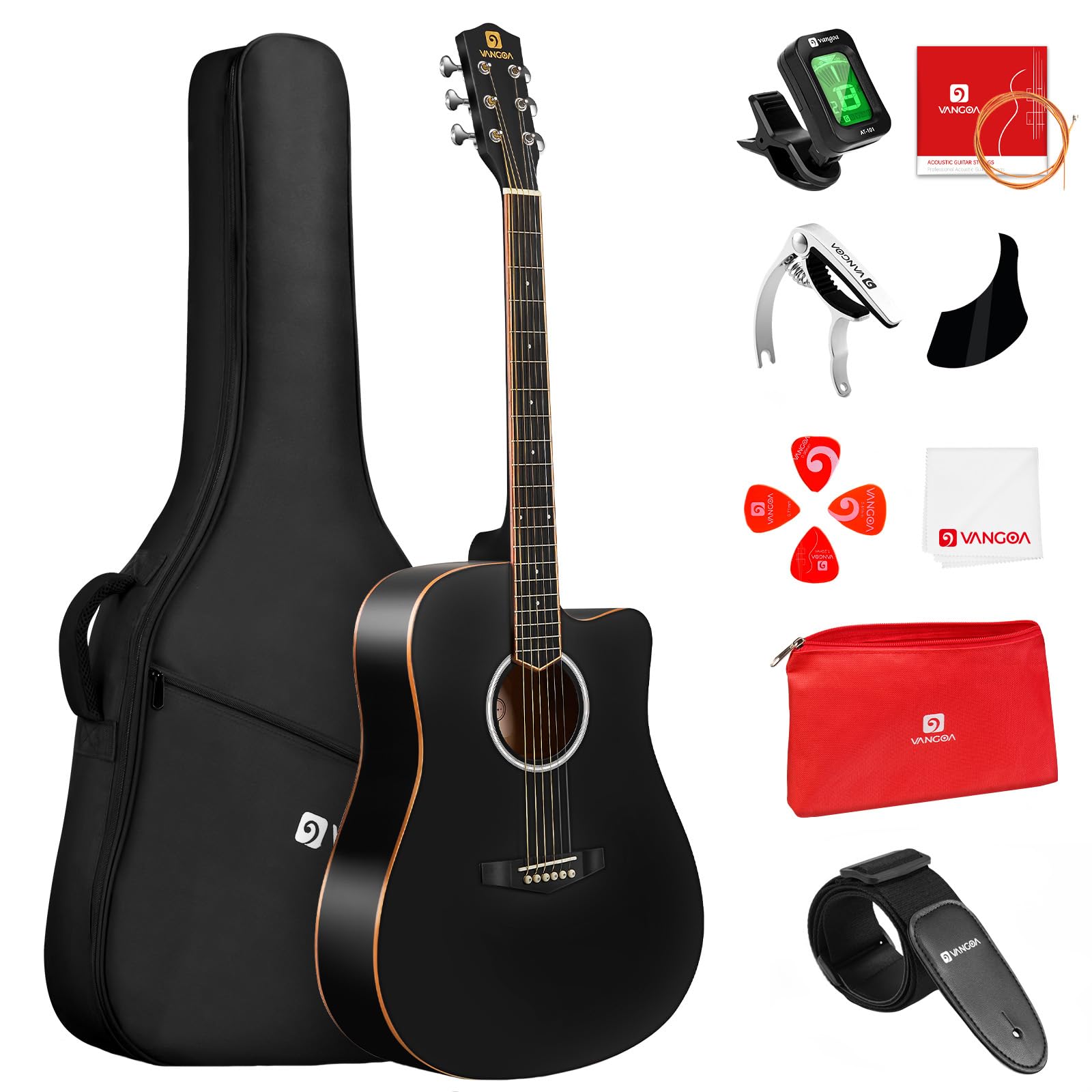
Built to keep your fretting fingers fresh through hour-long practice sessions.
Long practice sessions are where cheap guitars usually expose themselves, and this kit attacks that problem directly. The ergonomic Oval C-shaped neck fits the hand to cut fatigue, the fingerboard carries a 13.7-inch radius with polished fret ends, and the included dual-action truss rod lets you dial in a low, comfortable action for your own style. That combination is what owners notice most: it feels good after the first twenty minutes, not just the first five.
The tonal starting point is a genuine step up for the money — a Sitka spruce top paired with sapele back and sides, a bone nut and saddle for better resonance and sustain, and an ultra-thin 0.005″ polyester finish that lets the soundboard ring rather than fight the strings. A redesigned walnut bridge improves energy transfer for deeper bass, and the sealed nickel-plated tuning machines use an 18:1 gear ratio for finer, more stable tuning. High-density materials and precise mechanics, all put to work in service of holding tune.
The gig bag deserves a mention all its own — 600D Oxford waterproof fabric with 10mm shock-absorbing padding, a soft neck support, reinforced stitching, and a rubber base, so the guitar can survive being carried to lessons or jam sessions. The main trade-off is tonal rather than structural: this is a straight acoustic with no pickup, so if you plan to plug in, the Vangoa Acoustic Electric further down is the smarter pick.
Top choice for: a beginner who practices for long stretches and wants a low-action neck and solid-wood sound without electronics.
The one limitation: no pickup or preamp, so it is acoustic-only.
5. Vangoa Acoustic Electric Guitar Full Size Cutaway

An acoustic-electric that lets a first-year player walk on stage without a second guitar.
Two features separate this from the acoustic-only Vangoa above it: mahogany back and sides instead of sapele, and a built-in 4-band EQ with volume control wired to a 1/4-inch jack, so you can run straight into an amp, mixer, or PA. Owners confirm the electronics capture the guitar’s natural voice faithfully whether playing live or tracking. That is the whole point of an acoustic-electric — the tone you hear at home is the tone the audience gets.
Comfort gets equal attention. The type C profile neck and smooth fret ends let you move up and down the board without catching on anything, and the low string action reduces finger pressure, which matters most for a beginner still building calluses. The 18:1 sealed tuners offer more precise, stable tuning than standard 15:1 gears and resist dust. The dreadnought body with enhanced X-bracing keeps the sound full and minimizes loss.
The recurring honest note is durability — an occasional unit arrives with a blemish or a cracked body, so check it over on arrival. As one buyer sums it up, this guitar “sounds great after tuning up,” and the electronics are the upgrade you will reach for again. The matte black finish also shows scratches more easily than a gloss one, which is worth knowing if you are hard on your gear.
What owners rave about: rich, balanced tone from the spruce-and-mahogany build, described as bright and resonant both plugged in and unplugged.
The trade-off: a few units arrive with cosmetic or structural blemishes, and the matte finish marks up faster than gloss.
Your move if: you want an acoustic-electric with stage-ready electronics and a comfortably low action, all in a single starter bundle.
Consider the plain Vangoa above instead if: you never intend to plug in and prefer the sapele build.
6. Rosen Solid Top Dreadnought Acoustic Guitar 41 Inches

A genuine solid spruce soundboard for players who care about how tone develops over years.
A solid top is the upgrade serious players chase, and this is the one guitar here that leads with it. A Grade-A solid spruce top with sapele back and sides, a handcrafted body, and a reinforced X-bracing structure give the soundboard room to vibrate, which yields a crisper, purer voice with strong extension and response. Unlike a laminate top, a solid one tends to open up and mature as it is played in. If long-term tone matters more to you than extras, this is the pick.
The playing experience backs it up: a C-shaped neck on a 41-inch dreadnought cutaway with low string action that suits hands of any size, plus an adjustable truss rod so you can raise or lower the action yourself. Tuning stability comes from bronze strings on a high-carbon steel hex core and 1:21 closed-gear tuner knobs designed to lock strings in place. The kit is thorough too — padded gig bag, strap, digital clip-on tuner, capo, beginner guitar book, extra strings, picks, polishing cloth, and a truss rod tool.
The trade-off shows up in value perception, not build. Some feel the price sits a touch high for what you get, while others see the solid top as the whole reason to buy it. It arrives ready to play once tuned, and design, color, and finish satisfy buyers.
Go with this one if: a real solid spruce top and long-term tonal development mean more to you than a built-in pickup.
Shop the Vangoa Acoustic Electric instead if: you want electronics for the same kind of money.
7. Fender California Debut Redondo CE Series Acoustic Guitar

A trusted brand’s starter acoustic with electronics and lessons already included.
Name recognition counts for something when you are buying blind, and this is the guitar on the list carrying it. Built by Fender, the California Debut Redondo CE pairs the 6-in-line Fender headstock with a dreadnought cutaway body and laminate construction. Owners say the build quality and playability feel like a far more expensive instrument, and the easy-to-play C-shaped neck with a walnut fingerboard keeps it comfortable for beginners of any age.
The electronics are the standout feature at this price: a piezoelectric under-saddle pickup and a built-in tuner mean you can plug in or tune up without any add-ons. A 30-day Fender Play subscription throws in thousands of instructional videos so a total beginner has a lesson path from day one. That helps explain its 4.5+ star rating across 1,000+ owners. It also ships with a 2-year warranty, the only one here.
Where it gives ground is the soundboard material. A laminate top will not open up and mature the way the Rosen’s solid spruce top will, and the onboard electronics are described as adequate rather than premium — fine for practice and light performance, not a pro rig. At 4.3 pounds it is the lightest guitar here, which eases long standing sessions. Consider the setup and finish carefully, since an occasional unit arrives with a small cosmetic flaw.
The real draw: a stage-ready acoustic-electric from a name you know, complete with a built-in tuner and a lesson subscription.
The honest limit: a laminate top and ordinary electronics mean it will not grow the way a solid-top guitar will.
Perfect for: a beginner who wants brand-name confidence, built-in electronics, and a lesson plan bundled in from the start.
Look to the Rosen instead if: long-term tone development outranks the brand name and warranty.
Know the Specs
Body Size and Shape
A 39-inch concert body sits smaller and closer to your chest, which makes seated practice easier for smaller players and produces a tighter, more focused tone. A 41-inch dreadnought is the full-size standard — bigger, deeper, and louder, but harder to wrap your arm around if you are petite. A cutaway simply scoops out the shoulder where the neck meets the body so your hand can reach the highest frets.
Soundboard Material
A solid spruce top is a single piece of real wood that vibrates freely and tends to sound fuller and more open the longer you play it. A laminate top is built from layers and stays more stable in changing humidity, but it keeps roughly the same voice over time. The top does most of the tonal work, so it is the first spec worth comparing between two guitars at similar prices.
Nut Width and Neck Profile
The nut is the slotted strip at the top of the neck that sets the gap between strings; a wider one, such as 44mm, spreads them further apart and can be tough for small hands. The neck profile — the shape of the back of the neck — matters just as much. A “C” shape, or an Oval C, fills the palm and reduces fatigue during long sessions.
Electronics and Tuning Machines
A built-in pickup and preamp let you plug into an amp, PA, or recording interface, and a 4-band EQ with bass, midrange, treble, and presence controls lets you shape the tone for the room. Tuning machines with a higher gear ratio, such as 18:1 or 21:1 versus the standard 15:1, turn more gradually for finer, more stable tuning that holds pitch longer.
Common Questions
Is a 39-inch or 41-inch acoustic guitar better for a beginner?
Do I need an acoustic-electric guitar or is a plain acoustic enough?
What does a solid top actually change about the sound?
How long does a beginner acoustic guitar last?
Why does my new guitar keep going out of tune?
Can I lower the string action myself on these guitars?
Is a cutaway body worth it for a beginner?
What should I check first when the guitar arrives?
Will these guitars fit a standard case or bag?
Do I need a tuner, and do these kits include one?
The Bottom Line
For most beginners the acoustic guitar under $200 winner is the WINZZ AF227A, because the smaller 39-inch concert body is genuinely easier to hold while you build finger strength, and the seven-piece kit covers tuner, capo, bag, and lesson access in one purchase. If you want a full-size dreadnought to grow into, grab the Best Choice Products 41in Beginner Set, which carries the strongest track record of any guitar here. And for a plugged-in guitar with stage-ready electronics and a trusted name on the headstock, the Fender California Debut Redondo CE is the one to reach for — its 2-year warranty is class-leading in this lineup. Whichever you choose, open it the day it arrives, check the body, and get it set up properly; a comfortable guitar is the one you will actually play.
How we choose
We do not accept paid placement. Every pick is matched to a real buyer and a real use-case; we do not hands-on test units.
Sources
Specifications: manufacturer listings and product documentation. Review insights: verified customer reviews, as of October 2026. Pricing: not shown on this page (it changes often); check the current price via the retailer link.
As an Amazon Associate, Aappliancez earns from qualifying purchases. This does not affect which products we feature.