Disclosure: Some links in this post are affiliate links. As an Amazon Associate I earn from qualifying purchases, at no extra cost to you. Learn more
Specs are compiled from manufacturer listings and verified buyer reviews and can change over time — please confirm the key details on the product page before buying.
If your handheld drops out the moment you leave town, the fix is not a better antenna — it is more transmit power in the vehicle. A 2 meter mobile radio puts 25 to 80 watts behind your voice instead of the 5 to 8 watts a handheld manages, which is the difference between hearing a repeater and actually reaching it. Below you get nine radios sorted by what they genuinely do well, from a single-band powerhouse to a dual-band value pick to a detachable-faceplate rig for tight dashboards.
This guide is built by comparing the manufacturers’ published specifications and the patterns across verified customer reviews, so you get each pick’s real strengths and trade-offs instead of marketing spin.
Some rigs here are 2m-only, some cover both bands, and one is not a VHF mobile at all — so check the frequency range before you fall for a spec sheet. Read on for the honest breakdown of the 2 meter mobile radio options worth a dash mount.
Top Picks


How To Choose The Best 2 Meter Mobile Radio
Start with the band question, not the wattage question. A 2 meter mobile radio transmits on the 144–148 MHz VHF band, and that is where most local repeater traffic lives. Some radios here are VHF-only, and that is a feature, not a limitation — fewer circuits competing inside the box often means a cleaner receiver.
Decide single band versus dual band first
If every repeater you use sits on 2 meter, a single-band rig gets you the most watts per unit of complexity. If you want 70cm coverage as well, look for a radio listed at 144–148 MHz and 420–450 MHz. Check the published frequency range on the listing rather than assuming, because not every dual-band-looking front panel actually covers both.
Match wattage to your actual driving
Power output is the number that decides whether you reach a repeater over a ridge. The radios here run from 25 watts up to 80 watts, and several offer selectable levels so you can drop to low power for close-in simplex chats. Remember that doubling wattage does not double range on flat ground — terrain and antenna height do more of the work than raw output.
Plan your power wiring before you buy
Every radio in this list needs a 12-volt DC feed, and a high-power rig pulls far more current than a handheld charger ever did. The data here notes one 80-watt unit drawing roughly 13 amps at full output. Fused power leads come in most kits, so run them straight to the battery and keep the fuse close to the terminal.
Side-by-Side Comparison
| Model | Best For | Bands | Max Power | Memory Channels | Amazon |
|---|---|---|---|---|---|
| Yaesu FT-2980R★ Best Overall | Reaching far repeaters | 144 MHz VHF | 80W (80/30/10/5) | 200 | Amazon |
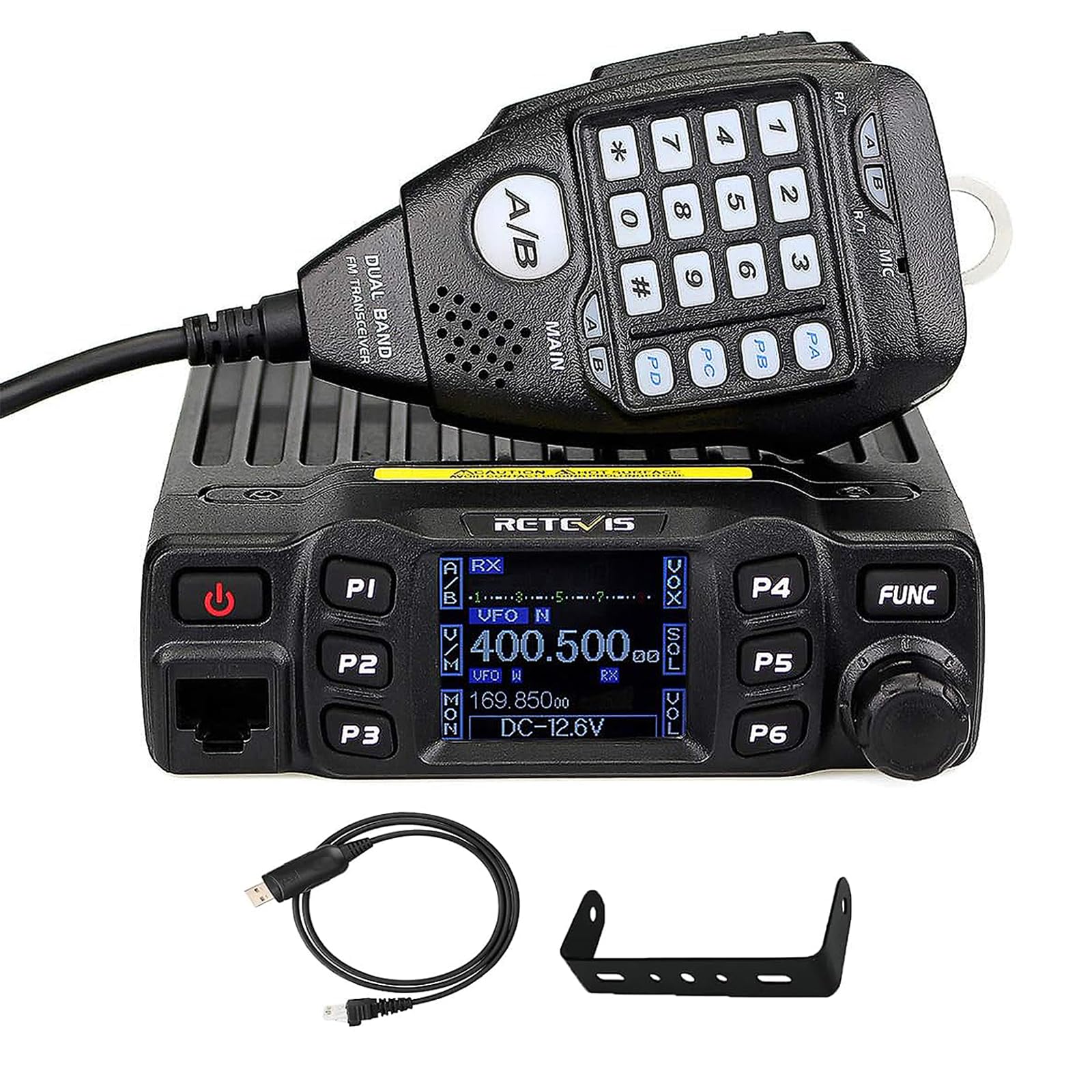
| Retevis RT95Best Value | Dual band on a budget | 144–148 / 420–450 MHz | 25W | 200 | Amazon |
| BTECH UV-25X2Compact Pick | Cup-holder-size installs | VHF / UHF | 25W | 4 (quad watch) | Amazon |
| AnyTone AT-778UVII | Clear audio and easy CHIRP setup | 144–148 / 420–450 MHz | 25W (25/15/5) | 200 | Amazon |
| BTECH UV-50X2 | Value 50-watt dual band | VHF / UHF | 50W | 200 | Amazon |
| AnyTone AT-5888UV | Full duplex cross-band work | 144–148 / 420–450 MHz | 50W VHF / 40W UHF | 758 | Amazon |
| Radioddity DB50 | Detachable faceplate in modern cars | VHF / UHF plus air band | 50W | 758 | Amazon |
| Icom IC-2730A | Long-term build quality | VHF / UHF | 50W | 1052 | Amazon |
| Xiegu G90 | HF travel, not VHF mobile | HF with wide-range ATU | 20W | — | Amazon |
Detailed Reviews
1. Yaesu FT-2980R 144 MHz Single Band Mobile Transceiver
Our pick — 4.5+★ from 250+ verified ratings; the strongest balance of quality and price.
The brute-force answer for anyone whose handheld dies at the edge of town.
Eighty watts of RF power (radio-frequency output, the strength your antenna actually pushes out) is the headline, and it is backed by a massive heatsink that keeps the rig cool without a cooling fan spinning at all. You get four selectable output levels — 80, 30, 10 and 5 watts — so you can drop to 5 watts for a local simplex chat and save the full 80 for the long haul. Audio output is 3 watts into the built-in speaker, which is enough to hear over road noise, and the six-digit backlit LCD stays readable at night.
Terrain is where this radio earns its keep. One buyer reports that after two years of failing to reach a 2m repeater about 16 miles away over mountains with an 8W handheld, this 80W radio at 30W reaches the net loud and clear. That is the whole case for a mobile rig: you are not buying watts for ego, you are buying the ability to punch through a ridge at 30 watts when a handheld could not at 8. The receiver keeps up too, with 200 memory channels, CTCSS and DCS encode/decode (the sub-audible tones that open a repeater’s squelch), and built-in weather channels with a severe weather alert.
Here is the honest catch: it is a 2 meter radio, full stop. No 70cm coverage, so if your club runs a UHF net you will need a second rig or a dual-band pick below. It also measures 7.3 by 6.3 by 2 inches and weighs 4.2 pounds, so the heatsink that makes it quiet also makes it chunky under a seat. And if menu-based programming frustrates you, budget for the RT Systems software — owners who tried the DTMF mic route often gave up and bought the cable.
What earns its keep
- 80 watts with four selectable levels down to 5 watts
- Fanless heatsink design means zero fan noise on the air
- 200 memory channels with alphanumeric labels
- Weather channels with severe weather alert built in
Where it stops short
- VHF 2 meter only — no 70cm band
- 4.2 pounds and a 7.3-inch-deep chassis need real mounting room
- Manual menu programming is tedious; software is worth adding
Go for it if: your daily driving puts hills or distance between you and the repeater, and 2 meter is all you need.
Pass on it if: you want one box covering both 144 MHz and 430 MHz.
2. Retevis RT95 2m/70cm Dual Band Mobile Ham Radio Kit
Two bands, a screen that flips upside down, and a footprint that hides almost anywhere.
Installation is where the 180-degree rotatable TFT LCD (a screen that turns to face you) changes everything. Because the screen rotates, you can bolt the body in upside down and still read the display right side up — handy under a shelf or in a footwell where a fixed-face rig would leave you guessing. The chassis measures 4.88 inches deep by 6.42 wide by 1.54 tall. Against the Yaesu above the gap is stark: the FT-2980R sits 7.3 inches deep by 6.3 wide by 2 tall versus this one’s 4.88 by 6.42 by 1.54, so the Retevis takes up meaningfully less space behind the dash.
Local repeater work is covered by 25 watts on both 144–148 MHz and 420–450 MHz, and the kit includes the cables, a mic with a lighted keypad, and a built-in heat dissipation fan so it holds steady during long high-power transmissions. Audio is what wins people over: sound quality draws far more praise than any other trait, and the twin speakers in the radio and the mic keep the receive side loud. One buyer reports hitting repeaters 35 miles away on 25W output from the road. Manual programming is simple enough that many skip the computer entirely, though CHIRP support is there when you want it.
The trade-off to know before you buy: this is a 25-watt radio, so it will not match the 80-watt Yaesu for reaching a repeater tucked behind a ridge. Range gets mixed feedback in owner experiences, and some buyers hit a factory narrowband default that made transmit audio sound weak until they switched to wideband in the settings. Neither is a defect — it is a reminder that this rig rewards a few minutes of setup before you judge it.
The setup advantage: VFO mode lets you change frequency without a computer, and the rotatable head means you are never squinting at an upside-down screen.
The honest limit: 25 watts is plenty for nearby repeaters and short simplex, but it is a step below the high-power single-band rigs when terrain gets serious.
Reach for this if: you want both bands in one compact box and value easy front-panel programming.
Look elsewhere if: your repeater sits far enough away that you already know you need more than 25 watts.
3. BTECH UV-25X2 Mini Mobile 25 Watt Dual Band Radio
A cup-holder-sized dual bander that watches four frequencies at once.
Quad watch is the defining trick here — the radio runs either 144 MHz or 430 MHz as its main transmit band while monitoring up to three other frequencies or channels alongside it, and you can set it for VHF-VHF or UHF-UHF operation. In a vehicle that means you can hold a club repeater on the main side while watching a simplex calling frequency and a second repeater without touching a knob. It also carries an RJ45 microphone port with a K1 audio adapter in the box, so aftermarket headsets and audio accessories that use the common K1 jack will actually fit.
Twenty-five watts, a rear cooling fan, and a genuinely small footprint make this an easy fit in tight cabs and side-by-sides. Owners of three separate units describe it as tiny but capable, and the customizable screen colors get a specific nod from colorblind drivers who can finally read the display. CHIRP programming handles the heavy lifting, and the included antenna is reported as well-tuned from the start.
The catch is the manual, not the hardware. Quad watch takes practice to set up, manual repeater entry is menu-driven and slow, and the included programming cable is a USB-to-1/8-inch type rather than a standard USB-C. A small number of units arrive faulty, and at least one buyer had a warranty claim denied over claimed SWR damage — so test it inside the return window and do not exceed 13.8 volts on the supply. For the price, though, it earns its place as the compact choice.
Why drivers like it: four-frequency monitoring in a body that disappears into a cup holder, with a fan keeping the power stage cool.
What to watch: the quad watch setup and repeater entries need the manual open in front of you the first time, and clean supply voltage matters.
Built for: off-roaders, UTV owners, and anyone with almost no dash real estate who still wants multi-channel monitoring.
Not for: buyers who want to program from the front panel in thirty seconds flat.
4. AnyTone AT-778UVII Dual Band 25W Mobile Transceiver
The audio reports are what sell this one — clear as a bell on both bands.
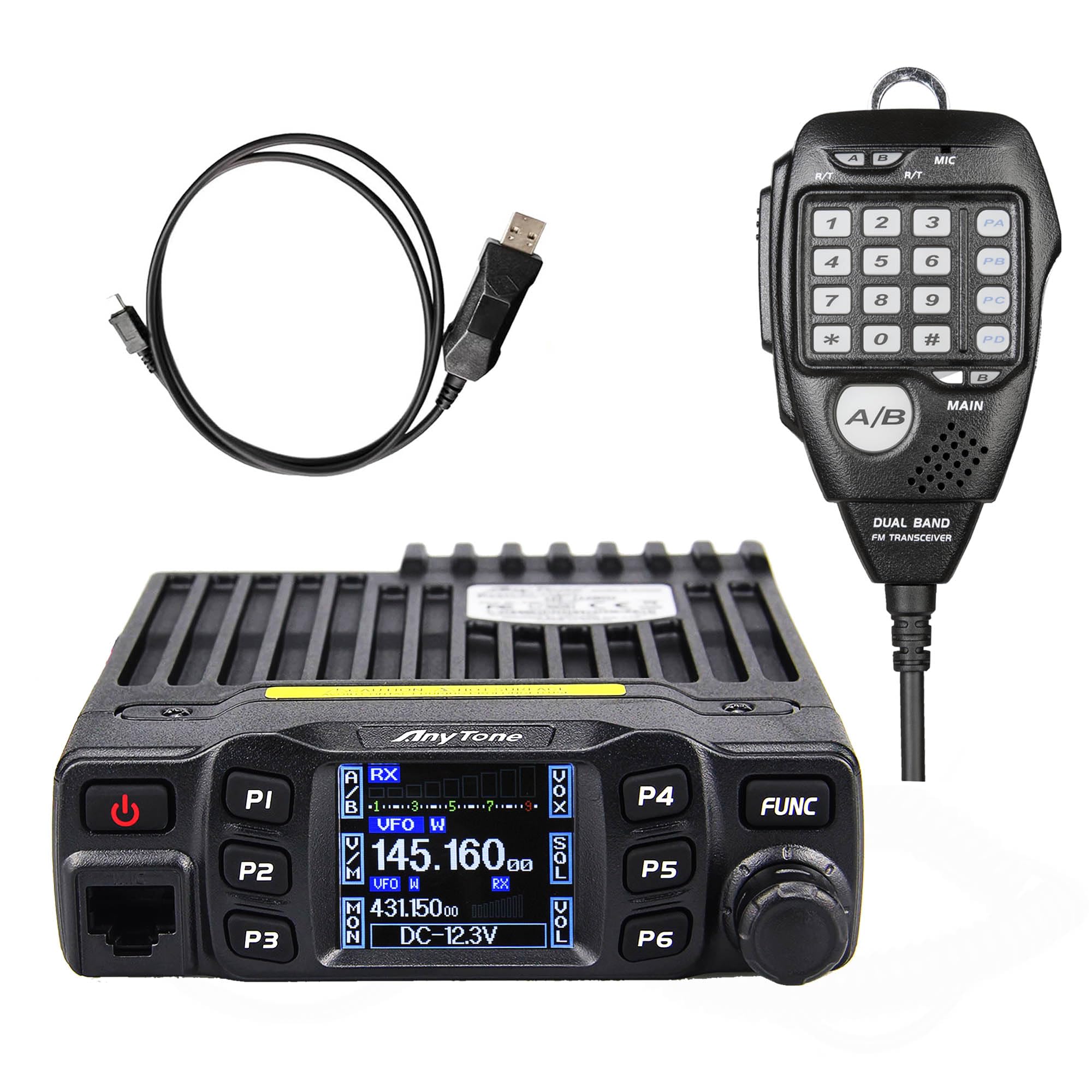
Sound quality is what this radio is known for, by a wide margin over every other thing owners talk about. It comes paired with 200 memory channels, CTCSS/DCS, DTMF and 5-tone signaling in a chassis just 124 by 163 by 39 millimeters. Output is selectable at 25, 15 or 5 watts, which covers both highway repeater work and close-in simplex without blasting the channel. A 180-degree rotatable TFT LCD (a screen that turns to face you) lets you mount the body at an angle and still read it, and there are speakers in both the radio body and the microphone.
A first mobile install here is close to painless. CHIRP is a free download from AnyTone’s own site, the hand mic carries channel-change buttons so you are not reaching for the faceplate at speed, and the radio runs on 144–148 MHz and 420–450 MHz in line with Part 97 rules (the FCC rules for amateur radio). New licensees report reaching repeaters several tens of miles out on an indoor antenna, which tells you the receiver is doing its job.
The compromises are real but small: there is no dedicated volume knob or squelch knob, so both live on buttons and an encoder, and the case acts as the heatsink with no fan behind it. Channel names are capped at six characters, which gets tight on a repeater list. Buyers who run heavy duty cycles report the body running warm — normally fine, but note if you plan long high-power talks in a hot cab.
Moves the needle
- Clear transmit and receive audio reported consistently
- 200 memory channels with free CHIRP programming
- Hand mic gives you channel changes without touching the body
- 25/15/5 watt selectable output
Know before you mount it
- No dedicated volume or squelch knobs
- Six-character channel name limit
- Fanless design runs warm during long transmissions
Worth it for: the buyer who cares most about how they sound on the other end and wants an easy CHIRP setup.
Think twice if: you want physical knobs for volume and squelch under your fingers.
5. BTECH UV-50X2 50 Watt Dual Band Mobile Radio

Double the power of the compact pick, in a body that still slides under a seat.
Fifty watts is the reason to step up here from the UV-25X2 above — same quad watch logic, same K1 audio adapter on the RJ45 mic port, but twice the output on tap for reaching distance repeaters. It runs 144 MHz or 430 MHz as the main transmit and receive band while watching up to three more, and you can set it for VHF-VHF or UHF-UHF operation if your local traffic sits all on one band. Build quality is what people talk about, and it is the single most-praised trait in owner reports.
Installation is straightforward with the included radio and mic brackets, and the PC04 FTDI cable is the recommended route for computer programming if you tire of the menu. Base-station use works too with the optional RPS-30M supply. Buyers running it as a home rig with a magnetic antenna report house-to-car contacts across a whole city at 25 watts in the vehicle and 50 at the house.
Two honest caveats. The mic connector sits right next to the volume knob, so a yanked cord can strain the socket — route the cable with slack. And reliability experiences are mixed: most units run for years, but at least one went silent on 70cm after a few months of high-power use. Buy from a seller with a clean return path and this is a strong value; treat it as a consumer rig rather than commercial gear.
The case for it: 50 watts, 200 channels, eight-character alphanumeric memories, and a heatsink-plus-fan combo that holds up during long transmissions.
The catch: the screen is small and the mic socket sits close to the volume knob, so plan your cable routing before you drill anything.
Pick it if: you want the extra watts of a 50-watt rig without paying premium-brand money.
skip it if: your install has no room for a 7.5-inch-deep chassis.
6. AnyTone AT-5888UV Dual Band VHF/UHF Mobile Transceiver

758 channels, twin displays, and a cross-band repeater built into the box.
Two independent receivers are the heart of this rig. You can run UU, UV, VU or VV combinations for dual receive and dual output, and the 758 programmable memory channels can each carry their own CTCSS, DCS, 2-tone and 5-tone settings so other radios cannot walk onto your channel. Output is 50 watts on VHF and 40 watts on UHF, with a direct-flow heatsink and built-in cooling fan keeping it steady. The faceplate detaches and runs on standard CAT5 cable (a common network cable), which means you can put the display where you can see it and the body where it fits.
Reception is the standout in real use. Owners rate its sensitivity against far pricier HF/VHF rigs and report working repeaters more than 60 miles away from a base antenna in a valley. A compander function squeezes down background noise in the car, and the large A/B switch and transmit indicator lights make band switching obvious at a glance.
Now the part that deserves your attention: menu design is the weak spot. The scan is slow across a long channel list, squelch lives in a menu rather than on a knob, and the control-head plastics feel lighter than the price suggests. A small number of units developed transmit audio faults after months of use. None of that stops this from being a serious dual-band tool — it just means you should learn the programming software rather than fight the front panel.
Standout spec: 758 memory channels and full duplex cross-band repeat in one chassis — a lot of capability for a mid-range price.
Fair warning: the manual is thin and the scan crawls, so budget an evening with the software before your first net.
Best matched to: ARES, RACES and Skywarn volunteers who need dual receive and cross-band flexibility.
Not the one for: you if you want big knobs and instant squelch adjustments while driving.
7. Radioddity DB50 Dual Band 50W Mobile Transceiver

For the modern dash where the radio body has nowhere to live.
The front panel comes off. In a newer vehicle that single design choice matters more than any spec sheet number, because you can mount the display up where you can see it and bury the 50-watt body under a seat or in a console. Dual display and dual watch let you monitor two channels at once across UHF and VHF, and the receiver also reaches air band and 1.25 meter if you like to listen wider than you transmit. Seven hundred fifty-eight channels with both VFO and channel modes give you room for every repeater you will ever program.
Fifty watts is the working number here, and it does exactly what you would hope for rural driving — enough punch to hit distant repeaters from a moving vehicle. Signal reports are the second thing owners praise after sound quality, and the kit arrives with a programming cable, a DTMF keypad mic, mounting hardware and spare fuses. Support answers quickly when something goes wrong, with one buyer reporting a replacement mic shipped after a fault.
Programming is where opinions split. CHIRP is advertised, but in practice it only reads and writes the first stretch of channels, so plan on Radioddity’s own software for the full list — and that software ships without a proper manual. The stock mic is light enough to shift in your hand, and the audio output is modest enough that some drivers add an amplified speaker. None of that is fatal, but it tells you this radio rewards a bit of patience.
What it does well
- Detachable front panel suits tight modern dashboards
- 50 watts with dual display and dual watch
- 758 channels with VFO and channel modes
- Broad receiver coverage including air band
The honest trade-offs
- Full-channel programming needs the maker’s software, not CHIRP
- Included manual is thin on detail
- Built-in speaker output is modest in a noisy cab
Right for: drivers whose dash cannot swallow a fixed-face 50-watt chassis.
Wrong for: anyone expecting a plug-in-and-go CHIRP experience across all channels.
8. Icom IC-2730A Dual Band VHF/UHF 50W Mobile Radio

The one you buy once because the build and the receiver both hold up.
Fifty watts on both VHF and UHF, 1052 memory channels, and simultaneous receive in VHF/VHF, UHF/UHF or mixed combinations — this is the rig experienced operators keep coming back to. It weighs 2.7 pounds and measures 5.9 by 5.9 by 1.6 inches, small enough that the body tucks away while the large white backlit LCD stays easy to read. A single mic button flips between frequency and band, and channels can be named so you see the repeater’s identifier instead of a string of digits.
Build quality is the trait people mention more than any other, and it shows up in the small things: a built-in cooling fan, a well-designed mic, accurate frequency control and a manual that is actually worth reading. Range is not a worry either — Buyers report hitting repeaters over 40 miles away with a proper mobile antenna, and one reached a repeater 42 miles out at only 15 watts.
Accessories are what will bite you. The faceplate mounting bracket is not in the box, and the adapters needed to separate the head from the body are sold as extras — Icom parts run a meaningful fraction of the radio’s own cost, so factor that in before you commit. The rear fan is audible when it spins up. For a long-term install the spend pays off, but go in knowing the total.
The quotable number: 1052 memory channels and 50 watts on both bands, with simultaneous receive so you never miss one net while working another.
The fine print: mounting brackets and separation adapters cost extra, and that adds up fast on a premium rig.
The right call if: you want a radio you will still be using in a decade and do not mind paying for the accessories separately.
Reconsider if: your budget leaves no room for the brackets and cables that are not included.
9. Xiegu G90 HF Transceiver with Built-in Auto Antenna Tuner

Twenty watts of HF with a tuner that will load almost any wire you throw up.
Let us be clear about what this is: an HF transceiver, not a 2 meter mobile radio. It does not transmit on 144 MHz, so it belongs on this list only if you are building a travel or truck HF station and want the tuner. That tuner is the reason it keeps showing up in conversations — a wide-range internal automatic antenna tuner that loads up field antennas other QRP radios refuse, plus a built-in mediumwave high-pass filter and an onboard antenna analyzer.
Twenty watts is plenty for the portable work this rig was built for. Owners mention cross-continent HF contacts from modest antennas and full days of operation on a small LiFePO4 battery., and the 48 kHz spectrum display with waterfall makes finding a clear frequency far easier than tuning blind. The display detaches from the radio body so you can place the head where you can see it, and the color screen stays visible in daylight. Quick Mode keys let you toggle functions directly rather than digging through menus.
The honest limit is the learning curve. This is a menu-driven software-defined radio (a radio whose functions run in software), and while the interface is learnable, it is not the rig to hand a brand-new operator for their first HF contact. A small number of units arrive with manufacturing inconsistencies — one buyer received a defective tuner and a low carrier output before a replacement sorted it. Buy from a seller with a clean return window and you get among the most capable portable HF radios at its tier.
Why it earns a slot: wide-range auto tuner, detachable display, and 20 watts that punch well above their class on a good antenna.
What it is not: a VHF mobile rig — no 2 meter transmit, and the menu system assumes some SDR fluency.
Buy it for: POTA, backpacking and truck installs where HF reach matters more than band count.
Do not buy it for: joining your local 2 meter repeater net — it cannot transmit there.
Know the Specs
Transmit Power and What It Really Buys You
Wattage is the strength your antenna pushes into the air, and every extra step up the ladder costs you current draw and heat. A 25-watt rig is plenty for local repeaters and short simplex, while an 80-watt radio with selectable levels down to 5 watts gives you the option to go loud when terrain demands it. More watts never replace a good antenna — but they do decide whether a repeater behind a ridge hears you at all.
Heatsink and Cooling Design
A radio that transmits at high power turns electricity into heat, and how it sheds that heat decides whether it holds steady on a long net. Some units here rely on a massive heatsink with no fan, which keeps the airwaves quiet with zero fan noise. Others use a built-in cooling fan for continuous operation at high output. Either approach works — just know a fanless body will run warm on long transmissions, and give it airflow.
Memory Channels and Programming Route
Channel capacity ranges from a handful of watched frequencies to over a thousand stored memories. More channels only help if you can program them, so check whether the radio supports CHIRP, the maker’s own software, or front-panel entry. Some rigs program fully through CHIRP; others only handle part of the list and need proprietary software for the rest. Factor in a programming cable before you start.
CTCSS, DCS and Repeater Access
Repeaters use sub-audible tones to decide who gets in, and a radio must encode and decode them to work properly. CTCSS and DCS are the two common schemes, and most rigs here handle both. Pair that with wide versus narrow deviation settings — some units ship narrowband by default, which can make your transmit audio sound weak until you switch it. Learn where that setting lives before your first net.
Common Questions
Will a 2 meter mobile radio reach farther than my handheld?
Do I need a license to transmit on one of these radios?
How much current does a 50 or 80 watt mobile radio draw?
Can I use a dual band radio on 2 meter only?
What is quad watch and do I actually need it?
Why does my new radio sound quiet or muffled on transmit?
Can I program these radios with CHIRP?
Where should I mount the radio body and the antenna?
Is a detachable front panel worth the extra cost?
Can a 2 meter mobile radio work as a base station at home?
The Bottom Line
For most buyers, the 2 meter mobile radio winner is the Yaesu FT-2980R because 80 watts behind a fanless heatsink is what actually gets you into a repeater over a ridge. If you want both bands in a compact body with a screen that rotates to suit your install, the Retevis RT95 delivers dual band coverage for a value-tier outlay. And if your dash simply will not fit a full chassis, the Radioddity DB50 puts the panel where you need it and the body out of sight.
One last thought on timing: The FT-2980R is the highest-rated pick here at 4.5+ stars across hundreds of ratings, and radios in this category hold their resale and usefulness for years — so buying the one that fits your terrain once beats upgrading twice.
How we choose
We do not accept paid placement. Every pick is matched to a real buyer and a real use-case; we do not hands-on test units.
Sources
Specifications: manufacturer listings and product documentation. Review insights: verified customer reviews, as of October 2026. Pricing: not shown on this page (it changes often); check the current price via the retailer link.
As an Amazon Associate, Aappliancez earns from qualifying purchases. This does not affect which products we feature.