Disclosure: Some links in this post are affiliate links. As an Amazon Associate I earn from qualifying purchases, at no extra cost to you. Learn more
Specs are compiled from manufacturer listings and verified buyer reviews and can change over time — please confirm the key details on the product page before buying.
Here is the short answer: buy the Celestron SkyMaster 12×60 if you want the most proven 12x view for the money, and buy the Nikon Monarch M5 if you want the lightest, sharpest glass you can carry all day. Everything else on this list wins on one specific trade-off — close focus, a harness, a wide angle — and those trade-offs are what this page is built to sort out.
This guide is built by comparing the manufacturers’ published specifications and the patterns across verified customer reviews, so you get each pick’s real strengths and trade-offs instead of marketing spin.
A 12x binocular magnifies twelve times and is a different animal from an 8x pair, so shake control and exit pupil matter more than raw power. That is the core of what you get from this 12x binoculars breakdown.
Top Picks


How To Choose The Best 12x Binoculars
Twelve times magnification is where a binocular stops being a casual toy and starts demanding a steady hold. That single fact reorganizes every other decision you make here. Pick the glass that matches how you actually stand, glass, and carry it.
Magnification and objective lens size
The first number is the power and the second is the objective lens diameter in millimeters — that front glass that gathers light. A 12×50 pulls in a wide, bright scene; a 12×60 pulls in noticeably more. The Celestron SkyMaster carries a 60 mm objective lens, and the Vortex Razor UHD runs a 50 mm lens, so the Celestron gathers light from a wider front door. Both are real 12x, so the magnification is a wash — the glass size is the difference.
Exit pupil and low-light viewing
The exit pupil is the bright circle of light you see when you hold the binocular away from your face, and bigger is easier on the eye. The Celestron SkyMaster delivers a 5 millimeters exit pupil against the Vortex Razor UHD’s 4.17 millimeters. If you plan to spot at dawn, dusk, or under stars, that circles-of-light advantage is what keeps detail readable when the light fades.
Weight, shake, and tripod mounts
A 12x view amplifies hand shake as much as it amplifies the subject, so a tripod socket is not a luxury on the heavier glass. Some models here mount to a standard photo tripod; others do not ship the adapter. Budget for a steady rest if you plan long sessions.
Side-by-Side Comparison
| Model | Best For | Objective Lens | Exit Pupil | Field of View | Amazon |
|---|---|---|---|---|---|
| Celestron SkyMaster 12×60★ Best Overall | Astronomy and wide-field viewing | 60 mm | 5 millimeters | 278 feet | Amazon |
| Vortex Razor UHD 12×50Premium Pick | Premium resolution with harness included | 50 mm | 4.17 millimeters | 288 feet | Amazon |
| Occer 12×50 | Birding and travel on a budget | 50 mm | 4.17 millimeters | 8.3 degrees | Amazon |
| Bushnell PowerView 12×50 | Range and general outdoor use | — | — | — | Amazon |
| Celestron Nature DX 12×50 | Long-range birding with a tripod | 50 mm | 5 millimeters | 246 feet | Amazon |
| Nikon PROSTAFF 5 12×50 | Lightweight all-day carry | 50 mm | 4.2 millimeters | 246 feet | Amazon |
| Nikon Monarch M5 12×42 | Sharpest compact carry | 42 mm | 3.5 millimeters | 267 feet | Amazon |
Detailed Reviews
1. Celestron SkyMaster 12×60 Binoculars
Our pick — 4.5+★ from 1,000+ verified ratings; the strongest balance of quality and price.
The big-glass value pick that turns the night sky into a map you can actually read.
If you want the most light-gathering 12x view here without jumping to premium glass, start with this one. A 60 mm objective lens pulls in more light than the 50 mm lenses on most picks in this list, so it holds up for astronomy, dusk spotting, and wide-field scanning. BaK-4 prisms (a prism type that keeps the light path efficient and the image bright) boost light throughput to your eye. The result is a brighter, more detailed view at dawn, dusk, and deep night.
The field of view is 278 feet, and the exit pupil is 5 millimeters. In plain terms, that’s a wide, bright circle for your eye, which is exactly what you want for finding a star or scanning an open ridge. Two quirks matter for setup. The binoculars can be handheld, but due to their size and weight some users mount them on a standard photo tripod (not included) for long sessions. Also, the design does not ship with a tripod adapter, unlike Celestron’s 15×70. Bottom line: this is the pick most buyers will be happiest with.
The 12x power is a real strength and a real demand. The Vortex Razor UHD runs a 50 mm objective and a 4.17 millimeters exit pupil against this one’s 60 mm and 5 millimeters — a meaningful light gap. But a 12x image wants a steady hold, and the weight makes that harder over long sessions. As buyers report on the SkyMaster: “crisp images, easy focus, wide FOV, rubber grips, water-resistant.” The trade-off is honest: this is a big, capable glass built for a rest, not a shirt-pocket companion.
What earns its keep
- 60 mm objective lens with BaK-4 prisms for bright, detailed low-light views
- 5 millimeters exit pupil — a wide circle of light for dim conditions
- Water-resistant rubber-armored housing for tough conditions and rain
- Multi-coated optics and an 18 mm eye relief figure
Where it asks more of you
- No tripod adapter included, unlike Celestron’s 15×70 model
- Heavier build — a rest or tripod helps for extended viewing
- The stock neck strap is thin; a thicker one is worth adding
Worth the buy: anyone who wants maximum light and a wide field for astronomy, dusk spotting, or open-country scanning.
Know this first: plan on a tripod or a steady rest for long sessions — the size and weight reward a mount.
2. Vortex Razor UHD 12×50 Binoculars & GlassPak Pro Harness
Premium glass that arrives ready to wear, harness and rangefinder pouch included.
This is the top-tier optics answer. The 12×50 Razor UHD uses an Abbe Koenig prism design — a premium prism layout built for resolution, sharpness, color, and light transmission. Index-matched lenses correct color across the visual spectrum, and ultimate anti-reflective coatings sit on all air-to-glass surfaces for maximum light transmission. If you want the sharpest, most color-accurate image in the line, the Razor UHD’s Abbe Koenig prisms and index-matched lenses are built for it.
Compare the field stats directly. The Razor UHD delivers a 288 feet field of view and 5.5 degrees apparent angle of view, against the Celestron SkyMaster’s 278 feet and 5.3 degrees. That’s a slightly wider field, useful for tracking fast-moving birds or sweeping a valley. Its 4.17 millimeters exit pupil is smaller than the SkyMaster’s 5 millimeters, so the big Celestron still wins the pure low-light light-gathering test. The Razor wins on optical refinement and a wider view.
The body is magnesium — light and strong — in a true open-hinge design that improves ergonomics while cutting bulk. Rubber armor provides a secure, non-slip grip. A right-eye diopter tailors each barrel’s focus to your eyes, and twist-up eyecups give customized eye relief (17 millimeters). Argon purging and o-ring seals handle water and fog, and ArmorTek coating protects the lenses from scratches, oil, and dirt. It’s tripod-adapter compatible for a tripod or car window mount.
Why go premium: the Abbe Koenig prism, index-matched lenses, and dielectric prism coatings are a step up in image quality over the entry glass, and the included GlassPak Pro harness plus rangefinder pouch means you can carry it comfortably from day one.
The honest catch: the smaller 4.17 millimeters exit pupil gives up light-gathering to the 60 mm Celestron, and the premium build carries a premium tier label. If pure low-light brightness is your goal, the bigger objective wins; if refined color and a wider field matter more, this delivers.
The right buyer: someone who wants top-shelf resolution and color accuracy and is happy to pay the premium tier for it.
Look past it if: you need maximum low-light brightness — the larger objective lens on the Celestron holds that edge.
3. Occer 12×50 Binoculars

The birding and travel workhorse that punches above its budget label.
For portability and price, this is the pick to beat. It runs a 50 mm objective lens with a fully multi-coated finish, so it gathers a good amount of light for mornings, evenings, and cloudy days. Birders are the target here: the wide field of view and 12x power show distant detail without blur. It’s also light and easy to adjust, making it a fine cruise, concert, and wildlife companion.
The 18 mm prism is the standout in the spec sheet — a larger prism that produces brighter, clearer images, per the maker. The kit includes the binocular, case, neck strap, and cleaning cloth. Field of view is 8.3 degrees, and the exit pupil is 4.17 millimeters, so the bright view is there for a 50 mm glass. The close focus and smooth wheel keep fast-moving birds and game in frame.
Price-to-value is the whole story, and owners say it delivers. As owners mention: “12×50 magnification and 50mm lenses provide wide field of view and clear bird/wildlife spotting.” It’s built for the entry-level outdoorsperson who wants a real 12x view without the premium outlay. The honest note: it’s ABS plastic body and lighter glass, so treat it with care and calibrate expectations against premium optics.
Why it sells
- 18 mm prism for bright, clear images at a budget-friendly tier
- 8.3-degree field of view — wide for tracking birds and wildlife
- Fully multi-coated 50 mm objective lens for dawn and dusk
- Light and portable for travel, cruises, and concerts
Fit note
- ABS plastic body and lighter glass than premium picks
- Optics sit below premium brands — fine for entry, not for high-end demands
Reach for this if: you want a portable, budget-smart 12x for birding, travel, and casual wildlife watching.
Step up if: you need premium optical sharpness and rugged longevity for hard use.
4. Bushnell PowerView 12×50 Binoculars
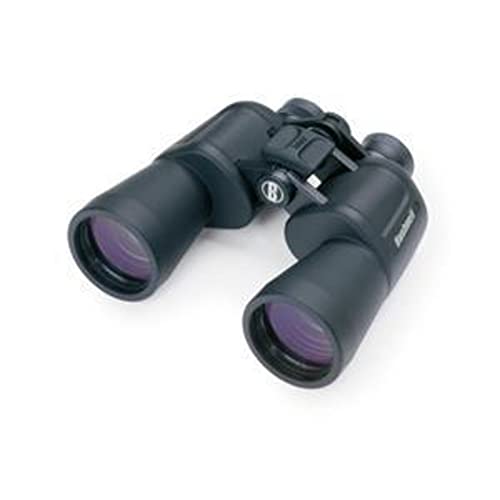
The stubbornly dependable wide-angle that carries a lifetime warranty and a fair price.
This is the general-use range binocular. It uses a porro prism construction (the offset, stepped-body design) with BK-7 prism glass — a high-quality prism that provides efficient reflectivity and light transmission for bright viewing. Multi-coated optics put multiple layers of coating on all lens surfaces to boost light transmission and image brightness. The rugged rubber housing adds durability and grip for use anywhere.
The long-distance clarity is the thing people come back for. At 12×50, it’s enough power to reach across a valley or downrange, and the included case, strap, and caps make it ready to go. The honest catch is the shake — a 12x view needs a steady rest to stay still. The lens caps also don’t hold well, which is a small annoyance on a otherwise solid kit. InstaFocus keeps the focusing quick.
For the price, it performs. As one buyer put it: “The price-quality ratio is correct. I bought them to see.22LR impacts at 60 meters in the shooting range.” That’s a real-world job this glass handles. The lens caps are the recurring gripe — note, but minor. The rest is a sturdy, budget-friendly 12x that covers birding, hunting, concerts, and the range adequately.
What it gets right: porro prism construction with BK-7 glass and multi-coated optics gives bright, clear views at a fair price. The lifetime warranty and included case, strap, and caps round out the value.
What you’ll notice: the shake at 12x is real — brace against a rest or tripod for long-range work. The lens caps are a bit loose. Neither changes the verdict for a general-use pair.
Go with this if: you want a versatile, budget-friendly 12×50 for range, birding, and general outdoor use.
skip it if: you need rock-stable long-session viewing without adding a rest.
5. Celestron Nature DX 12×50 Binoculars
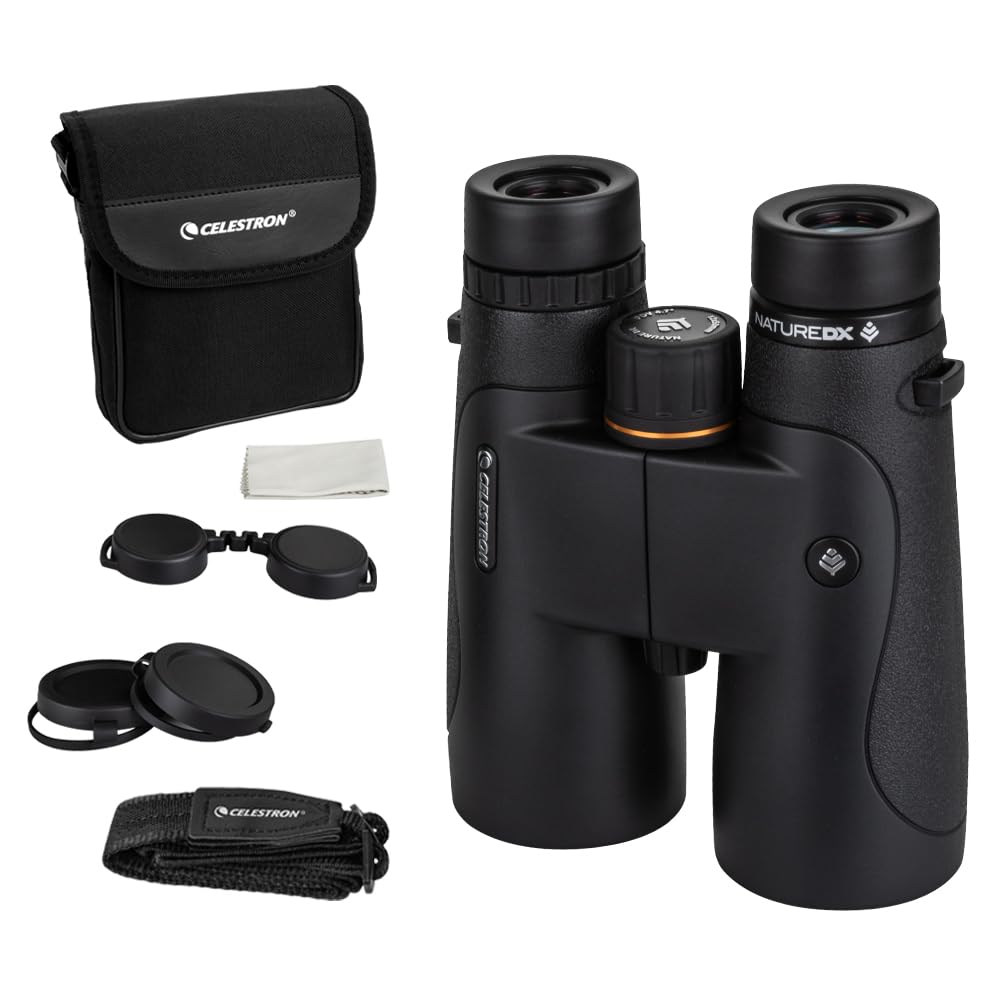
A tripod-ready 12×50 built for dawn-to-dusk scanning and long-range birding.
The Nature DX 12×50 is built for distance. Fully multi-coated lenses boost light transmission, while phase-coated BaK-4 prisms enhance contrast and resolution for crisp, color-accurate images in any lighting. The 50 mm objectives deliver brightness for low-light conditions like dawn, dusk, or dense forests. A wide 7.4-degree angular field of view helps you track movement and scan open landscapes with ease.
The build is weather-ready. A rubber-armored polycarbonate housing shields against bumps and drops, and it’s waterproof and nitrogen-purged to resist fogging in rain, snow, or humidity. With high magnification comes a need for stability, so there’s a built-in tripod adapter socket for steady, shake-free viewing (adapter sold separately). The 14 millimeters eye relief is on the shorter side, so glasses wearers may want to check the fit.
Here’s the honest framing: the field of view is 246 feet and the exit pupil is 5 millimeters, which is bright for a 50 mm glass. The tripod socket is the real differentiator — if you plan long sessions, it earns its place. The caveat is stability: even with good concentration, keeping a 12x image still by hand is hard without a rest. This is a pick for the disciplined long-range viewer who will mount it.
Built for the long look
- Built-in tripod adapter socket for shake-free long sessions
- Phase-coated BaK-4 prisms and fully multi-coated lenses for contrast
- Waterproof and nitrogen-purged against fogging
- 5 millimeters exit pupil for a bright 50 mm view
What to plan for
- Tripod adapter sold separately
- 14 millimeters eye relief is shorter for glasses wearers
- 12x needs a rest to stay steady by hand
Best suited to: long-range birders and viewers who will mount it on a tripod for steady, extended sessions.
Think twice if: you want pure handheld convenience — the 12x power rewards a rest.
6. Nikon PROSTAFF 5 12x50mm Binoculars
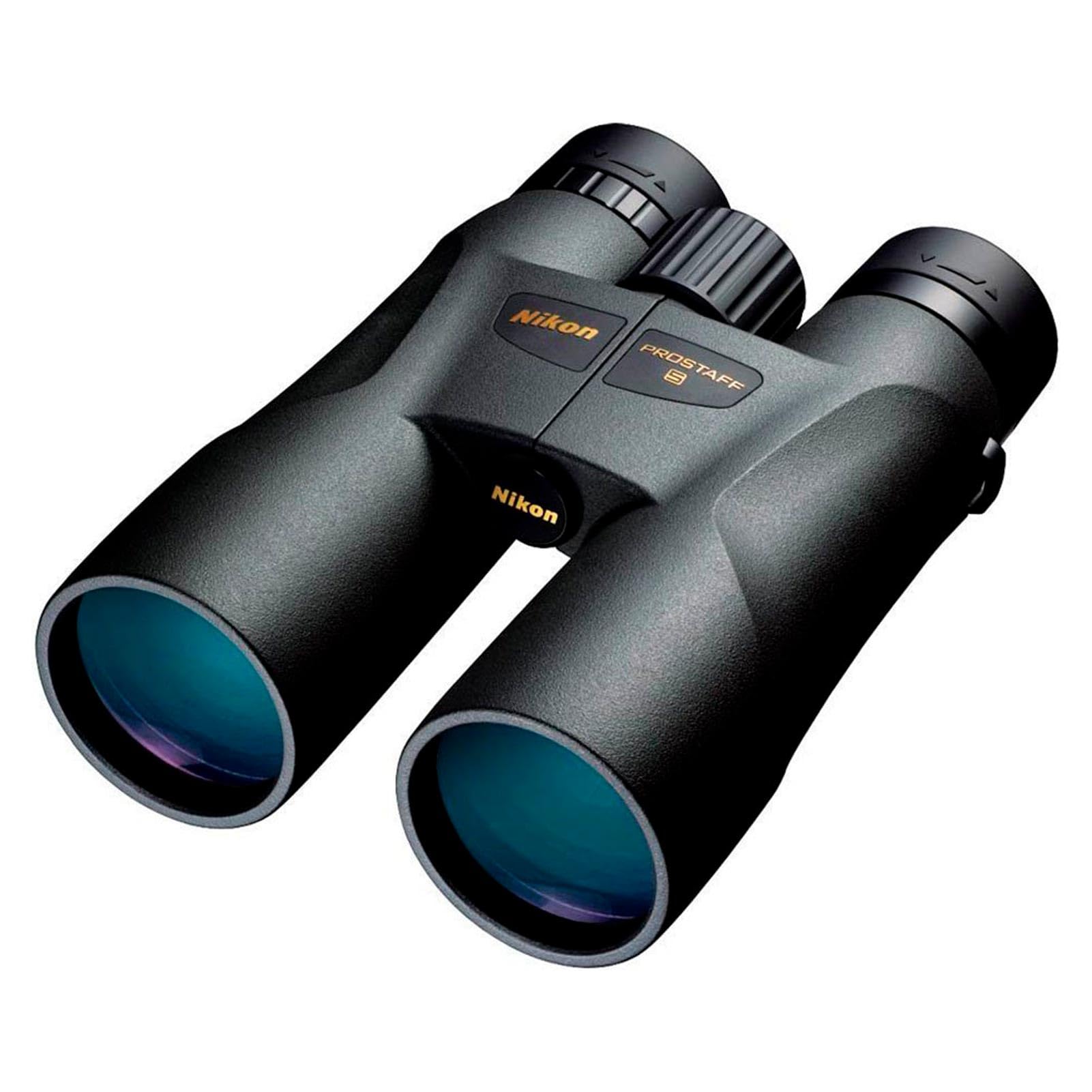
The lightweight field companion that keeps sharp color-correct views all day.
When carry weight is the deciding factor, this is the pick. Its fiberglass-reinforced polycarbonate resin construction makes it light enough to take anywhere, and rugged rubber armoring absorbs shocks for a firm grip in wet, cold, or rough conditions. Multilayer-coated lenses and prisms deliver bright, sharp, color-accurate views, so tracking birds at dawn or scanning a distant horizon at dusk stays clear.
The ergonomics are built for long sessions. Nikon’s high-eyepoint design delivers a full, uninterrupted field of view with generous eye relief (15.5 millimeters), and turn-and-slide multi-click rubber eyecups let you fine-tune alignment to avoid eye strain. A central focus knob shifts smoothly from near to far subjects. Nitrogen-filled and O-ring sealed, it’s waterproof and fogproof, so downpours, mist, humidity, or rapid temperature shifts won’t cloud your view.
One owner with direct experience put it plainly: it beat the Nikon Aculon 8×42 on weight and fogging, and stayed the best sub-Monarch option for spot-and-stalk hunting. The field of view is 246 feet and the exit pupil is 4.2 millimeters — brighter than a 42 mm glass but behind the larger objectives. The honest caveat is that the 12x power still demands a steady hold at distance, so brace for long-range scanning.
The carry advantage: lightweight fiberglass-reinforced construction and generous 15.5 millimeters eye relief make this the pair you’re least likely to leave at home.
The honest limit: the 4.2 millimeters exit pupil is smaller than the bigger-glass picks, so the very dimmest light favors a larger objective.
Pick this one: hikers, hunters, and birders who prize low carry weight and comfortable all-day viewing.
Not for: buyers who want maximum low-light brightness from a bigger objective.
7. NIKON Monarch M5 12×42 Binoculars
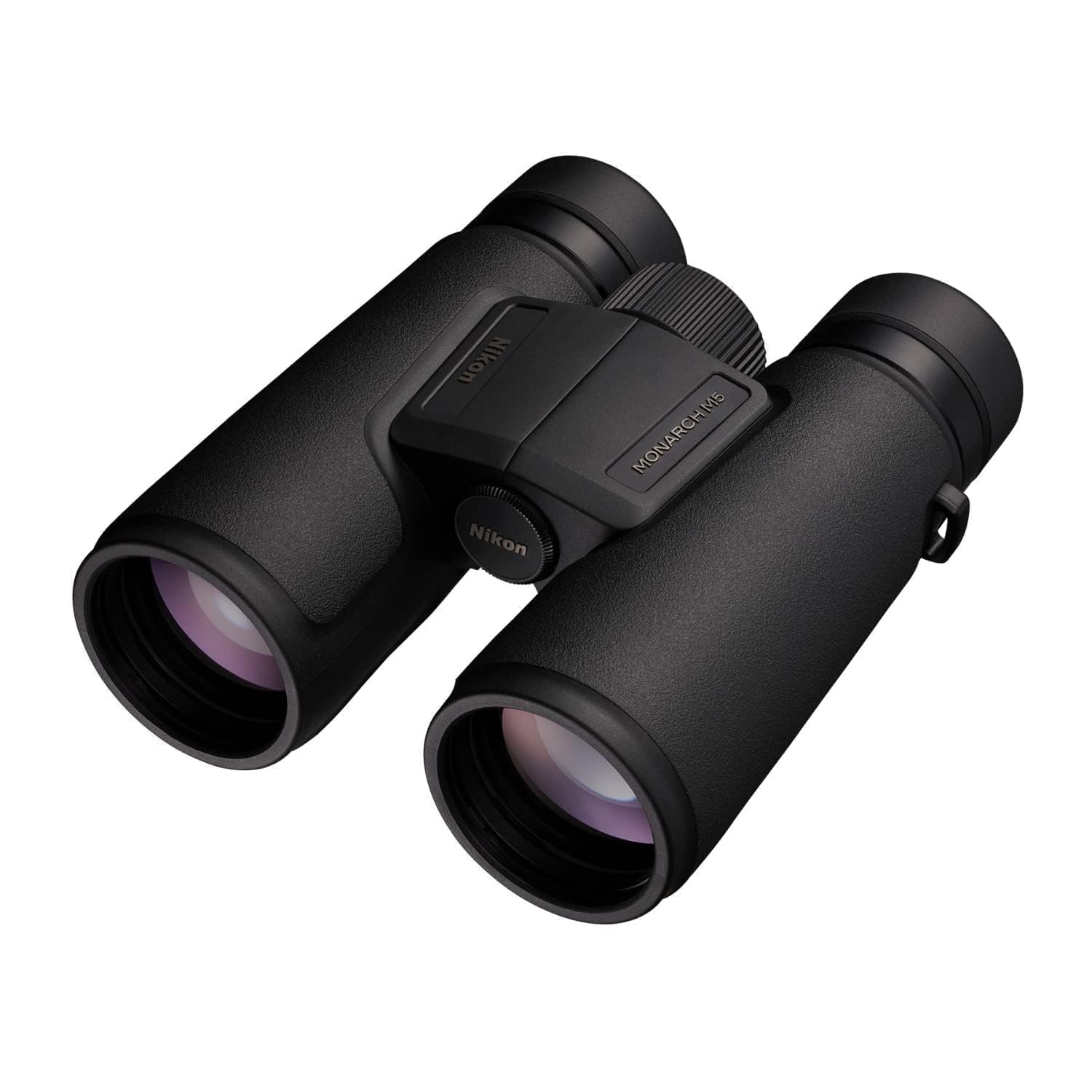
Premium low-dispersion glass in the smallest, sharpest package here.
This is the compact premium pick, and the glass is the reason. Extra-low Dispersion (ED) glass lenses minimize chromatic aberration and color fringing — that rainbow edge you see around high-contrast subjects — for high-resolution, true-to-life color. Dielectric high-reflective multilayer prism coatings enhance light transmission for brighter, more natural colors in low light. If refined color and a compact body matter most, the Monarch M5’s ED glass and 42 mm body deliver both.
The numbers tell a compact story. The 42 mm objective and 3.5 millimeters exit pupil are the smallest here, and the field of view is 267 feet — wider than the 50 mm Celestron Nature DX’s 246 feet. A large, smooth central focus knob allows precise adjustment, and close-focus capability as near as 8.2 ft reveals intricate detail up close. Nitrogen-purged and O-ring sealed, it’s waterproof and fogproof.
The trade-off is real and worth naming. A 42 mm glass gives up light-gathering to the 50 mm and 60 mm picks, so the darkest conditions favor a larger objective. And as one reviewer noted, it’s “quite large and heavy enough that you’ll need a sizable backpack” — this is no pocket pair. But as buyers see it, the 12x magnification is a clear step up over 10x, and the compact build is favored for bird watching and moon gazing. The mountable body also takes a tripod.
Why it earns the premium
- ED glass minimizes chromatic aberration and color fringing
- Dielectric prism coatings for brighter, more natural colors
- 8.2 ft close focus reveals fine detail up close
- Waterproof, fogproof, shock-resistant rubber-armored body
What it costs you
- 42 mm objective and 3.5 millimeters exit pupil give up low-light brightness
- Bulkier than expected for a compact — it needs a real backpack
Choose it for: the sharpest, most color-accurate compact view and easy all-day carry.
Look elsewhere for: the dimmest conditions — the larger objective glass is brighter when light is scarce.
Know the Specs
Exit Pupil (millimeters)
This is the bright circle of light you see when you hold the binocular away from your face. A bigger exit pupil is easier on the eye in dim light. The Celestron SkyMaster’s 5 millimeters and the Celestron Nature DX’s 5 millimeters are the widest here; the Nikon Monarch M5’s 3.5 millimeters is the most compact. If you spot at dawn, dusk, or under stars, this figure matters more than raw magnification.
Field of View (feet and degrees)
This is how wide a slice of the world you see at a distance. Wider fields help you find fast birds and scan open country. The Vortex Razor UHD leads at 288 feet against the Celestron SkyMaster’s 278 feet. The Occer lists 8.3 degrees, and the Nikon Monarch M5’s 267 feet is wider than the Celestron Nature DX’s 246 feet. Match the field to how much scanning your subject demands.
Eye Relief (millimeters)
This is how far your eye can sit from the eyepiece and still see the full view. A generous eye relief works better for glasses wearers. The Nikon PROSTAFF 5 offers 15.5 millimeters, the Vortex Razor UHD 17 millimeters, and the Celestron Nature DX 14 millimeters. Short eye relief with a thick pair of frames can crowd the view.
Coatings and Prisms
Coatings and prisms decide how much light reaches your eye with minimal glare. BaK-4 and Abbe Koenig prism designs are the higher-tier options here, while BK-7 appears on the Bushnell PowerView. Fully multi-coated surfaces on the Occer and Celestron Nature DX boost light transmission. The Vortex Razor UHD adds dielectric prism coatings and ArmorTek lens protection for a premium edge.
Common Questions
Is 12x too much magnification to hold steady by hand?
What does the second number in 12×50 or 12×60 mean?
Will 12x binoculars work for stargazing or just for daytime use?
Do these work if I wear glasses?
What is the difference between BaK-4 and BK-7 prisms?
Are these binoculars waterproof and fogproof?
What should I mount these on for long sessions?
How much heavier is a 60 mm binocular than a 50 mm one?
Are 12x binoculars good for hunting?
What is the difference between a center-focus and an individual-focus binocular?
The Bottom Line
For the widest light-gathering 12x view at a budget-friendly tier, the Celestron SkyMaster 12×60 is the top pick because its 60 mm objective and 5 millimeters exit pupil beat the 50 mm glass on brightness. If refined color and a premium harness matter to you, the Vortex Razor UHD 12×50 is the step up. And for light, all-day carry, the Nikon PROSTAFF 5 12×50 is the one to reach for. The honest nudge: the SkyMaster’s 4.5+ star rating across 1,000+ owners says most people keep the brightest, widest 12x view.
How we choose
We do not accept paid placement. Every pick is matched to a real buyer and a real use-case; we do not hands-on test units.
Sources
Specifications: manufacturer listings and product documentation. Review insights: verified customer reviews, as of October 2026. Pricing: not shown on this page (it changes often); check the current price via the retailer link.
As an Amazon Associate, Aappliancez earns from qualifying purchases. This does not affect which products we feature.