Disclosure: Some links in this post are affiliate links. As an Amazon Associate I earn from qualifying purchases, at no extra cost to you. Learn more
Specs are compiled from manufacturer listings and verified buyer reviews and can change over time — please confirm the key details on the product page before buying.
You want light that actually reaches tissue, not a red glow that just looks convincing. A device earns its place when four things line up. Wavelength in nanometers (the colour and depth of the light) decides how deep it goes. Irradiance in mW/cm² (how much energy lands on your skin per second) decides how strong it is. LED count decides how much area you cover. Steady output versus flicker decides whether the dose is even. Get those right and a daily ten-minute session becomes a habit. Get them wrong and you have bought a mood lamp.
This guide is built by comparing the manufacturers’ published specifications and the patterns across verified customer reviews, so you get each pick’s real strengths and trade-offs instead of marketing spin.
Some picks here are full panels built to cover a back, others are flexible masks for the jawline and cheeks. Sorting them by wavelength coverage and output first makes the shortlist obvious. Below you will find the shortlist that matters for a Best LLLT Device, sorted by what each one genuinely does well.
Top Picks


How To Choose The Best LLLT Device
The mistake most first-time buyers make is chasing the biggest LED number on the box. LED count tells you the size of the array, not the strength of what hits you. A panel with fewer diodes driven harder can deliver more usable energy at skin level than a mask packed with tiny emitters. Read the wavelength, the irradiance and the distance that irradiance is measured at — those three numbers decide whether a session is ten minutes or forty.
Wavelength decides the job, not the colour
Red light around 630–660nm sits closer to the surface, which is why it shows up in devices aimed at skin tone and appearance. Near-infrared around 810–850nm travels further into tissue, which is why panels sold for post-exercise recovery and joint comfort lean on it. Several picks here carry both, and some add a third or fourth wavelength. More wavelengths is not automatically better — it is only better if the device lets you run them separately, so you can tell what is doing what.
Irradiance and the distance trap
Irradiance is the density of light energy landing on a surface, written as mW/cm² (milliwatts per square centimetre). It always comes with a distance, and that distance matters as much as the figure. A panel rated at 131mW/cm² at six inches delivers far less if you sit three feet away. When you compare two devices, check both are quoted at the same distance before you draw any conclusion — otherwise you are comparing apples to distance.
Panel or mask — pick by body part, not by hype
A mask wraps the contours of your face and holds the LEDs at a fixed gap, which makes it hands-free and consistent. It will not treat a knee. A panel throws a coverage rectangle at a set distance, so it handles a back, a shoulder or a thigh, but you have to position yourself and stay there. Buy for the body part you actually want to work on most weeks, not the one you think you should.
Build details that decide whether you keep using it
Flicker-free LEDs matter because a device you hold near your eyes for ten minutes a day should not pulse. Cooling fans matter because heat shortens the life of any LED array. An auto-off timer matters because it stops a session running long while you read. And a warranty matters most of all — these are electronic devices with power supplies, and the good brands stand behind them for years.
Side-by-Side Comparison
| Model | Best For | Wavelengths | LED Count | Form Factor | Amazon |
|---|---|---|---|---|---|
| Hooga PRO300★ Best Overall | Whole-body sessions at home | 660nm + 850nm | 60 dual-chip | Tabletop panel | Amazon |
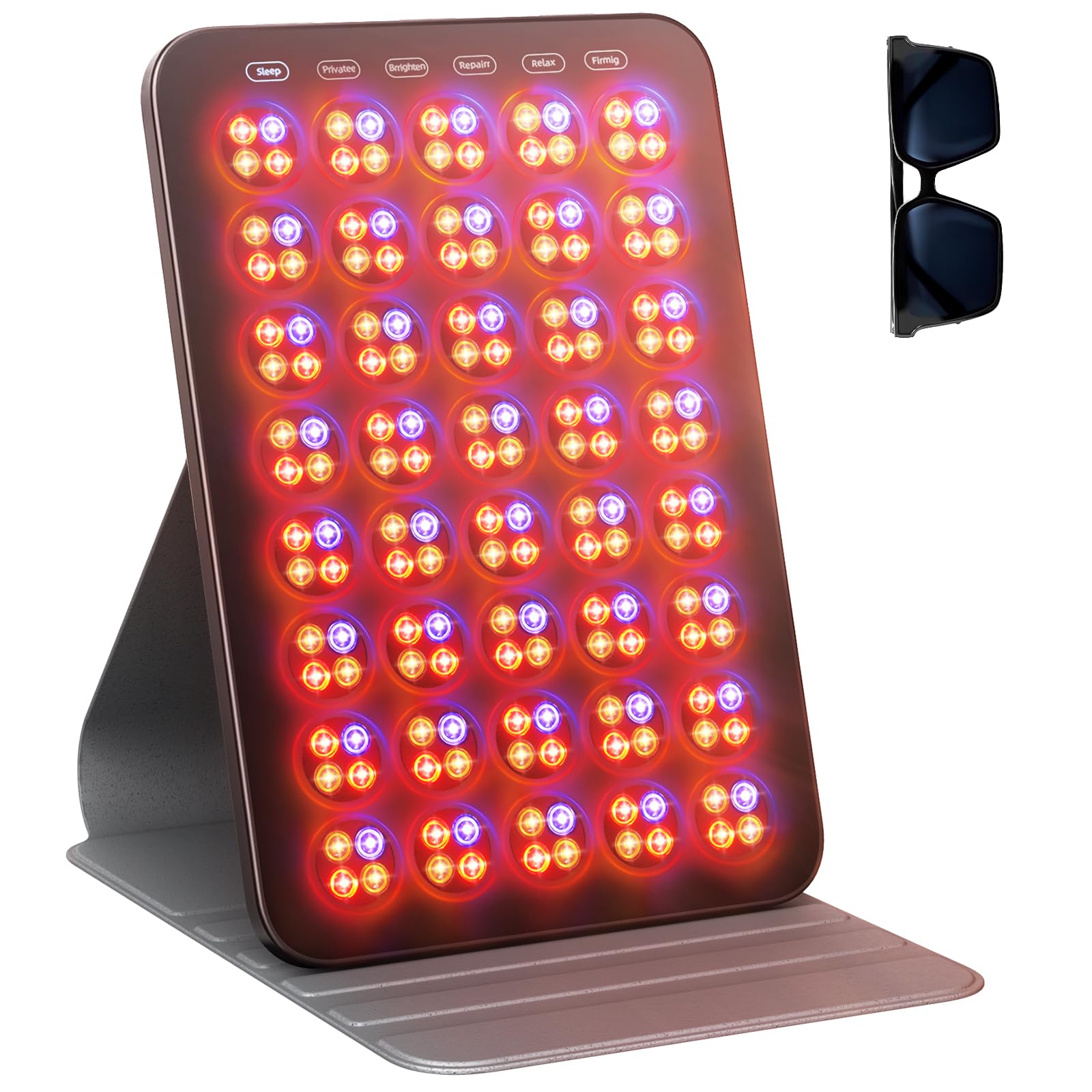
| Red Light Therapy for Face 6 ModesBudget Entry | Travel and small budgets | Red, blue, yellow, infrared | — | Portable panel | Amazon |
| INIA Face, Neck & Chest SetBest Coverage | Neck and décolleté coverage | 620/630/460–470/590nm + 850nm | 228 | Mask + chest panel | Amazon |
| BONTANNY BO-300 | Five wavelengths on a budget | 630/660/810/830/850nm | 60 dual-chip | Panel with remote | Amazon |
| INIA GLOW 4D | Wireless hands-free face time | Red, blue, amber + dual NIR | 320 | Wireless silicone mask | Amazon |
| MitoMIN 2.0 | Targeted face and neck work | 660nm + 850nm | 60 | Compact panel | Amazon |
| Ulike Reglow | Short daily face sessions | Red, yellow, blue, infrared | 272 | Full-face mask | Amazon |
| BestQool Pro100 | Linking panels into a bigger rig | 650nm + 850nm | Dual-chip array | Modular panel | Amazon |
| iRestore 360 LED Mask | Full face, highest LED count | 635/830/415nm | 360 | Dual-strap mask | Amazon |
Detailed Reviews
1. Hooga Red Light Therapy Panel for Body & Face, PRO300
Our pick — 4.5+★ from 750+ verified ratings; the strongest balance of quality and price.
A 300-watt tabletop panel that treats a face and a lower back in one sitting.
The PRO300 is the pick that covers the most ground per session. Each of its 60 dual-chip LEDs fires 660nm red and 850nm near-infrared at once — dual-chip meaning one diode does both jobs, so the panel stays compact while light stays dense. You get independent controls for red and near-infrared, which lets you run just the red for skin or just the near-infrared for a stiff shoulder. A built-in digital timer ends the session for you, and internal cooling fans keep the array from cooking itself. The beam spreads at 60 degrees, so it covers a wide patch rather than a tight spotlight.
What wins people over here is sleep. Sleep is the most-discussed benefit in this panel’s feedback, with owners consistently reporting deeper rest after sessions late in the day. Value runs a close second, which is unusual for a panel this size. Skin clarity and back-of-the-shoulder comfort come up constantly too, with the warmth from the diodes described as genuinely relaxing rather than merely tolerated. Owners with cataracts and eye floaters report tracking skin smoothness and back comfort over the first week of twice-daily use.
The one thing to know before you commit: the adjustable tabletop stand is the least premium part of the package — the panel itself feels far sturdier than the bracket holding it. Several owners also find the touch-sensitive side buttons easy to brush by accident mid-adjustment. Neither changes the light output, and both are workarounds rather than faults. If you plan to move the panel between rooms daily, budget for a better mount.
Where it earns its place
- 60 dual-chip LEDs delivering 660nm red and 850nm near-infrared together — one panel, two jobs
- Independent red and near-infrared controls so you can run a single wavelength
- Flicker-free output with internal cooling fans and a 3-year manufacturer warranty
- Links to other PRO Series panels if you later want a wider setup
Worth knowing first
- The tabletop stand is the flimsiest part of the whole package
- Side buttons sit where your hand lands when you reposition the panel
- It is a stationary panel, so a session means staying put in front of it
Buy this if: you want one device for face, back and shoulders without building a rig — the 60 dual-chip array and a 3-year warranty make it the safest starting point in this list.
Think again if: you only ever treat your face and want something you can wear while walking around.
2. Red Light Therapy 6 Modes
The entry ticket: four wavelengths squeezed into six preset modes at the lowest outlay here.
INTEO packs red, blue, yellow and infrared into a single portable panel, then splits them into six preset modes so you never have to think about wavelengths. Sleep mode before bed, repair mode after sun, relaxation mode on your back after yoga — each has a set time, and the device shuts the light off and powers itself down when that time is up. That auto-off is the best feature on the unit. It means a session can end while you are already drifting off, with no fumbling for a switch.
Effectiveness is the thing people actually talk about with this one, and the reports are consistent about skin adjusting well and visible change arriving quickly for a device in this tier. The six adjustable levels give you somewhere to start gently. It ships with infrared-protective glasses, which is not a given at this end of the range.
Here is the honest trade-off. Battery life is the weak point, and it is not a minor footnote. Buyers report units arriving that would not hold charge. Some owners mention a panel failing inside the first week, with both the battery and the direct power port giving out. That is not every unit, and plenty of owners are running theirs happily after six months. Treat the battery as the part to watch, keep your receipt, and buy from a channel with a clear returns path. If you want a device to lean on daily for years without a second thought, this is not that device.
Small-package upside: the dual spotlight optical design pushes light energy further than the panel size suggests, and the voice prompt plus auto power-off make bedtime sessions genuinely hands-off.
The part to watch: battery reliability is the recurring theme in the negative feedback, so this suits a low-commitment first device rather than your forever setup.
Reach for this if: you want to test whether daily light sessions fit your routine before spending panel money.
Look elsewhere if: you need a device that runs on its battery reliably for years of daily sessions.
3. INIA Red Light Therapy Mask
Two pieces instead of one — a face mask plus a chest panel that reaches where masks never do.
Most masks stop at the jawline, which leaves the neck and décolleté — the areas that show age first — completely untreated. INIA solves that with a paired set: a face mask and a separate neck-and-chest panel, 228 high-energy LED chips between them, pushing up to 105mW/cm² across the wider chest area. The face mask runs Red-L at 620nm, Red-H at 630nm, Blue at 460–470nm and Yellow at 590nm, plus a Red+Blue blend. Near-infrared at 850nm can be layered onto any of those. The controller carries a 2600mAh battery and a timer you set for 10, 20 or 30 minutes with one press.
Coverage is what buyers keep coming back to. The chest panel is the standout half of the set — it works on a zone that a mask physically cannot reach, and the results there show up as firmness and tone across the upper chest. The silicone is light enough to wear during other tasks, and the wired version lets you keep working through a session.
Two practical notes. Yellow plus near-infrared is a neck-device-only combination and will not run on the face mask, so plan your modes around that. And the chest plate can be awkward to tie on a smaller neck, while the head strap slides down over hair on the face piece. Neither stops a session; both mean a couple of attempts to find your fit. Give it four-plus weeks of regular use before you judge — the visible change here is gradual by design.
The verdict: if neck and chest are part of your plan, this paired set covers them in a way no single-piece mask in this list can, at 228 LEDs and up to 105mW/cm².
Set expectations: the strap and chest tie take fiddling, and improvement is measured in months rather than days.
4. BONTANNY Red Light Therapy BO-300, 5 Wavelengths

Five wavelengths and a stated 131mW/cm² — the spec sheet here reads like a panel costing far more.
Where most panels in this list run two wavelengths, the BO-300 runs five: 630nm, 660nm, 810nm, 830nm and 850nm. Sixty dual-chip LEDs carry them, each spreading light across a 60-degree beam angle. The headline figure is 131mW/cm² at six inches of distance — that is the density of energy landing on your skin at that gap, and it puts this in the same conversation as panels that cost noticeably more. At six inches it covers a 14-by-12-inch patch, which is enough for a face, a shoulder or a knee without repositioning. A remote control and an on-panel keypad both let you set one of three modes and a session from 1 to 30 minutes.
Build quality is the aspect that dominates feedback on this unit, and buyers consistently describe it as feeling like healthcare equipment rather than a consumer gadget. The 7.94-pound body is a deliberate part of that — the weight keeps it planted on a flat surface instead of tipping. It hangs on a door or sits on a table, runs a cooling fan, and ships with eye protection and an adjustable stand. In the first days of 15-minute sessions, owners describe waking up with more energy rather than any dramatic skin change.
Two honest catches. The remote takes a 23A 12V battery that is not included, though the on-panel buttons are simple enough that plenty of people never bother. And brightness is mixed in the feedback — some love the intensity, others report the output turning yellowish over time. If you are sensitive to bright light directly in your eyeline, position it at an angle rather than face-on.
What the spec sheet buys you: five wavelengths and 131mW/cm² at six inches is genuinely dense coverage for a mid-range panel, and the 7.94-pound housing stays put wherever you set it.
What to expect long-term: the colour shift some owners notice over months is the thing to keep an eye on, and the remote needs its own battery before it works.
Pick this one when: you want the widest wavelength spread available without jumping to the top tier — the five-wavelength array is unique in this list.
Pass if: you want a panel you can sling in a bag; at 7.94 pounds this stays on its stand.
5. INIA GLOW 4D Wireless Red Light Therapy Mask, 320 LEDs
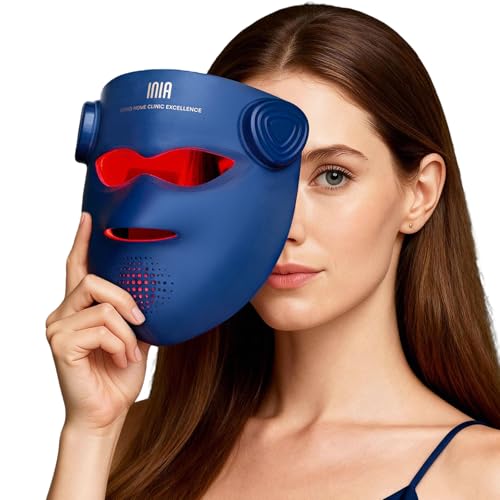
320 LEDs in flexible silicone, with no cable to tether you to a socket.
The GLOW 4D runs 320 LEDs through medical-grade flexible silicone that bends to your forehead, cheeks, chin and jawline. Four modes cover the routine: red for radiance, blue for clearer-looking skin, amber for tone, and a combo that runs everything together. There is also a magnetic cooling gel pad that sits over the eye area to take down puffiness and redness — a small addition that turns the session into something closer to a spa ritual than a chore. Because it is wireless, you can wear it while working or watching television instead of sitting pinned to a wall outlet by a cord.
Quality is the word that dominates feedback on this mask, and it shows in the hardware — the silicone is thick and odorless, the straps adjust, and a single button cycles modes. Owners describe skin feeling firmer and looking brighter, with the most striking reports after two months of consistent use: softened fine lines, smaller-looking pores, and visibly reduced sun damage on one cheek. Collagen stimulation is the stated goal for most, and the mask is built to be used daily rather than occasionally.
The trade-off is weight and fit. Sitting upright, the mask sags forward and pulls at your eyebrows; the workaround that owners land on is lying down for the session, which is not unreasonable for a fifteen-to-twenty-minute treatment. Some also find it presses on the forehead. It is heavier than it looks in photos, so plan a session where you can recline. Set realistic expectations too — this softens and brightens, it does not erase.
Why it stands out
- 320 LEDs across a flexible 4D silicone shell that follows your contours
- Fully wireless, so sessions fit around chores or television rather than the reverse
- Removable magnetic cooling eye pad adds a soothing step to each session
- Four modes plus a combo, all reached from one button
Where it asks something of you
- The mask is heavy enough to sag forward when you sit upright
- Forehead pressure is noticeable on some face shapes
- Patches warm up during longer sessions, so cooling time matters
Best suited to: anyone who wants a face-only routine they can run lying on the sofa with no cable in sight — wireless is the whole point of this one.
Not the one for: a full-body treatment plan; this stops at the jawline.
6. Mito Red Light MitoMIN 2.0 Red Light Panel

A 12-by-9-inch panel built for one knee, one neck, one patch of skin at a time.
MitoMIN 2.0 is the panel for people who know exactly what they want to work on. Its 60 high-powered LED diodes run 660nm red and 850nm near-infrared across a 12-by-9-by-3-inch face, delivering 21,720 joules in a 10-minute session — joules being total energy delivered, not just intensity. Three modes let you choose Red Only, Near Infrared Only, or Both. The digital control panel carries a timer, whisper-quiet fans keep the array cool, and the whole thing is small enough to live on a nightstand or a desk without dominating the room.
Mito has been building these devices since 2018 out of Scottsdale, Arizona, and each panel goes through independent third-party testing for irradiance and spectral output, plus electrical safety certification. For a daily-use electronic device sitting near your face, that testing is not a marketing footnote — it is the reason to trust the wavelength printed on the box. It also qualifies as FSA HSA eligible, which changes the effective cost for plenty of buyers.
What it does well is targeted relief. The panel is genuinely effective on a specific ache — knees, necks, aching joints — and owners with eczema-prone skin report a calmer barrier after roughly two weeks of consistent use. The catch is portability. At 10.36 pounds with no handle, moving it between rooms is awkward enough that most people leave it in one spot. And the light fires the instant the timer starts, with no countdown to let you settle in first.
The build and the proof: third-party irradiance verification, a 10-minute session delivering 21,720 joules, and FSA HSA eligibility make this the most credential-heavy small panel here.
The awkward bit: no handle on a 10.36-pound body, and no delay before the light comes on.
Made for: a single troublesome joint or a face-and-neck routine you want to repeat in exactly the same spot each day.
Wrong pick if: you want to carry the device room to room — the missing handle is a real annoyance on a 10.36-pound unit.
7. Ulike Red Light Therapy Mask, 360° Full Face Coverage

Eight minutes a day is the whole commitment, and 272 beads do the work.
Ulike builds its Reglow mask around time saved. A session runs eight minutes, and the 272 light beads sit at a deliberate 1cm gap from your skin — a gap that spreads light evenly and stops the array overheating against your face. Four modes — Glow, Firm, Rejuvenate and Clear — draw on red, yellow, blue and infrared, so you can steer between anti-aging and breakout control depending on the week. The maker quotes a 77.4% increase in light energy irradiance compared to direct exposure, which is why the 1cm gap exists rather than the mask lying flat.
Quality is what carries this mask in the feedback, and it feels like professional equipment in the hand rather than flimsy plastic. The 4D ergonomic shell and contoured woven straps hold it in place, and the silicone eye cover lets you keep your eyes open if you want. Owners wearing it while watching television describe brighter, more even skin after weeks of use, with smoother-texture reports arriving around the year mark. Customer service has a solid record too — replacement controllers have gone out within days when a connector failed.
The honest limits are weight and the eye cutout. Some find it heavier than expected — supporting it with a hand during a session is a common workaround, and over-tightening the straps leaves marks around the eyes. Others find the eye opening too large. Also charge the remote fully before the first use; a flat remote is the most common reason the mask appears not to work at all.
Choose it for: an eight-minute routine that fits between other things, backed by 272 beads and a design that keeps the diodes off your skin.
Consider the alternative if: you want to lie back completely hands-free — the weight means some people end up supporting it mid-session.
8. BestQool Red Light Therapy Panel, 4 Wavelengths, 160W
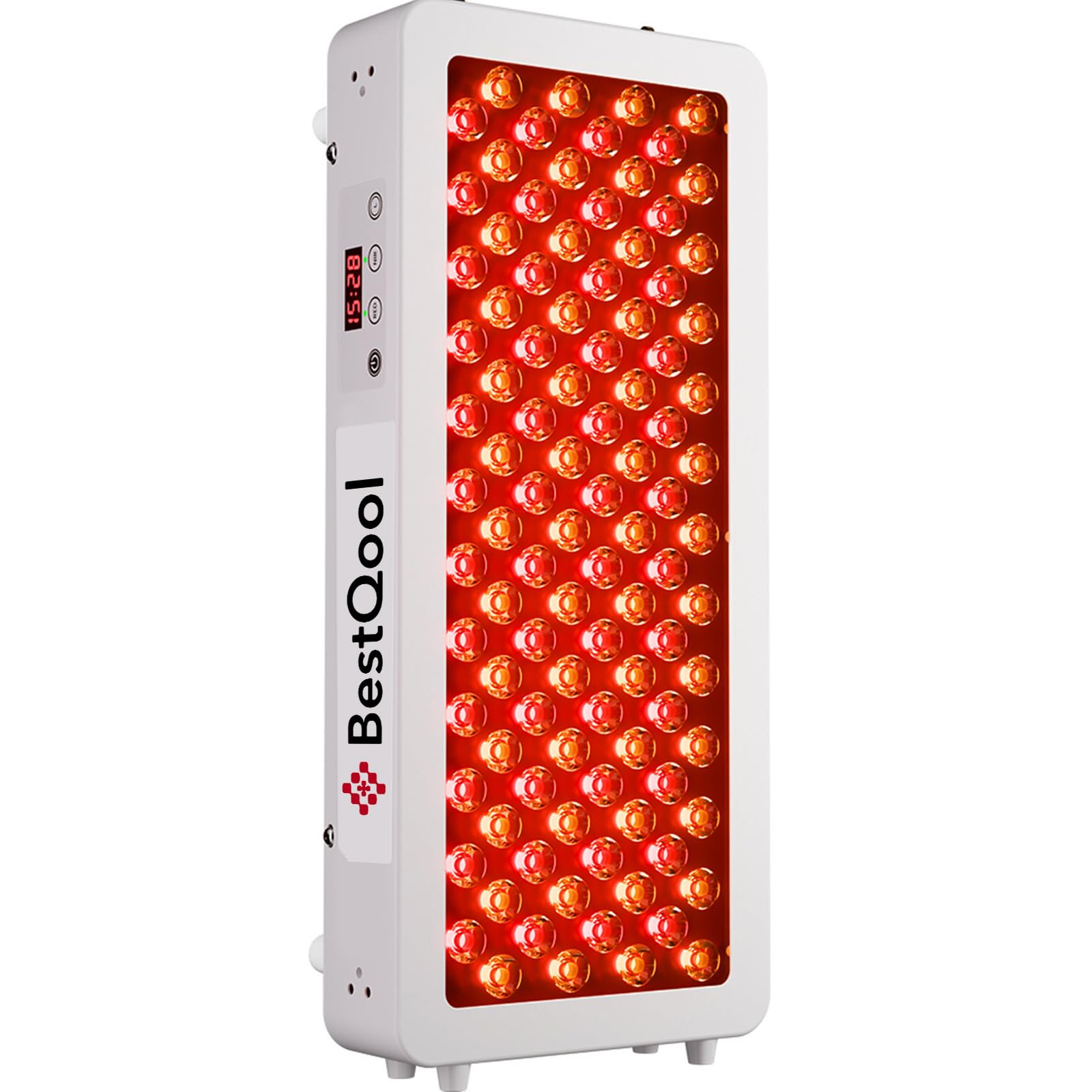
Buy one panel now, bolt on a second later — this is a rig you grow, not a device you replace.
Most panels are a closed box. The BestQool Pro100 has connection holes down its sides, so two or more units link into a wider irradiation area that mimics sunlight more closely than a single panel can. That modular idea is the reason to pick it: start with one 19.7-by-8.4-by-2.6-inch panel for a shoulder, add another when you want full-body coverage. It is rated at 109mW/cm² at three inches of distance, with 60-degree beam angles and dual-chip LEDs running red and near-infrared. Three modes let you run red, near-infrared, or both, and heat release stays low enough for skin contact.
Pain relief is what buyers mention most in feedback on this panel, and the reports are unusually specific. Reviewers report frozen shoulder inflammation easing, years-old plantar fasciitis calming enough to finish a half marathon, and an ankle sprain recovering faster. Sleep quality and general aches follow close behind. The build feels hefty and professional, the buttons are simple, and it auto-shuts off so a session does not run long.
Two things to plan for. The hanging setup is fiddly and the printed instructions are not clear, so most people end up improvising a mount or buying a stand separately. And at 6.59 pounds it is not a carry-around device — this lives where you put it. Set it up once, correctly, and the annoyance disappears.
Why the modular design earns its keep: connection holes let you join panels into a larger array, and 109mW/cm² at three inches is dense output for a single unit.
What to sort out before it arrives: the hanging hardware and instructions — neither is clear, so plan your mount in advance.
Go here if: you expect to expand — linking panels is a feature almost nothing else in this list offers.
Skip if: you want something you can move from room to room without a permanent mount.
9. iRestore Red Light Therapy for Face, 360 LED Face Mask
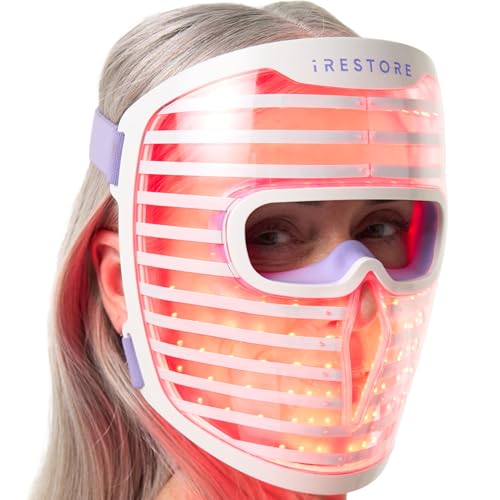
360 LEDs is the biggest array on this list, and it barely touches your face.
The iRestore mask packs 360 LEDs into a dual-strap shell that hovers over your face rather than pressing against it. Three wavelengths do the work: red at 635nm, infrared at 830nm and blue at 415nm, so you can target fine lines, tone, or breakouts depending on the mode. Ten-minute sessions, three to five times a week, are the stated routine, and a built-in timer handles the countdown for you. The external battery is replaceable and recharges magnetically, and it doubles as the control unit, so there is no separate remote to lose.
Quality is what this mask is known for, and it is the most-discussed thing about it by a wide margin, with ease of use right behind. Owners describe the straps holding the shell in place without adjustment and the eye protection blocking direct light well enough to keep your eyes open. Skin reports come in fast for some — smoother, healthier-looking skin inside the first week — while the fuller picture settles around twelve weeks. It is light enough to wear while walking around, which is not true of several masks here.
The fit is the deciding factor. The nose space sits low, so anyone whose nose bridge runs close to their mouth will feel pressure across a ten-minute session — enough that some return it inside a day. If your nose sits higher, the shell clears it comfortably. Blue light is also part of the built-in modes, which matters if blue is something you specifically avoid.
What makes it the busiest array here
- 360 LEDs — the highest count in this list — across red, infrared and blue
- Hovers clear of the face with strong eye protection, so you can stay active
- Replaceable external battery with magnetic charging and a built-in 10-minute timer
- Sessions of 10 minutes, three to five times a week, no gels or downtime
Check this against your face
- The nose cutout sits low, so a low nose bridge can mean real pressure
- Three Velcro strap sets take trial and error to dial in
- The lithium-ion battery must travel as carry-on if you fly with it
Strongest fit for: a face-only routine where LED density is the priority and you want to move around while it runs.
Measure first: your nose bridge — that cutout is the one thing that sends this mask back.
Know the Specs
Wavelength in nanometers (nm)
The number after the letters tells you the colour and, roughly, how deep the light goes. Red sits around 630–660nm and works closer to the surface, which is why skin-tone devices lean on it. Near-infrared sits around 810–850nm and travels further into tissue. Blue around 415–470nm and yellow around 590nm show up on masks aimed at breakouts and tone. A device quoting five wavelengths is not automatically better than one quoting two — what matters is whether you can run each separately, so you know which one you are reacting to.
Irradiance in mW/cm² and joules
Irradiance is how much light energy lands on a square centimetre of skin each second, written as mW/cm². It is meaningless without a distance beside it, because the same panel drops off sharply as you move away. Joules measure total energy across a whole session rather than per second — one panel here quotes 21,720 joules in a 10-minute session. When you compare two devices, check the irradiance figure was measured at the same gap for both.
Dual-chip LEDs and LED count
A dual-chip LED carries two wavelengths in a single diode, so one 60-LED dual-chip panel does the work of two separate arrays in half the space. A higher LED count spreads light over a larger area, which matters on a mask covering a whole face. It does not, on its own, mean more energy reaches your skin — output strength depends on how the diodes are driven. Read count and irradiance together, never count alone.
Flicker-free output, cooling and timers
Flicker-free means the LEDs hold steady rather than pulsing on and off at a rate you may not consciously see. For a device held near your eyes for minutes a day, that is worth having. Cooling fans protect the LEDs from heat degradation, which is why panels with internal fans tend to hold their output over years. And an auto-off timer is the quiet hero — it ends a session while you are relaxed, so a ten-minute treatment never stretches into forty.
Common Questions
What is the difference between red light and near-infrared in these devices?
How long should a session last on an LLLT device?
Should I buy a panel or a face mask first?
Is a higher LED count always better?
What does mW/cm² actually mean on these panels?
Why do some masks say yellow light only works on the neck piece?
How do I know a panel’s wavelength claim is accurate?
Can I link two panels together for a larger treatment area?
Why does my mask feel heavy or slide down during a session?
Do these devices need eye protection?
The Bottom Line
For most people, the lllt device that makes the most sense is the Hooga PRO300, because 60 dual-chip LEDs running 660nm and 850nm with independent controls cover a face and a back in the same session, and the 3-year warranty covers the part that fails first. If you want neck and chest treated together rather than one at a time, the INIA face, neck and chest set isthe only paired system here. And for a single stubborn joint you want to work on in the same spot every day, the MitoMIN 2.0 is the one to reach for, with third-party irradiance verification behind its 660nm and 850nm output.
What separates a device you keep using from one that ends up in a drawer is rarely the brand name. It is whether the wavelengths match the job, whether the output is dense enough at the distance you actually sit, and whether the form suits the body part you want to treat. A panel that covers a back will not wrap a jawline. A mask that hovers over your cheeks will not reach a knee. Pick the shape first, then check the wavelength pair, then check the LED count as the last tiebreaker rather than the first.
One nudge worth making: the category rewards consistency more than it rewards spending. Every pick here is built to run a short daily session, and the difference between the top tier and the mid tier shows up in glass and housing as much as in light. Start with the form that matches your routine, run it for a month, and let the habit decide whether you ever need a bigger rig.
How we choose
We do not accept paid placement. Every pick is matched to a real buyer and a real use-case; we do not hands-on test units.
Sources
Specifications: manufacturer listings and product documentation. Review insights: verified customer reviews, as of October 2026. Pricing: not shown on this page (it changes often); check the current price via the retailer link.
As an Amazon Associate, Aappliancez earns from qualifying purchases. This does not affect which products we feature.