Disclosure: Some links in this post are affiliate links. As an Amazon Associate I earn from qualifying purchases, at no extra cost to you. Learn more
Specs are compiled from manufacturer listings and verified buyer reviews and can change over time — please confirm the key details on the product page before buying.
You want to record what you’re actually seeing — the trail, the concert, the kid’s game — without holding a phone in front of your face. That’s the whole promise of live stream glasses. Three things separate a pair you wear daily from one that ends up in a drawer: how long the battery survives, how smoothly the footage comes out while you move, and whether the frames actually fit your head. This guide sorts the strongest options by those three realities, not by marketing copy.
This guide is built by comparing the manufacturers’ published specifications and the patterns across verified customer reviews, so you get each pick’s real strengths and trade-offs instead of marketing spin.
The category has matured fast, and the gap between a gimmick and a genuinely useful pair is now mostly about battery and stabilization. Below you’ll find the honest breakdown of the live stream glasses worth wearing.
Top Picks
How To Choose The Best Live Stream Glasses
Most people assume the camera is the hard part. It isn’t. The camera is now good enough on almost every pair here. The hard part is wearing them for hours without the battery dying, the footage shaking, or the frames sliding down your nose. Shop with those three in mind and you’ll skip the returns.
Battery capacity tells you more than the hour rating
A battery measured in mAh (milliamp-hours — how much charge the cell physically holds) is the honest number. The advertised playtime is often measured with music only, or with everything switched off. A 290mAh cell in a pair rated for 7 hours of music will not give you 7 hours of video. Recording is the hungry task, so expect far less filming time than listening time on any pair. Plan your shooting in short bursts rather than one long session.
Stabilization is what separates watchable from shaky
EIS (electronic image stabilization — software that smooths out your movement frame by frame) is the feature that makes hands-free footage usable. Without it, walking footage bounces and cycling footage is a blur. Look for EIS or “anti-shake” named explicitly, and check whether the listing mentions HDR (high dynamic range — software that keeps bright skies and shadowed faces both visible in the same shot).
Lens setup decides whether you wear them daily
Sunglasses you only wear outdoors, clear lenses you wear indoors — the pair you actually reach for is the one that adapts. Interchangeable modular lenses or photochromic transition lenses (glass that darkens in sunlight and clears indoors) turn a camera gadget into everyday eyewear. If you need prescription correction, check for a removable prescription frame before you buy, because not every model offers one.
Fit is not a small detail
Every frame here is built to a fixed shape. Bridge width (the gap across your nose) and arm length (the distance to your ear) determine whether the glasses sit level or slide. If you have a narrow bridge or a wide head, read the fit notes carefully — oversized frames are the most common reason a pair goes back. A lanyard or rubber nose grips help, but they cannot fix a frame that is fundamentally the wrong shape.
Side-by-Side Comparison
| Model | Best For | Camera | Battery | Lens Setup | Amazon |
|---|---|---|---|---|---|
| Meta Ray-Ban (Gen 1), Skyler★ Best Overall | Everyday hands-free content | 12 MP ultra-wide + five-mic | Mixed — some report 3 hours | Transition lenses | Amazon |
| EarlySincere AI Smart GlassesTranslation Leader | Translation and meeting notes | 8MP sensor, 4K UHD with EIS | 290mAh, 7h music / 4h calls | Photochromic + blue light (2 pairs) | Amazon |
| QDOJC POV Sports SunglassesBest for Action Sports | Cycling, running, baseball | 32MP anti-shake, EIS + HDR | — | Polarized blue + prescription frame | Amazon |
| AMZISH AI Smart Glasses | Travel and daily wear | 8MP, 1080P 30fps, 32MP photos | 300mAh, 8h music / 12 min video | Three interchangeable pairs | Amazon |
| MSCGLYXGS AI Smart Glasses | Budget travel vlogging | 8MP, 1080P with anti-shake | 290mAh, 7h audio / ~1h video | Color-changing lenses | Amazon |
| Meta Wayfarer Transitions | Style-led everyday streaming | 12 MP ultra-wide + five-mic | ~6 hours reported | Clear to graphite green transitions | Amazon |
| Meta Oakley HSTN | Athletes and activity metrics | 12 MP, 100° FOV, 3K video | Up to 8h + 48h charging case | Prizm / Prizm Polarized / Clear / Transitions | Amazon |
| Meta Ray-Ban (Gen 2), Skyler | Longer battery, family filming | Higher quality camera (Gen 2) | Longer than Gen 1 | Transitions | Amazon |
| Meta Ray-Ban (Gen 2), Wayfarer | Iconic frame, iPhone users | Higher quality camera (Gen 2) | Longer than Gen 1 | Transitions | Amazon |
Detailed Reviews
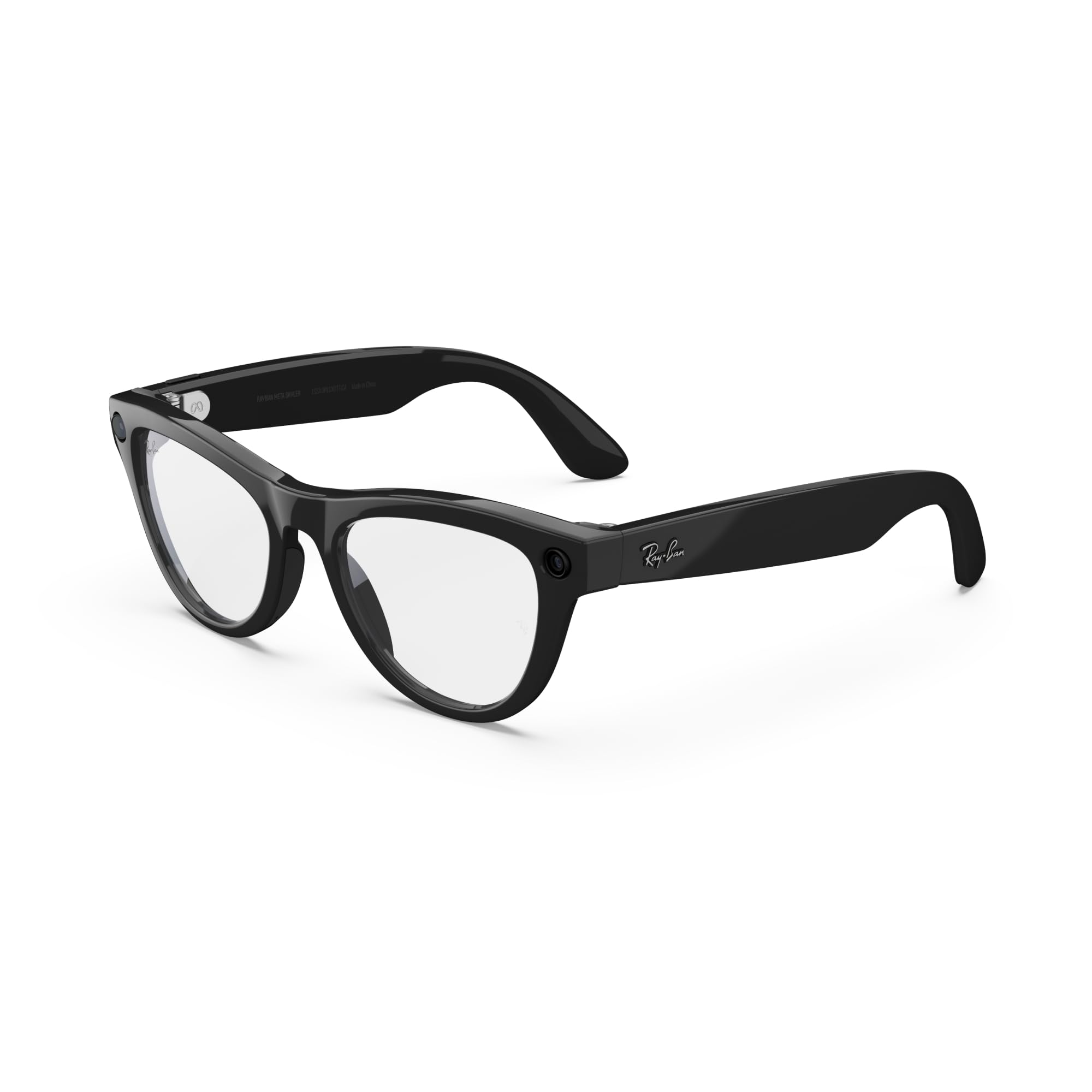
1. Meta Ray-Ban (Gen 1), Skyler AI Glasses
Our pick — 4.0+★ from 1,000+ verified ratings; the strongest balance of quality and price.
The pair that made hands-free recording look like normal eyewear.
This is the one most people picture when they hear “smart glasses,” and for good reason. The 12 MP ultra-wide camera captures exactly what your eyes are framing, which means no more aiming a phone one-handed at a concert or a birthday cake. The five-mic system is what makes the audio work — five microphones (small sound pickups) working together so your voice stays clear while the room noise sits behind it. If you want to livestream to Facebook or Instagram straight from your face, this pair was built for that job.
What wins people over is the look. These read as ordinary Ray-Bans to everyone around you, so you don’t get the “why are you filming me” stare that a chest-mounted action cam earns. Owners describe them as a genuinely good buy for creators who want to record without fussing with gear. One owner’s grandmother, who got a pair as a gift, now shoots better photos than she ever managed with a phone.
The honest catch is the battery and the setup. Some buyers report music playback running only around 3 hours, and the app occasionally asks to restart or drops the connection even with the phone nearby. If your plan is a two-hour livestream in one take, plan around a charge. For everyday short-form recording, the trade-off is easy to live with.
What earns them a spot on your face
- 12 MP ultra-wide camera with a five-mic system for livestreaming to Facebook and Instagram
- Open-ear speakers that deliver audio without blocking the room around you
- Real-time translation between French, Italian, Spanish, English, German and Portuguese with no WiFi needed
- Looks like a normal pair of Ray-Bans, so it never feels like tech strapped to your head
Where the trade-off sits
- Battery is the recurring gripe — some owners mention music lasting around 3 hours
- The Skyler frame runs large and wide, which suits some faces far better than others
- App restarts and occasional disconnections are part of ownership, not a one-off fault
Wear these if: you want a camera that disappears into your everyday glasses and you record in short bursts rather than marathons.
Try the Oakley HSTN instead if: you need the sunglasses to do real sun-blocking work — Skyler’s sun protection is the one aspect owners push back on.
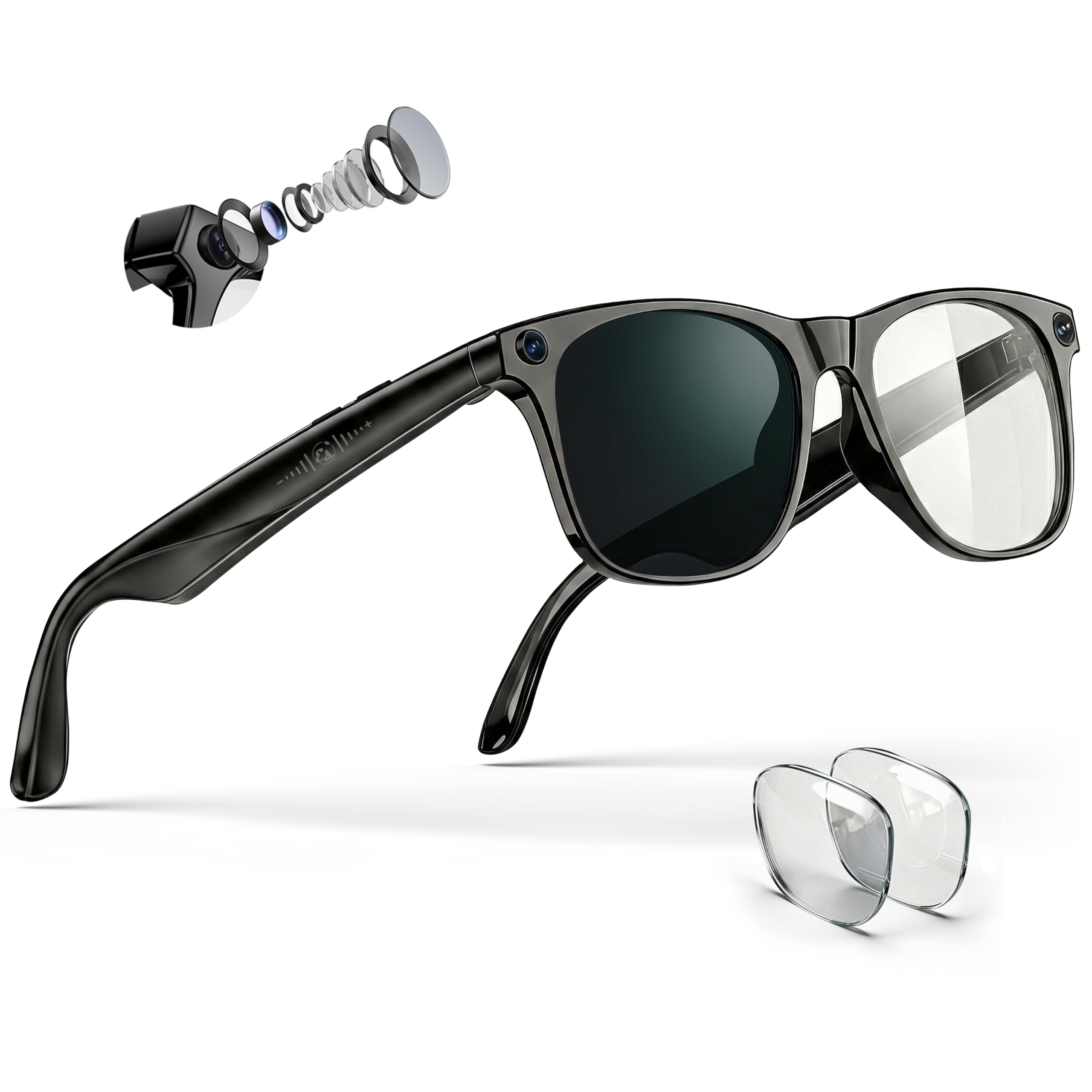
2. EarlySincere AI Smart Glasses with 4K Camera & ChatGPT
Built for the traveler who needs to read a menu in a language they don’t speak.
The headlining feature here isn’t the camera — it’s the translation. The EarlySincere handles 100+ languages with a claimed 0.1s response (the brand says replies come back almost instantly), and it runs three separate modes: Face-to-Face (each person speaks and hears the reply), Simultaneous Interpretation, and Meeting Minutes, which converts speech to text and mind maps as you go. If your work involves calls with people in other countries, that last one is the reason to look at this pair over the Ray-Bans.
The camera side is an 8MP sensor delivering 4K UHD footage with EIS stabilization, so moving shots come out steadier than the number alone would suggest. Sound comes from F0 280 HIFI speakers with dual-mic noise cancellation for calls. Connectivity runs on Bluetooth 5.4 with a claimed 10m range, and the TR90 frame is rated IP65 — resistant to dust and splashes, not submersion. You get two lens pairs in the box: photochromic and blue light blocking.
Here’s the part the spec sheet won’t tell you: the software experience is uneven. The companion app’s noise reduction has a habit of fading video audio in and out, and one disappointed buyer noted the assistant simply didn’t respond, which gutted the entire reason for the purchase. Battery was also reworked over time — after a replacement unit, half the charge went in roughly 30 minutes of recording, which customers note as a meaningful improvement over the original unit’s behavior. Buy it for the translation stack, and temper your expectations for the AI.
What the box actually contains: the glasses, a magnetic charging wire, a cleaning cloth, a triangular case, a storage bag, anti-slip ear hooks, and two interchangeable lens pairs — photochromic and blue light. That’s a more complete kit than most rivals ship.
The part that needs patience: the frame runs oversized on a lot of heads, and the app is where the friction lives. Translation features are free for life on the app with no restrictions, which is a real commitment in a category that often charges subscriptions.
Reach for these when: translation, transcription, and meeting minutes are the job, and the camera is a bonus.
Look elsewhere if: you want a polished, dependable voice assistant — this is the pair most likely to need troubleshooting.
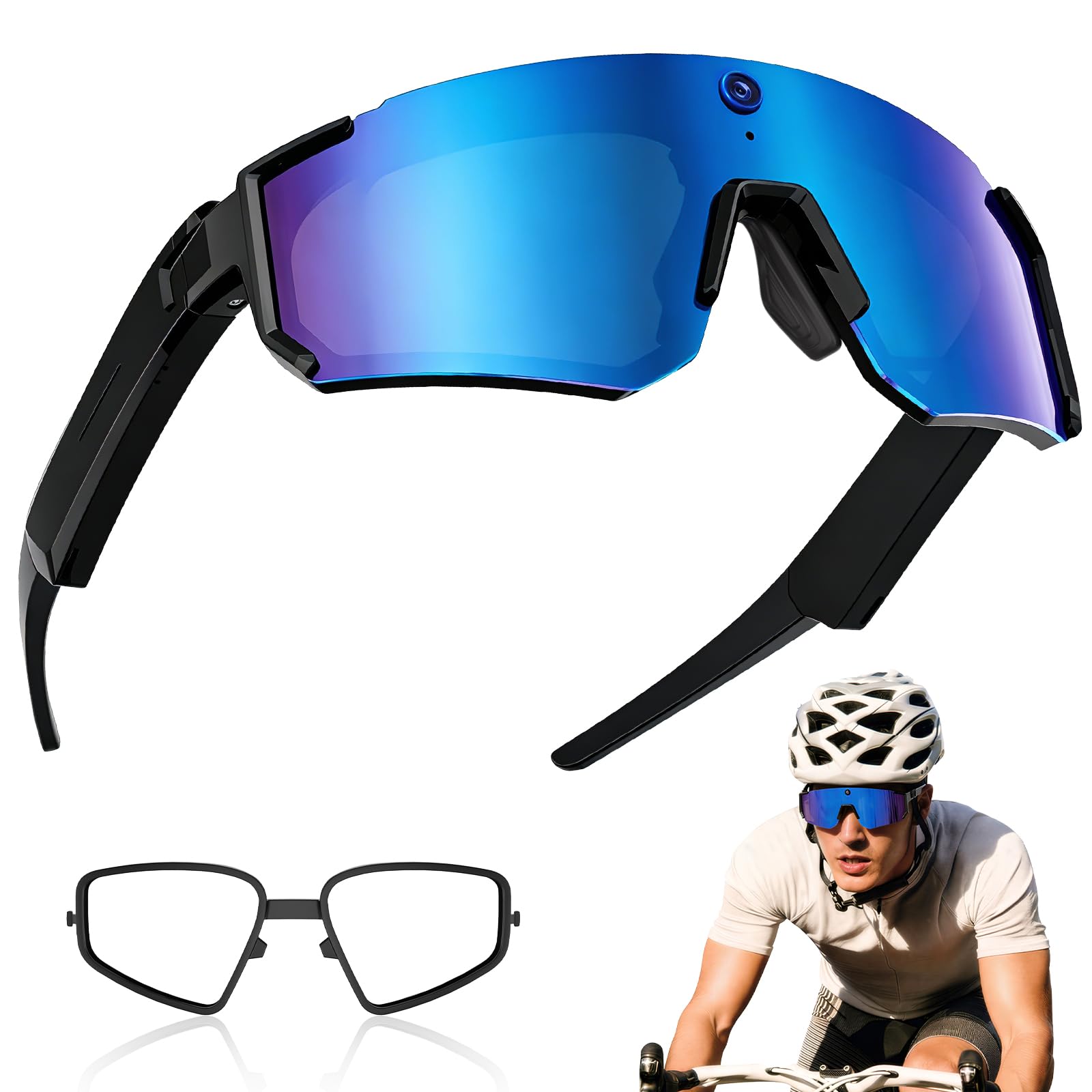
3. QDOJC Smart Glasses
A POV camera for the trail that blocks glare and survives a light rain.
The QDOJC earns its place on the strength of its stabilisation and its lens. The 32MP anti-shake camera pairs with EIS and HDR to keep fast breaks, goals, and downhill runs from turning into a smear, and the blue anti-glare lenses cut glare while blocking UV. The IP64 rating means dust and light rain won’t end the run. Bluetooth 5.3 pairs quickly and transfers clips to your phone in seconds, so you can post while you’re still catching your breath.
Sports buyers will appreciate the small design choices. Anti-slip rubber nose pads and temple grips keep the frame steady during activity, the curved lenses reduce fogging, and a safety lanyard is included so a rocky trail doesn’t cost you the pair. There’s a removable prescription lens frame too — you can add your own correction and still record. Dual mics with ENC (a noise-reduction process that separates your voice from wind and background) keep calls clear when you’re moving.
The recurring gripe is the app. When it connects, the photos and video come out very clear, but a bad connection renders the camera useless, and there are no workable instructions for viewing or transferring footage if it fails. Buy this as an action recorder with decent odds on the app, not as a guaranteed one-tap workflow.
On the quality front: footage clarity is what earns the most goodwill here, and it’s paired with a frame that sits like normal glasses — most people around you won’t clock the camera.
One thing to weigh: the photochromic behavior on the lenses is only partial. They shift toward a light grey rather than a deep tint, so this isn’t the pair for full sun.
Best for: cyclists, runners, and ballplayers who want hands-free POV footage in a frame that stays put on rough ground.
Think twice if: you need deep sunglasses or a rock-solid app — this is the value play, not the polished one.
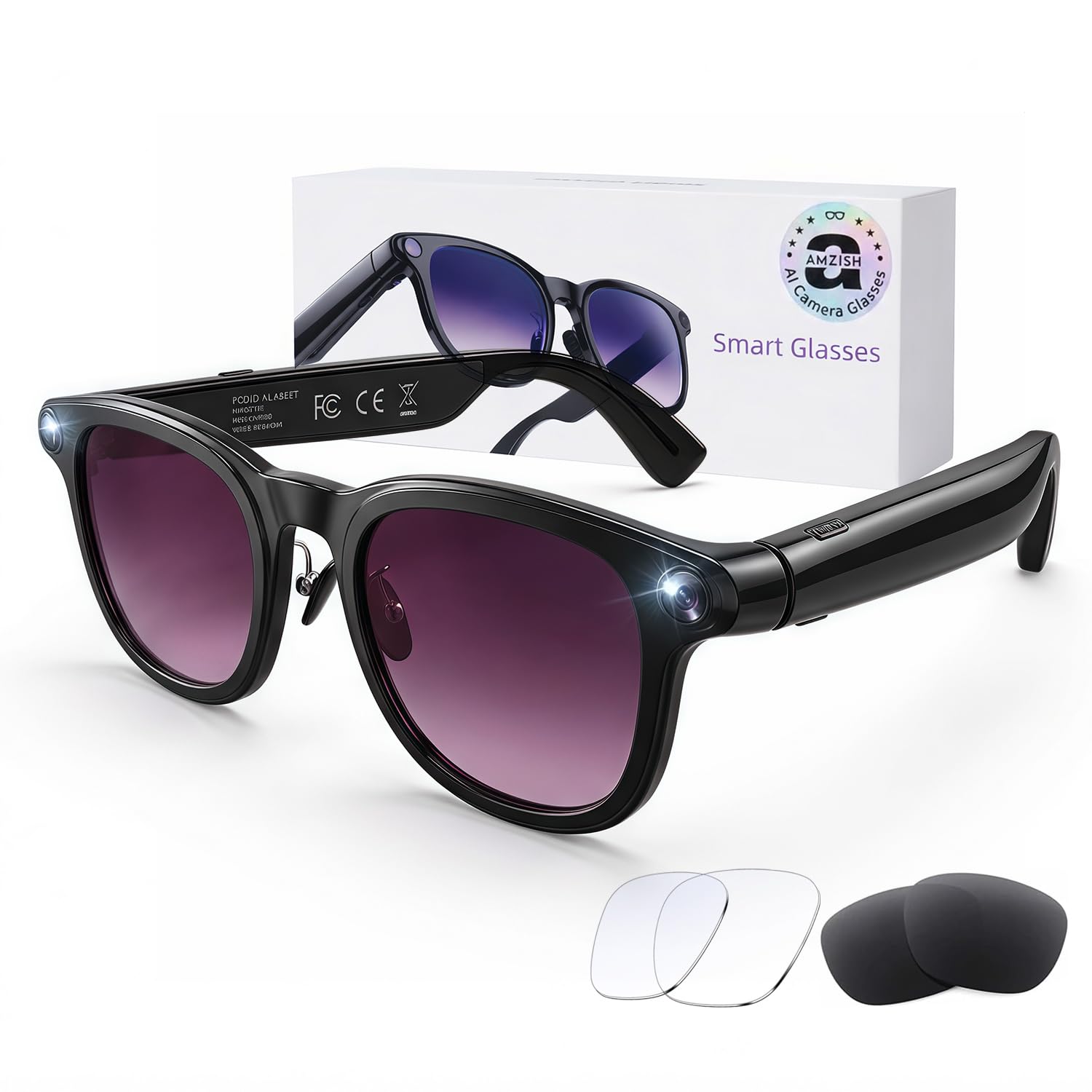
4. AMZISH AI Smart Glasses with Camera, 8MP HD Camera Glasses
Three lens pairs and 144 languages make this the travel-day workhorse.
Where the Meta pairs push you toward one look, the AMZISH hands you a wardrobe. You get a pair of blue light clear lenses (they filter screen glare), a pair of UV protection black lenses (they block sun rays), and a pair of red polarizing lenses (they cut glare off water and roads) in the box — switch them and the same frame goes from office to beach to evening. The camera is an 8MP HD lens shooting 1080P video at 30fps (30 frames per second, which keeps motion smooth) with 32MP still photos, smoothed by multi-frame noise reduction (it blends several shots to cut grain) and an upgraded stabilization algorithm (it steadies the picture as you walk). That’s a combination built for the person who films in a lot of different places.
The AI side leans on both ChatGPT and DeepSeek models for instant translation across 144 languages, with no phone needed. Voice wake-up, object recognition, and smart dialogue are all on the table. Battery sits at 300mAh, rated for up to 8 hours of music playback or 12 minutes of continuous recording per session. Bluetooth 5.4 and WiFi handle syncing, and the frame is rated IP65 against sweat and splashes.
The fit is the deal-shaper. One owner found the single generic size ran narrow across a high nose bridge with no adjustability, and described the audio and video as okay but capped at 1080p with no 4K option. The jointed arms and swiveling rubber nose grippers help on different head shapes, though the frame is heavy enough that long sessions get uncomfortable. Camera reliability is a genuine risk too — several buyers dealt with the camera quitting inside a few uses or the video download breaking a month in.
Why the versatility is real
- Three lens pairs included — blue light clear, UV black, and red polarizing
- 144-language real-time translation via ChatGPT and DeepSeek, no phone required
- 300mAh battery rated for up to 8 hours of music or 12 minutes of continuous video
- Bluetooth 5.4 plus WiFi for instant backup and manual transfer to your phone album
What you should know
- Camera and video recording failures show up in the reviews, always after the return window
- The frame is one size, so it either fits your bridge or it doesn’t
- 1080p is the ceiling — there is no 4K option on this model
Fits best when: you want one frame that covers work, outdoors, and travel without buying three pairs of eyewear.
Not the pick for: a narrow nose bridge or anyone who needs guaranteed 4K — check the fit before the specs.
5. MSCGLYXGS AI Smart Glasses with Camera and Bluetooth
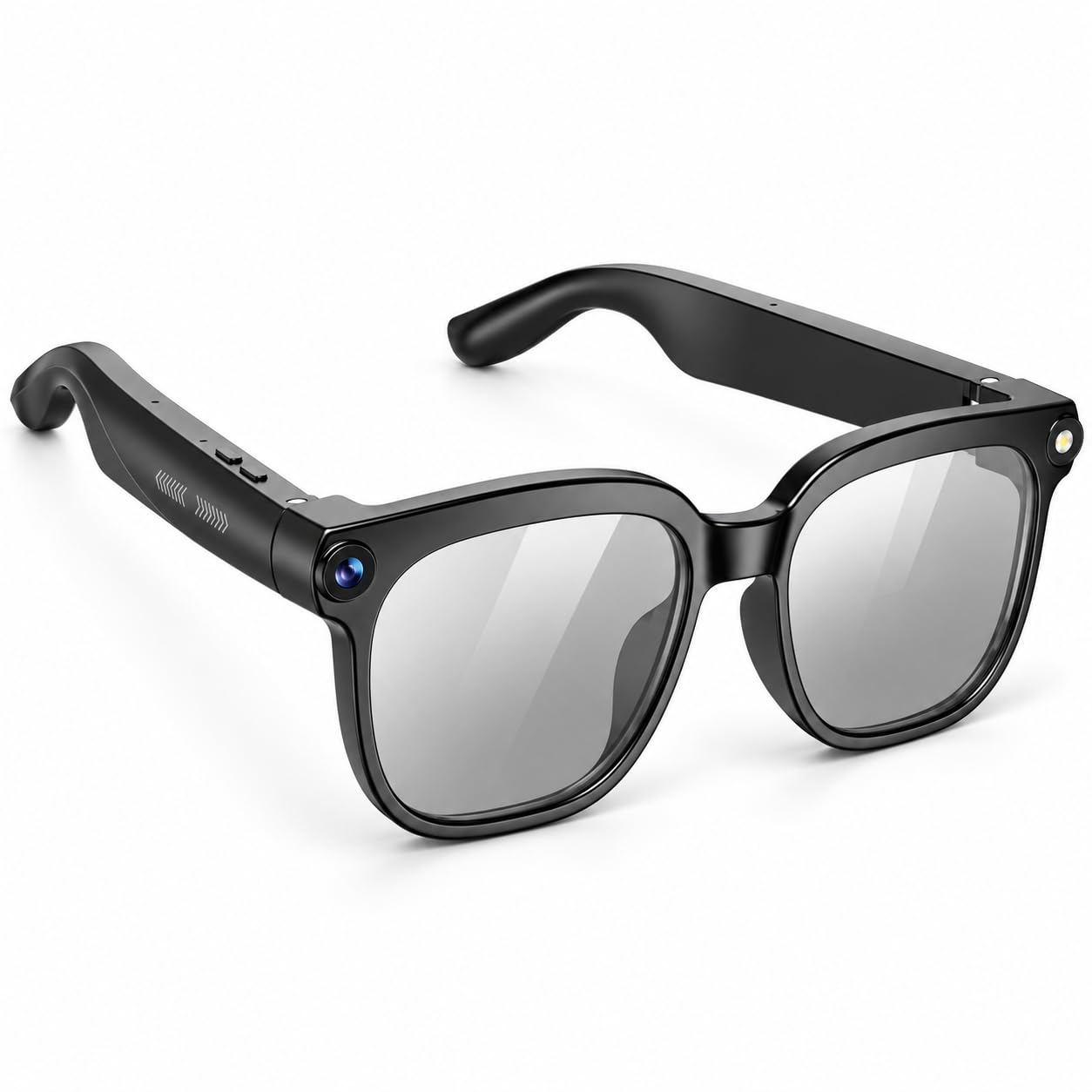
The entry-level pair that gets the basics right and the extras right-sized.
An 8MP camera shooting 1080P HD video with anti-shake, multi-frame noise reduction, and HDR is a sensible package for someone testing the water. The color-changing lenses auto-adjust indoors and out, so you’re not swapping eyewear between the office and the commute. AI visual recognition identifies objects, menus, landmarks, and plants with instant voice feedback, and ChatGPT handles spoken questions when you want to look something up without reaching for your phone.
Battery is a 290mAh cell rated for up to 7 hours of audio playback or about 1 hour of video recording, and the glasses charge in about an hour. That one-hour video ceiling is the number to hold onto — this is a short-burst recorder, not a livestreaming rig. Bluetooth 5.4 plus WiFi dual-transfer pushes photos and video to your phone automatically, and three-point ergonomic support keeps the frame steady on the face.
Where it stumbles is consistency. Video transfer over WiFi is the weak link and can fail repeatedly, and one reviewer noted clips cutting out at random. Hair touching the gesture sensors can pause or skip playback, which is a genuine nuisance for anyone with long hair. Sound is decent rather than rich, and the frame runs somewhat heavy for all-day wear. What you’re really buying is usability at an entry-level outlay — the app is friendly, and the glasses hold their charge.
The everyday win: wearable awareness. On a ride, open-ear audio keeps music and calls going while traffic stays audible, which is why owners keep them on.
The honest limitation: limited functionality and battery life, in the words of owners who expected more. It’s a good first pair, not a long-term one.
Worth it for: a first set of camera glasses where the goal is learning the workflow before spending more.
Pass if: you need video that syncs reliably or sessions beyond an hour — both are capped here.
6. Meta Wayfarer

The icon frame, now with a camera and a livestream button.
The Wayfarer silhouette does more work than any spec sheet can claim. It’s the shape people already wear, which means the 12 MP ultra-wide camera and five-mic system hide inside eyewear that looks entirely at home on a commute. Livestream to Facebook and Instagram straight from the glasses, flip between your phone camera and the glasses’ POV mid-call, and take hands-free calls or join work meetings over Bluetooth. Real-time translation covers French, Italian, Spanish, English, German, and Portuguese with no WiFi needed.
Its 15cm arm length and 22mm bridge width give it a fit that most faces settle into easily, and the resin frame keeps it light enough for hours. Open-ear speakers deliver the audio without covering your ears, so conversations and traffic both stay audible. For zip lining, gym sessions, and work events, owners describe these as the pair they keep reaching for rather than the novelty they expected.
The transition lenses are the honest weak point. They work, but they don’t go very dark in shade, and a handful of buyers found them failing outright within months. Battery runs around 6 hours, less with music, and a full charge takes 20 minutes. Notifications can interrupt a conversation mid-sentence, which is a small thing that gets annoying. Buy it for the frame and the camera; treat the tint as a bonus, not a sunglass replacement.
The case for the Wayfarer
- 12 MP ultra-wide camera with a five-mic system and native Facebook and Instagram livestreaming
- Strong noise-canceling call quality and open-ear audio that keeps you aware
- Hands-free texting with read-back and reminders, without pulling out your phone
- A frame shape that already looks like everyday eyewear
The honest caveats
- Transition lenses stay light in shade and are the most common durability complaint
- Roughly 6 hours of battery, less when music is playing
- Meta AI is capable but basic — closer to a novelty than an assistant
Choose this if: you want the most recognizable frame in the category and you film short everyday moments rather than long sessions.
Skip the transition version if: you need real sun protection — the tint is the weakest link here.
7. Meta Oakley, HSTN AI Glasses
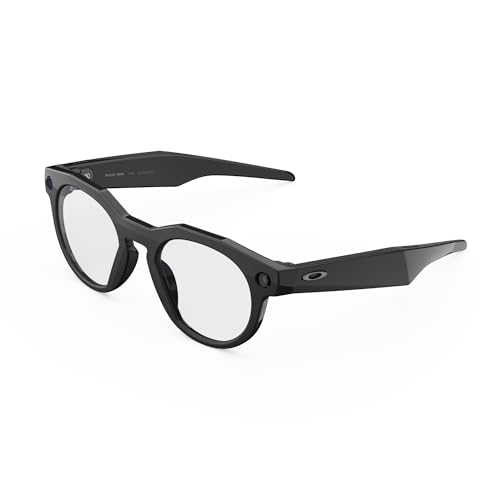
The only pair here that ships with a charging case good for two extra days.
Battery is where the Oakley HSTN separates itself. A charged pair lasts up to 8 hours of typical use, and the included charging case adds 48 hours of charging on the go. Compare that to the roughly 6-hour figure reviewers point out on the Wayfarer and the case alone changes how you travel with these. At 53.15g the frame sits heavier than a plain pair of glasses, but it’s built to stay put through movement.
The camera is a hands-free 12 MP unit with a 100° field of view (how much of the scene the lens takes in), recording 3K Ultra HD clips up to 3 minutes per session. Say “Hey Meta” and it shoots, so you’re never fumbling for a button mid-run. Open-ear audio and Bluetooth handle music and calls, and Meta AI gives you live translation plus the kind of contextual answers an athlete actually wants — wind conditions on the golf course, surf reports before you paddle out. You can also layer performance metrics from Garmin devices or Strava onto your photos and video.
Durability is the question mark. One owner had water enter the speaker area from light rain or drizzle, leaving the glasses unable to power on, and the warranty process afterward was slow and unclear. Lens choice is the widest in this lineup — Prizm, Prizm Polarized, Clear, and Transitions — so pick the version that matches your sport rather than the default. For most buyers the battery and the 100° field of view outweigh that risk.
What keeps people wearing them: the camera quality holds up over months of use, and the battery routinely finishes a workday with charge to spare, even after photos, video, and questions.
What to plan around: they’re not built to shrug off rain. Treat them as fair-weather gear and keep the case handy.
The right call for: runners, golfers, and cyclists who want a day of battery plus a case that covers a weekend trip.
Not for you if: you get caught in weather often — the speaker area is the vulnerable spot.
8. Meta Ray-Ban (Gen 2), Skyler AI Glasses
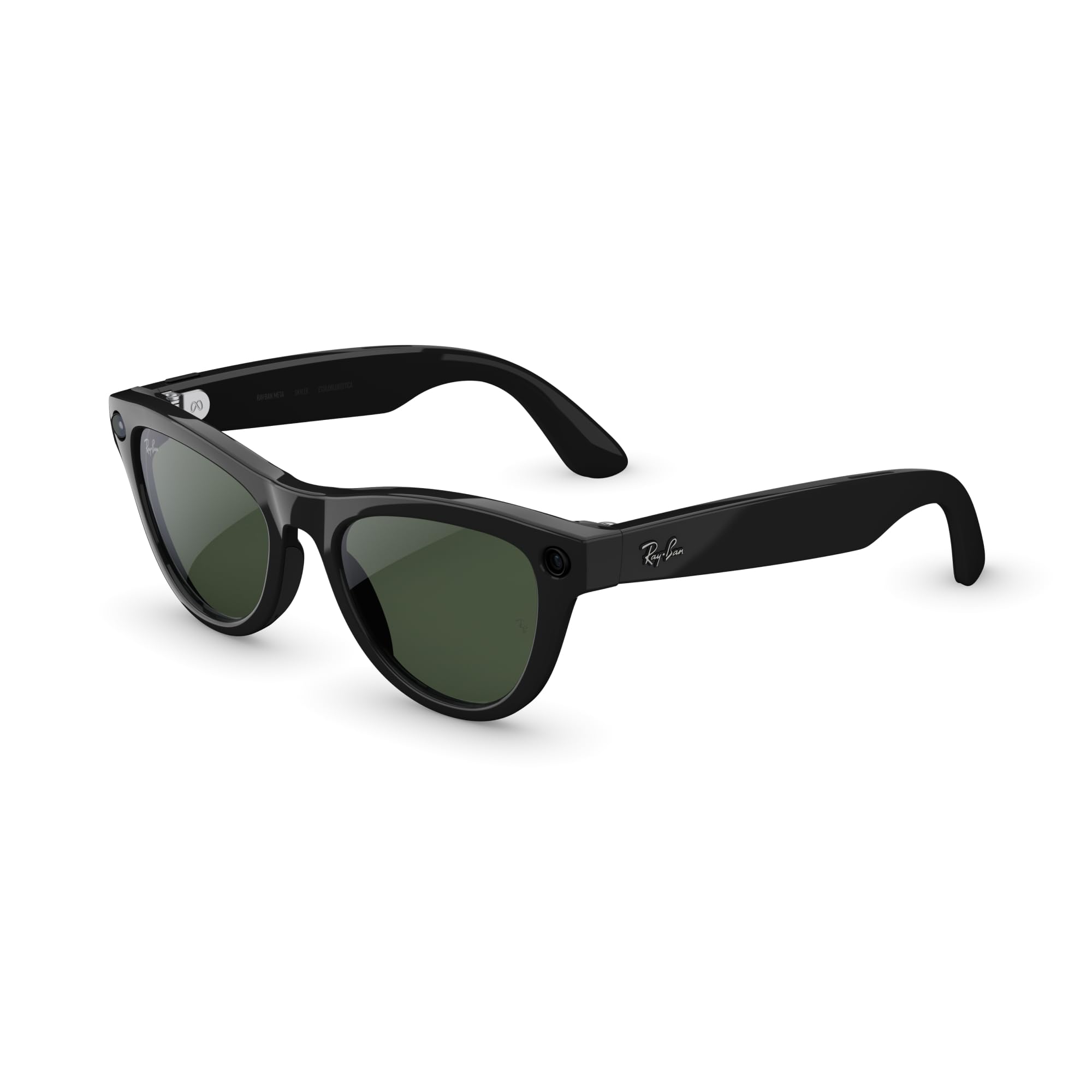
The second-generation Skyler, where the battery finally stops being the story.
Meta’s own description of this generation names the two changes that matter: a longer battery life and a higher quality camera. Those are the two gripes that dogged the first Skyler, so if you were on the fence about the original, this is the version aimed at you. Everything else carries over — Meta AI for hands-free questions, real-time translation, music control, and hands-free calls, all without reaching for your phone. The slim Skyler fit is designed to wear from morning until night.
Where this pair earns its keep is family moments. Owners describe filming a kid’s game while actually watching it, hands free, which is the whole pitch of the category in one sentence. The microphone, camera, and audio all draw praise for travel and for situations where hands aren’t free — on a bicycle, for instance. The transition lenses adapt to changing light, and the frame is comfortable enough for full days.
Two costs are worth naming. The AI is inconsistent — one owner described it contradicting its own capabilities, playing music unprompted, and ignoring stop commands, calling it closer to a beta than a finished assistant. And there’s the durability question that follows any integrated electronics frame: hardware failures get expensive once you’re past the return window. The improvements over Gen 1 are real; the AI still needs another pass.
The upgrade that counts: a longer battery and a better camera address exactly what owners of the first generation flagged. That’s a rare case of a follow-up fixing the right things.
The one to watch: the AI behaves like unfinished software. Use it for translation and voice prompts, not as a reliable assistant.
Buy this version over Gen 1 if: you liked the Skyler shape but the battery held you back.
Hold off if: a dependable AI assistant is the main reason you want smart glasses.
9. Meta Ray-Ban (Gen 2), Wayfarer AI Glasses
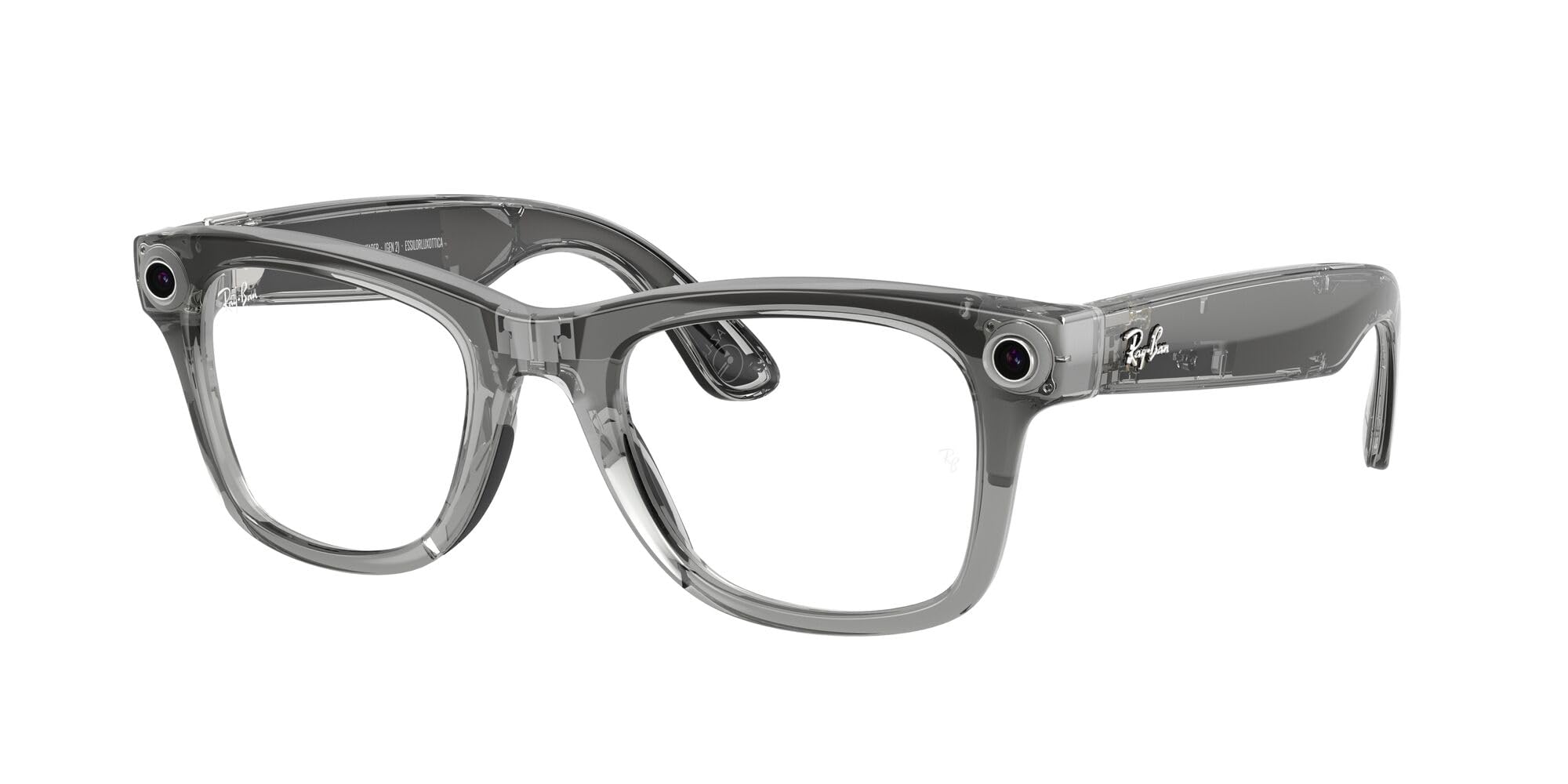
The Wayfarer’s second act, with a better camera and a battery that lasts.
Same frame, better guts. The Gen 2 Wayfarer takes the shape people already own and adds the longer battery life and higher quality camera Meta built into this generation. Capture photos and video, control your music, take hands-free calls, or translate conversations in real time — none of it requiring you to touch your phone. The slim, comfortable fit is designed to stay on from morning through evening.
There’s one genuinely moving use case in the reviews that shows what these are worth beyond vlogging. One legally blind buyer’s son uses them to read restaurant menus aloud so he can order for himself, and to read spice and can labels while cooking. In that same household, the glasses accurately named room objects and colors on the spot. That’s a different job than livestreaming, and this pair handles it. One owner noted it works best with an iPhone, with Android less well supported.
The friction points are fit, connectivity, and value. Fit is the most-discussed issue and it cuts both ways — comfortable for many, off for others because every frame is one fixed shape. Connection drops happen intermittently, and setup, while easy via a phone walkthrough, doesn’t solve a weak link. Several owners argue the tech is cool but gimmicky, with durability unproven over the long run. If you wear Wayfarers already, those complaints shrink to tolerable; if you’re buying for the tech alone, they don’t.
Why the frame wins
- Real-time translation and hands-free calls in the widest-worn silhouette in eyewear
- Second-generation camera and battery improvements over the original Wayfarer
- Described as easy to set up and easy to use, with good video quality
- Capable of reading menus and labels aloud, which some buyers find genuinely useful
Fit notes worth reading
- The frame is one fixed size and fit is the most-discussed issue
- Intermittent disconnections are a recurring experience
- Transition lenses don’t darken as fully as photos suggest
Made for: anyone already comfortable in a Wayfarer who wants the second-generation camera and battery without changing shapes.
Look at another shape if: the classic frame has never quite sat right on your face — this one doesn’t adjust.
Know the Specs
Battery Capacity vs. Battery Rating
The number on the box — 7 hours, 8 hours, a full day — is almost always measured with the lightest task, usually music playback. The mAh figure is the physical size of the cell (milliamp-hours, how much charge it holds), and it’s the more honest guide. A 290mAh battery and a 300mAh battery will behave similarly in real use. Video recording burns through charge far faster than audio, so plan on short shooting sessions and keep a charging case or cable nearby for anything longer.
Stabilization and Field of View
EIS (electronic image stabilization) is software that smooths your movement frame by frame, and it is the single biggest factor in whether hands-free footage is watchable. HDR (high dynamic range) keeps bright and dark parts of a shot both visible. Field of view, stated in degrees, describes how much of the scene the lens captures — a 100° FOV takes in a wide slice of the action, which suits sports. Both matter more than raw megapixels for video you’ll actually want to post.
Lens Types and Swap Options
Polarized lenses cut glare off water and pavement. Photochromic lenses darken in sunlight and clear indoors, which removes the need for a second pair. Blue light blocking lenses are for screen-heavy indoor work. Interchangeable modular lenses give you all three in one frame, which is the most practical setup for travel. If you wear a prescription, check for a removable inner frame — not every model offers the option, and adding correction after the fact isn’t possible on a fixed lens.
Water and Dust Ratings
An IP rating has two digits: the first covers dust, the second covers water. An IP64 rating resists dust and light rain; IP65 resists dust and water jets or splashes. Neither means submersible, and swimming or full immersion will damage most of these frames. If you ride or run in wet conditions, a splash rating is worth having. If you expect real weather, treat any smart glasses frame as fair-weather gear and carry a case.
Common Questions
Can live stream glasses actually stream to Instagram or Facebook directly?
How long do live stream glasses really last on a charge?
Will these fit over my prescription glasses or take my own lenses?
Can I take these in the rain or wear them swimming?
What’s the difference between the photochromic and interchangeable lens options?
Do these glasses work with an Android phone or only iPhone?
How much video can I record in one go?
Is the Meta AI actually useful or just a gimmick?
Will the frames fit my face if I have a wide head or narrow bridge?
Do these glasses need a phone nearby to record?Not for recording — photos and video save straight to the glasses, and you sync to your phone later. The QDOJC pairs over Bluetooth 5.3 and transfers clips to your phone in seconds, the AMZISH syncs over Bluetooth 5.4 or WiFi, and the MSCGLYXGS pushes files across WiFi automatically. What does need a phone is the app-side work: setup, changing settings, and some AI features. The glasses also keep working as speakers and cameras without a live connection, though several models report disconnecting even with the phone nearby.?
The Bottom Line
For most people, the live stream glasses winner is the Meta Ray-Ban (Gen 1), Skyler because it puts a 12 MP ultra-wide camera (a wide lens that fits more of the scene in) and a five-mic system (five microphones that pick up your voice clearly) inside eyewear that looks like eyewear — and it can go live to Facebook and Instagram straight from your face. If you need the battery to outlast a full day of shooting and a weekend away, the Meta Oakley HSTN is the one to reach for, with up to 8 hours of use and a charging case worth 48 hours more. And for translation, transcription, and meeting minutes, the EarlySincere carries the widest language coverage in this lineup.
Two last things worth saying plainly. First, the camera is no longer the deciding factor — stable footage and honest battery life are, which is why the picks above weight those so heavily. Second, the Smart Glasses category is still young enough that the AI feels like a work in progress on almost every pair. Buy for the camera, the audio, and the fit, and treat the assistant as a bonus that software updates may improve. Shop by the lens setup and frame shape that match how you actually live, and the pair you choose will stay on your face long after the novelty wears off.
How we choose
We do not accept paid placement. Every pick is matched to a real buyer and a real use-case; we do not hands-on test units.
Sources
Specifications: manufacturer listings and product documentation. Review insights: verified customer reviews, as of October 2026. Pricing: not shown on this page (it changes often); check the current price via the retailer link.
As an Amazon Associate, Aappliancez earns from qualifying purchases. This does not affect which products we feature.