Disclosure: Some links in this post are affiliate links. As an Amazon Associate I earn from qualifying purchases, at no extra cost to you. Learn more
Specs are compiled from manufacturer listings and verified buyer reviews and can change over time — please confirm the key details on the product page before buying.
If your recordings pick up the room instead of your voice, the fix is usually the microphone type, not the software. A dynamic mic (a moving-coil capsule that ignores most of what happens behind and beside it) is the plainest answer. This guide ranks the seven dynamic mics worth your attention and tells you honestly which one suits your room, your interface, and the way you actually work.
This guide is built by comparing the manufacturers’ published specifications and the patterns across verified customer reviews, so you get each pick’s real strengths and trade-offs instead of marketing spin.
You will see which mics want a gain-hungry interface, which ones plug straight into USB, and which are built for guitar cabinets rather than speech. Every pick below is judged on the same three things: how much of the room it lets in, how hard it is to drive, and whether it survives a gig bag. That is the whole test behind the best dynamic mic shortlist here.
Top Picks


How To Choose The Best Dynamic Mic
The first question is not which mic sounds best — it is what you are plugging it into. A dynamic mic with low output needs an interface or mixer with plenty of clean gain, or your recordings arrive quiet and hissy. A USB dynamic mic solves that by building the preamp into the body, but locks you to a computer.
Start with your input, not the capsule
XLR mics connect through a three-pin cable into an audio interface, mixer, or PA system. USB mics connect straight to a laptop or desktop over a data cable. If you already own an interface with strong gain, an XLR dynamic mic gives you the most room to grow. If you just want to talk into a computer this afternoon, USB is the shorter road.
Match the pickup pattern to your room
A cardioid pattern (the mic is most sensitive directly in front and rejects the rear) is the forgiving standard for vocals. A supercardioid pattern is narrower and rejects more side noise, but it demands that you stay on axis — wander off and your level drops. In a loud room, that trade is often worth it. On a small quiet stage, the wider cardioid is easier to live with.
Decide between speech duty and instrument duty
Broadcast and vocal mics are tuned to flatter the human voice. Instrument mics are built to sit in front of a guitar cabinet or a drum and often come with a mount that hangs over the speaker. Buying the wrong one is not a disaster — it just means more EQ work later. Pick the job first, and the mic shortlist narrows fast.
Side-by-Side Comparison
| Model | Best For | Connection | Pickup Pattern | Frequency Range | Amazon |
|---|---|---|---|---|---|
| Sennheiser e 609 Silver★ Best Overall | Guitar cabinets and drums | XLR (wired or wireless) | Supercardioid | 40 Hz – 18 kHz | Amazon |
| RØDE PodMicBroadcast Value | Podcasting and streaming | XLR | Cardioid | 20 Hz – 20 kHz | Amazon |
| Logitech G Yeti GX | Gaming desks and USB setups | USB Type-A / USB Type-C | Supercardioid | — | Amazon |
| Sennheiser e 935 | Live vocals on stage | XLR | Cardioid | — | Amazon |
| Shure SM58S (2 Pack) | Rented-out gigs and shared stages | XLR | Cardioid | 50 Hz | Amazon |
| Shure MV7+ | Flexible podcast and studio work | USB-C and XLR | — | 50 Hz – 16 kHz | Amazon |
| Electro-Voice RE20 | Broadcast voice and instruments | XLR | Cardioid | — | Amazon |
Detailed Reviews
1. Sennheiser e 609
Our pick — 4.5+★ from 900+ verified ratings; the strongest balance of quality and price.
The amp mic you drape over the speaker and forget about.
If you record or gig with an electric guitar cabinet, this is the pick that removes a whole piece of gear from your load-in. The Sennheiser e 609 Silver is built to hang directly over the speaker, so you do not need a mic stand in front of a loud cab. It runs wired or wireless, connects over a standard XLR, and uses a supercardioid pattern — narrower than cardioid, so it aims harder at the cone and turns away more of the stage around it.
Guitarists keep buying it for its faithful cabinet tone. It covers a 40 Hz to 18 kHz range, and the pickup is quick enough that the amp sounds like the amp rather than a processed version of it. Placed just past the edge of the dust cap it needs far less fiddling than a standard side-address mic, which is the practical appeal for anyone who sets up in a hurry. Buyers report leaving the mic clips on so the body cannot rotate mid-set, which is a small trick that solves the only handling quirk the design has.
Here is the honest limit: it is an instrument mic first. Put it in front of a voice and you get a bright, present result, but it was not tuned to flatter speech the way a broadcast mic is. And a supercardioid capsule is unforgiving about aim — point it at the cone, not the room. What wins people over is simply how faithfully it copies the cabinet, and the crowd score backs that up: 4.5+ stars across 900+ ratings. Its 150 dB max SPL figure sits well above the RØDE PodMic’s 78 dB, so it takes a cranked cabinet without clipping.
What earns its spot
- Hangs over a cabinet with no stand needed — one less thing to carry to a gig
- Covers 40 Hz to 18 kHz, so the full character of a guitar cab comes through
- Supercardioid pattern aims hard at the cone and rejects the stage around it
- Alloy steel and metal body takes gig-bag life without complaint
The trade to know
- Tuned for instruments, so voices sound bright rather than broadcast-smooth
- Narrow pickup means you must aim it deliberately at the speaker
- At 1000 ohm impedance it wants a preamp that can handle that load cleanly
Reach for this if: you mic guitar cabinets or drums and want studio-grade capture without a stand.
Look elsewhere if: your main job is spoken voice into a computer.
2. RØDE PodMic Cardioid Dynamic Broadcast Microphone, XLR
The all-metal podcast mic that made XLR affordable for beginners.
The PodMic is the answer for anyone who wants a broadcast-style sound on a desk, not a stage. Its 20 Hz to 20 kHz range is the widest of the speech mics here, and the cardioid pattern keeps most of the room out of the take. Construction is the part that convinces people: a full metal body with an integrated swing mount, plus an internal pop filter and internal shock mounting that tame plosives and desk thumps without you buying accessories.
Gain is where buyers split. This mic puts out a quiet signal (a low-output design), so your interface has to boost it a long way. A cheap interface turned all the way up can add hiss, so the honest fix is a preamp with more headroom or an inline booster. One buyer runs it through a FetHead 27dB boost (an inline preamp that adds 27 decibels of gain) into a mixer and reports crisp, hiss-free results. Noise rejection is the other sticking point: some owners mention it blocks the room cleanly, others say it picks up more than they expected. Treat that as a room-and-setup question, not a defect.
Weigh it against the e 609 above and the split is clean: the Sennheiser is for cabinets, the PodMic is for your voice. The weight is another common note — this is a substantial mic, which feels premium in the hand and asks more of a boom arm. Build quality is the most praised trait in buyer reviews. At 4.5+ stars across 7,000+ owners, it is the mic most home podcasters should start with.
What buyers keep saying: the sound is clear and pro-leaning, the metal body feels like gear rather than a gadget, and the internal filtering saves you from buying a separate pop shield.
The caveat that matters: budget for a real interface. If yours cannot supply clean gain, the PodMic will sound quiet before it sounds good.
Pick it when: you podcast or stream over XLR and own an interface with gain to spare.
Hold off when: your only interface is an entry-level unit with a single maxed-out preamp.
3. Logitech G Yeti GX

Crisp voice on a noisy desk, no interface required.
This is the USB route for people whose desk has a mechanical keyboard on it. The Yeti GX uses a supercardioid capsule tuned for gaming, and that narrow pickup is aimed squarely at ignoring key clicks. It plugs in over USB Type-A or USB Type-C with no interface, so you go from unboxing to talking in minutes. The software side handles the rest: Smart Audio Lock adjusts gain with an analog limiter to stop clipping and a downward expander to pull down room noise, and Blue VO!CE filters give you studio-style processing on top.
It also looks like gaming gear on purpose. Two RGB zones sync with other Logitech G hardware in G HUB, and the 616 g body sits at 3.94 x 3.94 x 6.69 inches, compact enough for a crowded desktop. Buyers who game with an open mic single out the mute button, and having the light ring turn with your PC is a small thing that owners clearly enjoy. The tone is the headline though: the supercardioid pattern blocks other voices and room sound well for a USB mic.
The trade is that this mic is happiest in a busy room. In a quiet, treated space it is not the most refined option, and the honest recommendation is to spend more only if your room demands it. Reliability is the one area where feedback splits, with a few units giving trouble early. Setup also rewards a little effort — the settings need a preset or a quick tutorial before the sound lands. Quality is the most-cited strength, which tells you most people get the result they wanted.
Where it shines: plug-and-play USB with processing built in, aimed at blocking keyboard noise without extra gear.
What to weigh: it is a computer-only mic, and a handful of buyers hit early failures, so keep your receipt handy.
Best match: gamers and streamers on USB who want clean voice over a loud desk.
Less of a fit: quiet-room podcasters chasing the last bit of tonal polish.
4. Sennheiser Pro Audio e 935 Cardioid Dynamic Vocal Microphone
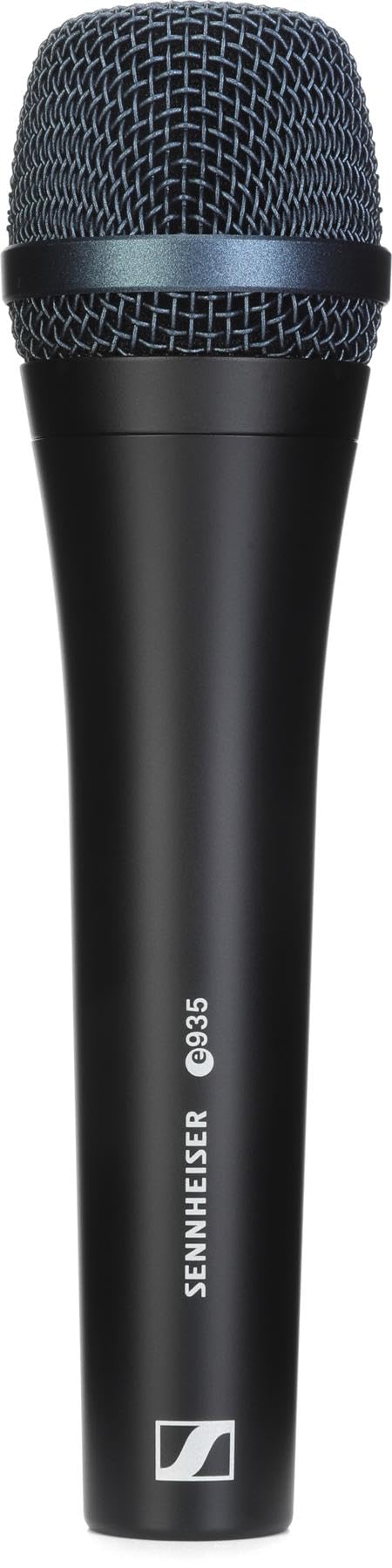
Warm, high-output vocals for a singer who moves while they play.
Singers who drift off the mic mid-song get punished by narrow capsules. The e 935 answers that with a forgiving cardioid pattern, so you can move your head and still be heard. Output is high for a dynamic mic, which means it needs less gain than a low-output model like the PodMic above. The result is a warm, clear tone with strong presence, and its feedback control is a repeated point of praise — it stays stable on a loud stage rather than howling when you push it.
Build is where this mic quietly wins arguments. A neodymium ferrous magnet with boron keeps the capsule stable across climate shifts, and the metal body in black takes drops and bumps. Sennheiser backs it with a 10 year warranty, the longest coverage on this list. It ships with a clamp, a pouch, and a manual, so it is stage-ready from the start. At 355 g it has enough heft to feel serious without tiring your hand.
What you give up is plosive control. The tighter pattern that helps on a loud stage demands precise mic technique, and a few singers note that p-pops are less handled than on a classic workhorse like the SM58. There is also no on/off switch, which matters only if you kill the channel between sets. For a three-piece band running one set of settings across vocals and instruments, the accuracy and detail are the draw.
Why singers trust it
- Forgiving cardioid pattern keeps you audible when you move
- High output needs less gain, so cheap preamps stay quiet
- Stable on loud stages with controlled feedback
- 10 year warranty on a metal body built for drops
Where it asks more
- P-pops need a little technique or a pop filter
- No on/off switch for muting between sets
- Precise aim still helps on a crowded stage
The right buy for: live vocalists who want a warm, stable mic that forgives movement.
Think twice if: you need a switch on the body or expect condenser-level plosive control.
5. Shure SM58S 2 Pack

Two switch-equipped workhorses for anyone who rents mics out.
When you need a pair of mics that survive being borrowed, dropped, and handed to a stranger, this bundle answers directly. You get two SM58S mics with on/off switches, two swivel stand adapters, and two storage bags. The cardioid pattern focuses on what is in front of it and turns away the back and sides, which is exactly the behaviour you want on a stage with monitors and crowd noise. The frequency response is shaped for vocals — midrange lifted, bass rolled off — so a voice cuts through a busy mix without much EQ.
The alloy steel body is the real argument for buying this instead of a cheaper pair. These get rented out and come back working, and the shift from a single mic to two changes how you can run a small gig. Each one connects over XLR into any interface, mixer, or PA system. For outdoor stages, the solid build and consistent output are what keep them in the kit.
One honest quirk: the on/off switch is not labelled, so guests on a podcast or a shared stage can be unsure which position is live. That is a labelling annoyance rather than a fault, and it is worth a ten-second briefing before you hand one over. Quality leads the feedback on these by a wide margin, and that is the whole point of the SM58 name.
The value read: two switchable mics plus adapters and bags covers a small band or a rental drawer in one order.
The one gripe: an unlabelled switch can confuse anyone who has not used one before — show them which way is on.
Made for: small venues, rental kits, and bands that need two dependable vocal mics.
Not the pick if: you want a single refined studio voice mic for recording.
6. Shure MV7+ USB-C & XLR Podcast Dynamic Microphone – Black

One mic that starts on USB and grows into an XLR studio.
The MV7+ solves the decision that trips up most first-time buyers: XLR or USB. It gives you both outputs, so you can plug into a laptop over USB-C today and move to an interface or mixer over XLR whenever you are ready. The 50 Hz to 16 kHz range is tuned for speech, and the real-time denoiser plus Auto Level Mode handle gain and background noise automatically — useful when you record in a room that is not treated.
The feature list is where it separates from a plain broadcast mic. A full-color LED touch panel offers 16.8 million color options, shows your level in real time, and mutes with a tap. Built-in reverb modes — Plate, Hall, and Studio — add depth to a voice track without a plugin. It ships with a foam windscreen and a 3m USB-C to USB-C cable, and the metal body stands up to daily desk work.
Two things to plan for. There is no XLR cable in the box, so budget for one if you intend to use the analogue output. And value is the area where opinion divides most — some buyers feel the price is steep for what is largely a convenience play. Sound quality still leads by a wide margin, and the owners who get the most from it are the ones who record in imperfect rooms.
Why it earns the spot: dual USB-C and XLR outputs mean you never have to rebuy when your setup grows.
What to know first: bring your own XLR cable, and expect to pay for the convenience of the onboard controls.
Go for it when: you want one mic that works on a laptop now and a mixer later.
Think twice if: you already own an interface and only need the analogue path.
7. Electro-Voice RE20-BLACK

The FM radio voice, in a body built to outlive your studio.
If you have ever wondered why a radio host sounds the same whether they lean in or sit back, this is the answer. The RE20 uses Variable-D design (a ported body that keeps the low-end from booming as you close in on the capsule), so the tone stays smooth and natural at any distance. It is a true cardioid with no coloration at 180 degrees off-axis, which means the back of your room stays out of the recording. The voice-tailored frequency response is what gives it that familiar broadcast character.
Durability here is proven, not promised. Broadcast stations have run RE20s for decades, and the 2.9 pound industrial metal body survives that daily handling. It handles plosives well through the built-in pop filter, and its proximity effect control is a standout — you can work close without the bass piling up. For voice, gaming, brass, and bass cabinets, it holds its character. Its 78 dB noise figure matches the RØDE PodMic on paper, but the true cardioid’s off-axis rejection is what keeps an untreated room out of the take.
The honest cost of all that is commitment. This is a premium mic with a body to match, and it is overkill if you record occasionally in a quiet room. It does reward good cabling — a cheap XLR lead can raise the noise floor — and the built-in pop filter still lets some plosives past, so angling it slightly off-axis helps. For a long-term voice setup, it is the one mic here you are least likely to outgrow.
what separates it
- Variable-D keeps your tone even as you move toward and away
- True cardioid with no off-axis coloration at 180 degrees
- Voice-tailored response gives that classic broadcast warmth
- 2.9 pound metal body built for decades of station use
What it costs you
- Premium tier, and more mic than a casual recorder needs
- Wants a quality XLR cable to keep the noise floor down
- Built-in pop filter still lets a hard plosive through unless you angle it
The right call for: podcasters, broadcasters, and voice pros who want one mic for the long haul.
Not for you if: you record now and then and would rather keep the setup simple.
Know the Specs
Pickup Pattern
This describes which directions the mic listens to most. A cardioid pattern is sensitive in front and rejects the rear, which is why it is the standard for vocals on a stage with monitors. A supercardioid pattern is narrower and rejects more of the sides, so it blocks more stage noise — but it demands you stay on axis. If you move a lot while you sing, a cardioid is more forgiving; if the room is loud, the extra rejection of a supercardioid can win the day.
Output Level and Gain
A dynamic mic sends a relatively quiet signal, and how quiet varies a lot between models. Low-output mics need a preamp that can boost the signal a long way without adding hiss — that is the difference between a clean take and a noisy one. High-output mics need less help. Before you buy, check what your interface can supply and whether other customers note needing a booster. This single number decides whether an XLR mic works on your desk.
Connection Type
XLR means a three-pin cable into an interface, mixer, or PA. USB means a data cable straight into a computer, with the preamp built into the mic. A dual-output mic offers both, which lets you start simple and expand later. The connection determines your whole path: an XLR mic can grow into a full studio, while a USB mic is tied to a computer but skips the interface entirely.
Frequency Range and Voice Tuning
A wider range generally means the mic can capture more of the source — the top of a cymbal or the low end of a bass cabinet. For speech mics, the tuning matters more than the raw width: a response shaped for vocals lifts the midrange and rolls off the lows so your voice sits forward in a mix. Instrument mics are tuned to reproduce a cabinet faithfully rather than flatter a voice, which is why the two jobs call for different picks.
Common Questions
Do I need an audio interface to use an XLR dynamic mic?
Will the RØDE PodMic work with a cheap interface?
What is the difference between cardioid and supercardioid for live vocals?
Can I use a guitar cabinet mic like the e 609 for vocals?
Does the Shure MV7+ work without installing software?
Why is the RE20 so heavy compared to other dynamic mics?
Is a two-pack of SM58S mics a good idea for a small band?
Do dynamic mics need phantom power?
Which dynamic mic is best for recording in an untreated room?
Can I use the Yeti GX with a console instead of a PC?
The Bottom Line
For most people shopping for the best dynamic mic, the Sennheiser e 609 Silver is the strongest pick on this list — 4.5+ stars across 900+ ratings, and it replaces a mic stand entirely for cabinet work. If your job is spoken voice on a desk, the RØDE PodMic delivers broadcast character for considerably less, provided your interface has real gain. For a setup that has to grow from USB to XLR, the Shure MV7+ is the flexible answer. And if you are building a voice setup you intend to keep for years, the Electro-Voice RE20 is the one that will still be working long after the rest.
How we choose
We do not accept paid placement. Every pick is matched to a real buyer and a real use-case; we do not hands-on test units.
Sources
Specifications: manufacturer listings and product documentation. Review insights: verified customer reviews, as of October 2026. Pricing: not shown on this page (it changes often); check the current price via the retailer link.
As an Amazon Associate, Aappliancez earns from qualifying purchases. This does not affect which products we feature.