Disclosure: Some links in this post are affiliate links. As an Amazon Associate I earn from qualifying purchases, at no extra cost to you. Learn more
Specs are compiled from manufacturer listings and verified buyer reviews and can change over time — please confirm the key details on the product page before buying.
If your back, neck, or shoulder aches and you want to try drug-free relief at home, the AUVON Rechargeable TENS Unit is the one to buy first. It is the highest-rated unit here at 4.5+ stars across 900+ ratings, it runs up to 60 hours of continuous therapy on one charge, and it packs 8 adjustable modes for a fair mid-range price. Below you will find six electronic muscle stimulators that real owners actually use, sorted so you can match one to your body and your budget.
This guide is built by comparing the manufacturers’ published specifications and the patterns across verified customer reviews, so you get each pick’s real strengths and trade-offs instead of marketing spin.
A stimulator sends small electrical pulses through sticky pads to quiet a sore muscle, and the right one depends on how many modes you need, how long the battery lasts, and whether the pads stay put. This breakdown of the best electronic muscle stimulators covers the specs that matter so you can pick with confidence.
Top Picks

How To Choose The Best Electronic Muscle Stimulators
You do not need a clinic-grade machine to get relief at home. What you need is a unit whose modes, pads, and power source fit the way you actually use it. Here are the handful of things that decide whether a stimulator earns a spot on your nightstand or ends up in a drawer.
Modes and intensity levels come first
More modes give you more ways to chase a stubborn knot, but you will likely settle on two or three you love. Look for at least 8 modes and a wide intensity range (the Belifu runs 20 levels, the AUVON and AVCOO run 40). Intensity control is what keeps the pulses comfortable instead of sharp, so a unit with fine steps is easier to live with than one that jumps from mild to fierce.
Rechargeable versus a 9V battery
A rechargeable unit with a USB-C port means no last-minute battery runs. The AUVON, AVCOO, Belifu, and rechargeable TENS 7000 all charge over USB, while the classic TENS 7000 and the Chattanooga Primera run on a 9V battery. If you travel light or hate hunting for batteries, rechargeable wins; if you like the simplicity of a disposable cell, a 9V unit is dead simple.
Channels, pads, and placement
A channel is one independent circuit that runs a pair of pads. Dual-channel units let you treat two spots at once — say, both shoulders — or run four pads around one big area like the lower back. Check the pad count in the box and the connector size (2mm is the common standard), because replacement pads are the one thing you will buy again and again.
Side-by-Side Comparison
| Model | Best For | Modes | Battery / Run Time | Pads Included | Amazon |
|---|---|---|---|---|---|
| AUVON Rechargeable TENS Unit★ Best Overall | Best overall for most people | 8 modes, 40 levels | 600 mAh, up to 60 hours | 12 pads | Amazon |
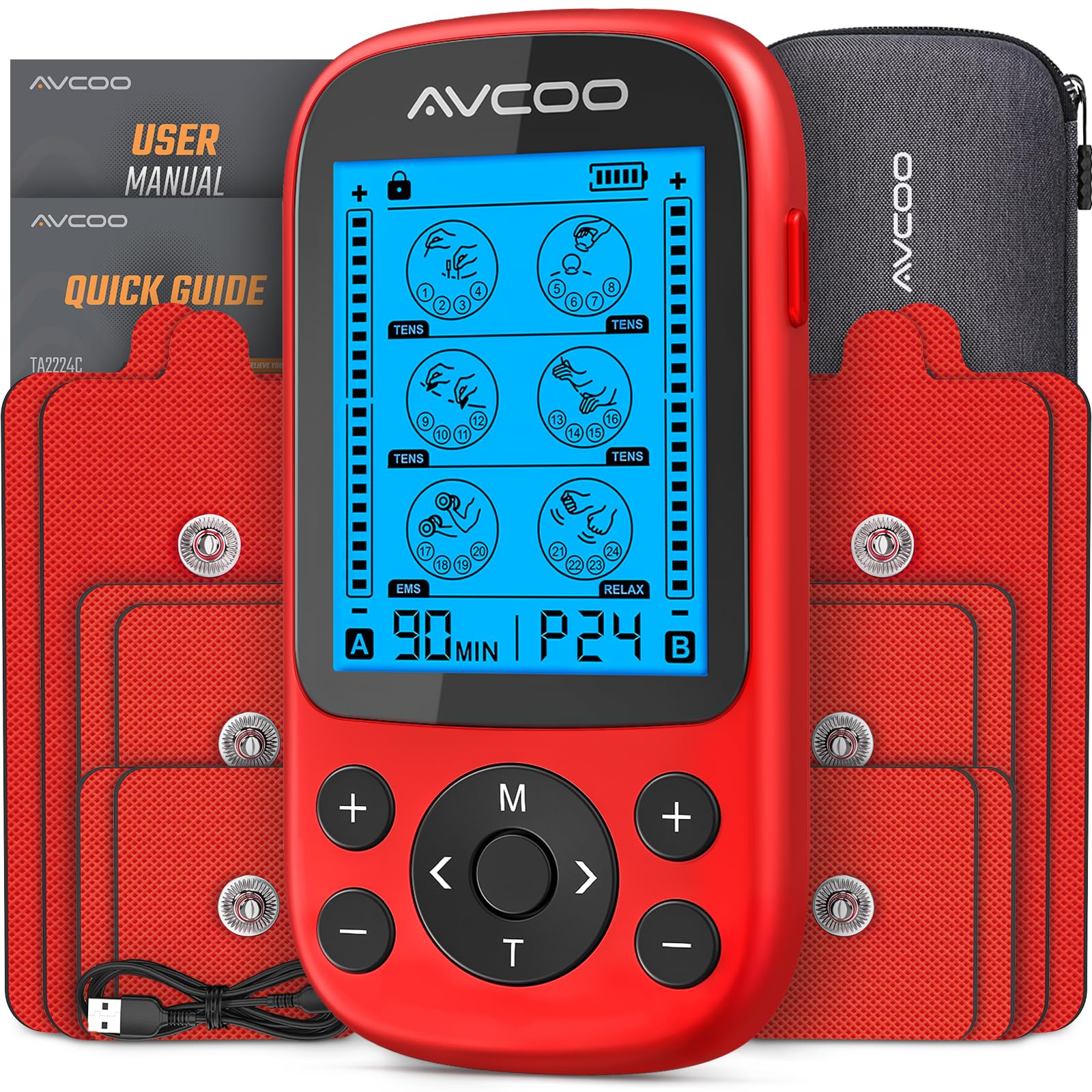
| AVCOO 3-in-1 TENS EMS UnitMost Versatile | Travel and versatility | 24 modes, 40 levels | Up to 40 hours | 12 pads (two sizes) | Amazon |
| Belifu Dual Channel TENS EMS Unit | First-time buyers on a budget | 24 modes, 20 levels | Rechargeable lithium | 10 pads | Amazon |
| TENS 7000 Digital TENS Unit | A proven, widely used classic | Multiple TENS modes | 9V battery | 4 pads | Amazon |
| TENS 7000 Rechargeable Unit | Recovery plus muscle work | TENS + EMS modes | Rechargeable | 4 pads | Amazon |
| Chattanooga Primera TENS/NMES | Serious rehab and guided programs | 8 TENS + 6 NMES presets | 9V battery | Included electrodes | Amazon |
Detailed Reviews
1. AUVON Rechargeable Digital TENS Unit
Our pick — 4.5+★ from 950+ verified ratings; the strongest balance of quality and price.
The do-everything unit that charges over USB-C and outlasts most rivals on one battery.
You get up to 60 hours of continuous therapy from the 600 mAh battery (a battery capacity rating) — that’s how long AUVON says it runs, well past the 40 hours the AVCOO claims. So you can go a full week or more of daily sessions between charges, and the unit is ready when your back tightens up. It also matches the AVCOO on modes, with 8 modes each, but the AUVON keeps its total lower because each of its 8 modes runs across 40 intensity levels instead of a big menu of near-identical presets.
What wins people over is how well built the thing feels. The controls click with a crisp tactile feel, the backlit screen stays readable, and flip covers plus a power-button lockout stop the settings from changing in a bag. Owners also single out the sticky pads — low-impedance gel pads rated for up to 45 uses each, with 2mm connectors that accept standard replacement electrodes. It is compact enough to clip onto a belt without limiting how you move.
The honest catch: it does not remember your custom rate, width, and time settings between sessions, so you re-enter your favorites each time. That is a small annoyance rather than a dealbreaker, and it fades once you find the two or three programs you use most. For most bodies, this is the safest first buy here.
Why it earns top billing
- Up to 60 hours of therapy per charge from the 600 mAh battery — fewer charging worries than the 40-hour AVCOO
- 8 modes across 40 intensity levels for fine-tuned pulses
- 12 gel pads rated for up to 45 uses each, with standard 2mm connectors
- Flip covers and a button lockout guard against accidental changes
Where it asks for patience
- Does not save your custom settings between uses
- The button layout takes a session or two to learn
Best for: anyone who wants one reliable, rechargeable unit for everyday back, neck, and shoulder relief.
Worth a detour if: you want a machine that remembers your exact settings, since this one starts fresh each time.
2. AVCOO 3-in-1 TENS Unit
Three therapies in one pocket-sized kit, packed into a rigid travel case you can toss in a bag.
You get 24 pre-programmed modes (TENS for pain blocking, EMS for muscle firing, and a RELAX mode) in a unit small enough to slip into a pocket. That means pain-blocking pulses for a sore back, muscle-firing pulses for recovery work, and a gentler relax setting — all from one device. The company pairs it with a rigid, moisture-resistant EVA carry case (a firm foam case that resists damp) that holds the unit, pads, and leads.
Pad variety is the other reason it travels well. You get 12 reusable pads in two shapes: small 2” x 2” squares for precise spots like the neck, knees, and ankles, and wider 2” x 4” rectangles for bigger areas like the lower back and thighs. The pads are latex-free gel rated for more than 50 uses. Run time is up to 40 hours, and dual A/B channels let you treat two spots at once or run four pads together. Note that the battery trails the AUVON’s 60 hours — a fair trade for the extra modes and travel case.
The recurring wrinkle is the manual, which skips detail on what each mode does, so plan to experiment with pad placement. The intensity also gets intense fast — many owners find the usable range sits low, around the 4-to-6 mark. Neither issue stops the unit from working; both just mean your first session is a little trial-and-error.
What lands well: the 3-in-1 setup and the rigid case make this the easiest unit here to carry to work or the gym, and the two pad sizes cover both small and broad areas.
Set expectations: the printed manual leaves mode descriptions thin, so watch the screen labels and let your own body guide placement.
Reach for this if: you want pain-blocking and muscle-recovery modes plus a hard case in one grab-and-go kit.
Look elsewhere if: you need the longest possible run time, where the AUVON’s 60 hours beats this unit’s 40.
3. Belifu Dual Channel TENS EMS Unit

A tiny, rechargeable workhorse that punches well above its compact frame.
If you are buying your first stimulator and do not want to overthink it, this is the entry point that keeps giving. It carries 24 pre-programmed modes across 20 intensity levels, and its dual A/B channels adjust independently, so you can run one set of pads light and another stronger. The rechargeable lithium battery kills the old AA-battery treadmill, and a battery-level indicator warns you before it dies mid-session.
For a modest mid-range price you also get real accessories: 10 upgraded reusable pads rated for up to 50 uses, a dust-proof drawstring storage bag, and fastening cable ties that end the tangled-lead mess. Owners find the pulse genuinely strong for a unit this small — one buyer who had used a chiropractor’s machine was impressed by how the intensity compares. It carries up to 1 hour per session and is small enough to wear under clothes at your desk.
Watch the pads, though. Adhesion is the one area buyers split on — some say the pads stick for many sessions, others find a set gives up after a single use. Now the caveat that only bites occasionally: a rare unit shows up with a dead output, and the good news is the maker has a track record of replacing faulty units quickly.
The plain-English take: a budget-friendly unit with serious punch, easy portability, and enough modes for anyone new to TENS and EMS.
One thing to plan for: pad adhesion varies, so stock a spare set and clean the area before each session.
Great first buy: newcomers who want strong relief, a rechargeable battery, and a full accessory kit without spending a lot.
Think twice if: you want guaranteed long-term pad stickiness right from the start, since adhesion sees the widest spread in feedback.
4. TENS 7000 Digital TENS Unit with Accessories

The therapy-clinic staple that has been the go-to for drug-free pain relief for years.
Physical therapists have recommended this design for years, and its appeal is proven power and simplicity rather than extra features. The maker says over 3M units have been sold since the device arrived in 2014, and owners who were steered to it by a PT commonly find it strong and simple. The kit arrives ready to go: the unit, 2 lead wires, a four-pack of reusable premium electrode pads, one 9V battery, a manual, and a hard carrying case.
It runs on that single 9V battery rather than a USB charge, which keeps things dead simple but is also the source of its main complaint — run time divides owners, with some finding the charge short-lived. Pack a spare 9V and the issue disappears. The hard case and straightforward controls make it an easy unit to live with at home, and it is happy being used while you watch TV or unwind on the couch.
It handles back, neck, shoulder, and sciatica-style muscle aches, and it is among the most widely used consumer stimulators anywhere. The flip side is that replacement pads are a running cost, since the included pads stay reusable only until they lose their grip.
The case for it: a long-proven design with clinic-style power, a complete starter kit, and a hard case, from a brand with a huge base of users.
The honest catch: it burns through a 9V battery at a rate some owners find disappointing, so keep a spare handy.
Pick it for: old-school simplicity and proven power, especially if a therapist already pointed you toward this design.
Consider a rechargeable instead if: you would rather plug in over USB than swap 9V cells.
5. TENS 7000 Rechargeable TENS Unit & EMS Muscle Stimulator

The rechargeable take on the classic, built for athletes who want recovery as much as relief.
You get the proven TENS 7000 formula with a rechargeable battery instead of a 9V cell — pain-blocking TENS for a sore back or neck, plus EMS pulses for muscle recovery and growth between workouts. It arrives with 4 electrode pads and adjustable intensity, and it is small enough to live in its own hardshell case between sessions. Athletes who use it after tennis report it clears knee and shoulder soreness following a match.
It fits the fitness crowd specifically: switch between TENS and EMS depending on whether you are chasing pain relief or a post-workout flush. The rechargeable power means no mid-session dead batteries, which is the whole point of the upgrade over the original. One tennis player who tried it a few times found the day-after soreness gone, and the compact case keeps all the parts together.
The catch is that it is a basic-plus machine, not a pro rig — intensity is a touch less fierce than some battery-operated rivals, and solo pad placement on your own back takes a steady hand. The controls also leave a few functions unclear at first. Treat it as an easy, capable starter for recovery work and it delivers.
Why athletes like it: a genuine TENS-to-EMS switch, rechargeable convenience, and a hardshell case that travels well.
Small frustrations: a couple of functions are not obvious from the panel, and placing pads on your own back solo is fiddly.
Best fit: gym-goers and athletes who want one rechargeable unit for both pain relief and muscle recovery.
Skip if: you need the most intense output available or want a big mode menu for experimentation.
6. Chattanooga Primera TENS/NMES Unit with HAN Waveform

A rehab-grade unit with a distinctive HAN waveform and guided programs for serious recovery.
This is the premium pick, and its justification is the HAN waveform — a stimulation pattern the maker says mixes low and high frequencies intended to release endorphins and ease muscle spasms. It pairs 8 TENS presets with 6 NMES presets, so you get pain-blocking programs plus muscle-firing programs for performance and recovery, all organized as ready-made modes rather than raw settings to build yourself.
The program menu is broad: continuous, burst, modulated, HANS, and NMES modes. The unit is lightweight for home, office, or travel, and the complete package includes a carry case, a 9V battery, lead wires, electrodes, an electrode-positioning back belt, plus a manual. The kit is built like clinical equipment, and it is commonly recommended in stroke-rehab settings where guided, multi-mode programs matter.
The honest limits: at this premium price the value-for-money and battery-life feedback is more mixed than on the cheaper picks, and it runs on a non-rechargeable 9V rather than USB. A few buyers also note settings do not always save, and pads wear quickly. That is the trade for the specialized HAN programs and rehab focus.
The standout: the HAN waveform plus 14 total preset programs give you professional-style guided therapy at home.
Worth knowing: it is the priciest pick here, runs on a 9V battery rather than USB, and the settings do not always hold between sessions.
Best for: rehab-focused users who want guided NMES programs and the HAN waveform, and value a clinical-style kit over a rechargeable battery.
Look to a cheaper pick if: you want USB recharging and the best value, since those flags land better on the budget-friendly units.
Know the Specs
Modes vs intensity levels
A mode is a preset pattern of pulses — think “kneading” versus “tapping.” An intensity level is how strong that pattern fires. A unit with 24 modes but only 20 levels may feel coarse, while 8 modes with 40 levels gives you finer control over comfort. Match the level count to how sensitive your muscle is.
TENS, EMS, and NMES
TENS sends pulses to block pain signals. EMS (electrical muscle stimulation) fires the muscle itself for recovery. NMES (neuromuscular electrical stimulation) is a clinical-style version aimed at making a muscle contract. Multi-function units like the AVCOO and the Chattanooga Primera bundle more than one of these.
Pad count and connector size
Pads are consumable — they lose stickiness over time, so more in the box and a standard 2mm connector save you money later. Two sizes of pad cover both small joints and broad areas like a lower back. Keep spare pads on hand and clean your skin before each session to extend their life.
Battery type and run time
A rechargeable lithium battery with a USB-C port means no battery shopping and consistent output toward the end of a charge; a 9V unit is simple but needs cells on hand. Run times vary widely — from roughly 40 hours on the AVCOO to up to 60 hours on the AUVON — so weigh how often you use it against how often you want to charge.
Common Questions
What is the difference between a TENS unit and an EMS muscle stimulator?
How many modes do I actually need on a muscle stimulator?
Will the electrode pads stick to my skin through a session?
Is a rechargeable TENS unit better than one that takes a 9V battery?
Can a muscle stimulator help with back pain and sciatica?
What does dual-channel mean on a TENS unit?
How long will the pads and the unit itself last?
Do all units use the same replacement pads?
Can I wear a muscle stimulator under my clothes during the day?
What is the HAN waveform on the Chattanooga Primera?
The Bottom Line
For most people, the electronic muscle stimulators winner is the AUVON Rechargeable TENS Unit because it pairs up to 60 hours of run time with 8 modes over 40 levels and 12 long-life pads, all at 4.5+ stars. If you want a travel-ready kit that also does recovery work, grab the AVCOO 3-in-1 TENS EMS Unit. And for guided rehab programs with the HAN waveform, the Chattanooga Primera TENS/NMES is the one to reach for. Whichever you choose, note that the AUVON earns the top spot on the strongest score here — a solid signal that it is the safest bet in the lineup.
How we choose
We do not accept paid placement. Every pick is matched to a real buyer and a real use-case; we do not hands-on test units.
Sources
Specifications: manufacturer listings and product documentation. Review insights: verified customer reviews, as of October 2026. Pricing: not shown on this page (it changes often); check the current price via the retailer link.
As an Amazon Associate, Aappliancez earns from qualifying purchases. This does not affect which products we feature.