Disclosure: Some links in this post are affiliate links. As an Amazon Associate I earn from qualifying purchases, at no extra cost to you. Learn more
Specs are compiled from manufacturer listings and verified buyer reviews and can change over time — please confirm the key details on the product page before buying.
If your goal is to actually feel your muscles working, buy a machine with four independent channels and adjustable frequency. That combination separates a serious EMS device from a cheap tingler, and it is what most beginners overlook. Four channels let you cover a lower back or a thigh with eight pads at once, while adjustable frequency lets you tune the pulse for strengthening instead of just numbing. The six machines below are the ones worth your attention, and the picks are ranked so you can settle on one before your next session.
This guide is built by comparing the manufacturers’ published specifications and the patterns across verified customer reviews, so you get each pick’s real strengths and trade-offs instead of marketing spin.
I have organised every pick by what it actually does in daily use, from channel count and programmable frequency to battery behaviour. By the end you will know which machine fits your body, your routine, and your recovery goals, including how to compare the best EMS machine options side by side.
Top Picks

How To Choose The Best EMS Machine
An EMS machine (electrical muscle stimulation) sends a mild pulse through pads on your skin that makes the muscle contract on its own. The buying decision is not really about “power” — it is about how many muscles you can reach at once and how much control you have over the pulse.
Start with channel count, not intensity
One channel drives one pair of pads. Four channels mean eight pads working together, which is what you need to cover a whole lower back or to treat two limbs in one sitting. If you only ever work one knee or one shoulder, two channels is plenty and you will save money.
Check whether the frequency is adjustable
Frequency is how many pulses per second the machine fires, measured in Hz. A unit that lets you dial Hz and pulse width yourself is a true muscle-building tool. A unit with fixed frequencies is really a pain-relief device wearing another label — so look for manuals that list visible Hz settings.
Be realistic about the pads
Pads are the wear item. They lose stickiness with use and eventually stop conducting cleanly. Any machine worth owning should either include a generous pad supply or use a standard connector that third-party pads fit, so replacements stay cheap and easy to find.
Decide on battery format before you buy
A rechargeable unit saves you from hunting for cells mid-session. A disposable-cell unit is fine if you keep spares on hand — just know that frequent use makes rechargeable the cheaper habit over a year of daily sessions.
Side-by-Side Comparison
| Model | Best For | Channels | Battery | Programs / Modes | Amazon |
|---|---|---|---|---|---|
| Med-Fit 906A Premier★ Best Overall | Full-back and multi-zone work | 4 | Rechargeable | 24 (12 TENS + 12 EMS) | Amazon |
| TENS 7000 Pro RechargeableBest Battery Life | Daily pain relief with room to grow | 4 | Rechargeable | 8 modes | Amazon |
| iStim EV-906 | High intensity and sensitive skin | 4 | 2 AA batteries | 30 preset | Amazon |
| Beurer EM59 | Heat plus stim in one pocket unit | 2 | Rechargeable | 64 preset + 6 custom | Amazon |
| Chattanooga Primera | HAN waveform rehab work | 2 | 1 9V battery | 8 TENS + 6 NMES | Amazon |
| Compex Performance 3.0 | Athletes tracking training load | — | USB rechargeable | 6 (warm-up, strength, recovery, TENS) | Amazon |
Detailed Reviews
1. Med-Fit 906A TENS EMS Combo Muscle Stimulator
Our pick — 4.5+★ from 350+ verified ratings; the strongest balance of quality and price.
Four channels, eight pads, and a screen you can read across the room.
The reason this earns the top spot is simple arithmetic a buyer can feel on day one: four independent channels means up to eight electrode pads placed on your body at once. That is what lets you work a whole lower back without shifting pads between zones. Each channel has its own intensity control, so a tender spot on the left can stay gentle while the right shoulder takes more.
Control is the other half of the story. Its 24 programmes split evenly: 12 TENS for pain and 12 EMS for strengthening. One owner with arthritic shoulder trouble called it “really helpful” for rebuilding the muscle around the joint. On the technical side the unit runs at 50V, keeps circuits stable in close proximity without power dropping, and steps intensity in 1% increments so you can nudge it up without a jolt.
The catch is physical and worth weighing before you commit. The body is thick enough that it will not slide into a pocket, and the pin-type leads take two hands to seat properly — snap leads are easier. Frequency and ramp also cannot be set per channel, and they reset after a programme ends, so you re-dial your preferences rather than storing them.
Why owners keep coming back
- Four independent channels with per-channel intensity, so you can cover a full back or two limbs in one session
- 24 programmes split 12 TENS and 12 muscle stimulation, covering both pain and strengthening
- Rechargeable design removes the cost and hassle of replacement batteries
- Large clear display and 1% intensity resolution for fine, gentle steps
- Genuinely sturdy build — pads and gel included work well from the start
Where it asks for patience
- Pin-type leads are fiddly to connect one-handed; snap leads are friendlier for solo sessions
- Too thick to carry in a pocket, so plan on a bag or belt clip
- Frequency and ramp reset after each programme instead of saving your setup
The right buyer: Anyone treating a lower back or two areas at once who wants real control over intensity and programme choice.
Think twice if: You only ever zap one shoulder and want something you can slip into a pocket.
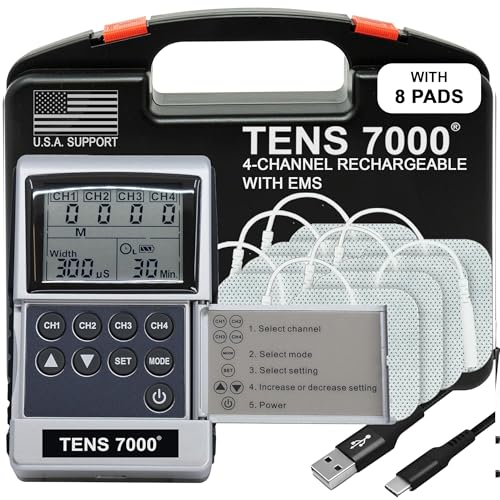
2. TENS 7000 Pro Rechargeable Tens Unit Muscle Stimulator
The four-channel workhorse that stays running through a long day of sessions.
Here is the practical distinction: this unit carries four channels against the two you get on the Beurer EM59 below — twice the coverage. That difference decides whether you can work both hamstrings after a run or only one at a time. Eight electrodes ship in the box, so you are ready for a full session the day it arrives.
What makes it worth keeping is how long it runs. As buyers put it: “I use it most days and so far has worked perfectly.” Its built-in rechargeable battery runs through a full day of sessions without a mid-session charge. A belt clip lets you walk around the house while it works. You get 8 modes with adjustable intensity, and the durable pads stick well enough to survive repeat placements.
The honest catch is the display. It has no backlight, which several owners call out — fine in daylight, awkward in a dim room or a late-night session. If you mostly treat yourself in a bright space, this is a non-issue.
The value read: A four-channel rechargeable machine with eight pads included sits squarely in useful mid-range territory — you are paying for coverage and battery convenience, not gimmicks.
Reach for this if: You want two-limb or full-back coverage and a machine that runs all day on a charge.
Look elsewhere if: You need to read the screen in a dark room.
3. iStim TENS EMS Muscle Stimulator EV-906

Goes up to 100 on the dial where cheaper units stop at 20.
If you have ever maxed out a cheap stim unit and still wanted more, this is the pick. As owners put it: “I’ve purchased 3 other tens units and they all only went to a 20 on the intensity. This one goes up to 100.” That headroom matters for large muscle groups — a big quad or a thick lower back can take a lot more current before you feel real engagement.
Coverage is generous too. Four channels and 30 preset programmes cover TENS for pain and EMS for strengthening, with intensity and pulse type adjustable on top. The package includes 24 electrode pads in two shapes (2″x2″ and 2″x4″) plus four lead wires, so you can treat a wide area in one go. The pads are made with Japanese gel, which the maker positions as a fit for sensitive skin.
The trade-off to know is in the wiring. Leads are not colour-coded, which slows down a four-channel setup, and there is no carrying case in the box — a small annoyance if you travel with it. The unit also runs on two AA batteries rather than charging.
Built for: Anyone who wants serious intensity headroom and a large muscle-strengthening programme library.
Not for: Someone who wants everything colour-coded and bagged for grab-and-go.
4. Beurer EM59 Digital 3-in-1 TENS Unit, EMS & Heat Therapy
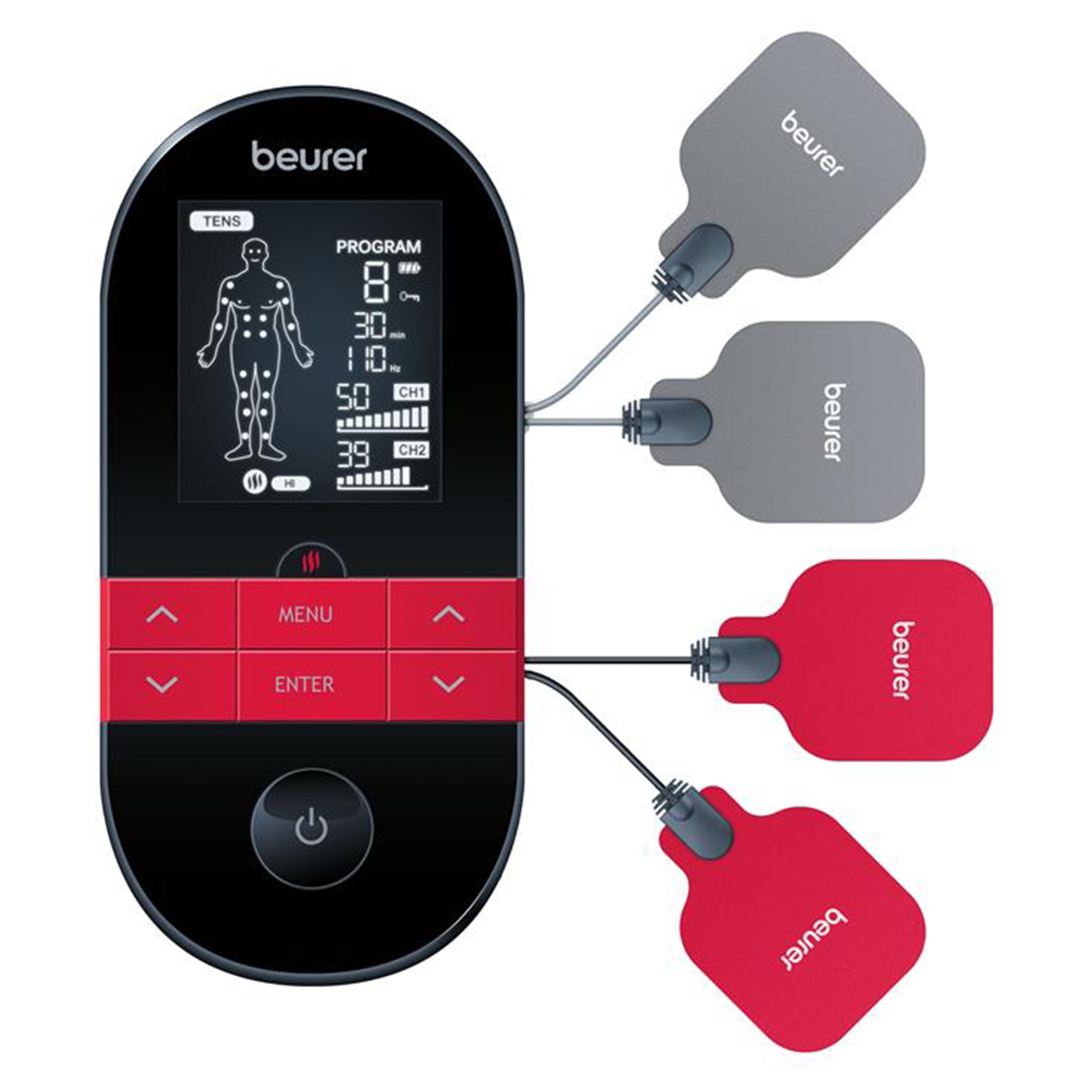
Sore muscles want warmth, and this is the rare stim unit that delivers it.
This is the only machine here that adds heat to the same pads. That is a real perk for a stiff knee or a tight hip: you warm the muscle and stimulate it in one session instead of reaching for a heat pack first. It packs 64 preset programmes and 6 customisable settings, so there is a routine for pain, recovery, relaxation and abs. A 5 to 100 minute timer lets you set the length and forget it.
What wins people over is quality — it feels solid and well made rather than toy-like — with pain relief close behind in how often it comes up. There are two independently adjustable channels and four pads, and 50 intensity levels to fine-tune the pulse. The belt clip and inverse LCD make it easy to work through a programme on the sofa.
Two things to brace for. Pad adhesion is the recurring gripe — the included pads lose their stick after a while, so plan on buying replacements. And it is more of a pain-and-heat device than a heavy muscle builder: two channels reach less at once than the Med-Fit’s four, and one weakness is that the machine uses Beurer-branded pads, which limits your budget options.
Where it shines: A compact three-in-one that adds heat to the routine, so stiff joints get warmth and pulses together.
For everyday recovery, warm the area, pick a preset, dial the timer, and let it run for 20 minutes. If you want maximum coverage for heavy strengthening, this is not the one.
Choose this when: Heat plus stimulation in one session is what your sore joint wants.
Pass if: You need four channels of reach for bigger training loads.
5. Chattanooga Primera TENS/NMES Unit with HAN Waveform

The rehab workhorse therapists reach for, built around a HAN waveform.
This is the unit you see in clinical hands, and the reason is the waveform rather than the flash. HAN is a blend of low- and high-frequency pulses, and it is the feature that makes this machine a favourite for post-injury muscle work. There are 8 TENS and 6 NMES presets, spanning continuous, burst, modulated and HANS modes, so you can shift from pain-blocking to muscle re-education without swapping devices.
What reassures buyers is that it is simple to get going — you can be running a session within 15 minutes of opening the box, and the included positioning back belt helps with back coverage. A stroke patient’s OT picked it after polling therapists, and the arm and hand movement improved steadily. It runs off a single 9V battery, which one owner was “skeptical” about before finding it worked better than expected.
Two honest limits. There is no end-of-session alarm, so a long session is on you to time. And the pads that ship with it wear out and lose adhesion quickly, so buy replacements early. The brand is also strict about needing fresh pads to reach higher settings — old pads will leave you flat.
The clinical angle: A HAN-waveform NMES unit for structured rehab rather than casual pain relief.
Best for: Rehab work and muscle re-education where a therapist-style waveform matters.
Not ideal if: You need a session alarm or pads that last beyond a few uses.
6. Compex Performance 3.0 Muscle Stimulator with TENS Kit

Built for the training log, with a warm-up and recovery programme built in.
The Pitch: this is a stim machine that talks like a coach, splitting its 6 programmes into 1 warm-up, 3 strength, 1 recovery and 1 TENS. That structure is aimed at athletes who use stimulation as part of a training week — warm up before a session, work strength during, and recover afterward. Its USB rechargeable lithium-ion battery is rated for up to 8 hours of stimulation per charge.
The redesign gave it a water-resistant silicone sleeve, an improved LCD and a centre navigation button. As owners put it, the interface is “very user friendly” and the durability holds up on the road. There is a genuine intensity ceiling too — 999 levels that start low and climb steadily.
The trade-offs are the reason this sits last despite its price. Output is divisive: some find it plenty strong while others barely feel it at high settings on certain body parts. The charging port has drawn complaints of fragility, and it is a proprietary connector rather than a standard USB-C. Weigh all that before you spend at the premium end.
Who it rewards: A structured athlete who wants warm-up, strength and recovery cues in one tidy kit.
If you want the most muscle engagement for the smallest outlay, a four-channel unit beats this on pure reach. But if your routine is training-block oriented, the programme split earns its spot.
One for the gym bag: Athletes who follow a scheduled training week and want recovery built into the same device.
Bypass if: You want dependable output at every site or a standard charging cable.
Know the Specs
Channels and pad count
A channel is one electrical circuit driving one pair of pads. Four channels means eight pads at once, which is what makes full-back or two-limb work possible. Two channels is enough for one joint at a time. If you plan to cover a whole lower back, count the channels before you buy anything.
Frequency and pulse width
Frequency is the number of pulses per second, measured in Hz, and pulse width is how long each pulse lasts. Together they decide whether the sensation is a gentle flutter or a firm thump. Machines that expose Hz and pulse width let you tune for muscle strengthening. Machines with only preset routines are more about pain blocking.
Intensity resolution
Intensity is how much current a pulse carries. Resolution means how finely you can step it up — a unit that scores 1% increments lets you climb gently rather than jumping in big leaps. That matters most when you are starting near a tender area and want to avoid an unpleasant jolt.
Pads and adhesion
Pads are reusable up to a point and then lose stick and conduction. A generous pad supply in the box, or a standard connector that third-party pads fit, keeps replacement costs low. Pads that only work with one brand’s proprietary connectors are the more expensive long-term habit.
Common Questions
How many channels do I need for lower back relief?
Can an EMS machine build muscle like lifting weights?
What is the difference between TENS and EMS programmes?
How long does the battery last between charges?
Are the electrode pads replaceable?
Is a HAN waveform different from standard TENS?
Where should I not place the pads?
How many intensity levels are enough?
Do I need a rechargeable unit or are batteries fine?
The Bottom Line
For most people, the ems machine winner is the Med-Fit 906A Premier. Its four independent channels, 24 split TENS and EMS programmes, and 1% intensity resolution give you the most control over a whole back or two limbs at once. If you want a rechargeable four-channel workhorse with a day’s worth of battery, grab the TENS 7000 Pro. And for a stim unit with heat built in for stiff joints, the Beurer EM59 is the one to reach for. It takes the top slot on four independent channels and 1% intensity steps, with owners repeatedly praising its sturdy build.
How we choose
We do not accept paid placement. Every pick is matched to a real buyer and a real use-case; we do not hands-on test units.
Sources
Specifications: manufacturer listings and product documentation. Review insights: verified customer reviews, as of October 2026. Pricing: not shown on this page (it changes often); check the current price via the retailer link.
As an Amazon Associate, Aappliancez earns from qualifying purchases. This does not affect which products we feature.