Disclosure: Some links in this post are affiliate links. As an Amazon Associate I earn from qualifying purchases, at no extra cost to you. Learn more
Specs are compiled from manufacturer listings and verified buyer reviews and can change over time — please confirm the key details on the product page before buying.
Most people start shopping for wall speaker mounts after a tripod stand has eaten a corner of the room, and they usually stop at the first pair that looks strong. That is a mistake. A bracket that is rated lighter than your speaker, or one that relies on wall anchors instead of timber, will sag within a season.
This guide is built by comparing the manufacturers’ published specifications and the patterns across verified customer reviews, so you get each pick’s real strengths and trade-offs instead of marketing spin.
Weight rating, clamp width, and swivel range are the three numbers that decide whether a bracket holds a bookshelf cabinet or a 15-inch PA box. The aim of this list is simple: match the mount to the speaker you already own, and match the hardware to the wall you actually have. The WALI SWM201 is the safest all-rounder for most rooms, and it leads this roundup of the best wall speaker mounts.
Top Picks

How To Choose The Best Wall Speaker Mounts
Before you compare brackets, answer two questions about your own setup: how heavy is each speaker, and what kind of wall is behind it. Those two answers eliminate most of the market instantly and save you a return.
Match the Weight Rating To The Speaker, Not The Other Way Around
Every mount quotes a maximum load in pounds, and that figure describes the bracket, not your cabinet. A bookshelf speaker often sits well under 20 pounds, so a bracket with a 55-pound ceiling gives you comfortable headroom. A large monitor or a PA box can push past 50 pounds, and that is where a 100-pound or 110-pound rating stops being overkill and starts being sensible.
Check how the mount attaches to the speaker, because that determines the load path. Side clamps grip the cabinet’s flanks, while a pole-and-socket design sits on a 35mm or 1 3/8″ mounting socket built into the speaker itself. If your speaker has no holes and no socket, a side-clamping bracket is the type that will work.
Width Range, Depth, and Wall Material Decide The Fit
Clamping brackets list a width range in inches, and staying inside it keeps the grip even on both sides. The WALI fits cabinets from 5.5 to 11 inches wide, while the Perlegear covers 5.12 inches up to 11.81 inches with a maximum depth of 13.78 inches. Go outside those windows and the arms will not sit flat against the cabinet.
Wall material is the other half of the decision. Studs and concrete hold a lag bolt firmly; bare drywall does not, and several makers state plainly that their included screws are for solid walls and brick only. If you are mounting into drywall on its own, budget for proper anchors or plan to find a stud.
Side-by-Side Comparison
| Model | Best For | Weight Capacity | Adjustment | Fit Range | Amazon |
|---|---|---|---|---|---|
| WALI SWM201★ Best Overall | Most rooms | 55 lbs | ±7.5° tilt, 45° swivel | 5.5″–11″ wide | Amazon |
| Howonder MY-23Big Box Hauler | Large PA boxes | 100 lbs | 90° tilt, 180° level | 8″–15″ speakers | Amazon |
| Nbguigdstr Heavy Duty | Deep-wall placement | 110 lbs | 60° tilt (4 positions), 180° swivel | 11.5″–15.7″ from wall | Amazon |
| Griffin MD-AP3372 | Studio and stage | — | 3 tilt levels: 90°, 105°, 120° | 35mm speaker pole | Amazon |
| Perlegear PGSM06B | Atmos height speakers | 55 lbs | ±15° tilt, ±90° swivel | 5.12″–11.81″ wide | Amazon |
| Sound Town STWSD-048B | Wide-angle coverage | 80 lbs | 180° swivel, 0–20° angle | 35mm adaptor | Amazon |
| OnStage SS7322B | Venue installs | 80 lbs each | 30° left/right swivel, up to 30° down tilt | Up to 22″ deep, 1 3/8″ sockets | Amazon |
Detailed Reviews
1. WALI Surround Sound Speaker Wall Mount
Our pick — 4.5+★ from 13,000+ verified ratings; the strongest balance of quality and price.
The default answer for a room full of bookshelf speakers that still refuse to stay put.
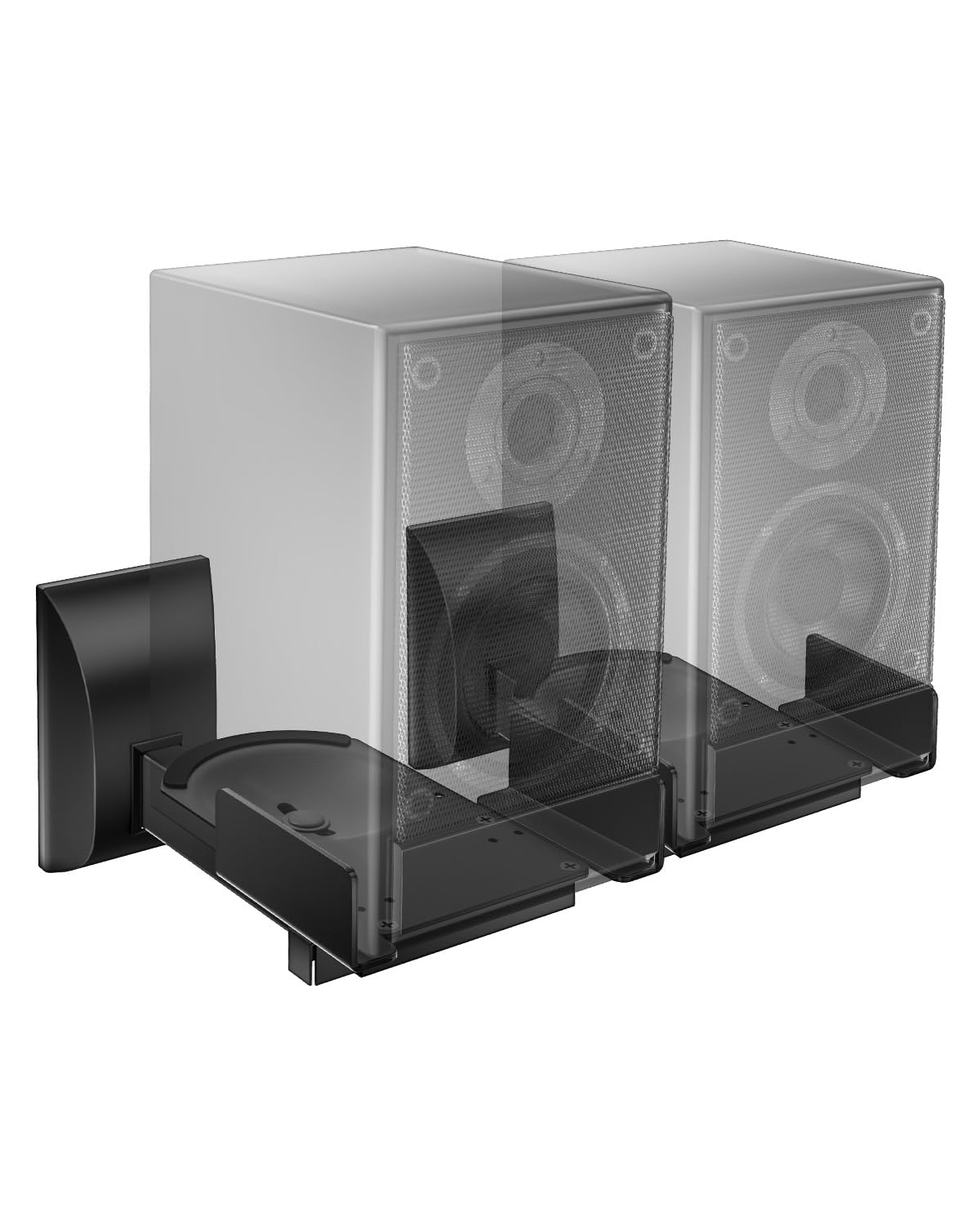
If your speakers are ordinary bookshelf or surround cabinets — no threaded sockets, no rear bolt holes — this is the pair to start with. Two arms clamp the sides of the cabinet and squeeze it against the bracket, so you never drill into the speaker itself. The clamps accept cabinets between 5.5 and 11 inches wide and carry up to 55 lbs, which clears most home-theater bookshelf models with room to spare.
Aim matters as much as grip here. The bracket tilts ±7.5 degrees and swivels 45 degrees left or right, so you can point the tweeter at your seat rather than at the opposite wall. That range beats the Howonder’s fixed 180-degree level sweep for fine, repeatable adjustment, and it is the reason the WALI stays put once you tighten the knobs. Integrated cable routing runs the speaker wire down behind the arm instead of dangling in mid-air, which keeps the wire hidden behind the arm instead of dangling.
You will likely need to supply your own wall anchors. The included plastic anchors spin without biting, so plan on buying better anchors or mounting straight into studs. One buyer put it plainly: “i had to drill into the back plate of my speakers because they didnt have mounting holes but the mount itself is very strudy! although i wish it had more rotation to it but overall its very very good for heavy speakers” — a workaround that shows the 45-degree swivel is the limit owners notice first. The grip pads that press against the cabinet are also modest, so heavier cabinets can creep if you leave them loose. Tighten them properly and they hold.
The Case For Clamping
- Clamps cabinets 5.5–11 inches wide without touching the speaker’s internals
- 55-lb capacity covers typical bookshelf and surround cabinets
- Cable routing hides the wire behind the arm
- ±7.5° tilt and 45° swivel give you aim you can lock in
The Catch
- Included plastic anchors do not bite — supply your own or use studs
- Grip pads suit light-to-mid cabinets better than heavy ones
- Not built for soundbar-style speakers
Reach for this if: you own standard bookshelf or surround speakers and want the simplest clean install in a living room.
Look elsewhere if: your cabinets are over 11 inches wide or need more than 45 degrees of swing.
2. Speaker Wall Mount, Swivel and Tilt, All Metal, 2 Packs
Built for the boxes most wall mounts quietly give up on.
Once your speakers grow past 8 inches, side-clamping brackets run out of width. This pair takes a different route: it holds the cabinet from underneath and behind, tilts 90 degrees up and down, and sweeps 180 degrees across the level. Solid steel construction carries up to 100 pounds, so a 12 or 15-inch driver no longer feels like a gamble on a bracket. That figure sits comfortably between the WALI’s 55-pound ceiling and the Nbguigdstr’s 110 pounds, which makes it the middle answer for a heavyweight setup.
The design also solves a real mounting problem. You fix the bracket to the wall, set the speaker in place, then lock it down with the bolt and pin mechanism — helpful when you are holding a heavy cabinet with one hand. Owners mount JBL cinema drivers and other large boxes on these because the 90-degree tilt and 180-degree level sweep stay adjustable under a 100-lb load.
Where it gets fussy is the wall side. The manufacturer states plainly that the included screws suit solid and brick walls, and are not intended for plaster or wood panels. That means drywall-only rooms need different anchors before you begin, and an occasional unit arrives needing a second pass on the mounting hardware. Rotation is the other sticking point — several owners describe wanting a wider swing than the bracket delivers once the speaker you are mounting does not have its own mounting holes. Not compatible with SONOS Era 100 or Era 300 speakers, so check the shape before you buy.
Where the strength shows: a 100-pound load rating and a two-axis head mean heavier cabinets stay adjustable rather than fixed in one pose.
Where it will trip you up: wall type decides the whole install — check for studs or brick before the box arrives, and keep drywall-only mounting off the plan unless you buy anchors.
Pick this for: large 8 to 15-inch speakers where a clamp-style bracket has no grip to offer.
Think twice if: you are mounting to plaster or wood panel walls, or you want more swivel than the bracket allows once loaded.
3. Heavy Duty Speaker Mounts 2 Packs

The bracket that pushes a heavy speaker out from the wall instead of hugging it.
Most wall brackets hold a speaker tight against the wall, which traps bass and forces you to live with whatever angle the flat surface gives you. This pair does the opposite. It extends the cabinet anywhere from 11.5 to 15.7 inches from the wall across five set positions, so you can clear a soffit, a radiator, or a corner that would otherwise block the driver. Combined with 60 degrees of tilt across four positions and 180 degrees of left-right level, it is the most placement-flexible mount on this list.
This mount carries the heaviest speakers in this group. Thickened steel and a larger base support up to 110 pounds, which is more than the Howonder’s 100 pounds and well clear of the 55-pound bookshelf brackets. That means it will hold a serious PA cabinet without flinching. It ships as a pair with 12 expansion screws and 2 setting screws, aimed at home theater, bookshelf, satellite, and PA speakers in bars, studios, and covered patios.
This bracket sticks out more than most, and that is where the complaints land. The 11.5 by 8.86 by 4.92-inch frame and 7.2 pounds of steel make it the heaviest bracket here, and it needs a solid wall to carry that weight plus whatever hangs on it. The adjustability works well for some owners and fights others, depending on whether they are chasing a precise angle or just trying to shorten the arm; the expansion screws split the same way, with drywall giving the most trouble. Several owners also note the load ceiling is optimistic for very heavy cabinets like 50kg boxes, so treat the rating as the outside edge for a strong wall and a strong stud, not a comfortable target.
what separates it
- Five depth settings from 11.5 to 15.7 inches clear obstacles near the wall
- 110-lb capacity leads this roundup for heavy PA cabinets
- 60° tilt across four positions plus 180° level swivel
- Twelve expansion screws included for a solid install
What To Plan Around
- Heaviest bracket here, so it needs a stud or solid wall
- Owners disagree on the real ceiling for very heavy boxes
- Included screws are not the answer for bare drywall
Best for: pulling a heavy PA cabinet away from the wall in a bar, studio, or covered patio.
skip it if: you want a slim mount tucked tight to the wall, or your only wall is drywall.
4. GRIFFIN PA Speaker Wall Mount Brackets 2-Pack

Turns a tripod speaker stand into a wall bracket and hands the floor back to you.
If you already own PA speakers with a 35mm pole socket on the bottom, this is the cleanest conversion on the market. The same socket that sits on a tripod stand slips over this bracket’s pole, so nothing touches the cabinet and no clamp width applies. Three horizontal level adjustments — a flat 90-degree setting, a 105-degree downward tilt, and a 120-degree final tilt — let you aim a monitor at a mixing position or throw sound across a room.
The footprint argument is the real selling point. Tripod stands spread their legs across a wide patch of floor and never fold away cleanly; this bracket lives on the wall and frees the space underneath. Stainless steel construction takes the load, and a locking pin secures each speaker so it cannot lift off the pole. Cable rings on the bracket keep the speaker wire straight rather than spiralling around the stand, which keeps the speaker wire straight instead of spiralling around a stand.
Owners push past the spec sheet: one reports these Griffin brackets holding 70+ lb Yamaha PA speakers, another uses them for commercial jukebox installs. The honest note is the wall fixing: the kit includes 10 wall anchors, and in several installs only one lag bolt actually reached a stud while the rest relied on drywall and thin plastic sleeves. A bracket this strong deserves solid timber or masonry behind it. It is also the longest item here at 26 inches on its main dimension, so plan the height before you drill.
Why studios pick it: the 35mm pole fit and locking pin turn any socketed PA speaker into a wall-mounted monitor without a clamp touching the cabinet.
The thing to get right: this bracket is only as good as the wall behind it — find studs, because the supplied plastic sleeves are best treated as a backup.
Made for: home theaters, recording studios, DJs, and stages running 35mm-socket PA speakers.
Not the one for: bookshelf cabinets with no pole socket, or anyone wanting a short, tidy bracket.
5. Perlegear Speaker Wall Mounts, Holds up to 55 lbs, 1 Pair

The most adjustability you can get on a clamp bracket this size.
Two things separate this pair from the WALI. First the grip: the expandable clamps accept cabinets from 5.12 inches up to 11.81 inches wide with a maximum depth of 13.78 inches, a slightly wider window than the WALI’s 5.5 to 11 inches.
Build quality is where it earns its keep. Steel construction carries 55 pounds, rubber padding on the clamp stops cabinets sliding or tipping, and a firm clip-on cover presses down on the arm to cut the vibration that muddies dialogue. Perlegear also load-tests this bracket to 4x its 55-lb rating, so the published limit carries real margin. Install is a four-step job with labeled hardware, and the U.S.-based support line is a small but real bonus when a part goes missing.
You can mount everything from Edifier R1280DB bookshelves to Atmos height speakers with these, and the clamp design means no screw ever enters the cabinet. The trade-offs are minor but worth knowing: the warning sticker is stubborn to peel and the clip covers take some persuasion to remove, and the tilt is set by bracket position rather than a dial, so fine-tuning takes a little patience. Crucially, this mount must not go on drywall alone — concrete, wood studs, and brick only.
Why It Justifies The Step Up
- Clamps 5.12–11.81 inches wide with 13.78-inch maximum depth
- ±15° tilt and ±90° swivel give precise aiming over the WALI
- Rubber padding plus a clip-on cover reduce vibration and sliding
- Four-step install with labeled hardware and stud, brick, or concrete mounting
Small Friction Points
- Warning sticker and clip covers take effort to remove
- Tilt is set by bracket position, not a dial
- Do not mount on drywall by itself
Go here when: you want the widest clamp window and the biggest swivel range in a bookshelf bracket.
Rule it out if: you have no stud, brick, or concrete to fix into.
6. Sound Town 2-Pack Adjustable Wall Mount Speaker Brackets

For venues where one speaker has to cover a whole room.
When a single cabinet needs to reach from the front of a bar to the back, you want swing, and this pair delivers 180 degrees of swivel with a 0 to 20-degree angle adjustment on top. Each bracket supports up to 80 pounds and hangs speakers on a 35mm adaptor, so it suits socketed PA and monitor cabinets rather than clamped bookshelves. Heavy-duty steel construction carries the load, and at 10.5 pounds for the pair there is real metal in the arm.
The pull-apart here is the swing hinge. The 180-degree rotation is exactly what owners buy it for — one can point a speaker down a long room, then walk it back to cover a stage without re-drilling. But the same hinge that gives you that reach is the part that draws mixed feedback, and the swing action has to be set deliberately rather than nudged. Set it once and lock it, and it holds.
This is the pick for fixed installs in bars, restaurants, clubs, and houses of worship where coverage beats precision. If your goal is a bookcase-full of small speakers in a living room, the clamp brackets above are a better fit — this pair wants a socketed speaker and a wall that can take 80 pounds of leverage at the end of an arm.
The coverage case: 180 degrees of swivel per bracket lets one speaker reach a wide area without repositioning the mount.
What to weigh up: the swing hinges need deliberate setting, and the 80-pound load hangs at the end of an arm, so fix into solid structure.
The right call for: bars, clubs, restaurants, and worship spaces that need broad single-speaker coverage.
Not the fit for: small bookshelf speakers without a 35mm socket, or a room where you just want a slim bracket.
7. OnStage On Stage SS7322B Adj Wall Mount Spkr Bracket, Pair

The bracket you buy when the speaker is big enough to need a proper arm.
Size is the reason this one exists. The support arm accommodates speakers up to 22 inches deep and up to 80 pounds each, using the standard 1 3/8-inch mounting socket found on most professional cabinets. That depth figure is the largest here, and it is what lets a deep PA box or a large club speaker hang flat without the back of the cabinet fouling the wall. Alloy steel construction and a durable black finish that resists chips keep it looking deliberate in a venue.
You can aim the speaker in two ways: the main arm swings 30 degrees left and 30 degrees right, and the speaker pole tilts from straight up to 30 degrees down. That is a narrower swing than the Sound Town’s 180 degrees, but it is aimed at precise positioning rather than wide coverage — the kind of adjustment a house of worship or a restaurant wants once and then leaves alone. Owners running QSC K10 speakers on these report the arm swinging a full 90 degrees to each side, wider than the published 30-degree figure.
Budget for fasteners. Several owners note the mounting hardware is not included, so you are buying bolts separately, and the 8-pound bracket plus a heavy speaker demands fixing into solid structure rather than drywall on its own. It is the top of this lineup on price, and worth it only if you actually need the 22-inch depth and the 80-pound capacity. For a living room pair of bookshelves, it is more bracket than you will ever use.
Where It Wins
- Holds speakers up to 22 inches deep and 80 lbs each
- Standard 1 3/8-inch socket fits most professional cabinets
- 30° left/right arm swing plus up to 30° down tilt
- Chip-resistant black finish suits permanent venue installs
Before You Buy
- Mounting hardware is not included
- Swing is narrower than the Sound Town’s 180 degrees
- Overkill for small bookshelf speakers
Choose this when: your speaker is deep, heavy, and socketed, and it is going into a school, club, bar, or worship space.
Look past it if: you need included hardware or you are mounting light bookshelf cabinets.
Know the Specs
Weight Capacity
This is the maximum load the bracket is built to hold, quoted in pounds. It describes the mount, not your speaker, so the number to compare is your cabinet’s own weight against that ceiling. A 55-pound rating covers most bookshelf and surround cabinets; a 100 or 110-pound rating is what you want for a heavy PA box. Leave margin rather than loading to the limit, especially on a bracket that extends away from the wall.
Tilt and Swivel
Tilt moves the speaker up and down; swivel turns it left and right. Together they decide where sound lands. A bookshelf bracket might offer ±7.5 degrees of tilt and 45 degrees of swivel, which is plenty to aim at a sofa, while a venue bracket can swing 180 degrees to cover a whole room from one position. Match the range to the job: precision aiming wants fine adjustment, wide coverage wants a big swing.
Clamp Width and Depth
Side-clamping mounts list a width range in inches, and the speaker has to sit inside it. The WALI covers 5.5 to 11 inches; the Perlegear covers 5.12 to 11.81 inches with a 13.78-inch maximum depth. Outside that window the arms will not meet the cabinet evenly. Pole-mounted brackets skip this entirely because they use the speaker’s own socket instead of gripping its sides.
Wall Material and Hardware
The screws in the box are usually meant for solid walls and brick, and several makers say outright that they are not for plaster or wood panel. Studs and concrete carry a lag bolt properly; bare drywall does not, and a bracket holding a heavy cabinet will work loose. Decide the wall first, then pick the bracket. If the included anchors feel flimsy, your own anchors or a stud are the fix.
Common Questions
Will a wall speaker mount work with my existing bookshelf speakers?
How much weight can a wall speaker mount hold?
Can I mount a speaker bracket on drywall without a stud?
What is the difference between a clamp mount and a pole mount?
How much tilt and swivel do I actually need?
Will these brackets fit large PA speakers?
Do I need to drill into my speakers to mount them?
How far from the wall can these brackets hold a speaker?
Are the mounting screws included with wall speaker mounts?
Can I route speaker cables behind the bracket?
The Bottom Line
For most rooms, the wall speaker mounts winner is the WALI SWM201 because it clamps ordinary bookshelf and surround cabinets without drilling into them, carries 55 lbs, and tilts and swivels enough to aim properly. If you need raw load capacity for a heavy PA box, grab the Nbguigdstr Heavy Duty pair — 110 lbs and a wall distance you can dial from 11.5 to 15.7 inches. And for a studio or stage setup with 35mm-socket speakers, the Griffin MD-AP3372 is the one to reach for, turning a tripod stand into wall space you can use.
One last note on the step up: if your speakers are wide and you want the biggest swivel range in a clamp design, the Perlegear is worth the jump for its ±90-degree swing and 5.12 to 11.81-inch grip window. Whatever you choose, buy for the wall you have and the weight you own — that decision, more than any other, decides whether the brackets stay true for years.
How we choose
We do not accept paid placement. Every pick is matched to a real buyer and a real use-case; we do not hands-on test units.
Sources
Specifications: manufacturer listings and product documentation. Review insights: verified customer reviews, as of October 2026. Pricing: not shown on this page (it changes often); check the current price via the retailer link.
As an Amazon Associate, Aappliancez earns from qualifying purchases. This does not affect which products we feature.