Disclosure: Some links in this post are affiliate links. As an Amazon Associate I earn from qualifying purchases, at no extra cost to you. Learn more
Specs are compiled from manufacturer listings and verified buyer reviews and can change over time — please confirm the key details on the product page before buying.
TPU is the flexible filament that makes phone cases, gaskets, and grippy feet — and it is also the filament most likely to peel up mid-print, weld itself to the bed, or tear a chunk out of your print surface when you pull it. The plate surface, not slicer settings, decides whether TPU releases clean. These picks cover what holds TPU and which size fits your printer.
This guide is built by comparing the manufacturers’ published specifications and the patterns across verified customer reviews, so you get each pick’s real strengths and trade-offs instead of marketing spin.
Flexible filament grips hard while hot and releases only once the bed drops near room temperature, which is exactly why plate surface and coating choice decide whether your TPU print comes off clean. This breakdown ranks the strongest options for a build plate for tpu.
Top Picks
How To Choose The Best Build Plate for TPU
Choosing a plate for flexible filament is a narrower job than picking a general-purpose bed. Four things drive the decision, and none of them are marketing language.
Match the plate to your printer’s bed size first
TPU prints are usually functional parts — gaskets, bumpers, feet — so a plate that hangs past the magnetic bed or leaves a dead strip along one edge wastes usable area. A Bambu Lab P1S, X1C, A1, P2S, or X2D bed takes a 256x256mm or 257x257mm sheet. A Bambu Lab H2D or H2S is far larger and needs a sheet built for it specifically.
Textured PEI versus a smooth holographic film
A textured PEI plate is powder-coated, which gives the bottom of your print a rugged, matte-looking grain. A smooth PEI or holographic film plate transfers a glassy finish instead and can leave a rainbow or galaxy pattern on the base of the model. Choose by the base finish you want on the finished part, not by which sheet is newer.
Adhesion and release are two different tests
What grips flexible filament well while the bed is hot is often what fights you when the part is done. The best plates pair a coating that holds the first layer down with a flex-and-pop release once the bed cools. A 0.5mm stainless steel plate with magnetic backing supports that flex without permanent bending.
Side-by-Side Comparison
| Model | Best For | Footprint | Plate Weight | Surface Type | Amazon |
|---|---|---|---|---|---|
| H2D PEI Build Plate (Double Sided Textured)★ Best Overall | Large-format TPU on H2D/H2S | 355x346mm | 1.4 lb | Double-sided textured PEI | Amazon |
| IdeaFormer-3D Rainbow Confetti PEF+Galaxy PEY PlateBest Finish | Decorative holographic bases | 257x257mm | 13.1 oz | PEF+PEY double-sided film | Amazon |
| BIQU CryoGrip Pro Glacier Panda Plate | Low-temperature PLA/PETG work | — | 14.4 oz | 7-layer polymer coating | Amazon |
| Bamboo Textured PEI Build Plate | Everyday textured PLA and TPU runs | 256x256mm | 1.1 lb | Powder-coated textured PEI | Amazon |
| Bamboo Original Dual-Sided Textured/Smooth PEI Plate | Switching between matte and glossy bases | 257x257mm | 1.15 lb | Textured PEI + smooth PEI | Amazon |
Detailed Reviews
1. H2D PEI Build Plate 355x346mm
Our pick — 4.5+★ from 300+ verified ratings; the strongest balance of quality and price.
Built for the big Bambu beds — a 355x346mm sheet that actually covers the whole H2D build area.
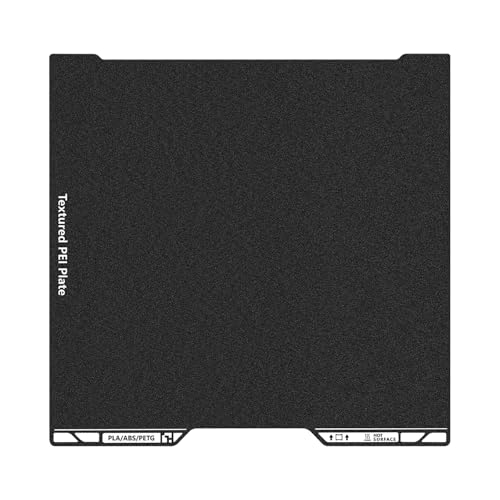
If your printer is a Bambu Lab H2D or H2S, the size math is the whole story. This plate measures 355x346mm, cut for that machine, so flexible filament runs, big flat gaskets, and wide single-piece parts all sit inside the printable zone instead of hanging over an edge. The KOYOFEI-made sheet has a uniform PEI spray coating across both faces, which is the part that keeps the first layer pinned down and stops soft prints from lifting at the corners.
Release is the part TPU owners worry about, and this design handles it the sensible way. Parts detach on their own once the bed cools to room temperature, or you can flex the steel and lift them off. The bottom carries a powder-coated texture, so the base of your print comes out with a rugged matte grain rather than a slick finish. It also runs PLA, PETG, ABS, and Nylon, so one plate covers the whole shelf of filaments you own. The manufacturer notes you should re-level the printer after swapping it in.
Owners on smaller printers have adapted it too — the same sheet reportedly drops onto an Elegoo Neptune 4 without trimming and sits flat on the magnetic bed, with PETG releasing far more easily than the stock plate. The recurring note is that it runs a touch thinner and slightly smaller than some original equipment plates, so if you are replacing a factory sheet on a non-Bambu machine, measure first.
The case for the full-size sheet
- 355x346mm footprint covers the Bambu Lab H2D and H2S build area fully, so no dead strip on large TPU parts.
- Double-sided textured PEI, so you get two usable faces instead of one.
- Self-release at room temperature plus a flex-to-lift option, which is what flexible filament needs.
- Handles PLA, TPU, PETG, ABS, and Nylon from the same plate.
- 1.4 lb spring steel with an evenly applied coating and uniform bottom texture.
Where it asks something of you
- Re-leveling the printer after installation is required to get the best results.
- Reported by some owners as a bit thinner and slightly smaller than original equipment sheets.
- The full-size format is oversized for anyone on a standard 256mm-class bed.
Right plate if: you run a Bambu Lab H2D or H2S and want full coverage plus a textured base on your TPU parts.
Measure first if: your printer uses a standard 256mm bed — this sheet is built for the larger platform.
2. IdeaFormer-3D Rainbow Confetti PEF+Galaxy PEY Build Plate 257x257mm
The one that puts a rainbow on the bottom of your print — and asks you to slow down for it.
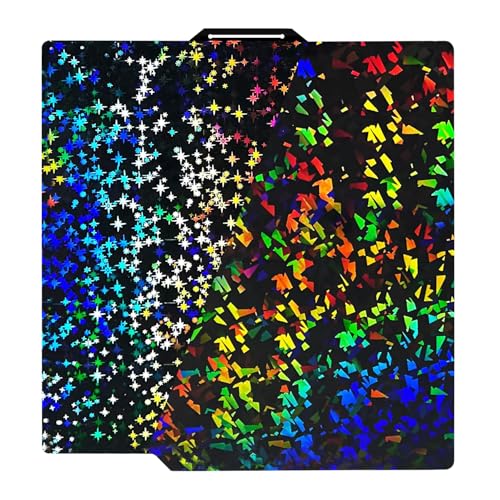
This is the decorative pick. The IdeaFormer-3D sheet pairs a Rainbow Confetti finish on one face with a Galaxy pattern on the other, so your TPU part comes off with a holographic base rather than a plain matte one. It is a double-sided film sheet built on high-strength spring steel that holds its flatness and resists deforming after repeated bending — which matters because flexing the plate is exactly how you release flexible filament.
Here is the honest trade-off, and it is a real one. That holographic film wants a slow first layer: a 20mm/s first-layer speed, 20mm/s infill, and 0.25mm layer height are the numbers that hold on large prints. Glue stick is off the table — it blocks the image transfer. The maker also flags that the film scratches easily even with reinforced packaging, so a scratched unit is a known risk rather than a rare one. Owner reports back this up: adhesion is genuinely mixed, with some getting a clean bond and others finding nothing sticks, and ABS will not hold at all.
What wins people over is the effect itself. Spirit sticks, display pieces, and anything where the base is visible come out looking like a different product, and on a Bambu P1S the setup runs clean once dialed in. It is 13.1 ounces, lighter than the BIQU Glacier plate at 14.4 ounces, and it covers Bambu Lab X2D, X1C, X1, X1E, P1P, P1S, P2S, and A1 beds at 257x257mm. Wipe with rubbing alcohol before every print and the bond tightens up considerably.
The holographic transfer is the point: the Rainbow Confetti and Galaxy faces transfer a holographic pattern to the bottom of the print, something no textured PEI sheet can do.
Budget the tuning time: expect trial and error before it behaves, and keep it away from ABS entirely.
Grab this for: display TPU and PLA parts where the bottom surface is part of the design.
Think twice if: you want a set-and-print plate with no settings changes, or you print ABS.
3. BIQU CryoGrip Pro Glacier Panda Build Plate

A seven-layer polymer coating that lets you pull prints off a hot bed without waiting.
The Glacier Panda takes a different approach to adhesion than any steel PEI sheet on this list. Instead of a spray coating, it uses a seven-layer polymer build on spring steel that grips PLA and PETG at unusually low bed temperatures — the maker recommends 45-55℃ for PLA and 60-75℃ for PETG. That lower heat means less thermal cycling stress on the plate over time, and the honeycomb handle stays cool enough to touch even when the heated bed sits at 100℃. No waiting for cooldown before you pull the part.
It covers a lot of filament ground. PLA, PETG, ABS, and PA all run, and it works with anything that prints under a 300℃ nozzle temperature. The maker is upfront that it beats most PEI plates on engineering-material adhesion but does not match their own CryoGrip Frostbite sheet for straight PLA and PETG — worth knowing if those two filaments are your whole workflow. Cleaning is just water and soap or alcohol, and a simple wipe restores the coating’s grip.
Two practical notes before you buy. On a Bambu Lab X2D or P2S you need to switch off the “Build Plate Detection” setting in your slicer, and the package includes AR-code stickers so the X1C can still recognize the plate by material. The mammoth H2D sheet above ships in a 14.5 x 14 x 1-inch package, so this one stores far more compactly.
Why it earns a spot
- Seven-layer polymer coating holds PLA and PETG at 45-55℃ and 60-75℃ bed temps.
- Heat-insulated honeycomb handle stays cool at a 100℃ bed, so you remove parts immediately.
- Runs PLA, PETG, ABS, and PA plus any material under a 300℃ nozzle.
- Self-recovering coating — a wipe with soap, water, or alcohol brings the grip back.
- Includes AR-code stickers so the X1C recognizes the plate and avoids setup errors.
What to plan around
- Build Plate Detection must be disabled in the slicer on an X2D or P2S.
- Trails the CryoGrip Frostbite on plain PLA and PETG adhesion, by the maker’s own description.
- At 14.4 ounces it is the heaviest sheet on this list.
Suits you if: you want to skip the cooldown wait and print a wide range of materials from one plate.
Look elsewhere if: PLA and PETG are your only filaments — the maker points those users toward their Frostbite sheet instead.
4. Bamboo Textured PEI Build Plate
The straightforward textured plate for anyone who just wants TPU to stick and let go.
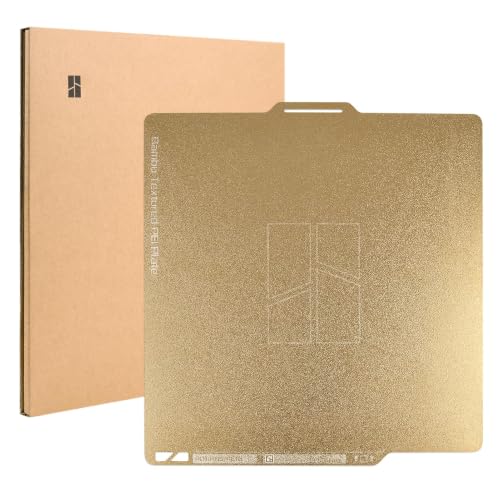
No exotic coating here, and that is the point. This ENOMAKER sheet is 256x256mm, sized for the Bambu Lab A1, P1P, P1S, P1, X1C, X1E, X1, P2S, and X2D — not the A1 mini. The texture comes from a powder-coating process on both surfaces, and it is built around a 0.5mm-thick stainless steel plate that adds magnetic adhesion and helps hold larger warping-prone prints flat. Prints release once the bed drops to room temperature, with 35℃ or lower as the recommended target, or you bend the steel and the model drops into your hand.
Flexible filament behaves well on this kind of surface, and it shares the material range of the other PEI sheets here — PLA, TPU, PETG, ABS, and Nylon, with surface temperature resistance up to 180℃. Owners describe the adhesion texture as excellent and the plate as sturdy, with long runs of clean prints. The consistent operational note is cleaning discipline: the surface needs frequent washing, because hand oils transfer to the texture quickly and dull the grip.
Call it 1.1 pounds, and note the package runs 13.35 x 10.67 x 0.79 inches — a slim tray format that sits flat in a drawer. There is one honest wrinkle: on a P2S the printer may not recognize this as an official Bambu Lab plate, so treat it as a third-party sheet rather than a factory drop-in. A few owners also find the smooth side of a similar dual-sided design needs glue for reliable release, though this plate is textured on both faces and avoids that problem.
The no-fuss pick: a textured, 0.5mm stainless plate that sticks well, releases on cooldown, and covers PLA through Nylon.
Keep the soap handy: oily fingerprints are the one thing that reliably kills the grip, so wipe it before each session.
Best fit for: Bambu Lab owners who want a no-fuss textured surface and will keep it washed.
Keep in mind: a P2S may not detect it as an official Bambu Lab plate.
5. Bamboo Original Dual-Sided PEI Build Plate 257x257mm
Two surfaces on one sheet — flip it for a matte TPU base or a glossy one.
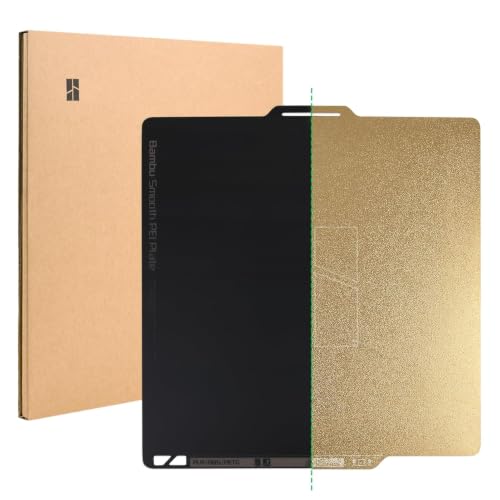
This COMTREE plate gives you both finishes in a single 257x257mm sheet, sized for the Bambu Lab X1C, X1, X1E, P1P, P1S, and A1. One face is textured PEI, the other is smooth PEI, both on a 0.5mm magnetic stainless steel core that adds hold and resists warping. The textured side handles the standard job — good first-layer adhesion and release once the bed cools to room temperature. The smooth side is the reason to pick this one, because a matte PEI sheet transfers a far cleaner, glossier base to your print, which matters on visible TPU parts.
That smooth face also improves Z-axis precision, meaning the vertical dimension of your print stays more accurate and consistent across layers. Owner feedback reflects both sides honestly: the textured face earns steady praise for first-layer grip, and the smooth side is described as harder to remove parts from but producing a noticeably cleaner finish. Compared with the stock plate on a P2S this sheet has a glossier surface, so expect a slightly different look on the bottom of your prints than the factory matte texture.
Weigh it in at 1.15 pounds, with a package size of 13.46 x 10.87 x 0.98 inches. Buyers report it runs a bit thinner than an original textured plate, which does not affect how it prints. There is one caution worth flagging for flexible-filament users specifically: on a similar dual-sided sheet, a PETG print welded itself to the plate even after cooling and cracked the coating on removal. TPU and PLA behave well, but if PETG is on your list, let the bed drop fully before you flex.
What the two faces buy you
- Textured PEI on one side, smooth PEI on the other, both on a 0.5mm magnetic stainless core.
- Smooth face gives greater Z-axis precision and a cleaner, more matte-looking base.
- Prints self-release once the bed reaches room temperature.
- Fits the Bambu Lab X1C, X1, X1E, P1P, P1S, and A1 at 257x257mm.
The catches worth knowing
- Smooth side holds parts harder, so removal takes patience.
- Runs thinner than the original textured plate, by owner report.
- A glossier finish than the stock P2S surface, so the print base looks different.
- PETG has been known to weld to a plate like this if you flex it before full cooldown.
Pick this if: you want to choose between a matte and a glassy base without buying two separate plates.
Not for you if: you only ever want the textured look and want to save the extra attention the smooth face demands.
Know the Specs
Plate Footprint (mm)
The two numbers in a listing, such as 256x256mm or 355x346mm, are the width and depth of the print surface. Both must match your printer’s heated bed if you want the sheet to sit flat on the magnet and cover the full build area. A Bambu Lab P1S or X1C takes a 256mm-class sheet; a Bambu Lab H2D or H2S needs the far larger 355x346mm format.
Surface Type and Finish
A textured PEI surface is powder-coated, so the base of your print comes out with a rugged grain. Smooth PEI and holographic films transfer a glassy or patterned finish instead. Choose by the base finish you want — matte and grippy or polished — since both hold TPU, just with different release feel.
Common Questions
Will a textured PEI plate work with TPU filament?
Which plate size fits a Bambu Lab P1S or X1C?
Do I need glue stick when printing TPU on PEI?
How do I get a TPU print to release without tearing the plate?
Why does my plate stop holding prints after a few runs?
Do I need to change slicer settings for a different build plate?
Is a smooth PEI side better for flexible filament than textured?
Will a third-party PEI plate be detected as an original by my Bambu Lab printer?
Should I print ABS on a PEI plate?
Does plate thickness affect print quality?
The Bottom Line
For most people hunting the right build plate for tpu, the H2D PEI Build Plate is the pick — full 355x346mm coverage for the big Bambu Lab machines, double-sided textured PEI, and clean self-release at room temperature. If you want a decorative base on your prints, take the IdeaFormer-3D Rainbow Confetti PEF+Galaxy PEY Plate. And if you need to switch between a matte and a glossy finish, the Bamboo Original Dual-Sided PEI Plate is the one to reach for.
How we choose
We do not accept paid placement. Every pick is matched to a real buyer and a real use-case; we do not hands-on test units.
Sources
Specifications: manufacturer listings and product documentation. Review insights: verified customer reviews, as of October 2026. Pricing: not shown on this page (it changes often); check the current price via the retailer link.
As an Amazon Associate, Aappliancez earns from qualifying purchases. This does not affect which products we feature.