Disclosure: Some links in this post are affiliate links. As an Amazon Associate I earn from qualifying purchases, at no extra cost to you. Learn more
Specs are compiled from manufacturer listings and verified buyer reviews and can change over time — please confirm the key details on the product page before buying.
Meltwater that backs up under your shingles is how an ice dam turns into a ceiling stain, and the roll you stick to the deck is what stops it. Grace Ice & Water Shield HT is worth buying first for one reason: it pairs a genuinely tough rubberized asphalt (a sticky, rubbery waterproof layer) with the longest UV window of anything in this guide. The other six rolls below cover different roofs and budgets, so you can match one to your deck.
This guide is built by comparing the manufacturers’ published specifications and the patterns across verified customer reviews, so you get each pick’s real strengths and trade-offs instead of marketing spin.
A roof that sheds an ice dam and one that drips into your ceiling usually split on three things: membrane choice, how well the laps seal, and how long the material can sit exposed. Below you get the real specs, the installation reality, and the trade-offs, so you can pick the right ice and water shield the first time.
Top Picks


How To Choose The Best Ice and Water Shield
An ice and water shield is a self-adhering rubberized membrane (a sticky rubber sheet that bonds to the deck) that goes directly onto your roof deck before the shingles. Its job is to stop water that gets past the shingles from ever touching the wood underneath. That water usually arrives one of two ways: wind-driven rain pushing sideways under a shingle course, or an ice dam forming at the eave, melting, and backing up under the roof covering.
What actually separates one roll from another
Three specs decide whether your money was well spent: UV exposure rating, coverage per roll, and how aggressively the adhesive grabs. UV exposure matters because once the membrane is unrolled and stuck down, the clock starts. If your roofer cannot get shingles on within the rated window, the sun bakes the surface and the material degrades. A 30-day rating leaves very little scheduling slack, while a 120-day rating can survive a full season of delays.
Coverage math and roll weight
Rolls are sold by length, but you buy by coverage. A single “square” of roofing equals 100 square feet, so a roll advertised at 195 square feet covers roughly two squares. Roll weight climbs with coverage, and a heavier roll is harder to control on a ladder — the heaviest option here weighs 72 pounds at the larger size and needs two people to position without tearing the membrane or trapping air pockets underneath. Lighter rolls are far easier to handle solo.
Side-by-Side Comparison
| Model | Best For | Coverage | UV Exposure Limit | Roll Weight | Amazon |
|---|---|---|---|---|---|
| Grace Ice & Water Shield HT★ Best Overall | Hot-climate decks and long exposure windows | Roll width 36 in; lengths of 66.6 ft and 75 ft | Up to 120 days | 56 pounds | Amazon |
| ZIP System Peel & Stick Roof UnderlaymentMost Versatile | Full-deck protection paired with ZIP sheathing | Roll dimensions 10 x 10 x 38 inches | — | 51 pounds | Amazon |
| HydroShield HT Underlayment | Metal roofing and high-heat applications | 195 square feet (1.95 squares) | 120 days | 50 pounds | Amazon |
| Platinum HT-B Self-Adhering Underlayment | Low-slope roofs needing a long-lived bond | 200 square feet (2 squares) | 180 days | 36.8 pounds | Amazon |
| Grace Select Roll Roofing Underlayment | DIY reroofs and budget-conscious patches | 195 square feet | Up to 30 days | 33 pounds | Amazon |
| HydroShield Ice and Water Shield Underlayment | Flat-roof repair and quick fixes | 100 square feet (1 square) or 195 square feet (1.95 squares) | 60 days | 35 pounds (33 ft roll); 72 pounds (65 ft roll) | Amazon |
| Pushglossy EPDM Rubber Roofing Membrane | RV roofs, sheds, and small waterproofing projects | 39 in x 10 ft | — | 11.57 pounds | Amazon |
Detailed Reviews
1. Grace Ice & Water Shield HT (1)
Our pick — 4.0+★ from 70+ verified ratings; the strongest balance of quality and price.
Built to stay stuck through a whole season of sun-baked delay
This roll earns the top spot with up to 120 days of UV exposure (how long it can sit in the sun before the material degrades). That is double the 60-day limit on the HydroShield self-adhering roll and four times the 30-day window on Grace Select, so if permits, weather, or a slow crew push your shingle install back, this is the one that survives the wait.
The adhesive is the headline feature and the one thing this product is known for. It is built from aggressive rubberized asphalt bonded to a polyethylene film (a thin plastic skin on top), and the manufacturer lists it as self-adhered with superior adhesion and slip-resistant. It also seals around fasteners, which is what stops a stray nail or a screw from becoming a leak path. The roll itself is 36 inches wide in both available lengths, 66.6 feet and 75 feet, and it carries CertainTeed’s SureStart Warranty.
The membrane’s holding power is what buyers praise most. The trade-off is real and worth planning around, though: heat makes the adhesive extremely aggressive, and buyers report that once this stuff folds onto itself it cannot be separated — “If it stick to itself, there is no way to unravel it, you’ll have to cut it off – that’s how strong it sticks.” The same buyer notes it should not go down in temperatures above 90 degrees. Several others describe the surface turning extremely tacky in hot summer sun, which means your working window is early morning or late evening. At 56 pounds it is also heavy enough that a single installer will struggle on a steep pitch. Grace Select weighs 33 pounds and covers 195 square feet, while this roll is the heavier one.
The one thing to know: install it cool, with a helper, and it will outlast the shingles it sits under.
Where It Wins
- Up to 120 days of UV exposure gives you a huge scheduling cushion versus 30-day and 60-day rolls
- Rubberized asphalt with polyethylene film delivers the strongest grab in this lineup
- Seals around fasteners and stays slip-resistant on the deck
- Backed by CertainTeed’s SureStart Warranty
The Real Catch
- At 56 pounds it is a two-person roll on a roof
- Above 90 degrees the adhesive grabs so hard a folded section has to be cut out
Reach for this if: you want the longest exposure window paired with the most aggressive adhesive and can wrangle a 56-pound roll.
Look elsewhere if: you are installing solo in July heat or need something you can reposition after it touches the deck.
2. ZIP System Peel & Stick Roof Underlayment
The membrane that turns your whole roof deck into one sealed system
This 51-pound roll is the only one here built for full-deck coverage across the whole roof instead of just eave and valley strips. That makes it the right pick if you are building new or replacing sheathing rather than patching. The rubberized asphalt forms a nail seal membrane — meaning it closes back up around every fastener that punches through it — and the surface is slip-resistant while you are walking on it.
Where it separates from Grace Ice & Water Shield HT is the system angle. Installed with ZIP System sheathing and tape, this underlayment qualifies for the ZIP System Leak-Free 30-year Guarantee, and it is engineered to act as a continuous air and water barrier so you do not need additional house wraps. That is a genuine design advantage if you are already committed to the ZIP wall and roof assembly. If you are just buying a membrane to stick on an existing deck, you are paying for system compatibility you will not use.
The annoying part is shelf life. The roll is on a one-year clock, and the complaint that shows up in the reviews is that stock arrives with very little time left — check the date code before you unroll anything. One buyer wrote that both boxes arrived unsealed and badly worn and that the material “expires within in 30 days of arriving to the construction site.” A different buyer had a roll that had overlapped itself on the roll and got a replacement immediately, so the seller does respond. Make sure you have at least one helper, because the membrane grabs OSB sheathing firmly once it lands.
The system trade: you get a sealed deck and a potential 30-year guarantee, but only if the rest of your roof uses the ZIP assembly and the roll is fresh enough to install.
Best matched to: builders running the full ZIP System roof and wall assembly who can install within the shelf-life window.
Think twice if: you are patching an older roof and cannot verify the date code on arrival.
3. HydroShield Ice and Water Shield HT Underlayment

A blue-skinned hot-weather membrane that goes the distance under metal
This roll holds a service temperature range of -40°F to 250°F — the widest in this group — which is why it can sit under copper and zinc roofs without cooking. One roll is 65 feet long, 36 inches wide, covers 195 square feet, and weighs 50 pounds, so you get nearly two full squares in a single carry. It is rated for 120 days of UV exposure, matching Grace Ice & Water Shield HT, and it carries ASTM D1970 (the industry test standard for these membranes), ICC listing, and UL classification.
The blue polyolefin film is the standout construction detail. The blue polyolefin skid-resistant film gives the surface actual grip — you can walk on it instead of tip-toeing across a slick rubber sheet. It self-seals around nails and fasteners, has a selvage edge (an uncoated strip that lets laps overlap tighter) for tighter waterproofing at the seams, and the split-back release liner (a backing you peel away in two halves) lets you place it in two passes rather than fighting one long strip. It is also the thickest sheet listed here at 40 millimeters. One reviewer noted it goes down easy and that the material is “Very strong material, Tuff to cut need a very sharp knife.”
The honest catch is that the same aggressive adhesive that makes it trustworthy makes it unforgiving. It sticks on contact, so there is no repositioning a misaligned course. The blue walking surface also loses its grip when it is wet, and on a steep roof that combination is a real hazard — one owner specifically warns against walking the blue side if it is wet. High-temp rated roofing also costs more than standard rolls, and you are buying that rating whether or not your climate needs it.
Who it fits: metal-roof installs, hot climates, and anyone who wants walkable traction during the install.
The friction point: it grabs instantly, so every course has to be right the first time.
Worth it for: copper, zinc, and metal roofing jobs where surface temperature swings are extreme.
Less ideal for: steep wet decks, where that smooth blue film becomes slippery.
4. Platinum HT-B Self-Adhering Roofing Underlayment, 41 mil
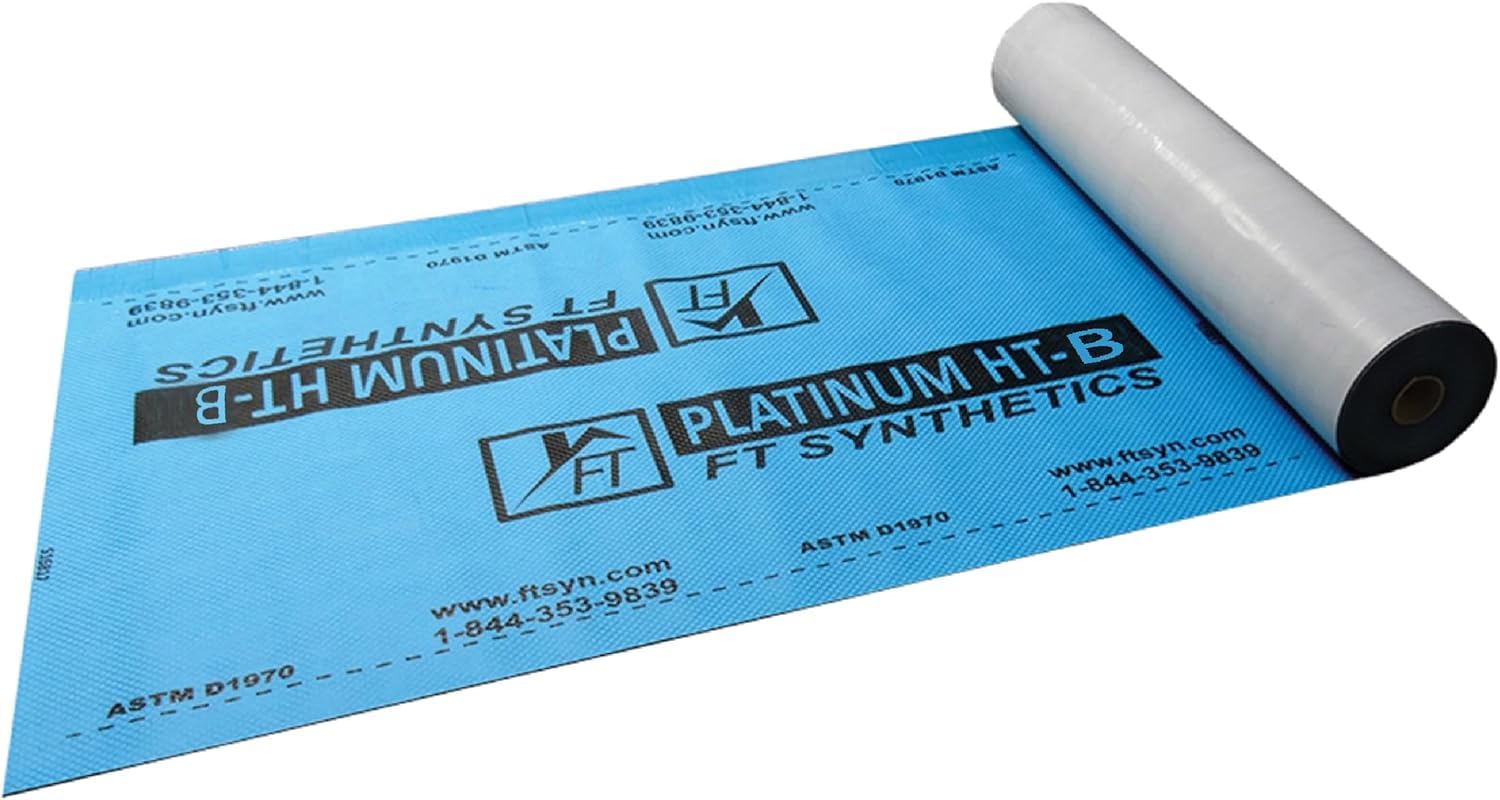
The longest UV window here, and the easiest backing to peel
Platinum HT-B carries 180 days of UV resistance — 50 percent longer than the 120-day rating on the Grace Ice & Water Shield HT and HydroShield HT rolls, and six times the 30-day rating on Grace Select. On a project that stalls, that is the most forgiving timeline here. Coverage is 200 square feet, or two full squares, from a 36-inch-wide, 67-foot roll weighing 40 lbs, and the material is 100 percent butyl (a synthetic rubber adhesive), which bonds to plywood or OSB roof decks.
The other spec worth knowing is the shelf life: 18+ months, which is far longer than the one-year window on the ZIP System roll and the thing that lets you buy ahead without the material going off. It meets and exceeds ASTM D1970, is nail sealable, and is compatible with low-slope roofing materials such as EPDM and TPO. Buyers single out how cleanly the split silicone release liner peels away — one buyer who had used both this and a hardware-store brand said the backing “comes off easily, which wasn’t the case with the other brand.” Another reports it stuck without issue in 45-degree weather, which is genuinely cold for a self-adhering membrane.
What it is not is a solo job. At 40 lbs and 67 feet, the roll wants two people; one owner warns that without a second set of hands “you will be on that roof for hours rolling out air pockets.” The only other thing to watch is fulfilment — one order arrived with only one of two rolls inside a box built for two, and that single roll was not self-adhering as the sticker claimed. Check what lands on your driveway before you schedule the install.
Why It Earns Its Spot
- 180 days of UV resistance, the longest in this group
- 18+ months of shelf life means you can stock the material early
- 100 percent butyl bonds hard to plywood and OSB and works on EPDM and TPO low-slope systems
- The silicone split liner peels away cleanly, which speeds up the install
The Honest Drawbacks
- Two people are basically required — the roll is unwieldy solo
- A rare delivery arrives short or with the wrong roll, so verify before installing
Pick this one when: the schedule is uncertain and you want the longest exposure window and the longest shelf life in the same roll.
Not the fit when: you are installing alone or need a membrane you can handle one-handed.
5. Grace Select Roll Roofing Underlayment

The DIY-friendly roll that patches a roof without punishing your back
At 33 pounds, this is the lightest full-coverage roll in this guide — 23 pounds lighter than Grace Ice & Water Shield HT and roughly two pounds lighter than the HydroShield self-adhering roll. That matters when you are working alone off a ladder. It covers 195 square feet at 36 inches wide and 65 feet long, is 25 mils thick (thousandths of an inch), and is a self-adhered, self-sealing membrane with a slip-resistant surface that can be reroofed over. It carries CertainTeed’s SureStart Warranty.
The heavy wax-paper backing is what makes it easy to install. Instead of a plastic liner, Grace uses a heavy wax paper that separates cleanly — one owner noted that plastic backings tend to become “a mess,” and that with two people working it, the wax paper makes application reasonably easy. It also waterproofs well enough for real jobs: one buyer used it to keep an addition’s floor insulation dry through heavy rain and snow during a month of framing. Most of the praise clusters around the overall material quality.
The two limits are exposure time and long-term adhesion. UV exposure is capped at up to 30 days, the shortest window here, so this is not a roll to leave naked on a roof for a season. Adhesion is the mixed part — many owners find it aggressively sticky going down, but the occasional one reports it letting go over time, and a couple mention that it gets fussy in both cold and heat. One buyer describes a 40-inch width that is genuinely hard to control solo and recommends two people. It is also 25 mils thick, thinner than the 41-mil Platinum HT-B or the 57-mil HydroShield sheet.
The value read: you trade exposure window and sheet thickness for the lightest, most manageable roll on this list and a stress-free backing.
Good call for: DIY patching, shed and addition work, and reroofs where shingles go on within a month.
skip it if: your schedule runs long or you need the thickest membrane available.
6. HydroShield Ice and Water Shield Underlayment

The flat-roof patch that buys you a couple more seasons
When you need the leak to stop now and a full replacement is still a year or two away, this is the roll you reach for. It is applied to shingle rooftops on a slope of 2:12 or greater, self-seals around nails and fasteners, and uses a sand-based surface for foot grip during installation rather than a smooth film. The split-back release liner lets you peel in two passes for faster handling. The 65-foot version covers 195 square feet and weighs 72 pounds; the 33-foot version covers 100 square feet and weighs 35 pounds.
What makes it a repair standout is the paperwork — this membrane is listed to ASTM D1970, ASTM E108 and UL 790 Class A Fire Resistance, and is Florida Building Code approved and Miami-Dade County approved. Service temperature runs from -40°F to 200°F, and it is rated for 60 days of UV exposure. Owners mention exactly the kind of long-tail save this roll is built for: one describes using it on a flat roof repair and having it work great, and another says the membrane “Kept my roof going for almost two more years” on a quick fix.
Where it struggles is adhesive consistency. This is the roll where the tack is genuinely mixed — it holds well when it holds, but some owners find the bond weaker than expected, and one unit arrived with the backing already lifting before it was even unrolled. Others report it performing fine in a non-standard use, like between joists and a concrete foundation, where heavy tack mattered less. The 60-day UV window is also half of what Grace Ice & Water Shield HT and HydroShield HT offer, so plan to cover it quickly.
The patch verdict: strong on certifications and sand-surface traction, lighter on consistent bite — ideal for short-term repairs, less so for a permanent deck.
Fits best: flat-roof leaks, temporary fixes, and jobs where building-code documentation matters.
Not the pick if: you need maximum adhesive certainty or a long exposure window for a full replacement.
7. Pushglossy EPDM Rubber Roofing Membrane

Featherweight rubber for RV roofs and sheds, not shingled houses
At 11.57 pounds for a 39-inch by 10-foot sheet, this roll is a fraction of the weight of any full-deck membrane here — Grace Ice & Water Shield HT checks in at 56 pounds for comparison. That lightness suits its purpose: this vulcanized EPDM rubber membrane (a cured synthetic rubber sheet) is built for RV roofs, garden sheds, garages, patios, gutters, skylights, and HVAC duct sealing, not a shingled roof deck. The 50-mil sheet is designed to resist tearing and to handle UV exposure and temperature swings without cracking or shrinking, and the butyl rubber adhesive backing is meant to seal on contact and conform to irregular surfaces and corners.
At 39 inches by 10 feet, the sheet is sized for small waterproofing jobs. The white release liner lets you peel precisely, and the membrane is formulated to stick to wood, metal, concrete, and most roofing substrates. Owners using it on metal report it going down faster than expected — one said it works great and stuck even when the metal was not fully hot, and used extra tape around the edges for reinforcement. For an RV or a shed, that is exactly the job it is built for.
The honest caveat is long-term hold. This is the roll where buyers describe the adhesive backing as convenient for placement but weak for long-term use, with one using a separate Eternabond tape along the edges to make it stay put. The protective film on the adhesive side also tears easily, so you have to verify the membrane actually bonded before you walk away. If you need a permanent deck-level barrier, look at the Platinum HT-B or the Grace Ice & Water Shield HT instead; if you need a light, manageable sheet for a weekend repair, this is the one.
What It Does Well
- At 11.57 pounds it is easy to carry, cut, and place solo
- 50-mil vulcanized EPDM resists tearing and UV degradation
- Sticks to wood, metal, concrete, and most roofing substrates
- Ideal for RV roofs, sheds, garages, patios, and duct sealing
Where It Falls Short
- The butyl adhesive backs out over time on exposed edges without tape reinforcement
- The protective film on the adhesive side tears easily
- At 39 inches by 10 feet, it will not cover a full house roof deck
Buy it for: RV roofs, sheds, and small waterproofing projects where a light roll matters more than maximal hold.
Don’t buy it for: a full shingled roof deck — this is a specialty repair membrane, not an eave-to-ridge barrier.
Know the Specs
UV Exposure Limit
This is the number of days the membrane can sit in direct sun before the adhesive and surface start to break down. It is not a performance rating — it is a schedule rating. A 30-day limit means your shingles need to be on within a month; a 120-day or 180-day limit gives you a full season of cushion. The ratings in this guide run from 30 days on Grace Select up to 180 days on Platinum HT-B, so if your project has any chance of delay, longer is better.
Roll Coverage and Weight
Coverage is what you actually install — a full square equals 100 square feet, so a 195-square-foot roll covers just under two squares and a 200-square-foot roll covers exactly two. Roll weight climbs with coverage and thickness: the heaviest roll here hits 72 pounds at its largest size, while the lightest full-coverage option is 33 pounds. Weight decides your crew size more than any other spec. A heavy roll on a steep pitch is hard to control without a second pair of hands.
Service Temperature Range
This is the temperature window the membrane is rated to perform within, both during installation and for the life of the roof. HydroShield HT lists -40°F to 250°F, its standard roll lists -40°F to 200°F, and HydroShield’s HT membrane also notes a maximum storage temperature of 104°F. A wider range matters most for metal roofs, which get much hotter in the sun than a shingled deck, and for cold-climate installs where the adhesive still has to grab below freezing.
Self-Sealing and Nail Sealability
This is the property that lets a fastener punch through the membrane and have the material close around it again, sealing the hole against water. It is the reason you can nail or screw roofing materials over the shield without creating leak paths. It is listed explicitly on Grace Ice & Water Shield HT, HydroShield HT, HydroShield standard, and Platinum HT-B, which meets and exceeds ASTM D1970 on this spec. If your roof covering requires fasteners through the membrane, insist on this.
Common Questions
How much ice and water shield do I need for my roof?
Can I install ice and water shield in cold weather?
What is the difference between 30 mil and 40 mil membrane?
Does ice and water shield need to cover the whole roof deck?
How long can ice and water shield be left exposed to the sun?
Will ice and water shield stick to OSB or plywood?
Can I walk on ice and water shield after installation?
Does ice and water shield seal around nails and screws?
Is butyl adhesive better than rubberized asphalt on a roof?
How should I store leftover ice and water shield?
The Bottom Line
For most roofs, the ice and water shield winner is the Grace Ice & Water Shield HT because it pairs the longest UV window (up to 120 days) with the most aggressive rubberized asphalt adhesive, and it seals around fasteners the way a real deck-level barrier should. If you want the longest exposure window and the longest shelf life in one roll, grab the {“@context”: “https://schema.org”, “@graph”: [{“@type”: “ItemList”, “name”: “7 Best Ice and Water Shield”, “url”: “https://aappliancez.com/best-ice-and-water-shield/”, “numberOfItems”: 7, “itemListElement”: [{“@type”: “ListItem”, “position”: 1, “name”: “Grace Ice & Water Shield HT (1)”, “url”: “https://aappliancez.com/best-ice-and-water-shield/#product-1”}, {“@type”: “ListItem”, “position”: 2, “name”: “ZIP System Peel & Stick Roof Underlayment, Standard Temp, Waterproof”, “url”: “https://aappliancez.com/best-ice-and-water-shield/#product-2”}, {“@type”: “ListItem”, “position”: 3, “name”: “HydroShield Self Adhering Ice and Water Shield HT Underlayment (1)”, “url”: “https://aappliancez.com/best-ice-and-water-shield/#product-3”}, {“@type”: “ListItem”, “position”: 4, “name”: “Platinum HT-B Self-Adhering Roofing Underlayment, 41 mil”, “url”: “https://aappliancez.com/best-ice-and-water-shield/#product-4”}, {“@type”: “ListItem”, “position”: 5, “name”: “Grace Select 36 in. x 195 sq. ft. Roll Roofing Underlayment (1)”, “url”: “https://aappliancez.com/best-ice-and-water-shield/#product-5”}, {“@type”: “ListItem”, “position”: 6, “name”: “HydroShield Self Adhering Ice and Water Shield Underlayment (1.95 Square – Single Roll)”, “url”: “https://aappliancez.com/best-ice-and-water-shield/#product-6”}, {“@type”: “ListItem”, “position”: 7, “name”: “Pushglossy 1 Roll EPDM Rubber Roofing Membrane 50 Mil, 39\” x 10 Ft, Black”, “url”: “https://aappliancez.com/best-ice-and-water-shield/#product-7”}]}, {“@type”: “Product”, “position”: 1, “name”: “Grace Ice & Water Shield HT (1)”, “image”: “https://m.media-amazon.com/images/I/61r6Cqgw-UL.jpg”, “brand”: {“@type”: “Brand”, “name”: “Grace”}, “url”: “https://www.amazon.com/dp/B0774XK29W/?tag=aappliancez0f-20”, “offers”: {“@type”: “Offer”, “url”: “https://www.amazon.com/dp/B0774XK29W/?tag=aappliancez0f-20”}}, {“@type”: “Product”, “position”: 2, “name”: “ZIP System Peel & Stick Roof Underlayment, Standard Temp, Waterproof”, “image”: “https://m.media-amazon.com/images/I/51So2Qt9MZL.jpg”, “brand”: {“@type”: “Brand”, “name”: “ZIP”}, “url”: “https://www.amazon.com/dp/B09XJDM7SW/?tag=aappliancez0f-20”, “offers”: {“@type”: “Offer”, “url”: “https://www.amazon.com/dp/B09XJDM7SW/?tag=aappliancez0f-20”}}, {“@type”: “Product”, “position”: 3, “name”: “HydroShield Self Adhering Ice and Water Shield HT Underlayment (1)”, “image”: “https://m.media-amazon.com/images/I/71iRA2SdonL.jpg”, “brand”: {“@type”: “Brand”, “name”: “HydroShield”}, “url”: “https://www.amazon.com/dp/B0CKY56QGZ/?tag=aappliancez0f-20”, “offers”: {“@type”: “Offer”, “url”: “https://www.amazon.com/dp/B0CKY56QGZ/?tag=aappliancez0f-20”}}, {“@type”: “Product”, “position”: 4, “name”: “Platinum HT-B Self-Adhering Roofing Underlayment, 41 mil”, “image”: “https://m.media-amazon.com/images/I/61XjdMjRDUL.jpg”, “brand”: {“@type”: “Brand”, “name”: “Platinum”}, “url”: “https://www.amazon.com/dp/B09JQCCPML/?tag=aappliancez0f-20”, “offers”: {“@type”: “Offer”, “url”: “https://www.amazon.com/dp/B09JQCCPML/?tag=aappliancez0f-20”}}, {“@type”: “Product”, “position”: 5, “name”: “Grace Select 36 in. x 195 sq. ft. Roll Roofing Underlayment (1)”, “image”: “https://m.media-amazon.com/images/I/61seFhBk7xL.jpg”, “brand”: {“@type”: “Brand”, “name”: “Grace”}, “url”: “https://www.amazon.com/dp/B00O9RH0QW/?tag=aappliancez0f-20”, “offers”: {“@type”: “Offer”, “url”: “https://www.amazon.com/dp/B00O9RH0QW/?tag=aappliancez0f-20”}}, {“@type”: “Product”, “position”: 6, “name”: “HydroShield Self Adhering Ice and Water Shield Underlayment (1.95 Square – Single Roll)”, “image”: “https://m.media-amazon.com/images/I/518e6NCCa0L.jpg”, “brand”: {“@type”: “Brand”, “name”: “HydroShield”}, “url”: “https://www.amazon.com/dp/B0CKY5FCX7/?tag=aappliancez0f-20”, “offers”: {“@type”: “Offer”, “url”: “https://www.amazon.com/dp/B0CKY5FCX7/?tag=aappliancez0f-20”}}, {“@type”: “Product”, “position”: 7, “name”: “Pushglossy 1 Roll EPDM Rubber Roofing Membrane 50 Mil, 39\” x 10 Ft, Black”, “image”: “https://m.media-amazon.com/images/I/313wzaIrKRL.jpg”, “brand”: {“@type”: “Brand”, “name”: “Pushglossy”}, “url”: “https://www.amazon.com/dp/B0FPC8VFZS/?tag=aappliancez0f-20”, “offers”: {“@type”: “Offer”, “url”: “https://www.amazon.com/dp/B0FPC8VFZS/?tag=aappliancez0f-20”}}, {“@type”: “FAQPage”, “mainEntity”: [{“@type”: “Question”, “name”: “How much ice and water shield do I need for my roof?”, “acceptedAnswer”: {“@type”: “Answer”, “text”: “Measure the square footage of the areas you intend to cover, then divide by 100 to get squares. A full square equals 100 square feet. Most rolls here cover 195 square feet (1.95 squares) or 200 square feet (2 squares), so each roll handles roughly two squares. Eaves and valleys are the priority zones, so if you are not covering the full deck, you can get away with far less material than a full-deck calculation would suggest.”}}, {“@type”: “Question”, “name”: “Can I install ice and water shield in cold weather?”, “acceptedAnswer”: {“@type”: “Answer”, “text”: “Self-adhering membranes rely on contact pressure and warmth to bond, so cold decks are harder. Platinum HT-B is reported sticking without issue in 45-degree weather, and Grace Select has some owners noting adhesion gets fussy in cold. Roll the membrane out, apply firm pressure with a roller or a stiff push broom, and avoid doing the install on the coldest morning of the week.”}}, {“@type”: “Question”, “name”: “What is the difference between 30 mil and 40 mil membrane?”, “acceptedAnswer”: {“@type”: “Answer”, “text”: “The mil number is the sheet thickness in thousandths of an inch. Grace Select is 25 mils, Platinum HT-B is 41 mils, Pushglossy EPDM is 50 mils, and HydroShield’s HT roll is 40 millimeters. Thicker sheets resist tearing and punctures better during installation and tend to handle foot traffic. Thinner sheets weigh less and are easier to cut and position. Thickness does not change the UV rating or the coverage — those are separate specs.”}}, {“@type”: “Question”, “name”: “Does ice and water shield need to cover the whole roof deck?”, “acceptedAnswer”: {“@type”: “Answer”, “text”: “Not always. The traditional approach covers eaves and valleys, where ice dams form and water backs up. ZIP System Peel & Stick is explicitly designed for full-deck coverage across eaves and valleys. A full-deck installation costs more material and time but gives you a continuous air and water barrier. Many codes require eave coverage at minimum, and if your roof has low slope, full-deck coverage offers far more protection.”}}, {“@type”: “Question”, “name”: “How long can ice and water shield be left exposed to the sun?”, “acceptedAnswer”: {“@type”: “Answer”, “text”: “That depends entirely on the roll. Grace Select is rated for up to 30 days, HydroShield’s standard roll for 60 days, and both Grace Ice & Water Shield HT and HydroShield HT for up to 120 days. Platinum HT-B pushes it to 180 days. Once you pass the rated window, the surface begins to degrade, so schedule the shingle install inside it.”}}, {“@type”: “Question”, “name”: “Will ice and water shield stick to OSB or plywood?”, “acceptedAnswer”: {“@type”: “Answer”, “text”: “Both, on the right product. Platinum HT-B uses 100 percent butyl to bond to plywood or OSB roof decks, and ZIP System Peel & Stick is reported sticking firmly to OSB sheathing over a valley. Clean, dry, dust-free decking is the key — the adhesive grabs whatever is on the surface, so it is worth sweeping before you unroll. If the deck is wet or covered in sawdust, even the strongest adhesive will not hold.”}}, {“@type”: “Question”, “name”: “Can I walk on ice and water shield after installation?”, “acceptedAnswer”: {“@type”: “Answer”, “text”: “Yes, but be careful about the surface. HydroShield’s HT roll uses a blue polyolefin skid-resistant film so installation crews can walk on it, though one owner warns that the blue surface loses grip when wet and steep roofs become dangerous. Grace Ice & Water Shield HT and Grace Select both list slip-resistant surfaces. HydroShield’s standard roll uses a sand-based surface for foot grip. Always avoid walking on a slick membrane in wet conditions.”}}, {“@type”: “Question”, “name”: “Does ice and water shield seal around nails and screws?”, “acceptedAnswer”: {“@type”: “Answer”, “text”: “The good ones do. Grace Ice & Water Shield HT seals around fasteners, and both HydroShield rolls self-seal around nails and fasteners. Platinum HT-B is nail sealable and meets and exceeds ASTM D1970, which is the standard that tests exactly this property. If you are fastening roofing through the membrane, this feature decides whether you get a leak path or a sealed hole.”}}, {“@type”: “Question”, “name”: “Is butyl adhesive better than rubberized asphalt on a roof?”, “acceptedAnswer”: {“@type”: “Answer”, “text”: “They serve different jobs. Butyl, used on Platinum HT-B and Grace Select, gives a strong initial grab and is the adhesive behind 100 percent butyl bonds to plywood and OSB. Rubberized asphalt, used on Grace Ice & Water Shield HT and ZIP System Peel & Stick, forms a nail-seal membrane that closes around fasteners. Which matters more depends on your install — if fasteners go through the shield, rubberized asphalt’s nail-sealing behavior is a big deal.”}}, {“@type”: “Question”, “name”: “How should I store leftover ice and water shield?”, “acceptedAnswer”: {“@type”: “Answer”, “text”: “Keep it cool, dry, and rolled tight. HydroShield’s standard roll lists a maximum storage temperature of 104°F, and Platinum HT-B carries an 18+ month shelf life, so a stored roll stays usable for a long time if it never heats up. The ZIP System roll only has a one-year shelf life, so do not stockpile that one. Never store a roll on its side where the liner can compress or shift.”}}]}]}