Disclosure: Some links in this post are affiliate links. As an Amazon Associate I earn from qualifying purchases, at no extra cost to you. Learn more
Specs are compiled from manufacturer listings and verified buyer reviews and can change over time — please confirm the key details on the product page before buying.
Filet crochet lives or dies on one thing: the openness of the grid. Pick thread that is too thick and the picture you charted turns into a solid block. Pick something too fine and your blocks wobble, your chains gape, and the whole panel looks like a practice swatch. The threads that behave in filet are the thin, mercerized cottons sold in large economical balls, and this guide narrows them down fast.
This guide is built by comparing the manufacturers’ published specifications and the patterns across verified customer reviews, so you get each pick’s real strengths and trade-offs instead of marketing spin.
Filet crochet is a chart of open and filled squares, and your thread decides whether those squares stay square after washing. The first thing to check is the labeled ball size, because a size 10 thread and a size 20 thread are not the same tool. The picks below cover both, and each one lists the hook you will actually need. That way you can match the thread to your chart before you commit to any yarn for filet crochet.
Top Picks

How To Choose The Best Yarn for Filet Crochet
Filet crochet is worked as a grid: solid blocks of double crochet build the picture, and empty squares made of chains and one double crochet create the background. Everything you buy should serve that grid. If the thread is too thick, your open squares close up and the design disappears. If it is too fine, the solid blocks look thin and the whole panel droops.
Match the thread size to the grid you charted
The number on the ball is a thread weight, not a length. A size 10 thread is the mid-weight of the thread world — thin enough to read as lace, sturdy enough that your blocks hold their shape. A size 20 thread is noticeably finer and a good fit for very detailed panels where you want more squares inside the same width. Buy the size your pattern was written for, because switching sizes changes the finished dimensions of the panel.
Check the hook gauge printed on the label
Each ball lists the hook size that produces its stated gauge. Aunt Lydia’s Classic 10, for example, is charted at 32 to 42 double crochet across a four-inch square using a 1.6 mm to 2.25 mm hook — the fine steel hooks most filet workers already own. A thick worsted cotton like Lion Brand 24/7 calls for a 4.5 mm hook instead. That 4.5 mm hook is a very different tool from a 1.6 mm steel hook, and it produces a much denser fabric.
Weigh yardage against the size of your project
A doily eats a fraction of a ball. A tablecloth or a curtain panel can eat several. The bigger the finished piece, the more you want a 400-yard ball and matching dye lots across the whole project. Buying all your thread in one multi-pack is the simplest way to keep every ball in the same dye lot.
Read the care instructions before you commit
Filet pieces get washed — doilies get starched and rinsed, table runners get spot-cleaned, wearable panels get laundered. A machine wash and dry instruction means you can clean the finished work without hand-wringing a fragile panel. Mercerized cotton handles machine washing far better than a loose, low-twist fiber that pills and sheds.
Side-by-Side Comparison
| Model | Best For | Thread Size | Ball Length | Material | Amazon |
|---|---|---|---|---|---|
| Aunt Lydia’s Classic 10 Cotton Crochet Thread, Cream, 3-Pack★ Best Overall | Doilies, lacework and everyday filet panels | Size 10, 3-ply | 350 yard | 100% Mercerized Cotton | Amazon |
| Red Heart Extra Fine Crochet, WhiteFine Detail Pick | Fine, detailed charts with tiny squares | Size 20 | 1437.01 inches | 100% Cotton | Amazon |
| Aunt Lydia’s Classic 10 Cotton Crochet Thread, Ecru, 3-Pack | Big panels and tablecloths in a warm neutral | Size 10, 3-ply | 400 yard | 100% Mercerized Cotton | Amazon |
| Lion Brand Yarn 24/7 Cotton Yarn, White, 3 Pack | Dense filet-inspired home pieces and bags | Light worsted | 185 yard | 100% Mercerized Cotton | Amazon |
| Milk-Cotton Crochet Yarn Kit, 10x50g Skeins DK Weight | Beginners who want a full starter kit | DK weight (#3) | 130 yard | 80% Cotton / 20% Milk Protein | Amazon |
Detailed Reviews
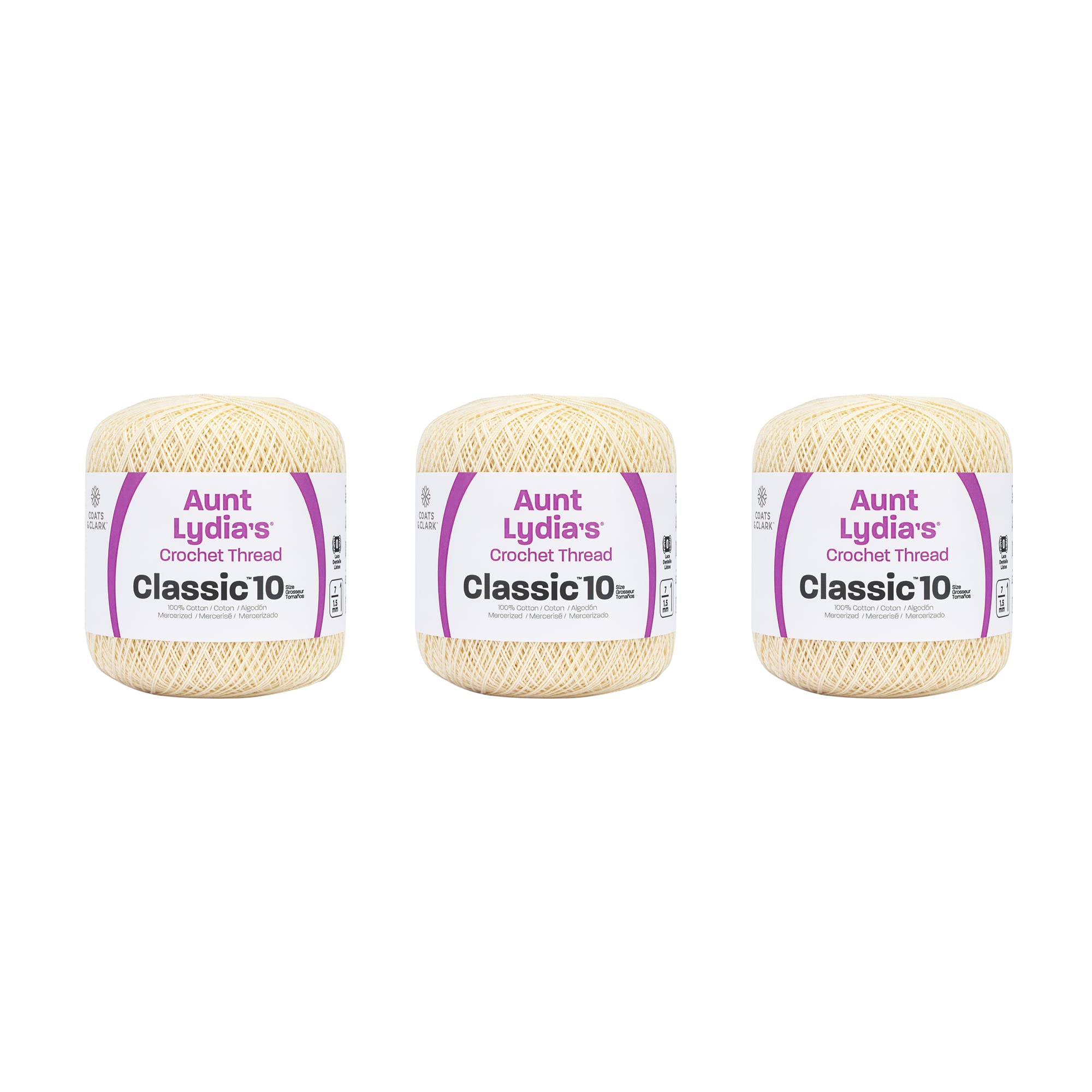
1. Aunt Lydia’s Classic 10 Cotton Crochet Thread, Cream, 3-Pack
Our pick — 4.5+★ from 900+ verified ratings; the strongest balance of quality and price.
The thread most filet charts were actually written for, in a warm cream that hides dust.
If you want the safest starting point for filet crochet, this is it. Aunt Lydia’s Classic 10 is a 3-ply, size 10 thread — thin enough that your open squares read as genuine lace, substantial enough that the filled blocks stay crisp. The cream colorway is a practical pick for a table runner or a doily that will sit out, because it warms up a room without showing every speck the way a bright white does. Each ball in the three-pack runs 350 yards of 100% mercerized cotton.
Gauge is where this thread earns its place. The label charts 32 to 42 double crochet across a four-inch square on a 1.6 mm to 2.25 mm hook (U.S. 6, 7, 8, B-1). That range is exactly the working zone filet lives in — fine enough for detail, controllable enough that you are not fighting the thread for every stitch. For the knitting side, the same ball gauges at 33 to 40 stitches on a 2 mm needle (U.S. 0-1).
What wins people over is the color range. Cream holds its tone wash after wash instead of yellowing, and crafters keep coming back because the shades do not bleed into each other on a multi-tone panel. Where a thicker cotton would need a 4.5 mm hook and produce a dense, almost fabric-like sheet, this thread produces an open, delicate grid you can actually see through. As buyers report: “This crochet thread is thick and doesn’t break easily.”
The case for the cream three-pack
- Size 10, 3-ply thread charts at 32-42 dc per 4-inch square on a 1.6 mm to 2.25 mm hook, the exact working zone for filet
- 350 yards per ball of 100% mercerized cotton, so a large panel does not stall mid-row
- Machine wash and dry, which matters once the finished piece leaves the blocking board
- Cream tone resists the yellowing that shows up on bright white pieces over time
Where it asks for patience
- Fragility splits opinion — the thread holds beautifully for many makers, while a few find it frays at the hook over long stretches
- The 1.6 mm hook end of that gauge range is genuinely small, so if you dislike steel hooks this is not your thread
Grab this if: you want a proven size 10 workhorse for doilies, table runners, and any traditional filet chart, and you would rather buy three balls at once than chase matching dye lots later.
Handle with care: the fine 1.6 mm hook end of the gauge range rewards a light tension — pull hard on this thread and the few fragile-fray reports start to make sense.
2. Red Heart Extra Fine Crochet – 1 Pack of 400y/365m – White
Half the thickness of a standard filet thread, for charts with squares the size of a pinhead.
When a chart has more picture than space, you graduate to size 20. Red Heart’s extra fine thread is a 100% mercerized cotton in a high-luster white, and the finer gauge packs far more squares into the same width of fabric. That is the whole appeal of going finer: a portrait panel or a detailed monogram that would be nine inches wide in size 10 comes out noticeably narrower here, with the open squares still clearly hollow.
The hook needed is a real step up in delicacy. This thread charts to a 2.75 mm hook (U.S. 20), and the same size 20 designation applies to the knitting needle. If you are moving down from a size 10 ball and a 1.6 mm hook, expect your hands to work harder for the same number of stitches, and expect to count more carefully — a dropped stitch is harder to spot in thread this fine.
What buyers value here is clean, nub-free fiber. The thread runs smooth through the loop without the little slubs that break the surface of a lace panel, and it works especially well for bead crochet, where you are threading beads onto the strand as you go. The one thing to settle before you buy is quantity expectations — the listing reads as a single 400-yard pack, and confusion over how many balls arrive has been a recurring frustration in the reviews. Read the pack size carefully and you will not be surprised.
What you get: a 400-yard ball of size 20 mercerized cotton that opens up fine, detailed charts without the grid collapsing. The 2.75 mm hook it calls for is a very different tool from the 1.6 mm steel hook a size 10 thread wants.
Settle one thing first: confirm the number of balls in the listing before you order. Buyers who expected a three-pack and received one ball were unhappy, and that disappointment had nothing to do with the thread itself.
Pick this for: detailed pictorial charts, monograms, and bead work where a size 10 grid would simply be too coarse to hold the design.
Think twice if: your hands tire quickly on very fine steel hooks, or you want one ball to cover a whole tablecloth — at 400 yards this is a single-pack format.
3. Aunt Lydia’s Classic 10 Cotton Crochet Thread, Ecru, 3-Pack

The longest ball in the lineup, in an ecru that reads vintage instead of stark.
Same thread, more of it. This is the ecru version of the classic size 10 cotton, and the ball length is the reason to reach for it over the cream — each ball holds 400 yards instead of 350. That extra 50 yards per ball is not a rounding detail when you are three quarters of the way through a tablecloth and the row still needs to finish. Across a three-pack, the difference is enough to complete a larger panel without breaking into a fresh ball mid-pattern.
Everything else is the familiar Aunt Lydia’s formula: 100% mercerized cotton, 3-ply bedspread weight, charted at 32 to 42 double crochet over four inches on a 1.6 mm to 2.25 mm hook, with the same 400-yard ball weighing 7.2 ounces. For scale, a light worsted cotton like Lion Brand 24/7 is listed at 185 yards and 3.5 ounces — this ball is more than double the length and more than double the weight. When you are pricing out a big project by the yard rather than by the ball, that gap decides it.
The ecru tone is the quiet win for filet specifically. It sits between white and cream, so it photographs beautifully on a dark table and does not glare the way bleached white can. Color reliability does vary a touch in this shade — a few buyers describe one ball in the pack arriving slightly brighter than the others, which is a common reality of dyed cotton and easy to plan around by alternating balls within a row. Workability earns its own praise: the color holds where you want it and the thread feeds cleanly off the ball.
On durability, the thread behaves well in the wash as long as you keep the tension even. Treat the finished panel to the machine cycle the label allows, dry it flat, and it keeps its grid. Pull too aggressively at a tight gauge and the finer end of the hook range will start to show wear.
The yardage math that matters: 400 yards per ball at 7.2 ounces each, against a light worsted cotton listed at 185 yards and 3.5 ounces. For a large filet panel, this is the ball that gets you to the end of the chart.
One small thing to expect: ecru balls can vary slightly in brightness between dye runs, so alternate them row by row if you are working a single large piece and want an even tone throughout.
The right call for: long, unbroken filet panels — tablecloths, curtain valances, and wide runners — where running out of thread mid-pattern would mean reworking a section.
Consider the cream instead if: you only ever make doilies and small motifs, where the extra 50 yards per ball will simply sit in your stash.
4. Lion Brand Yarn, 24/7 Cotton Yarn, White, 3 Pack

Not a lace thread at all — the dense, high-shine cotton for filet-inspired home pieces.
Be clear about what this is before you buy it. Lion Brand 24/7 is a light worsted cotton, not a size 10 or size 20 thread, and it takes a 4.5 mm hook rather than the fine steel hooks the actual filet threads call for. The comparison is stark: the Aunt Lydia’s size 10 above charts to a 1.6 mm hook metric size, while this charts to 4.5 mm. If you tried to work a traditional doily chart in this, your open squares would close and you would be crocheting a solid mat.
So who is it for? Makers who want the look of filet — clean geometric blocks, defined stitches, a subtle sheen — in a fabric thick enough to hold up as a bag, a dishcloth, a summer hat, or a home décor piece. The mercerized finish gives excellent stitch definition with a soft sheen, which is exactly what makes a chunky filet-inspired grid read cleanly at a larger scale. Each ball is 185 yards and 3.5 ounces, so you get a generous skein for the money.
What this yarn does better than almost anything in its class is resist splitting. Mercerization strengthens the cotton fibers and smooths the surface, so the hook slides through without catching and shredding the strand. Buyers describe it as silky and softer than a normal cotton cord, and the fiber holds its shape through repeated machine washing. This is not a fragile thread you baby — it is a workhorse that stands up to kitchen and market use.
The honest catch is softness consistency. Some makers find the feel a little firmer and more cord-like than the butter-soft milk cotton below, and a few note the white can read slightly cooler in person than on screen. Neither is a defect, but if your hands need a plush fiber for long sessions, the milk cotton is the gentler choice.
Reach for this if: you want a durable, mercerized cotton for larger filet-style home projects — bags, dishcloths, mats — where a dense, defined stitch is the point.
Skip it for traditional lace: at a 4.5 mm hook this is far too thick to hold an open doily grid — pair it with projects that want body, not air.
5. Milk-Cotton Crochet Yarn Kit

Ten colors, two hooks and a printed pattern in one box — the easiest way to try the craft.
This is a different proposition from the thread balls above, and worth saying plainly: a DK weight yarn takes a 4 mm hook and works up into a soft, plush fabric, not a delicate lace grid. If you are brand new to crochet and want to learn the basic chain and double crochet before graduating to fine filet thread, a kit like this removes every excuse to delay — 10 skeins in the Nature palette, 1250+ yards total, 2 crochet hooks, 2 yarn needles, 10 stitch markers, and 6 safety eyes all arrive together.
The fiber is the talking point. It blends 80% cotton with 20% milk protein, which is what creates the smoother, silkier glide that pure cotton cannot match. The result is a yarn that slides easily off the hook with noticeably less hand fatigue over long sessions — a real benefit if you are practicing rows for an hour at a stretch. At 130 yards per 50-gram skein, each color holds enough for a small practice project, and 40+ free patterns are included if you want direction.
What buyers love most is the softness and the color range. The Nature palette runs sage greens, warm browns, soft creams and terracotta, and the saturation is rich enough to make a woodland or farmyard amigurumi look premium. It is a yarn makers buy again once they have tried it, and it works well for children and baby items where a scratchy cotton would be the wrong feel.
Two honest notes for this kit. First, this fiber is deliberately soft and low on body, so it is poorly suited to hot pads or dishrags — it lacks the firmness those projects need, and makers who tried it there said as much. Second, the yarn is split-prone and can knot, so a knitter who likes a tight, high-twist hand may find it finicky. Work a little looser than usual and it behaves far better.
Where it shines: 10 skeins of 50 grams each across 10 nature-toned colors, plus hooks, needles, markers, safety eyes and a printed amigurumi pattern — a complete first project in one box, backed by a soft cotton-milk blend that eases hand fatigue.
Where it needs a lighter touch: this fiber splits and can knot, and its soft drape makes it a poor fit for dense projects like hot pads. It is built for amigurumi, wearables and decorative pieces.
Suits you if: you are starting out and want a soft, well-equipped kit with enough colors to finish a real first project — the included hooks mean you can begin the same day it arrives.
Look elsewhere if: you are shopping for traditional filet thread — a 4 mm DK yarn is far too thick to build an open lace grid, and its low twist is too soft for firm, dense work.
Know the Specs
Thread Size (10 vs 20)
This is the number that decides your grid. A size 10 thread is the standard for traditional filet — it is thin enough to read as lace and sturdy enough to keep filled blocks crisp. A size 20 thread is noticeably finer, ideal for detailed charts where you want more squares inside the same width. The finer the thread, the smaller the hook it needs, so size 20 wants a 2.75 mm hook while size 10 works on a 1.6 mm hook.
Mercerization
Mercerized cotton has been treated so the fibers smooth out and take dye more deeply. For filet, that matters in three ways: the strand slides through the hook without shredding, the stitch definition is cleaner so your solid blocks look sharp, and the color stays more vivid over time. It also adds a subtle sheen that gives a finished doily a polished look rather than a flat, matte one.
Ball Length And Weight
The yardage on the label tells you how far a single ball will run. A 400-yard ball at 7.2 ounces covers more ground than a 185-yard ball at 3.5 ounces. Plan your yardage against the size of the finished piece — a doily needs a fraction of a ball, while a tablecloth can eat several. Buying all your thread in one pack keeps the dye lots matched across a large project.
Hook Gauge And Your Grid
Every ball lists the hook that produces its stated gauge. Filet charts assume a specific block size — usually a fixed number of double crochet filling a fixed square. If you use the wrong hook, your blocks come out larger or smaller than the chart intends, and the finished picture stretches or shrinks. Always match the hook to the thread size the pattern was written for.
Common Questions
What thread size should I use for filet crochet?
Can I use regular worsted weight yarn for filet crochet?
What hook size goes with size 10 crochet thread?
How much thread do I need for a filet crochet tablecloth?
Is mercerized cotton better than regular cotton for filet crochet?
Does crochet thread fray or break while you work?
Can I machine wash a finished filet crochet piece?
Do I need a finer hook for a size 20 thread than a size 10?
What is the difference between size 10 and size 20 crochet thread?
Is a yarn kit a good way to learn before trying fine thread?
The Bottom Line
For most makers, the strongest pick for the money is the Aunt Lydia’s Classic 10 Cotton Crochet Thread, Cream, 3-Pack because it delivers the exact size 10, 3-ply mercerized formula filet charts are written for — a 350-yard ball on a 1.6 mm to 2.25 mm hook, in a cream that stays put through washing. If your chart is dense and detailed, the Red Heart Extra Fine Crochet size 20 thread opens up finer work. For long panels where running out mid-pattern would hurt, the Aunt Lydia’s Ecru 3-Pack carries 400 yards per ball. And if you are new to the craft and want yarn, hooks and patterns in one order, the Milk-Cotton Crochet Yarn Kit gets you started the day it arrives. Whichever you choose, match the hook size on the label to your chart before you start, since block size is what makes or breaks the finished picture.
How we choose
We do not accept paid placement. Every pick is matched to a real buyer and a real use-case; we do not hands-on test units.
Sources
Specifications: manufacturer listings and product documentation. Review insights: verified customer reviews, as of October 2026. Pricing: not shown on this page (it changes often); check the current price via the retailer link.
As an Amazon Associate, Aappliancez earns from qualifying purchases. This does not affect which products we feature.