Disclosure: Some links in this post are affiliate links. As an Amazon Associate I earn from qualifying purchases, at no extra cost to you. Learn more
Specs are compiled from manufacturer listings and verified buyer reviews and can change over time — please confirm the key details on the product page before buying.
Wrist monitors are the easiest blood pressure cuffs to live with, and the easiest to get wrong. Everything depends on cuff placement: the band must sit level with your heart, your wrist supported and your arm still. Positioned that way, a good wrist unit reads close to a clinic cuff. Get it wrong and readings can swing 20 to 40 points. This guide covers seven wrist monitors, what each does well, and the honest catch with each.
This guide is built by comparing the manufacturers’ published specifications and the patterns across verified customer reviews, so you get each pick’s real strengths and trade-offs instead of marketing spin.
You will see which cuff fits which wrist, how much memory each unit holds, and where the quiet models beat the chattery ones. By the end you will know exactly which of these wrist blood pressure monitors belongs on your bedside table.
Top Picks

How To Choose The Best Wrist Blood Pressure Monitors
Start with your wrist, not the feature list. A cuff that does not close snugly around your arm gives you a number you cannot trust, no matter how good the chip inside is. Measure your wrist circumference before you buy anything.
Wrist circumference is the first filter
The A&D UB-525 fits wrists from 5.3 to 8.5 inches. The Beurer BC54 tops out at a narrower range, and the HoMedics BPW-930BT-AMZ fits 5.3 to 7.7 inches. If your wrist runs thick, check the upper limit carefully — a cuff that barely closes will read high or throw an error.
Heart-level positioning is not optional
Your wrist reading only matches an arm-cuff reading when you raise your wrist to heart level, rest it on something steady, and keep your feet flat. Skip that setup and the numbers drift — that is the single biggest reason wrist readings differ from arm-cuff readings. A positioning sensor (a built-in guide that tells you your wrist is at the right height) or a resting indicator cuts some of the guesswork. Neither one removes the need to sit still.
Decide how you want to store readings
On-device memory ranges from 60 readings on the A&D up to 240 across two users on the HoMedics. Bluetooth models push readings to a phone app so you can hand your doctor a tidy history instead of a scribbled notebook. If you already keep a paper log, on-device memory alone is plenty.
Side-by-Side Comparison
| Model | Best For | Wrist Fit | Memory | Weight | Amazon |
|---|---|---|---|---|---|
| A&D Medical UB-525★ Best Overall | Simple daily checks | 5.3–8.5 in | 60 readings | 3.2 oz | Amazon |
| Beurer BC54Best for App Tracking | App-based tracking | — | 120 readings | 3.36 oz | Amazon |
| AOJ FDA Cleared Wrist Monitor | Bright screen and dual power | 5.3–7.7 in | 198 readings | 7.41 oz | Amazon |
| IIF Voice Broadcast Monitor | Seniors and low vision | — | 240 readings | 3.6 oz | Amazon |
| HoMedics Premium BPW-930BT-AMZ | Two-person households | 5.3–7.7 in | 240 readings | 7.62 oz | Amazon |
| Beurer BC57 | Bluetooth sync | 5.3–7.7 in | 120 readings | 3.39 oz | Amazon |
| OMRON Gold BP4350 | Quiet readings and app history | 5.3–8.5 in | 400 readings | 3.17 oz | Amazon |
Detailed Reviews
1. A&D Medical UB-525 Wrist Blood Pressure Monitor
Our pick — 4.0+★ from 250+ verified ratings; the strongest balance of quality and price.
The compact wrist cuff that makes a daily reading a one-press habit.
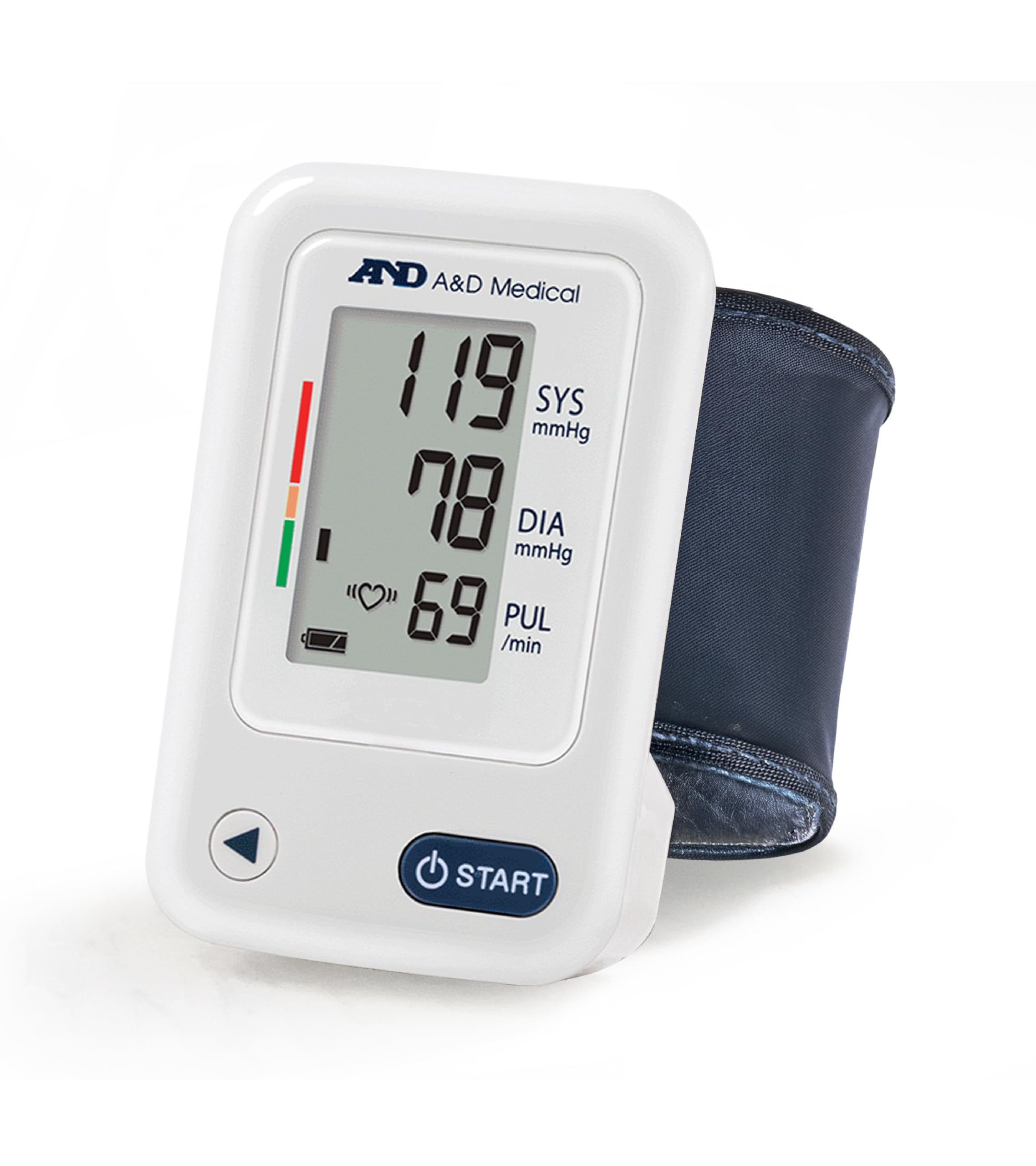
If you want a wrist monitor with no setup fuss, the UB-525 is the one to beat. It fits wrists from 5.3 to 8.5 inches, which is the widest range on this list. At 3.2 ounces it slips into a bag or a drawer and disappears until you need it.
Operation is a single button. Press it, the cuff inflates gently, and the oversized digits on the LCD show your systolic, diastolic, and pulse together. It stores 60 readings on board so you can flip back through the last several weeks of numbers. The free A&D Heart Track app lets you log unlimited measurements manually if you want a phone record too.
Build quality is the most-praised trait in owner feedback, and you can feel it in the snug cuff and the clean screen. The honest catch: accuracy is the trait that splits opinion. It can read high for some wrists, and the fit is fussy on thicker arms. As buyers report: “you have to position it exactly right to get a real good reading.”
What earns the top spot
- Widest wrist range here at 5.3–8.5 inches
- One-button operation with a large, clear digital display
- 60-reading on-board memory for trend checks
- At 3.2 ounces, lighter than the AOJ monitor’s 7.41 ounces
Where it can trip you up
- Accuracy splits opinion — reads high for some wrists
- Cuff fit gets fussy on thicker arms
- No Bluetooth; app logging is manual
Reach for this if: you want a dead-simple daily cuff that fits a wide range of wrists and lives in a drawer between readings.
Think twice if: your wrist runs toward the top of the range and you need push-button app sync.
2. Beurer BC54 Wrist Blood Pressure Monitor with Bluetooth
A Bluetooth cuff that logs two people’s readings and flags an irregular rhythm.
The BC54 packs a lot of features into a small body. It holds 120 readings across two user profiles, versus 60 readings on the A&D UB-525. Each reading comes with a color-coded risk indicator that compares your numbers against WHO guidelines, so you can tell at a glance whether you are in the normal, improve, or high band.
The electric inflation tech takes the reading as the cuff fills, which is meant to be quicker and more comfortable than a slow squeeze. It also detects an irregular heartbeat during the measurement and alerts you. The whole unit weighs 3.36 ounces and comes with a travel case.
The friction point is accuracy. Owner feedback is genuinely split here, with readings sometimes landing lower than other units and varying with wrist placement. As owners mention: “readings ~20 points lower than other units; wrist position critical, results vary 20-40 points.” Setup on the app is quick, and the Bluetooth logging is a real convenience when it cooperates. The low-battery indicator has a habit of showing up early, which is easy enough to ignore.
Where the value lands: 120 readings across two profiles and a travel case make this a neat two-person or on-the-go option. The color risk bands do a lot of the interpreting for you.
The honest trade-off: accuracy is the most-discussed topic in owner feedback and it is mixed, so treat this as a monitor to use carefully at heart level, not as a set-and-forget device.
Go with this if: you want Bluetooth logging and a risk indicator in a light, travel-friendly cuff.
Look elsewhere if: you need the most consistent accuracy above all else.
3. Wrist Blood Pressure Monitor, FDA Cleared BP Cuff Machine
A bright-screen cuff with two ways to power it and room for two users.
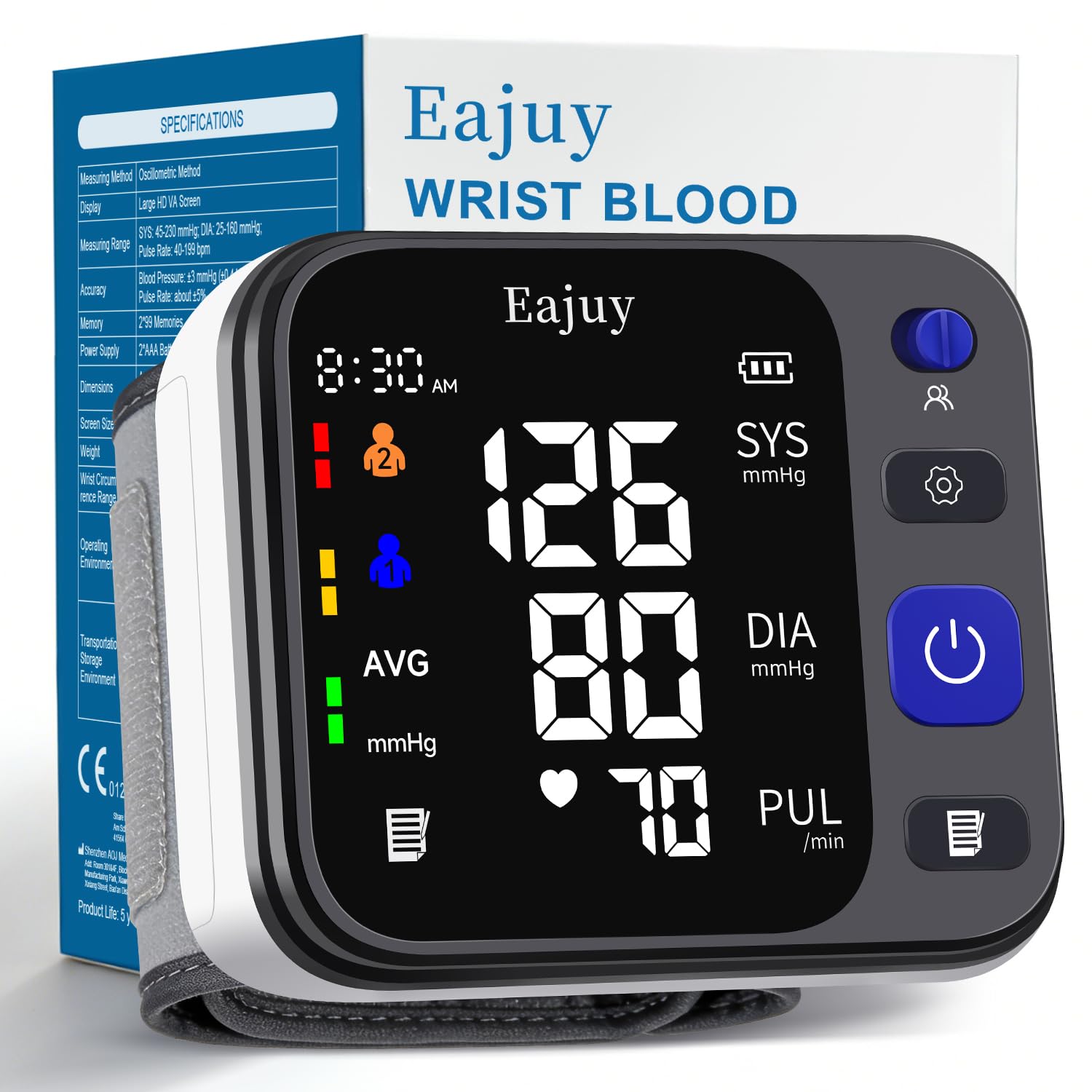
The screen on this one is the draw. The high-definition LED display uses large fonts, and the backlight adjusts to ambient light so it stays readable at night. A three-color indicator gives you a quick read on where your numbers land. For low-vision users, the large backlit digits are the reason to pick it.
Power is flexible — it runs on two AAA batteries or through a Type-C port, so you are not stuck scrambling for batteries. Dual-user mode stores 2×99 readings, and the cuff fits wrists from 5.3 to 7.7 inches. Raised physical buttons give you a click you can feel, which cuts down on accidental presses.
Not everything lands. Accuracy is the loudest complaint in owner feedback, and readings can differ from minute to minute. It is also one of the heaviest units on this list at 7.41 ounces versus the A&D UB-525’s 3.2 ounces, so it feels denser in hand. As customers note: “at least 20° off from regular portable machine.” When it is positioned right at heart level, though, some owners find it tracks close to an upper-arm cuff.
Bright side: the large backlit display and three-color indicator make numbers easy to read and interpret, and dual power removes battery anxiety.
The thing to watch: inconsistent readings are the recurring theme, and at 7.41 ounces it is among the heaviest cuffs here — best treated as a positional, sit-still tool.
Pick this if: a bright, large screen and a recharge-via-Type-C option are what you are after.
Reconsider if: you need readings that stay tight and repeatable above all.
4. IIF Wrist Blood Pressure Monitor with Voice Broadcast

A talking cuff built for older eyes and ears, with two-user memory built in.
This monitor speaks its results out loud, which is a real difference-maker if your eyesight makes a small screen hard to read. The backlit display uses extra-large digits for low light, and the voice broadcast reads your numbers to you. The one-touch inflation takes a measurement in 25 seconds.
Storage runs to 240 records across two users with 120 each — the same capacity as the HoMedics Premium. It also flags irregular heartbeats as an early-warning signal and runs on a chipset that filters out movement interference. At 3.6 ounces it is light enough to carry, and the breathable cuff is built to be gentle on the skin.
The trade-off is accuracy, and it is not a small one. Systolic readings in owner feedback track close to an upper-arm cuff, but diastolic runs consistently higher, which raises a caution flag. A few units have also failed to show numbers at all. For a senior who wants a no-fuss reading, the voice broadcast and one-touch inflation deliver.
Worth it if: loud voice guidance and a big backlit screen are what will get a senior family member to actually check their numbers.
Hold off if: you want tight agreement between systolic and diastolic readings.
5. Homedics Premium Wrist Blood Pressure Monitor

Two-user memory plus a wrist positioning sensor that tells you when you are ready.
The positioning sensor is the standout here. It helps you find the ideal spot for the reading before the cuff inflates, which addresses the exact problem that trips up most wrist monitors. The monitor also uses Smart Measure inflation and stores 240 records across two users with 120 each.
You get useful extras: AM/PM averaging (it averages your morning and evening readings separately), an irregular heartbeat detector, and a risk category index (a scale that labels each reading). It also flags excessive body movement and shows an error if you are not still — a helpful nudge to sit down and retry. Bluetooth sends your readings to the HoMedics Health App, so you can review them on your phone. The cuff fits wrists 5.3 to 7.7 inches. At 7.62 ounces it is the heaviest monitor in this guide, which you will notice on your wrist.
The app is the weak link. Reliability is the most-discussed topic in owner feedback and it is mixed. The Android app in particular is no longer maintained and does not store data in the cloud, so switching phones can lose your history. When taken alongside an upper-arm device, readings were not always close. The positioning sensor counters some of that, but not all.
What earns the price: the positioning sensor, dual-user memory, and motion-error detection are the sort of features that make wrist cuffs less fussy to use.
What to know: the app is dated and reading consistency is mixed — a strong cuff held back by software support.
Best for: a couple who each want their own memory bank and a cuff that helps you get positioned right.
Pass if: app-based tracking on Android matters to you.
6. Beurer BC57 Wrist Blood Pressure Monitor with Bluetooth

The resting indicator lights only when you are settled — wait for it, then measure.
That resting indicator is a smart bit of design. It stays dark until you are in a rested position, so it visually stops you from taking a reading too soon. The BC57 also has a color-coded risk indicator, syncs to the HealthCoach app via Bluetooth, and stores 120 readings across two users versus 60 on the A&D UB-525. At 3.39 ounces it is easy to pocket.
The Bluetooth sync is the feature that draws people in. When it works, you tap through readings on your phone without touching a notebook. It also measures heart rate alongside blood pressure and sounds an alarm if it detects an irregular heartbeat. The cuff adjusts from 5.3 to 7.7 inches.
Where it stumbles is the Bluetooth itself. Connectivity is the most-complained-about trait in owner feedback and it is negative — pairing can be finicky, and readings have failed to transfer after several uses. Accuracy is also mixed, with some readings landing higher than a clinic cuff. If you get a clean unit and a stable connection, it is a tidy little monitor.
The quiet win: the resting indicator and the color risk band make the BC57 one of the more thoughtful-positioned cuffs here.
The honest caveat: Bluetooth reliability and accuracy consistency are the two areas owners flag most, so plan on babysitting the app.
Choose it if: you want a light Bluetooth cuff with a resting indicator and you can live with occasional pairing trouble.
Skip if: you want set-and-forget sync.
7. OMRON Gold Wireless Wrist Blood Pressure Monitor
The quiet one that stores more readings than any other cuff on this list.
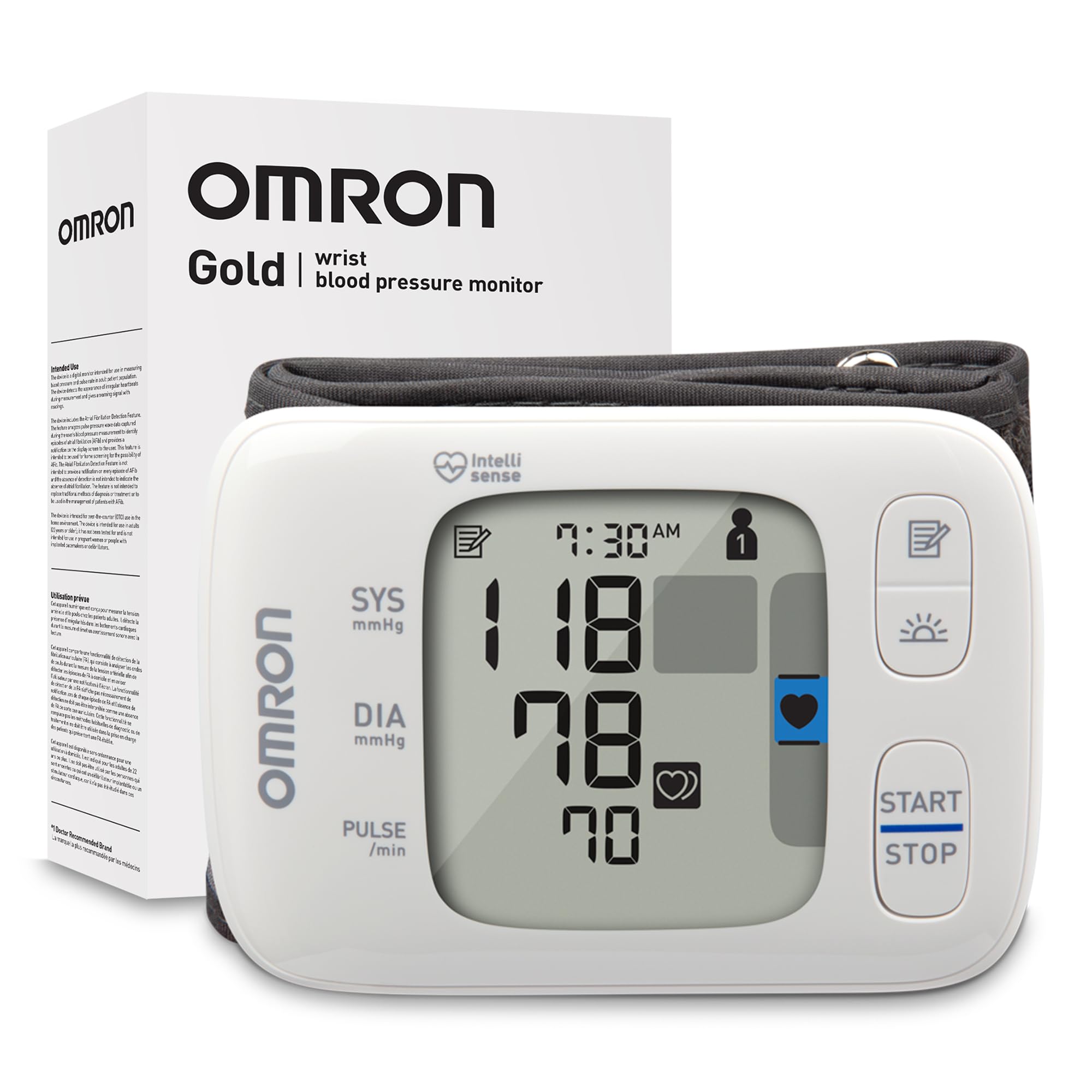
The headline spec is memory: OMRON stores 200 readings for you and 200 for a partner, 400 total. It also runs the High Morning Average Indicator, which flags morning blood pressure spikes. Bluetooth sync to the free OMRON connect app stores unlimited readings, and the app works with Apple Health and Google Fit. It fits wrists 5.3 to 8.5 inches and weighs 3.17 ounces.
What owners talk about most is the quiet. There is no talking and no loud pump noise, so it will not wake a sleeping partner at 6 a.m. The compact size and consistent readings are the next things people mention. Compared with the AOJ monitor above, the OMRON is dramatically lighter — 3.17 ounces versus 7.41 ounces — and fits a wider wrist range.
The catch is the level indicator. It only confirms your position after the test, so you may need a couple of attempts to get a clean reading. The E4 error code shows up when the cuff is not positioned right, and the LED screen is harder to read off-angle. Those small annoyances do not undo the memory and quiet, but they are why this is not the easiest cuff here to use in a hurry.
Standout strengths
- 400-reading memory across two users — the most on this list
- High Morning Average Indicator for spotting morning spikes
- Very quiet — no talking or loud pump noise
- At 3.17 ounces, the lightest cuff in this guide
Small sticking points
- Level indicator only confirms position after the test
- E4 errors when the cuff is not placed right
- LED screen is hard to read from an angle
Go for it if: you want the biggest memory bank, the quietest measurement, and a partner’s readings tracked too.
Reconsider if: you want a cuff that confirms positioning before it starts inflating.
Know the Specs
Wrist Circumference Range
This is the span of wrist sizes a cuff’s band will close around securely. The numbers here run from 5.3 inches on the low end to 8.5 inches on the high end, depending on the model. Measure your wrist before you buy — a cuff that barely closes will read high or throw an error. The A&D UB-525 and OMRON Gold both top out at 8.5 inches, while the Beurer, HoMedics, and AOJ models stop at 7.7 inches.
Memory Sets and User Profiles
Memory sets are how many past readings the device stores on board. Capacity ranges from 60 readings on the A&D up to 400 across two users on the OMRON. Two-user profiles let you and a partner keep your numbers separate so the history stays clean. If you only track your own numbers, a single profile with 60 sets is plenty.
Heart-Level Positioning
Wrist monitors read accurately only when the cuff sits at the height of your heart. That means raising your wrist and resting it on a steady surface, feet flat and still. Units with a positioning sensor or a resting indicator help you find that spot, but none of them remove the need to sit still. This single habit matters more than any feature here.
Irregular Heartbeat and Risk Indicators
An irregular heartbeat detector alerts you if the rhythm of your pulse looks uneven during a reading. A risk indicator compares your numbers against color-coded guidelines so you can see at a glance whether you are in a normal or high band. These are convenience features for tracking trends — they are not a diagnosis, and your doctor remains the one who interprets your numbers.
Common Questions
How do I know which wrist size a monitor fits?
Do I really need to hold my wrist at heart level?
How many readings should a monitor store?
Are wrist monitors as accurate as upper-arm cuffs?
What does an irregular heartbeat alert actually do?
Can two people share one wrist monitor?
Batteries or rechargeable — what should I expect?
Why does my wrist monitor throw an error or read oddly?
Is Bluetooth worth it on a wrist monitor?
Which model is best for a senior with low vision?
The Bottom Line
For most people, the wrist blood pressure monitors winner is the A&D Medical UB-525 because it fits the widest range of wrists and keeps daily checks simple with one button and 60 stored readings. If you want Bluetooth logging with two-user memory, grab the Beurer BC54. And for the most memory and the quietest measurement, the OMRON Gold is the one to reach for.
How we choose
We do not accept paid placement. Every pick is matched to a real buyer and a real use-case; we do not hands-on test units.
Sources
Specifications: manufacturer listings and product documentation. Review insights: verified customer reviews, as of October 2026. Pricing: not shown on this page (it changes often); check the current price via the retailer link.
As an Amazon Associate, Aappliancez earns from qualifying purchases. This does not affect which products we feature.