Disclosure: Some links in this post are affiliate links. As an Amazon Associate I earn from qualifying purchases, at no extra cost to you. Learn more
Specs are compiled from manufacturer listings and verified buyer reviews and can change over time — please confirm the key details on the product page before buying.
Filling a gouge in a door frame or a rotted window sill depends on one thing: does the patch dry hard, stay put, and take stain without leaving a sunken crater? The five picks below do exactly that, whether you are patching a hairline crack in a cabinet or rebuilding a chunk of missing deck board. Some dry in minutes and set like stone, others spread like paste and clean up with water. The one you want depends on how deep the hole runs and whether it lives indoors or outside in the weather.
This guide is built by comparing the manufacturers’ published specifications and the patterns across verified customer reviews, so you get each pick’s real strengths and trade-offs instead of marketing spin.
Depth and location decide almost everything here, so the picks are grouped by how they cure rather than by brand loyalty. Below you will find a straightforward comparison of the wood putty filler options that hold up best on real repairs.
Top Picks

How To Choose The Best Wood Putty Filler
The single biggest mistake buyers make is grabbing any tub of filler and expecting it to work on every hole. A paste filler spreads beautifully into shallow dents in cabinet doors, but push it into a deep rotted sill and it may crack or crumble once it dries. A two-part epoxy stick is the opposite — it sets hard enough for a structural repair, but it cures fast enough that you need to work in small batches. Knowing which job you are doing before you buy saves you a second trip.
Match the filler to the depth of the hole
Shallow dents, nail holes, and scratches are the easy case. A knife-grade paste spreads in thin, feathers out at the edges, and sands flush with a light hand. Deep voids are where things get tricky. A latex-based formula dries in 3 to 6 hours for repairs up to 1/8″ deep, and 36 hours for fills 1/4″ and over. Epoxy fillers set faster and harder but give you only minutes of working time.
Check the dry-time indicator and cure window
Some fillers go on pink and dry to a natural color, which tells you at a glance when the patch is ready to sand. That beats poking at it with your thumb and guessing. The other half of the equation is the cure window: a fast-curing formula that is sandable in as little as 15 minutes is ideal for same-day work, but it also means you have to mix and apply without dawdling.
Decide interior versus exterior before you buy
Exterior repairs sit in rain, freeze-thaw cycles, and sun, so a filler without water resistance will fail. Look for a formula rated for interior or exterior use, and check whether it takes paint and stain once cured. Interior-only pastes spread easier and clean up with water, but they are not built for a deck or a window sill facing the weather.
Side-by-Side Comparison
| Model | Best For | Cure Time | Container Size | Interior/Exterior | Amazon |
|---|---|---|---|---|---|
| Timbermate Maple/Beech/Pine Hardwood Wood Filler★ Best Overall | Interior edge and surface repairs | Fast drying | 8 oz jar | Interior | Amazon |
| PLASTIC WOOD DAP X with DryDex Wood FillerBest Value | Sanding and mid-depth interior fills | 3 to 6 hours at 1/8″; 36 hours at 1/4″+ | 32 oz | Indoor | Amazon |
| Bondo Wood Filler with Hardener | Exterior rot and structural repairs | Sandable in 15 minutes | 12 oz + 0.5 oz hardener | Interior or exterior | Amazon |
| J-B Weld KwikWood Wood Repair Epoxy Putty | Loose joints and small structural fixes | 15 to 25 min set; 1 hr cure | 1 oz stick | Interior | Amazon |
| Elmer’s ProBond Professional Strength Wood Filler | Large interior and exterior jobs | 12 hours full cure | 32 oz tub | Interior/exterior | Amazon |
Detailed Reviews
1. Timbermate Maple/Beech/Pine Hardwood Wood Filler 8Oz Jar
Our pick — 4.5+★ from 550+ verified ratings; the strongest balance of quality and price.
The interior filler that dries quick, sands smooth, and takes a stain without fighting back.
Timbermate built its name on the part of the job most fillers fumble: the finish. This 8-ounce jar of putty is made for wood-to-wood repairs, and owners consistently rate the quality above everything else they mention about it. The claim that carries the most weight is how it dries — quickly, without the mushy center you get from a paste that only skins over on top.
What separates it from a generic tub filler is the sanding and staining behavior. Once cured, it feathers out cleanly so the patch disappears under a coat of finish instead of flashing through as a dull ring. The idea is simple: you scoop out what you need, work it into the grain, and when you are done you put the leftovers back in the bucket. Nothing about it demands special handling. At 8 ounces and 1 count, it is a one-jar purchase that covers a normal round of trim and edge repairs.
Two caveats are worth knowing up front. Owners split on value and smell — some find it worth the spend, others call it pricey for the volume, and the odor draws mixed reactions. Neither is a dealbreaker, but if you are chasing the cheapest possible patch, this is not that product. It is the one for the buyer who wants the repair to vanish.
Where it earns its keep
- Dries fast enough to sand the same day, a point owners bring up again and again
- Sands and stains cleanly, so patches blend under finish
- Simple scoop-and-return workflow from the jar keeps waste low
What to weigh first
- Value and odor both drew mixed feedback — the price per ounce is on the higher side
- Built for interior repairs; it is not the pick for a weather-exposed exterior sill
Reach for it if: you are patching edges, trim, and surface defects inside the house and you want the fix to disappear under stain.
Look elsewhere if: the repair lives outside in the rain — that is a job for a water-resistant two-part filler instead.
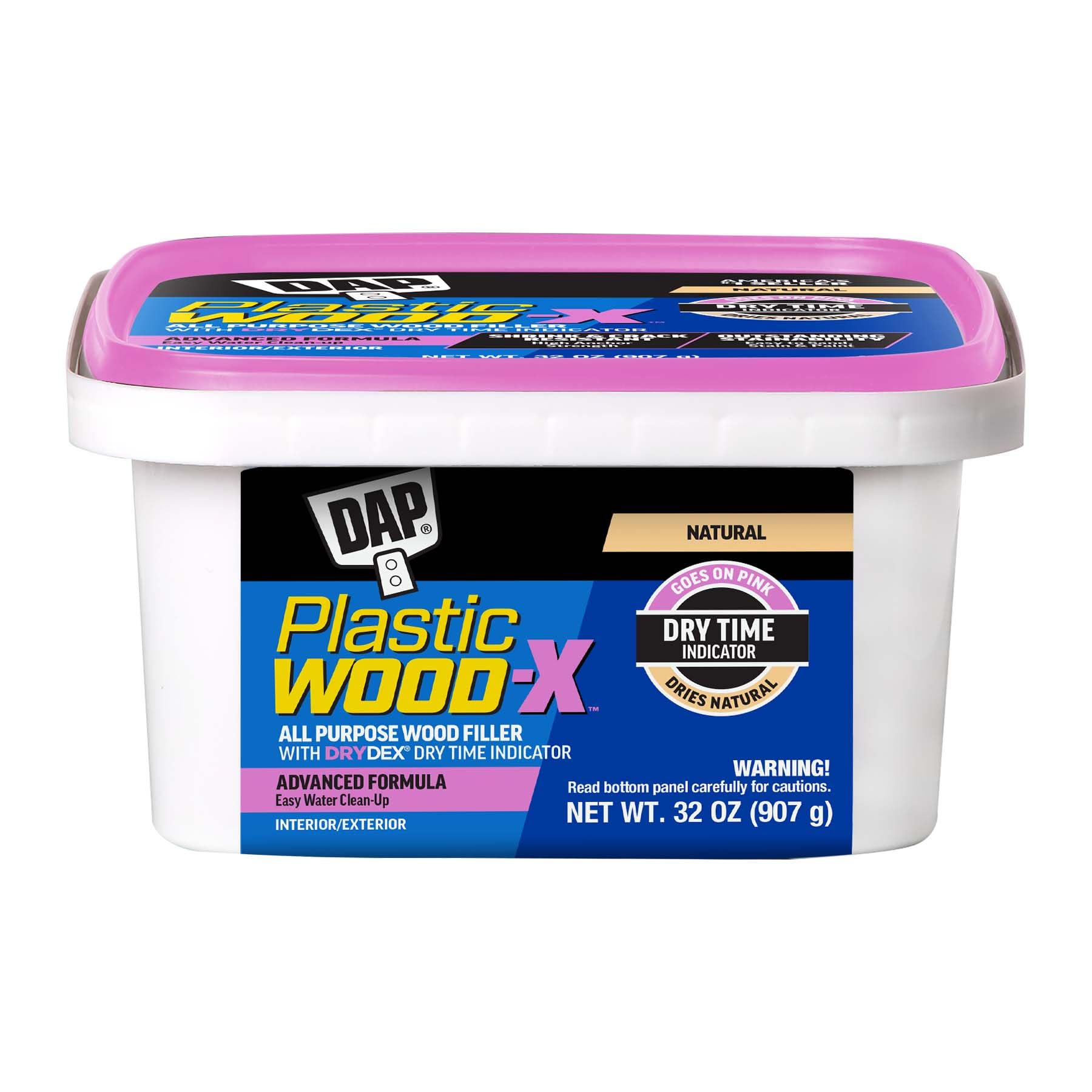
2. PLASTIC WOOD DAP X 32 Oz
Pink going in, natural coming out — the color-change trick that tells you exactly when to sand.
The most useful feature here is the one that looks like a gimmick at first. This filler goes on pink and dries to a natural finish, so you get a visual confirmation the patch is ready instead of guessing by touch. For anyone who has sanded too early and smeared a wet patch across a door frame, that signal alone justifies the tub.
You can plane, cut, drill, screw, nail, sand, stain, and paint this filler because it is latex-based — more than most fillers in its class allow. It is also thick and knife-grade, so you can mold and sculpt it to fill an irregular shape rather than only flat dents. Buyers praise the sanding most, and the pink-to-natural shift is a genuine usability win. The trade-off is the drying curve: Amazon’s own summary of the reviews flags drying time, durability, color change, adhesion, and value as mixed, and spreading registers as a weak spot. One honest detail buyers report is that the bulk container can arrive cracked and the lid is a light press-fit rather than a secure seal, which lets the product dry out in days unless you intend to use the whole tub right away. Pair that with slow spreading behavior and the picture is a filler that is easy to sand but demands a well-sealed container.
Depth matters here. This latex paste dries in 3 to 6 hours for repairs up to 1/8″ deep, and 36 hours for fills 1/4″ and over. So it handles modest dents quickly and rewards patience on anything substantial. Interior use only — one buyer who tried it on an exterior patio frame came away calling it unsuitable for weather, while another successfully patched an interior door frame with it and repainted over the pink-turned-white patch.
The practical read: a 32-ounce tub with a real dry-indicator and the flexibility to be cut, drilled, and sanded — a versatile interior performer for the buyer who values feedback over speed.
Right call for: interior dent-and-crack repairs where you want to know the patch is dry before you touch it.
Think twice if: you need an exterior-grade filler or you plan to store an opened tub for months — this formula wants a tight seal and interior conditions.
3. Bondo Wood Filler 12 oz
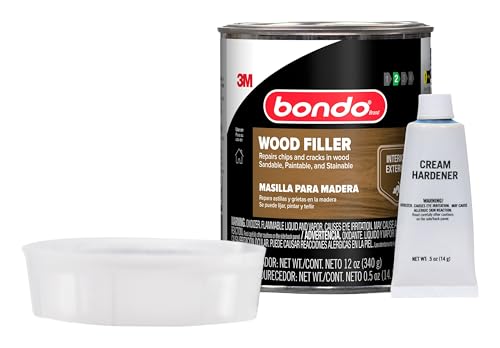
The repair that hardens like stone and shrugs off the weather — if you can work fast.
This is the heavy-lift option in the lineup, and the numbers explain why. It is a two-part formula that chemically bonds with the surface, sets non-shrinking so it will not leave gaps or divets after drying, and is rated water resistant for interior or exterior use. You also get a 12-ounce can plus a separate 0.5-ounce hardener, applied in measured portions. For a rotted window sill, a deck board, or a door frame taking rain, that is the durability you want backing the patch.
Where it splits from the paste fillers here is speed and finish. The two-part formula is sandable in as little as 15 minutes and fully cures in 20 minutes — same-day territory. Owners describe mixing it with the hardener, watching it set in a matter of minutes, and then hitting it with a power sander to get a flush surface. Bondo’s crew formula: mix, apply while it is still workable, and keep a scraper and rags within reach, because once it starts going there is no slowing it down.
The honest trade-offs are real but manageable. It carries an odor, so wear a mask and ventilate the workspace. Reviewers also note the can can arrive looking underfilled, and a few find the lack of included instruction tougher to navigate — a quick look at a mixing tutorial before opening the can pays off. That is offset by the fact that this is the easiest of the picks to take outside and expose to weather, which the interior-only fillers cannot claim.
The strengths that matter
- Two-part formula cures hard and non-shrinking, so deep fills stay filled
- Water resistant and rated for interior or exterior use — the exterior pick here
- Sandable in as little as 15 minutes for genuine same-day repairs
The catches to know
- Noticeable odor — ventilate and mask up
- Short working time means small batches, and the can can arrive looking underfilled
Best match for: rotted sills, deck boards, and exterior trim where the patch has to hold up against water and time.
Not the pick if: you want a no-mixing, forgiving paste for a quick indoor dent — the fast cure works against a slow, careful touch.
4. J-B Weld KwikWood Wood Repair Epoxy Putty – 1 oz Tan Stick

A pocket-sized epoxy stick for the repair that needs strength, not volume.
Where the paste fillers chase a smooth surface, this one chases structural strength. It is a hand-mixable epoxy stick rated at 900 psi tensile strength — enough pull resistance to hold a loose joint, not just a cosmetic dent. You knead it, mold it into the void, and it sets up firm. The set time is 15 to 25 minutes, with a full cure in 1 hour.
Weight tells the size story cleanly. This stick is 1.44 ounces against the 8-ounce Timbermate jar — a 5.6x gap in heft, and that difference is the whole point. This is a compact tool for a targeted fix, not a bulk filler for a whole room of trim. Owners put it to work on exactly that kind of job: a loose armchair leg that other methods failed to secure, a chew-damaged window sill that needed a second attempt, and dresser handle holes that needed patching. In each case the fix held because the epoxy bonded instead of just filling.
The limitation is volume, and owners mention so plainly. It fills a modest number of small holes before the stick is spent, and one complaint about an old, dried-up product shows up occasionally — so buy fresh and check the stick before you rely on it. For a single stubborn repair, the compact size is an asset. For anything sprawling, it runs out fast.
Why it stands out: 900 psi tensile strength in a 1.44-ounce stick, with a 15-to-25-minute set that makes it a genuine structural repair option rather than a surface patch.
The honest trade-off: at 1 ounce it is not built for volume — buyers wish the stick was bigger and note it covers only a handful of holes.
The one to grab for: a single high-strength fix, like a wobbling chair leg or a cracked joint, where bonds matter more than surface blend.
skip it if: you are filling a large repair area — the 1-ounce stick will run out long before the job is done.
5. Elmer’s ProBond Wood Filler 32 Ounce

The big-tub all-rounder that takes stain, spreads like paste, and cleans up with water.
This is the pick for someone with a whole project, not a single dent. The 32-ounce resealable tub holds a patented formula built for interior and exterior surfaces, and it is loaded with ceramic microspheres — tiny hard spheres that give the cured patch its resistance to shrinking and cracking. The maker claims it is 3X stronger than its standard formula, and its real wood fibers let it take stain and paint.
The material choice is what makes it forgiving. There are no solvents in the mix, so cleanup is with water, and it stands up to the heat from a high-speed sander or can simply be sanded by hand. That combination — water cleanup, hand-or-power sanding, and real wood fibers — is what lets it move from a dented wallboard to an exterior clapboard without changing products. Buyers have used it on half-log siding with a deep defect that took several layers, on log cabin repairs, and on exterior trim that stayed intact through winter. One buyer used it to fill gaps in 3D printed models before painting, and found it dried quickly and odorless.
The full cure time is 12 hours, so plan an overnight sit before sanding or painting. Consistency and application draw mixed notes — some describe it spreading like a dream while others find it gritty, and a few report it drying out if the lid is left off mid-job, which is a good reason to lay a sheet of plastic wrap under the lid. For the size and the interior/exterior rating, though, it covers the most ground of any pick here.
What it does best: a solvent-free, water-cleanup formula with real wood fibers and ceramic microspheres, rated for both interior and exterior work in a 32-ounce tub.
Where it needs attention: the 12-hour cure asks for patience, and the texture is a love-it-or-tolerate-it detail — seal the tub properly between sessions.
Made for: larger interior and exterior projects where one tub has to handle siding, trim, molding, and painted surfaces.
Pass if: you need a fast same-day patch — the 12-hour full cure means an overnight wait before sanding and paint.
Know the Specs
Cure Time and Set Time
These are the two clocks that decide how you work. Set time is how long you have before the filler stops being workable — a two-part epoxy can set in 15 to 25 minutes, and one Bondo formula is sandable in as little as 15 minutes with a 20-minute full cure. Cure time is when the patch is truly hard all the way through; a paste filler can take 12 hours to fully cure. Fast set is great for a quick repair, but it also means mixing small batches and applying without a break.
Interior vs Exterior Rating
An interior-only filler is fine for dents, nail holes, and trim inside a dry house. The moment a patch faces rain, sun, or freeze-thaw cycles, you want a filler rated water resistant and approved for exterior use — a two-part formula that chemically bonds and cures non-shrinking. Buying an interior paste for an exterior sill is the most common mistake, and it tends to show up a season later when the patch cracks or pulls loose.
Common Questions
Will wood putty filler take stain without showing a dull patch?
How deep can I fill a hole with wood putty filler in one pass?
Can I use the same wood putty filler inside and outside the house?
How long before I can sand and paint a filled patch?
Is a two-part epoxy filler better than a paste filler for rotted wood?
Why does my wood filler dry out in the container between jobs?
How much wood putty filler do I need for a typical repair?
Will a knife-grade wood filler hold a screw or a nail after it cures?
Do I need to wear a mask when using a two-part epoxy wood filler?
Can wood putty filler be used on 3D printed parts before painting?
The Bottom Line
For most repairs, the wood putty filler that earns its spot is the Timbermate Maple/Beech/Pine Hardwood Wood Filler because it dries fast, sands and stains cleanly, and is built for the interior edge and surface repairs that make up most of the job. If the patch faces weather, grab the Bondo Wood Filler with Hardener — its two-part formula cures non-shrinking and water resistant for exterior work. And for a single high-strength fix like a wobbling chair leg, the J-B Weld KwikWood Epoxy Putty is the one to reach for. Pick by depth and location, mix in small batches, and let the patch cure fully before you sand — that is how the repair disappears.
How we choose
We do not accept paid placement. Every pick is matched to a real buyer and a real use-case; we do not hands-on test units.
Sources
Specifications: manufacturer listings and product documentation. Review insights: verified customer reviews, as of October 2026. Pricing: not shown on this page (it changes often); check the current price via the retailer link.
As an Amazon Associate, Aappliancez earns from qualifying purchases. This does not affect which products we feature.