Disclosure: Some links in this post are affiliate links. As an Amazon Associate I earn from qualifying purchases, at no extra cost to you. Learn more
Specs are compiled from manufacturer listings and verified buyer reviews and can change over time — please confirm the key details on the product page before buying.
If a chair leg is wobbling or a table apron is splitting, the glue you choose decides whether the repair lasts a season or a lifetime. The problem is that “wood glue” covers very different products. PVA glue (a water-based glue that soaks into the grain) creates a joint stronger than the board itself. Cyanoacrylate formulas (CA glue, which grips in seconds) let you skip the clamps entirely. Your right pick depends on whether the joint needs to slide into alignment first, or if you need three seconds of setup and a permanent hold before the piece shifts.
This guide is built by comparing the manufacturers’ published specifications and the patterns across verified customer reviews, so you get each pick’s real strengths and trade-offs instead of marketing spin.
From sticky clamp-time problems to crack-filling precision, this breakdown covers the trade-offs that actually matter when you are choosing the wood glue for furniture repair.
Top Picks


How To Choose The Best Wood Glue For Furniture Repair
Furniture repair splits into two very different jobs, and they demand two different glues. A loose tenon or a cracked rail calls for a PVA glue that wicks into the grain, stays slideable for a minute or two, and sets up hard enough to sand flush. A snapped drawer front or a chipped molding is a clamping problem, not a grain problem — and that is where a cyanoacrylate with an activator earns its place. Knowing which job you are doing is the first decision; everything else (viscosity, cure time, water resistance) follows from it.
PVA wood glues: the strength that comes from soaking in
A PVA (polyvinyl acetate) glue — the yellow or white woodworking stuff most people picture — builds its grip by absorbing into the wood fibers and locking them together as it dries. Because the glue and the wood move as one, the bond can end up tougher than the board around it. The trade-off is time: full cure usually runs overnight, and a water-based formula needs the joint clamped while it sets.
Cyanoacrylate glues: when seconds decide the repair
A cyanoacrylate adhesive (CA glue, sold as “super glue”) is the opposite approach — it bonds on contact and reaches full speed with an activator spray. That means no clamps and no waiting, which is exactly what you want on a chipped surface or a small detail that cannot hold a clamp. The honest catch is that you get one shot at alignment: once a fast CA grabs, you cannot slide the joint, so dry-fit the repair first.
Viscosity: thin for cracks, thick for gaps
Viscosity is simply how much a glue runs, measured in CPS (centipoise — a thickness scale where water sits near 1 and honey runs into the thousands). A thin CA wicks into hairline cracks by capillary action, while a medium-thick or gel formula bridges a visible gap without dripping down a vertical face. Furniture makers frequently keep both, because a chair-leg split and a missing veneer chip are fixed by completely different consistencies.
Water resistance and cure ratings
Not every repair lives inside. Exterior furniture, kitchen pieces, and anything near a sink demand moisture resistance, so look for the water-resistance rating in the specs — an ANSI/HPVA Type 1 rating marks the top end. Indoors, a standard PVA that dries clear with minimal fumes is usually the safer, easier choice, especially when you care about a clean finish under stain.
Side-by-Side Comparison
| Model | Best For | Glue Type | Full Cure Time | Tensile Strength | Amazon |
|---|---|---|---|---|---|
| FastCap 2P-10 SoloKit★ Best Overall | Instant trim & joinery fixes | CA + Activator | 30 seconds | 4,000 psi | Amazon |
| Weldbond Multi-SurfaceMost Versatile | Glass, tile & mixed-material repairs | PVA (multi-surface) | 20 minutes | — | Amazon |
| Thick Super CA Glue KitPrecision Pick | Gap filling & precision bonding | CA (thick, 2000 CPS) | 0.5 minutes | 2610 psi | Amazon |
| PC-Woody Epoxy Paste | Rotted & missing wood rebuild | Two-part epoxy paste | 24 hours | — | Amazon |
| STARBOND Dark Brown CA | Knot & crack filling in dark wood | CA (500 CPS, dark brown) | 3 minutes | — | Amazon |
| Titebond Original | Everyday furniture & joinery | PVA (aliphatic resin) | 24 hours | — | Amazon |
| DAP Weldwood Original | Impact & shock-resistant joints | PVA (aliphatic resin) | 24 hours | — | Amazon |
| Magic Chems CA with Activator | Multi-material instant assembly | CA + Activator (2000 CPS) | 5 minutes | — | Amazon |
| Everbuild 502 All Purpose | Interior & exterior wood bonding | PVA (D3, resin-based) | 8 hours | — | Amazon |
| Titebond III Ultimate (2 Pack) | Waterproof indoor & outdoor builds | PVA (waterproof gel) | 24 hours | — | Amazon |
| Gorilla Wood Glue Ultimate | Large builds & shop-volume use | PVA (Type 1 waterproof) | 24 hours | — | Amazon |
Detailed Reviews
1. FastCap 2P-10 SoloKit Instant Adhesive & Activator Set
Our pick — 4.5+★ from 6,000+ verified ratings; the strongest balance of quality and price.
The kit that turns a two-clamp repair into a ten-second job.
For trim, molding, and small furniture repairs where a clamp simply will not reach, this two-bottle set is the one buyers keep coming back to: 4.5+ stars across 6,000+ owners, the strongest combination of score and volume on this list. You get a 12 oz activator on one side and a 2 oz thick adhesive on the other. The glue grabs in 10 seconds and cures to a stated 4,000 psi strength in 30 seconds once the activator hits it, so a repair you cannot clamp is done before the piece can shift.
That speed is the entire point. The thick gel formula fills gaps and holds vertical faces without dripping, so it works on a molding bead or a baseboard corner that would sag with a runnier glue. Owners sand and shape the cured bond without it breaking away, and the precise tip applies a controlled line instead of a puddle. The activator bottle is roughly the size of a standard school glue bottle, which lasts a long stretch of trim work. FastCap also holds the highest score of anything here, and it beats the Weldbond’s 20-minute full cure by a wide margin — 30 seconds against 20 minutes.
The honest catch is alignment. As owners put it, the glue sets so fast that you only get a couple of seconds to slide the joint into place before it locks, so dry-fit and mark everything first. It also performs best when you pair the two bottles from the same brand rather than mixing brands. Expect an occasional remark that it is glue, not a miracle worker — fair, and still good enough to top this list.
Where It Wins
- Cures to a 4,000 psi bond in 30 seconds with the activator — no clamps needed
- Thick gel viscosity fills gaps and holds vertical trim without running
- Activator bottle runs to 12 oz, sized for repeated workshop use
Where It Tests You
- Near-instant grab means you cannot reposition the joint once it sets
- Best results come from pairing both bottles from the same brand
Reach for this if: you are fixing trim, molding, or a small break where a clamp will not fit and you want the repair done today.
Think twice if: your joint needs to slide into alignment over a slow, careful minute — that is a PVA job, not this one.
2. Weldbond Multi-Surface Adhesive 14.2oz / 420ml
One bottle for the wood repair and the ceramic knob that broke with it.
This bottle earns its spot because of what it can bond. A standard PVA is wood-only, but Weldbond’s 14.2 oz formula is built to bond “most anything” — glass, ceramic, tile, mosaic, stone, and wood — so one bottle covers a mixed-material repair instead of sending you back to the shelf for a second product. It dries crisp, so the squeeze-out on a light-wood repair wipes clean and leaves no yellow line under a finish.
What wins people over is consistency: owners keep coming back to how it holds on glass and ceramic mosaic work, not just wood. It also carries a water-resistant, weatherproof label and stays slightly flexible once cured, so a joint that sees a bit of movement does not crack the way a brittle glue might. The full cure lands at 20 minutes, and the finish dries to a clear film with no odor left behind.
Here is where it sits against the STARBOND above: on capacity, the Weldbond’s 14.2 oz container holds roughly seven times the 2 oz STARBOND bottle, so it is the bulk choice for a multi-part project. The trade-off is speed — a 20-minute full cure versus a cyanoacrylate that sets in seconds. And one practical note: this is a cream-colored, multi-surface PVA, so on a dark, open-grained wood it will not hide a visible gap the way a dark-tinted filler will.
Why owners keep it: the clear, odorless dry and the weather-resistant, flexible bond make it a single-bottle answer for repairs that mix wood with glass, tile, or ceramic.
The trade-off to know: at a 20-minute full cure it is slower than any CA glue here, and its cream color cannot camouflage a gap on dark wood.
Best for: mixed-material repairs — a wood frame with a ceramic insert, a mosaic table, or any job where you want one bottle to handle every surface in the room.
Skip if: you are bonding two bare, dark boards and want the glue itself to disappear into the grain.
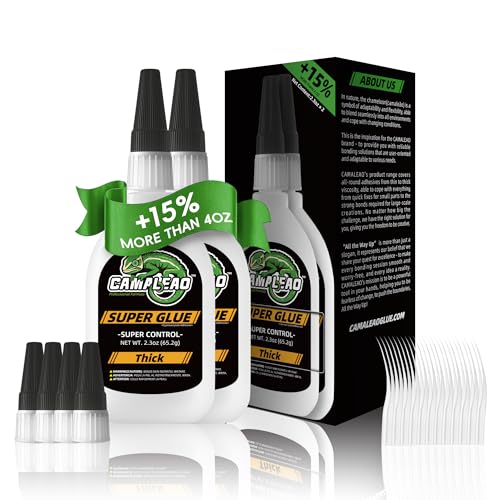
3. Thick Super CA Glue Kit 4.6 oz
Gap-filling CA with a squeeze bottle you can actually control.
For furniture repair that involves a visible gap — a split apron, a missing chip, a drawer front that pulled away — this kit’s 2000 CPS thick viscosity is the spec that does the work. That is roughly honey-consistency, thick enough to bridge a gap and stay put on a vertical surface, with a stated penetration of 0.02″ for precision bonding. It cures in 30-45 seconds and rates at 2610 psi, and it will bond wood alongside plastic, metal, leather, and ceramic.
The accessories earn their keep too. The anti-clogging cap has a built-in steel pin, and the set ships with extra spouts and caps, so you do not throw out the bottle the moment the tip gums up — heavy users get real mileage out of the set. On speed it runs far ahead of any PVA here: 0.5 minutes to full cure against the Weldbond’s 20 minutes, a genuine speed advantage when you cannot clamp a piece.
The one thing to set expectations on is thickness. Some find the viscosity only slightly thicker than a standard medium CA rather than the gel they pictured, and the “honey” description oversells it for them. It still flows predictably and holds well. The 4.6 oz bottle also gives about 15% more glue than a 4 oz size at a similar price point, which is note if you go through a lot of it.
What it delivers: a 2610 psi, gap-filling bond in under a minute, with a steel-pin cap and spare tips that keep the bottle usable.
What to expect: the 2000 CPS body runs a touch thinner than a true gel, so treat it as a heavy medium rather than a honey-thick filler.
Go with: this if you need fast, controllable gap-filling on a repair you cannot clamp and want a bottle that will not jam on you.
Pass on: it if you specifically want a thick, no-run gel that stays exactly where you drop it.
4. PC-Woody Wood Repair Epoxy Paste 12 oz
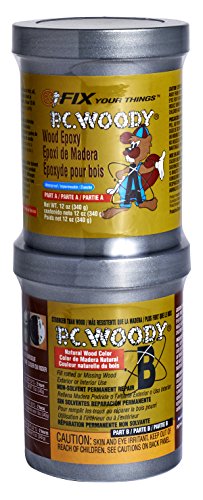
Not a glue at all — a two-part paste for wood that has rotted away.
When a repair means replacing missing material rather than joining two pieces, this is the product in the lineup for it. PC-Woody is a two-part epoxy paste that you mix in equal volumes on a flat surface with a stiff putty knife and pack into the void, where it hardens into something you can sand and finish like wood. It is resistant to dry rot, UV light, and both fresh and salt water, and it works in an application temperature range of 35 to 115 degrees F with a service range of -20 to 200 degrees F.
What earns this its following is the strength of the finished repair. Owners say the cured paste holds its shape, sands smooth with ordinary sandpaper, and finishes tougher than the original wood. Its high tack holds it on a sloped or vertical surface without sagging before it sets, which suits a window sill or a door edge. As a weight reference, the 12 oz can counts in smaller than the 4.48 oz FastCap kit, but as a paste it is spread, not squeezed, so you will not run through it the same way. The full cure runs 24 hours.
The honest caveat is the mixing. This is two parts combined by hand, so getting the ratio even matters, and the manufacturer specifically warns against mixing it while wearing gloves. A few users describe the paste’s consistency and stain absorption as inconsistent from batch to batch, which means tinting a repair to match an existing finish takes some trial. Treat it as a rebuild material for damaged and missing wood, not a fast grab-adhesive for a clean joint.
Where it shines: repairing rotted or broken-away wood — it packs into voids, stays put, and cures in 24 hours to a sandable, water- and UV-resistant surface.
Where to be ready: it is a hand-mixed two-part paste, so even ratios matter and color matching to an existing finish can take a couple of passes.
Pick it for: restoring furniture with missing or rotted wood — a rotted chair rung, a soft window sill, a chewed edge — where you need material back, not just a bond.
Not the one for: a simple wood-to-wood joint, which a straight PVA glue handles faster and cleaner.
5. STARBOND 2 oz. Dark Brown Medium-Thick CA Glue
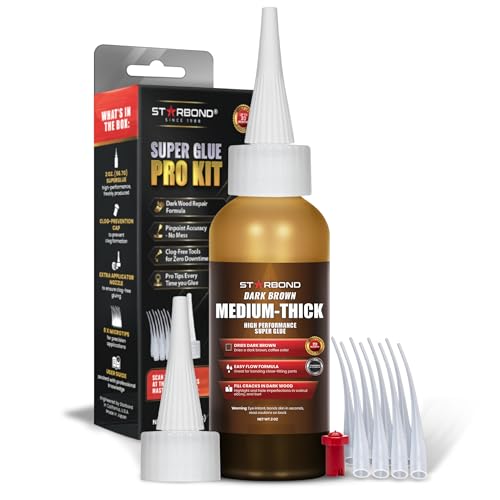
The filler that hides a crack instead of announcing it.
What sets this bottle apart is the color, not just the strength. The glue cures to a coffee-brown shade matched to dark woods, so a filled knot or a hairline crack blends into walnut or mahogany instead of leaving a pale scar a lighter glue would. Its 500 CPS medium-thick body sits between a wicking thin CA and a no-run gel: thick enough not to run, fluid enough to seep into fine cracks and fill small-to-medium gaps. Full cure lands at 3 minutes.
Working it is the other half of the appeal. It stays liquid while you work and flashes off fast when an activator hits it, and it ships with anti-clog caps, spare nozzles, and micro-tips for controlled application into tight spaces. For furniture restoration the color match is the clincher — owners reserving this for dark furniture, speaker boxes, and guitar work describe the tint blending cleanly into the surrounding grain. The 2 oz bottle carries strong bonding on various woods and holds up indoors and out, with a stated shelf life up to 20 months when stored properly.
Two honest notes. On deep holes, you must build it up in thin layers with extra activator between passes, because the activator cannot reach the bottom of a deep void in one go — and the glue shrinks slightly as it dries, which can leave a cavity in a deep pour. It also cures hard and brittle, so this is a crack- and gap-filler rather than your pick for a joint that needs to flex.
What Earns Its Place
- Dark brown cure hides cracks and knots in walnut, ebony, and dark-stained wood
- 500 CPS body wicks into fine cracks without running off vertical faces
- Includes anti-clog caps, spare nozzles, and micro-tips for precise fills
The Fine Print
- Deep fills need thin layers with activator between passes, and the glue shrinks slightly as it dries
- Cures hard and brittle, so it is not the pick for a joint that needs to flex
Made for: anyone filling knots, cracks, or voids in dark-stained or dark-wood furniture who wants the repair to vanish into the grain.
Wrong tool for: light-colored woods, where the coffee-brown fill would stand out, or for structural joints that flex under load.
6. Titebond 5066F Original Wood Glue – Gallon, Yellow

The gallon bucket that keeps a whole workshop running.
If most of your repairs are ordinary wood-to-wood joints — a loose rail, a cracked chair seat, a drawer box rebuild — this is the glue that has earned the word “standard.” The aliphatic resin formula (a type of PVA made from resin) gives strong initial tack and a fast set to cut clamp time, then cures in 24 hours to a bond the maker rates as stronger than the wood itself. It also delivers among the most reassuring numbers in the category: filling a gallon at 9.9 pounds, it is not framed as a glamorous glue but as the default one.
The practical strengths are clear. It dries to a translucent film that sands smooth without softening, and it is unaffected by most stains, paints, and finishes, so a repair under a topcoat stays clean. It cleans up with water and the low-VOC, nonflammable formula (under 0.2 g/L) keeps fumes minimal around the bench. It also handles a wider material list than plain wood glue — hardboard, particleboard, leather, and most other porous materials. What wins people over is sheer holding power.
The one thing to respect is time. This is a water-based PVA that needs a clamp while it sets, and it will not wick into a fine dark crack the way a thin CA would — the STARBOND above is the better tool for that job. There is also a real shelf-life point: glue this size will separate or gel if you do not use it, so do not buy a big bucket for one small repair. A gallon makes sense only if you have a project list, and the maker’s own advice is to mix parts A and B carefully on the epoxy — this one is simply applied straight from the bottle.
The case for a gallon: fast-tack aliphatic resin, water cleanup, low fumes, and a cured bond rated stronger than the wood — ideal for a busy bench doing regular furniture work.
The honest limit: it needs clamping, and a large container will gel or separate over time if you do not work through it.
Get the gallon if: you repair furniture regularly and want the industry-standard glue in a size that keeps pace with real projects.
Buy small instead if: you are fixing one loose joint — a big bottle you never finish is wasted money.
7. DAP Weldwood Original Wood Glue, Yellow, 1 gal (7079800498)
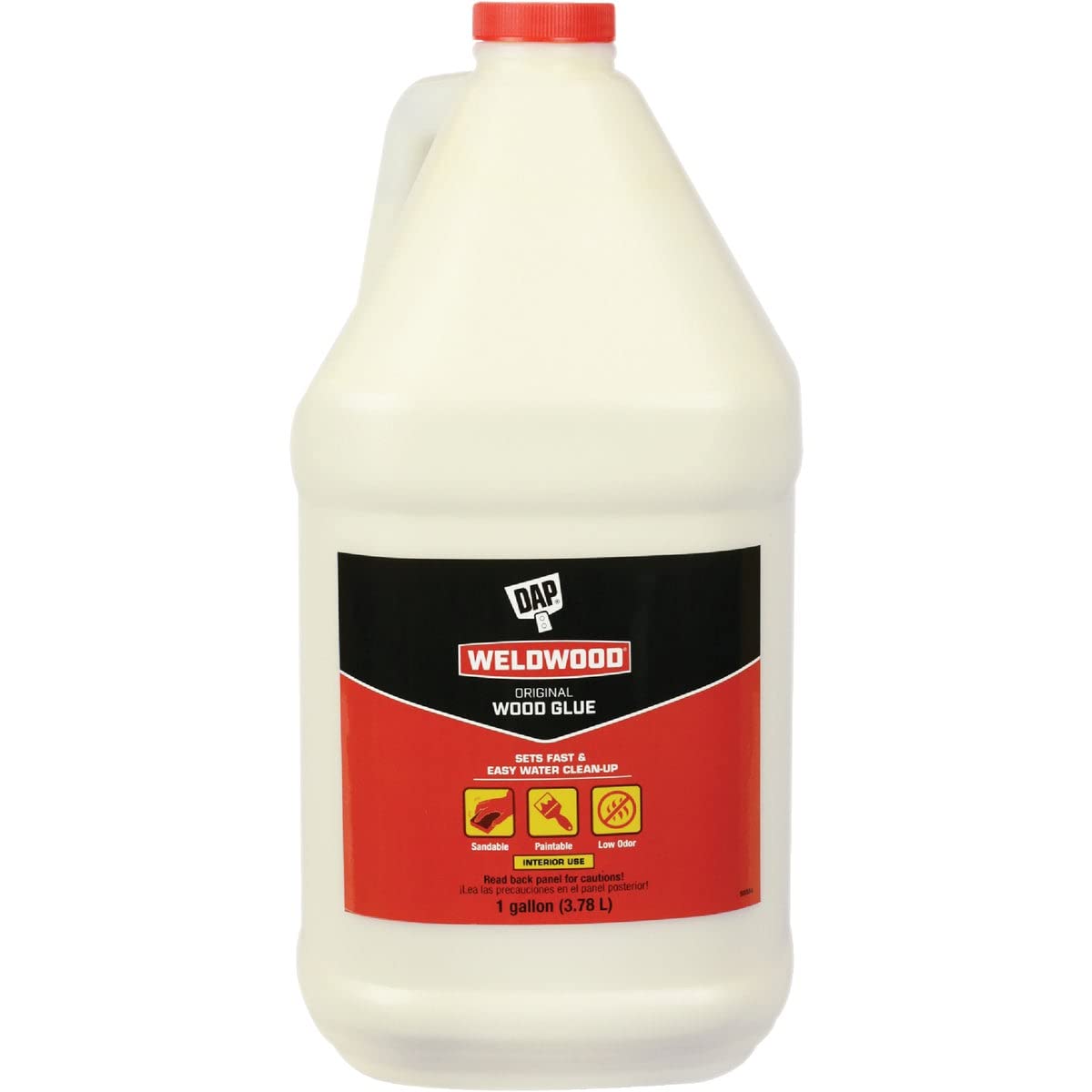
Built to shrug off the knocks a furniture repair takes.
What sets this glue apart is toughness against impact. DAP’s aliphatic resin formula is made for heat, water, and solvent resistance, and it is especially resistant to shock and sharp impact once thoroughly set — the quality that matters on a piece that gets knocked around, like a chair or an end table with a repaired leg. It comes in a gallon pail (8.3 pounds) and forms strong bonds across most porous and semi-porous materials, then sands easily once it is dry for a quick finish.
The application is a straightforward PVA story: spread it, clamp it, and let it cure over 24 hours. It grips a repair through edge-bonding and larger furniture-manufacturing work, so it holds up under the load a structural joint actually carries. It also spreads evenly and blends with the wood’s color, and the airtight top on the bottle keeps the last bit usable. Owners call it simply wood glue that works, and credit the easy-close top for keeping the container usable.
Two things to keep straight. The adhesive quality itself draws mixed feedback on the review pages — some find it excellent while others are unimpressed — so this is not the pick if you want a glue with a spotless track record across every batch. It is also a water-based aliphatic like the Titebond above, meaning it needs clamping and a full 24 hours to cure before you stress the joint. On scope, it overlaps with the Titebond Original gallon: both are 24-hour-cure aliphatic PVA glues, so the deciding difference is the impact-resistance claim on this one.
What stands out: a shock- and impact-resistant aliphatic bond in a gallon pail that sands clean for a fast repair finish.
What to weigh: adhesive performance is inconsistent across reviews, and like any PVA it wants a clamp and a full 24 hours.
Worth it for: high-impact furniture repairs — a chair leg, a heavy table joint — where you want the bond to hold up to a knock, in a quantity that covers several jobs.
Look elsewhere if: you want the guarantee of consistently praised adhesion, or you need a fast setup you do not have to clamp.
8. Magic Chems CA Glue with Activator 2 Pack
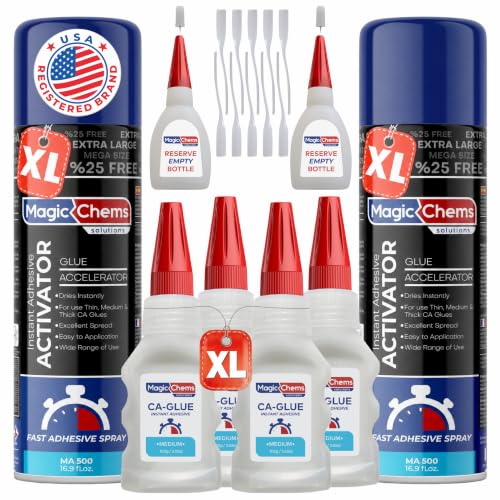
A CA and activator pair that bonds almost anything in a couple of the two bottles.
This two-bottle set pairs a 2000 CPS gel cyanoacrylate with an activator spray, and it cures in about 5 minutes — instantly wherever the activator touches. What makes it useful around furniture is its material range: it is built to bond wood, MDF, PVC, plastics, rubber, metal, fabric, ceramic, leather, glass, and more. So a repair that mixes a wood frame with a plastic corner or a metal fitting does not need three products. The gel consistency gives you control and precision during placement.
The activator does real work here, and owners on 3D-printing and multi-material builds lean on it for exactly that reason: the spray sets the glue the moment it lands, so there is no clamping and no holding a piece in position while your arms get tired. Woodworkers repurposing it for repair and gap-filling appreciate the same no-clamp speed. It is note a practical limit from the maker — it is not intended for nonstick or polyethylene surfaces, so check your material before you commit.
The recurring gripe is the bottle itself. The glue bottles are hard to squeeze, and the thin tips will harden with glue after a while unless you keep them clean. There is also a shelf-life reality with CA glue generally: it thickens over time whether the bottle is open or not, so the advice from the review pages is to use it within roughly six months and not to lay in a stockpile. Past that, the strength and hold hold up fine.
The draw: an activator-spray CA set that bonds wood alongside plastic, metal, ceramic, and more, cures in about 5 minutes, and needs no clamping.
The friction: the squeeze bottles are stiff, thin tips clog over time, and the glue thickens as it sits, so this is not a stockpile purchase.
Choose it for: multi-material repairs and quick assemblies you cannot clamp, where an instant-set CA and activator earn their place in the kit.
Pick another if: you plan to store a bottle for a year — this formula wants to be used within months, not shelved.
9. Everbuild 502 All Purpose Weatherproof Wood Adhesive 1 Litre

The one you grab when the repair lives outside in the weather.
For furniture that stays outdoors — a garden bench, a porch table, a sill that meets the rain — the key spec here is the D3 water resistance rating. That is a formal grade for a high degree of water resistance, and it is what lets this resin-based adhesive handle both interior and exterior wood bonding. It cures in 8 hours, which is quicker than the 24-hour PVA glues elsewhere on this list, and it forms a high-strength, impact-resistant bond rated as potentially stronger than the wood itself. The 1-litre bottle (1.14 kg) covers a good run of projects.
The finish is a real selling point for visible furniture work. Everbuild’s formula contains no inert fillers, dries clear, and is non-staining — it will not discolor the surrounding wood, so a repair on a finished surface stays invisible. It cleans up with water, which keeps the cleanup simple. Owners on the review pages describe it bonding fast and drying clear, and keep reordering it for indoor and outdoor work. That weatherproof label, plus the D3 grade, is what separates it from the standard indoor PVAs.
The main risk to know about is storage and shipping of a vinyl-type glue this size. Some users have received a bottle that arrived already thickened, needing water and a good mix to salvage, and even rescued it can stay lumpy and require the whole cap to be removed to pour. That is a rare but real outcome for a large liquid adhesive bottle — and worth knowing before you count on it arriving ready-to-use. Fresh, it performs exactly as the clear-drying, weatherproof glue it claims to be.
What earns the spot: a D3 weatherproof, non-staining formula that bonds inside or out, dries clear, and cures in 8 hours.
The honest risk: on the odd occasion a large liquid bottle arrives gelled, so check the consistency when it lands.
Grab it for: outdoor and moisture-prone furniture repairs where you need a water-resistant, clear-drying bond that will not stain the wood.
Can skip if: you are fixing something strictly indoors and want a glue you do not have to worry about arriving pre-thickened.
10. Titebond 1415 III Ultimate Wood Glue 32-Ounce 2 Pack

Waterproof, gel-thickened PVA that grips a joint and holds through moisture.
This two-pack of 32-ounce bottles is built around one headline trait: a waterproof formula that resists moisture and water damage for lasting bonds. Where the standard Titebond Original above is meant for indoor work, this III-grade version is the same trusted brand answering the outdoor and moisture-prone question. It is a gel-based glue, so it spreads smoothly and stays put on a vertical surface without running — easier to control on an upright repair than a thin liquid. Two bottles means you are not rationing a single container across a big job, and the full cure runs 24 hours.
Longer working time is the underrated virtue here. The gel holds long enough to get a complex or large furniture assembly positioned and clamped before it starts grabbing, which is the exact struggle on a multi-part build. Buyers report rock-solid bonds and easy cleanup, and the water resistance suits damp spots like a kitchen chair, a bathroom shelf, or a part-time outdoor piece. Between the waterproof rating and the gel body, it covers the gap the indoor glue leaves open.
The one spec to note honestly is that adhesion draws mixed feedback: the review pages describe a range from excellent bonds to the occasional messy experience where the glue behaves differently than expected. That is the trade-off to weigh if you want a spotless adhesion record, but for the majority the waterproof rating and longer workable time carry the day. Just clamp it and give it the full 24 hours like any PVA.
Why It Tops Some Benches
- Waterproof formula for indoor and outdoor wood bonding
- Gel body spreads smoothly and resists running on vertical joints
- Longer workable time for complicated, multi-piece assemblies
What to Factor In
- Adhesion draws mixed feedback across the review pages
- Like any PVA it needs clamping and a full 24 hours to cure
Best suited to: furniture that lives or works near moisture — kitchen chairs, bathroom shelving, outdoor-adjacent pieces — where a waterproof gel bond is the priority.
Consider skipping if: your job is strictly dry indoor woodworking and you would prefer a glue with a less divided reputation for adhesion.
11. Gorilla Wood Glue Ultimate 1 Gal Bottle
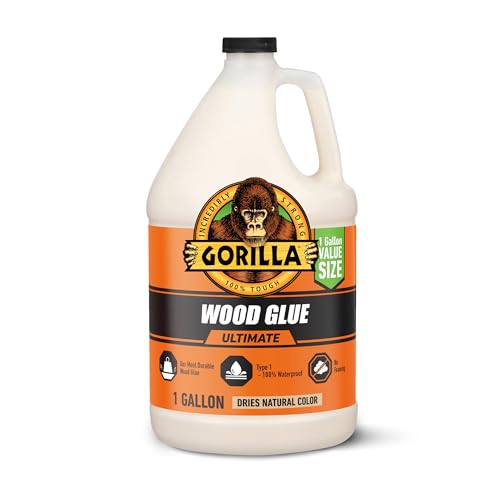
A gallon of waterproof PVA built for big, slow, careful assemblies.
For a large build you need time to line up before the glue grabs, and that is where this gallon earns its keep. It gives up to 15 minutes of open assembly time — the window before the glue starts setting — so a complex or large-scale project can be positioned and clamped without rush. On top of that it needs only 20 to 30 minutes of clamp time and fully cures in 24 hours, which keeps a project moving on the same day. It is a natural-color finish and it is 100% waterproof, passing the ANSI/HPVA Type 1 water-resistance standard for outdoor and moisture-prone work.
The volume argument is straightforward for a shop. One gallon equals 32 four-ounce bottles, so you refill far less often and reduce downtime between repairs — real value for anyone working through furniture regularly rather than fixing one chair. Owners use it at scale: one reports laying floors with 35 gallons of it and having it work perfectly. It is a PVA, so it bonds wood and stays water-resistant across the indoor-outdoor line.
Be realistic about one thing before committing to a gallon: it is a large share of any single-buy comparison, and it is a liquid PVA that must be worked through before it ages. A few note it can arrive a little older and clump on dispensing, so it favors a buyer with a genuine project list over someone fixing one loose joint. Sized for the shop, not the single repair.
Why shop users want it: 15 minutes of open assembly time plus a Type 1 waterproof rating make it the pick for large outdoor-capable builds you need to position carefully.
Why it is a commitment: a gallon is a lot of glue to finish, and it needs to be worked through before it ages and clumps.
Right for: high-volume woodworkers and anyone laying floors or building large furniture, where 15 minutes of open time and Type 1 waterproofing both matter.
Overkill for: a single loose joint — a gallon is a project-sized buy, not a one-repair purchase.
Know the Specs
Full Cure Time
This is how long the glue needsto reach its full rated strength, and it is the number most buyers misread. A cyanoacrylate that lists a 30-second full cure, like the FastCap kit, is grab-and-go — you can use the piece almost immediately. By contrast, the PVA glues here list 8 or 24 hours, which is why they need clamping and patience. Match the cure time to your real deadline: fast CA for a repair you need back in service now, slow PVA for a joint you can leave overnight.
Tensile Strength and Viscosity
Tensile strength is the pulling force a cured bond can take before it gives, and the CA formulas here quote it directly — 4,000 psi on the FastCap kit, 2610 psi on the CAMALEAO super glue. Viscosity, measured in CPS, is how thick the glue is: a low CPS wicks into hairline cracks, while a high CPS like 2000 fills a visible gap without running. For furniture repair you often want both, which is why many woodworkers keep a thin CA and a thicker filler on the shelf.
Common Questions
Is CA glue or wood glue better for a loose chair leg?
How long do I need to clamp a wood glue repair before it holds?
Can I use wood glue for outdoor furniture that gets rained on?
What does D3 water resistance mean on a wood glue?
Why did my wood glue arrive thick or gelled in the bottle?
Can I use super glue to fill a crack in dark wood furniture?
What is the difference between a thick and a thin CA glue for repairs?
Do I need an activator with CA glue for a furniture repair?
How much glue do I need for a single furniture repair?
Will a clear-drying wood glue show under a stain or finish?
The Bottom Line
For most furniture repairs, the standout wood glue for furniture repair choice is the FastCap 2P-10 SoloKit, because it bonds in 10 seconds and cures to a stated 4,000 psi in 30 seconds, so a repair you cannot clamp is done before the piece can shift. If you need a weatherproof bond for something outdoors, the Everbuild 502 carries a D3 water-resistance grade and dries clear. And for filling knots and cracks in dark-stained furniture so the repair disappears into the grain, reach for the STARBOND Dark Brown CA. Pick the tool for the job in front of you — a fast CA for the joints you cannot clamp, a slow curing PVA for the ones you can — and you will get a bond that outlasts the furniture itself.
How we choose
We do not accept paid placement. Every pick is matched to a real buyer and a real use-case; we do not hands-on test units.
Sources
Specifications: manufacturer listings and product documentation. Review insights: verified customer reviews, as of October 2026. Pricing: not shown on this page (it changes often); check the current price via the retailer link.
As an Amazon Associate, Aappliancez earns from qualifying purchases. This does not affect which products we feature.