Disclosure: Some links in this post are affiliate links. As an Amazon Associate I earn from qualifying purchases, at no extra cost to you. Learn more
Specs are compiled from manufacturer listings and verified buyer reviews and can change over time — please confirm the key details on the product page before buying.
You want earbuds that just work when you plug them in — no pairing screen, no dead battery at the worst moment, no charging case to remember. That narrow list of wired USB-C earbuds is what this guide covers, and the honest answer up front is this: if you own an iPhone 15 or newer, a modern iPad, or a USB-C laptop, the Apple EarPods with USB-C are the safest all-round buy. They cost less than most of the wired in-ear monitors here, they plug straight into your phone’s charging port, and they skip Bluetooth pairing entirely. The rest of the list splits into two camps: cheap spares you keep in a bag, and proper multi-driver in-ear monitors for people who care about bass depth and detail.
This guide is built by comparing the manufacturers’ published specifications and the patterns across verified customer reviews, so you get each pick’s real strengths and trade-offs instead of marketing spin.
The specs below matter less than one question: will the plug actually fit your device and your ears? That is why every pick here is a true USB-C connection with no adapter in the chain. The picks that follow show you what to expect from wired USB-C earbuds before you commit.
Top Picks

How To Choose The Best Wired USB-C Earbuds
Start with the plug, not the sound. A USB-C earbud only works if your device sends audio out of its USB-C port — which iPhone 15 and later do, and which most Android phones, iPads and laptops do. Older iPhones with a Lightning port will not work with any pair on this list.
The DAC chip is the invisible part that decides your sound
A DAC (digital-to-analog converter) turns the digital file on your phone into the analog signal your earbuds actually move air with. Phones that dropped the headphone jack push that job onto the earbud’s own plug, so a built-in DAC chip is what keeps the sound clean instead of thin or buzzing. Several picks here name their DAC directly, and that is worth more than a fancy driver count on a phone.
Driver count versus driver quality
A single dynamic driver — one moving cone — handles the whole frequency range and is the simplest, most reliable design. Balanced armature drivers are tiny precision units that specialize in treble and mid detail. Hybrid setups combine both. More drivers can mean more detail, but only if the crossover tuning is good; a badly tuned six-driver set sounds worse than a well-tuned single one.
Fit and ear tips decide your bass more than the spec sheet
An in-ear seal is what gives you bass and blocks outside noise. If the tip does not fill your ear canal, the low end disappears and everything sounds thin. Look for a set that ships with multiple tip sizes — several here include small, medium and large — and expect to experiment for a day before you judge the sound.
Side-by-Side Comparison
| Model | Best For | Connection | Driver Setup | Inline Mic | Amazon |
|---|---|---|---|---|---|
| Apple EarPods with USB-C★ Best Overall | Everyday iPhone and laptop use | USB-C plug | Dynamic driver | Yes, with remote | Amazon |
| 2 Pack USB-C Headphones (SKLNXAZ)Budget Champion | Cheap backup pair | USB-C plug | Dynamic driver | Yes, with volume control | Amazon |
| Koajim 710C | All-day work calls and commuting | USB-C plug | Dual 6mm dynamic | Yes, inline remote | Amazon |
| Moondrop CHU II DSP | First in-ear monitors on a budget | USB-C plug | 10mm dynamic | Yes | Amazon |
| Sony IER-EX15C | Travel and airplane backup | USB-C plug | Dynamic driver | Yes, multi-function button | Amazon |
| Audiovance Vibes 202MC | Musicians and loud, clear monitoring | USB-C plug | Balanced armature | Yes, inline remote | Amazon |
| KZ ZS12 Pro 2 | Gaming and multi-driver detail | USB-C plug | 5BA + 1DD hybrid | Yes, omnidirectional HD | Amazon |
Detailed Reviews
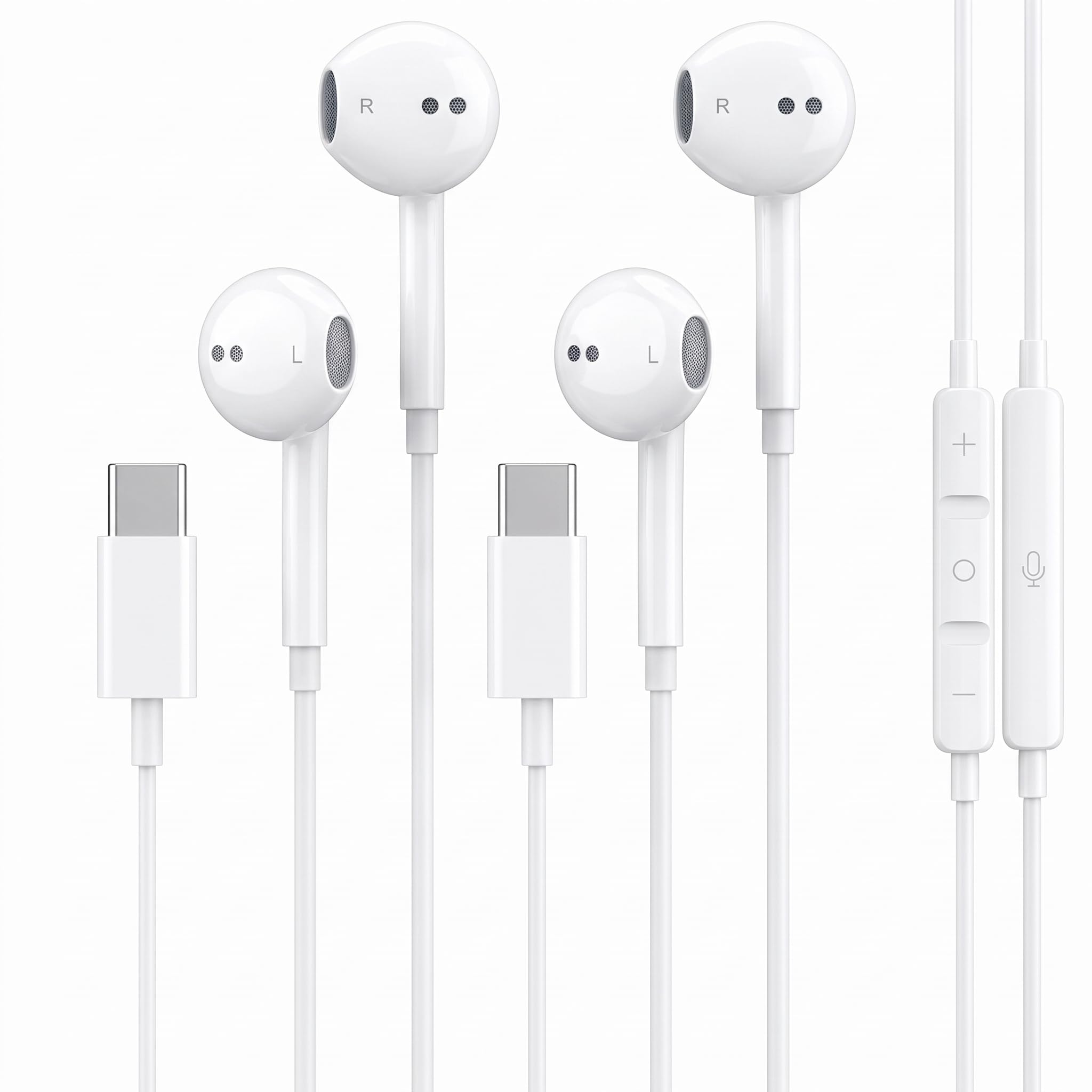
1. Apple EarPods Headphones with USB-C Plug
Our pick — 4.5+★ from 19,000+ verified ratings; the strongest balance of quality and price.
A no-battery pair that lives in a bag and works the moment you plug it into a USB-C port.
The EarPods shape is built around the outline of the ear rather than a round bud, and that geometry is the reason people who normally hate in-ears can wear these through a full workday. At 1.12 ounces the whole set practically disappears in a pocket, and because there is no battery inside, there is nothing to charge and nothing to run flat mid-call. You plug into the USB-C port and the audio is simply there. This is the crowd favorite of the list — 4.5+ stars across 19,000+ ratings — and the reason is not audiophile sound. It is that the thing never asks anything of you.
Sound is clean and even, with no rumble to speak of. A pair of eight-hour days on calls and podcasts is where these shine, because the built-in mic picks up your voice clearly without a boom arm, and the inline remote on the cord handles volume, track skips and answering calls with a pinch. Apple also puts a DAC inside the USB-C plug, which keeps the signal clean on phones and laptops that no longer have a headphone jack. Compare that to the KZ ZS12 Pro 2 at the bottom of this list, which stacks five balanced armatures and a 10mm dynamic driver — the Apple set is not trying to win a detail contest.
The catch is durability, and it is a real one. The pause and restart function can fail after months of use, likely from the mic hardware rather than the cord. Ears that are sensitive to long wear also start to ache after a few hours, because the tip does not seal deeply like a proper in-ear monitor. Neither issue is universal — the housing survives rain, gym bags and being stepped on — but if you want a pair that lasts years under heavy daily use, plan to replace these or step up to a set with replaceable cables.
What earns its place
- The ear-shaped housing fits more people than a round bud, with no seal pressure
- No battery means zero charging time and zero Bluetooth pairing
- Inline remote covers volume, playback and calls without touching your phone
- Built-in DAC keeps the USB-C signal clean on phones with no headphone jack
Where it gives ground
- The cord tangles easily — normal for wired, still annoying
- Pause and restart controls can fail after months of use
- Prolonged wear hurts some ears because the tip does not seal deeply
The easy default: Buy this if you want one pair that works with your iPhone 15 or newer, your MacBook, or any USB-C tablet and you would rather not think about charging.
The honest limit: If you need bass depth or a cable you can swap out when it wears, look at the Moondrop or KZ picks instead.
2. 2 Pack USB-C Headphones for iPhone 17/16/15
Two full pairs in one box, so a dead set in the glovebox never leaves you without a backup.
The point of this pack is not sound — it is that you get two full pairs, which changes how you treat them. Toss one in the car, keep one at your desk, and stop worrying about losing a single pair. Each set has a 1-meter cord, roughly arm’s length from pocket to ear, with metal-plated connectors that resist the poor contact you get on cheap plugs. A built-in DAC chip handles the audio conversion so the signal stays clean when you plug into an iPhone 15 Pro or a Samsung Galaxy.
The honest read is that this is a stopgap, and the review pages say so plainly. Owners describe the sound as “sub-par” and the microphone as “isn’t great either,” and one said the outbound call quality was bad enough that people on the other end could barely hear them. Another found they “do not stay in your ear whatsoever.” What you do get is a pair that keeps working — one reviewer noted two months of steady use, and the ergonomic rounded tips are comfortable enough for long stretches, which is more than many spares manage.
Where this pack earns its slot is the price tier and the redundancy. If you are someone whose wireless earbuds die at the exact wrong moment and you want a drawer full of backup pairs that plug straight into a USB-C port, buying two at once is the sensible move. If you want a pair to actually listen to music on, the Koajim two spots down costs a little more and delivers far better sound.
Who it is really for: The person who wants a spare cord in every bag and does not want to spend real money doing it. Two pairs, plug-and-play, no charging, no app to set up.
What you give up: Call quality and a secure ear fit. The microphone struggles on the other end, and the rounded tips work loose in some ears — a fit mismatch rather than a defect, but worth knowing before you buy.
Reach for this if: You want a low-cost two-pack of backups for the car, the gym bag and the desk drawer.
Look elsewhere if: Clear phone calls or music detail matter — the Koajim 710C and the Moondrop CHU II both beat it on sound.
3. Koajim 710C USB-C Wired In-Ear Earbuds
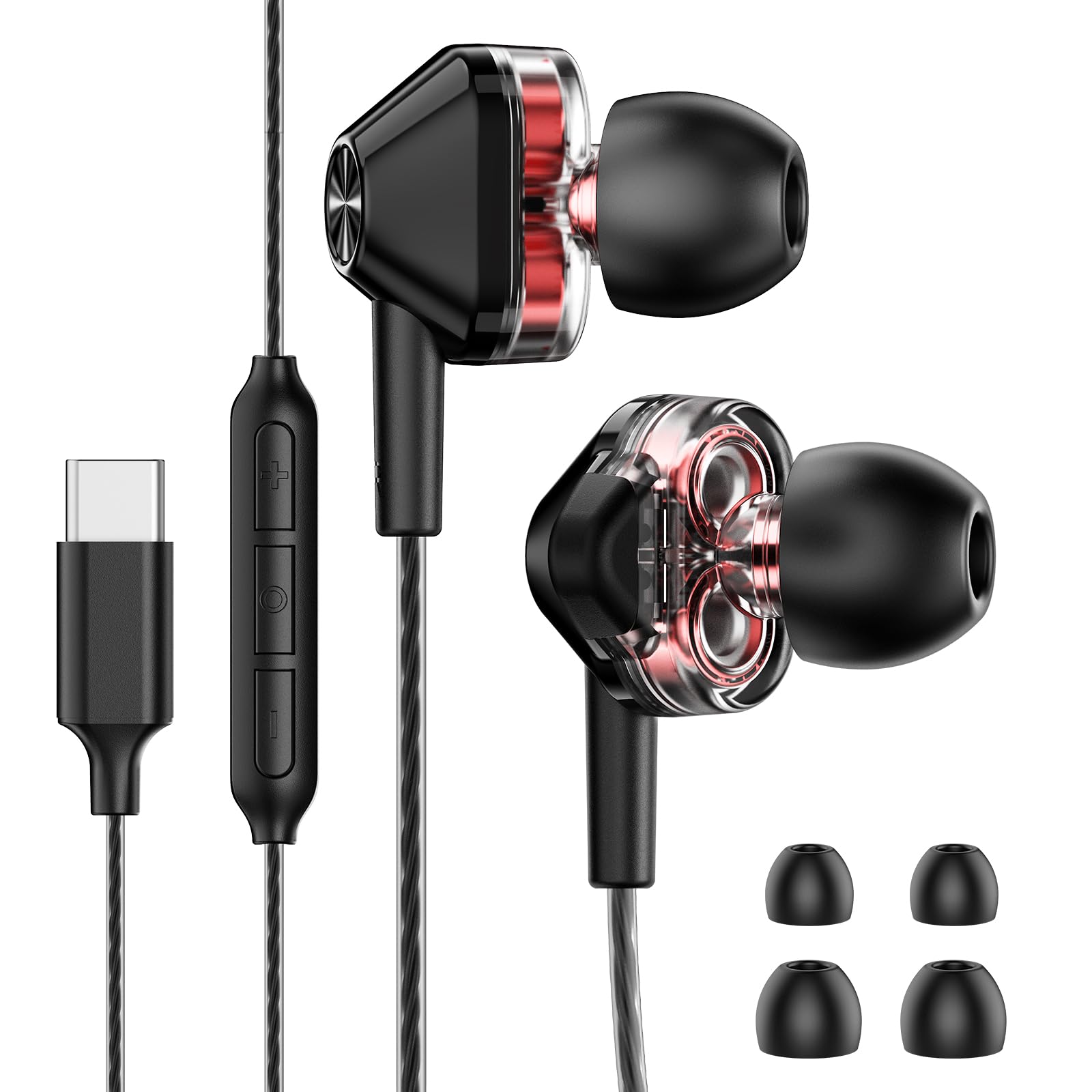
Dual 6mm dynamic drivers plus a three-size silicone seal that blocks train and open-office noise.
Two 6mm dynamic drivers sit in each earpiece, and a high-performance DAC chip runs the conversion from your phone’s USB-C port. The claimed frequency range runs from 16Hz to 40kHz, with lossless audio support up to 24-bit/192kHz resolution — numbers that only matter if your source files are that good, but they tell you the hardware was not built to the lowest spec. In practice that means punchy bass, warm mids and crisp highs, which is the balance most commuters actually want rather than a perfectly flat monitor sound.
The fit is where this set pulls ahead of the cheaper picks. Self-adapting ear fins and a 45A silicone tip in three sizes form a seal, and that seal is what blocks ambient noise — no electronics involved, just a properly filled ear canal. Owners wear them for full 6-to-8-hour shifts without fatigue, and the cable is reinforced with a bulletproof fiber core so it bends without splitting at the plug. The inline remote handles volume, play/pause and skipping without you touching your phone, and the mic is clear enough that calls in a noisy room still come through.
The trade-off is that the controls are the weak link, not the audio. The front buttons can work intermittently, and one set’s connector died inside a year. It also catches people out with small ear canals — the manufacturer says outright that very small ears may struggle with the fit. Two years of warranty is the safety net here, which is more coverage than any other pick on this list offers.
The reason to pick it: Sound quality gets more owner attention than any other trait on this set, and the fit backs it up — the seal is secure enough to stay put while you move and block the noise of a train or an open office. You get three tip sizes in the box, so dialling in that seal is a matter of swapping once.
The one thing to watch: The push-button controls on the cord are the part most likely to act up over time. Treat the buttons gently and keep the receipt — the two-year warranty covers this exact failure.
Best suited to: Anyone who spends hours on calls or in a noisy office and wants a wired set that seals, stays put and sounds genuinely good.
Skip the fit risk if: Your ear canals are very small — the tips may not seal, and this brand says so directly.
4. Moondrop CHU II DSP USB-C In-Ear Monitors

An alloy-shell in-ear monitor with a 0.78mm swappable cable, so a worn cord does not retire the set.
This is the entry ticket into proper in-ear monitors. The 10mm dynamic driver uses an aluminum-magnesium alloy dome diaphragm — a stiff, light material that extends the treble and pulls out details a plastic cone smears over. The acoustic cavity is cast from alloy, the nozzle is a separate brass CNC component, and the shell has a durable paint layer to fend off corrosion. None of that is marketing filler; it is why a metal-bodied monitor feels and sounds different from a plastic bud. The 0.78mm interchangeable cable is the practical standout, since you can replace it or move to other cable types rather than binning the whole set.
The DSP version adds three bass presets that you switch inside the Moondrop LINK app, so you can nudge the low end toward your taste without an equaliser. On acoustic, classical and vocal-heavy music these hold up against sets costing several times more, and they fit very small ears without the pressure points bulkier designs create. The tuning leans bright and clear rather than bass-heavy — if you want a thick, rumbling low end for rap or EDM, this is the wrong character.
Two caveats are worth your attention before you buy. The app crashes often, which makes the preset switching a chore when it happens. And the biggest complaint across the reviews is a channel imbalance where the left side sounds noticeably quieter than the right — not everyone hears it, but it is the single most-reported issue. Buying from a source with an easy return policy is the smart hedge.
Why the metal build matters
- Aluminum-magnesium dome diaphragm extends treble and reveals fine detail
- Replaceable 0.78mm cable means the set outlives a worn cord
- Three DSP bass presets switch through the app
- Small-ear friendly fit with no pressure points
The realities of owning one
- Some pairs have a left channel that sounds quieter than the right
- The Moondrop LINK app crashes often, interrupting preset changes
- Bass is thinner than the marketing suggests — great for acoustic, weaker for rock and pop
The buy if: You want your first proper in-ear monitor and care about detail, build quality and a replaceable cable more than thumping bass.
Think twice if: You need heavy low end or you are not prepared to test both channels the day it arrives.
5. Sony IER-EX15C USB-C Wired In-Ear Headphones

A washer-proof travel pair with an anti-tangle cable that plugs in when your wireless buds die mid-flight.
Sony’s play here is durability and a cable that behaves. The serrated outer jacket resists tangling, so pulling it out of a jacket pocket does not produce a knot, and the silicone earbuds come in multiple sizes to find a secure fit. The frequency range is listed at 20Hz–20,000Hz, the standard span of human hearing, and the inline remote with its multi-function button covers volume and calls. It is also available in four colors, which matters if you want to spot it in a bag.
What buyers actually get is a set that survives punishment. One pair went through the washing machine and still worked, buttons intact. Another lasted a full trip with a secure fit while walking, and the USB-C plug is slim enough to seat inside a thick phone case rather than forcing you to strip the case off. The passive noise blocking from the silicone tips is good enough that one flyer switched to these simply because wireless earbuds were not loud enough on a plane.
Set your expectations on sound, though. Owner opinion is genuinely split, leaning toward competent rather than impressive — some find a decent bass response when the tips seal properly, others hear a thin, mediocre output with no low end at all, and a few reports of crackling when the wire moves. It is a reliable backup, not a primary listening piece, and it is note a rare unit arrives dead from the start. Buy from a seller with a return window you trust.
The travel case for it: Reliability and fit are the two things this set gets right, and for a pair that lives in a backpack and gets yanked out at an airport gate, that is the whole job. The washer-proof housing and the anti-tangle jacket do the real work here.
Where the sound lands: Good enough for podcasts, calls and in-flight audio, not good enough to make anyone gasp. If a sealed tip does not fit your ear, the bass disappears entirely — try all the supplied sizes before deciding.
Pick it for: A rugged second pair that lives in your travel bag and punches back when wireless dies.
Pass if: Music listening quality is the priority — the Koajim and Audiovance picks are the stronger listen.
6. Audiovance Vibes 202MC HiFi USB-C Wired Earbuds
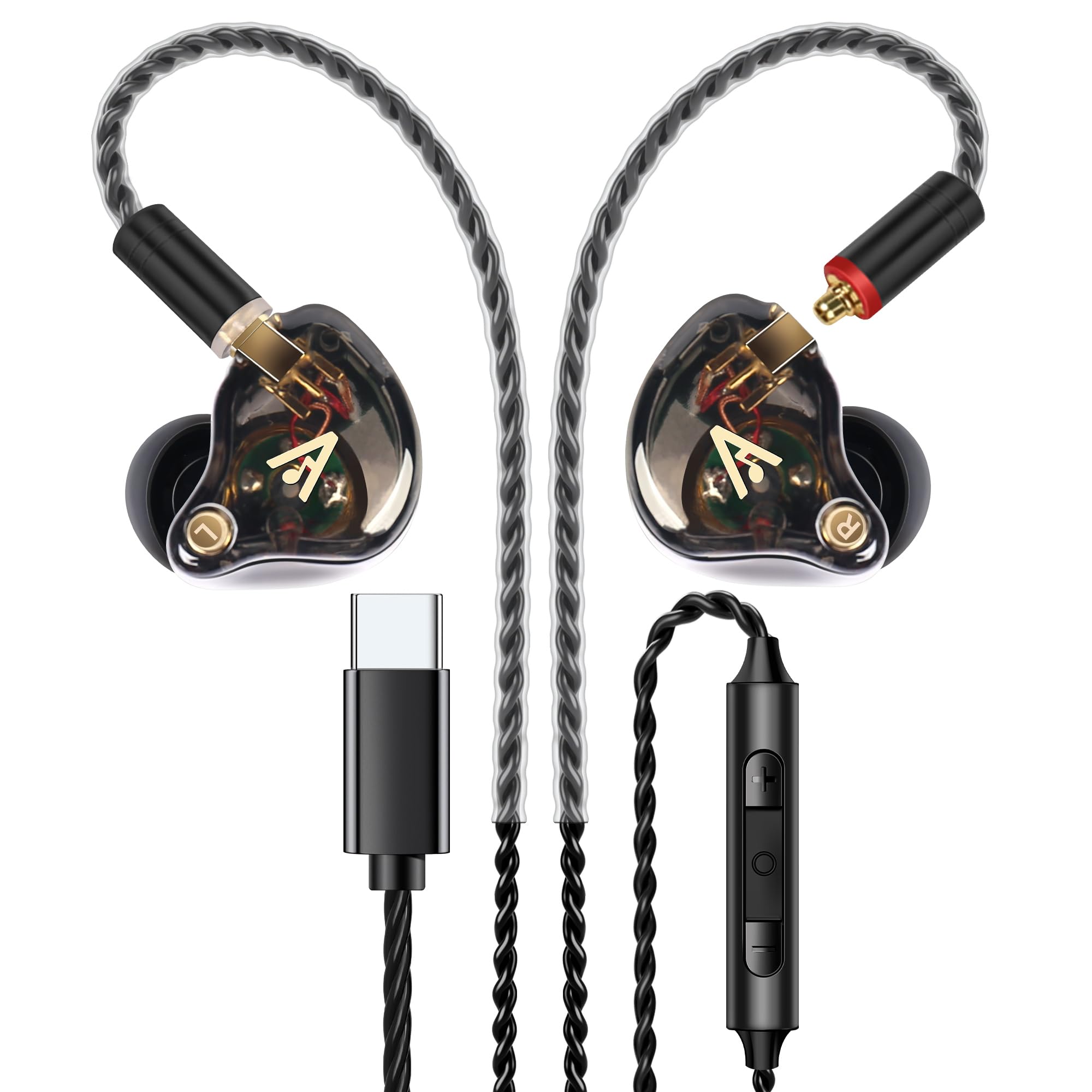
A 1-Tesla balanced armature with over-ear hooks, built for players who need to hear every note and every mistake.
The 1-Tesla driver here is a strong magnetic motor — the unit that moves the diaphragm — and it is paired with tuned acoustic chambers covering a wide 8Hz to 23kHz range. A silver-plated, Litz-braided cable carries the signal without loss, and 24K gold-plated MMCX connectors let you detach and swap the cable. Preformed over-ear hooks keep the cord behind your ear so it does not snag your hands while you play. Six pairs of eartips come in two colors and three sizes, so you can chase a proper seal without buying extras.
For singers, drummers and guitarists, this is the shape that makes sense: the cable routes over the ear, the resin shell sits flush against the head, and the passive isolation blocks the room so you can hear yourself. Volume stays clean at high levels with no noticeable distortion, and the built-in mic handles calls while the inline remote controls playback. A six-hour flight passes comfortably on these, and the included carrying case and carabiner make them easy to pack without losing the tips.
The weak spot is the cable design itself. It kinks easily on the twisted section and can develop signal loss after a month of steady use — one owner traced it to an internal break while the audio still sounded good when it connected. Bass also runs lean and clean rather than thick, so if you want a heavy low end you are in the wrong set. There is no cord keeper or clothes clip either, which is a small annoyance for commuters.
Built for stage and studio
- 1-Tesla driver delivers clean, detailed output at high volume with no distortion
- Silver-plated Litz cable and 24K gold-plated MMCX connectors are swappable
- Over-ear hooks keep the cord secure through movement
- Six pairs of eartips in two colors and three sizes for a proper seal
Watch for on the cord
- The twisted cable kinks easily and can break internally over time
- Bass is lean and clean rather than heavy
- No cord keeper or clothes clip for commuters
The gig-ready pick: Choose this if you play an instrument, record at a desk, or want the clarity of a silver-plated, detachable-cable monitor on a USB-C phone.
If you need rumble: Go elsewhere — the bass tuning here is clean and flat, not thumping.
7. KZ ZS12 Pro 2 USB-C In-Ear Monitor Headphones

Five balanced armatures and a 10mm dynamic per side, crossed over to pinpoint where an enemy is standing.
Each earpiece packs four ultra-high-frequency balanced armatures and one mid-high balanced armature, plus a 10mm dynamic driver for low end — five balanced armatures and one dynamic per side, six drivers total. An electronic crossover board splits the frequencies between the two driver types so they do not fight each other, and that is the part that makes a hybrid work or fall apart. Precise imaging is the payoff: in a first-person shooter you hear footsteps and gunshots from a direction, not just a location. Four preset sound modes switch on the inline controller, so you can go from a gaming profile to a podcast profile with one button.
The over-ear cable design keeps the set stable through long sessions, and the metal faceplate with resin shell stays comfortable for eight-hour stretches. Everything is plug-and-play over USB-C with no charging and no app required, working on a phone, a PS5 or a PC. This is a genuinely different class of detail than the Apple or Sony picks above — with six drivers doing the work, the separation and layering are the whole reason to own it.
The one genuine complaint is the cable. Multiple owners call it very short and end up plugging in an extension to reach properly, and the connector at the ear can loosen over months and need pressing back down. Reliability is the other sticking point, with a wire breaking in one report after only a few uses. Bass is also smoother and softer than the punchier KZ ZS10 models, so bass-heavy listeners may prefer that older tuning. Buy knowing the cable is the part you may replace.
The case for six drivers: Sound is what wins these their following, and it shows in competitive play — opponents get easier to locate, and with clean low-to-high separation the detail stays legible in complex scenes. If you want the gaming edge, this is the pick.
The catch to plan around: The cable is short and detachable, so it works fine with a USB-C extension. Budget for a longer or tougher cable from the start and the reliability risk drops.
Built for gamers: Get these if you play shooters or want the most driver detail per earpiece on this list and are happy to swap the cable.
Not for bass heads: If you want the punchy low-end rumble of a ZS10-style tuning, this smoother tuning will feel flat.
Know the Specs
Driver count and driver type
A dynamic driver is a moving cone that handles the full range. A balanced armature is a tiny precision unit tuned to a narrower band, usually treble and mid detail. Hybrid sets combine both, and how well they are crossed over decides whether the extra drivers actually help. A single well-tuned 10mm dynamic driver can sound better than six badly blended ones, so treat driver count as a starting point, not a score.
DAC and digital audio support
A DAC (digital-to-analog converter) lives inside the USB-C plug on most modern phones, because there is no headphone jack chip in the phone itself. A better DAC keeps the signal clean and avoids the buzz and pop that cheap plugs produce. Lossless support at higher resolution only helps if your audio files are that good — it will not rescue a low-quality stream.
Impedance and frequency range
Frequency range describes which pitches the driver can produce; human hearing spans roughly 20Hz to 20,000Hz, so a set listing that exact span is covering the standard band, while wider claims extend beyond what you can hear. Impedance is how hard the earbud is to drive — a lower figure is easier for a phone to push. Both are useful reference points, but your ear seal changes the perceived sound far more than either number.
Passive isolation versus noise cancellation
Passive isolation means a physical seal blocks outside sound — no electronics. Noise cancellation uses microphones and processing to cancel sound actively. Every pick here relies on passive isolation, which is why tip fit matters so much: a loose tip lets in the room and strips the bass, while a good seal turns the same earbud into a quiet, full-sounding one.
Common Questions
Will these wired USB-C earbuds work with my iPhone?
Do wired USB-C earbuds need charging or an app?
What is the difference between a balanced armature and a dynamic driver?
Will a USB-C earbud fit through a phone case?
How long do wired USB-C earbuds usually last?
Can I use USB-C earbuds for gaming on a console or PC?
Why does my earbud sound quieter on one side?
Do I need a DAC chip in my USB-C earbuds?
How do I get good bass from an in-ear USB-C earbud?
Are these earbuds good for calls and video meetings?
The Bottom Line
The wired USB-C earbuds that make the most sense for most people are the Apple EarPods with USB-C, because they plug into any USB-C phone or laptop, cost less than the in-ear monitor picks, and skip charging and Bluetooth entirely. They will not win a bass contest, but they handle calls, podcasts and everyday listening without a second thought. If sealed noise isolation and real sound quality matter more to you, the Koajim 710C gives you dual drivers, a proper seal and a two-year warranty for a small step up. For gamers who want the sharpest positional detail on the list, the KZ ZS12 Pro 2 and its six drivers per side are the pick — just plan to swap the cable. Whatever you choose, buy from a seller with an easy return window and test both earbuds on day one; the channel imbalance and dead-arrival issues here are rare, but a return receipt turns a rare disappointment into a five-minute fix.
How we choose
We do not accept paid placement. Every pick is matched to a real buyer and a real use-case; we do not hands-on test units.
Sources
Specifications: manufacturer listings and product documentation. Review insights: verified customer reviews, as of October 2026. Pricing: not shown on this page (it changes often); check the current price via the retailer link.
As an Amazon Associate, Aappliancez earns from qualifying purchases. This does not affect which products we feature.