Disclosure: Some links in this post are affiliate links. As an Amazon Associate I earn from qualifying purchases, at no extra cost to you. Learn more
Specs are compiled from manufacturer listings and verified buyer reviews and can change over time — please confirm the key details on the product page before buying.
You already own the records. What you need is a pair of wired speakers that plugs into your turntable and makes them sound like something. Active models have the amplifier built in, so you go from box to first spin in minutes. Passive models need a separate amp, but they open the door to bigger sound later. If you want the short answer: the Klipsch R-41M is the strongest recital of the vinyl hobby in this whole roundup, and it holds a 4.5+ rating from 5,500+ owners.
This guide is built by comparing the manufacturers’ published specifications and the patterns across verified customer reviews, so you get each pick’s real strengths and trade-offs instead of marketing spin.
Below you get the connection types explained without the jargon, plus a comparison of the eleven sets that actually earn a shelf spot beside a turntable. One caveat matters before you read any further: turntables with a PHONO-only output need a phono preamp, and that single detail trips up more vinyl newcomers than any other. Every pick here is laid out so you can match it to your own turntable and room, and this page works as a straight reference for the best wired speakers for record player setups.
Top Picks


How To Choose The Best Wired Speakers for Record Player
Buying speakers for vinyl is really two questions wearing one coat. First, does your turntable put out a signal these speakers can swallow? Second, will the sound fill the room you actually listen in? Get those two right and the rest is taste.
Active or passive: the first fork in the road
An active speaker has its own amplifier inside, so you run a cable straight from the turntable to the speaker and you are done. The Edifier R980T does exactly this with 24 watts of RMS power — that watts figure is the honest continuous output, not a peak number on the box. A passive pair, like the Klipsch R-41M, has no amp, so it needs a separate amplifier or receiver between the turntable and the speakers.
Active sets usually include the cables you need, while the Klipsch R-41M takes bare wire into binding posts, which means you supply the speaker wire and the amp yourself.
The PHONO output trap that catches most beginners
Some turntables send out a very quiet PHONO-level signal that needs a phono preamp to boost it before any speaker can use it. Others, and most modern decks with a built-in preamp, send out a louder LINE-level signal that plugs straight into an auxiliary or RCA input. The RIOWOIS set lists a plain RCA input for a record player, which suits a deck that already outputs LINE. If your deck is PHONO-only, add a phono preamp first — the Edifier R1280T crowd flags this exact step for large living room record setups.
Watts, sensitivity, and the number that actually predicts volume
On a passive speaker, look for sensitivity — the Klipsch R-41M runs at 90dB at 2.83 volts over 1 metre, a measure of how loud it goes for a given push from the amp. A higher number means an easier speaker to drive, and the Klipsch also handles 50 watts continuous and 200 watts peak. On an active speaker, the RMS wattage is the one that counts, whether that is the 24 watts of the R980T or the 42 watts of the R1280Ts.
Woofer size and what it means for your room
Driver diameter is the bass dial. A 4-inch woofer suits a desktop or a small room, while the Saiyin 5.2-inch driver is the biggest cone in this group and pushes more low end. The Edifier M60 splits duty between a dedicated woofer and a 1-inch silk dome tweeter — a small fabric-domed part that handles high frequencies. Match cone size to the space, not to the marketing.
Sub out: the future-proofing jack
A subwoofer line-out lets you bolt on a powered bass box later without buying new speakers. The Edifier R1280Ts includes one with automatic detection and a built-in crossover that switches on when a sub is connected. The 5-inch MEVOSTO set notably leaves a sub out off the panel, and the Saiyin 5.2-inch keeps one but without an adjustable crossover.
Side-by-Side Comparison
| Model | Best For | Power | Woofer | Inputs | Amazon |
|---|---|---|---|---|---|
| Klipsch R-41M★ Best Overall | Big-room vinyl with an amp | 50W cont / 200W peak | 4″ spun-copper | Binding post / RCA | Amazon |
| RIOWOIS DS6701NPPlug and Play | Turntable plug-and-play | Powered (built-in amp) | — | AUX, Optical, Bluetooth, ARC | Amazon |
| BESTISAN SW65DSubwoofer Ready | Desk turntable and sub add-on | Powered (built-in amp) | — | RCA, Bluetooth | Amazon |
| Edifier R980T | First vinyl rig on a budget | 24W RMS | 4″ | 2x AUX (RCA + 3.5mm) | Amazon |
| Saiyin 5.2″ | Biggest cone for bass | Powered (built-in amp) | 5.2″ | Optical, RCA, Bluetooth | Amazon |
| Saiyin Powered | Sub out and TV duty | Powered (built-in amp) | 4″ | Optical, Coax, RCA, Bluetooth | Amazon |
| MEVOSTO DS19 | Desk and console crossover | 36W RMS | 5″ | RCA/AUX, USB, Bluetooth | Amazon |
| Edifier R1280Ts | Room-filling stereo with sub | 42W RMS | 4″ | Dual RCA, sub out | Amazon |
| PreSonus Eris Accent | Vinyl on a desk with tone control | 50W | 4″ | RCA, 1/8″ AUX, USB | Amazon |
| Edifier R1280T | Large living room vinyl | 42W RMS | 4″ | 2x AUX (RCA + 3.5mm) | Amazon |
| Edifier M60 | Desktop with high-res streaming | 66W RMS | 3″ mid-low | USB-C, AUX, Bluetooth 5.3 | Amazon |
Detailed Reviews
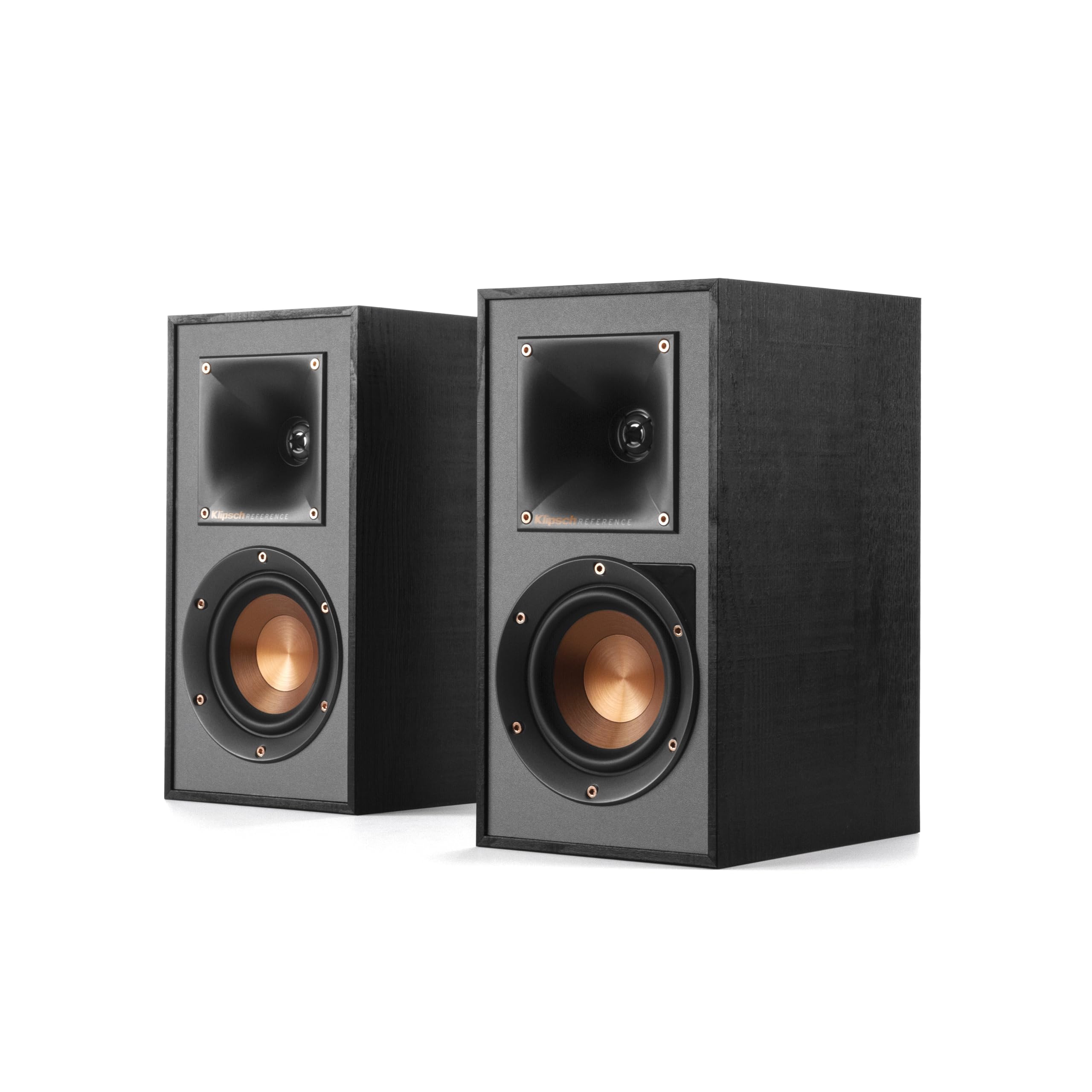
1. Klipsch R-41M Reference Bookshelf Speakers (Pair), Black
Our pick — 4.5+★ from 5,500+ verified ratings; the strongest balance of quality and price.
The horn-loaded pair that turns a modest turntable into a genuine hi-fi rig.
Here is the set you buy when your turntable already sits in a room you care about. It is a passive pair, so you supply the amplifier or receiver — run one from the turntable to the amp, then wire the amp to these. The 4-inch spun-copper woofer (a copper-plated cone that handles the mid and bass range) pairs with a 1-inch aluminum tweeter (the small high-frequency driver) behind a 90×90 square Tractrix Horn, which is a flared horn that shapes and focuses the treble across the room. The payoff is a rated frequency range of 68 hertz to 21 kilohertz within +/- 3dB, so the whole audible spectrum stays balanced rather than one end shouting over the other.
Drive them comfortably, too. Sensitivity sits at 90dB at 2.83 volts over 1 metre, which means these speakers go loud even from a modest amp, and they soak up 50 watts continuous or 200 watts peak. What wins people over is the detail — the horn tweeter carries highs that owners describe as crisp and non-harsh, and the little 4-inch cone manages tight punchy bass that belies its size. A voiceover producer working in a small studio reported clear highs and a slight midrange dip, and another listener running a vintage Marantz 2230 with a separate sub called them a strong balance for a warm amplifier. One turntable owner summed it up flatly: “One Hundred Percent Happy with these Speakers.” Sized at 11.3 inches tall and 5.75 inches wide, each 7-pound cabinet slides onto a real shelf or stand.
The trade-off is honest: this is a rear-ported design that wants a subwoofer for deep bass slam, and the bright Klipsch treble is a love-it-or-hate-it signature. One listener found it fatiguing over long sessions, and a 4-inch cone struggles on bass-heavy tracks at high volume without a sub. If you want a turntable rig that fills a large room with a dedicated bass box later, these are the ones.
What plays in its favour
- 68 hertz to 21 kilohertz range keeps the spectrum balanced
- 90dB sensitivity drives easily from a modest amp
- Handles 50W continuous and 200W peak without strain
- Compact 11.3-inch tall cabinets slot onto real shelves
What to weigh first
- Needs a separate amplifier or receiver — it is passive
- Rear port means placement matters for clean bass
The right fit: a listener with an amp who wants genuine hi-fi detail and room-filling range from a turntable. a listener with an amp who wants genuine hi-fi detail and room-filling range from a turntable.
Where it holds back: deep bass needs a subwoofer to back it up.
2. RIOWOIS Powered Bookshelf Speakers
The powered set that lets a turntable and a TV share one pair without a receiver.
If you want music without a tower of boxes, this is the short answer. The RIOWOIS DS6701NP has the amplifier built inside, so it runs from your turntable with no receiver or amplifier in the chain at all. It is the opposite path from the passive Klipsch up top: that one trades convenience for amplifier flexibility, while this one trades amplifier flexibility for a single clean cable run. A wood-grain cabinet with hand-polished rounded corners keeps it looking like furniture rather than gear.
The connection spread is where it earns its place. You get an AUX input for the turntable, plus Optical and TV-ARC ports for a television, and ARC even lets the TV remote control the speakers. Bluetooth 5.3 handles wireless streaming from a phone or laptop, and three sound modes plus volume sit on the included remote. As to whether it holds up in real rooms, one office turntable owner praised the “Rich and warm tone from both the turntable and streaming from my phone,” while another record player owner compared the sound to a soundbar costing far more. For a compact set, the appearance draws real attention — it looks pricier than it is.
Now the catch, and it is worth reading twice for vinyl. If you plan to connect by Bluetooth, your turntable must have a Bluetooth transmitter — a deck with only Bluetooth reception will not work here. The Bluetooth link itself also runs mixed, so some owners find it easy and others find it spotty, which makes the wired AUX path the surer ride for records. For a small space where the turntable and the TV share a living room, it is a lot of connection for the outlay.
The connection case: AUX, Optical, ARC, and Bluetooth 5.3 cover a turntable, a television, and a phone from one pair of boxes, all with no receiver in sight.
One thing to know: powered speakers like these are not compatible with receivers or amplifiers, so do not try to route an external amp through them.
Reach for this if: you want a turntable and a television on one set with nothing else in the chain.
Look elsewhere if: you plan a Bluetooth-only turntable connection — a wired AUX run is far more reliable.
3. BESTISAN Bluetooth Bookshelf Turntable Speakers
A wood-sided desktop pair that leaves the door open for a bass box down the line.
Desktop vinyl rigs are where this one lives. The BESTISAN SW65D keeps RCA for a wired turntable and Bluetooth for a phone, and it puts a sub out on the panel so a powered subwoofer takes over the deepest frequencies whenever you get round to adding one. On a desk, the 5.94-inch depth and 9.13-inch height mean it sits neatly beside a monitor or a turntable without eating the whole surface. Bluetooth range is listed at 10 metres, enough to stream from a couch across a room.
For everyday listening it does the sensible job. An owner running one for a couple of years said “I’ve had these for a couple years and work efficiently,” while wishing the bass were a touch stronger — which is exactly the gap the sub out is there to close. A work-from-home user wired one pair to a PC and a Mac at once and got crisp, clear sound with no cable swapping. Bass boosts, a three-band tone setup, and the compact brown wood-side cabinet round out a tidy desk solution.
The honest wrinkle: straight from the start a few find the mids a little muddy and the bass limited, so EQ or a sub brings out its best. It also lacks a remote, which means volume tweaks come from the speaker itself. For a small room turntable on a table, that is a fair trade for the sub out and the look.
Where it shines: a sub out jack on a compact set means you can add deep bass later without replacing the speakers.
The honest limit: bass is modest on its own and the set ships with no remote, so a sub and a hands-on volume habit help.
Suits you if: you crate a turntable on a desk and want a wood-toned pair with a path to a sub.
Think twice if: you want deep bass from the start — plan for a subwoofer or EQ from day one.
4. Edifier R980T 4″ Active Bookshelf Speakers

The first-rig pair that plugs straight into a turntable with nothing else required.
Your very first vinyl setup is the target here. The R980T is active, so its 24 watts of RMS power — the wattage figure that reflects honest continuous output — is amplified inside the cabinet, and you simply run a cable from the turntable to one of two AUX inputs. Two inputs matter on a desk: a turntable on one and a computer on the other, both connected at once, no unplugging. The front-facing bass reflex port (an opening that helps the woofer breathe) means you can push it close to a wall without choking the bass.
For the money it does more than beginners expect. Rich bass and clear vocals sit at the front of the sound, and loud passages can mimic a small concert — one owner cautions that neighbours in an apartment will hear it. The wood enclosure is built to cut acoustic resonance, a real cause of muddy sound, and the front port plus a bass knob let you tune it to the room. It is the most approachable entry point if you are new to the hobby and want to hear your records properly without a stack of components.
Two things a first-timer should know. Wiring up a passive speaker, an active speaker, and a turntable can be murky from the manual alone — several people turned to video walkthroughs to sort the red and black cables. And it is not a true studio monitor, so if pinpoint clarity is what you chase, the R1280Ts further down this list steps up. For a first rig that works the moment you plug in, it is a smart pick.
Value first: dual AUX inputs remove the need for a turntable adapter and let a deck and a computer share the speakers, all built to cut cabinet resonance.
Takes your order if: you are setting up a first turntable and want clean sound with zero extra gear.
Set expectations: it is not a reference monitor, so a clarity chaser should budget higher.
5. Saiyin Bluetooth Bookshelf Speakers with 5.2 Inch Woofer

The 5.2-inch woofer that punches more low end than most bookshelf sets dare.
Bass is the mission with this Saiyin, and a 5.2-inch woofer — the largest cone in this entire roundup — is how it gets there. A silk dome horn tweeter handles the highs, a small fabric-domed driver set inside a flared horn that spreads the treble wide and clean. Four input types cover Optical, RCA, AUX and Bluetooth 5.0, so a turntable, a CD player, and a phone all have a home. The wood-grain cabinet adds warmth to a room rather than shouting “gadget”.
What it does best is fill space for its size. One garage owner found the sound “amazing” and said the pair fills the whole area; another reported it pumping loudly enough for a 20×26 room, with clear, non-muted highs. The sub out lets you add a separate powered bass box if the 5.2-inch cone still falls short on bass-heavy tracks. For a small to medium room, that combination earns its spot.
Two limits worth weighing for vinyl. The treble end, while clear, is not the most refined, and the onboard EQ presets are basic — a listener used to cleaner gear will notice the difference. More to the point for a turntable: only one cabinet is powered and the second is hardwired to it, which means one cable trails between the pair and they sit closer together than a true separate stereo pair. If you want the widest possible soundstage, that is a real compromise.
Who it suits: someone with a small room who wants the most bass a modest budget buys and does not mind a wire between the two cabinets.
Who should skip it: a listener chasing a wide, separated stereo stage — the hardwired second cabinet pulls the pair together.
Leans toward you if: a big woofer and a small footprint are the two things you most want from a turntable speaker.
Go bigger if: you want a true two-cabinet spread — that hardwired second speaker is the compromise.
6. Saiyin Powered Bluetooth Bookshelf Speakers

A set that proudly makes too much bass and gives you sponges to tame it.
The bass on this Saiyin is an event. A 4-inch woofer and a 0.5-inch silk dome tweeter back a sub out jack, and the low end hits hard enough that the set includes foam sponges for the bass-reflex ports — a simple plug to dial down the boom in a small room. Optical and coaxial inputs accept 24-bit / 192kHz digital audio, a high-resolution standard for a lossless connection to a television. RCA handles the turntable directly through LINE OUT, and the remote toggles inputs, mutes, and volume without you leaving the sofa.
The power is what owners latch onto. It fills a room loudly, and one owner said it was powerful enough to blow out a candle across the space. Another called it a huge upgrade from a computer speaker for PC and games, noting no Bluetooth latency worth mentioning. For a mixed living room — a turntable on one input and a TV on optical — it works as one pair for everything.
Now the honest part. Treble is on the softer side without EQ, and the base model leaves out tone controls on the speaker itself — the remote carries three EQ presets but no bass or treble knobs. Some find the bass overpowering until they fit the sponges, and the sponges are the fix rather than a subtle dial. If your turntable only outputs PHONO, you will need a preamp first, same as with any set here. Treat it as a bass-forward home theater pair that doubles for vinyl, and you will be happy.
Why it earns a spot
- Optical and coax accept 24-bit / 192kHz audio
- Sub out lets a powered bass box join the pair
- Remote toggles inputs, mute, and volume from the sofa
- Includes foam sponges to tame the port bass
Where it asks for patience
- Treble is soft without EQ, and no tone knobs on base unit
- Bass runs heavy until you fit the port sponges
Best matched to: a living room that wants one pair for a turntable and a TV with heavy low end.
Caveat: if treble sparkle matters, plan to lean on EQ — the base unit has no tone dials.
7. MEVOSTO 5-Inch Powered Bookshelf Speakers

The desk pair built to serve a turntable, a PC, and a game console at once.
Two 5-inch woofers and two 1-inch silk dome tweeters run off a built-in 36W RMS amp, so this M-VOSTO DS19 is a full stereo pair with no external amplifier. A 5-inch cone is bigger than the 4-inch drivers on several sets here, and it shows up as strong bass that some owners turn down rather than up. The US-B port, a digital audio connection, lets the pair plug straight into a desktop PC or a console, and RCA/AUX takes a turntable with a built-in or external phono preamp. Bluetooth 5.4 handles wireless streaming.
The versatility is the draw. You get independent bass and treble knobs on the speaker plus a remote, so tone shaping happens without an app. A PC user who moved over from a trouble-prone setup found the Bluetooth instant on pairing and switched to the USB link to erase a slight lip-sync delay. One happy buyer summed the whole appeal up as “very much a versatile piece of equipment” that works for a turntable and a phone at once. It carries PS5 and console support and even takes 12V/15V/18V DC input for camper or boat power.
Two things to note before you order. There is no subwoofer out, so a separate bass box cannot join later. And the pair is sized for a roomy desk — each cabinet is 5.9 x 6.1 x 9.7 inches, which wants space rather than a narrow shelf. For a listener who wants one pair across turntable, computer, and console, the input count is the selling point.
Inputs make the case: USB digital audio, RCA, AUX, and Bluetooth 5.4 mean one pair covers a turntable, a desktop, and a console.
Sizing note: confirm your USB port supports audio output before you rely on the digital link, and leave room for the 5.9-inch-deep cabinets.
Go for it if: a turntable and a gaming desk share a room and you want one pair for both.
Hold off if: you plan to add a subwoofer — the panel has no sub out.
8. Edifier R1280Ts Powered Bookshelf Speakers

The vinyl set that grows with you, thanks to a sub out that switches on a crossover.
Where the R1280T (further down) stops, this one keeps going. The R1280Ts runs 42 watts of continuous, undistorted power through a 4-inch woofer and a 13mm silk dome tweeter, and adds a subwoofer output with automatic detection — connect a powered sub and a built-in crossover activates to hand off the low end cleanly. That crossover on connection is the difference: bass transitions to the sub instead of doubling up. Dual RCA inputs take two devices at once, and a Soundfield Spatializer widens the stereo image from a single button.
For turntable use it is a warm, revealing companion. A former Audio-Technica Bluetooth speaker user upgraded to this set and praised the “warm vinyl sound, reveals texture/space across genres,” with easy setup and wood grain that suits a vintage look. Bass and treble live on the side panel knobs, and the remote handles volume and mute from across the room. Add a sub later and the same cabinet digs deeper without a replacement buy.
Read the fine print on the sub. A built-in crossover activates when a subwoofer is connected, so the low end is handed off cleanly, and the sub inherits the speaker’s controls including the spatializer — a speaker like this rewards a little experimentation. Others find the midrange a touch heavy and the treble ramps near the top. For a listener who wants to start with two speakers and build toward a fuller system, that sub out is the whole reason to choose this over the plain R1280T.
The upgrade path: a subwoofer output with automatic detection and a crossover on connection means your system can grow without buying new speakers.
Match tip: pair it with a deck that outputs LINE, or add a phono preamp — this set is not a turntable and does not boost a PHONO signal for you.
The pick for builders: someone who wants to start with two speakers and add a subwoofer later without replacing anything.
Not the one for: a listener who wants deep bass without adding a subwoofer — the 4-inch woofer still needs a powered sub to get there.
9. PreSonus Eris Accent — 50W Powered Bookshelf Speakers (Pair)
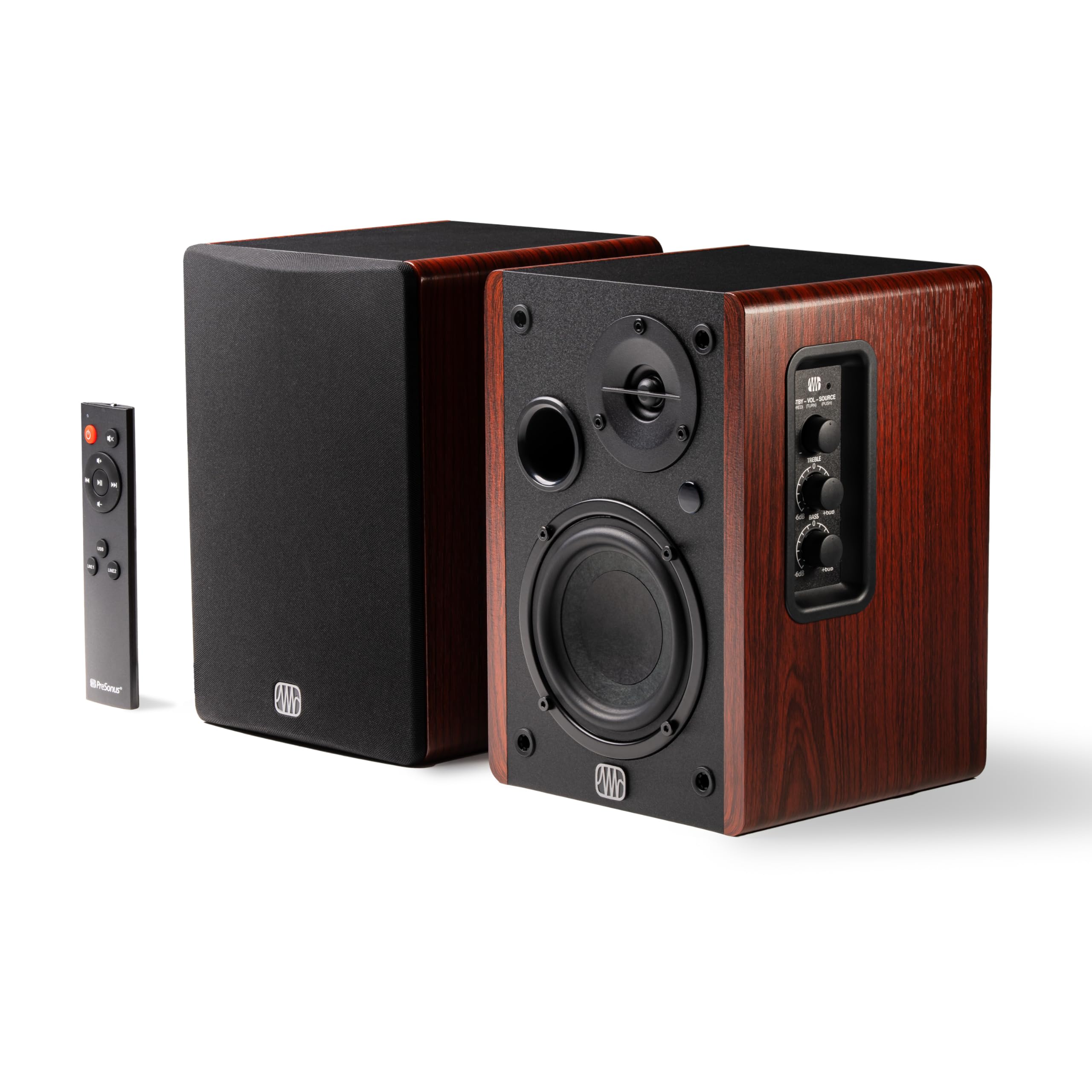
Studio-tuned tone controls that let you match the sound to your own ears.
The Eris Accent is built for the listener who likes to tinker. Fifty watts of power drive a 4-inch woofer and a silk dome tweeter, and front-panel Volume, Bass, and Treble knobs put tone adjustment within reach without digging behind the cabinet. Connect a record player straight in via RCA or 1/8-inch AUX — no software, no setup app. A wood-grain finish keeps it looking at home on a shelf or a desk.
The tonal control is the part owners gravitate toward. An amateur vinyl listener who replaced a cheaper pair called these “Loud, crisp and deep sound” with adjustable treble and bass and a five-minute setup over RCA to an Audio-Technica turntable. Another gamer and movie streamer found ample volume for any room size and reliable performance across a gaming PC and a PS5. A quiet but telling detail: one owner noted that over just a few extra dollars you also pick up a remote, a sub out, and three separate inputs over the smaller Eris 3.5 — the upgraded convenience for the least extra layout.
The catch is honest. These are not a flat studio reference — tone tweaks are needed to balance them, and a listener who dug into the numbers suspected real output lands under the rated 50 watts and the treble lacks brightness at the top. The powered speaker also has no Bluetooth on this variation, so vinyl is the primary wired path. For a listener who wants to shape their own sound on a desk, it is a satisfying and pliable pair.
What you gain
- Front Volume, Bass, and Treble knobs for easy tone shaping
- RCA and 1/8-inch AUX take a turntable directly
- RCA sub-out keeps a future subwoofer open
- 50W plays loud before it breaks up
What to accept
- No Bluetooth on this variation — vinyl and wired only
- Not a flat reference, so tone tweaks are part of the routine
Turn its knobs if: you like dialing the sound yourself and want a compact pair with a sub path on a desk.
Skip for this: wireless-first listening — this variation is wired, so a phone streams elsewhere.
10. Edifier R1280T Powered Bookshelf Speakers, Black

A big-room vinyl workhorse with the warm tone the R1280 name is known for.
Large living rooms are where the R1280T earns its keep. Forty-two watts RMS push a 13mm silk dome tweeter and a 4-inch full-range unit, and two AUX inputs — a 3.5mm and a dual RCA — let a turntable and a computer stay wired at the same time. Side-panel knobs shape bass and treble, and a simple remote covers volume and mute from the sofa. A high-quality MDF wood build with a wood-effect vinyl finish looks smart beside furniture rather than above it.
The sound runs rich, especially next to leaner sets. A record player owner with a large living room called it “Shockingly good at this price point” — with the caveat that a deck without a built-in preamp needs a phono amplifier added. Compare it to the Edifier MR4 and the R1280T runs lusher and heavier, with fuller highs from the start. It also survived a cross-country move with consistent volume and no static, which speaks to the build. For a turntable that wants to fill a room without a sub, the bass carries.
One point to keep straight: this is the R1280T, which means no subwoofer out — that is the R1280Ts above, which adds the sub output and crossover. If you never plan a sub, this R1280T gives you the same warmth without the extra port. If you think you will want deeper bass someday, pay the difference up front.
Warmth wins: lusher, heavier bass and full highs from the start make it a favorite for living-room vinyl and streaming.
Fits the bill for: a large living room record setup that wants rich sound and no subwoofer.
Not for the planner: no sub out here — if you see a bass box in your future, the R1280Ts is the safer door.
11. Edifier M60 Multimedia Speaker, 66W RMS

The compact desk set with studio-grade detail and high-res wireless streaming.
This is the small speaker that wants to be taken seriously. Sixty-six watts RMS split into 18W+18W for the low-mid and 15W+15W for the treble, fed through 1-inch silk dome tweeters and 3-inch long-throw aluminum mid-low drivers, all run by a Class-D amp (a compact, efficient amplifier type). A built-in DSP — a digital signal processor that cleans up the sound — handles a two-way active crossover and dynamic range control, and Hi-Res Audio certification covers both the wired and wireless paths. Each cabinet measures 100mm wide by 168mm tall, about the footprint of a phone standing up.
The wiring choices suit a modern desk too. USB-C and AUX handle wired connections, while Bluetooth 5.3 with the LDAC codec streams high-resolution audio from Android. A pair of aluminum stands angled at 15 degrees comes in the box, tilting the sound straight to your ears rather than at your knees. The sound impresses: one audiophile buyer found it loud enough at 30 to 50 percent volume with surprising bass and no distortion; another called it the perfect desktop monitor for music, gaming, and movies with a wide soundstage. It is the set to move to when you want a turntable and a computer on a compact desk and refuse to give up detail.
The honest caveat is bass reach. The M60 will not dig far below the low-mid range on its own, so heavy bass lovers should plan a subwoofer or accept a lean low end, and a producer-grade flat response is not what this is built for. It will not replace a dedicated amp-and-sub system for full-room music. What it will do is make every record and every video on your desk sound far bigger than its footprint.
Detail is the point: Hi-Res Audio certification, Bluetooth 5.3 with LDAC, 66W RMS, and included 15-degree stands add up to adesktop set that punches above its size.
The bass boundary: the low end does not reach the deepest octaves on its own, so a bass-heavy listener should plan a subwoofer or accept a leaner floor.
Choose this if: you want a compact desk set that handles vinyl and computer audio with detailed, high-res sound and built-in angled stands.
Don’t pick it if: you crave deep subwoofer-grade bass and refuse to add one.
Know the Specs
RMS watts versus peak watts
RMS (root-mean-square) power is the continuous wattage a speaker can deliver day to day, while peak is a short burst it can handle briefly. The Edifier R980T lists 24W RMS and the Edifier R1280Ts lists 42W RMS — the continuous figure is the one that matters for how loud your records actually play. A bigger RMS number generally means more headroom before the sound distorts when you push the volume.
Sensitivity and impedance
On a passive pair like the Klipsch R-41M, sensitivity is how loud the speaker plays for a given amount of amplifier push — the Klipsch sits at 90dB at 2.83 volts over 1 metre. The higher that number, the easier the speaker is to drive. Impedance (its 8-ohm rating) tells your amplifier how much load to expect, so match the speaker’s ohm figure to what your amp is rated for.
Frequency response
Frequency response describes the range of pitches a speaker can reproduce, and the Klipsch runs 68 hertz to 21 kilohertz within +/- 3dB. Lower hertz reaches deeper into the bass; higher kilohertz covers treble sparkle. A set that stops higher up the hertz range will sound thin if you want bass weight, while a wider range gives you more of the recording.
Woofer and tweeter size
The woofer handles low and mid frequencies, and its diameter (from a 3-inch mid-low driver up to a 5.2-inch cone) sets how much air it can move for bass. The tweeter handles highs — a silk dome is a soft fabric-domed type, while an aluminum tweeter is a metal dome — and the material shapes the treble tone. A horn, like the Klipsch’s 90×90 Tractrix, spreads and focuses the highs across a room.
Inputs and the phono question
Turntables output either PHONO (a faint signal needing a phono preamp) or LINE (a louder signal that plugs straight in). Match your deck to your speaker’s input: RCA and AUX suit a LINE signal, while optical and coaxial carry digital audio for a TV. If your turntable is PHONO-only, add a preamp before any powered speaker in this list can use it.
Subwoofer out and crossover
A sub out jack lets you add a powered bass box. Some, like the Edifier R1280Ts, switch on a crossover automatically when a sub connects, handing off the low end cleanly. Others, like the Saiyin 5.2-inch, offer a sub out without an adjustable crossover. For a turntable setup in a big room, a sub-capable set is a cheaper long-term path than replacing the whole pair.
Common Questions
Do I need an amplifier to connect a record player to these speakers?
Will a turntable with only a PHONO output work with a powered speaker?
Can I use a turntable speaker set for a TV and a turntable at the same time?
Is a bigger woofer always better for vinyl?
Do these speakers include a subwoofer out so I can add bass later?
What cables come in the box with these record player speakers?
How far apart should I place speakers beside a turntable?
Can I add a subwoofer to a passive speaker pair like the Klipsch R-41M?
Do these speakers need a specific power supply for camper or boat use?
Are Bluetooth turntable speakers any good compared to a wired connection?
The Bottom Line
If you already have an amplifier and want detail that does a record justice, the Klipsch R-41M is the pick — a 68Hz-to-21kHz range with a horn tweeter gives you genuine hi-fi stereo that scales into a large room. If you want to skip the amplifier entirely, reach for the Edifier R1280Ts with its 42W RMS and a sub out that turns on a crossover, so your system grows without a new speaker buy. And for a compact desk that handles a turntable and a computer with high-res detail, the 66W RMS Edifier M60 is the one to reach for. Whichever you pick, match your turntable’s output — a PHONO deck needs a preamp — and you will hear your records the way they were pressed to be heard.
How we choose
We do not accept paid placement. Every pick is matched to a real buyer and a real use-case; we do not hands-on test units.
Sources
Specifications: manufacturer listings and product documentation. Review insights: verified customer reviews, as of October 2026. Pricing: not shown on this page (it changes often); check the current price via the retailer link.
As an Amazon Associate, Aappliancez earns from qualifying purchases. This does not affect which products we feature.