Disclosure: Some links in this post are affiliate links. As an Amazon Associate I earn from qualifying purchases, at no extra cost to you. Learn more
Specs are compiled from manufacturer listings and verified buyer reviews and can change over time — please confirm the key details on the product page before buying.
You want one cable, no charging ritual, and a mic that does not make you sound like you are calling from inside a tin can. That is the whole job of a wired over-ear headphone with a mic, and the shortlist below is built around it. The Audio-Technica ATH-M20x is the pick for most people, because it is tuned for clean, flat sound and it is the model with the deepest owner base here.
This guide is built by comparing the manufacturers’ published specifications and the patterns across verified customer reviews, so you get each pick’s real strengths and trade-offs instead of marketing spin.
Your first decision is simple: do you need a boom mic (a microphone arm that sits near your mouth) for talking to people, or a pair built for listening first? Below you get both, sorted by what each one actually does well, so you can pick in a few minutes. Every pick here is a wired over-ear headphones with mic that connects over a cable, never over Bluetooth.
Top Picks

How To Choose The Best Wired Over-Ear Headphones With Mic
Start with the mic before anything else. A wired headset lives or dies on whether the person on the other end can hear you clearly, and that depends less on the headphones than on how the mic is built and where it sits. A boom mic that reaches toward your mouth, like the ones on the JBL Quantum 100M2 and the Poly Blackwire 5220, picks up your voice at close range and rejects more of the room. An inline mic on the cable sits farther away and tends to sound thinner.
Then decide what the cable plugs into. A 3.5mm jack (the standard round headphone plug found on controllers, laptops, and phones) works almost everywhere, but on a desktop PC with separate pink and green ports you often need a splitter to get the mic working. USB-C and USB-A sidestep that entirely and are the safer bet for work calls.
Driver size and what it does for you
The driver is the speaker inside each ear cup, measured across in millimeters. Every pick below uses a 40 mm driver or larger, which is the size that generally gives you fuller low end and more headroom before the sound distorts. That number matters far more than a logo on the box.
Clamping force versus long-session comfort
A headset that grips hard seals out noise better, so you hear less of the office or the bus. The cost is pressure at the temples, and it shows up fastest for glasses wearers. If you plan to wear it for a full workday, look for memory foam padding and a headband that flexes, and accept a little less isolation in return.
Cable length and connection type
A short cable is a problem on a desktop PC, where the tower may sit on the floor. A long braided cable handles that better but adds weight and can snag. Detachable cables are the practical answer, because you can replace one instead of the whole headset when the wire wears out at the plug.
Side-by-Side Comparison
| Model | Best For | Driver Size | Connectivity | Microphone | Amazon |
|---|---|---|---|---|---|
| Audio-Technica ATH-M20x★ Best Overall | Studio and editing work | 40 mm | Wired, single-side cable | Not included | Amazon |
| soundcore by Anker Q20iBest Noise Cancelling | Noise cancelling on a budget | 40 mm | Bluetooth 5.0 plus AUX cable | Built-in | Amazon |
| JBL Quantum 100M2 | Console gaming on a budget | 40 mm | Wired, 3.5mm | Detachable directional boom | Amazon |
| HyperX Cloud Alpha | Marathon gaming sessions | Dual chamber | Wired, detachable braided cable | Detachable noise cancelling | Amazon |
| Poly Blackwire 5220 | Work calls and Teams | — | USB-C, USB-A, 3.5mm | Flexible noise-cancelling boom | Amazon |
| Logitech G PRO X SE | Competitive PC gaming | PRO-G 50 mm | Wired, 3.5mm or USB sound card | Detachable 6mm Blue Voice | Amazon |
Detailed Reviews
1. Audio-Technica ATH-M20x Headphones
Our pick — 4.5+★ from 27,000+ verified ratings; the strongest balance of quality and price.
Flat, honest sound for tracking and editing, with a cable that will not quit on you.
Here is the odd one out on a list about microphones: the ATH-M20x does not ship with one. What it ships with is a 40 mm dynamic driver per ear, tuned for stronger low-frequency output, and a circumaural cup design that circles your whole ear instead of pressing on it. That combination is why it turns up in home studios and editing bays — you hear what was actually recorded, not a hyped version of it.
The specs describe it as built for studio tracking and mixing, with copper-clad aluminum wire voice coils and rare-earth magnets inside each driver. In plain terms, those materials are chosen so the driver moves cleanly and holds its composure at higher volume. Its 96 dB/mW sound pressure level means a laptop or camera headphone jack drives it loud enough without a separate amplifier. Buyers report it connects easily to both a camera and a laptop, and that the accurate levels make it genuinely useful for filming and editing work.
The tuning is what wins people over: roughly 1,400 mentions of sound quality, more than any other trait. The value read is just as strong, with the second-biggest group of comments pointing at what you get for the outlay. It is not a headset, though, and that is the honest catch: no mic, no inline controls beyond volume, and a single-side cable exit that is fixed in place rather than detachable.
Why It Tops The List
- 40 mm drivers with rare-earth magnets give a flat, clear response that suits editing and tracking
- 96 dB/mW output means it runs loud straight from a laptop or camera jack
- Circumaural cups surround the ear, which is what does the noise blocking
- Tuned for enhanced low frequency, so bass has body without smothering vocals
Where It Gets Awkward
- No microphone at all — this is a listening pair, not a calling pair
- The clamping force bites: owners mention it causes pain with glasses after around 30 minutes
- Cable is not detachable, so a worn plug means a whole new headset
- Comfort and fit both draw mixed feedback across the review pages
Buy this one if: your day is mixing, editing, or camera monitoring and you want flat, uncoloured sound over a cable that needs no charging.
Look past it if: you need to talk to people — there is no mic on board, and the head clamp gets noticeable with glasses.
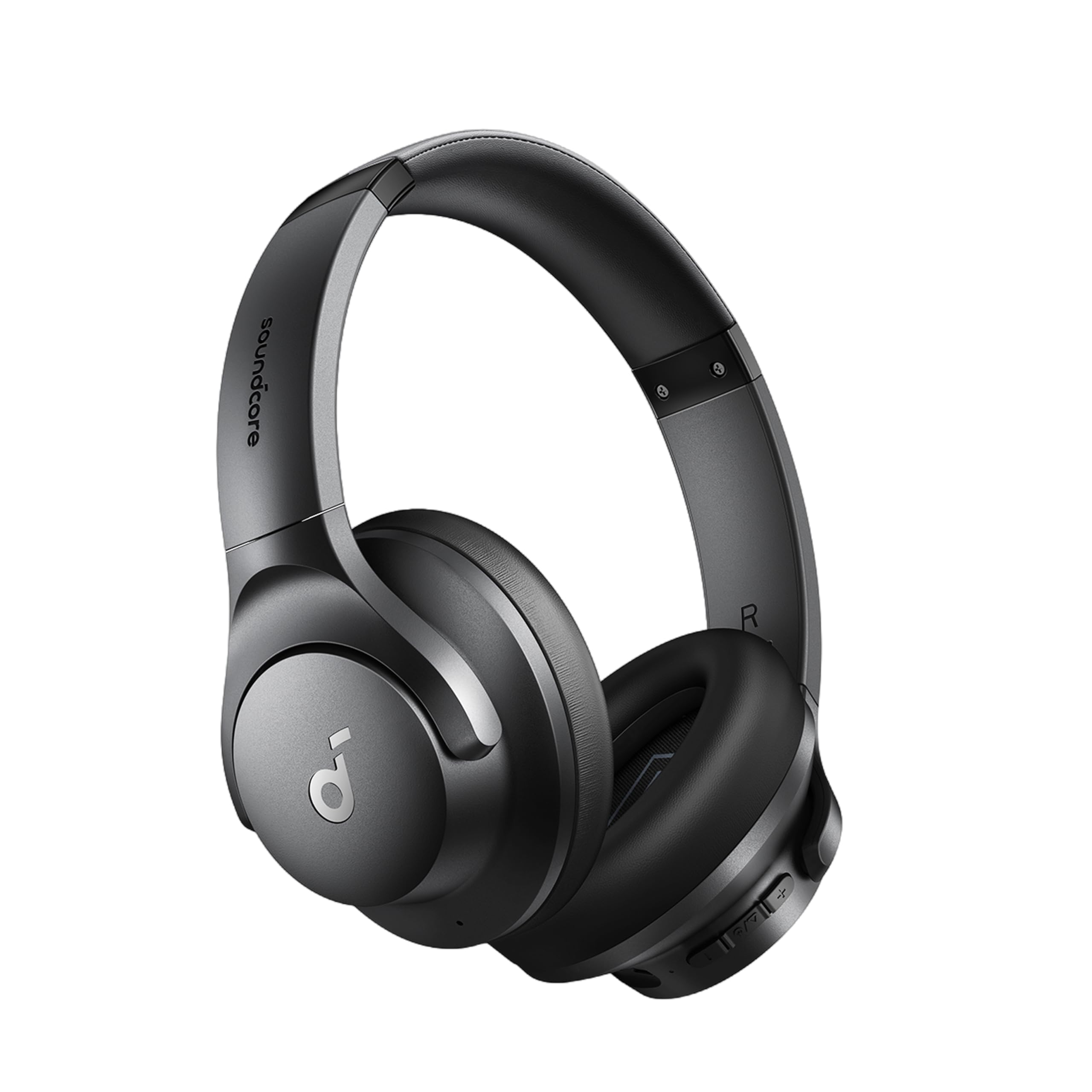
2. soundcore by Anker Q20i Headphones
Forty hours of quiet, and a cable that keeps working when the battery finally gives up.
Four microphones sit inside the Q20i — two facing your ear, two facing the world — and together they cut outside noise by up to 90%, per the maker. That hybrid setup is the reason an air compressor can go near-silent beside you, and it is why this pair earns the noise-cancelling badge here. The 40 mm dynamic drivers run with BassUp processing, and over the AUX cable the headphones accept Hi-Res certified audio, so a wired session gives you more detail than the Bluetooth one does.
Battery is the headline: 40 hours with ANC on, 60 hours in normal mode, and a 5-minute top-up buys 4 more hours. A full recharge from empty takes about 2 hours. Bluetooth 5.0 reaches roughly 10 meters and holds two devices at once, so a laptop call can cut into a phone playlist without you touching a menu.
One trade-off is worth knowing before you buy. Plug in the 3.5mm cable and you lose the app’s EQ and the noise cancelling with it — the wired mode is plain listening, not a processor-assisted one. The ear cups are also on the narrow side, which large-eared listeners may feel. As owners put it, the fit is where opinions split, with some calling it pillow-soft and others finding it loose on the head.
The quiet that sells it: the noise cancelling is the thing buyers keep coming back to — it silences engines, air conditioning, and yard equipment, and it works even with nothing playing.
And what it costs you: that 40 hours only exists in wireless mode. Use the cable and you are on a plain, unprocessed signal with no EQ shaping available at all.
Reach for this if: you split your day between commuting and desk work and want one pair that runs cable-free for most of it.
Think twice if: the whole point for you is a wired, zero-latency connection with active processing — the cable strips that away.
3. JBL Quantum 100M2 Gaming Headset

One plug, every console, and a mic you can pull off the moment you go solo.
One 3.5mm jack (the standard round headphone plug) is why the Quantum 100M2 earns its spot: it plugs into PC, PlayStation, Xbox, Nintendo Switch, mobile, Mac, and VR, so a console player never has to ask whether it fits what they own. The drivers are 40 mm dynamic units (the speaker parts that move air to make sound) carrying the JBL QuantumSound signature. That tuning is designed to place footsteps and explosions around you rather than flat in front of you, so you can hear where a sound comes from in a game. It is also fully compatible with Windows Sonic spatial sound (a surround-sound mode) on Windows 10 PCs and Xbox One.
The mic is the piece that separates this from a plain pair of headphones. It is a voice-focus directional boom that detaches completely when you are playing alone, and it carries its own mute option. The ear cushions are breathable fabric over memory foam with an oval ear shape, and a windshield foam for the mic sits in the box alongside the detachable boom itself.
The honest limit sits in the low end. Bass is light by default and needs EQ work before it satisfies, and on a desktop PC with separate mic and headphone jacks you will need your own 3.5mm splitter to get the boom working. The cable itself is short, so a tower under the desk is a stretch. A few units develop a poor connection at the angled plug, so handle the joint with care.
Built for multiplayer: the voice-focus boom with adjustable sensitivity is the part that earns its place — it keeps your voice clear and trims background noise so your squad hears the call, not the room.
The low-end caveat: from the start, the bass is thin. If you want punch without touching settings, this is not that headset.
Good match for: a console player or a gift-buyer who wants a mic that comes off and a jack that fits everything.
Worth a pass if: your desktop rig has split audio ports and you dislike buying extra adapters.
4. HyperX Cloud Alpha Gaming Headset

The one you forget you are wearing — until an eight-hour session proves it is still on.
HyperX builds the Cloud Alpha around two chambers in each ear cup, one for the bass and one for everything above it. Splitting the job means the low end does not smear into the mids, so dialogue and footsteps stay readable under an explosion. Frequency response runs 15Hz to 25,000Hz, and the aluminum frame with expanded headband keeps the weight off your crown. It works on PC, PS4, PS5, Xbox One and Series X|S, Nintendo Switch, mobile, and VR over 3.5mm.
Long sessions are where this headset earns its reputation. Comfort draws 712 comments, the second-most discussed trait on its review pages, trailing only build quality in the positive column. The mic is a detachable noise-cancelling boom, and the braided cable comes off too, with an in-line control for volume. A cloth carrying case ships in the box, so it travels without the cups getting scuffed.
Two honest notes. Sound quality is genuinely mixed in the feedback — it is rich and clear for some, muddy for others, and an echo can creep in when the mic picks up loud output from the cups themselves. Durability has complaints too, ranging from a mic that arrived dead to a left side that lost audio after months. Most owners never hit either, but they are the recurring themes.
Comfort is the whole pitch: the plush ear pads and aluminum frame are what make multi-hour sessions easy, and comfort ranks as the second-biggest positive theme in the feedback. Customers note that comfort edge over the JBL’s thinner fabric cushions, which matters if you wear a headset for a full evening of play.
What you should keep an eye on: treat the volume wheel and cable joint gently. The inline control sits in a spot that is easy to bump and a known failure point on a small share of units.
Pick it up if: you game for hours at a time and value the ear isolation and frame quality over a perfect flat response.
Keep looking if: you already own an earlier Cloud and want a clear step up — the sound character is a sideways move, not a leap.
5. Poly Blackwire 5220 Wired Headset

Built for the person who lives on calls all day and cannot afford a dropped connection.
It is the only pick here certified for Microsoft Teams and Zoom, so your call software recognises it as a supported device. It backs that with three ways to connect: a USB-C cord, a tethered USB-A adapter (the older rectangular USB plug) for older ports, and a 3.5mm jack for phones and tablets. A flexible noise-cancelling boom mic carries your voice, so callers hear you rather than the room. Dynamic EQ (automatic sound shaping) reshapes the output depending on whether you are on a call or playing media. The cable retracts, which keeps the whole thing tidy in a bag.
What separates it from the gaming headsets above is the priority order. Every reviewer point about sound quality is positive, and comfort is the second-biggest positive theme in the feedback. The conforming ear cushions and the flex strap under the headband are the reason it stays put through long meetings without pressing hard. Reviewers point out the mic’s noise rejection is real, not marketing — the zoom-call side is crisp, and one buyer’s loudly barking dog never reached the coworker on the other end.
The catch is the price of admission on that noise rejection. The earpiece audio is flat and light on bass, which is ideal for speech and unexciting for music. A smaller set of buyers find the ear pads too tight, with some reporting headaches and sore ears on very long call days. Durability also draws complaints: one long-term owner had the cord twist and short after a few years. Most of the loudest gripes come from a handful of returns, not the pattern.
Why it wins the desk: the boom mic and passive isolation do the real work — you get a clear voice to the other end and none of the battery worry that comes with a wireless headset.
Where it disappoints: the flat tuning is a work tool, not a listening one. If you want music to sound lively between calls, this is not the pair for you.
Best fit for: remote workers and phone-heavy roles that need Teams or Zoom certified hardware over one reliable cable.
Think twice if: your call days run past six hours and the snug ear cushions already sound like a problem for your head size.
6. Logitech G PRO X SE Wired Gaming Headset – Black

The biggest drivers here, plus a detachable mic that leans on software to clean your voice.
At 50 mm, the PRO-G drivers in this headset are the largest on the list, so they move more air than the 40 mm units in the Quantum 100M2. Logitech pairs them with 7.1 and object-based surround sound (audio that places a sound by distance and direction, not just left or right), so you can tell where a shot came from. The frame is an aluminum fork with a steel headband, and the ear pads are memory foam wrapped in leatherette. The detachable mic is a 6 mm boom running Blue Voice processing — noise reducer, compressor, and more — for cleaner voice comms.
The connection story is the technical bit worth knowing. You can plug in through the 3.5mm jack, or run the included USB external sound card, which holds onboard EQ memory so your tuned profile travels with the headset between machines. A 2-meter PC cable with in-line volume and mute is included, along with a Y splitter for separate mic and headphone jacks. The SE version trims some accessories from the standard model, which is why the value comments split.
Here is where it needs care. Sound quality divides opinion sharply: it is bass and low-mid heavy, and for a slice of buyers that means high-frequency cues get lost. The mic is sensitive enough that in a quiet room it sounds clean, but in a shared space it also picks up keyboard clatter and room noise. There are durability reports of the plastic size-adjustment clips breaking after around a year, and at least one unit arrived dead. Set your EQ in G Hub first, then expect a strong, bass-forward sound rather than a neutral one.
The Case For The Upgrade
- 50 mm PRO-G drivers, the largest here, for deeper bass and clearer imaging
- 7.1 surround with object-based positioning, so footsteps have direction as well as distance
- USB sound card stores your EQ on board, so settings survive a machine swap
- Steel headband and aluminum fork give it a denser feel than the fabric-and-plastic picks
What To Expect Going In
- The tuning is bass-heavy; some buyers find higher in-game cues get buried
- The Blue Voice mic picks up keyboard and room noise in shared spaces
- Plastic size-adjustment clips are a known weak spot over time
- Reliability and value both split across the feedback
Locked in for: PC players who want surround positioning and a pro-tuned mic, and who are willing to set EQ once and save it.
Not the easy pick if: you want a neutral, flat response from the start — this one leans into bass by design.
Know the Specs
Driver Size in Millimeters
The driver is the speaker cone inside each cup, measured across. A 40 mm driver is the common size for over-ear headsets, and 50 mm units like the ones in the Logitech G PRO X SE can push more air for a fuller low end. Bigger is not automatically better; a well-tuned 40 mm driver will beat a sloppy 50 mm one for clarity.
Clamping Force and Ear Cushion Material
Clamping force is how hard the headband squeezes your head. More squeeze means better isolation from office noise and the bus, but it also means pressure at the temples. Memory foam and fabric cushions are the softer choice for long wear; leatherette seals better but warms up more.
Boom Mic vs Inline Mic
A boom mic is the arm that reaches toward your mouth. Because it sits close, it picks up more of you and less of the room, which is why work headsets like the Poly Blackwire 5220 rely on one. An inline mic sits in the cable and generally sounds thinner and farther away.
3.5mm, USB-A and USB-C Connections
The 3.5mm jack fits controllers, laptops, and phones almost anywhere. USB-C and USB-A skip the analog port entirely, and are the more reliable route on a work laptop or a desktop with split audio ports. If you are on a desktop with separate pink and green jacks, budget for a Y splitter.
Common Questions
Will a wired over-ear headset work with a desktop PC that has separate mic and headphone jacks?
What is the difference between a detachable boom mic and a built-in mic?
Do I need a splitter to use a gaming headset mic on a PC?
How long will a wired over-ear headset last?
Can I use a wired headset with a phone or a tablet?
Is active noise cancelling available on a wired headset?
Will a gaming headset work for work calls on Microsoft Teams or Zoom?
Why does my headset hurt my head after half an hour?
Do I need an amplifier to run a 40mm wired headset?
The Bottom Line
For most people, the wired over-ear headphones with mic question depends on one split: talk or listen. If you are editing, monitoring, or just want flat reference sound and no charging routine, the Audio-Technica ATH-M20x is the crowd favourite — 4.5+ stars across 27,000+ owners — and its 40 mm drivers do the work without a mic on board. If the mic is the point, the Poly Blackwire 5220 is the one to reach for, because it ships certified for Teams and Zoom and plugs in three different ways. And if you want the biggest drivers and surround positioning for gaming, the Logitech G PRO X SE pairs 50 mm PRO-G drivers with a detachable Blue Voice mic and an EQ that saves to its own USB sound card.
How we choose
We do not accept paid placement. Every pick is matched to a real buyer and a real use-case; we do not hands-on test units.
Sources
Specifications: manufacturer listings and product documentation. Review insights: verified customer reviews, as of October 2026. Pricing: not shown on this page (it changes often); check the current price via the retailer link.
As an Amazon Associate, Aappliancez earns from qualifying purchases. This does not affect which products we feature.