Disclosure: Some links in this post are affiliate links. As an Amazon Associate I earn from qualifying purchases, at no extra cost to you. Learn more
Specs are compiled from manufacturer listings and verified buyer reviews and can change over time — please confirm the key details on the product page before buying.
You want a camera that keeps recording when your Wi-Fi drops and never charges a monthly fee to open up your own footage. That is exactly what a wired outdoor camera without a subscription gives you: power and data run down one cable, and the video lands on a drive or memory card you already own. This guide sorts the real contenders by how they store footage, how wide they see, and what they actually cost you over time.
This guide is built by comparing the manufacturers’ published specifications and the patterns across verified customer reviews, so you get each pick’s real strengths and trade-offs instead of marketing spin.
You want a camera that keeps recording when the internet drops and never sends a monthly bill. The crowd favorite here runs 4.5+ stars across thousands of owners, and it earns that spot by recording 24/7 to a local drive with no cloud plan. wired outdoor security camera without subscription. Below are the picks that hold up to weather, night, and daily use — plus the honest catch on each one.
Top Picks

How To Choose The Best Wired Outdoor Security Camera Without Subscription
The first question is not which camera looks sharpest — it is where your footage lives. A camera that records to its own drive or card keeps every clip yours, with no plan to renew and no cloud account to log into. Start there, then match the lens and the cable run to your yard.
Power over Ethernet versus a plain power cable
A PoE camera (Power over Ethernet — one network cable carries both electricity and the video signal) means you run a single wire to the camera instead of a power lead plus a data lead. That saves a lot of drilling and keeps the install tidy. The trade-off is that you need a PoE injector, a PoE switch, or an NVR with PoE ports to feed it — an Amcrest bullet and a Reolink dome both need that box in the chain.
Where the recording actually goes
Three storage paths dominate. An NVR (network video recorder) is a box with a hard drive inside that records every camera continuously — the Reolink 8-channel kit ships with a 2TB drive for exactly this. A microSD card inside the camera is the simplest no-fee option and lets a single camera run on its own. FTP or NAS storage pushes clips to a server you already own. Any of the three keeps you subscription-free; pick the one you will actually check.
Field of view and night range
A wider lens covers more of a driveway or side yard with fewer cameras, so a 129° angle on the Amcrest does more work than a narrow 80° dome. Night vision is the other half: look for the stated color night-vision distance and whether the camera uses infrared or white LEDs. Color night footage is easier to identify a face or a plate in than grainy black-and-white.
Side-by-Side Comparison
| Model | Best For | Resolution | Storage | Wiring | Amazon |
|---|---|---|---|---|---|
| ieGeek 4K PoE 8CH System★ Best Overall | Whole-property coverage with a recorder included | 8MP 4K | 2TB HDD (NVR) | PoE Ethernet | Amazon |
| Lorex 2K Add-On CameraSmart Add-On | Adding a camera to an existing Lorex setup | 2K | 32GB built-in | AC power, Wi-Fi | Amazon |
| aosu 2K Battery 2-Cam Kit | No-wire install with local hub storage | 2K | 32GB hub memory | Battery, wireless | Amazon |
| Amcrest UltraHD 4K PoE Bullet | Wide single-camera coverage, open-platform software | 8MP 4K @15fps | microSD up to 256GB, NAS, FTP | PoE Ethernet | Amazon |
| aosu Wired Floodlight 3K | Lighting up a dark entryway while recording | 3K | microSD up to 128GB | Hardwired | Amazon |
| REOLINK RLC-520A 2-Pack | Two-camera PoE starter on a budget | 5MP 2560×1920 | microSD up to 512GB, NVR, FTP | PoE Ethernet | Amazon |
| REOLINK 8CH 4K RLK8-800B6 | A full six-camera 4K system with a drive | 8MP 4K | 2TB HDD (expandable) | PoE Ethernet | Amazon |
Detailed Reviews
1. ieGeek 4K PoE Security Camera System
Our pick — 4.5+★ from 3,500+ verified ratings; the strongest balance of quality and price.
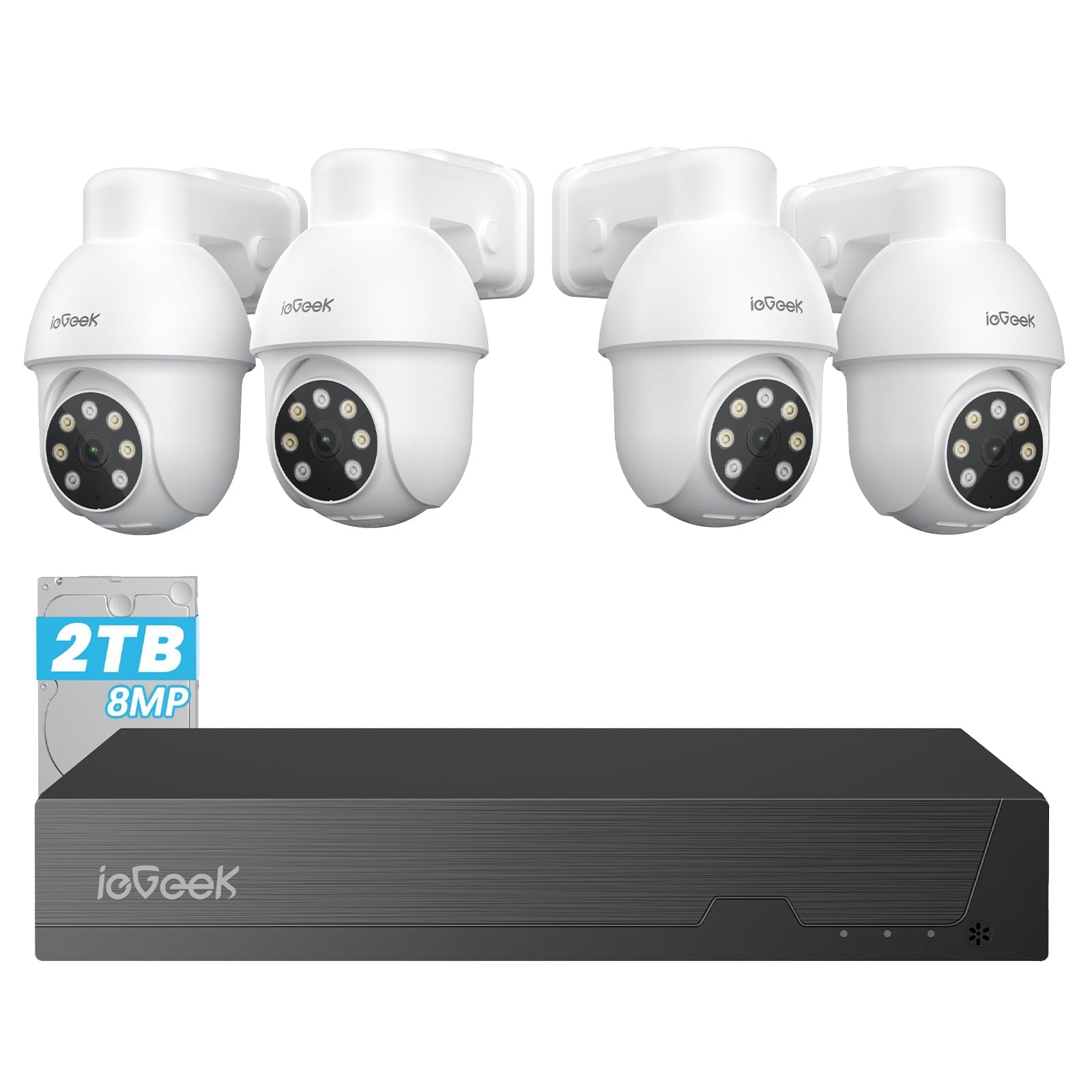
Four cameras, one recorder, and a 2TB drive — the whole no-fee setup in one box.
You get a whole working system in one box instead of buying pieces one at a time. This kit includes four PoE (Power over Ethernet) cameras, an 8-channel NVR (the network video recorder that stores every feed), and a 2TB hard drive already installed. The drive records continuous footage from four cameras for roughly one month before it overwrites, so you can scroll back weeks when something happens. Each camera runs on a single Ethernet cable, so it gets both power and video from the recorder. Owner reviews describe the wiring as genuinely straightforward.
The camera itself pans 355° horizontally and tilts 90° vertically, so one unit sweeps most of a yard instead of covering a fixed slice. Its 8MP 4K sensor (8 megapixels — a very high-detail image) keeps faces and packages legible, and the app-based 4x digital zoom lets you push in when you want a closer look. Know what digital zoom means: it crops and enlarges the picture rather than moving an optical lens, so past a certain point the image softens. The AI detection flags people, vehicles, packages, and pets, and can trigger a siren and spotlight on its own — a deterrent that runs without any cloud plan.
You are buying a system, not a plug-in gadget, and the honest catch is reliability on the electronics rather than the cameras. The recurring story in the reviews is a camera or recorder that misbehaves after a few weeks, followed by support that responds quickly and ships a replacement. The hard-wiring itself is the other cost: the box includes 18.3m network cables, so you need to get cable from that recorder to each mount point. Owners who wire it in and leave it alone report smooth, clear, stable footage with no signal dropouts — the very thing wireless cameras struggle with.
What the kit does for you
- 2TB drive and continuous 24/7 recording come bundled — no cloud plan, no monthly bill
- 355° pan and 90° tilt from a single camera covers a wide arc of the yard
- 8MP 4K resolution keeps fine detail readable on faces and packages
- Single-cable PoE install means one wire per camera, indoors or out
What you sign up for
- You need to route long network cables from the recorder to each camera location
- Some units have arrived with a failed camera or recorder and needed a replacement
- Digital zoom softens the image the further you push in
Built for: the homeowner who wants a complete four-camera 4K system that records locally with zero subscription and never loses a signal.
Plan for: a weekend of cable running, and keep your proof of purchase handy in case a unit needs swapping.
2. Lorex 2K Wireless Security Camera
The add-on that slots into a Lorex system — or stands alone on its own.
You get sharp detail and on-camera storage without a drive box. This is a 2K camera (twice the resolution of plain 1080p, per Lorex) with a 114° field of view and 32GB of built-in memory for local storage. That width covers a driveway or a side path comfortably. The 32GB flash memory means it can record straight into the camera with no drive box and no subscription. The recording can stay on the camera, sit on a Lorex NVR, or do both — so if your network drops, the card in the camera keeps the clip.
For a dark corner, the color night vision kicks in when there is ambient light, and a long-range infrared mode takes over when it is black. The build is an aluminum alloy housing rated IP65 (a weatherproofing scale where IP65 means dust-tight and protected from water jets), and Lorex rates it to work from -40°F to 131°F. An LED light and a remotely triggered siren act as active deterrence. It also ties into Amazon Alexa and Google Assistant, so you can pull the live feed up on a Firestick or Chromecast on a big screen.
Here is the practical tension: this camera needs an AC power run to each unit — the wireless part only describes the Wi-Fi video link, not the power. The setup voice prompts are loud, which makes pairing quick but also means the whole street hears it. The mount base is on the light side and has no lock, so an angle reset on a windy day is possible. For anyone already inside the Lorex app, adding this camera is the path of least resistance, and the picture wins people over once it is live.
Where it shines: people who want a no-fee camera that records into its own memory and slots into a Lorex system they already run.
The condition to note: each camera needs an AC power line, so if you were picturing a battery-free, wire-free install, the power run is still your job.
Reach for this if: you already run Lorex and want a local-recording camera that keeps filming through a network blip.
Look elsewhere if: you have no AC power within reach of the mount point you had in mind.
3. aosu 2K QHD Battery Security Cameras 2-Cam-Kit

Two battery cameras that store footage on a hub you own — no plan, no cloud account.
The reason this kit keeps showing up in no-subscription conversations is its storage model. Both cameras send their clips to a small aosuBase hub with 32GB of built-in memory, which aosu says holds 240 to 360 days of recording. All of it is encrypted and sits locally, so you can delete unwanted clips and save any you want to your phone. The 2K picture is a big step over 1080p, and the 166° lens is deliberately wide — aosu uses seven lens elements and corrects the fish-eye distortion so the edges stay straight.
Battery is where the honest math sits. aosu quotes 240 days per charge from lab data taken at 40 events a day with 10-second clips, so expect less in a busy spot. Plenty of owners get long stretches, while heavier detection and frequent live viewing drain it faster — the recurring note is a month or two between charges when the camera sits somewhere busy. Mounting height matters too: if the camera is out of arm’s reach you need to bring it down or run power up for the recharge. There is a solar panel accessory if you want to skip the ladder entirely.
What the two-camera tracking does is link events from both cameras in the same window, so you can follow a person from the driveway past the back gate. Person alerts, a scheduling alarm, a motion light, and two-way talk with a voice changer all run without a subscription. A hub limit of 4 cameras caps how far you can grow this kit before adding another base.
Why the storage wins
- 32GB hub memory holds hundreds of days of clips with no recurring fee
- 166° ultrawide field of view covers a lot of yard per camera
- Two-camera track and sync stitches the same event across both views
The real-world bill to expect
- Battery life falls well short of the quoted 240 days when detection is frequent
- The hub tops out at 4 cameras, capping how big the system can get
- Frequent two-way talk and live viewing pull the charge down fast
Best fit: a renter or a homeowner who cannot run cable and wants two cameras with local storage and no plan.
Weigh first: the recharge cadence — if you want a camera to disappear for a year, plan on the solar panel add-on.
4. Amcrest UltraHD 4K (8MP) IP PoE AI Camera, 129° FOV

One 129° bullet that out-grabs a narrow dome without needing a recorder.
Field of view is where this camera separates itself. At 129° it takes in noticeably more of a yard than a standard dome, and it pushes the picture at 8MP 4K (3840-line detail) at 15fps. That frame rate is the honest trade-off versus faster cameras, but for a still, watchful bullet monitoring a driveway it is plenty. Color night vision reaches up to 49.2 feet thanks to the dual white-LED and IR setup, and a built-in microphone adds audio.
You can record everything without paying a monthly fee. The camera records to a microSD card up to 256GB (the card slot is under a screwed panel, so it is not something you fiddle with daily), to an Amcrest NVR, to a NAS, or to an FTP server. You buy one camera, add one card, and you have a self-contained recorder with no monthly fee and no cloud account. For anyone already running Blue Iris or a Synology box, this integrates cleanly. The AI can be set to only record on human or vehicle events, which keeps the card from filling with leaves.
Plan for one extra purchase: this is a PoE camera, and it does not come with the injector or switch that feeds it power over the Ethernet cable — that box is an extra you supply. The AI detection and the tripwire/intrusion lines take some tuning to place without false triggers. The upside is a metal IP67 housing that shrugs off rain and a documented web interface that advanced users can settle in with. It is among the most DIY-friendly cameras here for the technically comfortable, and the picture holds up to close scrutiny.
Why the wide lens matters: a 129° view means fewer cameras to cover the same ground, and 4K detail picks out faces and plates at distance.
Setup reality check: budget for a PoE injector or switch and a half hour of tuning the AI zones before it runs quiet.
For the tinkerer: a single wide-angle 4K camera that records to a card or NAS with no plan, and plays nice with Blue Iris and Synology.
Skip if: you want plug-and-play with the power box in the box — this one expects you to bring the PoE source.
5. aosu Wired Floodlight Camera 3K 2600-Lumen 24/7 Recording

A hardwired floodlight that lights the porch and records around the clock.
Most cameras only wake when they sense motion. This one is hardwired and records 24/7, so nothing depends on the trigger firing. The 3K UHD sensor (a step above 2K, below 4K) with 6x digital zoom brings distant detail closer, and the white floodlight pours full-color light on the scene at night. Three PIR sensors (passive infrared — sensors that catch body heat) cover a 270° detection arc, so a person approaching from the side still registers and the lens swings to follow.
The 2600-lumen floodlight throws light across that same 270° span and reaches up to 33 feet, so the far edge of a driveway stays visible. It can trigger on motion at night or switch on a dusk-to-dawn schedule. A microSD card up to 128GB records the 24/7 stream with no subscription — buyers report a 128GB card in a high-traffic spot lasts over a year before it needs formatting.. This is the camera to pick when dark corners are the problem, not just a view you want to watch.
The honest limits show up in weather and motion. Mounted out in the open, a few users have found water getting into a floodlight unit after 15 months; tucked under an eave, it holds up far better. Heavy rain and snow can trip the motion alerts, so the practical move is to trim notification sensitivity rather than pull the camera. The 360° pan and 90° tilt make coverage broad, and the app plus two-way speaker are easy to live with. This model records to a card, not to a cloud plan, which fits the brief.
Where it earns its keep
- 2,600-lumen floodlight and 270° PIR detection light and cover a whole entryway
- 24/7 recording to a 128GB microSD card runs with no monthly fee
- 3K resolution with 6x zoom and full-color night imaging
What to plan around
- A fully exposed mount is the weak spot — mounting under cover improves its weather life
- Rain and snow can set off false motion alerts until sensitivity is trimmed
- The floodlight adjusts up and down only, not side to side
Right pick for: a dark porch or driveway where you want light plus nonstop recording, no cloud needed.
Watch the mount: keep it under an eave if you can — that is where these units live longest.
6. REOLINK RLC-520A Pack of 2

Two 5MP domes that feed off one cable each and record to a card you add.
The value here is in the pair. Each RLC-520A pulls 5MP super HD at 2560×1920 and 25fps, with a built-in mic for ambient sound, and each records to a microSD card up to 512GB, a Reolink NVR, or an FTP server. You supply the card, the recording is yours, and there is no subscription layer over any of it. Install is a single Ethernet cable per camera via a PoE switch, injector, or the Reolink NVR — a big reason wired PoE outshines wireless in heat, wind, and rain, where the signal survives where Wi-Fi fades.
The smart detection sorts people, vehicles, and animals so the alerts land on real events, and a time-lapse mode turns a long day into a short clip. The aluminum dome housing is the durable kind you want outdoors. What it will not do is look wide: this is a dome with about an 80° horizontal view, so it is suited to a door or a focused path rather than an open yard. For open ground you want the wider 129° Amcrest above instead. Its night vision and detection tuning are also things to dial in before they feel settled.
Know one setup step before you buy: older Reolink NVRs may not see the 5MP camera until you run a firmware update. The camera is added to the app first via a QR scan before the recorder picks it up. Get past that and two cameras give you a genuinely no-fee, self-hosted setup that plays with Blue Iris or Shinobi for anyone who wants a home server instead of a cloud.
Why the pair works: two cameras, one card each, one cable each — a complete local-recording pair with nothing to subscribe to.
Where to aim it: a door, gate, or path, because the 80° view wants a purpose-built angle rather than open acreage.
Go this way if: you want the cheapest path to two wired PoE cameras that store locally on cards you buy.
Look wider if: your coverage area is open — this dome is best pointed at a specific spot.
7. REOLINK RLK8-800B6 Security Camera System
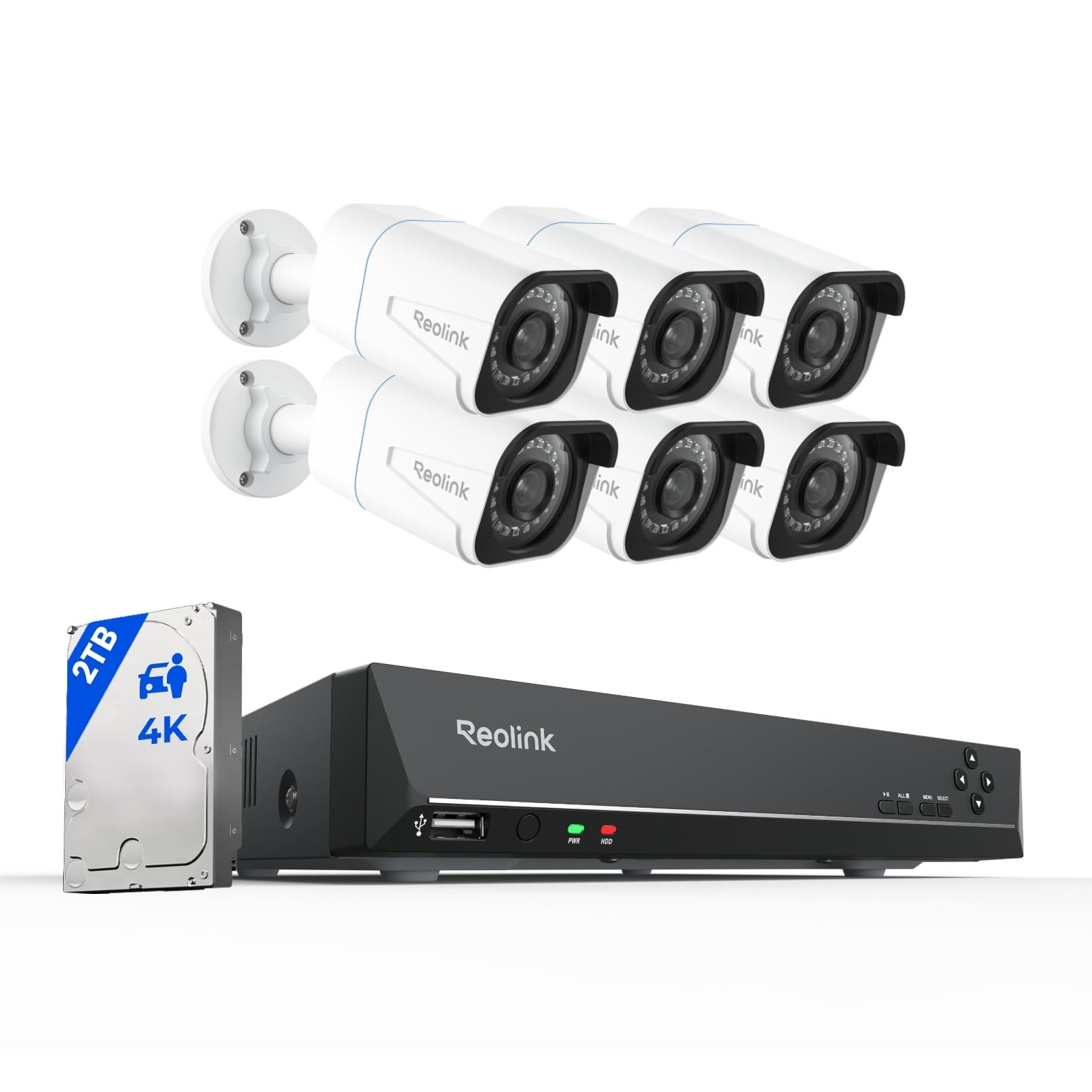
Six 4K cameras and a recorder with a drive — the full perimeter, one purchase.
This is the top-tier of the group: six 4K (8MP, 3840×2160) PoE bullet cameras, an 8-channel NVR, and a pre-installed 2TB hard drive that records continuously. Each camera runs on Ethernet up to 300 feet from the recorder, so the cameras carry no battery and no Wi-Fi drop risk. For a big property, that is the difference between footage you can count on and footage that gaps.
The 18 infrared LEDs push night vision up to 100 feet, and the person/vehicle/animal detection lets you filter out the cat so alerts land on real events. The plug-and-play promise is real once the cables are in: connect the cameras, add the device in the Reolink app, and you are live on a monitor or your phone. In practice, expect the labor of running cable through an attic or soffit — that is the honest work this system demands, and the owners who put it in describe the clarity as a leap over Wi-Fi setups.
The recurring gripe is not the picture but the safety net around it. Pixel-based motion detection trips on shadows, branches, and spiderwebs, so night vision can be noisy on the edges of the frame. Some units have arrived with a dead recorder, and support lives on email and forums. Set expectations accordingly: this is a system that rewards a tinkerer who wires it properly and dials in the detection zones, and frustrates a buyer who expects a box that installs itself. When it is set up and running, the 4K detail and 24/7 drive are the payoff.
The system’s strengths
- Six 4K PoE cameras plus a 2TB drive give a full perimeter with 24/7 local recording
- Night vision reaches 100 feet via 18 infrared LEDs
- Person and vehicle detection filters out most false alerts
What it demands of you
- Cable runs to six cameras is a hands-on job, not a drop-in install
- Motion detection can trip on shadows and branches until zones are tuned
- Support is primarily email-based, so slow problems are slow to resolve
Choose this if: you want a full six-camera 4K perimeter recorded to a drive you own, with the wiring work done once.
Weigh first: the install labor and a home that has somewhere sensible to run the cables.
Know the Specs
PoE (Power over Ethernet)
One cable does two jobs: PoE means one network cable carries both data and electricity to the camera, so you do not run a separate power line. That simplifies install and keeps the camera from depending on a wall outlet near the mount. The catch is you still need a PoE source — an injector, a switch, or an NVR with PoE ports — which usually comes as an extra on a single bullet camera and is built into a full kit. When you see a wired camera that needs it, plan that box into the setup before you buy.
Resolution and field of view
Resolution is the amount of picture detail, quoted in megapixels or as a pixel count. More resolution lets you zoom in on a far face or a plate and still read it. Field of view is how wide the lens sees — a 129° lens takes in more than an 80° dome, so it covers more ground per camera. The two trade off against each other: a very wide lens spreads the same pixels over more area, so a narrower lens on a specific door can look sharper than a wide lens pointed at a whole yard.
Local storage versus a subscription
You avoid fees by owning the storage: an NVR hard drive, a microSD card inside the camera, or an FTP or NAS server. An NVR records multiple cameras continuously to one drive. A microSD card keeps a single camera self-contained. FTP and NAS push clips to a box you already run. Each means no recurring bill and no cloud account, and each has a capacity limit — a 2TB drive or a 128GB card holds a set number of days before it overwrites, so match the storage to how far back you want to check.
Night vision and weatherproofing
Night vision comes in two flavors: infrared, which gives black-and-white footage in total darkness, and white-LED color night vision, which needs some ambient light but keeps color for easier identification. Look at the stated distance — a camera that sees 49 feet in color covers a driveway; one with less reach leaves the far edge dark. Weatherproofing uses an IP rating, where a higher second digit means more protection from water. A metal housing rated IP67 handles rain and dust better than a plastic one, so check the housing material alongside the number.
Common Questions
Do I need a subscription to keep watching my wired camera?
What is PoE and do I have to buy extra gear for it?
How long does a wired camera record before it overwrites?
Will a wired camera work if my Wi-Fi goes down?
Can I add a wired PoE camera to a system I already have?
Does 4K really matter over 2K or 5MP?
How do I keep a wired camera working in rain and cold?
Can I view a wired camera on my phone from anywhere?
Do these cameras need a monitor or can they run headless?
Is a battery camera really wired, or do I need an outlet?
The Bottom Line
The strongest all-rounder is the ieGeek 4K PoE System, because it bundles four 4K cameras, an 8-channel recorder, and a 2TB drive that records continuously with no subscription in sight. If you want the widest single lens, reach for the Amcrest UltraHD 4K with its 129° view and card-or-NAS storage. For a dark porch that needs light plus nonstop recording, the aosu Wired Floodlight is the one to grab. And if the cable run is the dealbreaker, the aosu 2-Cam-Kit keeps your footage on a hub you own without a wire in sight — the popular choice for anyone who refuses a monthly fee.
How we choose
We do not accept paid placement. Every pick is matched to a real buyer and a real use-case; we do not hands-on test units.
Sources
Specifications: manufacturer listings and product documentation. Review insights: verified customer reviews, as of October 2026. Pricing: not shown on this page (it changes often); check the current price via the retailer link.
As an Amazon Associate, Aappliancez earns from qualifying purchases. This does not affect which products we feature.