Disclosure: Some links in this post are affiliate links. As an Amazon Associate I earn from qualifying purchases, at no extra cost to you. Learn more
Specs are compiled from manufacturer listings and verified buyer reviews and can change over time — please confirm the key details on the product page before buying.
If you have a toddler who climbs, a window that slides open on its own, or a ground-floor slider you want to hold shut at night, a simple add-on lock fixes it for the cost of a takeaway coffee. The catch is that “window lock” covers at least four different jobs — restricting a casement so it opens only a few inches, wedging a double-hung sash, pinning a sliding patio door, and replacing a broken latch — and the wrong style simply will not bolt onto your frame. Here is what actually fits each job.
This guide is built by comparing the manufacturers’ published specifications and the patterns across verified customer reviews, so you get each pick’s real strengths and trade-offs instead of marketing spin.
Every pick below was chosen because its mounting style matches a real frame type rather than a marketing photo, and because buyers report it holding up over months of daily use — exactly what you want from a reliable set of window locks.
Top Picks

How To Choose The Best Window Locks
Before brand or finish, decide which part of the window moves. A casement window swings on a crank, a double-hung sash slides up and down, and a patio door glides sideways. Each one needs a physically different lock, so measure your frame and watch how it opens before you buy anything.
Match the lock to the frame, not the photograph
A cable restrictor, like the OMOTOOL set, anchors one end to the frame and one to the moving sash, letting the window travel only as far as the cable allows. A wedge block, like the Window Widget, sits in the opening track and physically stops the sash from sliding past it. A sliding door lock, like the eSynic or the Prime-Line U 9862, bolts to the door edge or frame and pins the panel shut with a keyed or push-button bolt. A lock that does not match your frame type is the one that ends up back in the box.
Decide how much air you still want
Total lockdown and ventilation pull in opposite directions, so pick which one you need. A cable or wedge that allows a small opening keeps a room from going stale while still blocking a child from squeezing through — the OMOTOOL cable lets the window travel 4-5.9 inches, which is enough airflow to matter and too narrow for a small body. If you want the window to close completely and lock, you need a bolt-style lock instead.
Think about the emergency exit before you commit
A window locked against a child is also one an adult may need to open fast in a fire. Look for a lock you can defeat quickly — a key kept within reach, or a wedge that pulls straight off its hook-and-loop fastener. Anything screwed permanently and keyed with no spare within arm’s reach deserves a second thought, especially in a bedroom.
Side-by-Side Comparison
| Model | Best For | Lock Style | Main Material | Mounting | Amazon |
|---|---|---|---|---|---|
| OMOTOOL Child Window Restrictor (2 Pack)★ Best Overall | Casement and vinyl windows with young kids | Keyed cable restrictor | Aluminum alloy, 304 stainless cable | Screw-mounted, reversible head | Amazon |
| Safety Innovations Window Widget (4-Pack) | Renters who cannot drill | Wedge block | ABS plastic, hook-and-loop | Adhesive, no tools | Amazon |
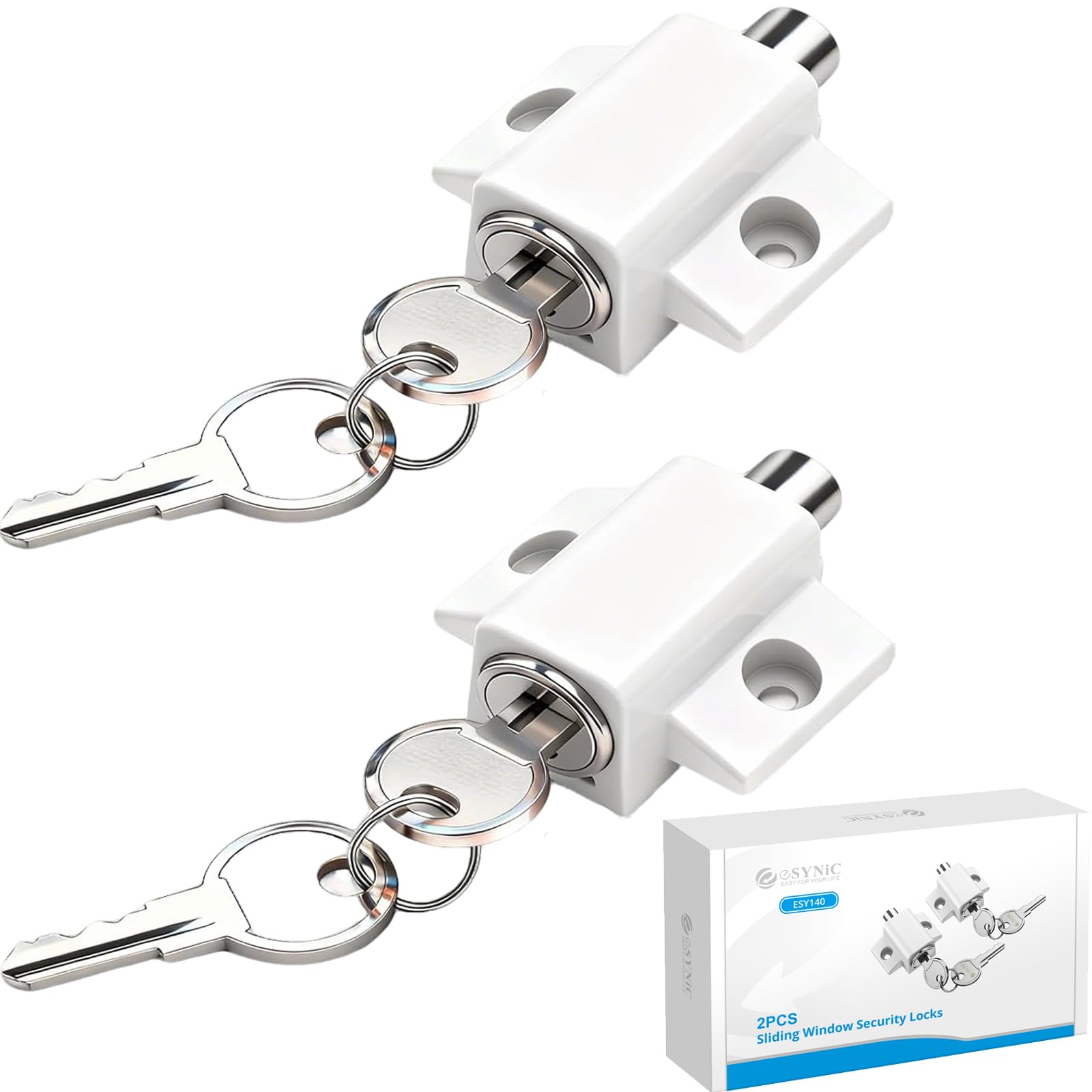
| eSynic 2-Pack Sliding Door & Window Locks | Patio and French doors, dual pane | Keyed bolt | Zinc alloy, iron, copper | Punch or non-punch option | Amazon |
| Prime-Line U 9862 Sliding Door Keyed Lock | Replacing a broken sliding door latch | Push-button keyed bolt | Painted diecast case, hardened steel bolt | Screw-mounted with two strikes | Amazon |
Detailed Reviews
1. OMOTOOL Child Window Restrictor
Our pick — 4.5+★ from 450+ verified ratings; the strongest balance of quality and price.
A 20cm tether that keeps a window open to the breeze but shut to a climbing toddler.
If your child has figured out the crank on a casement window, this is the pick to start with. The whole mechanism is a single cable: one end screws into the frame, the other into the moving sash, so the window can only travel as far as the cable lets it. That distance is fixed in the design — the 7.87 inch (20cm) cable lets the window open 4-5.9 inches (10-15cm), which is enough to pull fresh air into a stuffy room and nowhere near enough for a small body to pass through. The cable itself is 304 stainless steel (a rust-resistant grade) wrapped in smooth, clear PVC (a soft plastic coating that keeps the metal from scratching your frame or your hands), and the body is aluminum alloy that has been electrogalvanized — a plating process rather than a coat of paint, so there is nothing to chip off on a rainy window sill.
The two-way mechanism is the smart part for a family: the window locks by itself with no key, so it stays secure by default, but opening it requires the key. You get two locks, two keys, and eight installation screws in the box, and the locking end can be flipped so the key always points the same way on both windows. Owners consistently describe the install as a short job rather than a weekend project — as owners mention, you can “install 3 in 10-15 min; adjust placement to limit opening.” What wins people over most is simply that it works: functionality is the thing reviewers come back to praise, with quality a close second, and the same set going on double casement windows with a crank and on older vinyl double-hung frames. It is also the pick here for a set that stays consistent — since a second set is keyed to match the first, one key opens them all, which matters if you have more than one child’s room to secure.
The honest catch is screw quality and key matching between separate purchases. A few owners swap the included screws for sturdier ones, and if you buy kits at different times rather than the same batch, the keys may not be interchangeable. Treat the hardware as a starting point and confirm your order is a single set if one-key access matters to you.
Where it earns its keep
- Locks by itself without a key, so the window is never accidentally left openable
- 20cm (7.87 inch) cable holds the gap to 4-5.9 inches — air in, children out
- 304 stainless cable with PVC coating resists rust and frame scratches
- Reversible locking end keeps the key pointing the same way on both windows
What to plan around
- Included screws are on the soft side; some owners upgrade them
- Kits bought separately may not share the same key
- Adjustable only at install time, not day to day
Reach for this if: your windows are casement or vinyl and you want a keyed restrictor that stays locked by default.
Look elsewhere if: your frame is a glass-aluminum slider where a screw-in cable has nothing solid to bite into.
2. Safety Innovations Window Widget
A peel-and-stick wedge for anyone who cannot put a single hole in the frame.
Renters, this is your answer. The Window Widget is a small wedge-shaped block that presses onto a heavy-duty adhesive-backed hook-and-loop fastener, and the window sash simply slides up against it and stops. There is no drilling, no screws, and no tools at all — you peel the backing, press it onto the frame, and you are done. Four of them come in the pack, so you can protect a bedroom window and a bathroom window from the same box, and the 7 3/4 inch hook-and-loop strip is long enough that you can reposition the wedge to set exactly how far the window is allowed to open. Because the wedge pulls straight off the fastener, an adult can clear the window in a second during an emergency — a genuine advantage over anything keyed and screwed down.
The construction is ABS plastic (a hard, impact-resistant type used for lots of safety goods) paired with the adhesive fastener, and the whole unit weighs just 1.58 ounces, so there is no weight pulling on the adhesive over time. The trade-off is honest and worth stating plainly: an adhesive wedge is a barrier device, not a high-security lock. It stops a window from opening too wide and discourages a curious child, but it is not meant to defeat a determined intruder. If your priority is break-in resistance on a ground-floor slider, you want a keyed bolt lock instead.
Why parents keep it: instant, tool-free coverage across four windows with zero damage to the frame — the single best fit for rental homes.
The fair caveat: it blocks the opening rather than locking it, so treat it as child-safety rather than burglar-proofing.
Install-and-forget: ideal for apartment dwellers and anyone who wants child safety without touching a drill.
Not the one for: a window you want genuinely secured against entry, or a sash that needs a keyed latch.
3. eSynic Sliding Door & Window Locks
One box that adapts to a patio door or a window, and can be drilled or not.
The eSynic set solves the homeowner’s most annoying problem: not knowing exactly what your frame will accept until the lock is in your hand. You get two ways to mount it — a punch method using the supplied hole caps, or a non-punching approach with the fixed plates — so it works whether you are willing to drill or not. In the box you get two locks, twelve stainless steel screws, four fixed plates, four keys, four caps, and a packing box for storage. The body is zinc alloy with iron and copper components (zinc alloy being a dense, corrosion-tolerant metal blend), finished in white so it blends into the door edge rather than shouting at you.
It does a second job most locks cannot. Because it limits how far the door or window opens, you can crack it for ventilation and still have it pinned — and it can also lock completely as an anti-theft barrier. Owners describe it holding dual-opening and casement windows at both the top and bottom pane, and the non-punch route opens up doors you would never drill. The physical size is the thing to check: this is where the eSynic differs from the Prime-Line U 9862, which measures 1.5 x 3.81 x 5.44 inches against the eSynic’s 0.98 x 1.77 x 1.93 inches — a substantial size gap that favors the eSynic on tight frames and favors the Prime-Line where a chunky, coverage-heavy latch is preferred. Customers note a clean install: “It was easy to install with a 1/2 in drill and screwdriver.”
It is not a heavy latch for a high-crime slider, and a locksmith consulted by one household steered them elsewhere. On a hollow closet door the thin panel gives it less bite, though the supplied insert helps strengthen the connection. So if your priority is a bulky, hardened-steel bolt, look at the U 9862 above; if you want one flexible kit that covers several openings, this is the value buy.
The do-it-all kit: best for anyone with a mix of patio doors and windows who wants both drilling and non-drilling options in one purchase.
Skip this if: you need maximum bolt strength on a solid exterior sliding glass door.
4. Prime-Line U 9862 Sliding Door Keyed Lock, Push-In

The replacement latch for a sliding door whose original lock finally gave up.
When a sliding patio door’s built-in latch breaks, you cannot always find the exact original part anymore — and that is where this one shines. It is a push-in keyed lock with a hardened steel bolt (heat-treated for extra toughness) inside a painted diecast case, and it is designed to stop a door from being pried or lifted off its track. You get one lock with two strikes, two ferrules, two keys, and the mounting screws, and it uses the Yale Y-13 keyway (a standard key profile), so a locksmith can cut you spares without a fuss. Build quality is the standout: it is the number one thing owners talk about, with how well it functions running a very close second, and the mechanism is described as operating far more smoothly than the flimsier latches it replaces.
Adaptability is the other strong point — owners mount it on far more than patio doors. It has gone onto the inside frame of an outswinging industrial metal door with the bolt drilled into the metal, onto French casement windows, and onto bedroom sliding closet doors to secure valuables. Two mounting options are included for either a fully closed or a partially open window. Metal-door and heavy-frame installs are the ones it handles best; thin aluminum frames are trickier, which is the honest limitation worth knowing before you buy.
A caution for anyone new to this type of hardware: installation is physical work. It calls for drilling and, on wood, a chisel or carving knife to recess the metal plate — the manufacturer even warns to drill pilot holes to avoid cracking wood. Set aside a proper afternoon and it goes in cleanly.
Worth it for: the homeowner replacing a broken sliding-door latch who wants hardened, smoothly operating hardware with spare-key support.
Know before you buy: budget for real drilling and a chisel, and expect the trickiest fit on thin glass-aluminum frames.
Know the Specs
Opening gap and cable length
The number that matters most on a restrictor is how far it lets the window travel. The OMOTOOL cable runs 7.87 inches (20cm) and holds the opening to 4-5.9 inches (10-15cm) — that is the difference between a usable breeze and a gap wide enough to slip through. A wedge device works differently: instead of a fixed cable, its 7 3/4 inch hook-and-loop strip lets you set the stopping point yourself, so you can tailor the gap to your sash. Measure your gap before you buy, because a restrictor that opens too far defeats the purpose.
Material and weather resistance
Window hardware sits in rain and sun, so the metal decides how long it lasts. Look for a cable that is 304 stainless steel with a PVC coating, which keeps it from rusting and from scratching the frame. For bodies, aluminum alloy with an electrogalvanized finish resists chipping far better than paint, while zinc alloy mixed with iron and copper gives a denser, longer-wearing shell. A hardened steel bolt (heat-treated for toughness) is what makes a latch resist prying. Plastic bodies like ABS are perfectly fine for a wedge-style device that never has to carry a load. Match the material to the exposure — a bathroom window needs more rust resistance than a hallway window.
Common Questions
Will a cable restrictor fit my casement window?
How far will a window open with a restrictor installed?
Can I install these window locks without drilling?
What is the emergency release like on a child window lock?
Are the keys interchangeable between two sets of the same lock?
Which lock is best for a sliding patio door?
Do these locks work on an aluminium or vinyl frame?
How do I stop a window opening too wide for a child?
Will these locks damage my window or frame?
The Bottom Line
For most homes, the winning set of window locks is the OMOTOOL Child Window Restrictor, because it stays locked by default, needs no key to secure, and holds a window to a safe 4-5.9 inch gap while still letting air in — with two locks and two keys in the box. If you cannot put a hole in the frame, grab the Safety Innovations Window Widget for its tool-free adhesive mount, and its slim 1.58 ounce body keeps the adhesive under almost no load. And for a patio or sliding door you want genuinely pinned, the Prime-Line U 9862 brings a hardened steel bolt and a smooth, reliable mechanism worth reaching for.
How we choose
We do not accept paid placement. Every pick is matched to a real buyer and a real use-case; we do not hands-on test units.
Sources
Specifications: manufacturer listings and product documentation. Review insights: verified customer reviews, as of October 2026. Pricing: not shown on this page (it changes often); check the current price via the retailer link.
As an Amazon Associate, Aappliancez earns from qualifying purchases. This does not affect which products we feature.