Disclosure: Some links in this post are affiliate links. As an Amazon Associate I earn from qualifying purchases, at no extra cost to you. Learn more
Specs are compiled from manufacturer listings and verified buyer reviews and can change over time — please confirm the key details on the product page before buying.
If your toes go numb an hour into a snowy walk, the boot is almost never too cold — it is almost always too narrow up front. A pinched forefoot restricts circulation, which is why narrow boots leave your toes cold. The picks below all leave genuine room across the toes, and each one is honestly rated for a different kind of winter. One is even built with a rated cold-comfort system for deep-freeze work.
This guide is built by comparing the manufacturers’ published specifications and the patterns across verified customer reviews, so you get each pick’s real strengths and trade-offs instead of marketing spin.
You will see which boots handle deep snow, which suit long shifts on concrete, and which stay light enough for trail miles — all through the lens of the wide toe box winter boots that actually fit real feet.
Top Picks

How To Choose The Best Wide Toe Box Winter Boots
Buying a winter boot with a wide toe box is a two-part puzzle. You need room across the toes, and you need real warmth. Those two goals pull in opposite directions — thick insulation eats up interior space. Here is how to balance them.
Toe box shape beats a width letter
A “wide” size letter (W or EE) tells you the boot is built on a wider last — the foot-shaped mold the boot is built around. It does not promise a roomy toe box, because a wide boot can still taper sharply at the front. Look for makers who describe an anatomically shaped forefoot, and expect the toe area to feel full rather than pinched when you first slide in.
Here is the trap beginners fall into: they order a wide size and assume the problem is solved. Boots built on a traditional narrow form can still run tight up front even in a wide width. Check whether the product page describes the toe box itself, not just the width options.
Insulation grams and what they cost you
Hunting and work boots print an insulation weight in grams — for example, 400g or 1000g. That number is roughly how much synthetic fill is packed around your foot. Higher numbers mean more warmth, and also less interior room. If you plan to wear thick wool socks, either size up or pick a boot with a roomier forefoot to absorb that bulk.
Waterproofing, welt construction, and resoling
A waterproof membrane keeps slush out, but sweat has to escape or your socks get clammy. Look for language about breathable waterproofing, not just waterproof. Welt construction matters too: a Goodyear welt stitches the upper to the sole so a cobbler can replace the sole later, which extends the life of a boot you paid real money for.
Traction on ice and packed snow
Rubber compounds and lug patterns (the raised tread blocks) determine whether you stay upright on black ice. Softer rubber grips packed snow better; harder rubber lasts longer on concrete and asphalt. If you split your winter between a warehouse floor and a snowy driveway, decide which surface matters more before you buy.
Side-by-Side Comparison
| Model | Best For | Toe Box Fit | Warmth / Insulation | Weight | Amazon |
|---|---|---|---|---|---|
| Baffin Men’s Selkirk Snow Boot★ Best Overall | Deep-cold all-day wear | True to size for wide feet; snug liner that compresses | Removable liner, arctic-rated | 2.6 lbs per boot | Amazon |
| Danner Vital 8 Waterproof Hunting BootsTop Performer | Year-round hunting and duty | Wide sizing available; runs narrow for some | Non-insulated, breathable | 2.9 pounds | Amazon |
| KEEN Men’s Revel III Mid HeightBest Value | Everyday winter walking and work | Wide toe box on KEEN’s traditional wider form | Thermal heat shield, insulated | 1.31 pounds | Amazon |
| Georgia Boot Georgia Giant Pull-On | Jobsite protection with pull-on speed | Some report narrow toe box; can stretch | Work boot upper, no insulation figure listed | 4.5 pounds (shipping weight) | Amazon |
| KEEN Revel 4 Mid Height Polar | Snowshoeing and winter hiking | Wide toe box that fits thick socks | Thermal heat shield, rated to -25°F | — | Amazon |
| Irish Setter Wingshooter 9″ | Cold-weather hunting and outdoor work | True to size for most; some size up | 400g 3M Thinsulate Ultra | — | Amazon |
| Lowa Men’s Zephyr GTX Mid | Fast hiking and mixed winter terrain | Roomy toe area; no wide widths offered | Non-insulated, breathable mesh | 2 pounds | Amazon |
| Irish Setter Elk Tracker 12″ | Deep-freeze sitting and extreme cold | Wide widths available; runs snug initially | 1000g 3M Thinsulate Ultra | — | Amazon |
| Thorogood 1957 Series 8″ | Wide-footed tradespeople on concrete | Wide toe box even in standard D width | Waterproof membrane, no insulation listed | — | Amazon |
Detailed Reviews
1. Baffin Men’s Selkirk Snow Boot
Our pick — 4.5+★ from 550+ verified ratings; the strongest balance of quality and price.
Fourteen inches of shaft, a removable liner, and a narrow-feeling interior that opens up the moment you walk.
Winter boots rarely feel generous on the first step. The Selkirk feels tight, then settles. That first snugness is the liner’s thick interior foam, which compresses within a couple of minutes and leaves your toes resting in genuine room. Buyers with wider feet report it runs true to size, and those between sizes tend to go a half size down.
What wins people over is warmth, by a wide margin. The removable multi-layer liner sits inside a tall shaft that reaches well up the shin, and the nylon snow collar cinches shut to block the snow that normally finds the gap between pant leg and boot. One owner measured his pair at 13 inches high, 2.6 lbs per boot, and a 19-inch circumference, with 7 liner layers rated to -94°F. On a 7-day snowmobile trip at -18°F to 9°F with wind chills near -50°F, his feet stayed warm. Another buyer shoveled through a 20-inch blizzard for seven hours and finished with only normal perspiration inside.
The trade-off is entry. Several buyers find the shaft opening tight and the insulated liner bunches when you pull the boot on. There is a small grab loop at the top, but it is not generous. The Velcro ankle straps that stop heel slip are another spot to watch — one long-term owner wonders how well the Velcro will hold up over years.
Where the Selkirk earns its keep
- Removable multi-layer liner rated for extreme cold and easy to pull out and dry overnight.
- 13-inch shaft with a nylon locking snow collar that keeps deep snow out of the boot.
- Specialized rubber sole stays flexible in freezing temperatures, with grip on slick ice.
- Breathable enough to wear indoors without overheating, per buyers.
What to expect on day one
- The shaft opening is snug and the liner can bunch while you pull the boot on.
- Insulation feels tight until it compresses — give it a couple of minutes.
- Velcro ankle straps may loosen with years of use.
Reach for this if: you face deep snow, long cold shifts, or sub-zero sitting and want a tall boot with a liner you can dry out.
Think twice if: you want a quick slip-on — the shaft takes a firm pull to clear your heel.
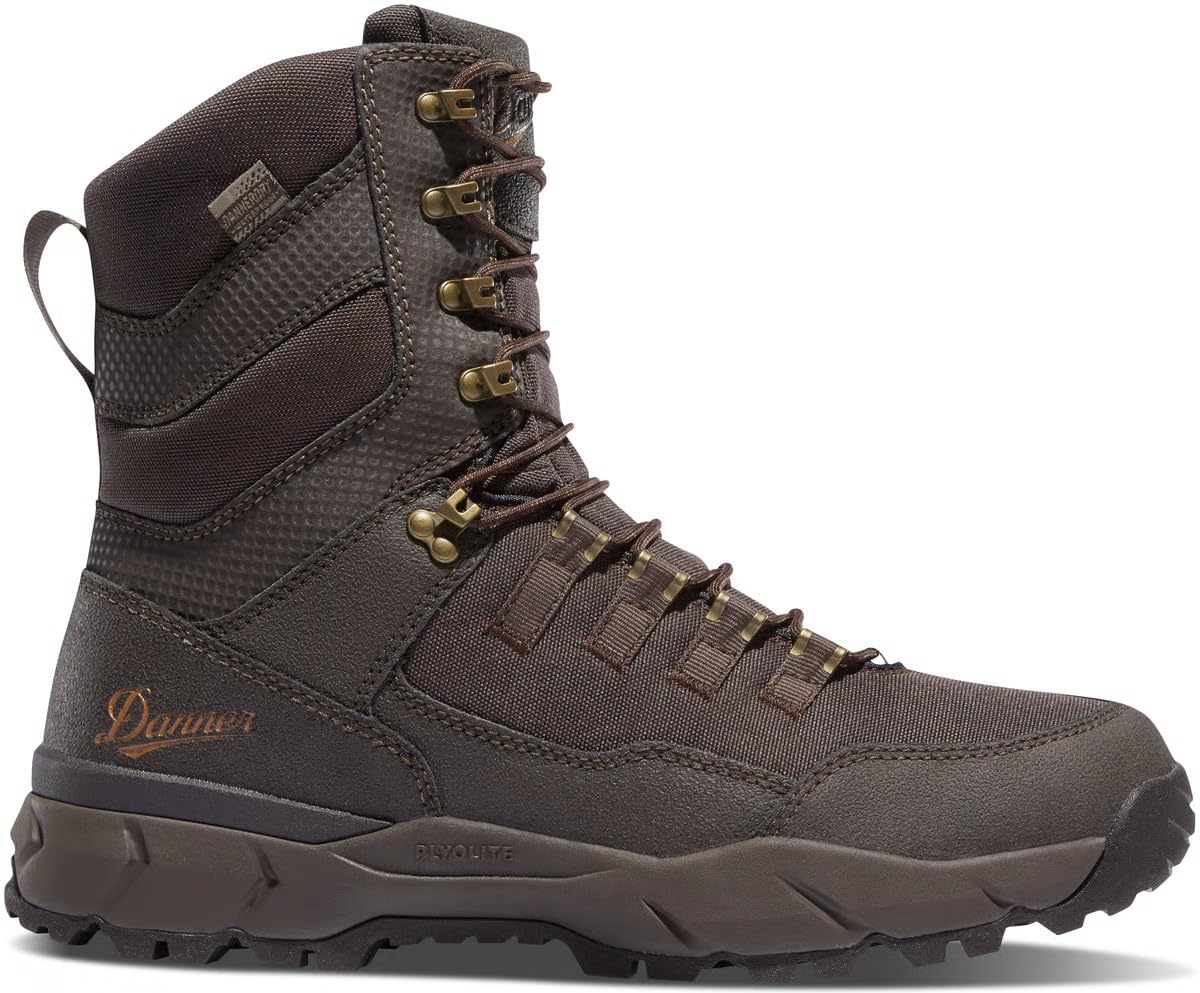
2. Danner Vital 8 Waterproof Hunting Boots for Men
A 2.9-pound leather workhorse that asks for zero break-in and keeps water out over long, rough miles.
Compared with the KEEN Revel III at 1.31 pounds, the Vital 8 carries more than double the weight on each foot. That heft is split leather impregnated with polyurethane, paired with 900 Denier polyester — a dense woven fabric built to shrug off abrasion. It is the boot you buy when the terrain is briars and rock rather than a shoveled sidewalk.
Owners put real miles on these. One hunting trip covered 7+ miles through sand, palmettos, briars, and mud with heavy gear on the back, and the feet inside stayed dry. The Danner Dry barrier is the reason — it lets sweat vapor escape without letting water in. The Lock & Load lacing system uses reengineered ghillies across the forefoot, which are the small loops the laces thread through. They pull the front of the boot tight in one motion and stay quiet, which matters when you are moving through cover.
Fit is the honest catch. The wide size option runs closer to a normal width for some buyers, and the boot generally skews narrow across the forefoot. If you have a genuinely broad foot, the Vital 8 may need a half size up rather than a wide width. A single review reports a back panel blowing out on day three of a hunt — worth knowing, but it is one voice against a broad pattern of satisfaction.
Underfoot feel: the Danner Plyolite midsole (a lightweight foam core under the foot) plus an open-cell footbed with air channels keeps you from feeling every rock. Multi-density foam is layered to remove hot spots and pinch points.
The honest read: this is a dry-weather-to-cold-weather boot, not a deep-freeze boot. It is comfortable in mild cold but not insulated, so plan on good socks and a mild winter or expect to pair it with a heavier boot for real cold.
Best for: upland hunting, property work, and anyone who wants rugged leather without a break-in period.
Not the one for: sub-zero sitting or a genuinely wide forefoot — this boot runs narrow up front.
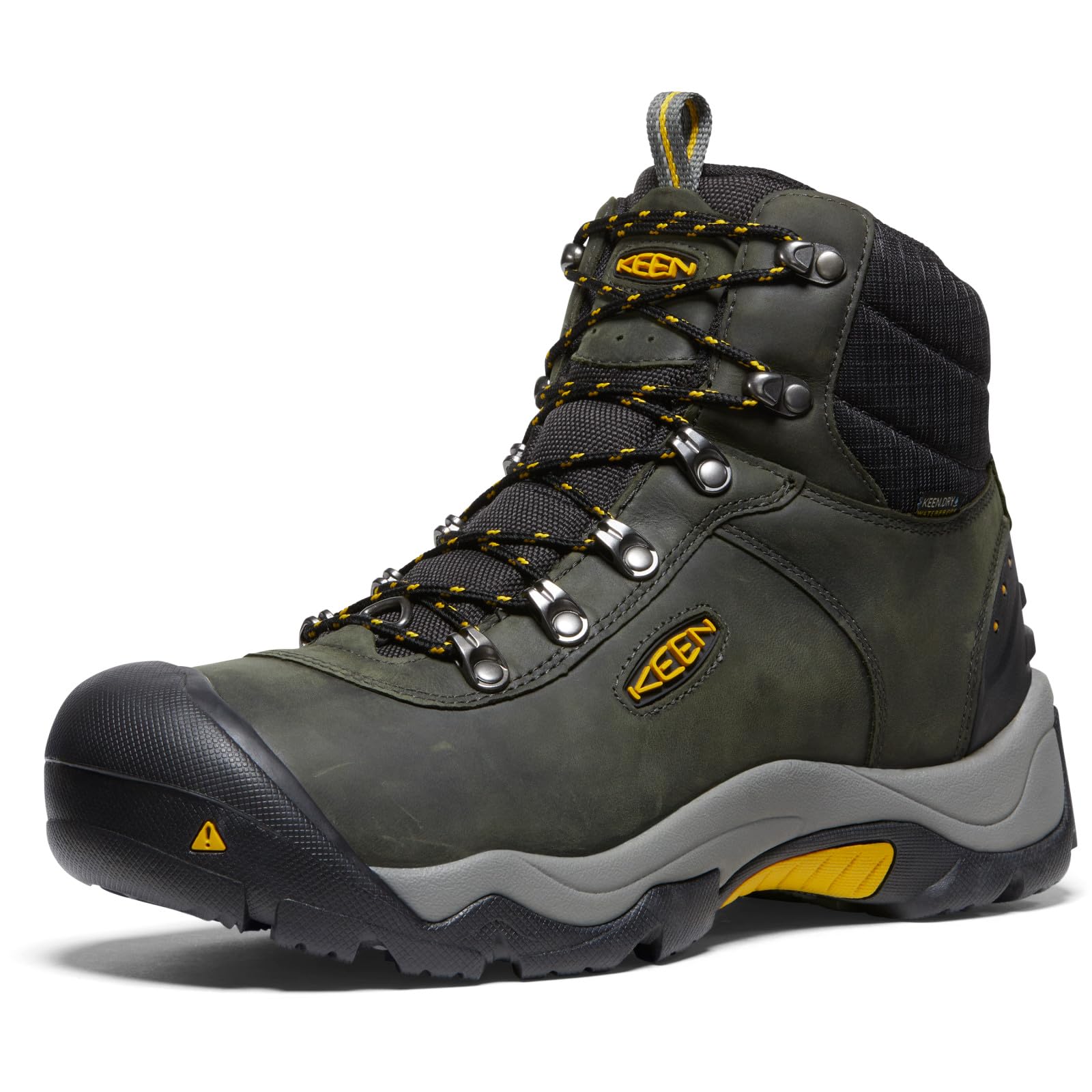
3. KEEN Men’s Revel III Mid Height Waterproof Insulated Hiking Boot
A 1.31-pound insulated hiker with a toe box that lets your toes spread — even in the regular width.
Comfort is the thing everyone raves about here, and the wide forefoot is a big reason. KEEN builds this boot on its traditional wider form, and buyers consistently describe the toe box as roomy. One owner notes the regular width fits like a wide, true to size, with minimal break-in. A buyer with arthritic toes chose it specifically for the wide toe box and rocker sole — a curved sole that rolls your foot forward.
Weight is the other headline. At 1.31 pounds, the Revel III is noticeably lighter than a full leather boot, and that matters over a long shift. One delivery driver wore his first pair for two Northeast winters of up to 12-hour days and called them warm but not too warm, truly waterproof, and well fitting. Another owner got three years of heavy use out of a single pair before replacing it. Water resistance holds up through cold wet nights and slick boat decks, and the ankle height has helped prevent a rolled ankle on uneven ground.
The recurring gripe is long-term toughness. The build is described as softer than a full leather boot, and the padding packs down so the boot needs re-tightening. Sizing runs large — an 11D feeling like an 11.25EE is the pattern. It is also on the bulky side for driving.
What sold us on it: a thermal heat shield inside the upper traps warmth without turning the boot into an oven, so it works on a cold morning and does not punish you indoors. The speed lace webbing system makes quick adjustments easy with cold fingers.
Pick this up if: you need warmth, a wide toe box, and low weight in one boot and you are hard on footwear but not brutal on it.
Look elsewhere if: you expect a decade of life from a boot — the softer build trades lifespan for comfort.
4. Georgia Boot Men’s Georgia Giant Pull-On Work Boots

A pull-on Wellington with a steel toe that clears the ASTM impact standard and a toe box you may need to stretch.
This is a boot built around protection and speed, not forefoot generosity. The steel toe meets the ASTM F2413-05 I/75 C/75 protective toe classification, which is a standard rating meaning the toe cap can withstand up to 75 lbs of impact and compression. It also carries the ASTM F2413-05 electrical hazard rating — a real spec for anyone working near live circuits. The SPR leather the upper is made from is tanned to resist abrasion and barnyard acids.
Durability is the strongest owner sentiment. The Goodyear welt construction is repairable, so a cobbler can replace the outsole instead of the whole boot. One tradesman has reordered the Georgia Giant 14 times in 20 years. A heavy construction worker reports comfort through 14-16 hour shifts with the steel toe holding up to kicks and abuse.
The obvious follow-up question for a wide-toe reader is fit. This is the honest weak point of the boot: the toe box runs narrow. Owners describe the toe area as tight and one stretched it out with a shoe stretcher. It also runs large — several buyers recommend going a half size down. This is the pick for narrow-to-average feet on a jobsite, not for genuinely wide forefeet.
Comfort underfoot: a cushioned insole covered in soft material plus a steel shank under the arch supports long days on hard ground. A rubber wedge outsole takes the edge off every step.
Fit note: the pull-on shaft drops on easily, which matters in the cold, but the forefoot does not have the spread of the KEEN or Thorogood picks above.
Right fit for: jobsite pros with average-width feet who want steel-toe protection, electrical hazard compliance, and a boot they can resole.
The catch: if wide toes are your whole reason for shopping, the Georgia Giant may need a half size down and a shoebox stretcher.
5. KEEN Revel 4 Mid Height Polar Insulated Waterproof
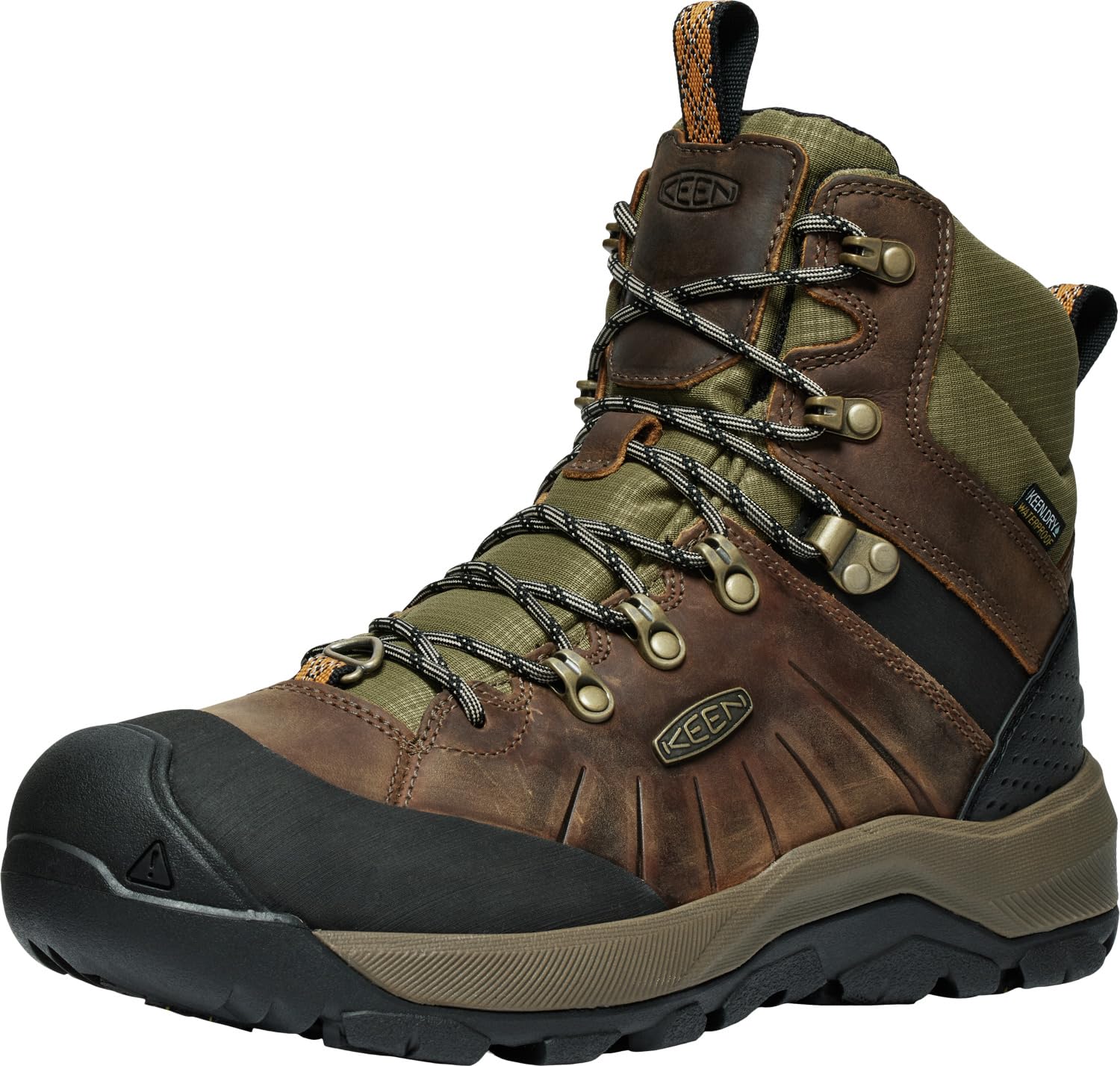
The winter version of KEEN’s wide fit — a snow boot rated to -25°F with a sole built to bite ice.
Where the Revel III mixes in a hiking build, the Revel 4 Polar is tuned for snowshoeing and winter hiking. The fit is what earns the most positive attention. The wider form means the toe box has room for thick winter socks, and buyers routinely say to size up a half size with heavy socks rather than a full size, which would feel sloppy.
Traction is the standout engineering detail. The Polar Grip rubber sole is softer than a standard outdoor sole, with siping (small slits that open to grip wet ice) and embedded glass micro-shards baked into the rubber. A reflective foil layer inside reflects your own foot heat back at you, and the boot is rated to -25°F. One owner climbed a Colorado fourteener in March through heavy snow and ice with a -5°F wind chill and stayed warm and dry.
The trade-off is uneven quality on the sole bond. Some units have arrived with a sole separating from the start, and there are reports of stitching failing in a second winter with hard use. Those are real risks, not universal ones — for many buyers these boots last a full season of hard snowshoeing with minimal wear.
What wins people over: the combination of roomy toe box, minimal break-in, and grip that keeps working on slick, wet ice.
Worth knowing: it is a mid-height boot, so for deep snow walking you may want gaiters — one owner’s suggestion for extended snow on foot.
Suits you if: you snowshoe, hike winter trails, or stand in deep cold for 10-12 hour stretches and need a forefoot with room.
Better skip if: you want a boot guaranteed to last a decade — sole and stitching durability are the weak spot here.
6. Irish Setter Wingshooter 9″ Mens Hunting Boot

Nine inches of full-grain leather, 400g of Thinsulate, and a Prairie outsole built for wet, frost-bitten ground.
This is the middle child of the Irish Setter lineup — enough insulation for a cold morning sit, but not the deep-freeze build of the Elk Tracker. The 400g 3M Thinsulate Ultra insulation is the synthetic fill layer inside the upper. That is a moderate weight, so the boot stays wearable in cool weather and also deep cold with good socks.
The construction is the real story. Full-grain leather is the top layer of the hide, the most durable and naturally breathable section. It sits on a Goodyear leather welt, which stitches the upper and sole together and lets the boot be resoled. That resoling capability may be the brand’s biggest value for an outdoor worker — but the durability counterpoint is real, as certain buyers report a full year per pair under daily water and mud exposure. For outdoor work in damp and cold, buyers describe it as fantastically made, warm in winter, waterproof, and well worth the money.
Sizing is the honest catch. Some owners find the fit slightly large and size up anyway, which is a confusing combination — the strong recommendation from several long-term users is to go up a half to a full size if you wear thick socks. So this is a great pick for a cold-weather hunter or roofer with a standard width who wants a classic leather boot and does not need a spread-out toe box.
Where it stands out
- 400g 3M Thinsulate Ultra insulation for genuinely cold days.
- Goodyear leather welt construction allows a resole to extend boot life.
- UltraDry waterproofing with a moisture-managing lining.
- Prairie outsole sheds mud and grips uneven ground.
Honest limits
- Sizing runs on the large side for some buyers.
- Durability feedback is mixed — some report yearly replacement under daily water exposure.
- The toe box is not the wide-mouth fit the KEEN boots offer.
The verdict: for cold-weather hunting, roofing, and outdoor work with a standard-width foot, it is a solid leather boot that rewards resoling.
One thing to know: size up for thick socks, and check the width — this is a traditional fit, not a wide-toe specialist.
7. Lowa Men’s Zephyr GTX Mid Hiking Boot
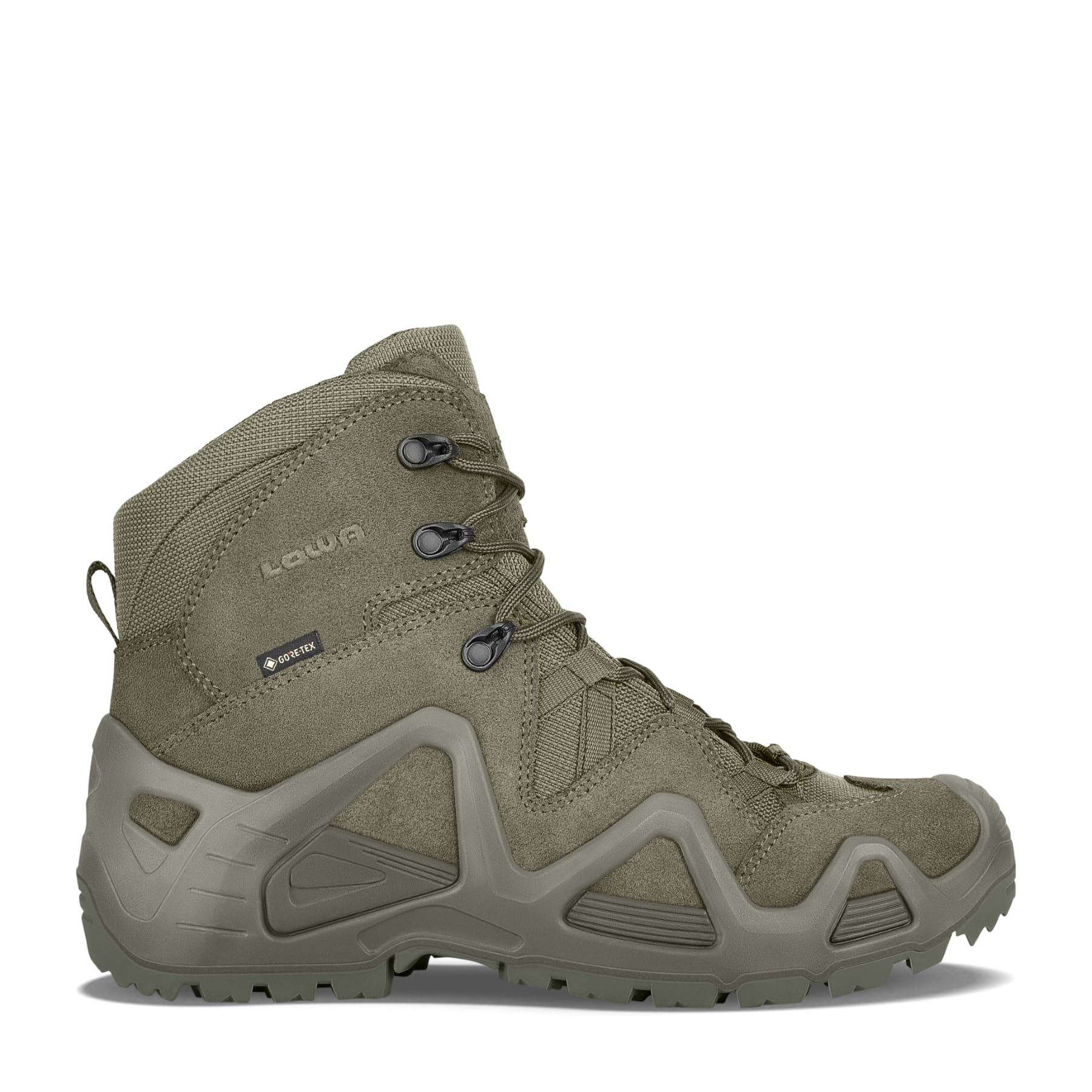
A 2-pound mid-cut boot with a roomy toe area and a stiffer shank — built for fast, mixed terrain.
Weighing 2 pounds, this boot stands in contrast to the Danner Vital 8 at 2.9 pounds. The lighter footprint comes from a moisture-wicking mesh and woven lining built for cooler running temperatures. Its special model is made for extreme stresses at high temperatures and heavy wear — that build also makes it popular for paintball and military use.
The fit on the Zephyr GTX is its own thing. The toe box is roomy for most, and the narrow heel locks into place on steep inclines. One right toe felt tight initially, then stretched after a week to a snug fit. The arch support is strong enough that a buyer who normally uses custom insoles did not need them. Stiff shank construction gives stability on loose rock and steep dirt. It has stayed dry when submerged in slush and kept feet warm for 4 hours in soaked knee-deep snow with wool socks.
The honest limits are width and insulation. No wide widths are offered — the medium width squeezes the sides of a wide foot after a couple of hours. And this is a non-insulated boot, so cold feet find it when the temperature drops hard.
Where it shines: a lightly insulated leather-and-mesh upper with a shock-absorbing climate-control footbed you can pull out, plus plenty of grip on dirt and loose rock.
The catch: a softer, thinner sole on very rocky trails — expect to feel the stones underfoot.
Go for it if: you hike fast, want room across the toes, and are not chasing extreme cold.
Avoid it if: you have a wide forefoot and need a genuine wide width — none is offered.
8. Irish Setter Elk Tracker 12″ Mens Hunting Boot

A 12-inch shaft packed with 1000g of Thinsulate, built for sitting still in sub-zero air.
The Elk Tracker is at the heavy end of cold-weather footwear. The 1000g 3M Thinsulate Ultra insulation is the highest fill weight in this group — a serious layer of synthetic insulation for standing or sitting in real cold. That matters for snowmobilers, ice fishermen, and anyone who works in frozen conditions. One owner wore these comfortably at 75°F indoors and at -10°F outdoors for an hour with stable foot temperature.
Warmth leads the owner feedback here, and the fit is the mixed part. The GORE-TEX waterproof lining keeps water out even when submerged above the ankle. The big tread lugs give traction on snow and ice. Sized in a wide width, the boot handles flat, wide feet well. A 12-inch shaft reaches mid-shin, which keeps snow out of the boot. It is a versatile build — trail walking, hiking, and hunting all land in the same boot.
The honest caveats are on the heavy side. The boot is heavy, and the stiff tread makes natural walking harder than a flexible trail boot. Fit runs snug initially in the 1000g build, so size up if you plan thick socks. Soles can wear fast on concrete — one owner needed a resole after a year and a half of factory-floor use.
Deep-freeze performance: GORE-TEX waterproofing plus 3M Thinsulate Ultra, a removable comfort cork EVA/memory foam footbed, and a Bulls-Eye Air Bob Aggressive outsole for grip.
Worth knowing: the 12-inch shaft adds a lot of leather and weight, so plan for the bulk and a couple weeks of break-in.
Made for: the hunter, ice fisher, or outdoor worker who stands or sits still in serious cold and wants a warm, roomy boot.
Not for: warm-weather hiking or long concrete shifts where its weight and stiff tread become a chore.
9. Thorogood 1957 Series 8″ Waterproof Work Boots for Men

A classic moc-toe work boot with a wide toe box even in standard D width — the pick for wide-footed tradespeople.
The Thorogood 1957 Series is built for the tradesperson who has tried everything else and keeps coming back to a wide forefoot. The full-grain Briar Pitstop leather upper gets most of the praise, with many calling the build quality excellent. The wide toe box is the quiet superpower, especially in standard width — enough room for a fused big toe where a narrower boot pinches. It breaks in fast with no rubbing.
The workhorse construction is the Goodyear Storm Welt, a stitched sole assembly that allows resoling and keeps water out. The MaxWear wedge outsole gives traction on mud and grass. The removable memory-foam footbed molds to your foot. Owners run these for 16 hours a day on their feet, and one mechanic reports they have held up over 5,000 miles in 13 months. Warm in winter with good socks and cool in summer.
The honest conflict here is sizing. Some buyers find the boot runs a whole size small, and the fit is described as narrow for some. That is a real issue, because the boot’s biggest selling point is a wide toe box. If the rest of the boot runs tight, the wide forefoot can be lost in a pinched overall fit. Order with care and expect to size up or try before you commit.
Why tradespeople pick it
- Wide toe box even in standard D width, with minimal break-in.
- Waterproof, breathable membrane keeps feet dry on wet jobsites.
- Goodyear Storm Welt lets a cobbler resole the boot.
- Memory-foam footbed molds to the foot for all-day comfort.
The honest downsides
- Sizing feedback is mixed — several owners mention running a full size small.
- Water resistance can fail over time under hard industrial use.
- Heavier than a trail or hunting boot, which is normal for a leather work boot.
The verdict: if you are on concrete all day and wide toe fit is your top priority, this is a confident choice with resole capability built in.
Size advice: several buyers find it runs a full size small — order up and confirm the width before committing.
Know the Specs
Insulation weight (grams of Thinsulate)
Hunting and winter boots list a fill weight, such as 400g or 1000g. That number tells you how much synthetic insulation is packed around your foot. Higher fill means more warmth and less room — so thicker insulation works best with a boot that has a generous forefoot or a size up. If you plan to wear two pairs of socks, look for a wide toe box and size up.
Waterproofing and breathability
A waterproof membrane keeps slush out, but if it cannot breathe, your sweat has nowhere to go. Look for language that names both waterproofing and breathability. Goodyear welt and GORE-TEX are constructions that manage this by stitching or sealing a breathable barrier inside the boot. This is why a waterproof leather boot can still feel clammy if the lining cannot vent.
Toe box and last shape
The “last” is the foot-shaped mold the boot is built around. A wide toe box depends on the last being shaped for a natural foot, not just a wider width letter. Wide sizing helps, but a wide boot can still taper at the toe. This is why reading whether the maker describes an anatomical or roomy forefoot matters. Look for “wide toe box” or a “wider traditional form.”
Sole and welt construction
A Goodyear welt is a stitched sole assembly that lets a cobbler replace the outsole instead of the boot. That extends the life of a boot and lets you keep a broken-in upper. Rubber compounds matter too — softer rubber bites ice and packed snow with more grip but wears faster on concrete. The trade-off should match where you spend most of your winter.
Common Questions
Will a wide toe box winter boot fit thick wool socks?
What does 400g or 1000g insulation actually mean?
Are wide toe box winter boots good for plantar fasciitis or wide forefeet?
Can these winter boots be resoled?
How do I know if a boot runs narrow in the toe box?
Are waterproof winter boots breathable enough to wear all day?
What is the difference between a hunting boot and a snow boot?
How long should waterproof work boots last with daily wear?
Should I size up or down in a wide toe box boot?
The Bottom Line
For most people shopping for wide toe box winter boots, the winner is the Baffin Selkirk because it combines a tall snow-dumping shaft, a removable liner you can dry, and 7 layers of cold-comfort protection that held up in a real blizzard. If you want a light, wide-toe everyday hiker, pick the KEEN Revel III at 1.31 pounds. And for fast winter trail miles, the KEEN Revel 4 Polar is the one to reach for, rated to -25°F with ice-biting grip. Any of these picks will leave your toes room to move — and that is what keeps them warm.
How we choose
We do not accept paid placement. Every pick is matched to a real buyer and a real use-case; we do not hands-on test units.
Sources
Specifications: manufacturer listings and product documentation. Review insights: verified customer reviews, as of October 2026. Pricing: not shown on this page (it changes often); check the current price via the retailer link.
As an Amazon Associate, Aappliancez earns from qualifying purchases. This does not affect which products we feature.