Disclosure: Some links in this post are affiliate links. As an Amazon Associate I earn from qualifying purchases, at no extra cost to you. Learn more
Specs are compiled from manufacturer listings and verified buyer reviews and can change over time — please confirm the key details on the product page before buying.
The hardest part of a mulch bed isn’t the mulching — it’s watching chickweed and clover push through two inches of bark chips a month later. You need a spray that kills the weed at the root without torching the shrubs, roses, and monkey grass you actually planted. The catch is that “weed killer” is a broad label, and the wrong bottle will either kill your ornamentals or do nothing at all. This guide narrows the field to five concentrates and ready-to-use sprays, each matched to a specific bed problem.
This guide is built by comparing the manufacturers’ published specifications and the patterns across verified customer reviews, so you get each pick’s real strengths and trade-offs instead of marketing spin.
You’ll see which formulas go after broadleaf weeds, which handle grassy invaders like Bermuda, and which are built for the cracks and edges around a bed. Every pick below is a real bottle with a real label — and the next section tells you exactly which one matches your mulch bed’s worst weed problem on the first try.
Top Picks
How To Choose The Best Weed Killer for Mulch Beds
A mulch bed sits in the worst possible spot for weed control: you have bare soil around established plants, a barrier of chips that keeps moisture in, and roots from desirable plants running right under the surface. That means a spray that will kill everything it touches is a liability. The first thing to know is whether you’re spraying in beds around perennials and roses, or just chasing weeds in the open edges between a bed and a walkway.
Selective vs. Non-Selective
Non-selective herbicides kill whatever green tissue they contact, so they belong on paths, cracks, and the bare strip between bed and lawn — not on a spray blanket around your roses. Selective formulas are designed to leave lawn grasses and ornamentals intact while attacking the weed species listed on the label. Read the label and confirm your weed type appears; a formula that skips your specific weed won’t do anything no matter how you mix it.
Concentrate vs. Ready-to-Use
A concentrate needs water and a tank or pump sprayer, but you mix your own strength and you stretch the bottle over far more area. A ready-to-use bottle means you shake, aim, and spray — a good fit for a single bed edge. The trade-off is coverage: a 128 fl. oz. ready-to-use container covers a set area, while a small concentrate can make gallons of spray solution. For a wide bed or repeated applications, the concentrate is the more practical format.
Surfactant and Temperature
A surfactant is a wetting agent that helps a spray spread out on a waxy leaf instead of beading off. Many experienced bed-keepers add it themselves, and the label will often say whether one is required. Temperature matters too — one label in this group specifies application above 60°F, another below 90°F — so time your spraying for a calm, moderate day. Never spray when rain is due within the label’s rainfast window.
Side-by-Side Comparison
| Model | Best For | Liquid Volume | Form | Stated Coverage | Amazon |
|---|---|---|---|---|---|
| Fertilome Weed Free Zone★ Best Overall | Broadleaf weeds in cool and warm turf | 32 fl. oz. | Liquid concentrate | Full (label rate) | Amazon |
| Ortho GroundClear Super ConcentratePath & Edge Pick | Paths, edges, and fence lines | 32 fl. oz. | Spray concentrate | 1,120 sq. ft. | Amazon |
| Liquid Harvest Mesotrione | Crabgrass and pre-emergent control | 8 fl. oz. | Liquid concentrate | Full (label rate) | Amazon |
| Fertilome Over The Top | Grassy weeds in and around ornamentals | 8 fl. oz. | Liquid concentrate | 2,000 sq. ft. per 8 oz | Amazon |
| Bonide Chickweed, Clover & Oxalis Killer | Spot-spraying weed patches in beds | 128 fl. oz. | Ready-to-use spray | 10,000 sq. ft. | Amazon |
Detailed Reviews
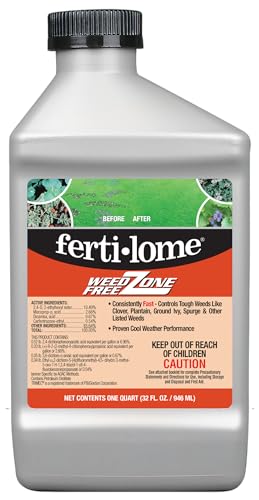
1. Fertilome 10525 Weed Free Zone Concentrate 32 oz
Our pick — 4.5+★ from 1,000+ verified ratings; the strongest balance of quality and price.
The bed-side broadleaf specialist that shows visible evidence of injury within hours.
If your mulch ring is full of creeping charlie, white clover, and thistle, and lawn grass runs right up to the edge, start with this 32 fl. oz. concentrate. It’s built to control over 80 broadleaf weeds, including clover, spurge, chickweed, and thistle, while staying labeled safe on Kentucky bluegrass, bermudagrass, bahiagrass, and zoysiagrass. That turf-safe labeling is why it earns the top spot in a bed setting: you can spray the weeds pushing into the bed and not worry about a dead strip of lawn on the other side of the chips.
What wins people over is effectiveness, and it’s the quality that keeps this bottle moving — the formula is described as providing evidence of injury within hours of application, so a bed that looked hopeless in the morning shows the weeds curling and yellowing the same afternoon. The label pushes you toward young, actively growing weeds in spring, summer, or fall, and you mix the concentrate with water at the rate printed on the bottle before spraying the lawn or bed edge thoroughly. A few bed-keepers keep a dedicated pump sprayer just for this bottle, adding a surfactant (a helper that makes the spray stick to waxy leaves) to help it stick to waxy leaves.
The honest catch is stubbornness at the margins. Wild violet is the weed that slips through — as buyers report of this one, “This broad leaf weed kill does kill several, but not what I wanted killed, the wild violet.” Expect a second or third treatment on the toughest leaves; the review pages are candid that some foliage needs repetition. In the same breath, the value question depends on how many square feet you’re covering, because this is a concentrate and a heavy-coverage yard will empty the bottle faster than a spot spray of one bed edge. Plan your mix rate before you start.
Why the bed-keeper reaches for it
- Controls over 80 broadleaf weeds including clover, spurge, and chickweed.
- Labeled safe on Kentucky bluegrass, bermudagrass, bahiagrass, and zoysiagrass.
- Evidence of injury within hours of application.
- 32 fl. oz. concentrate mixed with water at the label rate.
Where it stops short
- Wild violet can walk past it — the toughest leaves may need two or three treatments.
- A concentrate means you supply the water and a pump sprayer.
- Value perception splits depending on how much square footage you’re treating.
Go-to for clover and charlie: buy it if your bed edge is fighting creeping charlie, white clover, or thistle next to a lawn you want kept alive.
Expect a second pass: the wild violet in your bed may shrug off the first application and need repeated spraying.
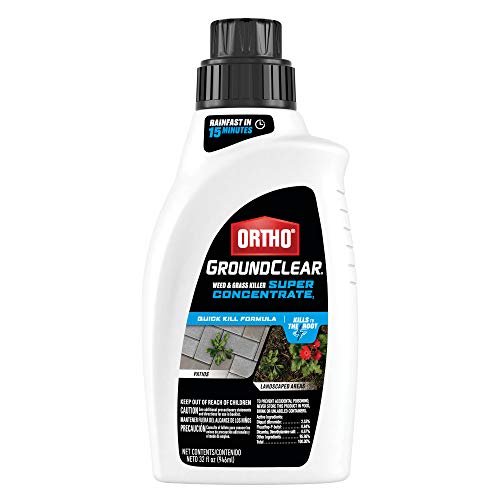
2. Ortho GroundClear Weed & Grass Killer Super Concentrate1 32 fl. oz.
The fast-acting concentrate that starts working immediately and shrugs off rain 15 minutes later.
The bottle lives on the shelf of someone whose mulch bed butts up against a patio, a walkway, and a driveway — surfaces where a weed-killer spray needs to do its job around hardscape, not soften the landscaping. This 32 fl. oz. concentrate kills tough weeds and grasses to the root, including clover, dandelion, oxalis, chickweed, and crabgrass. Where to use it, per the label: around perennial landscape plants, trees, shrubs, and fences, and on patios, paths, sidewalk cracks, walkways, and driveways. That’s the honest framing of its place in a bed setup — it’s the edge-and-hardscape spray that clears the seams where chips meet concrete.
The speed claim is where this one pulls away from the field: it starts working immediately and is rainfast in 15 minutes, so you don’t need to watch the sky for hours after you spray. Mix it with water for a tank sprayer and spray actively growing weeds when the air is above 60°F. One 32 fl. oz. bottle treats up to 1,120 sq. ft. — the smallest stated coverage in this group, which is worth knowing if a long, wide bed edge is your whole job. The concentrate carries a chemical odor while you’re applying it, but the smell doesn’t linger into the evening.
A common theme across the review pages is that following the label rate kills only part of the bed and the survivors creep back after a few weeks — as owners mention, “I used it at the recommended concentration and it killed a little more than half the weeds but some started coming back after a few weeks.” Bump the mix and the story changes; the same buyers who used it stronger tell you it “killed every plant.” Start at the label rate, watch for two weeks, and re-spray rather than overspraying on the first try.
Rainfast beats paranoia: the 15-minute rainfast window and immediate action make this the right choice for spraying right before a forecast you can’t control.
Hardscape edges: reach for it when your bed meets a patio, path, or driveway and you want fast, root-deep death on what’s pushing through the cracks.
The nuisance: 1,120 sq. ft. of stated coverage means a broad bed job needs more than one bottle.
3. Liquid Harvest Mesotrione – 8oz – Mesotrione Concentrate

The slow, deliberate one that stops crabgrass before it sprouts and turns survivors ghost-white.
If your mulch bed backs onto a lawn with a crabgrass problem, this is the bottle to consider before the seed heads rise. The active ingredient, mesotrione, targets 46 broadleaf species and grasses including barnyard grass, carpetweed, chickweed, clover, crabgrass, and dandelion. It works two ways: as a pre-emergent that prevents crabgrass seed from germinating, and as a post-emergent that attacks what’s already up. The split approach is what makes it a useful companion to a fast-kill spray — this one keeps the next flush from arriving.
There’s a patience clause built into this product. Mesotrione (the active ingredient) absorbs immediately and starts working, but full weed death can take 2-3 weeks, and it needs water to activate — if no rainfall falls within 10 days, you’re told to apply 0.15 inches of water to switch it on. The visible tell is color: weeds turn white as the chemical shuts down photosynthesis (how the plant makes its food) and moves through roots and leaves. Some bed-keepers find that ghost-white look unsettling even though it means the plant is dying; the label behavior is normal, not a failure.
One thing this formula demands that others don’t: a surfactant is essential, not optional. The label also warns it off bentgrass, Poa annua, kikuyugrass, zoysiagrass, seashore paspalum, and bermudagrass — so confirm your grass type before you spray anywhere near a lawn. And the wait is real — as customers note, the weeds “turn white but took more than two weeks,” with some still waiting into the third week for them to disappear. Budget the time, follow the label, and you’ll see it work; race it and you’ll be disappointed.
Two-for-one job: this is the only pick in the group that stops future crabgrass seed from germinating while it kills what’s already growing.
Season prep: this suits the bed-keeper with a crabgrass history who wants to prevent next spring’s flush, not just kill today’s.
Read the grass list first: zoysiagrass and bermudagrass are on the avoid list, so a lawn of either nearby rules this one out.
4. Fertilome 8 Oz Over The Top Grass Killer – 10434

A selective grass killer designed to slip past flowerbeds and monkey grass while taking out grassy weeds.
Here’s the problem this one solves: not every weed in a mulch bed is a broadleaf. When Bermuda grass starts threading up through the shrubs, broadleaf sprays do nothing. This 8 fl. oz. concentrate is designed to target annual and perennial grass weeds, and it can be applied around vegetables, gardens, trees, shrubs, and ornamentals without taking them out. The formula stops weed grasses from growing two days after application, and the small bottle makes 8 gallons of spray solution — covering 2,000 sq. ft. per 8 oz, which is more stated coverage than either the Ortho bottle or the mesotrione.
The scenario this bottle wins is the long-running Bermuda fight. A bed that’s been invaded for years survives pulling, fabric, mulch, and other herbicides and still comes back — that’s the exact problem the label approach addresses. Mix it per the instructions, spray a section, and expect yellowing after about a week with the sprayed grass dead by about three weeks. Shrubs and roses stay unaffected, which is the crucial detail for a bed full of established plantings. One tip worth borrowing from the review pages: a squirt of dish soap added as a surfactant helps the spray spread across grass blades.
The catch is that this is the least forgiving pick in the group for patience. Results take a week or more to be definite, and a minority of applications fall flat — one frustrated buyer applied it three times with a surfactant (a helper that makes the spray stick to leaves) and reported it “killed none of the grasses it claims to kill.” Do not use it on fescue — one neighbor reportedly wiped out her fescue yard with it — and confirm the grass you want killed is on the label before you mix. Where it works, it works well; where it doesn’t, the results are stubbornly flat.
Where it earns its shelf space
- Targets annual and perennial grass weeds that broadleaf sprays can’t touch.
- Labeled for use around vegetables, gardens, trees, shrubs, and ornamentals.
- 8 fl. oz. concentrate makes 8 gallons of spray solution.
- Stops weed grass growth two days after application.
The fine print worth reading
- Results take a week or more — not a same-day kill.
- Do not use on fescue; it can wipe out the whole yard.
- A minority of applications report zero effect even after repeat spraying.
For the Bermuda war: this is your pick if grassy weeds are threading through shrubs or monkey grass and broadleaf sprays have failed.
Wrong pick for fescue: a fescue lawn in the mix means skipping this one entirely.
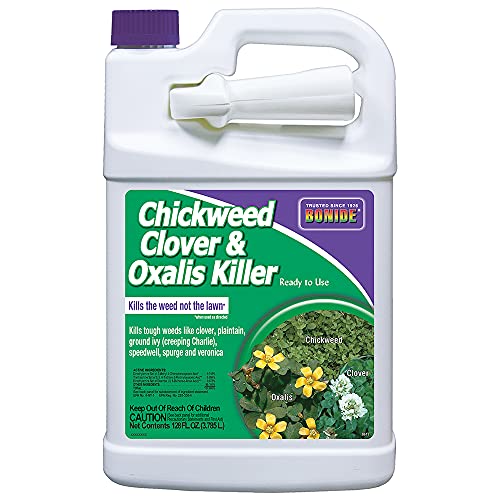
5. Bonide Chickweed, Clover & Oxalis Killer 128 oz
No mixing, no measuring — a full gallon of broadleaf spray you shake and aim at the bed.
For the bed-keeper who wants to walk out with a bottle and spray, this 128 fl. oz. ready-to-use formula skips the measuring cup. It controls more than 100 tough-to-control weeds including alder, aster, nettle, thistle, yarrow, chickweed, clover, dandelions, and ground ivy, and it’s designed to kill broadleaf weeds roots and all without killing lawn grasses. Spray when weeds are actively growing and the temperature is below 90°F, and pick a calm day so the spray doesn’t drift onto vegetables, flowers, or other desirable plants. The stated coverage is 10,000 sq. ft. — the widest headline number in this group, though a gallon goes fast on a heavily weeded yard.
What everybody raves about is the sheer range of broadleaf weeds it touts, and wood sorrel is the standout case that keeps people coming back — as reviewers point out, “This is the only product I used that killed off the wood sorrel weeds in my lawn.” Chickweed, clover, and dollar weed reportedly yellow and shrivel within about three days. That fast signal is the reason it earns a spot for spot-spraying isolated patches in a bed edge; you see movement in days, not weeks, which makes it easy to judge whether a second application is needed.
The important warnings should live on your mental label. This spray will kill zoysiagrass and St. Augustine grass where sprayed heavily — one buyer’s foliage killed along with the chickweed and clover — so treat it as a bed-edge and spot spray, not a blanket on a mixed lawn. Some bottles arrive missing their spray nozzle, and the included hand sprayer is slow work on large areas; transferring to a pump sprayer is a common workaround. It also isn’t a pre-emergent, so seeds already in the chips will germinate later.
The convenience trade: you pay in coverage per bottle for a format that needs no mixing, and the included hand sprayer earns its worst feedback on big jobs.
Quick spot spray: ideal if you want one bottle, no mixing, and fast visible kill on chickweed, clover, or wood sorrel in a small patch.
Grass caution first: if zoysia or St. Augustine runs through your bed, keep this away from heavy spraying.
Know the Specs
Liquid Volume vs. Coverage
Liquid volume in fluid ounces tells you how much product is in the bottle. Coverage in square feet tells you how much ground the label says it will treat. A 32 fl. oz. concentrate and an 8 fl. oz. concentrate can both claim a coverage figure, but the smaller bottle often makes more spray solution because it’s mixed at a lighter rate. Check the coverage number, not the bottle size, when comparing two concentrates.
Pre-Emergent vs. Post-Emergent
A pre-emergent stops seeds from germinating before the weed appears. A post-emergent kills weeds that have already sprouted. Most bed sprays are post-emergent, meaning they attack green tissue. Mesotrione works both ways — it stops crabgrass seeds and kills sprouts. Knowing which job your bed needs tells you whether you’re buying a prevention tool or a cleanup tool.
Concentrate vs. Ready-to-Use
A concentrate is mixed with water at a label rate; it’s cheaper per square foot and lets you dial strength for tough weeds. A ready-to-use bottle is pre-mixed and needs no measuring — good for small jobs and quick spot work, but it covers less ground per bottle and its built-in sprayer may be slow on big areas.
Rainfast Time
Rainfast time is how long a spray must stay on the leaf without rain washing it off. One label in this group claims 15 minutes. Others don’t publish a figure, and one wants water applied 10 days after spraying if no rain falls. Check the label’s rainfast number before spraying ahead of a forecast.
Common Questions
Can I spray weed killer directly on my mulch without killing my shrubs?
Will a broadleaf weed killer hurt my lawn grass if it drifts onto the edge?
How long does it take for a weed killer to show results?
Do I need a surfactant with these concentrates?
What temperature is safe to spray weed killer in a bed?
Is a pre-emergent weed killer useful in a mulch bed?
How much area does a bottle of weed killer actually cover?
What’s the difference between killing broadleaf weeds and grassy weeds?
Will a weed killer stop Bermuda grass threading through my shrubs?
The Bottom Line
The strongest all-around pick for the best weed killer for mulch beds is the Fertilome Weed Free Zone — it’s the crowd favorite, and the one formula in this group that hits 80-plus broadleaf weeds while staying labeled safe on the most common lawn grasses running along a bed edge. If your bed butts against a patio or driveway, the Ortho GroundClear Super Concentrate is the faster, rainfast 15-minute option for the hardscape seams.
For a bed invaded by Bermuda and grassy weeds threading through shrubs, reach for the Fertilome Over The Top. And if crabgrass keeps returning every spring, the Liquid Harvest Mesotrione is the only pick here that stops the next flush before it sprouts. Whichever you pick, spray on a calm day at a moderate temperature, add a surfactant where the label requires one, and give the formula its full stated window before deciding it didn’t work.
How we choose
We do not accept paid placement. Every pick is matched to a real buyer and a real use-case; we do not hands-on test units.
Sources
Specifications: manufacturer listings and product documentation. Review insights: verified customer reviews, as of October 2026. Pricing: not shown on this page (it changes often); check the current price via the retailer link.
As an Amazon Associate, Aappliancez earns from qualifying purchases. This does not affect which products we feature.