Disclosure: Some links in this post are affiliate links. As an Amazon Associate I earn from qualifying purchases, at no extra cost to you. Learn more
Specs are compiled from manufacturer listings and verified buyer reviews and can change over time — please confirm the key details on the product page before buying.
English ivy does not die politely. Cut it and it comes back from the roots; pull it and you tear up the fence it was climbing. The right weed killer for English ivy has to be systemic — absorbed through the leaf and carried down into the root crown, where it keeps working for days. This guide compares five concentrates and ready-to-use sprays on what actually decides the outcome: how deep the active ingredient travels, how long it takes to show you it worked, and whether it will also take out the lawn around it.
This guide is built by comparing the manufacturers’ published specifications and the patterns across verified customer reviews, so you get each pick’s real strengths and trade-offs instead of marketing spin.
You will see the difference between a slow systemic that kills roots and a fast contact spray that only burns the leaves. By the end you will know which bottle to grab for a fence line, a flower bed, or a whole lawn full of ground ivy, and you can compare each weed killer for english ivy pick below on the specs that matter most.
Top Picks

How To Choose The Best Weed Killer for English Ivy
Ivy is a woody vine, not a soft annual weed, so a spray that browns a dandelion in an afternoon often just scorches ivy leaves and leaves the crown alive. The product you want is one that moves through the leaf and down into the root crown. That usually means a systemic herbicide — one that gets absorbed and travels inside the plant rather than burning only what it touches.
Systemic versus contact: what kills the crown
A systemic killer is absorbed through the foliage and carried into the root system, which is why it takes days rather than hours to show yellowing. Ivy regrows from roots and stem nodes, so this is the mechanism that actually ends an infestation. A contact spray burns the green tissue it lands on, and that is enough for small seedlings but rarely enough for a mature vine climbing a fence.
Read the active ingredient, not the brand
Glyphosate is the workhorse for broad vegetation control and kills to the root with no lingering soil activity. Triclopyr is the brush specialist, aimed at woody plants, vines, and stump treatment. Some lawn products blend triclopyr, MCPA, and dicamba to knock out broadleaf weeds while sparing grass. Each behaves differently around desirable plants, so match the ingredient to the job.
Concentrate or ready-to-use
A concentrate lets you dial the mix strength and covers far more ground per bottle, but it demands a tank sprayer and careful measuring. A ready-to-use spray is a grab-and-go bottle for spot work on a few vines. If ivy covers a long fence line or a whole bed, concentrate math works in your favor; for two or three stray vines, ready-to-use saves the setup.
Protect what you want to keep
Spray drift is the reason a good ivy treatment can still ruin a garden bed. Spray on a calm day, shield desirable plants, and note that a lawn product is formulated for specific grass types. Some grass types brown out where a broadleaf spray lands heavily, so check the label list before you spray near turf you care about.
Side-by-Side Comparison
| Model | Best For | Active Ingredient | Form / Volume | Coverage | Amazon |
|---|---|---|---|---|---|
| Control Solutions Eraser & Grass Killer Concentrate★ Best Overall | Whole-yard brush and vine control | 41% Glyphosate | Concentrate, 32 fl oz | — | Amazon |
| Bonide Poison Ivy & Brush Killer BK-32Vine Specialist | Fence-line vines and stump treatment | Triclopyr blend | Concentrate, 32 fl oz | 1000 square feet | Amazon |
| Southern AG 01113 Brush Weed Killer | Stumps and hard-to-control vines | Triclopyr | Spray, 1 quart | 512-1024 square feet per gallon | Amazon |
| Roundup Weed and Grass Killer III Trigger Spray | Fast spot treatment in hard spots | Glyphosate | Ready-to-use, 30 fl oz | 3000 sq. ft. | Amazon |
| Bonide Chickweed, Clover & Oxalis Killer | Broadleaf weeds in lawns | Triclopyr, MCPA, Dicamba | Ready-to-use, 128 fl oz | 10000 square feet | Amazon |
Detailed Reviews
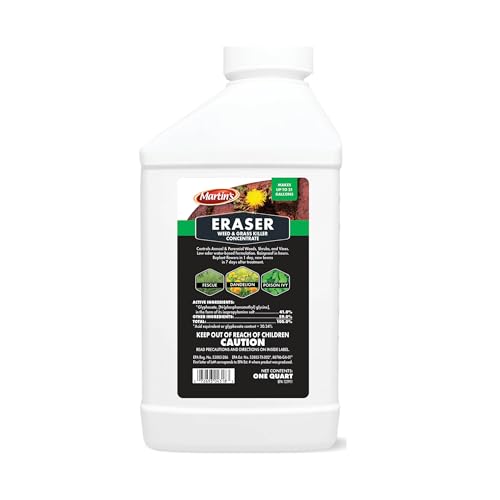
1. Control Solutions 82004318 Eraser & Grass Killer Concentrate
Our pick — 4.5+★ from 700+ verified ratings; the strongest balance of quality and price.
A plain glyphosate concentrate that kills ivy at the root and lets you mix the strength yourself.
If your English ivy has taken over a fence line or a back corner and you want it gone for good, this is the most forgiving place to start. The active ingredient is 41% glyphosate — a systemic herbicide, meaning it is absorbed through the leaf and carried down into the root system rather than just burning the surface. It also has no residual soil activity, so once it does its work you can replant that ground instead of fighting the soil for months.
The formula is water-based with a low odor, and it is rainproof within hours — which matters when you cannot predict an afternoon shower. Because it is a concentrate, you control the mix. Buyers work through the math and often add a little surfactant to help it cling to waxy ivy leaves, then spray on a warm, sunny morning. One thing to set your expectations on: this is not the instant-burn spray. Glyphosate is slow and deliberate, taking days to show the plant is losing.
What keeps this the strongest overall pick is that it kills to the root across a wide range of tough plants — annuals, perennials, vines, and shrubs — with no fancy additives to pay for. easy coverage: one 32 fl oz concentrate bottle mixes multiple gallon tanks depending on how strong you go, so a single bottle stretches across a full fence line. Patience required: unlike the ready-to-use Roundup below, which advertises visible results in 6 hours, this one works slowly — the surface looks unchanged for days before the plant starts to fade. Spray it, walk away, and judge it a week or two later.
What earns it first place
- 41% glyphosate systemic goes for the root crown, not just the leaf
- No residual soil activity means you can replant treated ground later
- Rainproof within hours of application
- Concentrate mixes multiple tanks, so one bottle covers a long fence run
What to plan around
- Slow visible action — you wait days, not hours, to know it is working
- You supply the tank sprayer and measure the mix yourself
- Thick vines may need a second pass, especially on deep roots
The verdict: the pick for anyone fighting a real ivy problem across a lawn, fence, or brush line who wants root-level kill and does not mind mixing.
The honest catch: if you want to see weeds brown by dinner, the speed here will feel underwhelming — this is a week-later result.
2. Bonide Poison Ivy & Brush Killer BK-32, 32 oz Concentrate
Named for the woody, climbing plants — the exact category English ivy belongs to.
This one is built for the woody end of the weed spectrum. Its label lists vines like poison ivy, poison oak, kudzu, and wild blackberries alongside 240 or more tough weeds — the same climbing, root-creeping behavior that makes English ivy so stubborn. And it is heavier in the bottle than the Southern AG brush killer below, 16 ounces versus 9.6 ounces, which tells you there is more product to work with before you are out.
The dual-purpose trick here is stump treatment. Undiluted, wiped straight onto a freshly cut stump with a paintbrush, it goes after the crown of a woody plant that has been cut back but keeps fighting. For ivy on a chain-link fence or wrapping a tree base, that root-and-crown reach is what you are buying. One experience worth hearing in the buyer’s own words, on a heavy vine choking a fence: “This Brush killer was easy to apply and worth the money.” The same user adds a caution that applies to any spray near grass — a bit of overspray ruined a patch of lawn, so shield grass you care about.
It is not the strongest option for every weed. A handful of buyers find that bindweed shrugs it off, and one overgrown brush situation only wilted rather than fully died. On the far more common case — vines and brush that need killing to the root — it does the job and does it cleanly when mixed into a tank or hose-end sprayer. Workload: the label states a coverage of 1000 square feet, so think of it as targeting a yard’s trouble spots rather than a whole acre.
Why it suits ivy: woody vines and stump treatment are literally on the label — you are aiming at ivy’s actual plant type instead of a broad lawn herbicide.
The follow-up question: how much area does it handle — the stated 1000 square feet of coverage sits well under the broad lawn sprays, so buy it to kill the vines that matter, not to blanket a big yard.
Reach for this if: you have woody vines on a fence, tree, or old stump that need a targeted brush herbicide and heavy-vine control.
Look elsewhere if: you need broad lawn treatment for a whole bed — this is a spot and vine tool, not a field spray.
3. Southern AG 01113 Brush Weed Killer, 1 Quart (32 oz)

One quart of triclopyr built to stop clean-cut stumps from sprouting again.
The job this one does best is preventing regrowth — the moment a vine or shrub is cut down but the stump keeps throwing new shoots. Its triclopyr base is a brush herbicide aimed at vines and hard-to-control plants, and it is intended for non-crop areas like fences, rangeland, pastures, and roadsides. If English ivy has crept along a fence line, that is exactly this product’s territory.
One quart does not sound like much, but the concentration is high enough that a small pour goes a long way — the label lists coverage of 512 to 1024 square feet per gallon once mixed. This is a tool for the person who already owns a tank sprayer and wants to stretch a single quart across a targeted area. Your expectations should stay in proportion to that: it is a precise, purposeful product, not a bucket of easy coverage.
Honesty matters with this one, because the buyer feedback is genuinely split. Some see fast results; others find the plant dies back slowly. Buyers split on value too — some call the quart a sensible spend, others say it over-promised for their situation. The honest read is that triclopyr is a real brush herbicide that works best when mixed and applied exactly to label, on actively growing plants, in the right conditions. Mixed to label strength and sprayed on actively growing vines in calm, under-90-degree conditions, it does its job. The real edge: sprout prevention on fresh stumps is where a dedicated brush product outshines a general glyphosate.
Where it genuinely delivers
- Triclopyr targets woody vines and hard-to-control plants
- Prevents sprouting on clean-cut stumps — its standout job
- Concentrated, so a little goes a long way once mixed
- Intended for non-crop fence lines and roadsides, ivy’s home turf
Where results vary
- Effectiveness feedback is genuinely mixed — timing and mixing matter
- Value perception splits between buyers
- You need a tank sprayer; a quart does not cover a large area
Reach for this if: you are cutting stumps and need to stop sprouts, or spot-treating vines on a non-crop fence line with a tank sprayer.
Look elsewhere if: you want a set-and-go spray for a big yard — this rewards careful measuring and a smaller, focused job.
4. Roundup 5003410 Weed and Grass Killer III Trigger Spray

For the hard-to-reach vine on a slope or behind rocks — spray and see it work the same day.
The whole reason to pick this bottle over a concentrate is instant feedback. The maker states it starts working immediately and shows visible results in 6 hours, and it kills to the root. For spot-treating ivy sprouting between rocks, along a driveway slab, or on a slope you would rather not scramble across, that speed and the built-in trigger sprayer are the draw. It is also rainproof in 10 minutes, so you do not have to watch the sky for long after you finish.
The foaming mechanism is a small but real convenience: you can see where you have sprayed, so you are not double-treating or missing a patch hidden under leaves. It needs no tank, no measuring, and no mixing — prime it, aim, squeeze. This is the option that fits the person who owns one problem vine and does not want to buy equipment to solve it.
Where it falls short is reach per bottle. At 30 fluid ounces ready-to-use, you are buying a spot tool — the Bonide broadleaf spray below holds 128 fluid ounces in one bottle. That difference is the trade you are making for convenience. Buyers split on whether 30 ounces of ready-to-use justifies the price, and reviews of the trigger mechanism are mixed as well. But on the core question — does it kill the weeds it hits — the record is strong, including one who did not have to scale a fence to reach the growth. The standout: rainproof in 10 minutes and visible results in 6 hours make it the least fussy option for a quick, targeted hit.
The case for it: zero setup, quick visible kill, and a foaming spray you can aim precisely into tight spots like rock gaps and slab joints.
Size it right: 30 ounces of ready-to-use will not carry a whole yard — if the ivy runs the length of a fence, refills add up and a concentrate is the smarter buy.
Reach for this if: you want to kill a handful of ivy sprouts in tricky spots today, with no mixing and no equipment.
Look elsewhere if: the ivy covers a large area — this is a spot sprayer, and the volume runs out fast.
5. Bonide Chickweed, Clover & Oxalis Killer Spray
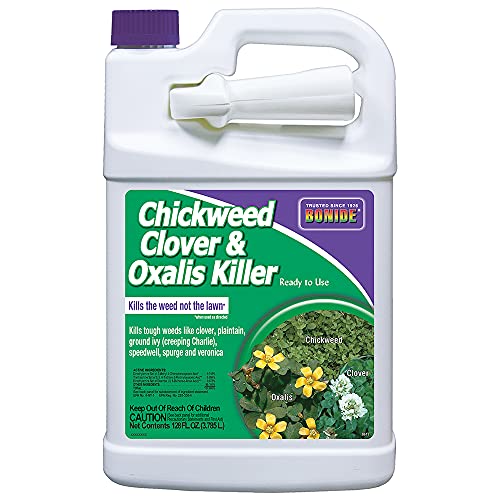
A broadleaf lawn spray with the biggest coverage here, aimed at ground ivy and creeping weeds in turf.
This is the option to consider if your fight is with ground ivy and broadleaf weeds running through a lawn rather than a fence-climbing vine. Its blend of triclopyr, MCPA, and dicamba is formulated to kill broadleaf weeds in lawns, roots and all, without killing lawn grasses when used as directed. The coverage is the headline — a stated 10000 square feet from the ready-to-use gallon, far beyond every other pick on this list. That said, you weigh the bottle at 8 pounds, versus 2 pounds for the Control Solutions concentrate, so it is a heavy pour-and-go jug rather than a light carry.
The label is specific about timing for good reason: spray when the weeds are actively growing and the temperature is below 90 degrees F, and spray when the air is calm so the mist does not drift onto vegetables and flowers you want to keep. It is also worth knowing that broadleaf sprays are not perfect across all turf — some grass types, including Zoysia and St. Augustine, brown out where a spray lands heavily. That is not the product failing; it is you needing to read the label against your own lawn.
What wins people over is the thorough kill on the wide range of broadleaf weeds it is built for, and the enormous stated coverage from one jug. The harder truths sit in the delivery: the hand sprayer is a weak point on a big lawn, and a few buyers open the box to find a missing or leaky nozzle. The practical fix is proven — pour it into a pump sprayer for even coverage. Best of both: sold ready-to-use, so no mixing, but you still want your own sprayer for wide-area work.
Strengths worth the trip
- States 10000 square feet of coverage — the most here by far
- Triclopyr, MCPA, and Dicamba target broadleaf weeds like ground ivy in turf
- Ready-to-use, so no mixing or tank measuring needed
- Designed not to kill lawn grasses when used as directed
Things to know before you spray
- The included hand sprayer is poor for large lawns — use a pump sprayer
- Occasional reports of a missing or leaky spray nozzle on arrival
- Can brown certain grass types like Zoysia and St. Augustine where sprayed heavily
Pick it for: ground ivy and broadleaf weeds spread across a lawn, where the huge coverage and lawn-safe formula are what you need.
Skip the sprayer inside: plan to pour into your own pump sprayer — the included hand trigger will leave you frustrated on a whole yard.
Know the Specs
Active ingredient: systemic versus contact
A systemic herbicide like glyphosate or triclopyr is absorbed through the greenery and carried into the roots, so it kills the crown of a vine rather than just the top. That is why a good ivy killer takes days to show damage — the plant is dying from the inside down. A contact spray burns only what it touches, often enough for small seedlings but rarely enough for a rooted vine that regrows from the base.
Concentrate versus ready-to-use
A concentrate is a bottle of active ingredient you measure into water; you control the strength and get far more mixed spray per bottle, but you need a tank and some care mixing. A ready-to-use bottle is pre-mixed and sprays straight from the package — ideal for a few vines, less economical for a big area where the volume runs out fast.
Coverage ratings
The coverage figure — whether in square feet for lawn sprays or square feet per gallon for concentrates — is your guide to how much ground a bottle handles. Concentrates are rated per gallon of mixed spray, so the number depends on your mix strength. Match that coverage figure to the square footage of your ivy problem so one bottle finishes the job.
Lawn safety and drift
A lawn product is designed to kill broadleaf weeds while sparing grass, but the label lists which grass types it suits. Spray on a calm day and shield flowers and vegetables, because mist that drifts onto a bed you care about does not care which plants you meant to treat.
Common Questions
Will a systemic weed killer actually kill English ivy down to the root?
How long before I see English ivy dying after spraying?
Can I use a brush killer near my grass without killing the lawn?
Is a concentrate or a ready-to-use spray better for ivy on a long fence?
What is the difference between glyphosate and triclopyr for ivy?
Will these products harm bees or butterflies?
Do I need to add a surfactant when spraying ivy?
How much area does one bottle of ivy killer actually cover?
Can I replant the ground after killing ivy with a glyphosate product?
What is the safest way to treat ivy climbing a fence near a garden bed?
The Bottom Line
For most ivy battles, the weed killer for english ivy winner is the Control Solutions Eraser & Grass Killer Concentrate because its 41% glyphosate goes straight for the root and leaves no residual soil activity, so you can replant once the vine is dead. If the ivy is woody and climbing a fence or tree, grab the Bonide Poison Ivy & Brush Killer, whose brush formula also handles stump treatment. For ground ivy and broadleaf weeds running through a lawn, the Bonide Chickweed, Clover & Oxalis Killer is the one to reach for, with the widest stated coverage of the group. One last nudge: the crowd-favorite Control Solutions concentrate holds a strong score even beside higher-priced bottles, so it is the low-risk place to start if you want root-level results without overspending.
How we choose
We do not accept paid placement. Every pick is matched to a real buyer and a real use-case; we do not hands-on test units.
Sources
Specifications: manufacturer listings and product documentation. Review insights: verified customer reviews, as of October 2026. Pricing: not shown on this page (it changes often); check the current price via the retailer link.
As an Amazon Associate, Aappliancez earns from qualifying purchases. This does not affect which products we feature.