Disclosure: Some links in this post are affiliate links. As an Amazon Associate I earn from qualifying purchases, at no extra cost to you. Learn more
Specs are compiled from manufacturer listings and verified buyer reviews and can change over time — please confirm the key details on the product page before buying.
Briars are the one weed that fights back. They slash your forearms, snag your sleeves, and come back from a stub of root you never saw. So the question you actually want answered is simple: which of these killers actually drives a blackberry or multiflora rose down into the ground and keeps it there? Here are the eleven that earn the job, each matched to a real property and a real spraying style.
This guide is built by comparing the manufacturers’ published specifications and the patterns across verified customer reviews, so you get each pick’s real strengths and trade-offs instead of marketing spin.
You still have to read every label before you spray, because a briar patch near a flower bed demands a different tool than a fence row in open pasture. Below you get the honest split between stump-and-brush concentrates, pasture herbicides, and fast knockdown sprays, all measured against the same yard. This is the working shortlist for the best weed killer for briars.
Top Picks


How To Choose The Best Weed Killer for Briars
Briars are not a grassy weed you can knock down and forget. Blackberry, multiflora rose, and kudzu are woody canes with a live crown at the base, so the spray has to travel from the leaf down into that crown. Pick the wrong active ingredient and you will watch the canes brown, drop their leaves, and push new shoots from the root within weeks.
Match the active ingredient to the kind of briar job
Triclopyr is the workhorse for woody plants. It moves through leaves and roots and targets broadleaf brush while leaving most grasses alone, which is why pasture owners reach for it. Glyphosate is non-selective — it kills whatever green thing it touches, including your grass — so it suits fencerows, driveways, and brush-clearing where nothing nearby has to live.
Decide between a ready-to-spray jug and a concentrate you mix
A ready-to-use jug with a wand lets you spot-treat a few canes behind the shed without buying a sprayer. A concentrate means you own the mix ratio instead of the factory, and one jug stretches across a lot of ground. Read every label for the exact ounces per gallon — going stronger than the label does not make it kill faster, it just wastes product and raises your exposure.
Plan for the cut-stump method on thick canes
On a briar crown as thick as your thumb, spraying leaves can be slow. Cutting the stem and painting undiluted concentrate onto the fresh cut feeds the root directly. Timing matters: one label here calls for applying within 45 minutes of the cut, before the wound seals over.
Side-by-Side Comparison
| Model | Best For | Active Ingredient | Format & Volume | Stated Coverage | Amazon |
|---|---|---|---|---|---|
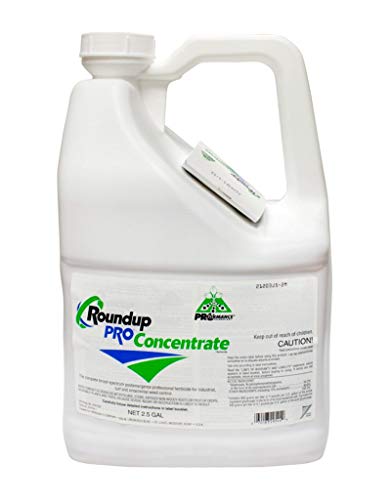
| Roundup Pro Concentrate★ Best Overall | Large acreage knockdown | Herbicide | Liquid concentrate, 2.5 gallons | Up to 435,600 sq. ft | Amazon |
| Southern Ag CrossbowBrush Specialist | Woody brush and vines | Garlon, 2,4-D | Liquid, 128 fl oz | Up to 96 gallons of spray; 2.23 acres | Amazon |
| Ortho GroundClear Tough Brush Killer3Ready To Spray | Fence lines and trails | Triclopyr, triclopyr salt, pelargonic acid | Ready-to-spray, 1 gallon | Over 60 listed weeds and brush types | Amazon |
| Fertilome Brush & Stump Killer | Stump and crown treatment | Triclopyr | Liquid concentrate, 32 oz | Full (see label) | Amazon |
| Gordon’s Pasture Pro | Pasture and rangeland spot spray | Herbicide | Spray | Kills 40+ brush species | Amazon |
| Alligare Triclopyr 4 | Forestry and rights-of-way | Triclopyr | Liquid concentrate, 1 quart | Refer to label | Amazon |
| Credit 41 Extra | Total vegetation strip-out | Glyphosate 41% with surfactant | Liquid, 2.5 gallons | Annual (no residual) | Amazon |
| Gly-Star Plus | Big-jug glyphosate value | Glyphosate 41% with surfactant | Liquid, 2.5 gallons | Refer to label | Amazon |
| Bonide Poison Ivy & Brush Killer | Brush over lawn grass | MCPA, triclopyr, dicamba | Liquid concentrate, 128 fl oz | Over 240 weed types | Amazon |
| Hi-Yield Killzall II | Fast knockdown in open ground | Glyphosate 41% | Liquid, 2.5 gallons | Full (see label) | Amazon |
| Remedy Specialty Herbicide | Pasture restoration and fencerows | Herbicide (triclopyr) | Liquid, 1 gallon | Selective brush and mid-size trees | Amazon |
Detailed Reviews
1. Roundup Pro Concentrate Herbicide
Our pick — 4.5+★ from 500+ verified ratings; the strongest balance of quality and price.
One jug that covers up to 435,600 square feet, which is roughly ten acres of treated ground.
If you own a lot of ground and briars are scattered across all of it, this is the pick the crowd has settled on — 4.5+ stars across 500+ ratings, the strongest score in this lineup. The number that matters is coverage: the maker lists up to 435,600 square feet from a single 2.5-gallon jug of concentrate. Mix it at label strength and one purchase carries you through a full season of fence-row spraying instead of three return trips to the store.
What owners talk about most is simply that it works. Buyers report treating five acres with it year after year, and one sums the jug up this way: “2-1/2 gallons of this concentrate will make 80 gallons of product.” Expect the visible turn slowly — brown-out in three to four days, and the plant dying down over about a week. That delay is normal for a systemic, so do not respray on day two thinking nothing happened.
Here is the catch, and it is a physical one: a full 2.5-gallon jug is heavy, and tipping it to pour will splash concentrate on your arms. The smart move owners make is a hand pump with a spigot that threads onto the jug throat and dispenses by the ounce. Also check your address first — this one is not for sale to Wisconsin or New Jersey.
The case for the big jug
- Up to 435,600 square feet of coverage from one 2.5-gallon jug.
- Concentrate lets you set the mix strength per label rather than accept a factory ratio.
- Highest-rated pick in this group, and the most-cited reason is straightforward effectiveness.
Where it bites back
- The jug is heavy and awkward to pour from without a pump spigot.
- Cannot be shipped to Wisconsin or New Jersey.
- Slow systemic kill means a week of waiting before you judge results.
Go here if: you are treating a big parcel and want one jug to last the season.
Buy the pump too: a screw-on spigot turns a back-straining pour into an ounce-by-ounce measure.
2. Southern Ag Crossbow Specialty Herbicide
Built for woody canes and vines, with Garlon and 2,4-D doing the work on blackberry and kudzu.
Crossbow is the one to reach for when the target is specifically brush — unwanted trees, vines, and perennial broadleaf weeds rather than a scruffy lawn. It is formulated around Garlon and 2,4-D, two active ingredients that go after woody growth. Mixed to the label, a single 128-fluid-ounce container makes up to 96 gallons of spray solution and covers 2.23 acres, so a quarter-acre briar thicket takes a tiny fraction of the jug.
What people rave about is the kill on the hard stuff. The review pages describe it taking out jewelweed and pokeweed overnight, and it is a favorite systemic for vines and ivy when painted onto cut stems. Soil behavior is the other selling point that keeps coming up — a short three-day soil half-life, so it breaks down quickly rather than sitting in your ground. It has no glyphosate in it either, which matters to anyone spraying near a pollinator garden.
Two honest notes before you buy. It carries a strong odor that you will notice while mixing, and it is slow in cool weather — a 1% solution takes about a week, so spray at the start of a warm dry day with no rain in the forecast. It also works unevenly by soil: reports range from 85-95% creeping charlie kill on brownish Ohio soil to 30-60% on rich black northern Illinois ground.
Who it suits: anyone with established vines and multiflora-type brush who wants a targeted broadleaf systemic and does not mind a smell.
The honest limit: results swing with soil and weather, so expect to spot-treat the survivors rather than call it done after one pass.
Reach for this if: the job is woody vines and broadleaf brush, not open grass.
Spray earlier in the day: warm, dry weather and a rain-free forecast do more for the kill than a stronger mix.
3. Ortho GroundClear Poison Ivy & Tough Brush Killer3
No mixing, no sprayer to buy — a battery-powered wand and a jug, ready on day one.
This is the one for the person who spots six briars along the back fence and does not want to own a sprayer, a measuring cup, or a pair of rubber gloves for the job. A 1-gallon jug arrives with a battery-powered Comfort Wand that lets you point and spray accurately at foliage, stems, and trunks. The formula is built on triclopyr, a triclopyr salt, and pelargonic acid, and the label names over 60 listed tough weeds and brush including poison ivy, poison oak, kudzu, and wild blackberry.
Speed is where it separates from the concentrates. The maker states visible results in just 1 hour and rainproof in 2 hours — a real advantage on a fence line when you cannot pick your weather window. What wins people over on the wand is that it sprays far and accurately without bending into the thicket. Do keep it away from lawns and garden beds with desirable plants; the label is clear that this is for around homes, cabins, fences, and trails.
The trade-off is honest and it is baked into the format. At 1 gallon of ready-to-use liquid you are paying for water and convenience, and the coverage is far smaller than a concentrate — compare that with the Roundup Pro jug’s 2.5 gallons and up to 435,600 square feet. It also works best only while weeds are actively growing and fully leafed out, so a winter spray on dormant canes is money wasted.
Best for the small, awkward job: a handful of canes on a fence or trail where setup time would beat the actual spraying.
Look elsewhere for acreage: a ready-to-use gallon will not stretch across a big patch the way a concentrate will.
4. Fertilome Brush Killer & Stump Killer
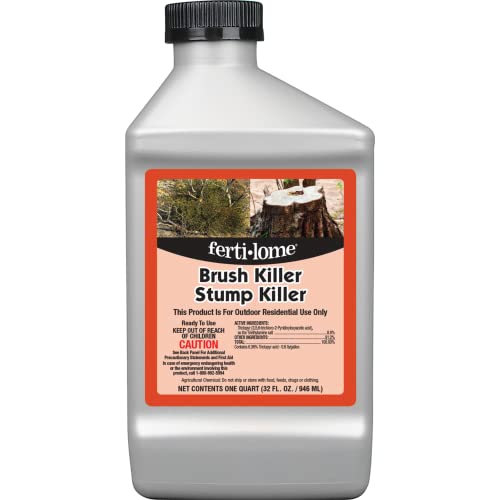
A triclopyr concentrate that doubles as a stump dab and a leaf spray, with no hole-drilling required.
When you have already cut the briar crown down to a stump and want it dead instead of resprouting, this is the format that fits. It is a triclopyr ester concentrate made for woody plants, vines, and stumps in non-crop areas. For a stump you use it straight from the bottle and paint it on with a brush, and the label asks you to work within 45 minutes of the fresh cut. For brush you dilute 8 ounces of concentrate into 1 gallon of water and spray the leaves.
The thing buyers appreciate most is the application itself — no drilling holes into the stump, just a brush and a dab. That said, the honest read on this one is that it is a mixed bag for some people. Growth control reports run both ways: some see no regrowth after three months, others watch the brush return. That spread usually tracks how fresh the cut was and how well the mix matched the label, not a bad batch.
Compare it against the big jugs and you see the trade: 32 ounces is a small bottle with a small coverage claim, so it suits spot work on a few crowns and mixed brush rather than a wholesale clearing. Buy it for precision, not for volume.
Precision pick: best used as a targeted stump treatment where you can reach the cut face and time the application.
Not a volume tool: a 32-ounce bottle is for the handful of crowns you can actually see, not a field of them.
Reach for this if: you have cut briar crowns and stumps waiting for a dab of undiluted concentrate.
Do not skip the timer: get the product on the fresh cut inside 45 minutes or the wound closes and the uptake drops.
5. GORDON’S Pasture Pro Brush Killer
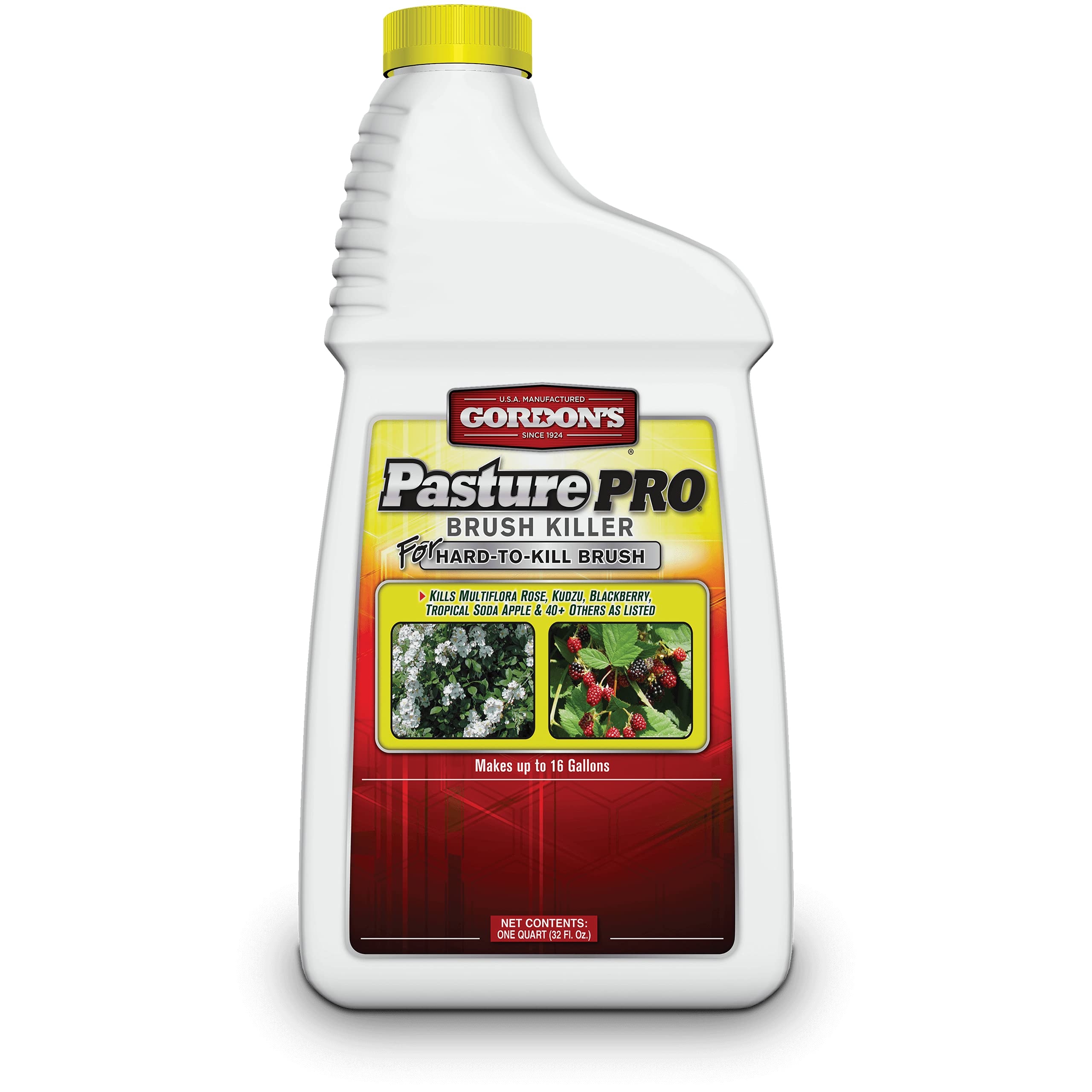
A concentrated pasture herbicide aimed at 40-plus brush species, including multiflora rose and kudzu.
For a farmstead or rangeland where you want to walk the fence line with a spot sprayer, this is a purpose-built option. The label names 40+ species of brush, woody plants, and vines, with multiflora rose, Himalayan blackberry, and kudzu called out by name — all three are exactly the kind of thorny growth that makes a pasture unmanageable. It is a concentrate, applied as a spot spray on pastures, rangelands, and farmsteads rather than broadcast over the whole field.
Here is the thing you need to know before you commit: this listing carries very little owner feedback to lean on. The score sits at 4.5+, but the rating base is tiny compared to the other picks here, so treat it as an untested-by-the-crowd option and rely on the label over the reviews. It is not a bad product — it is an unproven one in this lineup.
That makes it a fit question rather than a quality question. If you are managing pasture and want a named brush list you can check against what is actually growing, Gordon’s is straightforward. If you would rather buy the option that thousands of owners have already validated on their own land, the pasture pick further down this list carries far more evidence behind it.
Straightforward brief: a named list of 40+ brush species makes it easy to check against your own problem plants before you buy.
The caution: a thin review history means you are trusting the label, not a crowd — fine for a confident label reader, less so if you want proof.
Choose this if: you know your target plants, spray by spot application, and want a pasture-labeled concentrate.
Want company in the decision: look to the better-documented pasture triclopyr pick instead.
6. ALLIGARE Triclopyr 4 Herbicide
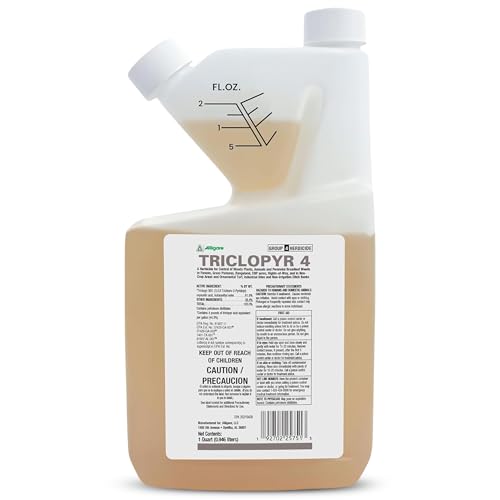
Ester triclopyr for forestry and rights-of-way, made to hit woody brush without taking the grass with it.
This is the classic professional tool for clearing brush from ground you want to keep grassy. Triclopyr 4 is a selective herbicide that targets woody plants, broadleaf weeds, and brush while leaving grasses alone — which is exactly the behavior you want on a pasture or a right-of-way where the briars grow up through grass you need. Its ester formulation is designed for absorption through both leaves and roots, and it is meant to be tank-mixed with other herbicides when a job needs a custom recipe.
The strength of this one is concentration and flexibility. A single quart of 32 fluid ounces goes a long way because you mix only a few ounces into a gallon of water, and the label allows application year-round rather than a narrow window. It is the kind of jug you buy once and work through across multiple seasons of fence-line maintenance.
The honest part: the instructions are the weak link. Several owners mention the label is not very clear, so plan to read it twice and measure carefully. It is also selective but not perfectly so — it can hit desirable plants and flowers if your spray drifts, so shield anything you want to keep. One buyer’s experience of spraying near a border: keep your aim tight.
What earns it a spot
- Selective on broadleaf brush while sparing grasses, ideal for pasture and right-of-way work.
- Ester formulation for uptake through leaves and roots.
- Year-round application flexibility and tank-mix compatibility.
What to plan around
- The mixing instructions are not written for beginners.
- Drift can damage nearby flowers and desirable plants.
- You supply your own sprayer and measuring gear.
Good fit for: a pasture, fencerow, or right-of-way where grass has to survive and briars have to go.
Read it slowly: the label is not beginner-friendly, so budget time to work out your mix before you spray.
7. Credit 41 Extra Herbicide

A total-vegetation glyphosate built to clear a strip of ground completely and hold it clear.
If the briars are growing through a gravel drive, along a building foundation, or across a patch you want bare, you want glyphosate rather than a selective brush herbicide. Credit 41 Extra is 41% glyphosate with a surfactant already mixed in — that surfactant is a sticker that helps the spray cling to a waxy leaf instead of beading off. The label describes it as a total vegetation killer with no residual, so it kills what it touches and then breaks down rather than sitting in the soil.
Users consistently point to the value. One notes it does the job of a pricier name brand at half the cost, and the value-for-money count leads its review aspects. In practice, a 2.5-gallon jug mixed to the label goes a long way — customers note stretching it across repeated applications and large areas. The kill is thorough: the reviews talk about grass and weeds staying gone through rain where a standard weed killer would have been followed by regrowth within weeks.
The real trade-off is that “total vegetation” is literal. You cannot spray this on a briar growing in the middle of a lawn you want to keep, because it will kill the grass too. Save it for ground where everything can go, and shield or avoid anything you want living.
The value read: 2.5 gallons of 41% glyphosate with surfactant, built for heavy repeat use across large, cleared areas.
The catch: no residual and no selectivity — bare ground only, never a lawn.
Pick this for: driveways, fencerow strips, and bare-ground cleanup where nothing has to survive.
Keep it off the lawn: it is a total-vegetation killer, so it will take the grass with the briars.
8. Gly-Star Plus Herbicide
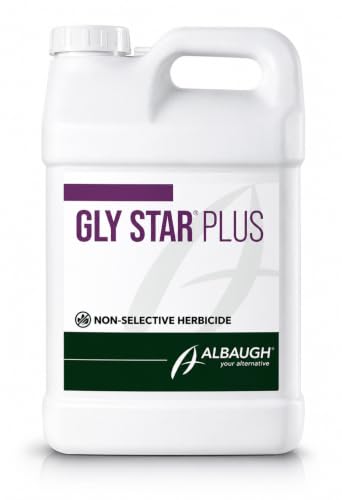
A 2.5-gallon glyphosate jug with the surfactant built in, aimed at large-scale non-selective clearing.
Gly-Star Plus is the same active ingredient as Roundup Ultra at a 41% glyphosate concentration, with a surfactant system already loaded in so you do not buy a separate sticker. It is a post-emergent systemic that moves from the leaf down into the root system, which is what makes it useful on woody brush and trees as well as broadleaf weeds and grasses. Expect visible effects within 2-4 days on most annual weeds and 7 or more days on most perennials — slow enough that you wait, thorough enough that it counts.
What wins people over is the combination of reach and price. The 2.5-gallon jug is big enough for large-scale applications, and buyers consistently rate its effectiveness on everything from weeds to brush. The no-residual claim means once it has done its work it does not linger in the soil, so you can replant treated ground on your own timeline.
The main caveat is geographic: this listing is not for sale to CA, MT, NV, OR, WA, or WY. Check your state before you commit, because no amount of good value helps if it cannot ship to your zip code. Compare it with the Credit 41 jug and they are near-twins — both 2.5 gallons of 41% glyphosate, so let availability and label match decide between them.
Take this if: you need a large non-selective jug with surfactant included and your state allows shipment.
Check your address first: several western states are excluded from sale on this listing.
9. Bonide Poison Ivy & Brush Killer BK-32

A brush killer blended to take woody weeds while leaving the lawn grasses you deliberately planted.
Most briar killers force a choice: kill the brush, lose the grass. This one is built for the case where the briars are growing up through a real lawn. The label lists over 240 tough weeds and brush, including poison ivy, poison oak, kudzu, wild blackberries, chickweed, dandelion, clover, and thistle, and it names the lawns it suits — bluegrass, fescues, rye, bent, Bermuda, Bahia, and zoysia. It is also labeled for stump removal when dabbed undiluted onto a freshly cut stump.
The kill on heavy vines is where it proves itself. One buyer recounts taking down a thick, intrusive vine that had been choking out a fence, and another reports it knocking back small mesquite bushes and thorny vines after a single application. For a mixed yard with briars in the grass, that grass-sparing behavior is the whole point.
Be precise, though. It is a lawn product but not a plant-safe product everywhere — a buyer who got some on a patch of ground outside the lawn described ruining that spot, so keep it on the target. And it is not universal: bindweed gets named as a survivor, and an overgrowth of established heavy brush may only wither rather than die on one pass.
Where it wins: broadleaf brush control that leaves listed lawn grasses intact, plus a stump-dab mode.
Where to be careful: keep it on the lawn and off the surrounding beds, and expect a second pass on dense, established brush.
Made for: a yard where briars and broadleaf weeds rise up through grass you intend to keep.
Mind your aim: it will damage ground outside the lawn, so keep the spray where it belongs.
10. Hi-Yield Super Concentrate Killzall II

Reaches the root in 1 to 2 hours and shows visible results in as little as 3 hours.
Speed is the headline here. This glyphosate 41% super concentrate is formulated to reach the roots in 1 to 2 hours and provide visible results in as little as 3 hours — the fastest stated action among the glyphosate big jugs in this lineup. It controls annual and perennial grasses, broadleaf weeds, and woody brush, and it is a non-selective, so you use it where everything can go: trees, flower beds (as a clear-out), buildings, driveways, and sidewalks. The 2.5-gallon jug is sized for acreage operators working through a lot of ground.
Owners describe it doing exactly what the label says. The green turns brown in a few days and finishes dying over a week or ten days, and the review sentiment is that it works as well or better than the big-name brand. It is a no-residual glyphosate, so once the spray does its work it clears out of the soil instead of blocking your next planting.
Two things to plan for. It is a heavy, potent jug — this is commercial-grade chemistry, so wear gloves, keep the sprayer clean, and wash your clothing and exposed skin afterward. And it is non-selective: diluted product seeps into ground and will kill wanted plants that sit in the drift, so keep a tight line on the nozzle.
The fast lane: visible results in as little as 3 hours and root reach in 1 to 2 hours, per the label.
Handle with respect: non-selective and potent, so drift and splash both need managing.
Good match for: open ground, driveways, and clear-outs where a fast visible knockdown is worth waiting on a slower product for.
Suit up first: gloves, clean sprayer, and careful aim — this is not a product to be casual with.
11. Remedy Specialty Herbicide
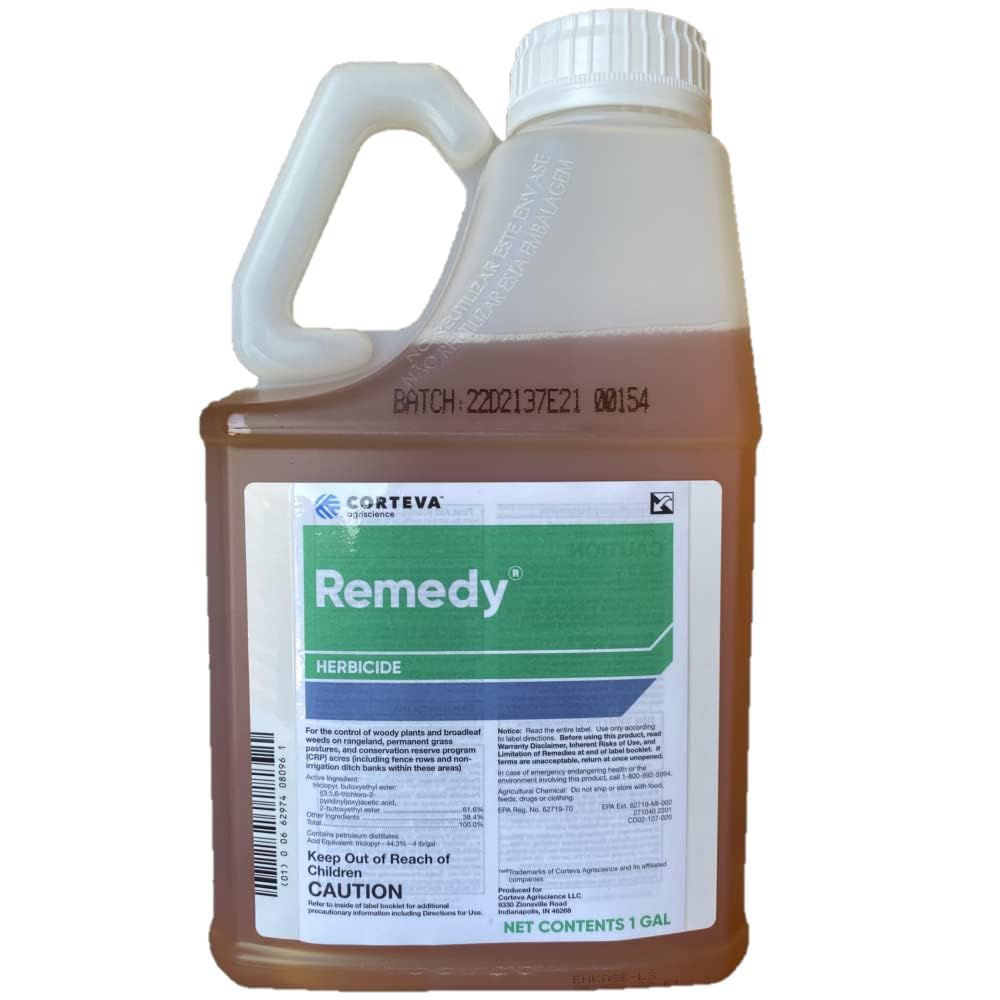
A low-odor triclopyr concentrate built for pasture restoration and fence-row brush control.
For someone bringing a neglected pasture back into use, Remedy is the classic name — a triclopyr concentrate aimed specifically at brush and mid-size trees, ideal for fence lines and pasture regeneration. Its low-odor formulation is the practical upgrade over some of the other brush concentrates here, because a briar-choked fencerow is a lot of spraying and you will be out there a while. It works on the entire plant, roots included, so the brown canes do not simply push new growth.
The effectiveness is the reason it is popular. Owners routinely describe near-total kill, and it is flexible enough to run alone or tank-mixed with GrazonNext or ForeFront HL for a custom recipe. A full 1-gallon jug at 128 fluid ounces is a serious amount of concentrate, so a mid-size pasture or long fence line gets several seasons out of one purchase.
Two truths to hold alongside that. First, on cost, the value feedback is split — some owners find it well worth it, others find it pricey, so set that expectation honestly. Second, it is selective toward brush but not on all desirable plants, so keep the spray on the briars you intend to kill. Compare it to the Alligare Triclopyr 4 above and you get the same triclopyr job done with a lower odor and a bigger jug here.
Why pasture owners keep it
- Low-odor triclopyr concentrate for long spraying sessions on fence rows.
- Works on the entire plant, roots and top growth.
- Tank-mix compatible with GrazonNext or ForeFront HL.
Before you commit
- Value feedback is split — some find it pricey for what you get.
- Selective for brush but not for every desirable plant nearby.
Aimed at: pasture restoration and fence-row clearing where odor and long spraying sessions both matter.
Price your job: the value reviews split, so size your acreage before you decide it is the economical route for you.
Know the Specs
Triclopyr versus glyphosate
Triclopyr is a selective herbicide aimed at woody plants and broadleaf weeds, so it targets briars while generally leaving grasses standing — which is why most pasture and fencerow products here are built on it. Glyphosate is a non-selective systemic, meaning it kills nearly any plant it touches, grasses included, so it suits ground-clearing and bare strips. Neither is better in the abstract; pick triclopyr to spare grass and glyphosate to clear everything.
Ready-to-use versus concentrate
A ready-to-use jug arrives pre-mixed, often with a wand, which suits a small number of briars where setup would take longer than spraying. A concentrate means you mix the solution yourself, so you control strength and get far more total spray from one container. The label lists the exact mix rate for each product — for example, one concentrate here calls for 8 ounces in 1 gallon of water for leaf spraying, while others use only a few ounces per gallon. Match the format to the job: a ready-to-use wand for a few canes, a concentrate for acreage.
Cut-stump versus foliage application
Foliage spraying is the common approach: you coat the actively growing leaves and let the chemical move down. Cut-stump application is for a briar crown too thick to spray down efficiently — you cut the stem and paint undiluted concentrate right onto the fresh cut. Timing is critical on stumps; one label here asks for application within 45 minutes of cutting, before the wound seals. Cut-stump uses far less product per plant but more hand labor.
Residual versus no-residual
Residual means the product keeps working in the soil for a while after the spray, which can slow a quick return of weeds. No-residual means the chemical does its job on the plant and then clears, so you can replant treated ground sooner. Products labeled total-vegetation kill typically carry no residual, so they clear a strip but do not keep re-suppressing what comes back after the plant is gone.
Common Questions
Will a brush killer kill blackberry and multiflora rose to the root?
Can I use a briar killer and still keep my lawn grass alive?
How long until a briar killer actually kills the plant?
Do I need a separate sprayer to apply a concentrate?
How much does a gallon of concentrate actually cover?
Is a triclopyr brush killer safe around pets and children?
What is the difference between a brush killer and a total vegetation killer?
Can I apply a briar killer in winter or when the plant is dormant?
How do I stop a briar killer from killing plants I want to keep?
Which briar killer is best for a small yard versus a large property?
Do these brush killers leave residue in the soil that blocks replanting?
The Bottom Line
The strongest all-around choice for a large property is the Roundup Pro Concentrate, because one 2.5-gallon jug covers up to 435,600 square feet and it holds the best rating in this lineup at 4.5+ stars. If your briars are woody vines and brush rather than grassy ground, the Southern Ag Crossbow targets that growth directly and makes up to 96 gallons of spray. And for a pasture or long fence row where you want a low-odor triclopyr, the Remedy Specialty Herbicide is the one to reach for.
If you only have a handful of canes and no sprayer, the Ortho GroundClear Tough Brush Killer3 gets you spraying on day one with its own wand, and the Bonide Poison Ivy & Brush Killer is the pick when the briars are growing up through lawn grass you want to keep. Whichever you choose, match the active ingredient to the plants you want to survive, and read the label before the first spray.
How we choose
We do not accept paid placement. Every pick is matched to a real buyer and a real use-case; we do not hands-on test units.
Sources
Specifications: manufacturer listings and product documentation. Review insights: verified customer reviews, as of October 2026. Pricing: not shown on this page (it changes often); check the current price via the retailer link.
As an Amazon Associate, Aappliancez earns from qualifying purchases. This does not affect which products we feature.