Disclosure: Some links in this post are affiliate links. As an Amazon Associate I earn from qualifying purchases, at no extra cost to you. Learn more
Specs are compiled from manufacturer listings and verified buyer reviews and can change over time — please confirm the key details on the product page before buying.
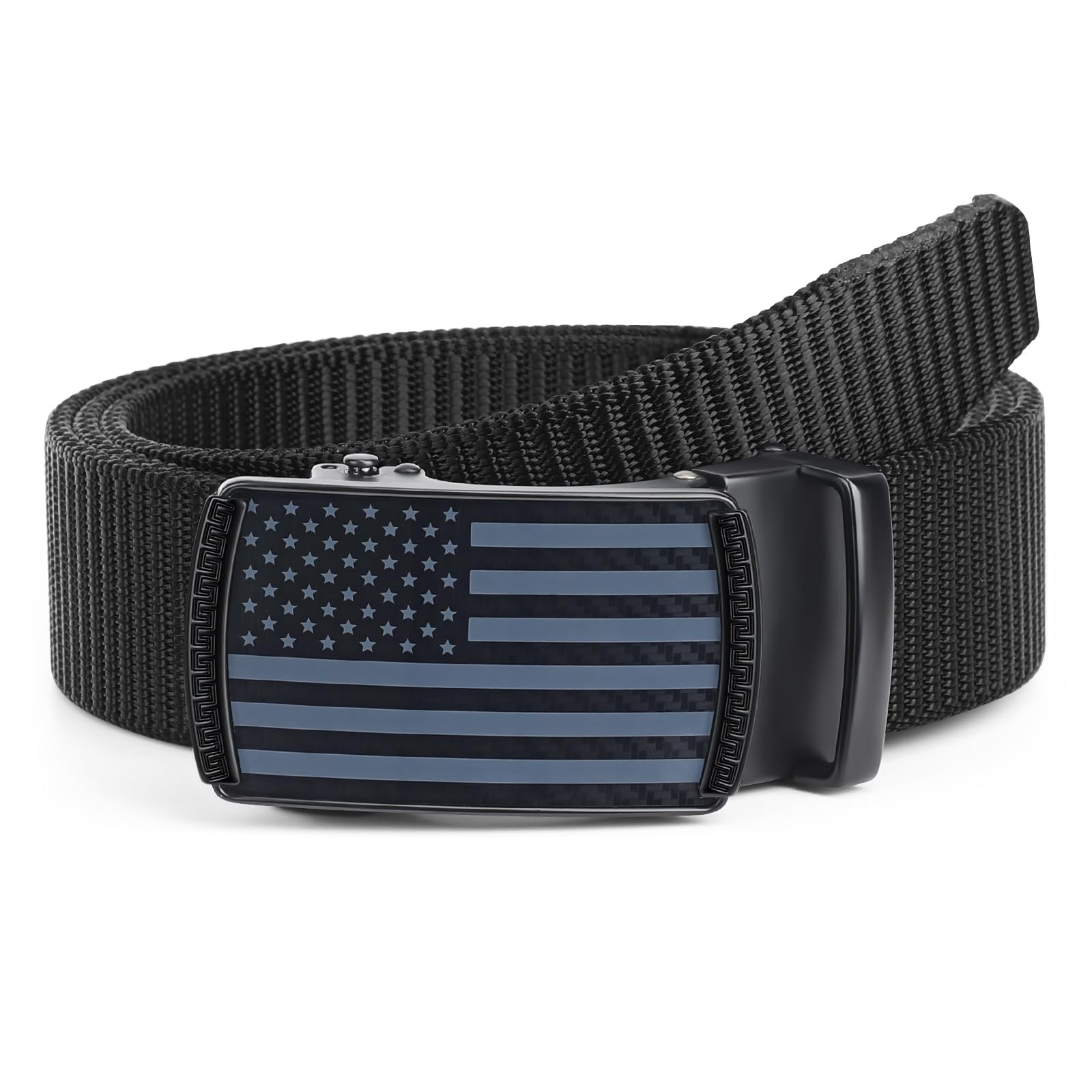
If your belt keeps loosening by lunchtime, the fix is a webbing belt with a ratchet buckle — a toothed metal clamp that locks the strap anywhere you set it instead of at pre-punched holes. The four picks below cover the realistic range: one for everyday jeans and golf shorts, one for bending and crouching all shift, one for water and salt, and one built to hang gear off. Start with the SANSTHS if you want the easiest all-rounder.
This guide is built by comparing the manufacturers’ published specifications and the patterns across verified customer reviews, so you get each pick’s real strengths and trade-offs instead of marketing spin.
Webbing belts are simple on the surface and fiddly in the details, so the sections below cover buckle type, strap stiffness, cut-to-fit sizing, and how each strap behaves on a real waistline. By the end you will know exactly which web belt matches how you actually move and what you hang off it.
Top Picks
How To Choose The Best Web Belt
A web belt is a strip of woven nylon with a metal buckle on one end. That is the whole design, and almost every difference that matters to you lives in two places: how the buckle holds the strap, and how stiff the strap itself is. Get the buckle and the strap stiffness right and the belt stays put through a full day. Get either wrong and you spend the morning hitching your pants back up.
Pick the buckle before you pick the color
There are two buckle families in this lineup. A ratchet buckle has teeth inside the housing that bite into the webbing anywhere you push the strap through, so you get a continuous range of fit rather than fixed holes. A roller-style ratchet buckle does the same job with a different feel in the hand. Either way, the buckle is the part that decides whether the belt stays where you set it.
Pay attention to how you loosen it, too. A spring-loaded release latch lets you back the belt off with one hand, which matters every time you sit down or get in a car. A two-step tighten — feed the end through loosely, snug it to your waist, then pull the free end to lock — takes a second longer but holds harder once it is set.
Match strap stiffness to your day
Stiffness is the spec nobody lists on the tag, but it is the one you feel. A rigid strap keeps a holster, a tool pouch, or a heavy pouch from dragging your waistband down. The same rigidity makes bending and crouching less comfortable, and it can fight the loops on soft, lightweight trousers.
If your day involves a lot of bending, climbing, or crouching, a belt with built-in stretch works with you instead of against you. If your day involves standing at a bench, carrying gear, or walking a lot of stairs, choose the rigid option and appreciate it.
Work out your length the right way
Most webbing belts in this category are cut-to-fit: you buy a long strap, then trim the tail to your waist and finish the cut end. That is why one size can genuinely fit many people. Cut in small steps, wear the belt for an hour, then cut again if you need to. Trimming too short is the one mistake you cannot undo.
Side-by-Side Comparison
| Model | Best For | Strap Width | Buckle Type | Sizing Method | Amazon |
|---|---|---|---|---|---|
| SANSTHS Nylon Ratchet Belt with Automatic Slide Buckle★ Best Overall | Everyday jeans, golf, and casual wear | 1 1/3″ | Automatic slide ratchet | Cut-to-fit, removable buckle | Amazon |
| Carhartt Men’s Rugged Flex Nylon Webbing Belt | Work days with constant bending | 1.5″ | Antique nickel ratchet-style roller | Continuous adjustment, no holes | Amazon |
| IDOGEAR SPORTS Tactical Ratchet Belt | Carrying gear, EDC, and duty use | 1.75″ | Metal ratchet | Cut-to-fit, screw-retained buckle | Amazon |
| Huk Fishing Nylon Webbing Belt | Boat days, saltwater, and hot weather | — | Webbing clamp buckle | Trim to fit up to 44″ waist | Amazon |
Detailed Reviews
1. SANSTHS Nylon Ratchet Belt with Automatic Slide Buckle
Our pick — 4.5+★ from 350+ verified ratings; the strongest balance of quality and price.
Fine-tuning in tiny steps is the whole point here — set it, forget it, done.
You get a fit that lands exactly where you want it, because this belt adjusts in 1/5″ steps. That is a fifth of an inch between settings, so you can tighten it a fraction at a time. Punched leather belts jump in much bigger gaps and leave you choosing between slightly loose and slightly pinching. The strap is woven nylon at 3mm thick and 1 1/3″ wide — thick enough to feel like a real belt rather than a strap, and narrow enough to slide through ordinary jeans and dress-trouser loops without a fight.
What wins people over is the build quality of the strap and buckle together. It reads as a belt you could wear to a job site or a dinner without changing it, which is unusual for something this simple. The buckle is zinc alloy with a removable design, which means you can pull the strap out, trim the nylon tail down to your length, and push it back in — no sewing, no tools, no guessing. The buckle face is anti-scratch, so the finish stays looking fresh rather than picking up a scratched patch in the first month.
The honest catch is durability, and it splits opinion. Some belts hold up beautifully for months and stay tight; a smaller share report the buckle slipping while the belt is being worn. That is a fair thing to know going in, and it is the reason this is a wear-it-and-check-it belt rather than a set-and-forget one. Wear it hard for the first few weeks — that is when a slipping buckle shows itself.
What earns its keep
- Fits a fraction of an inch at a time, so the belt lands exactly where your waist is.
- Removable buckle means you trim the nylon to your own length in a couple of minutes.
- Zinc alloy buckle with an anti-scratch face, so the finish survives daily wear.
- 3mm thick, 1 1/3″ wide webbing gives the strap real body on jeans and casual trousers.
Where it gets thin
- A share of owners have the buckle slip while worn, so it is not a guaranteed set-and-forget.
- Rigidity that makes it good for trousers can feel like more belt than you want on soft, light fabric.
Reach for this if: you want one belt that works with jeans, golf shorts, and casual trousers and you like to dial in an exact fit.
The honest caveat: it is a belt you have to trust over time — some units slip at the buckle, so wear it hard for the first few weeks and make sure yours holds.
2. Carhartt Men’s Rugged Flex Nylon Webbing Belt

A braided nylon belt that stretches with you on every crouch and every climb.
If your day is a lot of hauling, crouching, and bending, the belt fighting your waistband is a real annoyance, and that is exactly the problem this one is built to solve. The strap is braided two-tone nylon shock cord with built-in stretch, so it moves with you instead of pinching when you fold forward. It is 1.5″ wide, which fits standard jean and work-pant loops without bunching. That width is worth noticing against the narrower SANSTHS above — it fills the loop rather than floating inside it.
The engineering that matters most is at the parts that fail first. A thermoplastic rubber end cap sits over the belt tip, where braided belts normally start to fray and unravel, and the Carhartt logo is molded right into it. The buckle and keeper loop use contrast polymer material at the two highest-stress attachment points, which keeps the hardware anchored to the braid. The buckle itself is an antique nickel ratchet-style roller that adjusts across a continuous range rather than punched holes, so lunchtime or end-of-shift fitting is a small squeeze rather than a fight with a prong.
Two things to weigh before you commit. The buckle tightens with a slightly awkward motion for some hands, which is not a defect so much as a learning curve — once you have the motion, it is fine. And the strap is not a rigid load-bearing belt, so it is the wrong choice if you plan to hang a holster or a heavy pouch from it. Buy it as a comfortable, flexible work belt for bending and crouching, not as a platform for hanging gear.
Where the design pays off: braided shock cord with stretch is the right call for anyone who spends the day folding, lifting, and reaching. The end cap and reinforced buckle points address the two places braided belts usually let go. The continuous roller adjustment means you never hunt for a hole after a meal. And the branding is low-key enough that it does not shout workwear.
What to expect instead: this is a soft, flexible belt by design. If the job is stability and gear-carrying rather than comfort, look at the IDOGEAR below, which is built around a rigid strap and a wider 1.75″ profile.
Best matched to: trades, warehouse shifts, and anyone who bends all day and wants a belt that lets them.
Think twice if: you need to hang weight from the belt, because the stretchy braid flexes under load.
3. IDOGEAR SPORTS Tactical Ratchet Belt
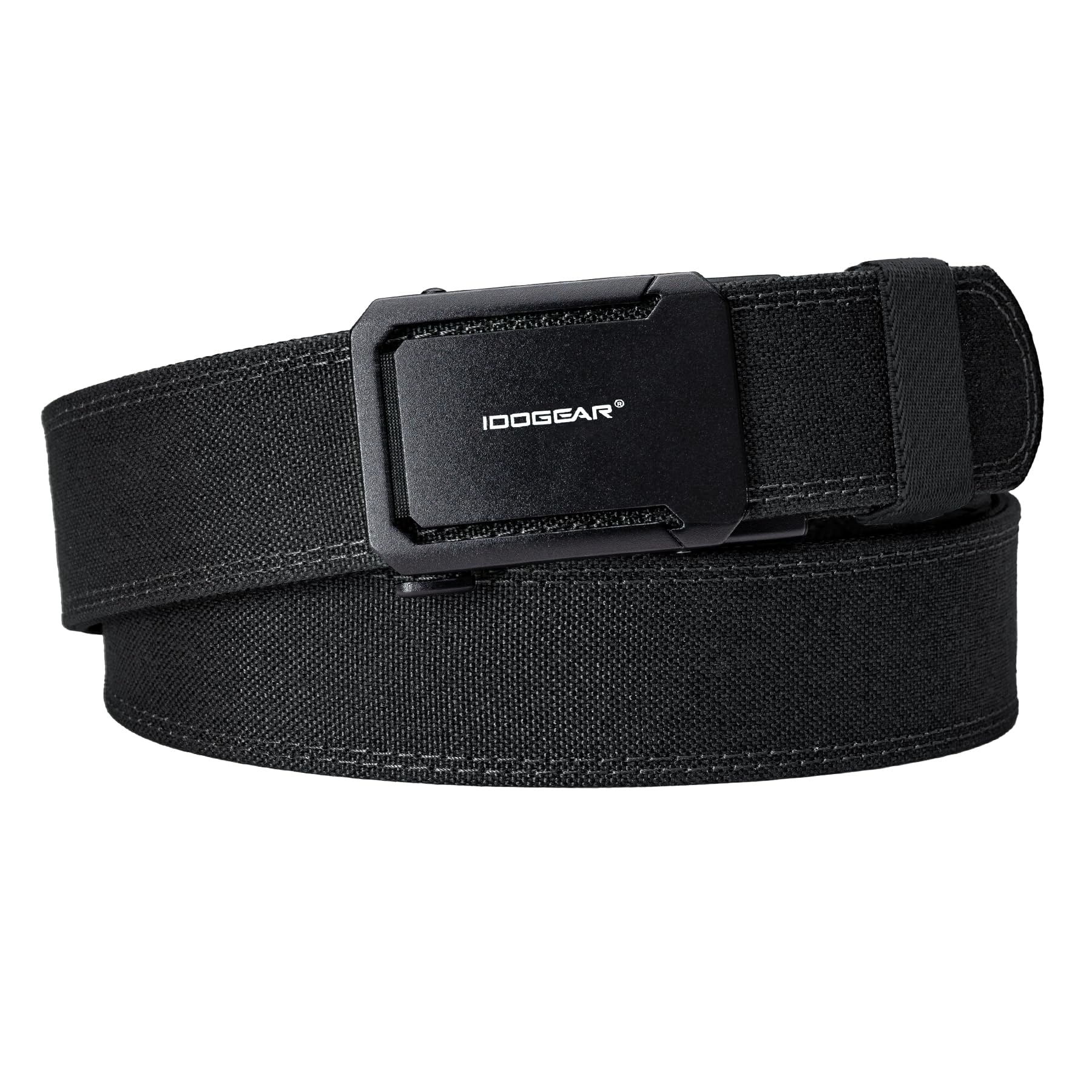
A wide, rigid belt that holds a loaded pant line without sagging an inch.
This is the pick for the person whose belt is really a mounting point. The strap is 1000D nylon — a heavy woven fabric rated for hard use — built as a double layer, which makes it stiff and essentially zero-stretch. The combined width is 1.75″, noticeably broader than the 1 1/3″ SANSTHS, and that extra surface is what stops a heavy holster or tool pouch from dragging your trousers down over the day.
Owners load this thing up and it keeps its shape. Full-size pistols, spare magazines, a medical kit — the belt holds the line instead of bowing. The honeycomb backing is built to spread pressure across your waist, and the ratchet closure micro-adjusts with one hand, so you can click it tighter or looser without undoing anything. The buckle is metal and the strap can be trimmed: release the buckle retainer, unscrew the locking screws, pull the belt out, cut the excess, and reassemble.
The very thing that makes this belt work is also its limit. At 1.75″ wide and genuinely rigid, it will not thread through the loops of every pair of trousers — slim-cut jeans and light casual pants are a real risk. It is also more belt than you need if you are not carrying anything. That is a belt-loop fit question, not a flaw — a 1.75″ load-bearing strap is doing exactly its job.
The core case: rigidity plus width plus a one-handed ratchet is the exact combination a loaded waistline needs. The anti-slip performance and the honeycomb backing mean a day of standing and walking with gear does not turn into a day of hitching. The metal buckle and double-layer 1000D nylon are built for years of loaded wear, not a season. And it still looks clean enough to wear off-duty without reading as costume.
The real limit: check your belt loops before you buy. A 1.75″ strap needs trousers that were made with room for it.
Built for: everyday carry, duty wear, range days, and any waistband with real weight on it.
Look elsewhere if: you wear slim or light trousers and want a belt that threads anywhere.
4. Huk Fishing Nylon Webbing Belt

The one you want on the boat — nylon that shrugs off spray and dries fast.
Nylon webbing is the right material for days on the water because it resists water and holds up to repeated wear. This strap is built on exactly that, and sizing is trim-to-fit up to a 44″ waist, so you cut the tail down to your length and finish the end. Buyers report cutting theirs to length and melting the cut end to stop fraying — a custom fit in a few minutes with a lighter and a steady hand. Multiple colors and patterns are part of the appeal if you want the belt to look like a choice rather than a default.
What the belt does well is stay put in wet conditions. The webbing is dense and rigid enough to hold its shape, and it stays locked where you set it instead of working loose as you move around the boat. It handles the usual boat-day jobs — holding up quick-dry pants and carrying sheathed fishing tools — without rust or corrosion showing up on the buckle. The buckle is a thick, solid piece of hardware rather than a thin stamped plate.
The buckle is also the trade-off. It is a heavier, thicker buckle than you would find on a plain everyday belt, and it protrudes enough that leaning forward can press it into your stomach, especially if you carry weight around the middle. Setting it takes a two-step tighten: feed the end through loosely, snug it to your waist, then pull the free end to lock. A few owners also find the securing teeth short once the belt is tightened all the way. Those trade-offs make it a purpose-built fishing belt, not the one you grab for a suit.
Why anglers keep buying it
- Nylon webbing resists water, so spray and splashes do not soak through or sag the strap.
- Trim-to-fit up to a 44″ waist lets you cut the exact length you want.
- Buckle holds up without rust or corrosion through repeated wet use.
- Stays locked in place instead of working loose as you move around.
What you trade away
- The buckle is heavy and protrudes, so it can press in when you lean forward.
- Locking takes a two-step tighten rather than a single push.
Worth grabbing for: fishing trips, beach days, hot humid climates, and anyone who wants a belt that dries instead of staying damp.
Pass on it if: you want a low-profile buckle you can forget about while sitting at a desk.
Know the Specs
Buckle Type and How It Holds
A ratchet buckle uses teeth inside the housing to grip the webbing wherever you push it through, so the fit is continuous rather than limited to punched holes. That matters because your waist changes through the day — after a meal, after a long sit, after a hard shift. A buckle that micro-adjusts lets you correct the fit with one hand. The trade-off to watch is the release: a spring-loaded latch is easy to back off, but a firm ratchet bite can occasionally slip if the teeth do not seat properly.
Strap Width and Thickness
Webbing width decides two things at once: how much surface sits against your waist, and whether the belt threads through your loops. A narrower strap like 1 1/3″ slides through almost any jeans, casual trousers, or dress pants. A wide 1.75″ strap spreads load better and resists sagging, but it needs trousers with generous loops. Thickness works the same way — a 3mm thick strap feels solid on the waist, while a thinner braided strap flexes more comfortably but carries less weight.
Common Questions
How do I know what length web belt to buy?
Will a 1.75″ tactical belt fit my jeans?
Why does my ratchet belt keep slipping?
Is a nylon web belt better than a leather belt?
Can I cut a web belt shorter myself?
What is the difference between a ratchet buckle and a roller buckle?
Does a web belt work for carrying a holster or tools?
Will the buckle rust if I wear the belt fishing or in the rain?
How tight should a web belt be worn?
Can a web belt be worn with dress trousers?
The Bottom Line
For most people, the web belt that gets the most daily use is the SANSTHS Nylon Ratchet Belt. It adjusts in 1/5″ steps, trims to your own length with a removable buckle, and looks tidy enough for jeans, shorts, and casual business. If your workday is bending and crouching, the stretch in the Carhartt Rugged Flex will feel better than any rigid strap. And if you hang gear from your waist, the IDOGEAR at 1.75″ wide is the one that will not sag — just measure your belt loops first. Grab the Huk if water and salt are part of your week.
How we choose
We do not accept paid placement. Every pick is matched to a real buyer and a real use-case; we do not hands-on test units.
Sources
Specifications: manufacturer listings and product documentation. Review insights: verified customer reviews, as of October 2026. Pricing: not shown on this page (it changes often); check the current price via the retailer link.
As an Amazon Associate, Aappliancez earns from qualifying purchases. This does not affect which products we feature.