Disclosure: Some links in this post are affiliate links. As an Amazon Associate I earn from qualifying purchases, at no extra cost to you. Learn more
Specs are compiled from manufacturer listings and verified buyer reviews and can change over time — please confirm the key details on the product page before buying.
If you are sizing a generator, planning a solar setup, or just trying to find out why your electricity bill jumped, you need a number — not a hunch. A watt meter plugs between your appliance and the wall socket and tells you exactly how much power that appliance pulls. This guide sorts the five models worth your money by what they actually measure, from a simple plug-in amp and watt checker to a whole-home panel monitor that tracks sixteen circuits at once.
This guide is built by comparing the manufacturers’ published specifications and the patterns across verified customer reviews, so you get each pick’s real strengths and trade-offs instead of marketing spin.
Some meters read a single plug-in load in amps and watts; others clamp into your breaker panel and log every circuit. Knowing which type matches your job is the whole decision, so here is the straight answer on the best watt meter.
Top Picks

How To Choose The Best Watt Meter
Start with the plug. Every meter on this list either sits between an appliance and a wall socket, or clamps around the wiring inside your breaker panel. That single physical difference decides almost everything else about what the meter can and cannot tell you.
Plug-in meters versus panel monitors
A plug-in meter is a pass-through device — the appliance plugs into it, and it plugs into the wall. These are the easiest to use because there is no wiring and no risk. A panel monitor uses clamp-on current sensors (sensors that wrap around a wire and read the magnetic field) to watch circuits that are hardwired, like a water heater or a furnace.
One important limit on plug-in units: a device that blocks the second socket on a duplex outlet can get in the way of a bulky three-prong plug or a power brick. Check the body size against your outlet layout before you commit.
What the readouts tell you
Watts tell you the actual power being used right now. Amps tell you the current flowing through the circuit, which is what matters for breaker and extension-cord limits. Kilowatt-hours (kWh) tell you energy used over time, which is what your utility bills you for.
Power factor is the odd one out. It is the ratio between real power in watts and apparent power in volt-amps, and on a motor or a pump it can sit well below a perfect 1.00. That is why a meter can show a lower watt figure than the label on the appliance suggests — the two numbers are measuring different things.
Match the range to your load
A plug-in meter built for household outlets works within a fixed amp and watt ceiling, and it will warn you when you exceed it. A panel monitor is chosen by how many circuits you want to watch and by whether your panel is single-phase or three-phase. Get the range wrong and the meter tells you nothing useful.
Side-by-Side Comparison
| Model | Best For | Type | Range | Circuits Watched | Amazon |
|---|---|---|---|---|---|
| Reliance Controls THP103 AmWatt★ Best Overall | Sizing a generator | Plug-in ammeter/wattmeter | 1 to 15 amps, 125 to 1875 watts | 1 plug-in appliance | Amazon |
| DROK AC Meter 80-300V 100ABest for Panels | Permanent panel readout | Panel-mount AC meter | AC 80.0-300.0V, 0-100A, 0-30000W | 1 circuit | Amazon |
| MECHEER 2 Pack Upgraded Watt Meter | Room-to-room energy checks | Plug-in power meter | 0 to 3680W overload setting | 1 plug-in appliance per unit | Amazon |
| DROK Battery Monitor WLS-PVA200 | Battery and solar banks | DC Hall-sensor monitor | DC 0-300V, 0-200A | 1 DC feed | Amazon |
| Emporia Vue 3 | Whole-home tracking | Breaker-panel monitor | ±2% accuracy claim | 16 branch sensors | Amazon |
Detailed Reviews
1. Reliance Controls THP103 AmWatt Appliance Load Tester
Our pick — 4.5+★ from 600+ verified ratings; the strongest balance of quality and price.
The plug-in number cruncher that tells you what a generator really has to carry.
This is the simplest meter here and, for most households, the right one to start with. You plug an appliance into it, plug it into the wall, and a digital screen shows you instantly whether that appliance is pulling 1 to 15 amps or 125 to 1875 watts. A slide switch flips between the amp reading and the watt reading, so you are never hunting through a menu to find the number you want.
The 26-inch cord is the detail that makes it genuinely usable — it reaches a remote outlet so you can actually read the screen while the appliance runs. It is a single-pack unit with a 4.5+ rating across 600+ owners, and the fact that owners just keep calling it the easy tool for a hard job tells you plenty. The crowd favorite of the plug-in class, and the one that holds the highest score here.
Where it earns its keep is generator and solar planning. RV and solar owners have used it for 16+ months to inventory the amp and watt draw of every device on board, which is how you work out whether a backup generator will carry a microwave, a hair dryer, and a grill without tripping.
Where it wins you over
- Instant digital readout with no menus — you flip a switch and the number is there
- 26-inch cord reaches outlets you would otherwise have to crawl behind furniture to see
- Buyers report using it for 16+ months in off-grid solar setups to inventory appliance loads
- Also exposes phantom draw, the power appliances sip while sitting idle
What to keep in mind
- Readings are most reliable on basic resistive loads like heaters, not complex electronics
- Watt figures can sit slightly off a manufacturer’s published spec on some appliances
- The display refreshes fast, so the digits keep moving while a load fluctuates
Reach for this if: you want one honest number for an appliance and no wiring to worry about.
Think twice if: you need a permanent, always-on readout for a whole circuit.
2. DROK AC Meter 80-300V 100A
Six readings on one color screen, if you are willing to wire it in.
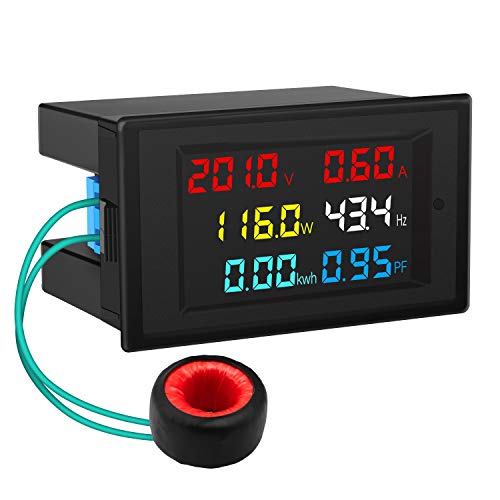
Where the Reliance sits on a cord, this DROK unit bolts into a panel and stays there. Its screen packs voltage, current, active power, energy in kWh, frequency, and power factor onto one interface — six numbers where most meters give you two. The range is wide for a panel meter: AC 80.0-300.0V, 0-100A of current, up to 30000W of power, energy up to 99999kWh, frequency from 45.0Hz to 65.0Hz, and power factor from 0.00 to 1.00PF.
The one rule you cannot break is the input type. This meter will only measure a clean 50-60Hz AC supply, and it can be damaged by a square wave, an inverter output, or a modified sine wave circuit. That makes it a city-power and generator-inlet meter, not a solar-inverter meter — a line people have tried unconventionally and had work, but you need to know the limit before you cut a hole in a panel.
Accuracy is what wins people over: paired against a Klein meter, voltage and current landed within 1%, and one owner has run a unit for five years and eleven months through brutal summers — yesterday was 106 degrees — and chilly winters in a garage. The catch is real: the current sensor wires run under 6 inches and the screen rim is tight enough that your mounting hole must land within 2mm, and the display gets hard to read beyond about 30° off-axis vertically.
Beautiful, if basic: the colorful LCD is easy to read from most angles and the price is gentle for a six-reading meter — but two of these weigh 102 g each and arrive as a bare multimeter, so plan your enclosure and wiring before it lands.
Built for the wiring-savvy: anyone adding a live readout to a generator inlet or a kiln outlet in the garage.
Look elsewhere if: you are measuring inverter or modified-sine-wave power — those waveforms can destroy it.
3. MECHEER 2 Pack Upgraded Watt Meter Power Meter Plug, 7 Modes

Two meters, seven readouts each, and a backlight you can leave on all night.
You get two units in the box — a genuine advantage here, because you can leave one in the garage and keep one indoors rather than chasing a single meter around the house. Each one cycles through 7 display modes covering power in watts, energy in kWh, volts, amps, hertz, power factor, and cost. That last one calculates what an appliance actually costs you over the time you have been watching it, which is the most useful figure on the screen.
The 2.36 by 1.85 inch backlit screen is readable in the dark and at a 180° viewing angle, so you can glance down at it from an awkward position without crouching. Backlight timing runs on five settings, from 10 minutes out to always on. Overload protection is adjustable up to 3680W, and the meter flashes OVERLOAD and freezes the buttons once you pass your setting — set it to 1800W before you plug in a tool.
Two caveats worth knowing. The body is chunky enough that it can block the second socket on a duplex outlet, so a three-prong plug or a power brick may not fully seat next to it. And a small number of units have died early, with one fried after roughly 100 hours and inaccurate voltage readings reported on that same unit.
Why two makes sense: a 2-pack means a spare sits ready if one misbehaves — and with a combined 8600+ owners behind these units, the odds are firmly on your side.
The practical pick: anyone who wants to leave a meter on a circuit and still have one free to carry around.
One limitation: the fat body can crowd the second outlet in a standard duplex socket.
4. DROK Battery Monitor, DC 0-300V 200A Hall Sensor Meter
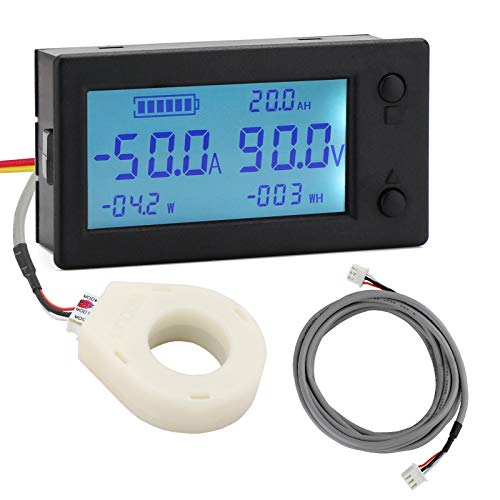
The DC specialist for anyone nursing a battery bank through the winter.
This is the only meter on the list built for direct current — batteries, not wall sockets. It measures from DC 0-300V and 0-200A, and it reads both directions of current, so it can show power flowing into a battery during charge and back out during discharge. That bi-directional reading is rare at this level.
A Hall transformer does the sensing, which gives isolated measurement — the sensor never makes direct electrical contact with the cable, so it is safer and more reliable than a shunt. A 2.5m shielded wire keeps the sensor far from the display, and the 20mm sensor opening fits 4-gauge cable comfortably. The two-wire setup covers 5-90V while the three-wire setup covers the full 0-300V range.
What makes it frustrating is the setup, not the hardware. You must enter your battery’s capacity in amp-hours and its full-charge voltage, then drain and recharge once before the amp-hour reading starts working. The manual is poorly translated and skips several menu parameters entirely — you will be holding the menu button and hunting for the ones the manual forgot. Owners running lead-acid, lithium polymer, and lithium iron phosphate banks all get sensible numbers once past that setup hump.
The honest read: voltage matches a pair of Fluke meters exactly, and the current drifts by a fraction of an amp — not laboratory-grade, but sound for battery management. Rated 4.0+ with a lower score than the others, so go in clear-eyed about the learning curve.
For the battery tinkerer: RV, boat, camper, and solar-bank owners who want to know what is left in the tank.
Not the easy win: the menu is a puzzle the first time, and it expects you to know your battery’s specs before you start.
5. Emporia Vue 3 Home Energy Monitor
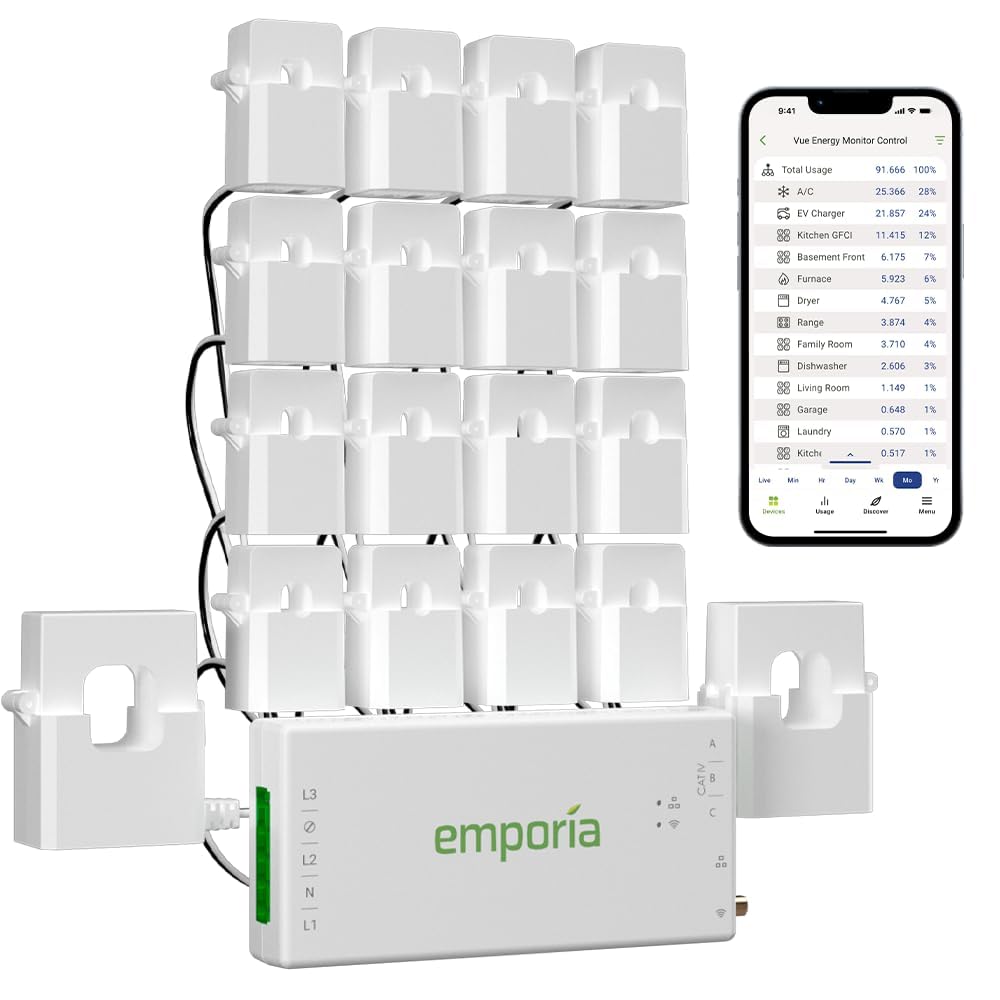
Sixteen clamps in the breaker panel, every circuit on your phone.
Every other meter here reads one thing at a time. The Vue 3 clamps into your breaker panel and watches 16 circuits simultaneously — air conditioner, furnace, water heater, washer, dryer, range — with 50A clamp-on sensors, and streams the data to a phone app. It is rated accurate from ±2%, and it is UL Listed, which means it met recognized electrical safety standards for the U.S. and Canada.
What it delivers is the thing a plug-in meter can never give you: the hardwired loads. Owners have watched their bill drop to a nine-month low after the Vue 3 exposed a humidifier running nonstop, appliances idling, and a furnace badly out of tune. A 50-year electrical engineer ran all 16 circuits for a week and caught an office PC drawing more than expected. Owners consistently report the Vue 3 pays for itself in electric savings within a couple of months.
The honest trade-off is installation. Clamping into a live panel carries real risk, and if you are not confident with breakers you should bring in a licensed electrician. The included wires are also messy enough that wire organizers are worth buying. And the app needs 2.4 GHz WiFi with an internet connection, which some find fussy to set up; the WiFi antenna cable is short too.
The monitoring ceiling: 1-second data lives in the app for 3 hours, 1-minute data for 7 days, and hourly data indefinitely in the cloud — so you get the sharp detail when you are actively watching and the long trend when you are not.
The right upgrade if: you want the whole panel on your phone and you are comfortable working near breakers.
Call someone if: panel work makes you nervous — the electrocution risk is real and worth paying a pro to avoid.
Know the Specs
Amps, Watts, and Power Factor
Amps are the current flowing through a circuit; watts are the real power an appliance consumes; and power factor is the ratio between the two. On a purely resistive load like a space heater, power factor sits at 1.00 and watts track amps closely. On motors and pumps it can fall below that, which is why a meter may show fewer watts than the label predicts. That gap is information, not an error — it tells you the appliance is drawing more current than the raw watt number suggests.
AC versus DC Meters
An AC meter reads the alternating current from your wall outlet or breaker panel. A DC meter reads the direct current from a battery bank or a solar array. They are not interchangeable — wiring a DC meter into a wall circuit, or a plug-in AC meter into a solar array, will give you nothing or will damage the unit. The DROK Battery Monitor and the plug-in units here sit on opposite sides of that line entirely.
Load Capacity and Overload Warnings
A plug-in meter has a ceiling. The MECHEER unit defaults its overload trip to 3680W and lets you adjust it, flashing OVERLOAD and locking the buttons when a load passes your limit. Set it below your circuit’s limit before you plug in a big tool. The Reliance unit works within a fixed 1 to 15 amp and 125 to 1875 watt range, which covers household plug-in appliances but not heavy 240V equipment.
Circuit Coverage and Data Retention
A panel monitor is chosen by how many circuits it can watch. The Emporia Vue 3 ships with sixteen branch sensors, enough for the main loads in most panels, and it can free up sensors by running one clamp with a multiplier on a balanced 220V load. Retention also matters: the Vue keeps fine per-second data for a short window and hourly data indefinitely, while the DROK AC Meter stores accumulated energy through a power loss so your kWh figure survives.
Common Questions
What is the difference between a plug-in watt meter and a panel monitor?
Can I use a plug-in watt meter to size a generator?
Will a plug-in watt meter work with an inverter or modified sine wave power?
Why does my watt meter show less wattage than the appliance label?
How accurate are these meters compared with a power company reading?
Do I need an electrician to install the Emporia Vue 3?
Why does my watt meter keep flashing overload?
Can the MECHEER watt meter remember readings after I unplug it?
What kind of batteries can the DROK Battery Monitor work with?
Does a plug-in meter block the second socket on my outlet?
The Bottom Line
For most people, the best watt meter is the Reliance Controls THP103 — it gives you an immediate amp or watt number on a cord long enough to actually reach, and it is the tool RV and generator owners rely on to plan emergency power. If you want to add a live readout to a panel you are already wiring, the DROK AC Meter puts six numbers on one bright screen. And for the full picture of where your whole bill comes from, the Emporia Vue 3 watches sixteen circuits and hands the data to your phone.
How we choose
We do not accept paid placement. Every pick is matched to a real buyer and a real use-case; we do not hands-on test units.
Sources
Specifications: manufacturer listings and product documentation. Review insights: verified customer reviews, as of October 2026. Pricing: not shown on this page (it changes often); check the current price via the retailer link.
As an Amazon Associate, Aappliancez earns from qualifying purchases. This does not affect which products we feature.