Disclosure: Some links in this post are affiliate links. As an Amazon Associate I earn from qualifying purchases, at no extra cost to you. Learn more
Specs are compiled from manufacturer listings and verified buyer reviews and can change over time — please confirm the key details on the product page before buying.
If water is finding its way through a basement wall, a garage floor or a paver patio, the fix is almost never “more paint” — it is the right kind of coating for the surface you actually have. A thick rubber membrane is the answer for a leaking cinder-block wall. A thin, soaking-in sealer is the answer for a driveway. Choose the wrong one and you get peeling, blotching or a puddle that never beads. This guide sorts seven real products into those jobs so you can pick once and be done.
This guide is built by comparing the manufacturers’ published specifications and the patterns across verified customer reviews, so you get each pick’s real strengths and trade-offs instead of marketing spin.
You will see what each coating is built for, how far a container stretches, and the honest limits that show up after a season of weather. Read on for the waterproofing paint picks that match your wall, floor or driveway instead of fighting it.
Top Picks

How To Choose The Best Waterproofing Paint
Your first decision is not brand or color. It is if you need a coating that sits on top of the surface or a sealer that soaks into it. Get that one call right and the rest of your shopping list falls into place.
Coating versus penetrating sealer
A coating like a liquid rubber builds a rubbery skin you can see and feel, and that skin is what holds back standing water on a basement wall. A penetrating sealer soaks into concrete or brick pores and repels water from inside, which suits a driveway or patio where a visible film would look wrong. If your wall is actively seeping, you want the skin. If your driveway just absorbs water and stains, you want the soak-in.
Match the product to the surface material
Concrete block, poured concrete, brick, stucco, stone and wood each grip a coating differently. A sealer built for concrete may not bond to metal or wood, and a rubber membrane sprayed onto a smooth paver can look uneven. Check the listed compatible materials before you buy, and never assume one container covers your whole project.
Do the coverage math before you order
Coverage is quoted per gallon, and the spread is wide — some products list 75 to 125 square feet per gallon, others up to 175 to 225 square feet per gallon. Porous, older concrete drinks more product than a fresh pour. Buy your second container before you start, not halfway through a wall.
Respect the temperature and prep window
Most of these coatings only work inside a stated temperature band, and one here requires the surface and air to sit between 50 °F (10 °C) and 90 °F (32.2 °C). Prep matters just as much: a dusty, damp or greasy surface will reject the coating, and you will be redoing it next season.
Side-by-Side Comparison
| Model | Best For | Type | Coverage | Container | Amazon |
|---|---|---|---|---|---|
| INSL-X WaterBlock Acrylic Masonry Waterproofer★ Best Overall | Damp basement walls | Acrylic latex coating | 75 to 125 sq ft per gallon | 1 gallon | Amazon |
| USG DUROCK Liquid Waterproofing MembraneBest for Bathrooms | Shower walls and tile backer | Liquid applied membrane | — | 1 gallon (128 fl oz) | Amazon |
| Pro Grade 1″ Chip Brushes (96 Pack) | Touch-up and trim work | Disposable natural-bristle brush | — | 96 pack | Amazon |
| MasonryDefender Concrete Sealer (Silane Siloxane) | Driveways and sidewalks | Penetrating silane siloxane | 90-150 sq ft per gallon | 1 gallon (128 fl oz) | Amazon |
| AMES Blue Max White Liquid Rubber Waterproofer | Leaking foundations and below-grade walls | Elastomeric liquid rubber | — | 1 gallon | Amazon |
| Armor SX5000 WB Silane-Siloxane Sealer | Pavers, stone and brick patios | Water-based silane siloxane | 175-225 sq ft per gallon | 1 gallon | Amazon |
| MasonryDefender All Purpose Brick Stone & Concrete Sealer | Large brick and stone surfaces | Penetrating silane siloxane | 90-150 sq ft per gallon | 2.5 gallon (320 fl oz) | Amazon |
Detailed Reviews
1. INSL-X WaterBlock Acrylic Masonry Waterproofer Paint, White, 1 Gallon
Our pick — 4.5+★ from 300+ verified ratings; the strongest balance of quality and price.
The wall-coating that holds back a pressurized seep instead of just shrugging off rain.
Most waterproofers on this list repel water falling from the sky. This one is rated for water pushing from behind — it withstands up to 12 psi hydrostatic pressure, which is the measured force of groundwater pressing against a basement wall. That is the number that separates a wall coating from a driveway sealer, and it is why this sits at the top for damp basements, foundations and retaining walls.
It goes on as a water-based acrylic for interior and exterior vertical concrete, and it shrugs off highly alkaline masonry up to pH-13 — the scale reading that tells you how caustic a fresh block wall is. A gallon spreads across 75 to 125 square feet, so a typical single basement wall usually means two containers. The included can opener and stir stick are small touches, but they mean you can start the moment the box lands. The crowd favorite holds 4.5+ stars across 300+ ratings.
Your one hard rule is the weather window: paint only when surface and air are between 50 °F (10 °C) and 90 °F (32.2 °C), so a cold snap or a heat wave rules out that day. Buyers report it holds: “No more water leaking in, and we have had a few good long heavy rains since the second coat and everything is dry.” Two coats are the recommended dose. Thin coverage with a brush is a known mistake — a long-nap roller lays it down far better. The honest limit: it stops minor-to-medium wall and floor seepage, not a heavy footer leak. It will not fix a humidity problem or a structural foundation issue.
Where This Earns Top Spot
- Rated to 12 psi hydrostatic pressure — the only wall-coated pick here built for water pushing from behind
- Resists alkaline masonry up to pH-13, so fresh block walls do not fight the coating
- Semi-gloss white finish brightens a dim basement while it seals
- 75 to 125 sq ft per gallon gives a predictable container count per wall
What To Plan Around
- Apply only between 50 °F and 90 °F — outside that band the coating will not cure right
- Needs two coats, so double your container estimate
- Brush application gives poor coverage; a long-nap roller is the right tool
Reach for this if: you have a damp or seeping concrete-basement wall, cinder block, stucco or brick, and you want a white coating you can roll on yourself.
Look elsewhere if: the leak is a heavy footer flow or a humidity problem — no wall coating fixes those, and this one will not either.
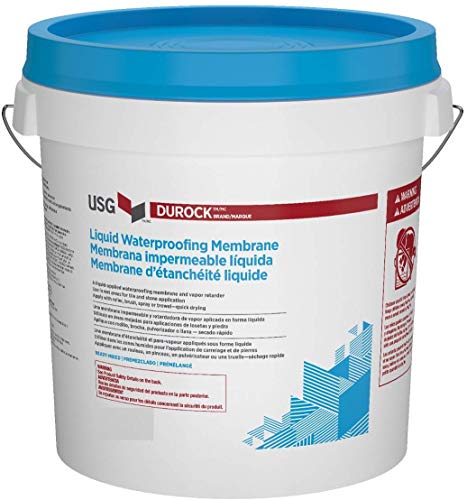
2. USG DUROCK Brand Liquid Waterproofing Membrane 1 Gallon
A shower-wall membrane measured in perms, not in promises.
This is the pick for tile: it lays down under thinset (the adhesive that sets tile) behind shower walls, floors and countertops. It also carries the one piece of hard evidence a vapor barrier can carry — a low perm rating of 0.38 perms at 20 mils dry thickness, tested to ASTM E96 Procedure E (a standard lab method for vapor transmission). A perm is simply a measure of how much vapor sneaks through a material, so a low number means moisture stays out. It also stretches its anti-fracture protection up to 1/8 in. (3 mm) over shrinkage and other non-structural cracks, which keeps your tile line from opening with the slab.
You can roll, brush, trowel or spray it, and it is formulated to accept tile adhesive. Owners mention the schedule works out simply: “Two coats ~1 hour apart; tile-ready next day.” That fast dry time is the whole appeal for anyone tiling a bathroom in a weekend. It is a 1-gallon container, and the thick paste-like body covers more area than most people expect — owners routinely describe coating a whole shower from tub to ceiling.
Two things to know before you open the can. It is bright blue and it does not wipe clean once cured, so mask the surfaces near your tile line — a tape pull on still-damp drywall took paint off in one account. And while the tube says low odor, at least one buyer found it strong enough to warrant a respirator while applying. Long-term leak performance after a year is the open question the manufacturer’s data does not answer.
Why tilers reach for it: the 0.38 perm rating at 20 mils is real, tested evidence of vapor control, and the fast recoat window lets a bathroom project finish on schedule.
Mind the clean-up: blue in the can and hard to correct once dry, plus a strong enough smell that good ventilation is worth the effort.
Fits the weekend tiler: a shower, tub surround or wet-floor project where you want a certified vapor barrier under the tile and need it ready overnight.
Not for the driveway: it is an interior tile membrane, not an exterior masonry coating — take the INSL-X or the AMES for outdoor walls.
3. Pro Grade 1″ Chip Brushes, 96 Pack

Not a coating — the throwaway brush that keeps thick waterproofers out of your good tools.
Thick, sticky coatings are murder on a brush, and this pack of 96 one-inch natural-bristle brushes solves that. You can cut in a corner, apply a sealer to a tight seam, and toss the brush instead of spending twenty minutes trying to clean it. At 96 pieces, it is a season’s worth of touch-up tools for a whole-house project.
Strong adhesive holds the bristles in, which matters when you are working against a clock. Customers note “Disposable chip brush didn’t shed, a plus.” A natural-bristle 1-inch brush is the right size for trim, detail, furniture, fence slats and small waterproofing repairs. The solid wood handle is drilled with a hanging hole, so your workbench stays tidy. If you are applying a penetrating sealer to a brick porch or patching a basement wall corner, this is the tool that reaches the spots a roller can’t.
The trade-off is baked into the price: these are low-quality brushes by design, meant to be used once and thrown out. Some arrive with bristles bent from packing, which spoils detail work, and in humid weather the natural bristles spread and stick together, making a clean edge harder to hold. For solvent-based glues and messy coatings, that “use it and bin it” logic is exactly what you want.
Where they shine: 96 individual brushes means you never stop to clean one, and the natural bristles work well in oil-based paint and encaustic wax alike.
Accept the rough edges: bent bristles out of the pack and spreading in humidity are the cost of a brush you were going to throw away anyway.
Buy for the mess: anyone applying rubber membrane, sealer or stain who wants a disposable brush for every awkward corner.
Skip for fine cabinetry: a detail painter chasing a perfect edge wants a proper sash brush, not a throwaway.
4. MasonryDefender Concrete Sealer, 1 Gallon
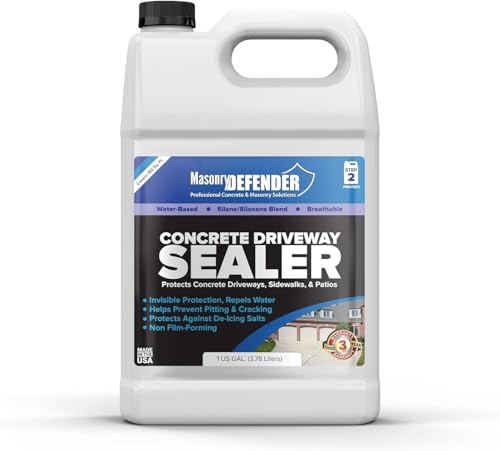
Invisible protection that makes rain bead and roll off the driveway without changing its color.
The selling point with this sealer is that it does nothing you can see. It is a silane siloxane — a clear liquid that soaks deep into concrete pores and bonds there — and it leaves no film, no gloss and no color shift. A gallon covers 90 to 150 square feet, and the whole point is that a treated driveway looks the same as an untreated one until the first rain beads and rolls off instead of soaking in.
What you get is defense against the things that actually shorten a driveway’s life: pitting, cracking, ice-melt salts, chloride ions, freeze-thaw cycles and efflorescence stains. That last one is the chalky white bloom that appears when water pushes salts to the surface, and blocking the water blocks the bloom. Application is a low-pressure garden sprayer and a clean surface, with drying time measured in a couple of hours before you can walk on it.
Reviewers point out long service: one driveway still beaded after two years of rain, and a fiber-crete drive held through a third year in South Carolina. The recurring gripe is batch quality: some containers arrive with gelatinous solids that shaking will not break up, and the surface can come out blotchy on very porous or older concrete. Call it a small, occasional risk with a product most owners still recommend — the trade-off is cosmetic, not structural.
The invisible barrier: silane siloxane soaks into the pores and lets the slab breathe while it keeps liquid water out, so there is no surface film to peel or flake.
The catch with batch quality: solids in the jug and a blotchy finish on porous concrete are the reported weak points — stir and inspect before you spray.
Reach for this if: you are sealing a concrete driveway, sidewalk or patio and want zero change to how it looks.
Think twice if: your concrete is very porous or aged and an uneven tone would bother you — do one test panel first.
5. AMES Blue Max White Liquid Rubber Waterproofer, 1 Gal

Rubber that stretches 900% with the wall so the membrane bends instead of splitting.
What makes this one different is the stretch: a 900% elongation rating, which means the cured membrane can pull and flex with a surface instead of cracking or peeling off. On a foundation that moves with frost or a below-grade wall that shifts, that flex is the difference between a coating that lasts and one that cracks in year two. It is a special blend of adhesive and high-strength elastomeric — meaning stretchy — liquid rubber, and it goes on concrete, wood, metal and more, brushed, rolled or sprayed.
It goes on white rather than the blue it is named after, so you can see where you have been on a dark wall. It is formulated to be non-toxic and VOC compliant (within solvent-fume limits) in all 50 states. The big scheduling catch is the recoat time: allow 24 hours between coats, so a two-coat job eats two days. It can be painted over once cured, so you are not stuck with a white wall. Owners repeatedly point to it sealing seams and sub-grade walls that stayed damp after heavy rain. Long-time users on Florida roofs report six-plus years before a refresh.
The honest caveat: this one is thick and heavy — you scoop it out of the pail, and two coats is the standard. Durability reports split, with some walls holding strong and others looking rough within a few months. One buyer on a desert job found the claimed quick dry time ran long in very low humidity. That is a mixed record on a capable product, nothing more.
What Wins People Over
- 900% elongation lets the cured rubber expand and contract with the surface instead of cracking
- Bonds across concrete, wood, metal and rubber in one container
- White finish is easier to see on dark masonry and can be painted over
- Non-toxic and VOC compliant in all 50 states
Before You Commit
- 24 hours between coats means a two-coat wall spans two days
- Thick enough that you scoop it from the pail rather than pour it
- Durability is the reported weak spot — a few walls aged badly while others held for years
For moving surfaces: below-grade walls, foundations and seams where you want a flexible rubber skin that can flex with the slab.
When to pass: tight one-day timelines — the 24-hour recoat gap does not negotiate, and thick rubber rewards patience.
6. Armor SX5000 WB Silane-Siloxane Sealer, 1 Gallon

The long-haul pick — one gallon reaching 175 to 225 square feet with no color change.
Coverage is what separates this from the driveway sealer above. Where the MasonryDefender gallon covers 90 to 150 square feet, this one covers 175 to 225, which is nearly double the area from the same container on typical surfaces. That spread is why it holds up as the premium choice for larger patios, driveways and stone — you buy fewer containers to finish the job. The manufacturer also claims it cuts water absorption by up to 95% and protects for up to 7-10 years.
It is water-based with 0 VOC (no solvent fumes) and no odor, so you can apply it in an adjacent room without clearing the house. It is designed for unsealed concrete, brick, paver, bluestone, flagstone, slate, natural stone and masonry. The formulation is built to leave the substrate looking and feeling exactly as it did — a matte finish with no color shift. You apply it with a pump sprayer on a clean, dry, absorbent surface. When it comes time to reseal, you simply apply another 1-2 coats with no stripping or film removal.
It works below the surface, so there is no film to peel. The trade-off: organic leaf debris left sitting on damp concrete over several wet days can leave tea stains, a quirk several owners hit. Water-based application also tends to pool in low spots, so dab the excess while it is wet. That 7-10 year figure is the manufacturer’s claim, not a measured guarantee — plan a reseal check in a few years.
The headline advantage: 175 to 225 sq ft per gallon versus 90 to 150 on the driveway pick, so larger patios finish in fewer trips.
The honest fine print: wet leaves left on the surface can stain sealed concrete, and pooling needs dabbing while wet — small habits for a sealer built to be touched only twice a decade.
Best for big surfaces: wide paver patios, driveways, flagstone and brick where coverage per gallon drives the bill.
Not for a fast aesthetic fix: if you want an immediate dark, glossy “wet look,” this one deliberately keeps the surface unchanged.
7. MasonryDefender All Purpose Brick Stone & Concrete Sealer, 2.5 Gallon

A 2.5-gallon jug built for whole-property jobs — brick, stone and sidewalk in one pass.
When the job is a whole brick wall or a resurfaced patio, size is half the battle, and this 2.5-gallon container (320 fluid ounces) means fewer refills. It is the same family of silane siloxane technology as the driveway sealer above but lists a much wider surface list: concrete, outdoor bricks, patio stones, limestone, granite and sidewalks. Coverage runs 90 to 150 square feet per gallon, so plan two containers for anything beyond a single small patio.
It is a clear, waterproof penetrating barrier that it describes as protecting outdoor surfaces from moisture without altering their natural appearance — no gloss, no color shift, so a red brick patio stays red. It is sprayed with a pump-up garden sprayer for even coverage, works for DIY and pro jobs alike, and is built to withstand harsh weather and heavy foot traffic. Buyers on varied surfaces take to it — one noted it works on “flagstone, stamped concrete and aggregate,” with water beading up nicely. Shake the jug very well first: the manufacturer’s own reviews warn that an unshaken container goes clumpy and clogs the spray nozzle.
The honest downside is inconsistency in the jug. On older or porous stone you can get uneven discoloration, and some buyers find the price steep for the volume. That said, sealing performance is where owners still land positive.
Where it earns its keep: the 2.5-gallon size and the clear penetrating formula suit large brick and stone surfaces with no color change and no surface film to maintain.
The practical caveat: clumpy or sulfur-smelling batches happen — shake hard and inspect the jug before you spray a whole wall.
Built for scale: a large brick patio, stone walk or full driveway where you want one container to go far and a natural, unchanged finish.
Look elsewhere if: you need to seal a leaking wall from behind — take the INSL-X or AMES for that job, not a soaking sealer.
Know the Specs
Hydrostatic Pressure Rating
Hydrostatic pressure is the force of water pushing against a surface from the other side — groundwater against a basement wall. A rating like 12 psi tells you how much of that push a coating is built to hold back. It appears only on the wall coating here, and it is the number to check first if your wall is actively seeping rather than just damp.
Perm Rating
A perm measures how much water vapor can pass through a material. The lower the number, the tighter the barrier. One membrane here rates 0.38 perms at 20 mils dry thickness under ASTM E96 Procedure E — that is a tested vapor-control rating, which is why it belongs behind tile in a shower rather than on a driveway.
Coverage Per Gallon
Coverage is quoted in square feet per gallon, and it is the number that tells you how many containers to buy. The spread on this list runs from 75 to 125 square feet per gallon on a wall coating up to 175 to 225 on a premium sealer. Porous, aged concrete absorbs more, so always buy toward the low end.
Elongation
Elongation is how far a cured coating can stretch before it splits. A 900% elongation rating means the rubber can flex with a surface that moves — through freeze-thaw or slight slab shift — instead of cracking. It matters most on below-grade walls and foundations, less on a flat driveway.
Common Questions
Can I use a driveway concrete sealer on my basement wall instead of a waterproofing paint?
How many coats do I really need to apply?
Can I apply waterproofing paint when it is cold outside?
What does pore-filling sealer do on old, porous concrete?
Will a clear sealer change the color of my brick patio?
How long do these coatings last before I need to reseal?
Can I spray these products or do they have to be rolled?
What is the difference between a film coating and a penetrating sealer for a basement wall?
Do these waterproofing products smell strong and need ventilation?
Can I use waterproofing paint on wood or metal, or only masonry?
The Bottom Line
If you have a seeping basement wall, the waterproofing paint winner is the INSL-X WaterBlock. It is the only coating here rated to 12 psi hydrostatic pressure (water pushing in from the soil side), and it resists pH-13 masonry so fresh block walls do not fight it. For a shower or tub surround, grab the USG DUROCK membrane, whose 0.38 perm rating under ASTM E96 is tested proof of vapour control. And for a large paver patio or driveway, the Armor SX5000 WB is the one to reach for, with 175 to 225 square feet of coverage per gallon and a 0 VOC, no-odor formula.
The pattern worth carrying into your buying decision is that coverage per gallon and the surface-material list decide the cost of a job more than the container itself. The AMES Blue Max is the pick for a wall that shifts, thanks to 900% elongation, and the 2.5-gallon MasonryDefender all-purpose is the budget-sensible choice for a whole brick patio. Buy for your surface, plan two coats, and prep the wall clean and dry — those three habits do more than any brand label.
How we choose
We do not accept paid placement. Every pick is matched to a real buyer and a real use-case; we do not hands-on test units.
Sources
Specifications: manufacturer listings and product documentation. Review insights: verified customer reviews, as of October 2026. Pricing: not shown on this page (it changes often); check the current price via the retailer link.
As an Amazon Associate, Aappliancez earns from qualifying purchases. This does not affect which products we feature.