Disclosure: Some links in this post are affiliate links. As an Amazon Associate I earn from qualifying purchases, at no extra cost to you. Learn more
Specs are compiled from manufacturer listings and verified buyer reviews and can change over time — please confirm the key details on the product page before buying.
You spray a jacket or a patio cushion, the rain hits, and the water just sits there in beads instead of soaking in — that is the whole job, and only some sprays actually do it. The ones below are the picks worth your time, and the short version is this: Scotchgard Fabric Water Shield is the safest all-rounder for household fabric, GEAR AID is the one for washable technical outerwear, and Thompson’s WaterSeal is for outdoor cushions and umbrellas that live in the sun.
This guide is built by comparing the manufacturers’ published specifications and the patterns across verified customer reviews, so you get each pick’s real strengths and trade-offs instead of marketing spin.
Some sprays are meant to be washed into a garment and some are meant to be misted onto a couch, and mixing those two up is the most common way people end up disappointed. Here is how to pick the right one for the fabric you actually own with the Best Waterproofing Fabric Spray.
Top Picks

How To Choose The Best Waterproofing Fabric Spray
The first thing to sort out is not the brand — it is whether you plan to wash the item or just mist it where it sits. A wash-in formula goes into the washing machine with the garment and gets heat-set in the dryer. A spray-on formula goes onto the surface and is left to cure in the air. Getting that wrong is where most frustration starts.
Spray-on versus wash-in, and who each one serves
Pick a spray-on can for things you cannot put in a machine: a sofa, curtains, a backpack, a pair of canvas sneakers, a patio umbrella. Pick a wash-in pouch when the item is technical outerwear — a soft shell, a rain jacket, gloves — and you want to treat several pieces at once. A single 10 fl oz pouch of wash-in formula is built to treat 10 jackets, so it is the batch job, while a can is the spot job.
What the fabric is made of decides the answer
Suede, delicate leathers and carpeting are named as off-limits on some labels, so read the fine print for the exact product before you buy. Synthetics with four-way stretch, fleece, nylon and canvas all take a treatment well. Wool is a different case — it can be treated, but it wants a gentle basin soak rather than a machine cycle. When in doubt, test a hidden patch first.
The drying step is not optional
Several of these treatments only lock in once the fabric is fully dry, and some want heat to activate. A wash-in formula that asks for a tumble dry on medium heat for 40 minutes needs a machine you are willing to run. A spray-on formula that air-dries in the sun is more forgiving. Factor the drying step into your choice as seriously as the spray itself.
Side-by-Side Comparison
| Model | Best For | Format | Size | Not For | Amazon |
|---|---|---|---|---|---|
| Scotchgard Fabric Water Shield Spray★ Best Overall | Household fabric and canvas shoes | Spray-on aerosol | 13.5 oz | — | Amazon |
| GEAR AID Wash-in Water RepellentBatch Treatment | Washable technical outerwear | Wash-in concentrate | 10 fl oz | Items with insulation or lining | Amazon |
| The Protector Water and Stain Repellent Spray | Shoes, boots and sneakers | Spray-on | 8 oz | — | Amazon |
| Nikwax Softshell Proof, Spray-On | Softshell and stretch outerwear | Spray-on, aerosol-free | 9 x 4 x 3 in | Suede and delicate leather | Amazon |
| Thompson’s WaterSeal Fabric Seal | Outdoor cushions and canopies | Spray-on aerosol | 11.5 oz | Suede, delicate leathers, carpeting | Amazon |
Detailed Reviews
1. Scotchgard Fabric Water Shield Spray, 13.5 oz, 1 Pack
Our pick — 4.5+★ from 27,500+ verified ratings; the strongest balance of quality and price.
One can that handles the sofa, the curtains and the canvas sneakers without changing how any of them look.
This is the can to buy if you want a single fabric spray for the whole house. A 13.5 oz aerosol can is built for household jobs — upholstery, curtains, pillows, table linens, backpacks, luggage — and it also covers clothing like shirts, dresses, silk ties, suits, outerwear and canvas shoes. That range is why it takes the top spot: it is the generalist you can reach for on almost anything in the house.
The finish is what wins people over. It dries clear and odorless, and it leaves no white residue — even on black shoes, which is where cheaper protectants usually leave a chalky haze. You spray two thin coats, let them dry overnight, and the fabric still feels like fabric. Light-coloured Hoka shoes treated this way repelled rain and kept looking new, and a light beige ottoman stayed soft with no discoloration. On upholstery and shoes, a finish you cannot see is the only finish worth having.
Coverage is decent for a can this size: 13.5 oz handles about 6 pairs of adult fabric shoes at two coats each, so a single can goes further than the small bottle in your hand suggests. The geometry of the can itself is compact — it measures 2.6 x 2.6 x 8.6 inches and weighs 14.08 ounces, which is roughly a can of hairspray in the hand. The catch is the smell during application: it is noticeable, so open a window or spray outside, and it fades once the fabric is dry. Overspray also makes smooth surfaces like marble and tile slick, so slide a plastic bag or drop cloth underneath before you start.
What earns it the top slot
- Dries clear with no residue or colour change, even on black shoes
- Works across upholstery, curtains, linens, luggage and canvas shoes
- One 13.5 oz can covers several items — about 6 pairs of shoes at two coats each
- Water beads up so spills wipe away instead of soaking in
What to plan around
- Noticeable odor while spraying — ventilate the room or work outside
- Overspray leaves smooth floors slippery until it is wiped up
- Durability is not stated on the label, so plan to re-treat seasonally
Reach for this if: you want one can for the couch, the curtains and the canvas shoes, and you want the fabric to look untouched afterwards.
Think twice if: the item is technical outerwear you would rather wash in a machine — a wash-in formula does that job better.
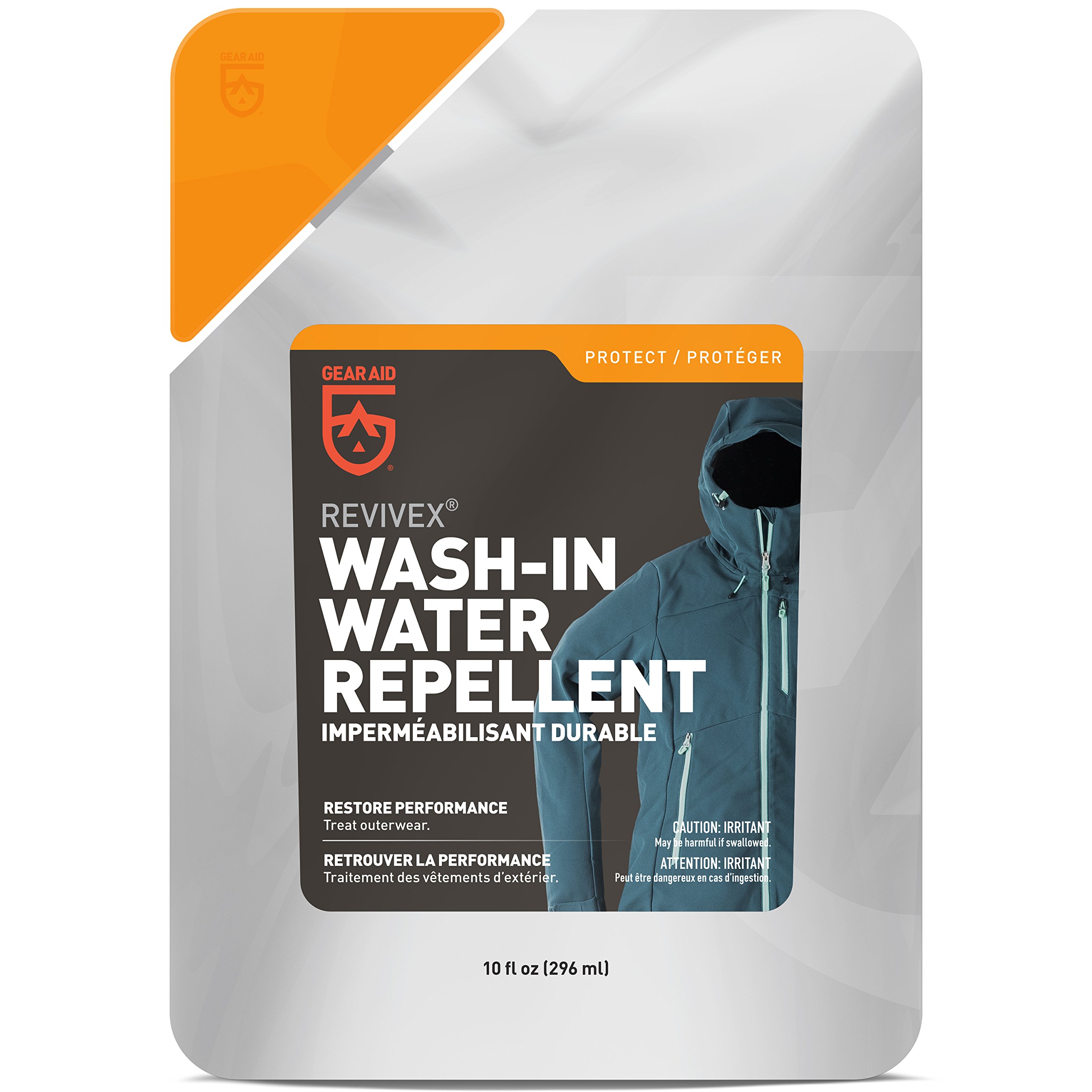
2. GEAR AID Wash-in Water Repellent 10 Fl oz
The pouch you tip into the machine when a whole rack of ski and rain gear needs its water repellency back.
This one is not a spray at all — it is a concentrated wash-in liquid, and that changes everything about how you use it. You add it to the wash cycle, let the machine do the work, then heat-set the garment in the dryer. One 10 fl oz pouch treats 10 jackets, which makes it the cheapest way to revive a whole closet of outerwear in one sitting. For families with ski jackets and rain shells stacked in the garage, that is the real value.
Get the preparation right and the results hold up. A jacket that was professionally dry cleaned and pre-washed without soap, then dried on medium heat for 40 minutes, shed water exactly as promised. Wool takes to it particularly well — a wool coat soaked in a basin came out near-waterproof, with snow no longer melting into the fabric and the wool still breathing. It also works on jeans and socks, and it is safe on waterproof-breathable shells including GORE-TEX jackets and pants without blocking their breathability.
Here is the honest part: the heat-set step is what makes or breaks it. One owner tried a nylon windbreaker and got only slight water repellency, barely enough for heavy rain. Another had a first attempt fail outright, then succeeded on a second run using warm water, no rinse, spin only, and a tumble dry on low to warm. Follow the machine directions precisely and dry it thoroughly, and the water beads. Skip the dryer, and you may wonder whether you used it at all. Note too that it is meant for outerwear and gloves with no insulation or lining — a puffy liner complicates the wash-in route.
The format is the feature: one pouch revives up to 10 jackets at once, and it works on fleece and soft shells without the fluorocarbon chemistry older formulas relied on.
The honest caveat: it needs the dryer to activate, so rain gear you cannot tumble dry is a poor match for this route.
Who it beats everything for: anyone with a pile of ski and rain shells who would rather run one machine cycle than hand-spray each garment.
Who should pick a spray instead: if your item cannot take a tumble dry, a spray-on formula that air-dries will treat it with far less fuss.
3. The Protector Water and Stain Repellent Spray

The bottle that keeps white knit sneakers white and pricey boots free of diesel spots.
If your worry is footwear rather than furniture, this is the bottle to buy. It goes on invisible — no yellowing, no stiffening — on white knit sneakers, and two light coats are enough to make water bead and roll off. That invisibility is the whole reason it works on expensive shoes: you are not trading looks for protection.
It holds up on the materials that usually ruin a spray’s reputation. Several coats on a pair of Lucchese boots caused no colour change at all, and diesel fuel spots washed off completely with soap and water. White leather boots stayed white and water-repellent even after a single coat, and scuffs came off with a baby wipe. Suede is trickier — one buyer cleaned a pair of Bearpaw suede slippers with it and needed some scrubbing, though the colour held. It is a shoe-cabinet staple, meant to be reapplied pair after pair.
Two things to know before you start. The sprayer is the weak point — a pump that breaks on the first press leaves you with a full bottle and no way to apply it, so have a spare spray bottle on hand as insurance. And give colourful shoes a small hidden test first, because colour-fastness varies by dye. The bottle itself is 8 ounces, and it is noticeably smaller and lighter than the Scotchgard can at 14.08 ounces, so factor in that it runs out sooner if you are treating a lot of pairs.
Why shoe people keep rebuying: it vanishes into the material — leather, suede and canvas all take it without a visible trace, and it makes everyday cleanup a wipe rather than a scrub.
The one weak link: the pump sprayer has been known to fail early, so budget for a backup applicator.
The clear match for: sneakerheads and boot owners who want an invisible guard across leather, suede and canvas.
Not the first pick for: a couch or a set of curtains — a bigger household can covers far more upholstery per bottle.
4. Nikwax Softshell Proof, Spray-On

A water-based spray built for stretch shells, not your sofa — and it revives breathability while it repels.
This is the pick for softshell jackets, stretch fleece and synthetic technical layers. The formula is water-based, PFAS-free, non-flammable, contains no optical brighteners and no added scent. It is recommended for Windstopper, Windbloc, Polartec and any synthetic technical material with four-way stretch, which is a very specific list — it is telling you what it is good at rather than pretending to cover everything. It names its fabrics — Windstopper, Windbloc, Polartec, four-way stretch synthetics — instead of claiming to cover everything.
Applied properly, it can rescue gear you thought was finished. Rain pants used for fishing came back to shedding water like new after a full routine: clean with Nikwax Tech Wash, never wring, dry to 90% in the dryer, spray liberally with gloves on, rub into the seams, let it soak in for five minutes, then tumble dry low for 20 minutes. A washed Canada Goose down jacket that leaked badly in rain came back almost fully on the first treatment and fully like-new on the second. It has a strong following among people who re-treat their jackets every season rather than replacing them.
Two honest limits. The smell is genuinely rough while it is wet — a strong, foul odor that disappears completely once the item is dry, so dry it somewhere away from your nose. And this is water-resistant, not a hard waterproof shell: one Marmot softshell treated twice still let rain soak into the shoulders and arms, though it added some resistance and stretched the jacket’s life. The 9 x 4 x 3 inch bottle is a squeeze bottle rather than an aerosol, and the formula is thinner than you expect, so lay a towel down before you start spraying.
Where it shines: synthetic stretch fabrics and down get their water repellency back without losing the breathability that makes them wearable.
Where it stops short: a soaked-in downpour will still find its way through a softshell — this raises resistance, it does not create a rain barrier.
Best suited to: softshell and down jacket owners who want a PFAS-free, water-based formula and will follow the clean-and-heat routine.
Skip the fuss if: you want to spray something and leave it — this one rewards proper preparation and penalises shortcuts.
5. Thompson’s WaterSeal TH.010502-18 Fabric Seal

The patio-cushion spray that fights sun fade as hard as it fights rain.
Patio furniture asks for something different from a couch. Thompson’s is aimed squarely at cushions, pillows, umbrellas, canopies and other outdoor fabrics, and its second job is resisting colour fade. The quality of the finish draws the most praise, and it does that job while keeping the fabric able to breathe — so a cushion still feels like a cushion rather than a plastic-wrapped seat. One 11.5 oz aerosol can goes on clear and dries fast.
The fade protection is the standout for sun-baked climates. In sunny southwest New Mexico, where the area sees 350 days of sun a year, an annual treatment left cushions with very little fading, and the fabric stayed strong against blowing dust. That is a season of sun without replacing the cushions, which is the saving that matters for patio furniture. Applied generously to fully saturate the material, it also makes debris and stains easier to wipe away — mud on fabric wheel wells came off noticeably easier after treatment.
Now the fair warning: this is a water repellent for outdoor fabric, not a hard waterproof coating. In heavy rain, cushions can still soak through, and a couple of seasons in, the fade protection showed its own limits — one set of cushions developed two red shades after a month and a half where accent pillows sat. Spray generously and reapply each season for the best result. The label also lists suede, delicate leathers, carpeting and surfaces subject to foot traffic as off-limits, so keep it away from your shoes and your rug.
Made for the patio
- Sheds water on cushions, umbrellas, canopies and other outdoor fabric
- Helps resist colour fade in constant sun
- Fabric still breathes, so cushions stay comfortable to sit on
- Dries quickly and goes on clear
Know before you spray
- Repels rain but is not fully waterproof in a downpour
- Fade protection needs a generous annual reapplication to hold up
- Not for suede, delicate leathers, carpeting or anything walked on
The right tool when: your outdoor cushions, umbrellas and canopies bake in sun and get rained on, and you want them to last more than one season.
Look elsewhere if: you want to treat a jacket or a pair of boots — its own label steers you away from footwear, and the shoe-specific sprays handle that far better.
Know the Specs
Spray-on versus wash-in format
A spray-on aerosol or pump bottle puts a layer of repellent on the outside of a surface you cannot machine-wash — a sofa, a set of curtains, a pair of sneakers. A wash-in concentrate goes into the washing machine with the garment and works from the inside out, which is why it suits technical outerwear. Match the format to the item in your hand — can for the sofa, pouch for the jacket — and you avoid the biggest beginner mistake in this category.
Water repellency versus waterproofing
These are two different promises. A repellent makes water bead and roll off the surface so spills wipe away and light rain is shrugged off. A waterproof coating stops water passing through entirely. Most sprays here are repellents, and the labels are honest about it — one even says outright that cushions will still soak in heavy rain. Set your expectation at repellent, reapply each season, and you will be satisfied. Expect a hard waterproof shell from a spray and you will not.
Coverage and size, in real terms
The number on the can matters less than what it treats. A 13.5 oz can covers about six pairs of adult fabric shoes at two coats each; a 10 fl oz wash-in pouch treats 10 jackets. Those two figures tell you which format suits your workload better than any ounce count. Two light coats beat one heavy coat every time, so a smaller bottle applied properly often outlasts a big can applied in one wet pass.
Drying and curing
Some formulas air-dry; others need heat to activate. A wash-in that asks for a tumble dry on medium heat for 40 minutes needs a machine you are willing to run and a garment that can take the heat. A spray-on that dries in the air or in the sun is far more forgiving for delicate or bulky items. The drying step is where a treatment succeeds or fails, so check it before you commit to a formula.
Common Questions
Can I use a waterproofing fabric spray on a leather sofa?
Will a fabric spray change the colour or feel of my couch?
How long does a fabric protector last before I need to reapply?
Is a wash-in water repellent better than a spray for a rain jacket?
Can I spray my running shoes or canvas sneakers?
Does waterproofing spray keep fabric from breathing?
How do I get rid of the smell after spraying fabric?
Can I use patio furniture spray on a jacket or backpack?
Does a fabric spray fully waterproof a tent or rain fly?
What should I put under the item while spraying?
The Bottom Line
For most homes, the waterproofing fabric spray that earns its place on the shelf is the Scotchgard Fabric Water Shield, because it covers upholstery, curtains, linens, luggage and canvas shoes in one can and dries clear enough that nobody can tell you used it. If you want to revive a stack of rain and ski gear in a single machine cycle, grab the GEAR AID Wash-in Water Repellent. And for outdoor cushions and umbrellas that bake in the sun all season, the Thompson’s WaterSeal Fabric Seal is the one to reach for. Three picks, three jobs: one can for household fabric, one pouch for a batch of shells, one aerosol for sun-baked patio cushions.
How we choose
We do not accept paid placement. Every pick is matched to a real buyer and a real use-case; we do not hands-on test units.
Sources
Specifications: manufacturer listings and product documentation. Review insights: verified customer reviews, as of October 2026. Pricing: not shown on this page (it changes often); check the current price via the retailer link.
As an Amazon Associate, Aappliancez earns from qualifying purchases. This does not affect which products we feature.