Disclosure: Some links in this post are affiliate links. As an Amazon Associate I earn from qualifying purchases, at no extra cost to you. Learn more
Specs are compiled from manufacturer listings and verified buyer reviews and can change over time — please confirm the key details on the product page before buying.
If you are shopping for a water structuring device, the thing worth knowing first is this: the products on this shelf are two different machines wearing similar labels. Some are hydrogen infusers that treat water you have already filtered, and some are full ionizer sinks-in-a-box that change pH and filter at the same time. Buying the wrong one for your kitchen is the most expensive mistake here — and it is also the easiest to avoid once you know which number on the box actually matters.
This guide is built by comparing the manufacturers’ published specifications and the patterns across verified customer reviews, so you get each pick’s real strengths and trade-offs instead of marketing spin.
You can judge these water structuring devices on what they physically do, not on wellness slogans. The picks below split into countertop pitchers and portable bottles. I grouped them so you can match a device to your counter space, your filter setup, and how much water you drink in a day.
Top Picks
How To Choose The Best Water Structuring Devices
Start with one honest question before you read a single spec: do you want a pitcher you fill and pour for the whole household, or a bottle you carry? Those are different machines with different jobs, and almost every complaint on this shelf traces back to a buyer who bought one wanting the other.
Pitcher or bottle — pick the shape before the spec sheet
A pitcher gives you volume you can pour into a partner’s glass or a coffee pot. A 50 fluid ounce pitcher such as the PIURIFY 3 in 1 fills a whole round of drinks in one cycle. A bottle gives you portability instead: 10 fluid ounces of hydrogen-rich water that fits in a gym bag. Neither is better; they solve different problems.
What PPB actually tells you
PPB stands for parts per billion — the concentration of dissolved molecular hydrogen in the water. A higher PPB number on the box does not automatically mean a better machine. Several devices on this list let you choose a shorter or longer cycle to dial that number up, so the honest question is whether you will run the long cycle every time.
SPE/PEM plates explained in plain terms
SPE/PEM is a membrane-based electrolysis method — a stack of platinum-coated titanium plates separated by a membrane that splits water into hydrogen and oxygen. The membrane lets the machine push the oxygen and chlorine byproducts out instead of leaving them in your glass. That is the single most important internal part to check, because it is what separates a real hydrogen generator from a bubbling novelty.
Filter first, then infuse
Almost every device here is an enricher, not a full water treatment plant. The PIURIFY pitcher removes chlorine as it runs its magnetic cycle, and the Aqua Ionizer Deluxe 7.0 carries its own active carbon filter. If your tap water is poor, plan on filtering upstream too — a hydrogen machine adds something to your water, and it does not replace a proper filter.
Side-by-Side Comparison
| Model | Best For | Capacity | Hydrogen Output | Material | Amazon |
|---|---|---|---|---|---|
| PIURIFY 3 in 1 Hydrogen Water Machine★ Best Overall | Two-person countertops | 50 fl oz | 700–1300 PPB | BPA-Free Tritan | Amazon |
| Upgraded Hydrogen Water Generator 110VBig Family Kettle | Family kitchen, filtered tap | 2 L | Up to 1800 PPB | Borosilicate Glass | Amazon |
| Hydrohealth Hydrogen Water Bottle | Daily grab-and-go | — | Up to 1600 PPB | Stainless Steel | Amazon |
| PIURIFY Hydrogen Water Bottle Generator | Pluggable desk and gym | 10 fl oz | 2,550–6,310 PPB | Food Grade Material | Amazon |
| PUREPEBRIX Hydrogen Water Bottle | Business travel | 10 oz | 2400–7560 PPB | Tritan Plastic | Amazon |
| Dr. Water Hydrogen Water Bottle 32 Oz | All-day volume | 33.81 fl oz | Up to 2000–3000 PPB | BPA-Free Tritan | Amazon |
| Aqua Ionizer Deluxe 7.0 | The full kitchen treatment | 4000 liters | pH 4.5–11.0 / up to -800mV ORP | Carbon Filter | Amazon |
Detailed Reviews
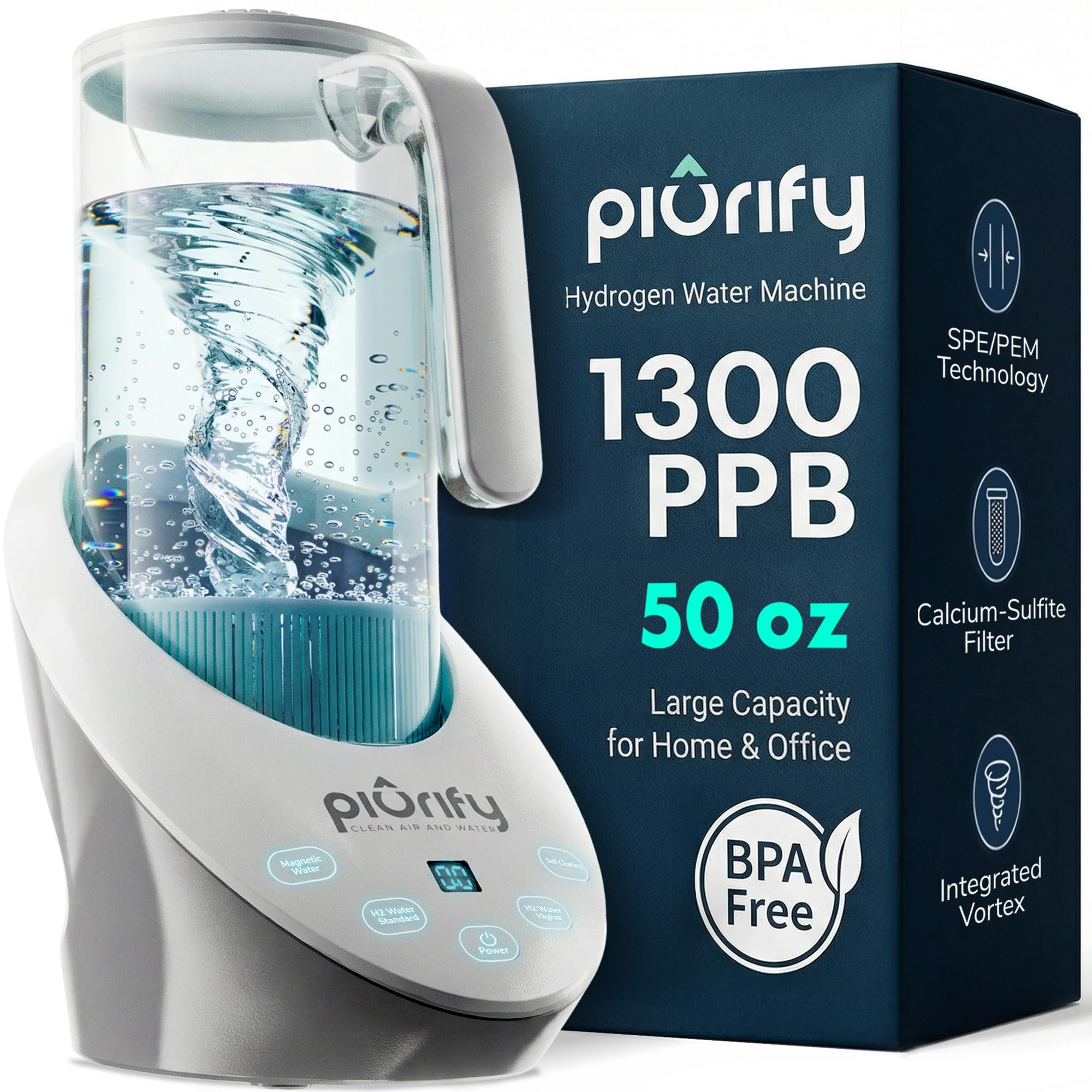
1. PIURIFY 3 in 1 Hydrogen Water Machine
Our pick — 4.0+★ from 650+ verified ratings; the strongest balance of quality and price.
A 50-ounce Tritan pitcher that swirls, filters chlorine, and infuses hydrogen in one countertop unit.
Two people, one counter, and a steady daily habit: that is exactly the buyer this pitcher was drawn for. The PIURIFY 3 in 1 holds 50 fluid ounces of water, roughly 1.5 liters, so a single fill covers a couple of glasses at breakfast without a refill. It runs a magnetic vortex cycle first — a gentle swirl that aerates the water — then a calcium-sulfite filter to take out chlorine, then the hydrogen infusion itself.
Everything you measure happens in plain language: an 8-minute cycle gives 700–900 PPB of dissolved hydrogen, and a 13-minute cycle pushes it to 1300 PPB. Run the longer cycle and the hydrogen is retained in the water for up to 8 hours, which is what makes a pitcher worth owning rather than a fresh-glass-only bottle. A built-in cleaning mode and a quick-swap filter keep the upkeep short.
What wins people over is the everyday convenience — owners describe running six to ten pitchers a day between two people for months, and report the water tastes clean and odorless with no chlorine bite. The recurring note is that the vortex step and the hydrogen step run one after the other rather than together, so the full ritual takes attention, not a single button tap. It is also not a heavy-duty filter, and Piurify itself says to pair it with a dedicated filter pitcher if your tap needs real purification. That is the honest trade-off of a device built to enrich rather than treat.
What earns the top spot
- 50 fluid ounces gives a whole household one cycle instead of one glass
- Three functions stacked — swirl, chlorine filter, hydrogen infusion
- Hydrogen retention holds up to 8 hours after the cycle ends
- Self-cleaning mode and a swappable filter make upkeep short
Where it asks for patience
- Vortex and hydrogen run as separate steps, not in one pass
- It enriches safe water — it is not a full purification system
Right for: a two-person kitchen that wants hydrogen water and light chlorine removal from one jug on the counter.
Think twice if: your tap water needs real purification — you will need a separate filter upstream.
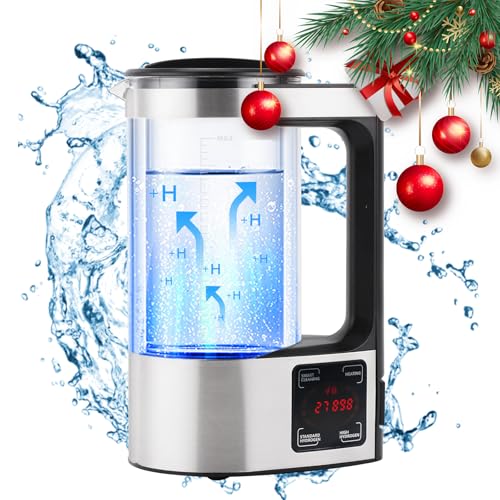
2. Upgraded Hydrogen Water Generator 110V
A 2-liter borosilicate glass kettle with a touch panel that runs one large batch per cycle.
If the pitcher on this list feels too small for a full house, this is the step up: a 2-liter glass kettle with a touch panel that runs one big batch instead of a couple of glasses. It sits on the counter at 7 inches long and 7 inches wide, a bit more footprint than the PIURIFY pitcher’s 8.3 by 7.2 inches — and about an inch less tall. The borosilicate glass body is the draw here, giving you a see-through tank where the bubbles and the cycle are visible.
This upgraded version swaps the older platinum-titanium plate for SPE ion membrane electrolysis, which is the membrane method that separates hydrogen from oxygen and pushes the oxygen and residual chlorine out. That is why the maker says it handles tap, bottled, and mineral water alike — though it also notes that poor faucet water should be filtered first. A self-cleaning mode rounds out the maintenance.
Here is where you need to read carefully: the 1800 PPB figure on the label is the top of the range, and not every unit measures there. Buyers report their own test meters reading meaningfully lower on both the regular and high settings — worth knowing before you buy on that number alone. The water taste is the consistent bright spot, and the machine keeps working for owners who have run it for a year. The recurring gripe is the handle, which feels light, plus the fuss of unplugging it between uses. If you want a big glass batch and can accept that the PPB peak is best-case, it delivers.
Borosilicate build, honest catch: the 2-liter glass tank is the reason to choose it over a plastic pitcher — you can watch the electrolysis run and it looks good on the counter. The catch is the output ceiling; treat 1800 PPB as the top of the range, not the everyday reading.
Pick this if: your household drinks through a lot of water daily and you want one large glass batch per session.
Skip if: you plan to rely on the advertised peak PPB number as your buying proof.
3. Hydrohealth Hydrogen Water Bottle | 1600 PPB SPE/PEM Tech
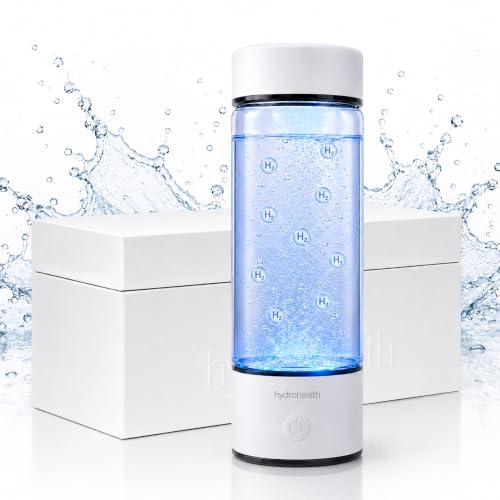
A rechargeable stainless bottle that runs a 3-minute SPE/PEM cycle on a single button press.
This is the bottle for the person who will not babysit a countertop machine. Fill it, press the power button, and the SPE/PEM five-layer platinum-plated titanium stack gets to work — three minutes later the indicator light goes off and the water is ready. The up-to-1600 PPB rating comes from that same membrane method, and the stainless steel shell means it survives a gym bag without stress.
What the owners keep coming back to is the simplicity: easy to fill, easy to recharge, easy to clean, and a size that fits a daily routine rather than a weekend project. The rechargeable battery covers a normal day of use, and the fill-press-wait loop is short enough that it becomes habit rather than chore. For anyone new to hydrogen water, that low friction is the whole point.
The honest limit is longevity. A small share of these bottles stop working over time, and a couple of buyers found no benefit from daily use — which is the nature of a category where individual results vary widely. The build quality and the short cycle are the reasons to go with it; the durability is the reason to buy from a seller with a clear return path. It is a genuine starter bottle, not a lifetime purchase.
The easy start: a 3-minute cycle plus a rechargeable stainless body is about as little commitment as hydrogen water gets.
Worth weighing: a handful of these units quit within months, so factor in the seller’s return window rather than assuming it lasts for years.
Made for: a first-timer who wants a portable bottle and a short cycle without a countertop machine.
Not for: someone who needs a household volume or a bottle they expect to run for years on end.
4. PIURIFY Hydrogen Water Bottle Generator
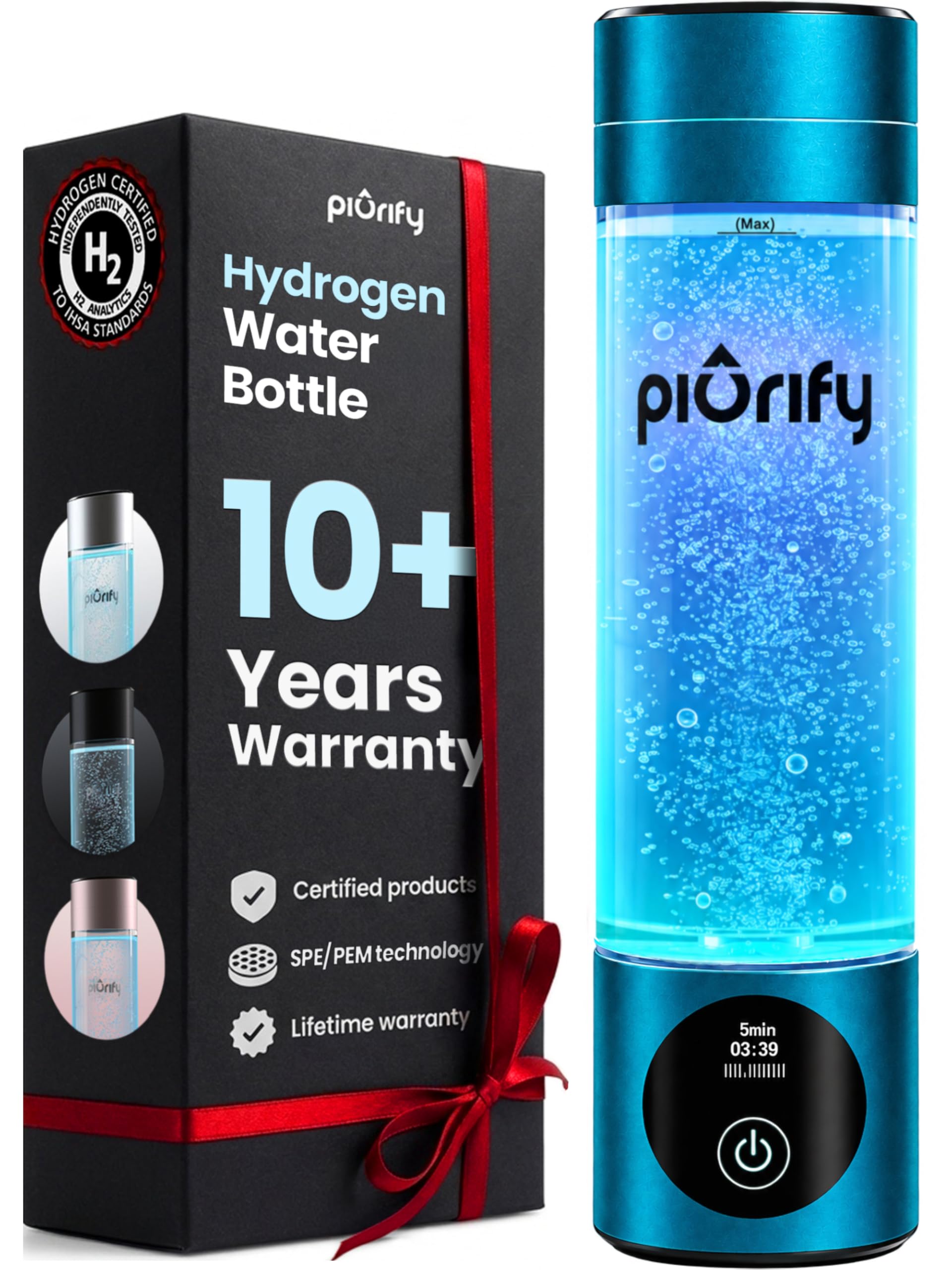
A 10-ounce bottle with 5- and 10-minute modes you can stack to climb from 2,550 toward 6,310 PPB.
Most bottles on this shelf give you one cycle and one number. This one gives you arithmetic: a 5-minute cycle for 2,550 PPB, or a 10-minute cycle for 4,100+ PPB, and you can run two or three 10-minute passes to climb toward 5,810 or 6,310 PPB. That is the defining feature — the same 10-fluid-ounce bottle can serve as a quick sip or a concentrated session depending on how many cycles you are willing to run. It has a lifetime warranty and an OLED display so you can see the mode you are on.
What the owners rave about is the build and the ease. The bottle is food-grade PC rather than glass for a practical reason — the membrane method generates gas and pressure, and glass is the fragile option under that load. Owners describe it as high-tech looking and simple to use, and the plug-and-play setup only asks you to peel off a moisture barrier before the first run. The 6,300 PPB ceiling is a genuinely high target for a bottle this portable.
The battery is the recurring compromise — some units hold a charge for months, others quit inside a few months, so it is the one spec to ask about before you commit. It is also small at 10 fluid ounces, which is fine for a desk or gym bag but not for a family pour. Go in expecting a compact, high-concentration bottle with a real warranty and a battery that needs looking after.
The case for the concentration
- Two modes plus cycle-stacking reach a 6,310 PPB ceiling
- OLED display and a nasal cannula in the box
- Lifetime warranty backs the build
- Food-grade PC body is safer than glass under gas pressure
The fine print
- Battery life is the mixed point — some die within a few months
- 10 fluid ounces is a single-serve size
Choose it when: a high concentration number from a bottle you can take to the gym is the goal.
Look elsewhere when: you need a large batch or a battery you can count on for years.
5. PUREPEBRIX Hydrogen Water Bottle Generator
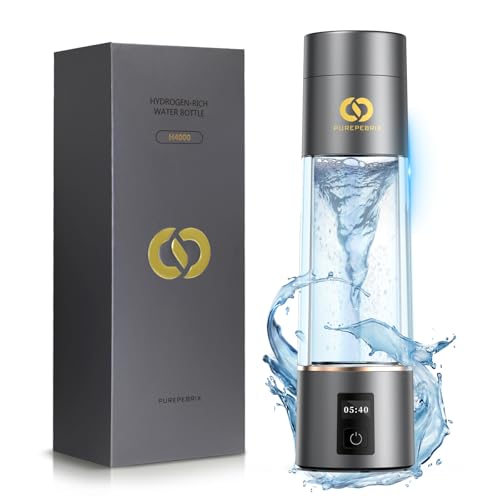
Five timed cycles from 6 to 30 minutes take the concentration from 2400 up to a 7560 PPB ceiling.
This is the bottle for the frequent flyer. It runs on a charge for multiple cycles, which makes it the pick to toss in a carry-on for a long flight or a hotel stay. The Tritan shell is shatterproof on purpose — the manufacturer says its high-pressure hydrogen output is the reason it skips glass. It even lights up as a running show, and owners describe it as looking like a lava lamp while it works.
You control the strength by time, not by a fixed setting. The device builds hydrogen in steps: 2400 PPB (parts per billion, a measure of concentration) in 6 minutes, 4930 in 12, 6360 in 18, 7160 in 24, and up to 7560 at 30 minutes. That step-by-step ladder gives you the most granular control on this list — you choose how long to wait rather than which number the maker printed. It also has a 10 oz capacity and a twelve-hour hydrogen retention claim on the spec sheet.
The honest tension sits in one number. Owners who test independently report readings well under the advertised peak, so treat 7560 PPB the same way you would treat any top-of-range figure — the lower cycle settings are the realistic band. The one thing that comes up unprompted is the modest size, which owners flag more than any other complaint. For travel and portability, though, it is the most capable bottle here.
Travel-first design: a shatterproof Tritan body, multiple cycles per charge, and a 10 oz tank built for a bag rather than a countertop.
The number to question: independent readings land below the 7560 PPB ceiling, so the 6- and 12-minute settings are the honest everyday range.
Reach for it if: you travel often and want a tough, multi-cycle bottle in a bag rather than a machine at home.
Pass if: you want a large water capacity or you buy on the peak PPB label alone.
6. Dr. Water Hydrogen Water Bottle 32 Oz
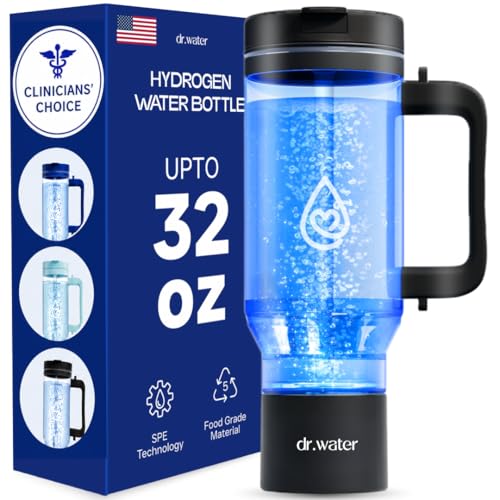
A 33.81-ounce BPA-free Tritan tumbler with a built-in sipper straw and self-cleaning electrodes.
If the small bottles feel like sipping from a thimble, this is the fix: 33.81 fluid ounces in one BPA-free Tritan tumbler. It generates up to 2000–3000 PPB with platinum-coated titanium plates and PEM technology, enough for a full day of sipping without repeated refills. It runs a self-cleaning electrode routine and the body and cap go in the dishwasher, so upkeep is a rinse away. A built-in sipper straw is part of the lid.
The volume is the reason it earns a spot. Owners who drink a lot of water describe it as sturdy and reliable through heavy use, and the capacity means you fill it in the morning and go. The ~3 PPM concentration one owner managed with regular hydrogen cycles is the kind of use case this bottle is built for: constant flow rather than a single measured glass. It is also a visibly well-made piece of gear, not a flimsy shell.
The handful of complaints land on durability and fit — the straw can loosen and let you pull air and water together, and the body is not the toughest plastic. That is the trade-off of a big lightweight tumbler. Buy it for the capacity, not for a rugged field bottle, and it does its job.
The capacity argument: nearly 34 fluid ounces in a portable tumbler is double the water of most bottles on this shelf.
Where to be careful: the straw can work loose and pull air with the water, and the shell is not built for rough handling.
Best when: you want the largest single-fill bottle on the shelf and will carry it through a whole day.
Not when: you need a tough field bottle or a straw that locks tight.
7. Aqua Ionizer Deluxe 7.0
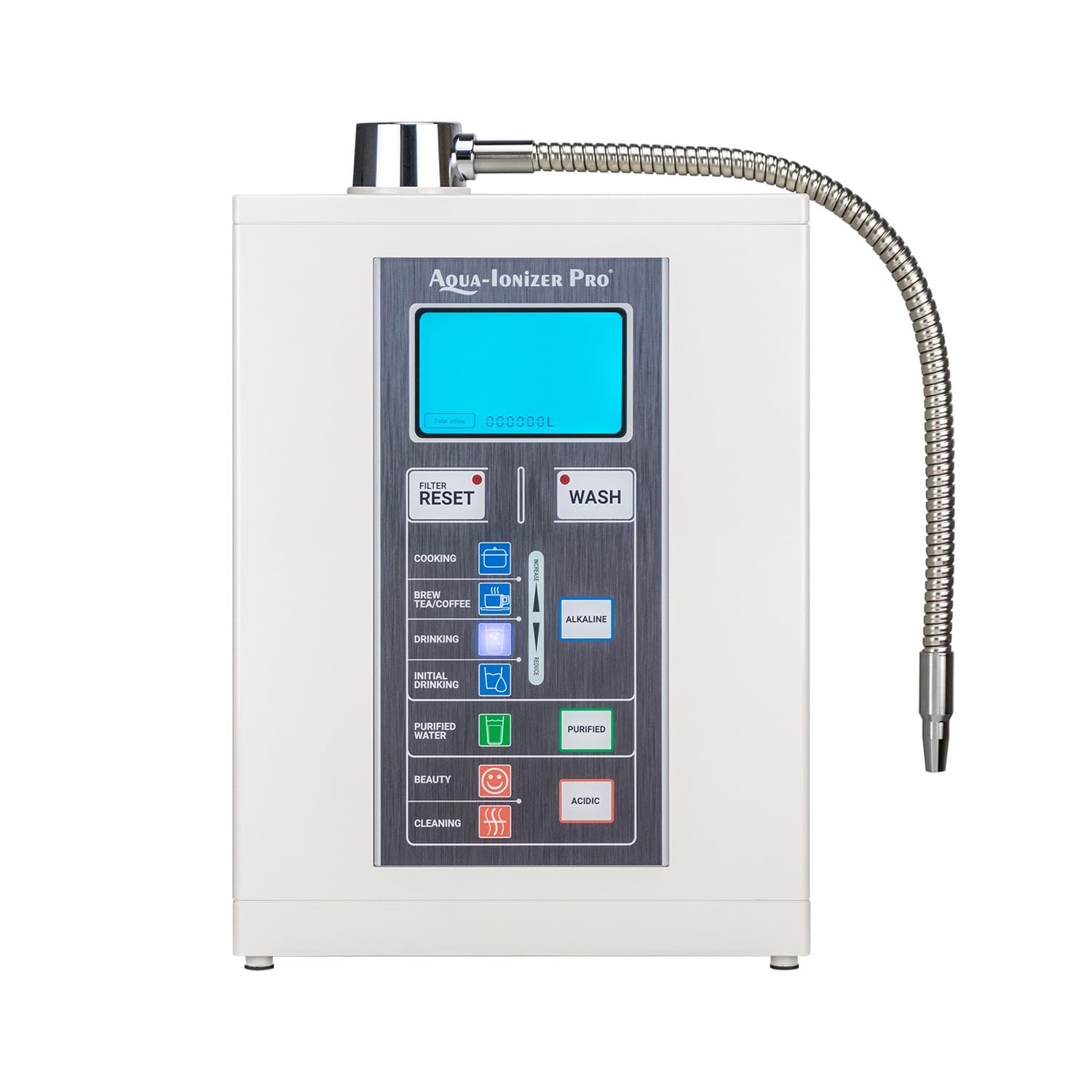
A plumbed countertop ionizer with a built-in carbon filter and seven pH settings from 4.5 to 11.0.
Different machine, different job. This one is a countertop ionizer plumbed to a water line. It pushes water through a built-in active carbon filter rated to purify 1,585 gallons and last up to a year, then runs it past seven platinum-coated titanium plates to shift the pH between 4.5 and 11.0. It also changes the ORP — oxidation-reduction potential, the reading that describes how the water behaves chemically — across a range from +600 to -750mV. It is the only pick here that treats the water rather than simply adding hydrogen to it.
The build is the story. Seven plates, a fully variable pH range, and a backlit LCD that lets you dial in exactly the setting you want. It self-cleans by reversing polarity after each use, and it auto-washes the plates every 10.5 gallons, which is what makes a plumbed machine livable. The maker backs it with a 5-year warranty. Owners describe an install that takes about ten minutes with the manual or a video, and report a crisp, distinct alkaline taste they notice right away.
The recurring note is long-term durability — a few units lost pressure or a filter burst well before the stated 4,000 to 6,000 liters, though the maker replaced filters and walked owners through the fix. This is the one pick on the list where you are investing in plumbing and a filter, so it rewards a buyer who will actually use the pH settings and maintain the filter. For a kitchen that drinks a lot of water, that extra function over a bottle is the difference between a gadget and a system.
Why it stands apart
- Seven water settings across a pH of 4.5 to 11.0
- Built-in carbon filter rated for 1,585 gallons
- Self-cleaning by polarity reversal after every use
- 5-year warranty on a plumbed machine
The long-term question
- Some units have lost pressure before the stated filter life
- Needs a sink hookup and filter upkeep
The strong fit: a kitchen that wants a full plumbed ionizer with a filter and pH control, not a bottle.
The weak fit: anyone who will not maintain the filter or needs something portable.
Know the Specs
Parts Per Billion (PPB) vs. Parts Per Million (PPM)
PPB measures how much dissolved hydrogen sits in the water — a tiny concentration, which is why the numbers are so large. Some devices list their output in PPM instead, where a single PPM equals a thousand PPB, so a 3 PPM reading and a 3000 PPB reading describe the same concentration. Read every label in the same unit before you compare two machines, or the numbers will mislead you.
SPE/PEM Plates and the Membrane
SPE stands for solid polymer electrolyte and PEM for proton exchange membrane — the internal plate-and-membrane stack that splits water through electrolysis. The practical reason to care is separation: the membrane lets a machine push oxygen, chlorine, and ozone out rather than leaving them in your glass. A device without that separation can still bubble, but it does not clean the gas out of your water.
pH, ORP, and What an Ionizer Adds
pH describes how acidic or alkaline the water is, from 0 to 14, and ORP (oxidation-reduction potential) describes how the water behaves chemically across a millivolt range. A true ionizer like the Aqua Ionizer adjusts both, which is a different job from enriching water with hydrogen. If you want filtered, pH-adjusted water for cooking and cleaning, an ionizer is what to look at. If you want hydrogen-infused water, a bottle or pitcher is.
Magnetic Vortex and Hydrogen Retention
A vortex pre-step swirls the water to aerate it before electrolysis begins. You will also see retention figures — how long hydrogen stays in the water after the cycle — quoted in hours. Longer retention matters if you plan to fill a pitcher once and pour from it throughout the day. For a bottle you drink in one sitting, retention is far less important than how fast the next cycle runs.
Common Questions
Do water structuring devices actually purify tap water?
Why does my hand-held meter read lower than the PPB number on the box?
Is a pitcher or a bottle better for a two-person household?
What is the difference between a hydrogen bottle and a water ionizer?
How long does the hydrogen stay in the water after a cycle?
Can I use tap water in these machines, or do I need filtered or bottled water?
How often do the filters need replacing?
Do these devices need to be plugged in?
Can I put the bottles in the dishwasher?
What should I check before buying a plumbed ionizer instead of a bottle?
The Bottom Line
For most people shopping for the best water structuring devices, the PIURIFY 3 in 1 is the one to reach for first. The 50-fluid-ounce pitcher covers a two-person household, the magnetic vortex and chlorine filter add real function, and the 8- and 13-minute cycles give you a genuine choice between everyday and concentrated. It is the pick with the most balanced spread of capacity, function, and daily livability.
If you travel and want to carry your water, the PUREPEBRIX bottle offers the widest range of cycle lengths in a shatterproof shell. For a big daily volume in one tumbler, the Dr. Water 32 oz carries the most water. And if you want a true kitchen system that filters and shifts pH, the Aqua Ionizer Deluxe 7.0 is the only plumbed machine here — a different class of purchase entirely. Whatever you choose, buy the shape that matches how you drink, and treat the peak PPB figure as a ceiling rather than a promise.
How we choose
We do not accept paid placement. Every pick is matched to a real buyer and a real use-case; we do not hands-on test units.
Sources
Specifications: manufacturer listings and product documentation. Review insights: verified customer reviews, as of October 2026. Pricing: not shown on this page (it changes often); check the current price via the retailer link.
As an Amazon Associate, Aappliancez earns from qualifying purchases. This does not affect which products we feature.