Disclosure: Some links in this post are affiliate links. As an Amazon Associate I earn from qualifying purchases, at no extra cost to you. Learn more
Specs are compiled from manufacturer listings and verified buyer reviews and can change over time — please confirm the key details on the product page before buying.
If your rain barrel sits at ground level, gravity gives you a dribble, not a spray. A pump fixes that — but the wrong one either can’t self-prime, can’t handle the grit in rainwater, or quits on you mid-season. The short answer: buy a mid-range submersible or transfer pump with a strainer and enough lift to reach your beds — the PowerMax 12V demand pump is the one most owners keep coming back to.
This guide is built by comparing the manufacturers’ published specifications and the patterns across verified customer reviews, so you get each pick’s real strengths and trade-offs instead of marketing spin.
You’ll see flow rates, lift heights, and strainer designs explained in plain terms, so you can match a pump to your barrel and your garden instead of guessing. Every pick below is ranked on measured flow, lift height, and how well its intake handles rainwater grit.
Top Picks

How To Choose The Best Water Pump for Rain Barrel
The biggest mistake rain barrel buyers make is shopping by gallons-per-hour alone. A pump rated at a big flow number can still leave your hose sputtering if its lift height — how high it can push water vertically — falls short of the run from your barrel to your garden beds. Match both numbers to your actual layout before anything else.
Submersible or transfer pump?
A submersible pump drops into the barrel and pushes water out, so it handles the last inch of water well and never needs priming. A transfer pump sits outside the barrel, pulls water up through a suction hose, and needs the motor kept dry. Submersible suits a fixed barrel you drain regularly; a transfer pump suits moving between barrels, pools, and jobs.
What the lift height number actually means
Lift height is the maximum vertical distance the pump can raise water. A pump rated at 36 feet of lift can push water up a slope and along a hose to a raised bed, but flow drops as you climb. Keep your real vertical rise comfortably under the rated maximum so the spray stays strong at the far end.
Grit, debris, and the strainer
Rainwater carries leaf bits, pollen, and sediment. A suction strainer or cleanable intake grate keeps that debris out of the impeller — the spinning part that moves the water. Without one, the impeller clogs and flow drops fast. Every pick here includes some form of intake protection, so check how easy it is to clean.
Side-by-Side Comparison
| Model | Best For | Flow Rate | Lift Height | Power | Amazon |
|---|---|---|---|---|---|
| PowerMax 4008-101-A65 12V RV Water Pump★ Best Overall | Quiet, self-priming demand flow | 3.0 GPM | 55 PSI | 12V DC | Amazon |
| XWILLING 120V Transfer Pump 330 GPHMost Versatile | Portable barrel-to-garden draining | 330 GPH | 39 ft | 1/10 HP | Amazon |
| Acquaer DC 12V Transfer Pump | RV and off-grid barrel transfer | 264 GPH | 46 ft | 1/10 HP | Amazon |
| Green Expert 1/3HP Sump Pump | Automatic last-inch drainage | 2000 GPH | 23 ft | 1/3 HP | Amazon |
| KITLUCK 115V Transfer Pump | Tight-space barrel draining | 330 GPH | 5 ft | 1/10 HP | Amazon |
| FLUENTPOWER 1/2 HP Rain Barrel Pump | Fixed submersible barrel setup | 1050 GPH | 36 ft | 1/2 HP | Amazon |
| TIGEROAR 115V Transfer Pump | Fast bulk draining | 330 GPH | 40 ft | 0.1 hp | Amazon |
Detailed Reviews
1. PowerMax 4008-101-A65 12V RV Water Pump
Our pick — 4.5+★ from 1,000+ verified ratings; the strongest balance of quality and price.
Quiet, self-priming, and automatic — the demand pump that minds its own business.
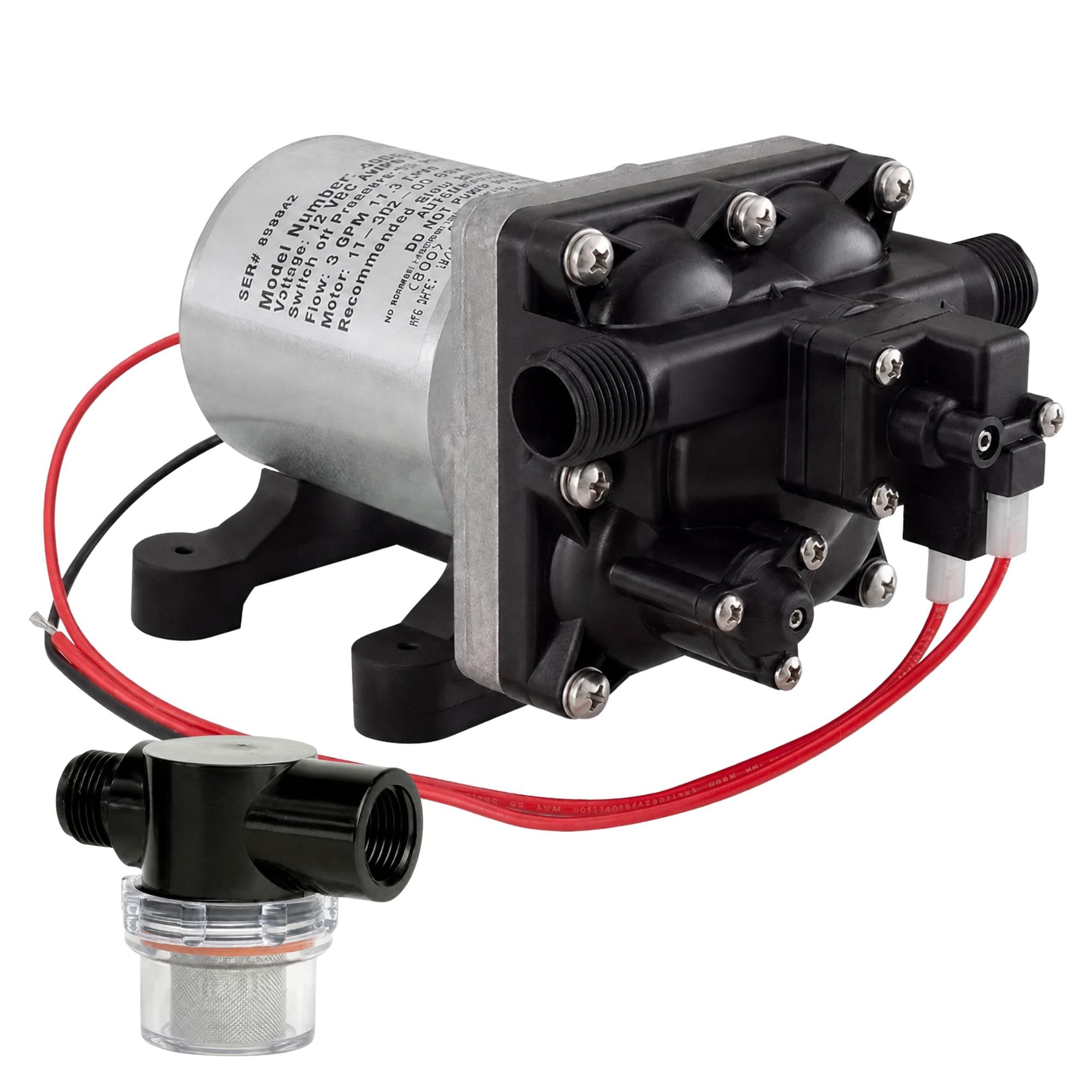
If you’ve rigged a rain barrel to feed a drip line or a small hose tap, this 12V demand pump is the one to beat. It delivers 3.0 GPM — gallons per minute, the actual water output — at 55 PSI, which is pounds per square inch of pressure, enough to push water through a garden hose and out a spray nozzle with real force. The built-in pressure switch starts the pump when you open a tap and stops it when you close it, so it runs only when you’re actually watering.
The self-priming diaphragm design (a flexible internal membrane that pumps instead of a spinning impeller) means it starts pulling without you manually filling it first — a genuine convenience for barrel setups you don’t want to babysit. The twist-on strainer keeps debris out of the internals, and owners consistently report it runs much quieter than the stock pumps it replaces. It holds the highest score in this group at 4.5+ stars across 1,000+ ratings.
The honest trade-off: owner reports on durability split sharply. A vocal minority report it lasted only about a year, while the bulk of long-term users treat it as a dependable workhorse. Factor that into how hard you’ll run it — light garden duty is its comfort zone, not continuous heavy drawdown.
Why owners keep re-buying it
- 3.0 GPM at 55 PSI gives a solid, useable spray on a garden hose
- Self-priming diaphragm design starts pulling without manual fill
- Pressure switch runs it only when a tap is open — fully automatic
- Quieter than most stock transfer pumps it replaces
Where it asks for a little care
- A minority report a roughly one-year lifespan under steady use
- Diaphragm internals tolerate grit less well than a debris-heavy barrel demands
Best for: Anyone with a fixed rain barrel feeding a tap or drip line who wants automatic, quiet flow.
Think twice if: You’ll be pulling mucky water with heavy leaf sediment — a strainer-first setup matters here.
2. XWILLING 120V Transfer Pump 330 GPH
A plug-and-go transfer pump that handles more jobs than just your barrel.
This one plugs into a standard 120V wall outlet and moves up to 330 GPH — gallons per hour, roughly five and a half gallons a minute. The 39-foot maximum discharge head (the highest it can push water) is the number to watch if your garden sits uphill from the barrel. The low-suction attachment drains water down to about 1/8 inch from the surface, so you leave very little behind at the bottom.
It comes non-submersible, meaning it sits outside the barrel and pulls water up through the included 6-foot suction hose — keep the motor dry. Owners put it to work well beyond barrel duty: pond covers, waterbeds, maple sap lines, even pressurizing a hose to spray a wide area. The zinc alloy pump head resists wear and corrosion from all that use.
The recurring gripes are noise and early failure — a few units quit after a handful of uses, though others run non-stop for hours. It’s a general-purpose transfer pump first and a barrel pump second, which is why it earns a spot here.
Value read: Budget-friendly and genuinely adaptable — the kind of pump that earns its keep across five different household jobs, not just one barrel.
The caveat to weigh: Non-submersible means the motor must stay dry, so you can’t drop it into a barrel the way you would a submersible. Plan the hose run accordingly.
Reach for this if: You want one transfer pump that drains the barrel, the pool cover, and the waterbed.
Look elsewhere if: Your heart is set on a drop-in submersible design that lives inside the barrel.
3. Acquaer DC 12V Transfer Pump

No outlet required — clamp it to a battery and pull water where the hose can’t reach.
For a rain barrel parked far from any power source, this 12V DC pump is the answer. It runs off battery terminal clamps instead of a wall plug, moving up to 264 GPH (gallons per hour). The 46-foot maximum lift is the tallest in this comparison — it can raise water farther up a slope or a tall bed than the FLUENTPOWER’s 36 feet. That extra reach matters on sloped properties.
The included on/off switch makes it easy to control without unplugging, and the kit adds a suction attachment, 6-foot suction hose, and spare impeller parts. The suction attachment pulls water down to about 1/8 inch, and metal connectors stand up better to corrosion than plastic. Buyers report it handles waterbed emptying and hot tub draining with ease, and it’s just as comfortable pulling water out of a camp barrel.
Quality feedback runs mixed — plenty swear by it, a few got a unit that powered on but wouldn’t move water. It’s non-submersible, so keep the motor dry and prime the head before first use.
Off-grid advantage: Runs off a 12V battery, so remote barrels and campsites are no problem — the 46 ft lift extends its reach well past most plug-in rivals.
Setup note: You must wet the impeller in the pump head before the very first run, and the motor stays dry at all times.
Best fit: RV owners, campers, and anyone with a barrel far from an outlet who needs battery-powered transfer.
Pass if: You want a set-and-forget submersible that never needs priming.
4. Green Expert 1/3HP Sump Pump

The last-inch specialist that empties a barrel nearly dry and shuts itself off.
Where most barrel pumps leave an inch or two at the bottom, this 1/3 HP submersible drains down to a lowest suction level of 1/25 inch, and a non-return valve stops water from flowing back in. That low-drain ability is its whole reason for being here — owners running 50-gallon rain barrels report it empties them in minutes. At full output it moves up to 2000 GPH (gallons per hour) at zero feet of lift.
The clever bit is the water sensor switch. In automatic mode it detects when water drops off the sensor and stops the pump about 15 seconds later, so it won’t run dry on you. You get manual mode too for stubborn puddles. It ships with three hose adapters, including a 3/4-inch garden-hose thread and a 1-inch high-capacity option, so connecting a standard hose is straightforward.
The catch: the sensor is the component owners trust least, especially outdoors, and a handful of units failed early. Treat the sensor as a helper, not a guarantee, and keep manual mode ready as backup. This is a barrel-and-basement hybrid rather than a pure garden pump.
What makes it the drain-down champ
- Drains to 1/25 inch with a non-return valve to stop backflow
- Water sensor auto-stops the pump roughly 15 seconds after water leaves the sensor
- Up to 2000 GPH at zero lift for fast emptying
- Includes a 3/4-inch garden hose adapter and high-capacity options
The honest limits
- The water sensor can be finicky outdoors — manual mode is your fallback
- A small number of units fail early; keep the manual socket handy
Pick it for: Near-dry barrel emptying and flooded-spot cleanup where an automatic stop saves you watching the water level.
Skip if: You need a purely sensor-driven pump you can leave running unattended outdoors.
5. KITLUCK 115V Transfer Pump

A palm-sized aluminum transfer pump for tight corners and small jobs.
This tiny 1/10 HP unit is built for cramped spots — the aluminum body keeps it light and compact, so it slips into a corner beside a barrel where a bulky pump won’t fit. It runs on 115 volts and moves a max 330 GPH (gallons per hour), with a suction strainer that pulls water down to about 1/8 inch. A metal connector holds up better than plastic against corrosion.
It comes with a 6-foot suction hose, strainer, spare impeller, and two carbon brushes, so you have the wear parts on hand. Owners use it for waterbeds, flooded areas, and clogged sinks as readily as barrels. It’s non-submersible — keep the motor dry, prime the impeller before startup, and never run it dry.
There’s no built-in on/off switch, which is a mild annoyance when you’re juggling a hose; a power strip solves it. Durability is the real question mark — some units quit after a few months, though others pump thousands of gallons without a hitch.
Size and value: The compact footprint is its calling card — ideal where space is tight, and the included spare parts add useful backup.
Watch for: No on/off switch and a plastic-grade inlet hose that kinks, so plan a better hose if flow matters.
Works well for: Small-space barrel setups and general household draining where a compact pump beats a big one.
Not for: Long, high-lift runs — its lift ceiling is modest, so keep the barrel close to the outlet.
6. FLUENTPOWER 1/2 HP Rain Barrel Pump

Built specifically for barrels — big flow, a float switch, and a 26-foot cord.
This submersible pump is purpose-named for rain barrels, and it shows in the flow: a 1/2 HP motor pushing up to 1,050 GPH (gallons per hour) with a 36-foot maximum lift. Compared with the TIGEROAR transfer pump’s 0.1 hp, this is a 0.5 hp motor — the muscle here is in a different league for a fixed barrel you drain often. A tethered float switch starts and stops the pump as the water level rises and falls, so it can run on its own.
The kit includes two aluminum extension tubes, an adjustable hook to hang it in the barrel, and a spray nozzle with flow control, plus a 26-foot cord for positioning flexibility. Owners appreciate the easy-clean grate that protects the impeller and a handle that sets how deep it sits. It draws a 55-gallon barrel down with strong pressure, and disassembles for base cleaning.
The recurring complaints are the quick-connect fitting that can leak and the absence of a power switch — you unplug it to stop it. A minority report shorter service life, so treat the pump as durable garden equipment, not a permanent fixture.
Barrel-dedicated strength: The 1,050 GPH flow and float switch make it a genuine automatic barrel pump — the purpose-built bits (hook, extension tubes, nozzle) all assume a barrel.
Fitting wrinkle: The quick-connect can seep and there’s no on/off switch, so keep a towel and plan to unplug after use.
Choose it for: A dedicated rain barrel you want pumped automatically with strong garden-hose pressure.
Reconsider if: You demand a perfect leak-free quick-connect or a built-in switch.
7. TIGEROAR 115V Transfer Pump 330 GPH
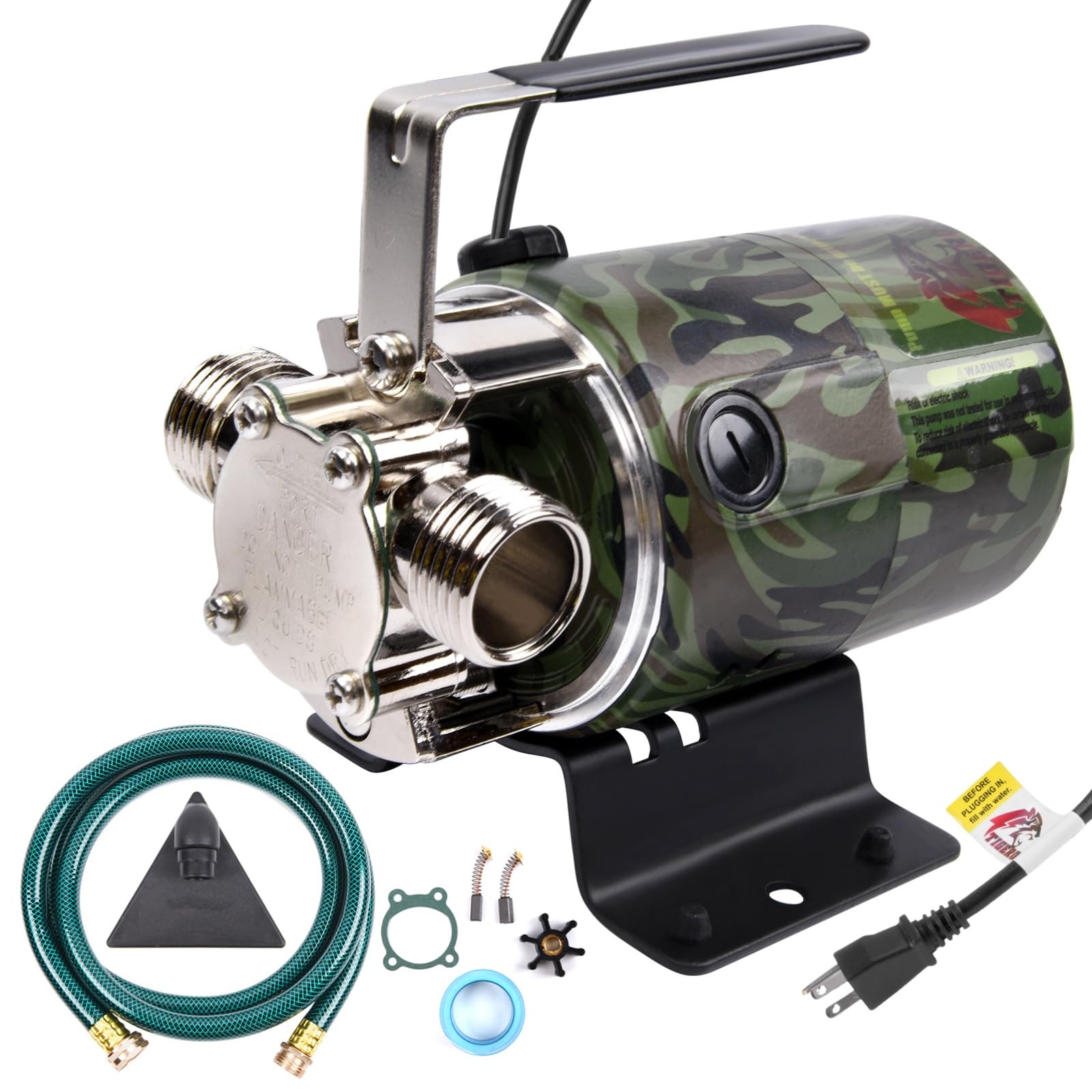
A lightweight transfer pump with a real carrying handle and a 40-foot lift.
The most budget-friendly way into a transfer pump that still lifts water seriously. This 0.1 hp unit moves 330 GPH (gallons per hour) and raises water up to 40 feet — four feet higher than the FLUENTPOWER’s 36 feet, despite carrying far less horsepower. It arrives with a 6-foot suction hose, a weighted suction strainer, and spare carbon brushes, impeller, and gasket. A carrying handle makes it easy to tote between jobs.
Owners emptying big volumes report it keeps pace: one drained a spa in about an hour, and it works for rain barrels too — good pressure, enough for a hose sprayer across five raised beds. The weighted inlet lets it suck water down near floor level.
The trade-offs: it’s a bit noisy, and a few units overheated or failed early. Keep the motor dry and the inlet submerged, and it earns its budget price.
Where it shines: Fast bulk draining at a low price point — the spa-emptying crowd and barrel-watering crowd both get service out of it.
Watch: Noise and the odd early failure; run it with the inlet submerged and don’t leave it dry.
Great for: Budget-minded buyers who need volume draining and a portable handle.
Hold off if: You want a quiet runner or a self-stopping automatic pump.
Know the Specs
Flow Rate (GPH / GPM)
Gallons per hour tells you total volume moved over time; gallons per minute tells you the pace. Higher flow empties a barrel faster and feeds a hose more strongly. But flow is measured at zero lift — the moment you push water uphill, the real output drops. Size the flow to your job, and don’t expect the headline number at the top of a slope.
Lift Height (Feet)
Lift height is how high a pump can raise water vertically. It’s the spec that decides whether water reaches raised beds or an uphill garden. A pump with generous lift but modest flow suits a long climb; one with high flow and short lift suits a flat run. Compare both together before you buy.
Horsepower (HP)
Horsepower signals the motor’s muscle. A 1/10 HP pump is light-duty and portable; a 1/2 HP or 1/3 HP unit moves far more water and can run longer. More horsepower means more flow but also more weight and current draw. Match it to how hard and how often you pump.
Float Switch / Water Sensor
A float switch starts and stops a submersible pump as the water level moves, so it can run unattended. A water sensor is an electronic version that detects low water and cuts power. Both save you from running dry, but sensors can be finicky — keep manual mode as a backup.
Common Questions
Can a submersible pump go directly into my rain barrel?
How much lift do I need to reach my garden beds?
Will these pumps connect to a standard garden hose?
Do I need to prime the pump before it will pull water?
How do I stop a pump running dry and burning out?
Does rainwater debris clog these pumps?
Is a 12V pump strong enough to water a whole garden?
Can I leave the pump in the barrel between waterings?
How many gallons per hour do I need for a typical rain barrel?
What’s the difference between a sump pump and a transfer pump?
The Bottom Line
For most barrel setups, the PowerMax 4008-101-A65 is the pick that earns its keep — automatic demand flow, quiet operation, and the highest rating here, backed by the crowd. If you want strong submersible output with a float switch, the FLUENTPOWER pushes 1,050 GPH for a dedicated barrel. And for off-grid or remote barrels, the battery-powered Acquaer 12V reaches water where a plug-in can’t. Whichever you choose, keep the strainer clean and never let the pump run dry — that’s what keeps a rain barrel pump alive season after season.
How we choose
We do not accept paid placement. Every pick is matched to a real buyer and a real use-case; we do not hands-on test units.
Sources
Specifications: manufacturer listings and product documentation. Review insights: verified customer reviews, as of October 2026. Pricing: not shown on this page (it changes often); check the current price via the retailer link.
As an Amazon Associate, Aappliancez earns from qualifying purchases. This does not affect which products we feature.