Disclosure: Some links in this post are affiliate links. As an Amazon Associate I earn from qualifying purchases, at no extra cost to you. Learn more
Specs are compiled from manufacturer listings and verified buyer reviews and can change over time — please confirm the key details on the product page before buying.
Most people buy a filtered water pitcher to fix one thing: the taste of their tap water. The trick is that not every pitcher handles the same problems. A basic carbon pitcher deals with chlorine taste and smell. A five-stage model goes after lead, PFAS and dissolved solids. Here is the short answer. If you just want better-tasting water for one or two people, a 10-cup carbon pitcher is the sensible buy. If your water has a real contaminant worry, look at the multi-stage filters on this list.
This guide is built by comparing the manufacturers’ published specifications and the patterns across verified customer reviews, so you get each pick’s real strengths and trade-offs instead of marketing spin.
Below you will find eleven picks sorted by how you actually use them — fridge pitchers, big dispensers, glass carafes — plus the filtration specs that matter. This breakdown of water pitchers with filters sticks to published specs and real owner experiences.
Top Picks


How To Choose The Best Water Pitchers With Filters
Start with your water, not with the pitcher. If your tap water tastes or smells of chlorine, that is the most common tap complaint and a standard carbon filter handles it. If you have a private well, older plumbing or a local water report listing lead or PFAS, you want a pitcher whose filter is certified against those specific contaminants. Buying a plain chlorine filter for a lead problem leaves the thing you were worried about untouched.
Read the certification, not the marketing
NSF/ANSI 42 is the basic taste-and-odor standard — it covers chlorine reduction. NSF/ANSI 53 covers health-related contaminants such as lead and mercury. NSF/ANSI 372 is a lead-free materials claim about the pitcher body itself, not the water. So a pitcher certified to 42 and 372 removes chlorine taste and is built without lead, while a model certified to 53 does more. Check which standards a filter actually holds before you count on it.
Work out your daily pour before you pick a size
Capacity here runs from 7 cups up to 27 cups in one dispenser. A 7-cup pitcher suits one person filling a glass at a time. A 10-cup pitcher fills roughly three 24-ounce bottles per top-up. And a 27-cup dispenser is built for a household that empties the thing before it has to refill. Bigger means fewer refills, but it also means more weight on a fridge shelf and a harder lift when it is full.
Filter life changes what you spend over a year
Filter life is quoted two ways — in gallons and in months. Standard carbon filters often run about 40 gallons or two months. Extended filters push to 100 or 200 gallons and three months. A longer-life filter costs more up front and less often at the margin. Match the quoted gallon figure to how much water you actually drink, and buy replacement filters by the exact model number the maker lists so they seat properly.
Side-by-Side Comparison
| Model | Best For | Capacity | Filter Life | Material | Amazon |
|---|---|---|---|---|---|
| Brita Large 10 Cup Pitcher★ Best Overall | Best Overall everyday fridge pitcher | 10 cups | 2 months | Plastic (BPA-free) | Amazon |
| Waterdrop PT-07BFilter Marathon | Long filter life on a budget | 2.4 liters | 3 months | Lead-free food-grade plastic | Amazon |
| PUR 7-Cup PitcherSmall-Space Pick | Small apartments and tight fridges | 7 cups | 2 months | Plastic | Amazon |
| Brita X-Large 27 Cup Dispenser | Large households and offices | 27 cups | 2 months | Plastic (BPA-free) | Amazon |
| ZeroWater 23-Cup Dispenser | Lowest dissolved solids with a TDS meter | 5.4 liters | — | Plastic (BPA-free) | Amazon |
| Waterdrop PT-72W Glass Pitcher | Glass carafe with NSF/ANSI 53 filtering | 7 cups | 2 months | Glass with plastic liner | Amazon |
| Brita Elite 10-Cup Pitcher | Lead and microplastic removal | 10 cups | 6 months | Plastic | Amazon |
| Clearly Filtered 10-Cup Pitcher | Widest contaminant coverage | 80 fluid ounces | 4 months | Medical-grade Tritan | Amazon |
| Aarke Purifier Large | Countertop showpiece in glass and steel | 1.66 liters filtered | — | Glass and stainless steel | Amazon |
| Culligan ZeroWater 12-Cup Pitcher | PFAS reduction with a built-in TDS meter | 96 fluid ounces | — | BPA-free plastic | Amazon |
| Waterdrop PT-05B-L | Cheapest way into certified filtering | 7 cups | 3 months | BPA-free, lead-free plastic | Amazon |
Detailed Reviews
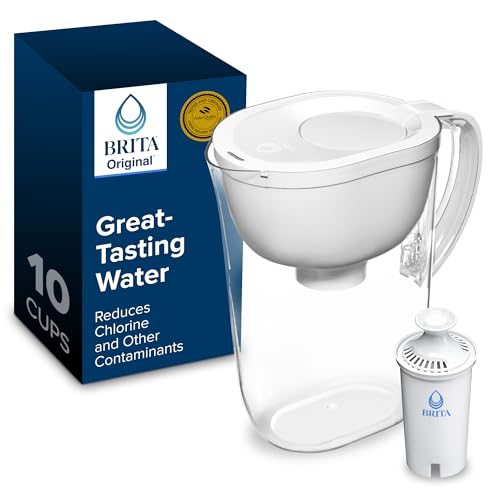
1. Brita Large 10 Cup Water Filter Pitcher
Our pick — 4.5+★ from 60,000+ verified ratings; the strongest balance of quality and price.
The default fridge pitcher for a reason — ten cups of better-tasting water without a learning curve.
Ten cups is the number that earns this one its place. That is enough filtered water to fill three 24-ounce reusable bottles before you have to walk back to the tap, which is the difference between a pitcher that gets used and one that sits in the door shelf. The pitcher body is BPA-free plastic and measures 10.7″L x 5.4″W x 10.1″H, so it slides onto a standard refrigerator shelf with room to spare. It weighs 2.29 pounds, light enough to lift out one-handed when it is full.
What wins people over is the taste. Chlorine is the thing most tap water announces itself with, and this filter is built to cut it — Brita rates the pitcher to reduce chlorine taste and odor along with mercury, copper, zinc and cadmium. It carries WQA and NSF/ANSI certification for that work. The Standard filter inside is quoted at 40 gallons or roughly every two months, and the same pitcher also takes the longer-life Longlast filter if you would rather swap less often. That flexibility is a genuinely underrated feature: you are not locked into one filter type.
The handle is the weak spot. A full plastic pitcher of this size is heavy, and the handle takes all the strain — a snapped handle is the most common way one of these ends its life. Lift it gently and fill it at the sink instead of carrying it full from room to room. On value, the picture is split: the pitcher itself is a small outlay, but the filters are an ongoing cost.
What earns it first place
- Ten cups fills three 24-ounce bottles per top-up, so refills stay rare
- Fits a fridge shelf at 10.7″L x 5.4″W x 10.1″H and weighs 2.29 pounds
- Takes both Standard and Longlast filters, so you choose your swap rhythm
- Reduces chlorine taste and odor plus mercury, copper, zinc and cadmium
Where it asks for care
- The handle is the weak point on a full pitcher — lift it by the body
- Standard filter runs about 40 gallons, so replacements come around every two months
- Value splits opinion because the pitcher is cheap but filters are not
Best for: a one- or two-person kitchen that wants better-tasting tap water with zero setup and easy filter shopping.
Think twice if: you need certified lead or PFAS removal — this filter targets chlorine taste and heavy metals, not everything.
2. Waterdrop PT-07B Water Filter Pitcher
A filter that runs 200 gallons — three months of drinking before you think about a replacement.
Filter life is where the PT-07B separates itself. It is rated for up to 200 gallons or three months, against the two months a standard Brita filter manages — that is real breathing room between swaps. Fewer replacement orders is the everyday payoff, and the LED indicator takes the guesswork out entirely: it tracks usage and flags when the filter is done. The body holds 2.4 liters and measures 10″L x 5″W x 10.1″H, a compact footprint that most fridges will take, though Waterdrop asks you to check your fridge dimensions before ordering.
The lid is the detail that makes daily use easier than it looks. It is hands-free, so water goes in and out without you lifting a cover, and that same design helps keep dust off the reservoir. Filtration runs through activated carbon and carbon fiber, and the filter carries NSF/ANSI 42 and 372 certification. It is built to reduce PFOA/PFOS, odor, iron, mercury, copper and other metal ions. One thing to know up front: this system does not lower TDS, so if a low dissolved-solids reading is your goal, Waterdrop points you to a different pitcher in its range.
Speed of use: owners consistently describe filtration that finishes in a few minutes, which matters when you want a glass now rather than later. The capacity and quick fill are the parts people talk about most — you pour and move on.
The trade-off to plan for: replacement filters must be the genuine PF-01A, so confirm the model before you order a refill pack and you avoid a filter that will not seat.
Reach for this if: you want the longest filter life in this group without the premium price — the three-month figure beats the two-month standard filter.
Look elsewhere if: your worry is TDS or hard-water minerals — Waterdrop states plainly that this one does not lower TDS.
3. PUR 7-Cup Water Filter Pitcher
Seven cups that fit where a ten-cup pitcher will not — built for a small fridge and a smaller kitchen.
If your fridge shelf is tight, the 7-cup PUR is the size question answered. It holds 7 cups, and it is the smallest pitcher on this list, which makes it the one that slides in without arguing with the shelves in a studio or a small apartment. The components are dishwasher-safe, a genuine convenience the bigger pitchers do not all offer. The lid is designed to stay tight through both filtering and pouring, so you are not chasing a cover that lifts off mid-pour.
Filtration is IAPMO-certified to reduce chlorine and other chemical and physical substances that turn up in tap or bottled water. The included genuine PUR filter uses 2-in-1 filtration, and the filter change light tells you when it needs replacing rather than leaving you to count the weeks. That filter is quoted at up to two months or 40 gallons. Against the 10.7″L x 5.4″W x 10.1″H Brita, this pitcher measures 9.6″L x 9.6″W x 10.1″H — a different footprint that trades depth for width, so measure your shelf before assuming either one fits.
PUR’s own household savings figures come from swapping bottled water for its system and filters. The real-world framing is simpler: a 7-cup pitcher is the right call if you drink a couple of glasses a day, and the wrong call if four people are filling bottles at breakfast. The most-discussed weak spots are the lid mechanism and long-term durability, so handle the lid as the delicate part rather than yanking it open one-handed.
Why small kitchens like it
- 7-cup body squeezes onto cramped fridge shelves
- Dishwasher-safe components make cleaning quick
- Filter change light removes the guesswork from swapping
- IAPMO-certified chlorine reduction
The give-and-take
- 7 cups empties fast with more than one drinker in the house
- The lid mechanism is the part that draws the most complaints over time
- Filter is a 40-gallon, two-month cycle
Suits: one or two people in a compact apartment where counter and fridge space are the limiting factor.
Not for: a busy family — you will refill a 7-cup body constantly, and a dispenser would serve you better.
4. Brita X-Large 27 Cup Water Dispenser

Twenty-seven cups on tap — a spigot that ends the refill treadmill in a busy kitchen.
Here is the size gap in plain numbers. This dispenser holds 27 cups against the 7 cups of the PUR above — nearly four times the water in a single fill. For a household where everyone drinks tap water all day, that is the difference between filling something twice a day and filling it twice a week. It is BPA-free, and the spigot is precision-pour, so you fill a glass or a bottle without lifting the whole unit off the shelf.
The filter inside is a Standard Brita filter, quoted at 40 gallons or about every two months, and a sticker indicator reminds you when the swap is due. Like the Brita pitcher, the dispenser can also take the longer-life Elite filter, which stretches to 120 gallons or roughly six months. Filtration is rated to cut chlorine taste and odor while reducing copper, mercury and other impurities, and it carries WQA and NSF/ANSI certification. There is an easy-locking lid so the reservoir stays covered between pours.
The straight answer on the trade-off: a 27-cup dispenser is heavy when full and it takes up real shelf or counter space at 18″L x 5.67″W x 10.47″H. Plan where it lives permanently rather than moving it around. For an office break room or a family of four it is the practical choice; for a solo drinker it is more capacity than you can get through before the filter ages out.
Why it earns the space: the spigot does the work — no lifting, no tipping, no drips down the side. It is the closest thing in this list to having filtered water on tap.
What to plan around: 13.5 pounds when full, so set it where it will stay and do not carry it full.
Go for it if: you have a family or a shared office that drains the thing daily and wants water without a lift-and-pour routine.
Hold off if: you drink a glass or two a day — you would be buying capacity and weight you do not need.
5. ZeroWater 23-Cup Water Filter Dispenser Removes PFOA/PFAS

The one that hands you a meter and dares you to check your water before you drink it.
ZeroWater takes a different approach to the rest of this list. Most carbon pitchers leave dissolved solids alone. This one runs a 5-stage ion exchange filter intended to remove virtually all of them, and it ships with a TDS meter so you can measure your water before and after. TDS means total dissolved solids — metals, minerals, salts and ions floating in the water. You test, you see the number drop, and you know when the filter is spent. That feedback loop is the whole appeal.
The dispenser holds 23 cups, or 5.4 liters, and measures 15″L x 5.5″W x 10.6″H. The 5-stage filter is IAPMO Certified to reduce PFOA/PFOS, lead, chromium and mercury, and the body is BPA-free. Per ZeroWater’s figures, each filter saves up to 110 single-use bottles, or up to 660 a year. One compatibility note to lock in: this unit takes only ZeroWater filters, not the newer Culligan ZeroWater filters — buying the wrong refill is the easiest mistake to make here.
What you should know before committing is that a five-stage ion exchange filter is doing more work, and it shows in two places. Filter life is the recurring complaint — heavier contaminant loads use the filter up faster. Taste splits opinion too: some drinkers love the stripped, flat quality of near-zero TDS water, and some miss the minerals. If you want water that reads clean on a meter, this is it. If you like the taste of your local water and only want the chlorine gone, a simpler filter will suit you better.
What the meter gives you
- Includes a TDS meter, so you can verify the filter is still working
- 5-stage ion exchange targets PFOA/PFOS, lead, chromium and mercury, IAPMO certified
- 23-cup capacity means long stretches between refills
- BPA-free body throughout
What to accept going in
- Filter life is the most common complaint — heavy water uses it up faster
- Taste divides drinkers: near-zero TDS water tastes flat to some palates
- Only compatible with original ZeroWater filters, not Culligan ZeroWater
Built for: the buyer who wants proof — a meter, a number, and near-zero dissolved solids they can see.
Wrong tool if: you just want chlorine taste gone and prefer water that keeps its natural mineral character.
6. Waterdrop PT-72W Glass Water Filter Pitcher

A glass carafe that filters to NSF/ANSI 53 — lead-free materials and a clean pour in one.
Glass changes the experience in a way plastic cannot. This pitcher is built from high-quality glass with a sturdy plastic inner liner for durability, so the water sits in glass rather than in a plastic reservoir. It is non-toxic, sustainable and easy to clean, and it reduces plastic use in the kitchen. Do not put it in the dishwasher — hand-wash the glass body, and the liner handles the structural work. It measures 8.1″L x 5.9″W x 8.5″H and weighs 1.62 kg.
The filtration is the part that puts it ahead of simple taste filters. It runs 5-stage filtration through carbon fiber, ion exchange resin and an activated carbon block. The filter carries NSF/ANSI 42 for chlorine, taste and odor, NSF/ANSI 53 for mercury reduction, and NSF/ANSI 372 for lead-free materials. Tested by a third-party lab, it also helps reduce copper, cadmium, PFOA/PFOS, sand, sediment and large particles. As with the other Waterdrop pitchers, it does not lower TDS. The filter lasts up to 100 gallons or two months, whichever comes first.
Pour speed is where it wins daily arguments. The flow rate is 8.5 oz/min, so an 8-ounce cup fills in under a minute — you are not standing at the counter waiting. The catch is size: 7 cups is enough for one or two people, and not enough for a family filling bottles. If you want the glass look and the certified filtering but need more volume, this is a one-person carafe rather than a household workhorse.
What owners fix on: the taste. Water comes out without the chlorine edge, and the glass body looks good enough to leave on the table rather than hide in the fridge door.
Care to build in: no dishwasher, and glass needs a gentle hand — set it down rather than dropping it onto a hard counter.
Pick this one when: you want certified lead-free materials and a glass carafe on the counter, and you are pouring for one or two.
Skip if: you need a big reservoir or dishwasher cleaning — this is a hand-wash, small-batch pitcher.
7. Brita Large 10-Cup Elite Water Filter Pitcher
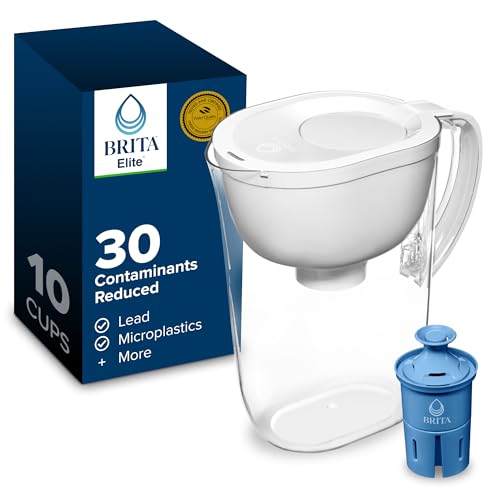
Ten cups, a six-month filter, and lead removal — the Brita for buyers who want more than taste.
This is the step up from Brita’s standard pitcher. The Elite filter is rated to reduce 99% of lead, plus chlorine taste and odor, cadmium, mercury, benzene and asbestos. That pushes it well past the plain chlorine job the original pitcher does, and it is why this one hand
les a different buyer. The filter runs six months — a much longer interval than the two-month Standard filter, which changes how often you think about replacements.
Capacity stays at 10 cups, enough to fill three 24-ounce reusable bottles per top-up and still fit most fridges. It measures 10.94″L x 5.59″W x 10.47″H and weighs 1.3 pounds, lighter than its plain sibling. The lid is easy-fill and an electronic indicator handles filter reminders. Brita Elite filters fit all Brita pitchers and dispensers except the Stream model, so if you already own a Brita pitcher, this filter likely drops straight in.
The reliability of that indicator light is the recurring complaint — it is the part that tends to stop working before anything else does. That does not affect the water you drink, but it means you should keep your own note of when you installed the filter rather than trusting the light alone. The rest of the story is the taste, which owners consistently describe as clean.
The value case: a six-month filter means half the swaps of a two-month one, plus lead and microplastic reduction the basic filter does not claim. That is the whole reason to step up to Elite.
Keep in mind: if the reminder light dies, track the six-month date yourself — the filter still works, you just lose the prompt.
Best for: a fridge-pitcher owner who has read a water report mentioning lead and wants a filter that addresses it without switching brands.
Not needed if: your water is clean and you only want the chlorine taste gone — the plain 10-cup does that for less complexity.
8. Clearly Filtered Water Filter Pitcher
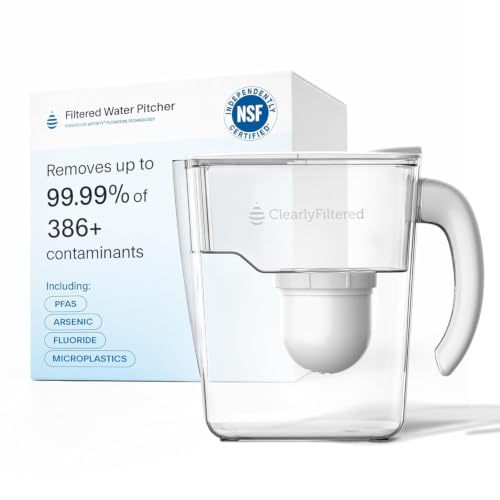
The deepest filter here — 386+ contaminants, fluoride and PFAS on the list, in medical-grade Tritan.
Contaminant counts are the reason this pitcher exists. The Clearly Filtered system is NSF-certified and targets 386+ contaminants at up to 99.99% removal, including fluoride, lead, PFAS/PFOA, arsenic, microplastics, chlorine and perchlorate. Its Affinity Filtration Technology uses ionic binding to capture contaminants while preserving beneficial minerals, which the maker rates at up to 73x more contaminants than typical store-bought filters. If you have a specific tap-water worry, this is the list that likely covers it.
Capacity is family-sized at 80 fluid ounces, roughly 10 cups or 2.4 liters, with a spill-resistant water dam, a comfort handle and a hinge fill lid. The body is medical-grade Tritan plastic that is BPA-free, BPS-free, non-leaching and free from endocrine disruptors. The filter handles up to 100 gallons, roughly 200 refills or about four months of daily use. It is certified to NSF/ANSI 42 and 372 for chlorine taste and odor and lead-free materials, and independently tested by EPA-accredited laboratories.
Two trade-offs to weigh. First, wide-spectrum filtration at high removal rates often comes at a trickle — filtration speed is the most disputed point over time, so fill the pitcher early rather than when you want a glass. Second, this depth costs more than the standard carbon pitchers. In return you get the widest spectrum of coverage in this batch, tested by a third party and published openly for anyone to check.
Why the depth matters
- Targets 386+ contaminants, including fluoride and PFAS/PFOA at up to 99.99% removal
- Medical-grade Tritan body — BPA-free, BPS-free, non-leaching
- Filter handles up to 100 gallons, roughly four months of daily use
- 10-cup capacity with a spill-resistant water dam
What it costs you
- Filtration speed is the most disputed point — slower when the filter ages
- You pay for the breadth, so budget for filter replacements as the ongoing cost
- No TDS reduction focus — this targets contaminants, not dissolved minerals
Where it wins: any household with a real tap-water concern — fluoride, PFAS or lead on a local water report — that wants one pitcher to cover the list.
Not the minnow: pour speed is deliberate, not fast, so do not expect it to fill a glass instantly.
9. Aarke Purifier Glass & Stainless Steel Water Filter Pitcher

A glass carafe and stainless steel with a refillable cartridge — as much a countertop object as a pitcher.
Aarke is a Swedish design house founded in 2013 by industrial designers Carl Ljungh and Jonas Groth, and the Purifier carries that design-first thinking. The core is a patented, refillable stainless steel filter cartridge inside a timeless glass carafe — one you refill rather than throw away. This is the Large version: a 2.8L pitcher with 1.66L of filtered capacity. The handle is made from recycled Ocean Bound Plastic and supports the carafe’s 57.47 fl oz volume.
Filtration is where the customization begins. The Purifier ships with one Pure granule refill for clean, crisp water, and Aarke sells an enriched granule option, developed with BWT, that adds minerals — that is sold separately. Each refill bag filters up to 120L of water, per Aarke. The components are dishwasher-safe, and the stainless steel cartridge is what Aarke bills as a hygiene edge over plastic reservoirs that can trap odors. The pitcher measures 5.3″L x 8.1″W x 9.8″H.
Two honest limits. Glass this thin demands care — breakage is the recurring gripe in the long run, so set it down rather than dropping it onto a hard sink. And filled, it gets heavy enough that lifting it one-handed takes attention. What it delivers is a glass-and-steel pitcher you would leave on the table, with a filter you refill instead of replace — and a price that reflects the design.
What people love: the glass-and-steel look and the taste of the water. Quality of materials gets more praise than any other trait, and the refillable cartridge cuts the plastic-stream cost.
Be careful with: the glass body. Treat it as a pitcher you set down gently, and the refillable cartridge pays off over a long run.
For the design buyer: someone who wants filtered water served from a carafe they are happy to keep on the counter, not hidden in the fridge.
Not for the clumsier kitchen: a glass body with a stainless cartridge is a beautiful, breakable thing — the durability trade-off is real.
10. Culligan ZeroWater 12-Cup Pitcher Water Filter Removes PFAS

A twelve-cup pitcher certified against total PFAS — with a built-in meter to prove the filter is working.
Total PFAS is the buzzword that puts this pitcher in the conversation, and it earns it. The 5-stage filter is certified by IAPMO to reduce Total PFAS — the “forever chemicals” — along with lead, chlorine, mercury and other contaminants. Culligan also states this filter is certified to reduce 5x more contaminants than the leading filter. The 5-stage design is guaranteed to remove 99.9% of dissolved solids, and a built-in TDS meter reads the level before you pour.
Capacity is 96 fluid ounces, which is 12 cups — a sensible middle ground between a 7-cup and a big dispenser. It is BPA-free, measures 10.3″L x 5″W x 10.5″H and fits easily into a small fridge or sits on a countertop. The design makes it easy to live with: drop-in filter, easy-slide lid and an ergonomic handle for a one-handed pour. Per Culligan, each filter saves up to 150 single-use bottles. One compatibility catch to remember — it takes the new Culligan with ZeroWater Technology filters, not legacy ZeroWater filters.
Filter life is the honest catch. Buyers report the filter wearing out faster than the marketing suggests — some in as little as three weeks — because a 5-stage ion exchange filter (a filter that swaps ions to pull out dissolved solids) works hard, and dirtier water uses it up quicker. If your water is mineral-heavy, budget for more frequent swaps. If you want PFAS coverage (PFAS are long-lasting man-made chemicals) and a meter to see it working, this is a strong middle option.
What’s on the spec sheet
- Certified by IAPMO to reduce Total PFAS, lead, chlorine and mercury
- Built-in TDS meter shows dissolved solids before you pour
- 12-cup capacity with drop-in filter and easy-slide lid
- 5-stage filtration removes 99.9% of dissolved solids, per the maker
What to know before you buy
- Filter life can be short on mineral-heavy water — budget for frequent swaps
- The lid does not lock in place, and the handle can slide off
- New Culligan filters only — legacy ZeroWater filters will not fit
It suits: a buyer specifically worried about PFAS in tap water who wants a meter to confirm the filter is still doing the job.
Look past it if: your water is hard and mineral-heavy — this filter will need replacing more often than you would like.
11. Waterdrop PT-05B-L Water Filter Pitcher

The cheapest way in — 3 months of filtered water from a pitcher that punches past its price.
The Waterdrop PT-05B-L is the smallest and simplest Waterdrop pitcher, and that is the point. It holds 7 cups and is made from BPA-free, lead-free plastic with an ergonomic handle, so it sits comfortably in one hand. The filter lasts up to 3 months or 200 gallons, depending on local water conditions and usage — a much longer interval than a standard two-month filter, and the reason it earns a place at the bottom of this list despite the low price. A mechanical life recorder tracks your filter usage and reminds you when it is time to swap.
Filtration runs through high-quality activated carbon fiber, certified to NSF/ANSI 372 and 42. It is tested by a third-party lab to reduce chlorine, taste and odor, along with PFOA, PFOS, iron, calcium, copper, mercury, magnesium and more. One thing Waterdrop states plainly: this system does not lower TDS. It is built to improve taste and target specific contaminants, not to strip dissolved minerals. If you want the low TDS reading, Waterdrop points you to a TDS-reduction glass model in its range instead.
The value story is straightforward — this is the least expensive way onto this list, and it still carries real certification and the three-month filter life. The trade-off is capacity: 7 cups suits one or two people, and empties quickly if the whole household is filling bottles. For a first filtered pitcher, a dorm or a small kitchen, it delivers the same core filtering as the pricier models without the extra size.
The case in one line: three months of NSF-certified filtering at the entry price, in a compact 7-cup body with a mechanical filter reminder that needs no batteries.
Keep in mind: replacement filters must be genuine Waterdrop PF-01A or ASB086ZPR3WM — confirm the model before you order refills.
Reach for this when: you want your first filtered pitcher and want certification and long filter life without a big outlay.
Move up if: you need more than 7 cups at a time, or you specifically want a low TDS reading — this one will not do that.
Know the Specs
NSF/ANSI certifications
NSF/ANSI is a set of independent standards a filter is tested against — not a brand’s own claim. Standard 42 covers taste and odor, mostly chlorine reduction. Standard 53 covers health-related contaminants such as lead and mercury. Standard 372 confirms the pitcher body is made without lead. So a filter certified to 42 and 372 reduces chlorine taste and is built with lead-free materials. A filter also certified to 53 goes after lead in the water itself. Check which standards apply before you count on a filter for a specific contaminant. Note that IAPMO and WQA are other certifying bodies that run the same style of independent testing.
Filter life in gallons versus months
Filter life is quoted two ways, and both matter. Gallons tell you how much water the filter can treat before it is spent — a standard carbon filter is often rated around 40 gallons, while extended filters reach 100 or 200 gallons. Months tell you the calendar side, and that matters because a filter can age out even if you do not drink much. Most makers phrase it as “whichever comes first,” based on local water and usage. Harder or dirtier water uses a filter up faster, which is why the same pitcher can last longer in one home than another. Buy replacement filters by the exact model number the maker lists so they seat properly.
TDS and TDS meters
TDS means total dissolved solids — the metals, minerals, salts and ions dissolved in your water. A TDS meter measures that level, and some pitchers ship with one so you can check your water before and after filtering. Here is the important distinction: many carbon pitchers are designed to improve taste and reduce specific contaminants while leaving TDS alone. A five-stage ion exchange filter, by contrast, is built to strip dissolved solids down. Neither is inherently better — they solve different problems. If you want a low TDS reading, choose a filter rated to reduce it. If you only want chlorine taste gone, a standard carbon filter is enough.
Capacity, fridge fit and weight
Capacity runs from 7 cups on the smallest pitchers up to 27 cups in a large dispenser. More capacity means fewer refills, but it also means more weight to lift and more shelf space to give up — a 13.5-pound full dispenser is not something you carry around. Fridge fit often you to check the actual dimensions rather than the name. A 10-cup pitcher at roughly 10.7″L x 5.4″W x 10.1″H may fit one shelf where a 7-cup at a wider footprint will not. Measure your shelf before you order, especially for a tall dispenser with a spigot, and plan where it will live permanently if it is heavy when full.
Common Questions
Will a filtered water pitcher remove lead from my tap water?
Does a filtered pitcher lower TDS, and do I need it to?
How often do I actually have to replace the filter?
Will a filtered pitcher fit on my fridge shelf?
Do I have to use the brand’s own replacement filters?
Is a glass pitcher better than a plastic one?
What is the difference between NSF/ANSI 42, 53 and 372?
Will a filtered pitcher help if my water has PFAS?
How long can filtered water sit in the pitcher before it goes stale?
Is the pitcher itself built without BPA?
The Bottom Line
For most kitchens, the sensible buy from these water pitchers with filters is the Brita Large 10 Cup Pitcher. Ten cups means real everyday volume, the footprint fits a fridge shelf, and the taste is the clean, chlorine-free water most buyers are actually after. If you want a much longer filter interval at a lower outlay, the Waterdrop PT-07B runs three months or 200 gallons against the two-month standard.
If your water report mentions lead or PFAS, step up to a filter certified for those contaminants — the Brita Elite for lead and microplastics, or the Clearly Filtered for the widest net at 386+ contaminants. For a busy family or a small office, the Brita X-Large 27-cup dispenser ends the refill routine with a spigot. Big household and heavy-drinking buyers will find the 27-cup dispenser earns its counter space faster than any small pitcher, and its volume and spigot are the reason to start there if size is your problem. Pick the capacity for your real daily pour and the certification for your actual water worry, and any of these will do the job.
How we choose
We do not accept paid placement. Every pick is matched to a real buyer and a real use-case; we do not hands-on test units.
Sources
Specifications: manufacturer listings and product documentation. Review insights: verified customer reviews, as of October 2026. Pricing: not shown on this page (it changes often); check the current price via the retailer link.
As an Amazon Associate, Aappliancez earns from qualifying purchases. This does not affect which products we feature.