Disclosure: Some links in this post are affiliate links. As an Amazon Associate I earn from qualifying purchases, at no extra cost to you. Learn more
Specs are compiled from manufacturer listings and verified buyer reviews and can change over time — please confirm the key details on the product page before buying.
If you want the short answer: buy a mechanical timer if you just need a hose switched off after a set time, and buy a digital one only if you genuinely need a repeating weekly schedule. That single split decides almost everything else about which water hose timer suits your garden. The picks below cover both jobs, from a twist-dial unit with no batteries at all to programmable models that handle three separate watering zones.
This guide is built by comparing the manufacturers’ published specifications and the patterns across verified customer reviews, so you get each pick’s real strengths and trade-offs instead of marketing spin.
You will see how run time, rain delay and inlet material change the day-to-day experience. By the end you will know exactly which of these water hose timers belongs on your faucet this season.
Top Picks

How To Choose The Best Water Hose Timers
Not every hose timer is a programmable computer, and assuming otherwise is how first-time buyers end up with a dead battery in the shed. Plenty of them are, and that is exactly why so many end up abandoned in a shed with a dead battery inside. Start by deciding whether your garden needs a schedule or simply a shut-off.
Mechanical or programmable — pick your job first
A mechanical timer works like an egg timer: you twist the dial to a number of minutes and it counts down, then closes the valve. There is no clock, no memory and no battery to replace. If you stand in the garden with a hose and want it to stop while you go inside, that is the whole feature set you need. A programmable timer handles the opposite problem — watering the same bed every day while you are away — but it needs batteries and a programming session first.
Match the run time to what you are watering
Short bursts suit a sprinkler on a small lawn. Long soaks suit soaker hoses and drip lines, where water needs to seep rather than spray. Check the maximum duration a timer allows before you buy, because a unit that caps out at a couple of hours cannot run a slow drip line properly. The same logic applies to frequency settings: a dial that only counts down has no concept of “every other day”.
Look hard at the inlet and the seal
The inlet is where the timer screws onto your faucet, and it takes the most stress of any part. A metal or brass inlet resists deformation better than a plastic one when the fitting is tightened or left in the sun. Sealing rings and a waterproof housing matter just as much, because water finding its way into the battery compartment is the classic way a digital timer dies.
Decide whether rain delay earns its place
Rain delay pauses your schedule for a set stretch after wet weather so you are not irrigating during a downpour. On a programmable timer it is genuinely useful. On a mechanical countdown timer it does not exist, because there is no schedule to pause. Know which camp you are in before you start comparing.
Side-by-Side Comparison
| Model | Best For | Timer Type | Max Run Time | Settings | Amazon |
|---|---|---|---|---|---|
| Dramm ColorStorm Premium Water Hose Timer★ Best Overall | Set-and-walk-away hose shut-off | Mechanical | Up to 120 minutes | 12 | Amazon |
| RAINPOINT Sprinkler Timer, 3 ProgramsMost Programs | Three separate watering zones | Digital, battery | 3 h 59 min per program | 3 | Amazon |
| Rain Bird FCKIT-1PK Connection Kit | Drip line without a timer | Connector kit | — | — | Amazon |
| Insoma Sprinkler Timer with Brass Swivel | Long soaks and soaker hoses | Digital, battery | 23 h 59 min | 7 | Amazon |
| Orbit Programmable Digital Hose Timer | Simple daily lawn schedule | Digital, battery | — | 7 | Amazon |
Detailed Reviews
1. Dramm ColorStorm Premium Water Hose Timer
Our pick — 4.0+★ from 350+ verified ratings; the strongest balance of quality and price.
Twist the dial, walk away, and the hose shuts itself off — no battery, no clock, no screen.
This is the pick for anyone who keeps forgetting the hose is running. You wind the dial to a time, and the unit counts down and closes the valve by itself. It runs for up to 120 minutes, so it covers a slow soak on a flower bed or a sprinkler pass on a small lawn. There are 12 settings on that dial, which gives you a useful spread of increments rather than a vague “somewhere around ten minutes” guess. It weighs 5.3 ounces, so it hangs light on the faucet and does not drag the fitting sideways.
Owners keep coming back to the same point: you twist the dial and walk away. There is no schedule to reprogram, so a mid-season downpour never sends you outside to reset it. Owners who run drip irrigation describe it as the piece that finally made their automatic drip setup practical, and well users point out it stops them draining a tank they forgot about. One owner put the honesty plainly: “Bought 2 timers in 2010; 1 failed recently. Dramm honored lifetime warranty: required only a photo, rep gave cell number for text when form upload failed, replacement shipped same day.”
Here is where the comparison gets concrete. Against the Insoma brass-swivel timer, this one has 12 settings versus 7 — a step up in count, though the Insoma offers longer single watering windows. Set against the RAINPOINT, the Dramm is the lighter unit at 5.3 ounces against 13.12 ounces. The trade-off is durability: the plastic body and simple valve mean some units give out within a week, and slight weeping at the connection is a recurring note. It also has no clock, so it cannot water every other day while you are on holiday.
Where It Shines
- No batteries — nothing to replace and nothing to corrode in the battery bay
- Automatic shut-off that saves water and stops the “left the hose on” panic
- 12 settings and up to 120 minutes of run time for beds and sprinklers
- Compact at 5.3 ounces, so it does not strain the faucet fitting
Where It Falls Short
- Plastic build means durability is the most-discussed weakness
- No schedule or rain delay — it only counts down
- Slight leakage at the connection is reported often enough to expect it
Buy it if: you want a hose to switch itself off with zero setup and zero battery fuss.
Think twice if: you need watering to repeat on a weekly schedule while you travel.
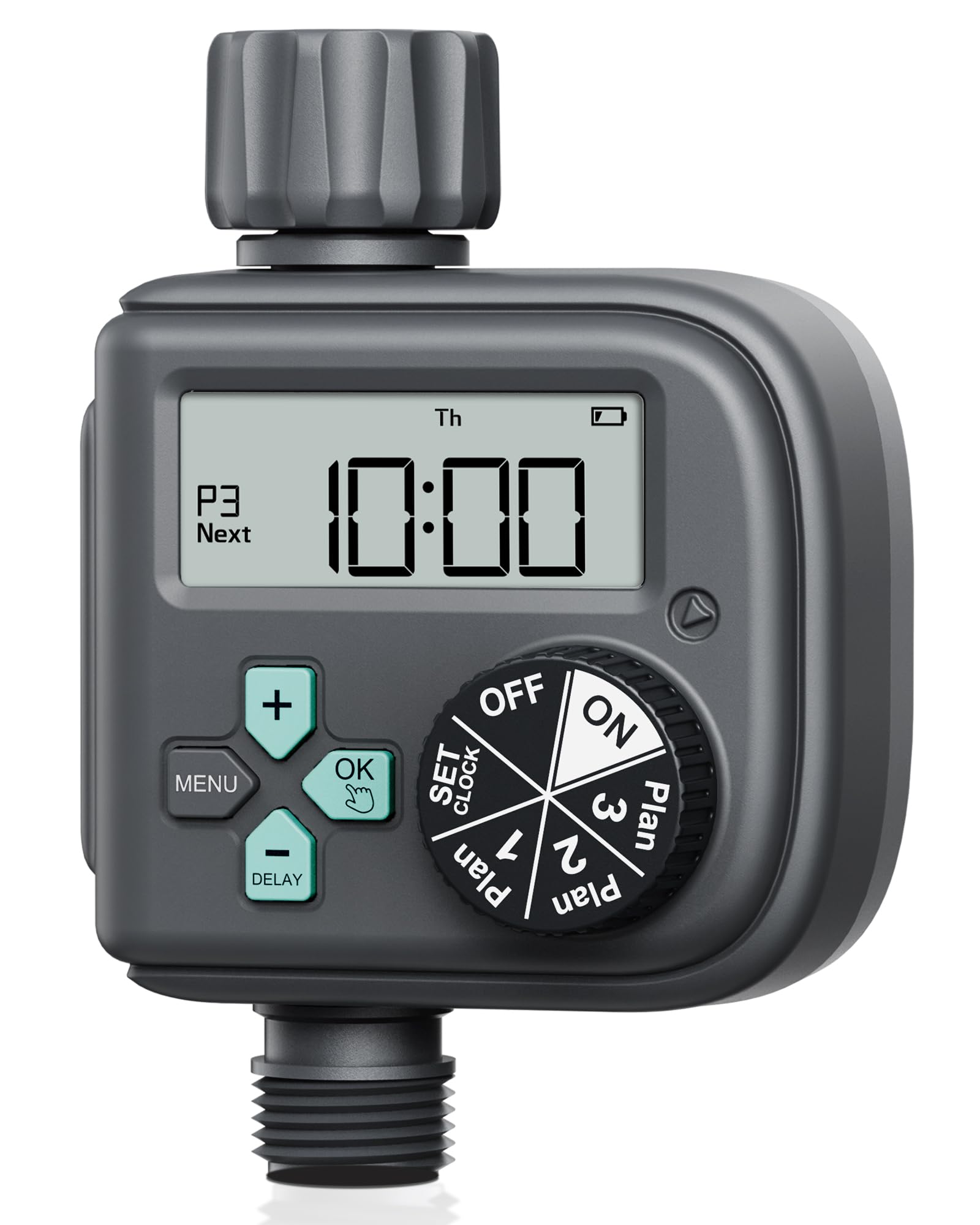
2. RAINPOINT Sprinkler Timer with 3 Independent Programs
Three independent watering programs on one faucet — the digital workhorse for a garden with different zones.
Three separate watering schedules is what sets this unit apart when your beds, lawn and greenhouse each need their own timing. Each of the three independent programs lets you set a start time, a run length from 1 minute up to 3 hours 59 minutes, and a frequency of 6, 8 or 12 hours or every 1 to 7 days. That is why it beats the Insoma on program count — 3 separate programs against a single-program dial — even though the Insoma runs longer per session. The 1.5-inch screen shows watering time, frequency and remaining battery together, so you can check the whole setup at a glance.
Pair it with a brass inlet and IP54 weatherproofing and you have a timer that takes a soaking. The listing pairs that inlet with a 116 psi pressure rating, so it holds up on a strong outdoor tap. Rain delay pauses the whole schedule for 24, 48 or 72 hours and then resumes on its own. Manual mode switches the water on for 1 minute to 8 hours without disturbing the programs you already set. Owners consistently find setup straightforward, and one habit to learn early: all three programs need to be programmed (even at zero) before the first one runs, so set the unused ones to zero on day one.
The honest catch is durability under the weather. Some units have filled with water and stopped, and a few report the display washing out in direct sunlight. The instructions are printed small, so reprint or enlarge them before you head outside. The 5-year warranty after registration is a genuine comfort here, and buyers describe the replacement service as fast and human. The three programs run separate zones without interference, and manual mode switches the water on for 1 minute to 8 hours without disturbing them.
The real strength: three separate programs mean you can water a lawn on a 1-day cycle and a greenhouse on a 12-hour cycle from the same tap — a genuine step up from any single-program dial.
The honest catch: the rain doesn’t always stay outside; internal leakage after heavy exposure is the recurring failure, so mount it where water can drain and keep the 5-year warranty registration handy.
Reach for this if: you have more than one planting zone and want each on its own repeating schedule.
Look elsewhere if: you only need a single hose switched off after a set time — the extra programming would be wasted on you.
3. Rain Bird FCKIT-1PK Drip Irrigation Faucet Connection Kit

Not a timer itself — the valve-and-filter foundation a drip system needs before a timer goes on the tap.
This kit does a different job from the other four, and it is worth saying so up front: there is no clock and no countdown here. It is the connector that turns a standard 3/4-inch male threaded faucet into a proper 1/2-inch drip line inlet. Inside the box you get a female threaded faucet connector, a backflow preventer, a 25 PSI pressure regulator, a 150 mesh filter and a 1/2-inch or 5/8-inch tubing adapter. That combination is why it exists — most drip tubing wants reduced, filtered pressure, and a bare tap will damage it.
Buyers use it as the base layer, then add a timer on top of the faucet. That is exactly the pairing the other picks here are built for, so if you run a drip line, this kit is what sits between your tap and the timer. Reviewers single out the compression fitting for sealing to 1/2-inch drip tubing without leaks. The all-in-one design also saves you buying a filter, regulator and backflow preventer separately. A trick worth knowing: warm the tubing with a hair dryer or lighter before pushing it onto the nipple, and it slides on far easier.
Hard sun is where this unit’s lifespan gets tested. The UV and chemical-resistant material is built for outdoor life, yet a Florida user reported the first unit spraying water from its own body after roughly a year in the sun, and that failure took some drip nozzles with it. Buyers also report leakage at the regulator junction, sometimes fixed with an extra rubber washer. Treat it as a part with a service life rather than a permanent fixture — it does its job well while it lasts. If you need the timer as well, add the Rain Bird hose-end timer sold separately to finish the setup.
Why Drip Growers Like It
- One box covers filter, pressure regulator, backflow preventer and tubing adapter
- 25 PSI regulator protects drip tubing from full faucet pressure
- 150 mesh filter keeps sediment out of the line
- Compression fitting seals to 1/2-inch drip tubing without extra parts
Things To Plan Around
- No timer built in — it is a connector, not a scheduling device
- Sun exposure can degrade the unit after a season or so
- The regulator junction is where leaks most often appear
This one is for: the drip-irrigation grower who needs filtered, pressure-reduced water before any timer is added.
Not the one for: anyone wanting an automatic shut-off — pair it with a timer, because this kit alone will not turn water off.
4. Insoma Sprinkler Timer with Brass Swivel
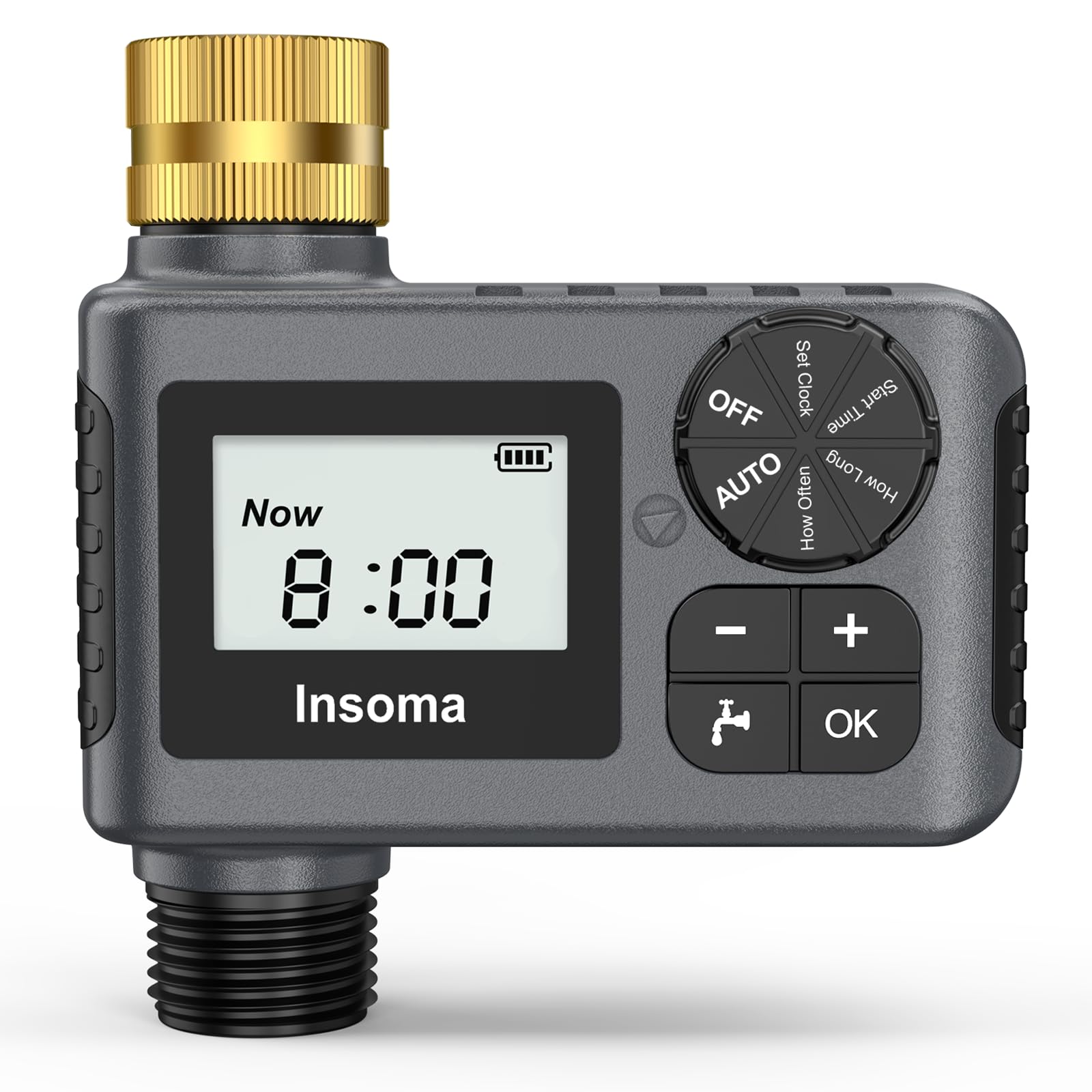
Allows watering windows up to 23 hours 59 minutes — the long-soak specialist for soaker hoses and drip lines.
The 23 hour 59 minute watering window is what sets this timer apart. Each watering window can run from 1 minute all the way to 23 hours 59 minutes, and the frequency spans 1 minute to 23 hours or every 1 to 7 days. That is what makes it the pick for a soaker hose or a slow drip line, where a short burst simply will not push enough water into the soil. The needle-inlet is 100 percent brass, which resists deformation better than a plastic inlet under tightened fittings. There are 7 settings, and the battery is rated for 4320 hours on two AA alkalines (not included).
Weather protection is thought through — IP55 waterproofing plus a seal ring on the battery cover to keep moisture out of the electronics. The brass inlet and a 35 percent fiber-reinforced connector body are rated to handle pressures from 7.25 psi to 116 psi. A child lock stops kids and pets from reprogramming it with a poke, and the larger LCD makes the readouts easier to see. The kit also includes a reducing hex bushing, a 3/4-inch GHT male thread and thread seal tape for fitting different hoses or faucets. The dial-and-buttons programming is described as easy to pick up.
Durability over a full season is the fair warning here. Some units run flawlessly for years, and some stop inside a couple of months — the worst stories land right before a holiday, which is the story no gardener wants. After a winter stored away, a few valves fail to fully close and leave a constant drip. Bright light is the display’s soft spot, hard to read in direct sun. The brand claims 6-month-plus battery life on AA cells, so one set should cover a full season. The long-window capability is something the other digital picks here do not match — only the Orbit gets close to a full-day soak.
Standout spec: the 23 hour 59 minute watering window lets a single schedule soak a new bed or a deep-root shrub properly — a far longer single pass than the RAINPOINT’s 3 hour 59 minute maximum.
The trade-off worth naming: brass at the inlet does not guarantee durability overall; valve wear and the sunlight-readable display are the two weak points to plan around.
Yes to this if: you water with soaker hoses or a deep drip line and need long, slow sessions on a schedule.
A second thought if: you only need short daily bursts — the long-window capability would be overkill, and the durability risk matters more.
5. Orbit Programmable Digital Hose Watering Timer
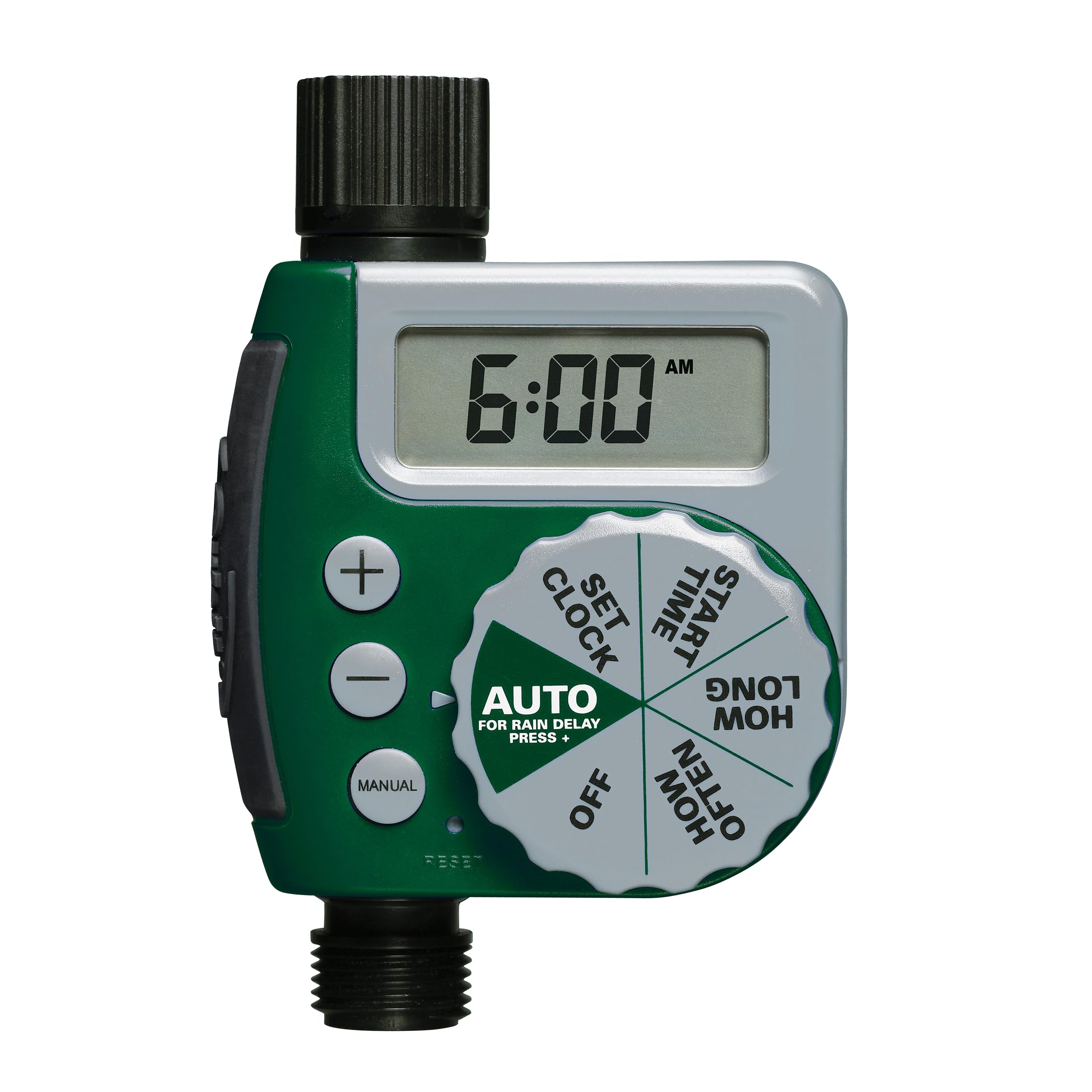
The familiar single-outlet dial timer — simple to program, with a six-year limited warranty backing it up.
This is the timer a lot of gardeners end up with because it is the least intimidating programmable model on the shelf. A clear LCD and a rotating dial handle the whole setup: you set how long, how often and what time, then it runs the schedule on its own. The built-in rain delay pauses watering when the weather turns, which is the one feature that separates a good digital timer from a dumb one. It runs on batteries, works as a water-resistant outdoor unit, and carries a six-year limited warranty against material and workmanship defects for private use.
A good unit runs multiple seasons on one set of batteries with the schedule intact. Long-term owners describe getting multiple seasons out of it, with the batteries lasting all season and the controls being easy to change with a retained schedule. Owners buy a second one rather than learn a new system, citing the rotating dial and large legible LCD text. If you have a limited water supply or fill livestock tanks, the flexible scheduling earns its keep. It is also the cheapest way into a repeating schedule among these picks — simpler than the RAINPOINT’s triple programs and less fussy than the Insoma’s long-window dial.
Reliability is the honest caveat, and it is the most-discussed weakness by a distance. Some units arrive and stop within a month or two, some fail to shut off and leave the hose running, and water finding its way into the battery compartment is a recurring story. The pattern points to inconsistency between individual units rather than a single design flaw — a good one is genuinely useful, a bad one is frustrating. The six-year warranty softens that risk, and the maker has been known to stand behind it after the return window closes. Strip the batteries out before winter storage and you remove the most common failure route.
Worth it for: a straightforward daily lawn schedule without the learning curve of multi-program timers.
The catch: unit-to-unit quality swings, so buy with the warranty in mind and pull the batteries before the cold season.
Know the Specs
Run Time and Watering Duration
Run time is the longest single session a timer will water before it stops. Mechanical units cap out at a fixed countdown — the Dramm at up to 120 minutes — which suits sprinklers and short soaks. Programmable models let you pick a duration per session, and the range matters: the RAINPOINT runs 1 minute to 3 hours 59 minutes, while the Insoma stretches to 23 hours 59 minutes for deep soaker-hose soaking. Match the maximum to your slowest water delivery, not your fastest.
Inlet Material and Water Pressure
The inlet is the threaded collar that screws onto your faucet, and it takes the tightening stress. A brass inlet (the Insoma uses a 100 percent brass swivel) resists deformation better than plastic. Pressure ratings tell you what the fitting can handle — the Insoma is rated from 7.25 psi to 116 psi, and the RAINPOINT inlet to 116 psi. If your tap runs strong, that ceiling protects the timer and the drip line downstream from a burst fitting.
Waterproofing and Battery Compartment
Rain, hose spray and condensation all attack a timer sitting on an outdoor tap. Look for an IP rating (IP54 on the RAINPOINT, IP55 on the Insoma) and a seal ring on the battery cover. That seal is the difference between a timer that survives a wet season and one that fills its battery bay and dies — the most common failure in the reviews across this whole category.
Rain Delay and Manual Override
Rain delay pauses a schedule for a set stretch — 24, 48 or 72 hours on the RAINPOINT, 1 to 7 days on the Insoma — then resumes automatically, so a wet week does not waste water. Manual mode turns the tap on for an on-demand burst without wiping your schedule. Mechanical timers have neither, because there is no schedule to pause; they simply count down and close.
Common Questions
Do water hose timers work with a drip irrigation system?
Can a hose timer water every other day while I am on holiday?
Do I need to remove the batteries before winter?
What is the difference between a mechanical and a digital hose timer?
How long does a hose timer usually last?
Will a hose timer fit my standard outdoor faucet?
How do I stop a hose timer from leaking at the connection?
Is a brass inlet better than a plastic one?
What does IP54 or IP55 mean on a hose timer?
Can I run a sprinkler and a drip line from one timer?
The Bottom Line
For most gardens, the water hose timers winner is the Dramm ColorStorm Premium Water Hose Timer because it does the everyday job — shut the hose off automatically — with no battery and no programming headache, backed by a lifetime guarantee. If you water several zones on different schedules, the RAINPOINT and its three independent programs are the stronger fit. And if you run a soaker hose or deep drip line, the long 23 hour 59 minute window on the Insoma is the one to reach for. Whatever you choose, buy one with a warranty worth trusting — in this category, that support is the feature that lasts.
How we choose
We do not accept paid placement. Every pick is matched to a real buyer and a real use-case; we do not hands-on test units.
Sources
Specifications: manufacturer listings and product documentation. Review insights: verified customer reviews, as of October 2026. Pricing: not shown on this page (it changes often); check the current price via the retailer link.
As an Amazon Associate, Aappliancez earns from qualifying purchases. This does not affect which products we feature.