Disclosure: Some links in this post are affiliate links. As an Amazon Associate I earn from qualifying purchases, at no extra cost to you. Learn more
Specs are compiled from manufacturer listings and verified buyer reviews and can change over time — please confirm the key details on the product page before buying.
If you want the short answer: buy a purifier, not a plain filter. A filter catches bacteria and protozoa, but only a purifier is rated to take out viruses too — and if you are drinking from a stream, a hotel tap overseas, or a flood-filled bucket, viruses are the part that actually makes you sick. This list covers seven devices that are built to handle that job, from gravity bags you hang at camp to a pump you can carry anywhere.
This guide is built by comparing the manufacturers’ published specifications and the patterns across verified customer reviews, so you get each pick’s real strengths and trade-offs instead of marketing spin.
Below, each pick is matched to the job it does best, with the flow rates, capacities, and field quirks spelled out in plain English. Every option here is a legitimate tool for the same goal: turning questionable water into a water filter for bacteria and viruses you can trust, without guessing at the specs.
Top Picks

How To Choose The Best Water Filter for Bacteria and Viruses
The single most important thing to get right is the word on the box: filter or purifier. A hollow-fiber filter traps bacteria and protozoa by physically blocking them, but viruses are far smaller and slip straight through the pores. A purifier adds a stage — or a UV lamp — that is rated to remove viruses too. If your water source is a mountain stream far from people, a filter is often enough. If you are traveling overseas, drawing from farm runoff, or dealing with flood water, you want virus-rated protection.
Match the method to how you drink
Gravity systems hang from a branch and let water drip through on its own, so you can set one up at camp and forget it. Pumps give you water on demand but need arm effort. Squeeze and press bottles are the lightest option for one person moving fast. UV pens are the odd one out — they zap everything in the water but do nothing for sediment, so you need fairly clear water to start.
Then look at flow rate and total capacity
Flow rate tells you how long you will stand there waiting, measured in liters per minute. Total capacity tells you how many liters the cartridge handles before you replace it, so it is really a cost-per-liter question in disguise. A group of nine and a solo trail runner need very different numbers on both counts.
Side-by-Side Comparison
| Model | Best For | Rated Capacity | Flow / Speed | Weight | Amazon |
|---|---|---|---|---|---|
| Survivor Filter PRO★ Best Overall | All-round emergency and camp pump | 100,000 liters | 500 ml per minute | 12.8 oz | Amazon |
| LifeStraw Mission 12LBest for Groups | Group and family base camp | 18,000 liters | 12 liters per hour | 15.04 oz | Amazon |
| MSR TrailShot | Ultralight solo hiking | 2,000 liters | 1 liter per minute | 5.44 oz | Amazon |
| Katadyn BeFree Gravity 3L | Fast hands-free filtering | 1,000 liters | 2 liters per minute | 6.4 oz | Amazon |
| GRAYL UltraPress | Global travel and sketchy taps | 16.9 fl oz per press | 500 ml in about 10 seconds | 12.5 oz | Amazon |
| SteriPen Ultra UV | Travel and clear-water sterilization | Up to 8,000 liters per lamp | 1 liter in 90 seconds | 9.12 oz | Amazon |
| MSR Guardian | Harsh sources and serious expeditions | 10,000 liters | 2.5 liters per minute | 1.1 lb | Amazon |
Detailed Reviews
1. Survivor Filter PRO
Our pick — 4.5+★ from 4,500+ verified ratings; the strongest balance of quality and price.
A hand pump that stacks three filter stages and still fits in a bugout bag at 12.8 ounces.
The Survivor Filter PRO is the pick that covers the most ground for the most people. It pumps at 500 ml (17 oz) per minute directly from any fresh water source, so you fill your own bottle rather than hunting for a tap. A three-stage stack does the work: a 0.3 micron pre-filter (a coarse mesh that catches grit), a carbon filter that reduces heavy metals and chemicals, and a 0.3 micron ultra filter that is the virus-rated stage. Each of those is replaceable and reusable, which is why the total rating climbs to 100,000 liters.
What wins people over is simply the build quality and the way it handles genuinely bad water — dirty pond water and muddy creek water both come out clear and clean-tasting, and the three-stage design keeps your clean water separate from the source. It is the safest piece of kit in this list for emergency use, and it needs no batteries or charging at all. Worth noting: it is a pump, so you do earn your water by hand — plan on a fair stretch of pumping to fill a full bottle.
One honest catch. The 0.3 micron pre-filter is a hollow-fiber layer that clogs faster than the other stages, so owners wrap it in a coffee filter or bandana when the water is silty. The carbon stage also runs out well before the ultra filter, and the whole unit is heavier than a squeeze filter for the same output. It is built for reliability, not for shaving grams.
Why this stays at the top
- Three stages including a 0.3 micron ultra filter, with every stage replaceable
- 500 ml per minute pump with no batteries, charging, or wait time
- 12.8 oz and 6.5 inches tall, so it packs into a bugout bag without hogging space
- Keeps dirty source water fully separated from the clean output
The honest trade-offs
- You supply the muscle — a full bottle takes real pumping effort
- The pre-filter stage clogs quickly in silty or algae-heavy water
- Heavier than squeeze-style filters that move the same volume
Go for this if: you want one device that handles camping, home backup, and emergencies without batteries.
Pass if: you are counting ounces on a fast solo trail and want the lightest possible carry.
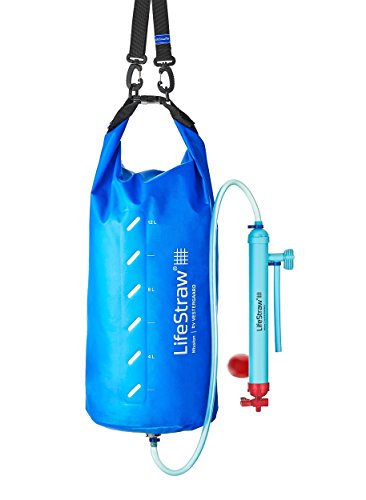
2. LifeStraw Mission 12 L
Hang it, walk away, and come back to twelve liters of virus-treated water for a whole camp.
The number that defines this one is 12 liters — the size of the roll-bag reservoir you fill, hang from a branch, and let gravity feed through a hollow membrane purifier. That is a very different scale from a personal bottle: a group of nine on a canoe trip can serve everyone from one hanging bag, and the included hose and manual get you set up in minutes. Rated capacity runs to 18,000 liters per filter, with a flow rate of 9–12 liters per hour.
Set against the Survivor Filter PRO, the trade is unmistakable: the Survivor claims 100,000 liters of capacity versus the LifeStraw’s 18,000, but the LifeStraw moves 12 liters per hour through gravity while the Survivor pushes 500 ml per minute by hand. Neither is “better” — one is for a base camp that wants to stop pumping, the other is for a single hiker who wants maximum total lifespan.
The recurring gripe is speed. Some owners find it noticeably slower than a pump, and the flow does slow over a long trip until you swish the membrane clean. The bag itself is consumer-grade and wants gentle handling — do not overfill it, and treat the hose and strap with care. A little paracord and a straight hose run both help the water move faster.
Where it shines: hands-free volume for families and groups, with a lifetime capacity of 18,000 liters and a 12-liter bag that holds enough for a full day of cooking and drinking.
What to plan around: gravity is patient, and so must you be — test it at home first, and bring a backup method for a large group.
The right call for camp cooks: anyone feeding four or more people who would rather hang a bag than pump by hand.
Think twice if: you want water in 60 seconds flat — a pump gets you there and this does not.
3. MSR TrailShot

Five-point-forty-four ounces of squeeze-and-go, built for the hiker who counts every gram.
If the Survivor pump feels like too much kit, the TrailShot is the answer to a different question: how little can I carry and still drink safely? At 5.44 ounces and 6 inches long, it drops into a hip-belt pocket and disappears. One-handed operation filters a liter in 60 seconds — you squeeze the bulb, water flows, and you drink straight from the source or fill a bottle or hydration pack without ever setting up a bag.
Owners consistently rank its filter quality at the top of the backpacking field, and the weight is why it earns a place on long trips. Measured against the LifeStraw Mission, the TrailShot is 5.44 ounces versus 15.04 ounces, so it saves you a real chunk of pack weight. The trade is volume: the LifeStraw’s 12 liters per hour versus the TrailShot’s 1 liter per minute means the TrailShot is built for one person drinking, not a camp cooking dinner.
Here is the thing you must know before buying: this is a filter, not a purifier. It removes 99.9999% of bacteria and 99.9% of protozoa, but it does not remove viruses and has no carbon stage. For clear mountain streams far from people that is usually fine; for sketchy water you need to boil or pair it with something else. The tube is also somewhat fragile and can nick, so carry it with a little care.
What earns it a spot
- 5.44 oz and 6 x 2.4 inches — barely noticeable on a long hike
- One-handed, no-bag operation that fills a bottle in about 60 seconds
- Hollow fiber construction with no chemicals, iodine, or chlorine added
- Rated to 2,000 liters before the filter needs replacing
Where it stops short
- Filters bacteria and protozoa but does not remove viruses
- No carbon stage, so it will not improve taste or pull out chemicals
- The intake tube is thin and can nick if packed carelessly
Made for: trail runners, thru-hikers, and solo backpackers pulling from clear high-country streams.
Not for: travelers facing farm runoff or flood water — you need the virus-rated purifiers further down this list.
4. Katadyn BeFree 3L

Gravity speed without the wait — a 3-liter bag that empties at up to 2 liters a minute.
Most gravity filters make you wait. This one moves water at up to 2 liters per minute through a 0.3 micron EZ-Clean hollow fiber membrane, which is fast enough to fill a bottle while you are still standing there holding it. The 3-liter collapsible bag packs flat when empty, weighs 6.4 ounces, and hangs from a branch, pole, or anchor point — fill, hang, and drink with no pumping, squeezing, or power of any kind.
Against the LifeStraw Mission, the comparison is clean: the Mission’s 12 liters per hour versus the BeFree’s 2 liters per minute makes the Katadyn the quicker pour per minute, but the Mission holds four times the bag volume at 12 liters versus 3. Different jobs — big group versus small group or solo-plus-one. Owners on rafting trips have run this for 18 people in a day, and its total rating of 1,000 liters suits a season or two of regular trips.
The membrane fouls over a long day, and the flow can fall to a trickle until you shake or swish the filter in water — no tools needed, and the cleaning steps are printed right on the bag. That 0.3 micron membrane removes bacteria, protozoa, and sediment, but this is a filter, so treat virus protection as your own problem. The bag itself can puncture if you are careless with it, and filling only happens through the cap end, so shallow water means a few scoops.
The selling point: hands-free speed — a 0.3 micron hollow fiber membrane rated to 1,000 liters, pushing up to 2 liters per minute with nothing to charge.
Best if: you want gravity convenience without the all-day drip of a bigger bag.
Skip if: you are filtering water that may carry viruses — this removes bacteria, protozoa, and sediment only.
5. GRAYL UltraPress 16.9 oz
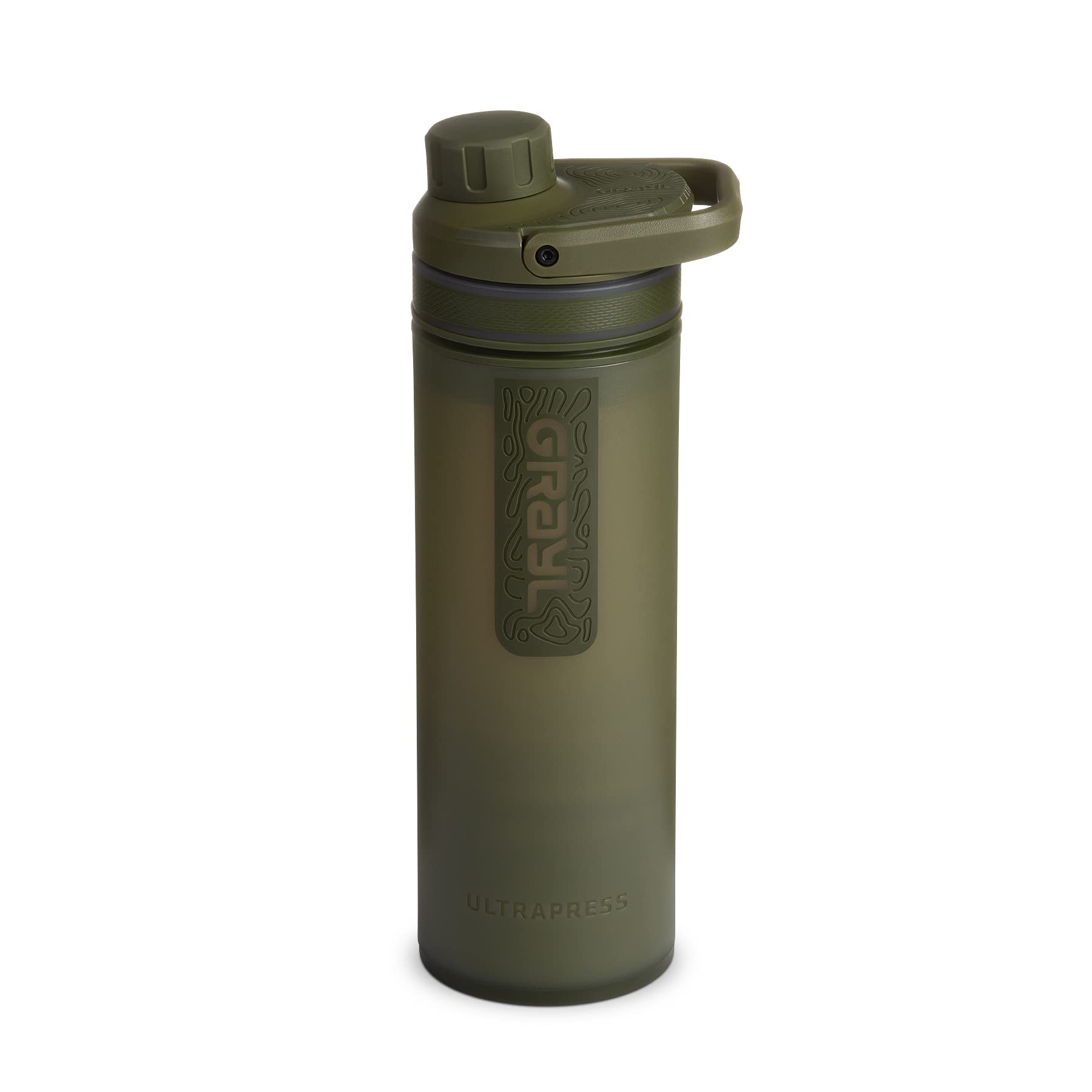
Fill it from a hotel tap, press down, and drink in about ten seconds flat.
This is the one to take when the water source is a tap you do not trust. The UltraPress is a purifier bottle — fill the outer cup from any river, faucet, or fountain, press it down on a flat surface, and drink. One press handles 16.9 oz (500 ml) in as quick as 10 seconds. The cartridge is rated to remove 99.9% of viruses (rotavirus, norovirus, hepatitis A), 99.9999% of bacteria (E. coli, salmonella), and 99.9% of protozoan cysts (giardia, cryptosporidium). It also filters sediment and microplastics and adsorbs VOCs, PFAS, chemicals, pesticides, herbicides, heavy metals, flavors and odors.
Quality is the aspect that owners talk about most, and the build feels solid in the hand at 12.5 ounces with a rugged outer cup. The one-way drink-mix valve means you can stir in electrolyte powder without fouling the filter. When not leaking, it produces tasteless, odorless water — one traveler used it across Europe and Asia for exactly that reason.
The honest catch is the press force: some owners find it hard to push at first, and the fix is simply removing the bottom silicone part, which makes the action much easier. A few report an initial side-leak of leftover dirty water before the seals break in, and the spout cap is unattached, so it can get lost. None of that changes the fact that this is the easiest virus-rated purifier to use on a city trip where you would otherwise be buying bottled water.
Why travelers gravitate to it
- Virus-, bacteria-, and protozoa-rated purification in a single bottle
- 16.9 oz per press in about 10 seconds — no pumping, hoses, or batteries
- Also pulls out PFAS, VOCs, heavy metals, and odors
- One-way valve lets you add drink powder without touching the filter
What you should know
- The press takes real downward force until you learn the technique
- The spout cap is unattached and easy to misplace
- Some units leak a little dirty water at the seal before breaking in
Reach for this if: you are flying somewhere with questionable tap water and want protection in your day bag.
Look elsewhere if: you want to filter liters for a whole group — this is a one-person bottle.
6. SteriPen Ultra UV Water Purifier, USB Rechargeable
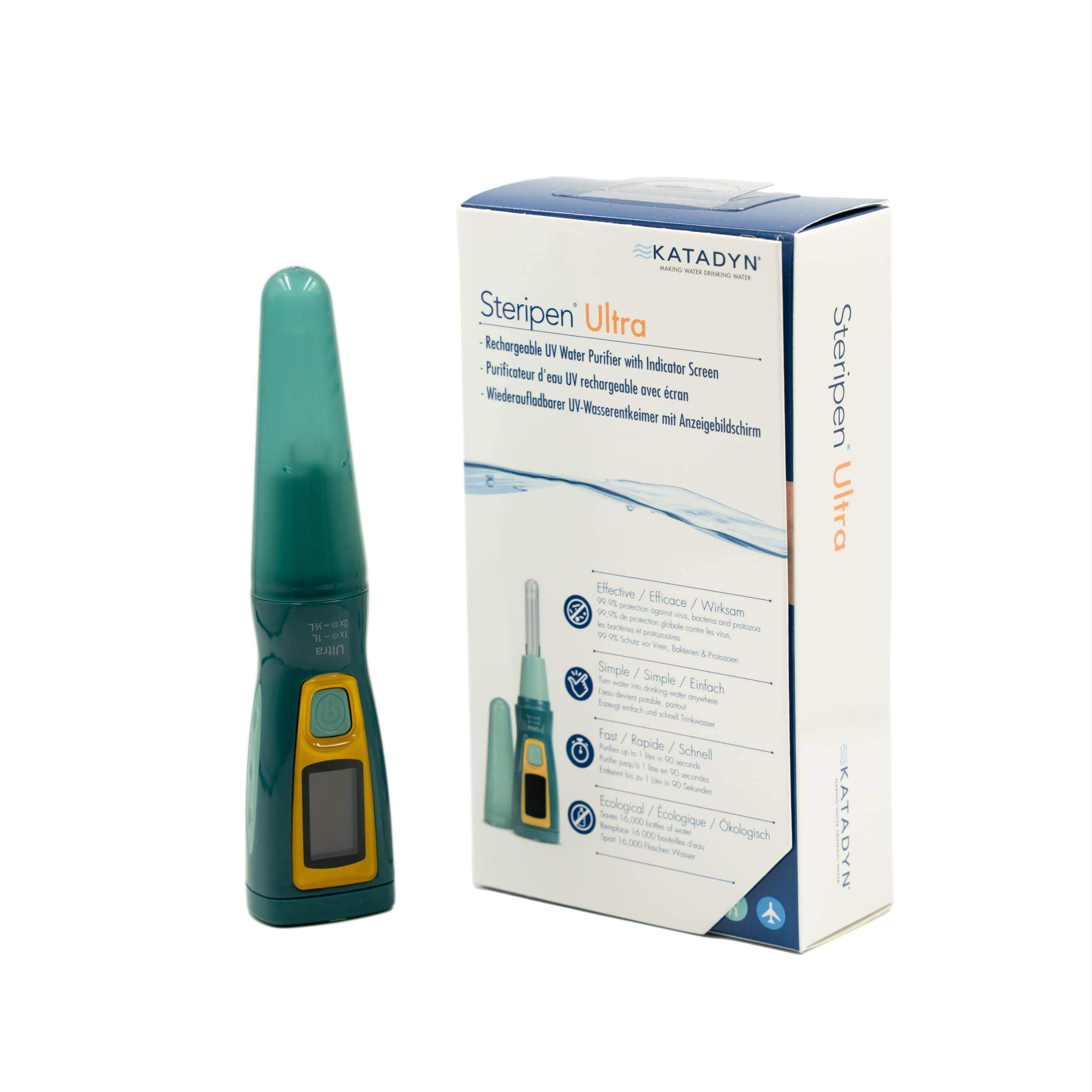
No chemicals, no filter cartridge — just UV-C light and 90 seconds per liter.
The SteriPen Ultra is the outlier here because it works differently from everything else on the list. Instead of pushing water through a membrane, it dips a UV-C lamp into a wide-mouth bottle and stirs for 90 seconds (or about a minute for half a liter), and the UV light neutralizes bacteria, viruses, and protozoa in clear water. There is nothing to clog and no cartridge to replace mid-trip. The internal battery is rechargeable over USB and powers up to 8,000 liters over the lamp’s life, with the option to top it up from a solar panel.
The OLED display is the standout feature — it confirms each treatment, counts your doses, and shows battery status, readable even in bright daylight. Owners who have used it across weeks of travel report no stomach trouble, and one full charge lasts a multi-day trek. It weighs 9.12 ounces and needs no filter cleaning, which is a real convenience on the move.
Two hard limits, stated plainly. First, this is UV treatment only: it does not filter sediment or improve taste, so the water needs to be fairly clear before you zap it — that is why the manufacturer labels it a purifier, not a sterilizer. Second, batteries run out, so carry sanitizing pills as a backup and keep the lamp from freezing. A small number of units have shown occasional failures, and one owner reported a broken tip, so inspect the lamp before each trip.
Why it earns its place: UV-C purification with a full OLED display — up to 8,000 liters per lamp lifetime, USB-rechargeable, and 90 seconds per liter with no chemicals.
The real boundary: it needs clear water to start and a charged battery to run, so pair it with a filter for silty sources.
For you if: you travel light, hate disposable filters, and prefer a device that tells you it worked.
Keep looking if: your water is muddy or you need chemical and sediment removal in the same step.
7. MSR Guardian

The purifier built to the U.S. military standard, with a pump that cleans itself every stroke.
The Guardian sits at the top of this list for one reason: it is tested to NSF protocol P248, the U.S. military standard, using medical-grade fibers that remove viruses, bacteria, protozoa, and particulate in a single step. It pumps at 2.5 liters per minute, which is the fastest on this list by a clear margin — the Katadyn BeFree tops out at 2 liters per minute and the Survivor Filter PRO at 500 ml per minute. Capacity runs to 10,000 liters per cartridge, and it is built to survive freezing, drops, and heavy use.
The self-cleaning design is what separates it from every other pump. Each stroke scrubs the fibers against themselves, so you never backflush or scrub a filter — which is exactly the chore that wears down other pumps over a long trip. On muddy floodwater, three people using it found the output smelled and tasted clean. It also meets its flow rate with no fiddling, which matters when you are tired and the light is fading.
The honest trade is weight at 1.1 pounds and 8.25 inches tall, and the price tier is the steepest here. There is also no carbon stage, so it does not remove chemicals — it is a purifier for biological threats, not a taste improver. One maintenance rule owners stress: keep the cartridge wet once used and never let it freeze, because a dried-out cartridge means a costly replacement. Carry Aquatabs for storage and run the integrity bubble test after any drop.
Why it costs what it does
- Meets NSF protocol P248, the U.S. military standard, for virus removal in one step
- 2.5 liters per minute — the fastest pump on this page
- Self-cleaning on every stroke, with no backflushing ever
- Rated to 10,000 liters and built to survive freezing, drops, and harsh use
Budget for these realities
- 1.1 lb and 8.25 inches tall — the heaviest device in this list
- No carbon stage, so no chemical or taste removal
- The cartridge must stay wet and unfrozen; drying it ruins the fibers
Built for: expeditions, global travel, and anyone who wants the strongest virus-rated protection in a hand pump.
Know the cost of care: the cartridge has to stay wet and unfrozen, so this is not a leave-it-in-the-shed tool.
Know the Specs
Micron rating
The micron number describes the pore size a filter blocks — a 0.3 micron membrane stops bacteria and protozoa but lets viruses through, because they are smaller. A 0.3 micron ultra filter or a UV stage is what actually earns the word “purifier.” If virus removal is your goal, look for that rating, not a lower number on its own.
Flow rate vs. total capacity
Flow rate is how fast water comes out, measured in liters per minute or liters per hour. Total capacity is how many liters the cartridge treats before you replace it. These are separate numbers: a pump can be fast and short-lived, or slow and rated for a huge total volume. Match both to how often you drink and how many people you are serving.
Common Questions
Does a water filter remove viruses or do I need a purifier?
Will these purifiers work on muddy or cloudy water?
How many liters does each filter treat before replacement?
Do any of these need batteries or electricity?
Can I use a purifier for travel in another country?
What temperature can these filters handle?
How do I clean and store a purifier between trips?
Is a gravity bag faster than a pump?
Do these remove chemicals and heavy metals too?
Can one purifier serve a family or a group?
The Bottom Line
For most people, the water filter for bacteria and viruses that gets the job done is the Survivor Filter PRO. Its three-stage stack includes a 0.3 micron ultra filter rated for 100,000 liters, it pumps 500 ml per minute with no batteries, and it is the one device that covers camping, home backup, and emergencies without a second purchase. If you are feeding a group at camp, the LifeStraw Mission hangs a 12-liter bag and lets gravity do the work. And if you are traveling somewhere the tap water is a gamble, the GRAYL UltraPress puts virus-rated purification in a bottle you can press in about ten seconds.
One last thought before you commit: decide where you will actually use it. A solo hiker is better served by the 5.44-ounce TrailShot, a family by the big gravity bag, and a frequent flyer by the press bottle. Match the purifier to the water you will actually face, and it will earn its keep for years.
How we choose
We do not accept paid placement. Every pick is matched to a real buyer and a real use-case; we do not hands-on test units.
Sources
Specifications: manufacturer listings and product documentation. Review insights: verified customer reviews, as of October 2026. Pricing: not shown on this page (it changes often); check the current price via the retailer link.
As an Amazon Associate, Aappliancez earns from qualifying purchases. This does not affect which products we feature.