Disclosure: Some links in this post are affiliate links. As an Amazon Associate I earn from qualifying purchases, at no extra cost to you. Learn more
Specs are compiled from manufacturer listings and verified buyer reviews and can change over time — please confirm the key details on the product page before buying.
If you want the short answer before the spec talk: the Apple Watch Ultra 3 is the strongest all-round step tracker here, the Garmin Instinct 2X Solar is the one to buy if you hate charging cables, and the Casio WS-B1000 is the pick if you just want steps on a screen with zero apps. Everything else in this article sits somewhere between those three, and the differences that matter are almost never the ones the marketing copy shouts about.
This guide is built by comparing the manufacturers’ published specifications and the patterns across verified customer reviews, so you get each pick’s real strengths and trade-offs instead of marketing spin.
Step counting sounds simple until you watch two watches disagree on the same walk in the same pocket. The trick is knowing which sensor setup, battery design and app ecosystem actually suits how you move — which is exactly what this breakdown of the watch for tracking steps category settles for you.
Top Picks

How To Choose The Best Watch for Tracking Steps
Step tracking is the one job every watch on this list claims to do, and the one job where the cheap watches and the expensive watches can land surprisingly close together. What separates them is how the count happens, where the number lives, and what you have to do to keep it running.
Sensor type and how the step count is made
Every watch here counts steps with an accelerometer — a tiny motion sensor inside the case that feels your arm swing and turns it into a number. Watches with GPS add distance and pace on top of that, so a walk becomes miles and minutes rather than a bare step total. A watch with 24/7 heart rate adds workout intensity, which is where rechargeable trackers like the Fitbit Charge 6 and the Apple models pull ahead of a plain step counter.
The catch is that arm-based counting drifts. Pushing a shopping cart, carrying a box, or holding a stroller rail can undercount because your wrist stops swinging. That is why a belt-worn pedometer and a wrist watch rarely match to the digit — a gap of a few percent across a measured quarter mile is normal, not a defect.
Rechargeable battery versus a sealed multi-year cell
This is the biggest lifestyle split in the category. Rechargeable watches give you heart rate, GPS, sleep stages and a screen you interact with, but you trade a charging cable for it. Sealed-cell watches give you steps, time and alarms with no charger at all, but no phone sync and no health metrics.
Pick based on your tolerance for a bedside charger. If a nightly top-up annoys you, a watch with a sealed cell is the honest answer. If you want the data, plan to charge.
Wrist fit, band width and case size
A loose band lets the case bounce, and a bouncing case invents and loses steps. The band width matters too: a 26 millimeter strap sits steadier on a bigger wrist than a narrow one, while a small-face watch on a large wrist tends to slide. Case size is the other half of the fit question — a small dial reads as neat on a narrow wrist and cramped on a wide one.
Water resistance and where you actually wear it
Water ratings in this category run from splash-proof to dive-rated, and the number is printed on the case back. If your steps happen in the pool or the rain, buy the higher rating rather than trusting a general claim. If your steps happen between a desk and a car, a basic rating is plenty and you should not pay extra for depth you will never use.
Side-by-Side Comparison
| Model | Best For | Battery | Step-Tracking Extras | Water Rating | Amazon |
|---|---|---|---|---|---|
| Apple Watch Ultra 3★ Best Overall | All-day training and health data | Up to 42 hours normal use | Dual-frequency GPS, heart rate, ECG | 100m | Amazon |
| Garmin Instinct 2X SolarBest Eco Hybrid | Weeks between charges, outdoors | Solar charging capability | LED flashlight, multi-band GPS, Pulse Ox | U.S. military standard 810 | Amazon |
| Casio LWS2200H Series | Small wrists, no-app simplicity | 2-year battery | Step tracker, countdown timer, chronograph | — | Amazon |
| Casio WS-B1000 Series | Phone-synced steps without a charger | 2-year battery | Bluetooth step sync, LED illuminator | 100M WR | Amazon |
| Google Fitbit Charge 6 | Sleep and calorie tracking on a budget | 7 days average life | Built-in GPS, ECG, Smart Wake alarm | — | Amazon |
| Samsung Galaxy Watch Ultra | Android users who want a full smartwatch | 60 hours average life | Energy Score, LTE, heart rate tracking | — | Amazon |
| Apple Watch Series 11 | Sleep score and a slimmer case | — | Sleep score, ECG, hypertension notifications | — | Amazon |
Detailed Reviews
1. Apple Watch Ultra 3
Our pick — 4.5+★ from 1,000+ verified ratings; the strongest balance of quality and price.
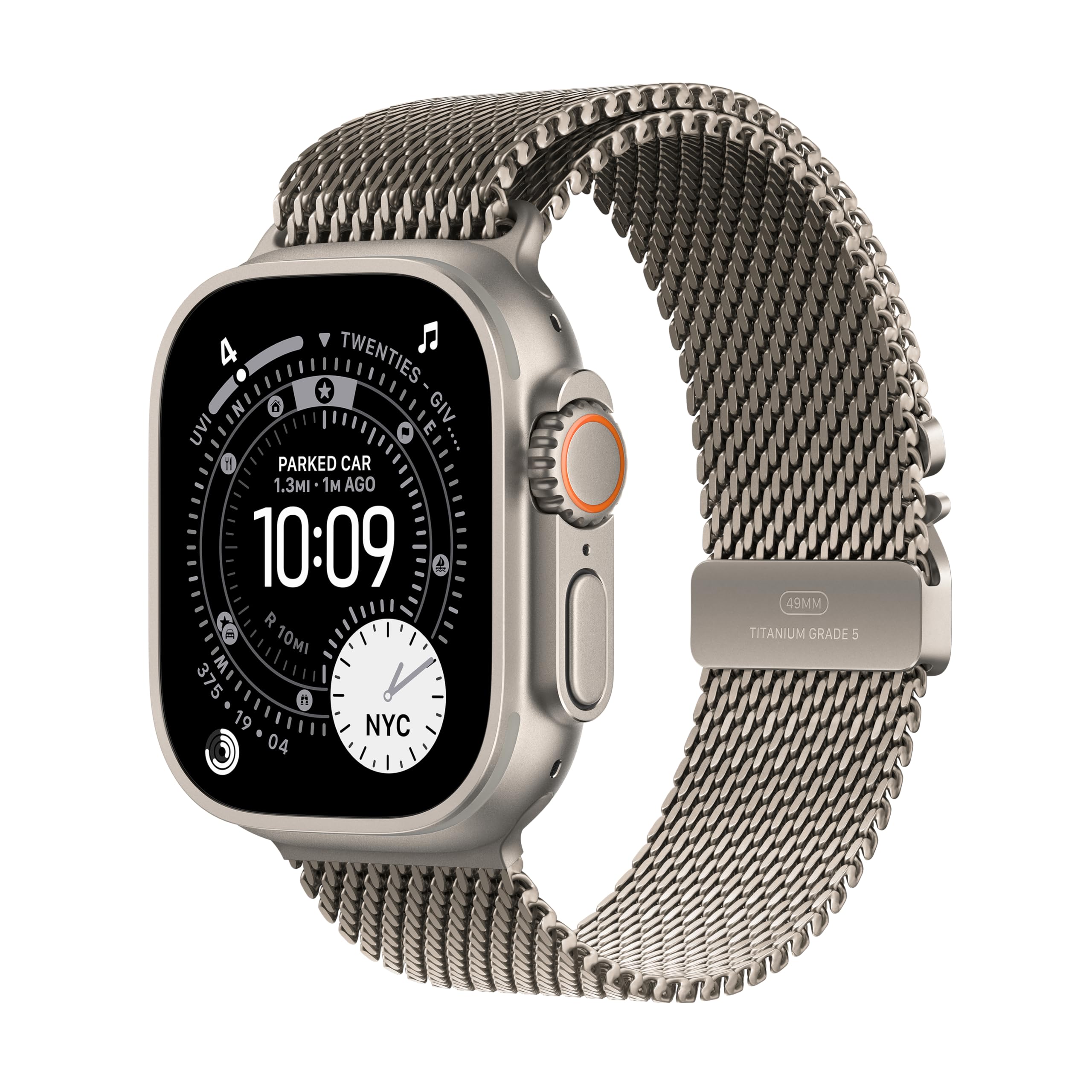
The 49mm titanium tank that keeps counting while you dive, climb and sprint
Somewhere between a mile and a mountain, most wrist trackers give up on precision. This one leans on precision dual-frequency GPS — a system that reads two satellite signals at once so your route and pace hold steady near tall buildings and tree cover — and pairs it with Pacer, Heart Rate Zones, running power and training load for the days you want numbers, not just a total. Weighing 2.24 ounces, it is the lightest full-featured watch in this lineup, and it is roughly 2.2 times lighter than the Casio WS-B1000 at 4.94 ounces, a gap you notice across a long day on the wrist.
The battery story is what keeps people loyal. You get up to 42 hours of normal use, up to 72 hours in Low Power Mode, and up to 20 hours of full GPS and heart rate tracking in Low Power Mode — so a weekend of hikes does not need a wall socket. In practice, buyers report a charge every two days, about an hour from five percent back to full. The titanium case and sapphire crystal face shrug off falls, mud runs and pool time, and the 100m water rating covers swimmers and divers without a second thought.
Where it earns its keep as a step machine is the health layer. It takes an ECG from your wrist, checks heart rhythm for signs of AFib, and flags an unusually high or low heart rate or an irregular rhythm, then folds all of it into overnight metrics in the Vitals app alongside a sleep score and blood oxygen readings. With cellular, you can leave the iPhone at home and still take calls, stream music and run turn-by-turn directions through your AirPods. The honest friction points: the feature list is deep enough that setup rewards patience, and if you wear lifting gloves the emergency panic button can trip during a set — the fix owners use is switching to water mode first.
What stands out
- Up to 42 hours normal use and 72 hours in Low Power Mode, charged in about an hour
- 2.24 ounces on the wrist — the lightest full-featured pick here, against 4.94 ounces for the Casio WS-B1000
- Precision dual-frequency GPS, Pacer, Heart Rate Zones and running power for outdoor routes
- Titanium case with sapphire crystal and 100m water resistance
Where it asks more of you
- The Health monitoring alerts are extensive, so setup takes real attention, not a five-minute skim
- Gloved workouts can trigger the emergency panic button unless you switch on water mode
- Cellular features need a separate plan to work away from your iPhone
Reach for this if: you want the step count wrapped inside full health tracking — ECG, blood oxygen, sleep score — with cellular freedom from your phone.
Look elsewhere if: you want a charger-free watch, because this one wants a top-up roughly every other day.
2. Garmin Instinct 2X Solar – Tactical Edition
The watch that lives on sunlight and forgets what a charging cable looks like
If the charger is the thing you hate most about step tracking, start here. The Power Glass lens over the display is a solar panel, and Garmin claims it produces 50 percent more energy than the standard Instinct 2 solar watch. In 3 hours of direct sunlight a day at 50,000 lux, Garmin rates the watch at unlimited battery life in smartwatch mode, so the step count never stops. Owners who track between charges report about 100 days per charge.
The step and health layer is deeper than the price of a dead-simple counter suggests. You get 24/7 wrist-based heart rate, advanced sleep monitoring, respiration tracking and Pulse Ox — a light-based blood oxygen estimate — plus heart rate variability read overnight to sketch out your recovery. Note that Garmin itself describes the data as a close estimation and not a medical device. Around the case sit a 3-axis compass and a barometric altimeter for elevation, and multi-band signal reception technology for positioning that is more accurate than single-band receivers.
The tactical extras are the reason people pick this version over the standard model. There is a built-in LED flashlight with variable intensities and strobe modes for night training, a ballistics calculator, and an SOS strobe for emergencies. The fiber-reinforced polymer case with a 50mm face is built to U.S. military standard 810 for thermal, shock and water resistance, and a 26 millimeter silicone band keeps a wide case firmly seated. Honest limits: the display is monochrome, so it reads like a tool rather than a tiny phone, and the feature spread is wide enough that the first week feels like a learning curve.
The weeks-between-charges reality: solar charging means the step counter keeps running through a hiking season with no routine top-up, which is a category of freedom the rechargeable watches here simply cannot match.
Know before you buy: this is a utility instrument, not a wrist screen. If you want app notifications on a colorful display, the Apple Watch Ultra 3 above fits that job far better.
The pick for: hikers, trail runners and anyone whose steps happen far from an outlet.
Think twice if: a monochrome display and a dense feature menu put you off before accuracy ever gets a chance.
3. Samsung Galaxy Watch Ultra (2024) 47mm LTE Smartwatch
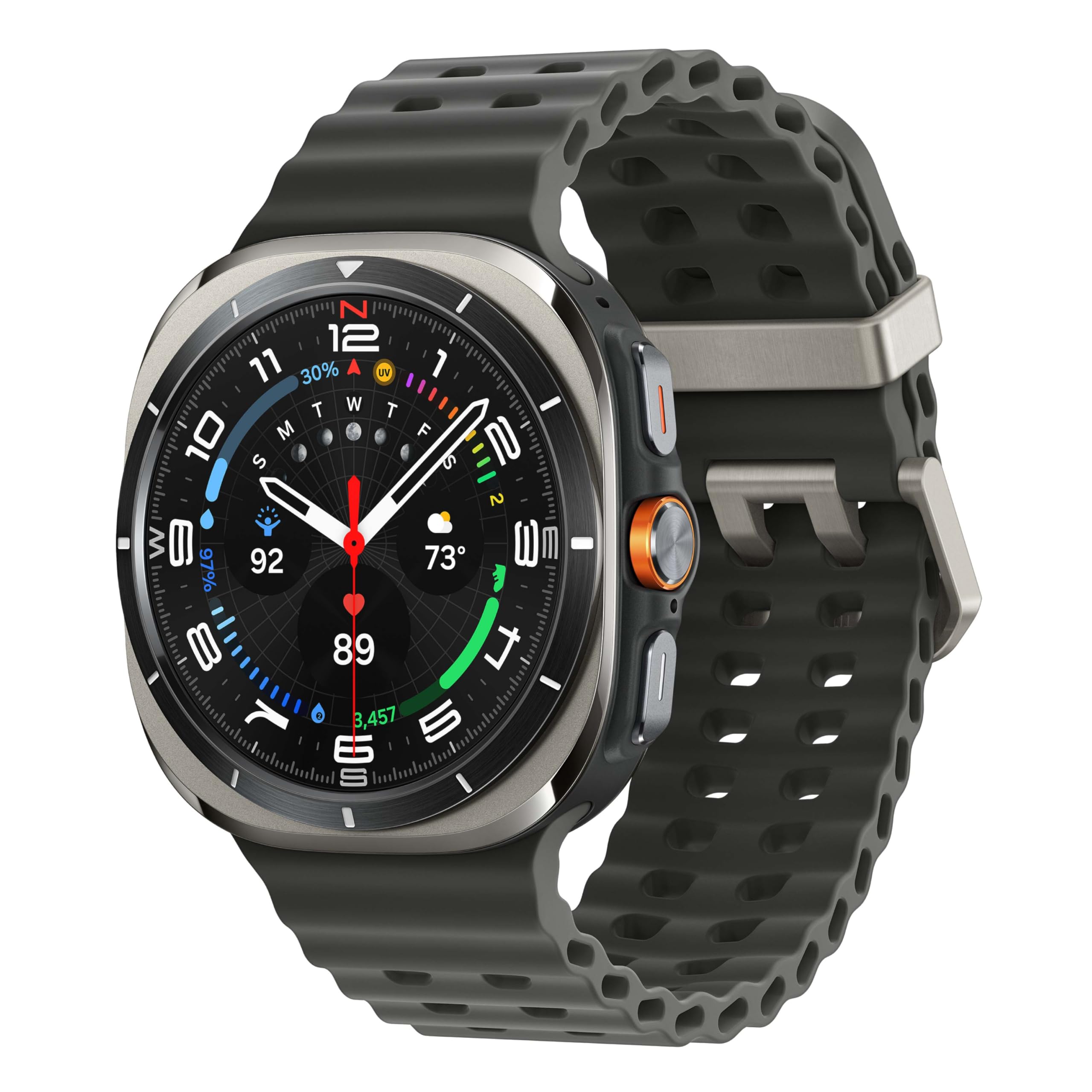
A 47mm titanium brute that turns yesterday’s steps into today’s score
Samsung built this one around a single idea: make the raw numbers mean something. Energy Score with Galaxy AI takes yesterday’s sleep, heart rate and step count and rolls them into one readiness figure, then Wellness Tips nudges you based on what your watch and phone collected. Heart Rate Tracking with Galaxy AI filters out your body’s movement during workouts — the arm swing that ruins heart rate reads on cheaper trackers — so the intensity data behind your step goal holds up.
Runtime sits at an average of 60 hours, and the 590 milliamp_hour lithium-ion cell charges in about 2 hours. Owners who tune the settings report stretching the 60-hour average toward three and a half days. Durability is the other headline: the titanium case stands up to rain, dust and ocean swimming, and the 22 centimeter silicone band swaps out easily. The design reads as premium on the wrist, and menu navigation gets consistent credit for being quick to learn.
This is a smartwatch first, and the honest note is that health tracking is not its sharpest edge. One long-term owner rated it below dedicated sport watches on accuracy and added a separate training app to fill the gap. The 47mm face is also genuinely large — a few buyers want it bigger still, which tells you how much real estate is already there. Pair it with a Galaxy phone and the ecosystem tightens up; take it outside that family and some integrations thin out.
Why Android owners gravitate here
- 60-hour average battery with a 590 milliamp_hour cell and 2-hour charge time
- Titanium case rated for rain, dust and ocean swimming
- Energy Score and Wellness Tips turn steps, sleep and heart rate into a daily readiness number
- LTE keeps calls, texts and maps running without the phone nearby
The trade you make
- Health-tracking accuracy trails dedicated sport watches, so keen trainers often add a second app
- The 47mm case is bulky on smaller wrists
- Full value depends on staying inside the Galaxy phone ecosystem
Best matched to: Galaxy phone owners who want a step tracker that also handles calls, messages and pay-by-wrist.
Pass it over if: you train seriously and need the most precise heart rate readings available, or your wrist runs narrow.
4. Google Fitbit Charge 6 – Fitness Tracker

A slim band that carries a week of steps, sleep and GPS on one charge
The Charge 6 is the lightest way into serious step tracking — a slim silicone band, a stainless steel case, and a spec sheet that reaches well past a basic counter. You get all-day activity tracking, 24/7 heart rate, automatic exercise detection, built-in GPS, an ECG and contactless payments through Google Wallet. The battery averages 7 days and recharges in about 2 hours, so a Monday charge can carry you into the next week.
What wins people over is how much useful data comes back for a band this size. Calories, Active Zone Minutes, a Daily Readiness reading, a personalized nightly Sleep Score and a stress management score all live in the app, and the Smart Wake alarm rouses you in a lighter sleep phase rather than a fixed minute. Linking to compatible treadmills and ellipticals shows your heart rate live on the machine’s screen, and Google Maps turn-by-turn directions cover runs and rides. A note on the numbers: the Charge 6 reports heart rate and sleep as estimates, and paired exercise equipment reads can lag the wrist reading on some machines.
The reliability record is genuinely mixed, and it deserves a straight answer rather than a slogan. Long stretches of happy use sit alongside a real minority reporting sync drop-offs, distance reads that undershoot on an elliptical, and units that stopped working. One owner’s battery dropped from 50 percent to dead in hours with the always-on display enabled, so switch that setting off first if runtime feels short. Most of the tracking complaints cluster around Google Health Premium being needed for coaching extras, and some smarter features living behind that membership.
Smart way to spend here: you are buying a week of steps, sleep stages and heart rate for a band you will forget you are wearing, not a phone on your wrist.
The fine print that matters: always-on display is the battery killer — leave it off and the 7-day average actually holds.
Worth it if: you want the fullest tracking picture for the least bulk and the fewest charging interruptions.
Choose differently if: you need rock-solid iPhone app sync, since that is the recurring complaint in this corner of the category.
5. Apple Watch Series 11 [GPS + Cellular 46mm] Gold Titanium

A thin titanium case built to count your steps and score your sleep
Series 11 takes the flat-out approach: a thin and lightweight case you can wear around the clock, including overnight, which is the only way a sleep score means anything. The headline feature is a Sleep Score that turns your night into one readable number, alongside overnight metrics in the Vitals app, blood oxygen readings, ECG readings and alerts for high or low heart rate, irregular rhythm and possible sleep apnea. It can also flag signs of chronic high blood pressure.
The design earns its keep. Owners upgrading from an older stainless steel Series describe a thinner build with a less bulky back sensor, and the gold titanium case with the gold Milanese loop reads as elegant rather than flashy. GPS plus Cellular means calls, messages and apps keep working when the phone stays home, and the always-on display stays legible mid-workout.
Battery expectations need setting honestly. One upgrade owner got around two days, dropping toward a day and a half when workouts stack up, with a 30-to-60-minute fast charge. A second owner found the silicone band irritated skin once sweat built up and planned a band swap. The sleep and health readouts also take a little decoding before they feel obvious. This is the newest watch in the lineup, so judgment here rests on its specification and owner impressions rather than a long track record.
Where it fits best: the compact-feeling Apple option for someone who wants step counts, sleep insight and an always-on screen without the bulk of the Ultra’s 49mm case.
One thing to plan for: a daily-or-two charge habit, and a band swap if silicone rubs your skin on sweaty days.
Matches well with: iPhone owners who value a slim case on the wrist and want sleep data as much as step totals.
Step back if: you refuse a charging routine or want the widest possible band and app ecosystem you can already see filled out.
6. Casio WS-B1000 Series | Men’s Digital Watch | Step Tracker

A sealed-cell Casio that walks your steps straight onto your phone
Here is the odd one worth understanding. The WS-B1000 runs on a 2-year battery you never charge, carries 100M water resistance, a 100-second chronograph, a daily alarm and an LED illuminator, and still syncs your step count to a phone over Bluetooth. It weighs 4.94 ounces — noticeably heavier than the 2.24 ounces of the Apple Watch Ultra 3, which is the gap a big resin case creates. For anyone who wants step data without a nightly charging ritual, that trade is the entire point.
The step tracking itself splits opinions sharply. On the plus side, the count lands close to an Apple Watch across a day, and it syncs automatically about four times a day on Android through a background app, with an app that covers step data and calories. On the other side sits the watch’s own screen — it shows a step goal chart rather than an exact step number, which makes standalone tracking awkward without the phone app. And the criticism is real: “Don’t buy for the step tracker function. That part is virtually useless,” as the review pages put it, from a buyer who wanted precise counting. That is harsh, and it is not everyone’s experience, but it tells you this is not the watch for someone who lives in the exact digits.
Other honest notes: the backlight is dim enough that it is close to useless in the dark, and the face is taller than it is wide, which some wrists wear well and others do not. There is also a durability risk on the band — one owner had a strap pin holder corner snap within a couple of months, and another reported water getting into the face after a week. Those are the minority, not the pattern, but if you need a watch you can rough up, a heavier-duty case is the safer call.
Buy it for: no-charger convenience and Bluetooth step sync on a watch you can swim in.
Leave it behind for: exact on-watch step digits and bright night reading — the screen shows a goal chart, not a total.
7. Casio LWS2200H Series | Men’s Digital Watch | Step Tracker
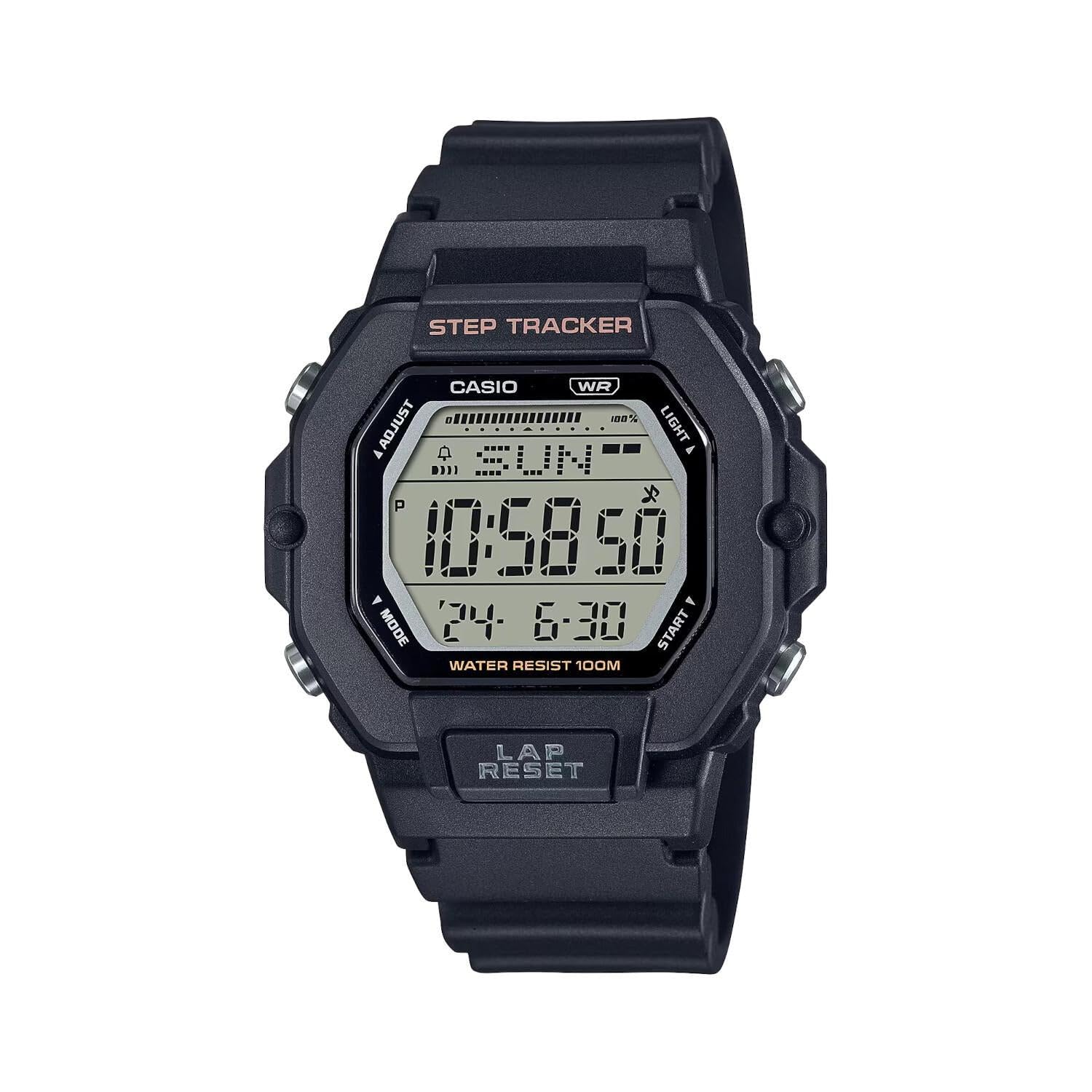
Tiny, charger-free, and the step count agrees with a Garmin more often than it should
This is the watch to buy when a full-size tracker feels like a brick on your arm. The case is deliberately small, and a 2-year battery means the step counter runs without a single charging session in between. Alongside steps you get a countdown timer, a 100-second chronograph, multiple alarms, an hourly time signal and an LED illuminator with afterglow — enough utility for a fraction of a wrist. At 4.94 ounces it carries more weight than its small face suggests, so the band does the work of keeping it steady.
On accuracy, the reports are genuinely encouraging. Owners put its step count within about 3 percent over a measured quarter mile, comparable to a Garmin Vivofit, with no data-selling apps attached. A buyer comparing two units found the newer one within 5 percent of a belt pedometer, versus about 20 percent overcounting on the earlier version. If you have a small wrist and want your steps without a phone in the loop, that combination is hard to argue with.
The gripes are worth naming. The supplied band runs short — one owner replaced it with a 16mm nylon strap — and the backlight is dimmer than the AE1200’s. The case size is the real divide: comfortable and neat on smaller wrists, but the face is smaller than a thumbnail, and a sturdy band can still feel tight on a wider men’s wrist. A single unit arrived with a step tracker that failed within days and was refunded, so buy from a seller with a clean return path.
The honest read: this is the smallest, simplest, most charger-free way to track steps in the entire lineup.
What you give up: no app, no notifications, no heart rate — and a face small enough that eyes over 40 should handle it in person first.
The pick for: small-wrist wearers and anyone who wants a step count with zero charging and zero phone involvement.
Skip over it if: you need a large readable dial or a band that arrives already long enough.
Know the Specs
Step-count accuracy and how it is measured
A step tracker counts arm swings, not footfalls, using an accelerometer — a motion sensor inside the case. That is why the number can drift a few percent from a belt pedometer on the same walk, and why a snug band matters more than a fancy screen. Expect close agreement on steady walks and more drift when your wrist stays still while your legs move.
Battery type and what it costs you daily
Rechargeable watches here run from roughly 42 hours up to a 7-day average, and the trade is a charging routine. Sealed-cell watches run on a battery rated for 2 years and ask nothing of you at all, but they cannot offer heart rate, GPS or sleep stages. Decide which lifestyle you actually want before comparing anything else.
Water resistance ratings explained
Water resistance is an engineered depth rating, not a vague promise. A 100m rating suits swimmers and divers; a watch built to U.S. military standard 810 shrugs off thermal, shock and water exposure. If you never swim in your watch, a basic rating is enough and you should not pay for depth you will not use.
GPS, phone sync and heart rate
Built-in GPS records route and pace so a walk becomes distance and minutes, not just a step total. Phone sync moves your day’s steps into an app for long-term trend lines. Heart rate adds workout intensity on top of steps. These features arrive as a package — you rarely get one without the others in a rechargeable watch.
Common Questions
How accurate is a wrist step tracker compared to a belt pedometer?
Does a step-tracking watch need to be paired with a phone?
Will a 100M water resistance rating survive swimming and showers?
How long does the battery in these watches actually last between charges?
Is a GPS watch better for step tracking than a plain step counter?
Can the band size or fit affect how many steps get counted?
What is the difference between a monochrome display and a full-color touchscreen here?
Do these watches track sleep and heart rate as well as steps?
Is a smartwatch like the Galaxy Watch Ultra worth it just for step counting?
Can I wear a step-tracking watch at night without it bothering my sleep?
The Bottom Line
For most people shopping for a watch for tracking steps, the winner is the Apple Watch Ultra 3, because it wraps a precise dual-frequency GPS step and workout count inside the deepest health picture here — ECG, blood oxygen, sleep score and overnight metrics — with up to 42 hours of normal use between charges. If charging is the thing you resent, the Garmin Instinct 2X Solar is the one to reach for, since its solar-charged Power Glass keeps the counter running for months at a time. And for a small wrist with no phone in the loop, the Casio LWS2200H counts steps within a few percent of a Garmin and never needs a cable. Whichever way you lean, let your wrist size and your charging tolerance decide — those two factors shape daily satisfaction on a step watch more than any feature list.
How we choose
We do not accept paid placement. Every pick is matched to a real buyer and a real use-case; we do not hands-on test units.
Sources
Specifications: manufacturer listings and product documentation. Review insights: verified customer reviews, as of October 2026. Pricing: not shown on this page (it changes often); check the current price via the retailer link.
As an Amazon Associate, Aappliancez earns from qualifying purchases. This does not affect which products we feature.