Disclosure: Some links in this post are affiliate links. As an Amazon Associate I earn from qualifying purchases, at no extra cost to you. Learn more
Specs are compiled from manufacturer listings and verified buyer reviews and can change over time — please confirm the key details on the product page before buying.
Buying a watch that has to survive chlorine and asphalt is harder than it sounds, because most smartwatches are good at one and mediocre at the other. A pool watch needs a lap counter that catches every turn and a water rating that survives repeated dunks. A running watch needs GPS that holds a lock between tall buildings and battery that outlasts a long training block. This guide separates the nine watches that genuinely handle both from the ones that only claim to.
This guide is built by comparing the manufacturers’ published specifications and the patterns across verified customer reviews, so you get each pick’s real strengths and trade-offs instead of marketing spin.
You will see exactly which watch suits a triathlete, which one fits a smaller wrist, and which one keeps its charge through a heavy week of training. Every pick below is judged on what it does in the water and on the road, and this breakdown of the watch for swimming and running covers the numbers that decide it.
Top Picks

How To Choose The Best Watch for Swimming and Running
Two activities pull a watch in opposite directions. Swimming punishes weak seals and demands a lap counter you can trust in churning water. Running punishes weak GPS and drains the battery fast. The watch you want is the one that does both without giving up much on either side.
Water resistance written as an ATM rating
An ATM rating tells you how much pressure a watch is built to take, measured in atmospheres. A 10 ATM rating means it can handle surface swimming and showering without trouble. A 100m rating on the Apple Watch Ultra 3 uses a different unit for a similar idea. Ignore the word “waterproof” on its own and look for the number, because the number is the real promise.
Pool laps versus open-water distance
Pool swimming is measured in laps and turns, so the watch counts each wall push. Open water has no walls, so the watch leans on GPS under the surface, and GPS signals struggle in water. That is why open-water distance readings can drift, and why a watch that reports stroke rate and water temperature gives you something solid to check against the distance guess.
GPS battery hours, not just days
A watch can claim a long stretch in smartwatch mode and still die on a long run with GPS running. Always look at the GPS number separately. A triathlon watch is judged on how long it lasts in full GPS mode with heart rate also running, which drains faster than a casual walk.
Weight and band material for distance comfort
You wear this thing for a marathon and for a night of sleep tracking. A featherweight case and a band that does not chafe at the wrist keep it on all day. A heavier metal case looks sharp but can rub during long sessions.
Side-by-Side Comparison
| Model | Best For | Water Rating | GPS Battery | Case Weight | Amazon |
|---|---|---|---|---|---|
| Apple Watch Ultra 3★ Best Overall | All-round health plus sport | 100m | — | 2.24 oz | Amazon |
| Amazfit Active MaxBest for Long Battery | Long battery on a budget | — | — | — | Amazon |
| COROS PACE 3Featherweight Pick | Featherweight daily runner | — | 38 hours | 30g | Amazon |
| COROS PACE 4 | Bright AMOLED training | — | 41 hours | 32g | Amazon |
| SUUNTO 9 Peak Pro | Demanding endurance athletes | 100m | 40 hours | — | Amazon |
| Garmin Instinct 3 Solar | Rugged outdoor tracking | 10 ATM | — | — | Amazon |
| SUUNTO Race 2 | Endurance training with maps | — | 55 hours | — | Amazon |
| Garmin Forerunner 570 | Smaller wrists and runners | — | 18 hours | — | Amazon |
| Garmin Forerunner 970 | Serious triathlon training | — | 26 hours | — | Amazon |
Detailed Reviews
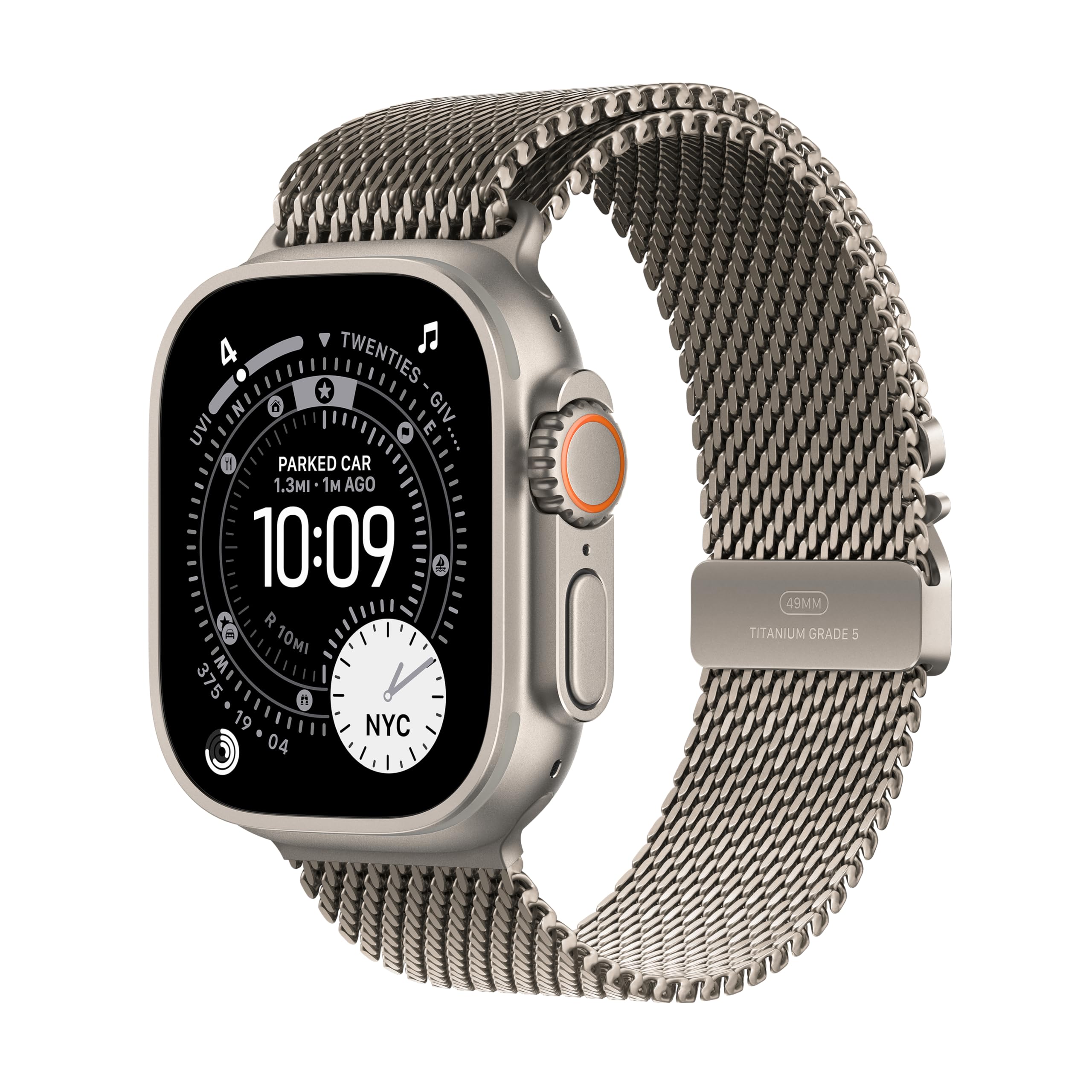
1. Apple Watch Ultra 3 [GPS + Cellular 49mm]
Our pick — 4.5+★ from 1,000+ verified ratings; the strongest balance of quality and price.
One watch for pool laps, muddy trail runs, and a marathon week without flinching.
If you want one watch to handle pool laps, long runs, and the rest of your life, this is the pick that covers the widest ground. The titanium case and sapphire crystal display are built to take hits, and the 100m water resistance rating clears competitive pool swimming comfortably. A 2.24-ounce case is heavy enough to feel solid on the wrist without dragging during a run.
Where the Ultra 3 pulls ahead is how much it does beyond sport. An ECG app checks for irregular heart rhythm, and high/low heart-rate alerts fire when you drift out of range. You also get overnight health tracking through the Vitals app, a sleep score, and blood oxygen readings. The dual-frequency GPS is the anti-drift part: it uses two signal bands so your route stays accurate between tall buildings instead of cutting corners.
Battery is the part to plan around. Up to 42 hours in normal use and up to 72 hours in Low Power Mode are the headline numbers, and 20 hours of full GPS and heart rate tracking in Low Power Mode is what a long race day actually draws on. As owners put it: “The extra battery life is a very nice improvement– I get nearly two days of battery from one charging.” The crowd favorite sits at 4.5+ stars across 1,200+ ratings, and functionality is the thing buyers praise most.
Where the Ultra 3 earns its keep
- 100m water resistance so pool and open-water sessions are not a worry.
- Dual-frequency GPS keeps your running route accurate in dense city blocks.
- Cellular means calls and streamed music without your iPhone nearby.
- Customizable Action Button starts a workout with one physical press.
The honest caveats before you commit
- The 49mm screen is generous but reads too big for smaller wrists.
- A metal band can scuff the face, so a silicone band makes more sense for training.
Reach for this if: you want one watch to cover swimming, running, and everyday health tracking in the Apple ecosystem.
Look elsewhere if: a 49mm case will overwhelm your wrist or you need more than two days between charges.
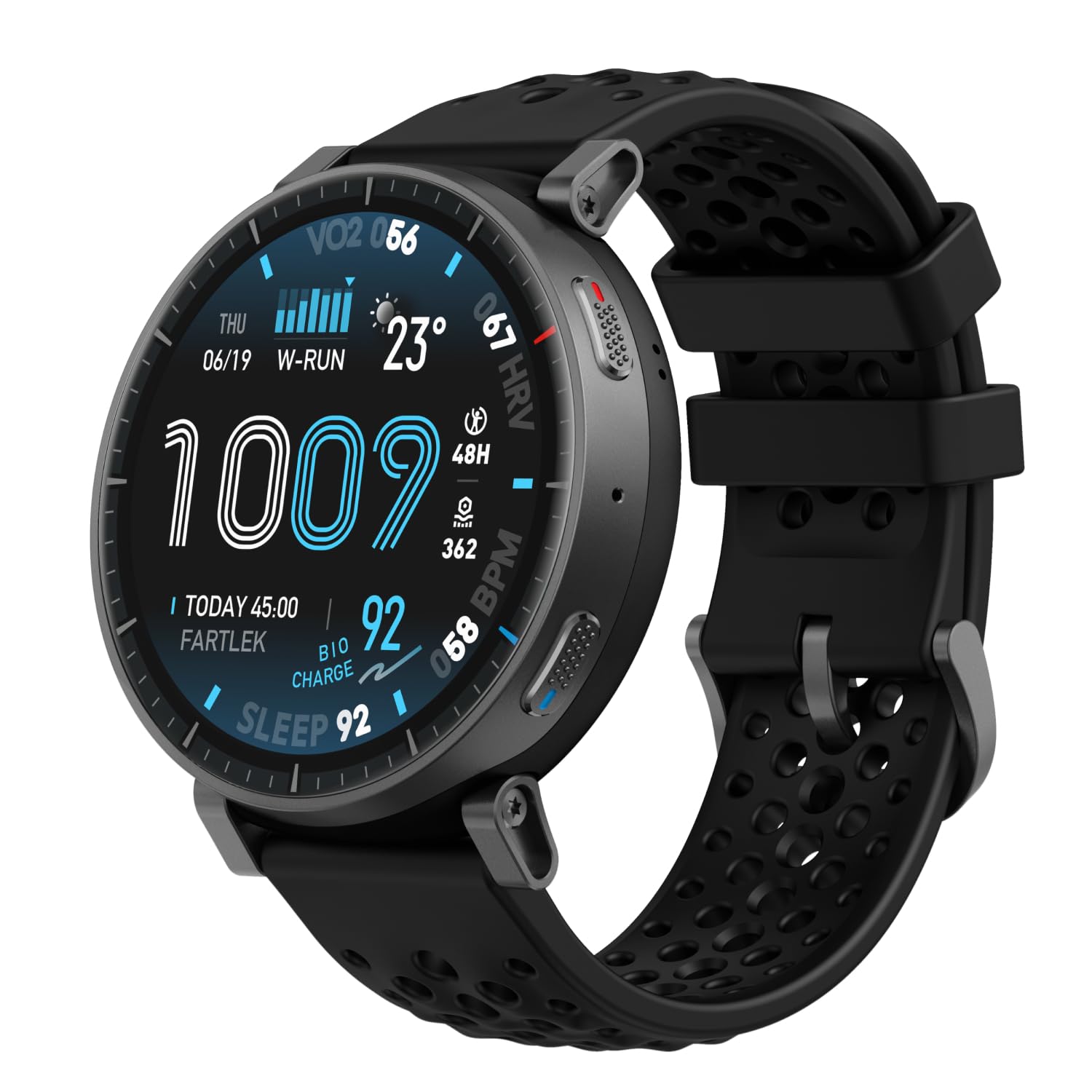
2. Amazfit Active Max Smart Watch
A 1.5-inch, 3,000-nit screen that stays readable in full sun on a watch you charge about twice a month.
Charging is the chore that kills most smartwatch habits, and the Active Max addresses it with a 25-day battery claim. That is measured in daily-use mode, not full GPS, but it means you can wear it through a week of swim sessions and runs without hunting for a cable. A 200 mAh lithium polymer battery sits behind that, and the 3,000-nit display is the reason you still see your lap data in direct sunlight.
For swim and run tracking, the built-in positioning pulls from five satellite systems, so it locks onto a route quickly when you step outside. You get 170+ workout modes, personalized Zepp Coach running plans for distances up to a full marathon, and BioCharge energy monitoring that adjusts to your training load. The 4GB of onboard storage lets you load music and downloaded maps with turn-by-turn directions, so the phone stays home on a jog.
The catch shows up in accuracy and materials. Heart rate and step counts read well during steady work, but some health metrics wobble during intense efforts. The band is also the weak link — a rash from the stock wristband is not unheard of, and a flexible replacement solves it. Skepticism about that battery claim is fair: “Skeptical of battery claims but still 77% after over a week—claims valid.” Appearance wins people over most, and the 1.5-inch screen reads comfortably.
What buyers keep coming back to: that 1.5-inch AMOLED makes lap counts and pace readable at a glance, and the 3,000-nit brightness means you are not cupping your hand over the glass poolside.
The trade-off worth knowing: this is a fitness-first watch, not a full app platform, so expect a thinner app store than an Apple or Garmin.
Fits best: anyone who trains several times a week and refuses to charge nightly.
Think twice if: you need precise health metrics during hard intervals or a large face suits your wrist badly.
3. COROS PACE 3 GPS Sport Watch
Thirty grams on the wrist, so it disappears somewhere around the second mile.
At 30g with the nylon band and an 11.7mm slim profile, this is a watch built to disappear on your arm during a long run. The always-on 1.2-inch transflective touchscreen is a different approach from a bright AMOLED: it uses reflected light so it stays readable outdoors without draining the battery. Battery runs 38 hours of continuous GPS or 24 days of daily use, which is a generous margin over a training week.
Swimming is where the honest limits sit. Open-water swims tend to overestimate distance, and the watch offers one basic open-swim mode. Stroke rate and water temperature track reliably, and strapping it to a swim buoy improves the GPS reading because the signal is not blocked by water. Pool and multisport work is well covered, and the customizable multisport function handles aquathlon and aquabike setups.
Dual-frequency satellite tracking keeps your track accurate between high-rise buildings and also records air pressure and elevation gain. Owners who expected a heavy, complicated sports computer find the opposite. A long-time runner who moved over from Apple hardware called it far superior in daily use, and the featherweight feel comes up again and again. The one recurring fault is the charging connection — the cable can stop sitting snug in the port. That is an occasional failure, not the norm, but it is the reason to treat charging gently.
Why runners convert to it: the transflective screen reads easily in daylight, the 30g build vanishes on the wrist, and the GPS tracks stay accurate in dense cities.
The honest bump in the road: open-water distance runs long, so treat the GPS number as a guide and trust stroke rate and water temperature instead.
Made for: runners and pool swimmers who want a light, long-lasting watch and do not need a glowing screen indoors.
Not the one if: serious open-water racing is your main sport and precise swim distance matters to you.
4. COROS PACE 4 Ultralight Sport GPS Watch
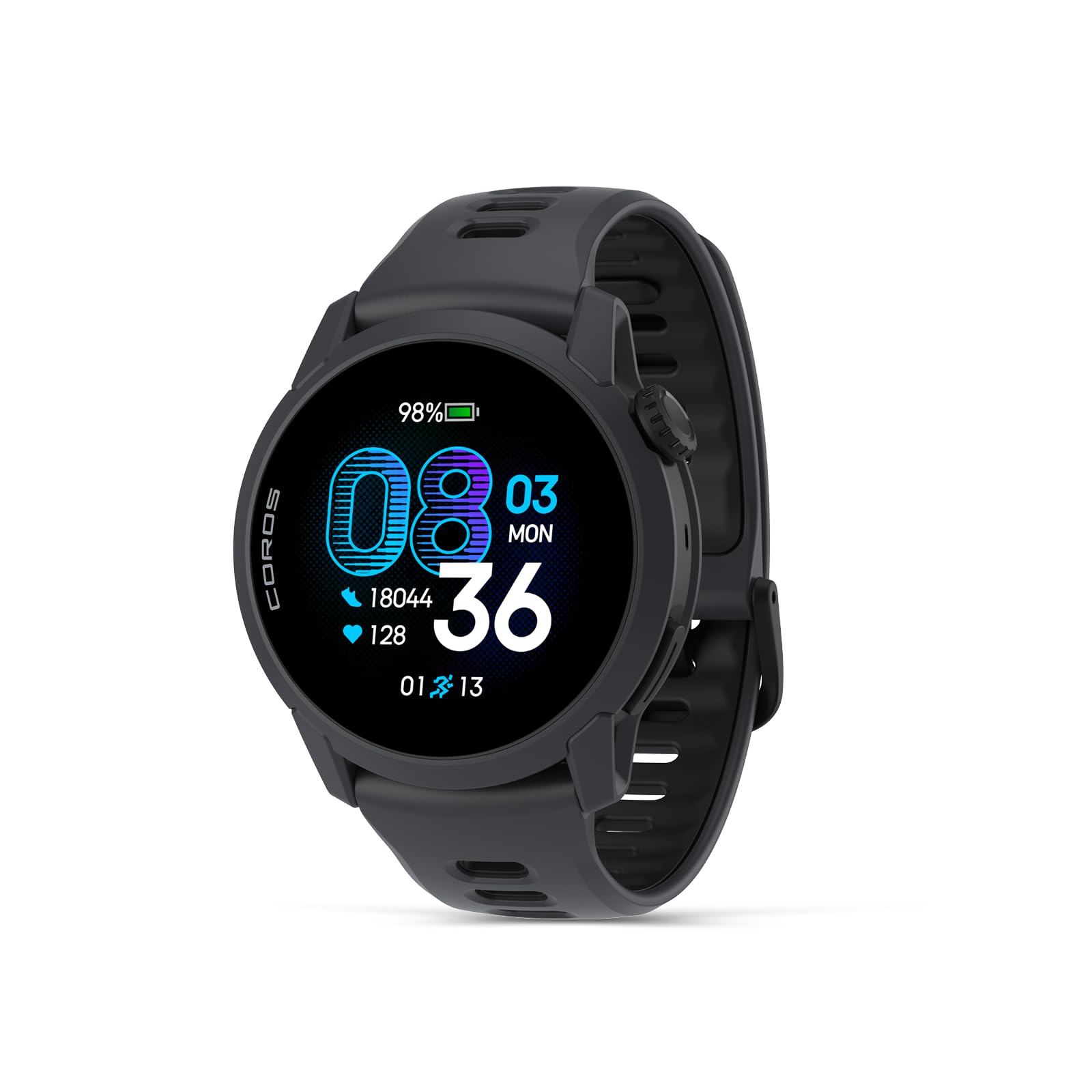
The PACE line steps up to a 1.2-inch AMOLED bright enough for midday sun, with 41 hours of GPS to outlast a training block.
Compared with the PACE 3 above, the PACE 4 steps up to a 1.2-inch AMOLED touchscreen with 164% higher resolution, and the auto-adjusting brightness keeps the glass readable in sun or shade. It stays ultralight at 32g with the nylon band and 11.8mm thin. Battery runs 41 hours of continuous GPS or up to 19 days of daily use, so a heavy week of runs and swims never forces a recharge.
Control is where the difference shows up. A tactile digital crown, two buttons, and the touchscreen give you three ways to control the watch, and a customizable Action Button jumps to media controls, breadcrumb navigation, or a Voice Pin with one press. The VOICE features let you record notes about where you were and how you felt after a workout, which builds a training log without typing.
Recovery tracking rounds it out — recovery time, sleep stages, HRV (heart rate variability, a measure of how ready your body is), and menstrual cycles all land in the COROS app. Among runners, the recurring honest note is that heart rate can go spotty during hard intervals, so a chest strap fills the gap. Pace lag on faster runs is the other one, and a foot pod covers it. Functionality is the thing buyers rave about, and the clean app is a big part of why.
What makes it worth wearing daily
- 1.2-inch AMOLED with auto-adjusting brightness stays readable in direct sun.
- 41 hours of GPS battery means a full training week without a cable.
- Action Button gives one-tap access to navigation and media.
- Voice recording builds a training log right from your wrist.
Points to weigh first
- Heart rate can lose precision during hard intervals, so a chest strap is worth having.
- The screen is small, and always-on display mode dims some watch-face details.
The right buyer: a runner who wants a bright, modern screen and leaves the smartwatch extras behind.
The wrong buyer: anyone expecting an Apple-style app library or phone replies from the wrist.
5. SUUNTO 9 Peak Pro

Built for mountain efforts and long pool sets, with a titanium, stainless steel, and sapphire shell that takes punishment.
The Peak Pro leans on three numbers. Battery runs 40 hours in best GPS mode, 70 hours in endurance mode, and 300 hours in tour mode, and a quick 10-minute top-up buys 2 hours of GPS training. That last figure is the one that matters on a race morning when you forgot to charge. Water resistance is rated at 100m, so pool swimming and open-water sessions are inside its comfort zone.
GPS pulls from four satellite systems, which speeds up the lock and holds the track between tall buildings and deep canyons. You get 97 sport modes, turn-by-turn navigation, and support for weather alerts and avalanche maps. The titanium, stainless steel, and sapphire glass build is rated military-grade, and the Suunto app creates structured workouts with real-time guidance on the watch.
The honest part is battery inconsistency after a stretch of software updates — some units burn power far faster than the specs promise, and one long-term owner had to charge nightly. Heart rate on a stairmaster also reads low. Those are real issues, but the broader pattern is a watch owners keep for years and praise for battery and durability. This is a sports watch first, not a full smartwatch, and it is priced in the mid-range tier accordingly.
The design decision that pays off: titanium, stainless steel, and sapphire glass make this a watch you can knock against pool edges and mountain rock without babying it.
What to verify on yours: battery behavior after updates is the recurring gripe — check it in your first week while the return window is open.
Made for: endurance athletes who value a tough build, multi-system GPS, and structured training plans.
skip it if: you want a polished smartwatch experience with notifications you can reply to.
6. Garmin Instinct 3 Solar

A tough watch that drinks sunlight, with a flashlight on the case and a 50mm shell built for hard use.
The solar lens on this 50mm watch stretches smartwatch mode toward unlimited, assuming all-day wear with 3 hours a day outside in 50,000 lux. The fiber-reinforced polymer case and metal-reinforced bezel take the knocks. Water resistance is 10 ATM, which covers swimming and showering, and the design is built to MIL-STD-810 for thermal and shock resistance.
Navigating is a strength here: a 3-axis compass, barometric altimeter, and multi-band GPS with SatIQ technology to balance accuracy against battery drain. You get heart rate at the wrist, advanced sleep monitoring, and Pulse Ox readings. A built-in LED flashlight with variable intensities and strobe modes is the surprise feature that gets used more than expected on early-morning and late-night runs. Garmin Pay lets you leave cards at home.
What wins people over here is the watch quality itself — the build, the buttons, the readability outdoors — and battery follows close behind. The thing to plan around is the lack of a touchscreen, which is a deliberate choice for wet hands and gloves but takes a shift in habits. Sleep detection occasionally misreads stillness as rest. Solar charging genuinely changes the routine, because the charge stays topped up without a cable.
Why it survives a hard training life
- Solar lens keeps charge topped up so the cable stays in a drawer.
- 10 ATM rating handles swimming without hesitation.
- Built-in LED flashlight is genuinely useful on dark runs.
- Multi-band GPS with SatIQ keeps the track clean and the battery intact.
Where it asks you to adjust
- No touchscreen, so every interaction is a button press.
- Sleep detection occasionally mistakes stillness for rest.
Point this at: outdoor athletes who spend hours in the sun and want a watch that will not quit.
Point it away if: a 50mm face is too large for your wrist or you want a touchscreen to navigate.
7. SUUNTO Race 2
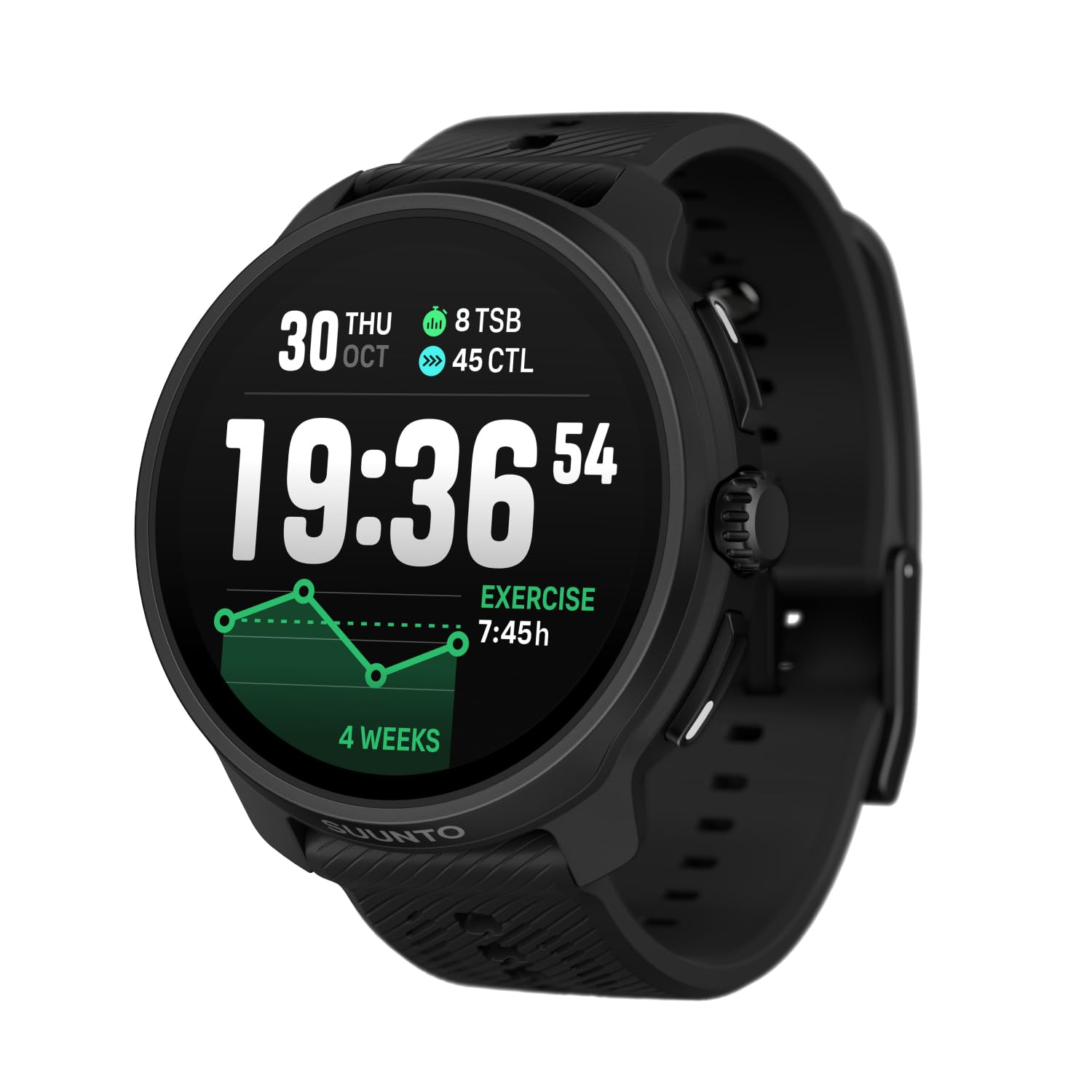
A 1.5-inch AMOLED racer built for the long haul, with 55 hours of GPS training in the tank.
Endurance is the headline. The Race 2 runs up to 16 days in daily use and up to 55 hours in best GPS training mode, so a weekend race or an all-day trail effort stays covered. A 1.5-inch AMOLED display gives you a bright, color-rich readout, and the dual-band GPS keeps your route accurate on technical terrain. Over 115 sport modes cover running, cycling, skiing, and swimming.
Training support goes deeper than a stopwatch. ClimbGuidance keeps you on course on steep ground, and Suunto Coach offers evolving guidance tied to your goals. You can control your headphone music, podcast, or audiobook from the wrist, and the watch tracks everyday activity and sleep. The large AMOLED and 49mm case with a 3-button and crown layout give you physical controls when your hands are wet.
Battery habits here surprise people who came from daily-charging smartwatches. An owner who switched from a Samsung watch noted the older watch barely made it through a day, while this one burns only about 5-6 percent a day — enough to survive a two-week trip without the charger and still come home above 50 percent. The honest wobble is mixed accuracy and reliability reports: the temperature sensor can read high, and the display can dim in direct sun during cycling. Functionality leads the praise.
The battery reality: 16 days of daily use and 55 hours of GPS mode make this a watch that fits long training blocks and travel without a charger.
The honest mismatch: accuracy and reliability reports are mixed, and the temperature sensor can run inaccurate — so treat the extras as nice-to-have, not gospel.
Best matched to: trail and endurance athletes who want a big bright screen and days of battery.
Reconsider if: you need reliable secondary sensors like a thermometer, or you cycle often in bright sun.
8. Garmin Forerunner 570, 42mm

A 42mm aluminum runner that finally fits a smaller wrist without cutting the training features.
Size is the reason this one exists. A 42mm aluminum case with a 20mm band width suits wrists that a 49mm or 50mm watch overwhelms, and the AMOLED touchscreen with button controls stays bright in daylight. Battery runs up to 10 days in smartwatch mode and up to 18 hours in GPS mode, so a shorter case does not mean a shorter week.
Training support is full-strength. Garmin Coach builds personalized running and triathlon plans that adapt to your performance and recovery, and a training readiness score weighs sleep quality, recovery, training load, and HRV status. You get a morning report covering sleep, recovery, training outlook, and weather, plus an evening report with sleep reminders and tomorrow’s workout. More than 30 activity profiles include running, triathlon, track run, cycling, and open-water swimming.
The microphone and speaker let you take calls from the wrist when paired to a phone. The honest gripe is the wristband, which some find uncomfortable, and the learning curve for on-watch settings. Music apps are also basic compared with a phone. Quality is what buyers praise most, and the smaller size genuinely fits — it does not read as bulky on the wrist. For swimmers and runners who want a compact case, the trade is a shorter GPS window than the bigger endurance watches.
The fit advantage: a 42mm case and 20mm band keep this watch comfortable for smaller wrists through a full marathon or a swim set.
The one compromise: 18 hours of GPS mode falls short of the multi-day endurance watches, so ultras are not its lane.
The one for you if: you have a smaller wrist and want full Garmin training tools in a compact case.
The one to pass on if: you run ultra distances and need GPS to last multiple days.
9. Garmin Forerunner 970, 47mm
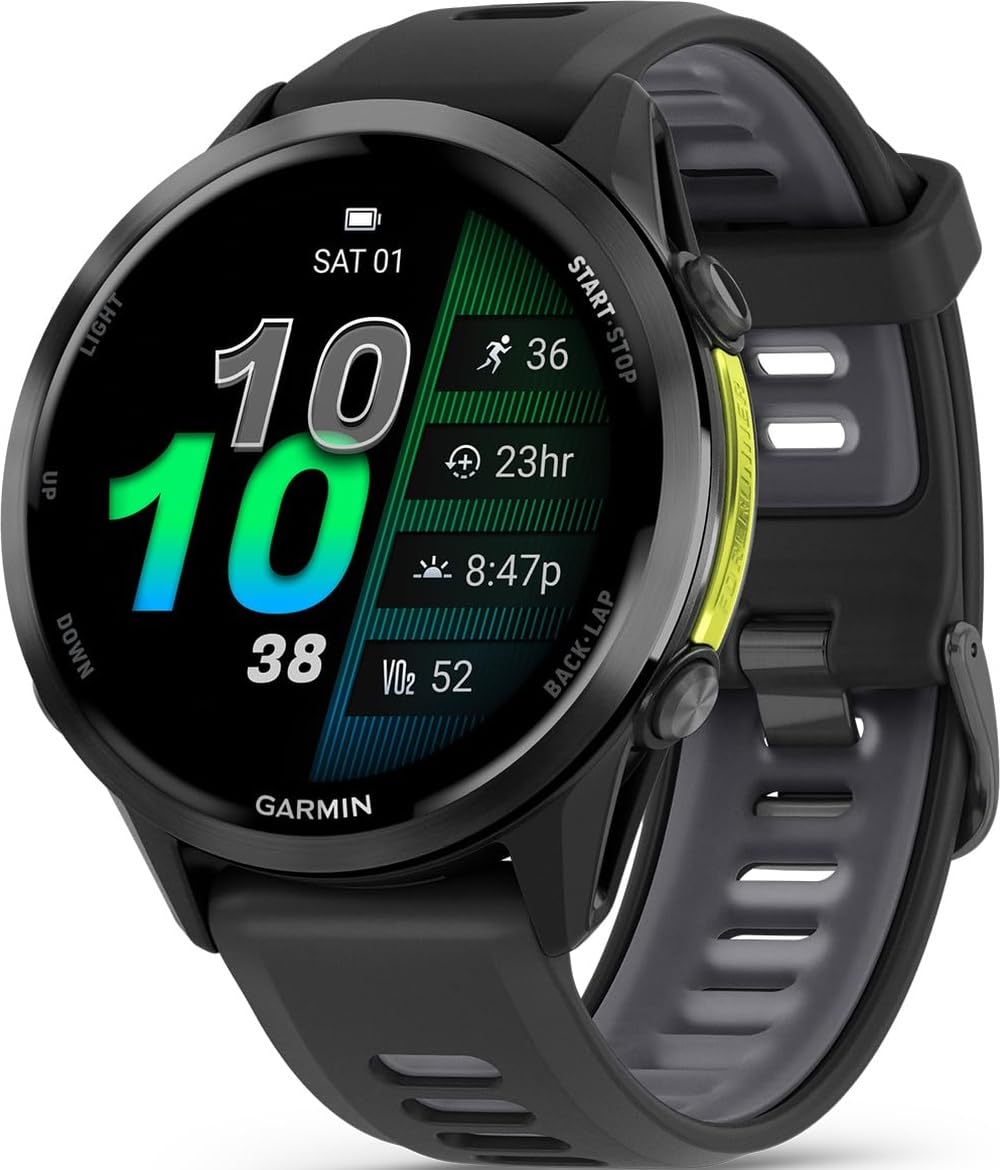
The triathlon machine with sapphire glass, a flashlight on the case, and 26 hours of GPS in reserve.
Built around a titanium bezel and sapphire lens, this is a watch meant to survive the full arc of a race. Battery runs up to 15 days in smartwatch mode and up to 26 hours in GPS mode, enough for a full iron-distance event and the training that leads to it. The AMOLED touchscreen with button controls is the brightest in the Garmin lineup, and the built-in LED flashlight handles early-morning and late-night runs.
Multisport auto-transition detects the change between swim, bike, and run, so splits record without you pressing anything. Full-color built-in maps and multi-band GPS keep you on route, and dynamic round-trip routing rebuilds a path to hit the same mileage when you break off course. Running dynamics cover cadence, stride length, and ground contact time, plus wrist-based running power. An ECG app checks for signs of atrial fibrillation, where available.
Design is what wins people over most, and functionality sits right behind it. Runners who switched from a decade-old Forerunner call the upgrade huge — the battery life, the flashlight, and the sapphire glass that shows no scratches after months of use. The honest limit is that it is less instantly intuitive than an Apple Watch, and some functions take exploring. The value questions that come with a premium watch are fair, but the training depth is real.
The triathlon advantage: auto-transition records swim, bike, and run splits without a button press, so you can focus on the race.
The honest learning curve: settings are dense and less self-explanatory than an Apple Watch, so expect to spend a few sessions exploring.
Built for: triathletes and serious runners who want full maps, running dynamics, and multi-day battery.
Overkill if: you train casually and would rather not spend time learning a deep menu system.
Know the Specs
Water resistance ratings explained
An ATM rating measures pressure tolerance in atmospheres. A 10 ATM rating suits surface swimming and showering, and 100m uses the same idea in a different unit. These are surface and shallow-depth ratings, not deep-diving grades. When a listing just says “waterproof,” ignore the word and find the number — that is the real promise.
GPS battery life versus smartwatch mode
A watch can claim many days in smartwatch mode and drain fast once GPS and heart rate are both live. Always compare GPS hours separately. The Forerunner 970 runs 26 hours in GPS mode, and the SUUNTO Race 2 runs 55 hours in best GPS training mode. That difference is what a long race or a multi-day trek actually consumes.
Dual-frequency GPS and why it holds a line
Dual-frequency GPS listens on two signal bands instead of one, so the track stays accurate between tall buildings and in canyons. In the pool, GPS struggles under water, which is why open-water distance can drift while stroke rate and water temperature stay solid. For pool laps, the lap counter and wall-push detection do the real work.
Case weight and band material for distance
A 30g watch stays unnoticed through a marathon, while a 2.24-ounce instrument on the wrist feels present. Band material matters as much: a nylon or silicone band cleans easily and does not cause the wrist irritation some users report from stiff stock bands. For swim and run use, a light case and a comfortable band decide whether you wear the watch all day.
Common Questions
Can a GPS watch track swimming in a pool accurately?
What does 10 ATM water resistance actually mean?
How many GPS hours do I need for a marathon?
Why does my open-water swim distance look too long?
Should I pick a touchscreen or buttons for swimming?
How heavy is too heavy for a running watch?
Do I need multi-band or dual-frequency GPS?
Can I take phone calls from a swim and run watch?
Does a smaller case size lose training features?
How often will I need to charge a swimming and running watch?
The Bottom Line
For most swimmers and runners, the watch for swimming and running that covers the widest ground is the Apple Watch Ultra 3, because its 100m water resistance, dual-frequency GPS, and up to 42 hours of normal-use battery handle both sports without asking you to pick one. If long battery life is the priority and you would rather charge twice a month than nightly, the Amazfit Active Max delivers 25 days of daily use with a 3,000-nit screen you can read in full sun. And if triathlon is the goal, the Garmin Forerunner 970 adds multisport auto-transition and full-color maps so race day records itself. Whichever way you lean, check the water rating and the GPS hours before anything else — those two numbers decide whether a watch truly handles both sports.
How we choose
We do not accept paid placement. Every pick is matched to a real buyer and a real use-case; we do not hands-on test units.
Sources
Specifications: manufacturer listings and product documentation. Review insights: verified customer reviews, as of October 2026. Pricing: not shown on this page (it changes often); check the current price via the retailer link.
As an Amazon Associate, Aappliancez earns from qualifying purchases. This does not affect which products we feature.