Disclosure: Some links in this post are affiliate links. As an Amazon Associate I earn from qualifying purchases, at no extra cost to you. Learn more
Specs are compiled from manufacturer listings and verified buyer reviews and can change over time — please confirm the key details on the product page before buying.
If you want a pull-up bar that never shifts mid-rep, the answer is simple: bolt it to the structure, not the door frame. A wall or ceiling mounted chin up bar screws through steel plates into wood studs, concrete, or ceiling joists, so your full bodyweight hangs on the house instead of on a tension clamp. That one difference — real anchors instead of pressure — is what separates a bar you trust at rep ten from one you quietly avoid.
This guide is built by comparing the manufacturers’ published specifications and the patterns across verified customer reviews, so you get each pick’s real strengths and trade-offs instead of marketing spin.
Below you’ll find seven bars ranked by how they actually mount, what they hold, and who they suit. The goal is straightforward: help you pick the best wall mounted chin up bar for your studs, your ceiling height, and your grip style.
Top Picks

How To Choose The Best Wall Mounted Chin Up Bar
Most people buy the wrong bar for one reason: they choose the bar first and check the wall second. Flip that order. The wall decides everything — the length of bar that fits, the anchors you need, and how much weight the setup will actually carry before anything creaks.
Find your studs before you fall in love with a bar
Your bar bolts into solid wood framing or masonry. That means the gap between your studs has to match the mounting plate spacing the bar was built for. Common residential framing sits at 16 inches on center, and ceiling joists often sit at 24 inches. A bar with plates spaced to span both patterns gives you far more installation freedom than one locked to a single layout.
Drywall, plaster, and hollow walls are out. A pull-up bar screwed into drywall alone will fail, and no weight rating printed on the box changes that. If drywall is all you have, you mount a board into the studs first and bolt the bar to the board.
Match capacity to bodyweight, then add margin
A capacity rating tells you the load the maker says the bar can hold. A 440-pound bar and a 500-pound bar sound like overkill for pull-ups, but that extra strength covers bouncing at the bottom of a kip, the jerk of a jumping grab, and the pull of a heavy backpack or weighted vest. On bars rated between 330 and 500 pounds, almost every home lifter stays well within the limit with room to spare.
Decide wall mount or ceiling mount
Wall mounting keeps the bar at chest-to-overhead height and works under standard ceilings. Ceiling mounting frees up floor space and puts the bar overhead so your knees never clip the floor, which is the single complaint doorway bars earn most. Ceiling height matters here: a bar with long risers, the vertical posts between the mounting plates and the bar, buys you clearance on a tall ceiling but crowds a low one.
The grip does more work than you think
Bar diameter runs from around 1-1/4 inches up to 32mm, and a smooth powder-coated bar is far easier on bare hands than bare steel. Knurling — the diamond-pattern texture cut into a bar — adds bite for sweaty palms and swinging work, but it also takes skin. If your hands tear easily, a smooth bar plus chalk beats aggressive texture.
Side-by-Side Comparison
| Model | Best For | Capacity | Mount Type | Bar Width | Amazon |
|---|---|---|---|---|---|
| Shnlie Joist Mounted Pull Up Bar★ Best Overall | Most home gyms | 440 pounds | Wall Mount | 42″W | Amazon |
| BeneLabel Pull Up Bar Wall MountBest Value | Band and TRX training | 500 pounds | Wall Mount | 39 inch bar | Amazon |
| ECOTRIC 46” Wall Mounted Pull Up Bar | Long-reach width | 500 pounds | Wall Mount | 46.13″W | Amazon |
| Kipika 32″ Ceiling Mounted Pull Up Bar | Garage ceilings | 400 pounds | Ceiling Mount | 32″W | Amazon |
| Titan Fitness Ceiling & Wall-Mount Pull-Up Bar | Heavy lifters | 500 pounds | Ceiling Mount | 52″ long bar | Amazon |
| LIONSCOOL Multifunctional Wall Mounted Pull Up Bar | Full cable pulley gym | 450 pounds | Wall Mount | 48″W | Amazon |
| Ultimate Body Press Wall or Ceiling Mount Pull Up Bar | Tall ceiling installs | 330 pounds | Ceiling Mount, Wall Mount | 48″W | Amazon |
Detailed Reviews
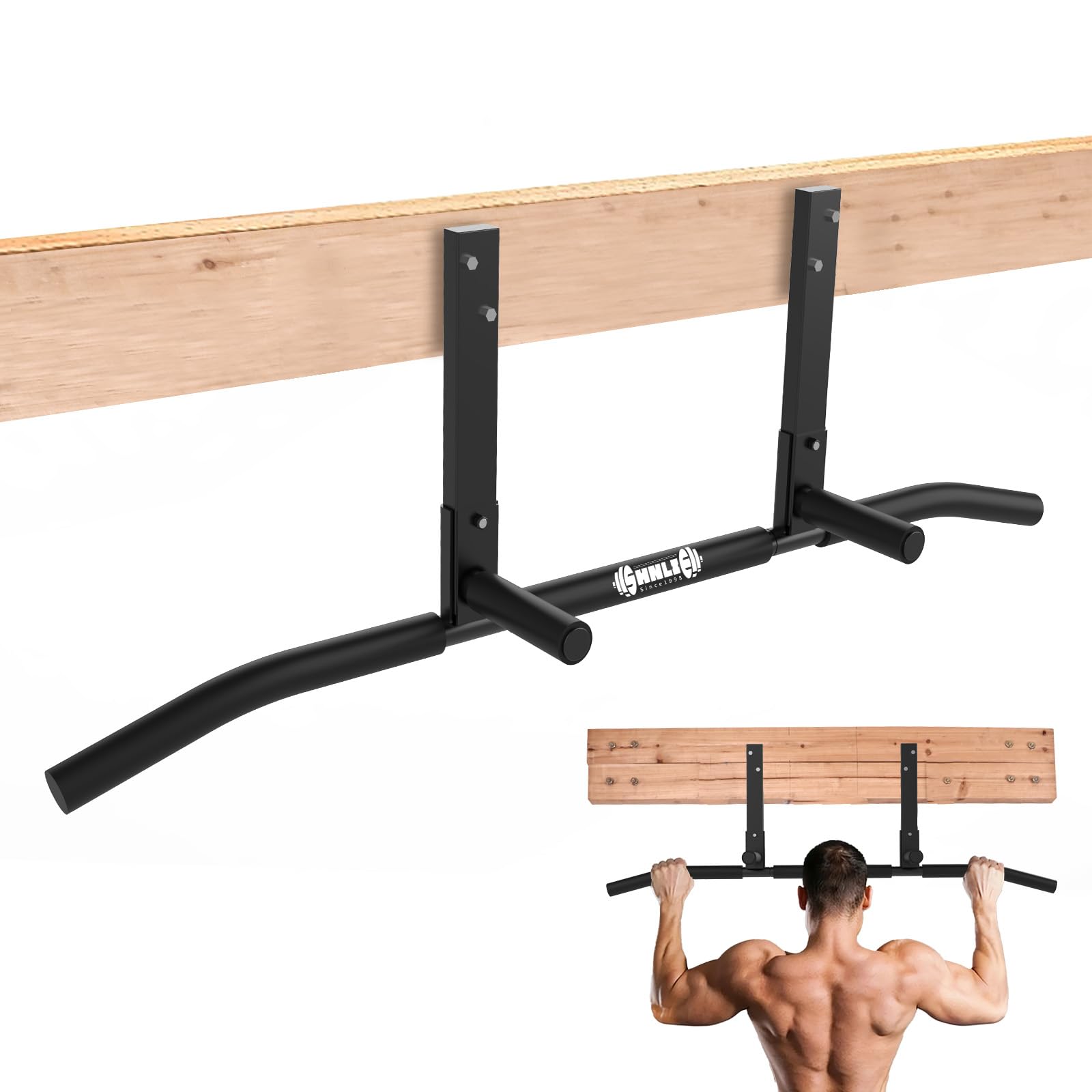
1. Shnlie Joist Mounted Pull Up Bar, 42″ Wide Bar
Our pick — 4.5+★ from 300+ verified ratings; the strongest balance of quality and price.
A 42-inch bar that bolts straight into a joist and disappears into the room.
If you have open wood framing above you and want one bar that simply works, start here. The Shnlie spans 42 inches across and 13 inches tall, which is wide enough for a proper wide-grip pull without turning your garage into a gym installation project. The bar itself is alloy steel finished in black, and six foam pads along the handles mean you can grab it bare-handed without the cold-metal sting or the blistering that bare knurling causes.
Buyers love how solid and stable this bar feels once it is up. They report it takes about five minutes to install with the included hardware after drilling pilot holes, and one verified review said it plainly: “One verified review reported a roughly five-minute install with the supplied hardware after pilot holes.” That fast setup is why this bar tops the list — it is a space-saving wall mounted chin up bar that won’t eat your weekend.
The real trade-off shows up over time. While the bar gets praise for sturdiness and function, durability feedback is mixed — some buyers report the hardware holding up beautifully for years, while a smaller group has had bolts break under hard use. If you do strict, controlled reps at a reasonable bodyweight, that worry barely matters. If you kip, drop, or throw yourself at the bar, upgrade to heavier lag bolts before you load it.
The case for bolting it in
- 440-pound rated steel frame that spans 42 inches wide — room for a true wide grip.
- Six foam pads on the handles for a comfortable, anti-slip grip you can use bare-handed.
- Mounts to wood joists and beams, and ships with full installation accessories and video guidance.
- Multiple grip positions built into one bar, so you can shift angle without buying anything else.
The catch to plan around
- Durability feedback is mixed — a small number of owners have had bolts fail, so heavier hardware is a smart upgrade.
- Wall mount only, with drilling required and no free-standing board included, so your framing has to cooperate.
- Anti-slip foam is gentle, but it means no knurled bite for sweaty, high-rep swing work.
Made for you if: you have exposed wood framing and want a fast, stable install that handles strict pull-ups and chin-ups without eating your floor space.
Look elsewhere if: you need a ceiling-mount setup or plan to kip hard and want the factory hardware to carry that on its own.
2. BeneLabel Pull Up Bar Wall Mount, 440 LBS Capacity
A carbon-steel wall bar that turns any doorway wall into a band and ring anchor.
At 3.35 kg this is the heavier of the two bars in our head-to-head weight comparison — the BeneLabel outweighs the Shnlie joist bar at 2.54 kg. That extra heft comes from 4mm thick carbon steel and a one-piece welded body with a triangular base, which is the kind of construction that keeps a bar dead still when you are mid-rep.
Two carabiners hang off both ends, and that single addition changes what the bar can do. You clip resistance bands or TRX straps to the hooks and suddenly you are training rear delts, chest press angles, and rows from the same anchor point. The mounting holes sit 36 inches apart, with a maximum span of 37.5 inches and a minimum of 34.4 inches, so it fits most doorways. Expansion bolts and wood screws come in the box, and the bar carries a 500-pound capacity rating on that carbon-steel frame. One owner-friendly note: this one asks for concrete, brick, or solid wood — drywall, plaster, and hollow walls are off the table.
Owners describe thick, well-finished attachment plates with no burrs, clean welds, and a smooth powder coat that resists rust. One verified buyer summed up the whole purchase in four words: “One verified buyer called it a sturdy pull-up bar that exceeded expectations.” The common note is that you still need a solid spot to screw into — this bar rewards a properly located stud, not a hopeful one.
Best for band work: the twin carabiners and 500-pound carbon-steel frame make this the most flexible sub-premium pick for anyone pairing pull-ups with resistance training.
The fit note: measure your mounting point first — the 36-inch spacing fits most doorways, but concrete, brick, or solid wood only.
Grab this one if: you want to hang bands and straps as well as do pull-ups, and you have solid masonry or a good wood stud to drill.
Pass if: drywall is your only wall or you need a bar that clips a doorway without any drilling at all.
3. ECOTRIC 46” Wall Mounted Pull Up Bar

The extra-wide bar for lifters who want room to breathe at the top of a rep.
Width is where the ECOTRIC pulls ahead of the pack. Its 46.13-inch span edges out the Ultimate Body Press at 48 inches in on-center plate terms but reaches further across the actual bar, and it comfortably beats the 42-inch Shnlie and the 32-inch Kipika. If your shoulders want a genuinely wide grip and your garage has the stud spacing to match, this is the bar built for that reach.
The 500-pound capacity is the highest tier alongside the BeneLabel and Titan, and the alloy-steel body wears a matte black anti-electrostatic and antirust coating that is meant to survive dusty garage air. You can mount it vertically or horizontally on concrete, drilling it at any width up to 53 inches with the supplied bar. At 1-1/4 inches in diameter, the bar is thicker than a standard pull-up grip — enough to give your hands something to hold without knurling eating your palms.
Owners describe it as solid and stable with a genuine gymnastics-gym feel, and a 190-pound owner reported it stayed rock-solid. The bar does not budge mid-set, which is exactly what you want when your full weight swings on it. The honest note is the flip side of all that steel: this bar is not a five-minute job. One buyer needed about four hours to install it into wood studs., and the hands get tender after daily use on the bare-ish grip. A handy installer and a free afternoon make all the difference here.
Why it earns the width crown: a 500-pound ceiling cap, 1-1/4 inch bar diameter, and adjustable mounting up to 53 inches wide give you the most setup freedom in the mid-tier range.
Who it punishes: anyone without patience or a helper — this is a screw and drill project, not a clamp-and-go bar.
Reach for this if: you lift or hang at serious volume, want the widest usable reach, and have a stud wall or concrete surface ready for a proper anchor.
skip it if: you want a two-minute install or you rely on aggressive knurling for sweaty swing sets.
4. Kipika 32″ Ceiling Mounted Pull Up Bar

A ceiling bar you can angle and re-height, so your garage floor stays clear.
If your ceiling is your only clear anchor point, this Kipika is the one built around that reality. It carries 400 pounds, mounts to your ceiling studs, and uses a three-hole mounting base that spreads the load across the frame instead of two wobbly points. The 32-inch mounting plates fit joists spaced 16 and 32 inches apart, and the base is 2.2 inches wide — exactly what you need on 2-inch studs.
What makes this pick stand apart is the adjustability. Four gear positions let you set the bar height for your ceiling, and you can change the bar angle to switch exercises. Two rubber grips run the length of the bar to keep your hands from sliding, and two multifunctional hooks let you hang suspension straps, training rope, or even a boxing bag off the same anchor. The whole unit comes with wood screws for wood mounting and pull-pop screws for concrete.
Build quality earns the most praise — buyers describe a strong, matte, slightly-textured finish that stays grippable, and the bar thickness gets called out as ideal for large-glove hands. The recurring note is that height adjustment takes tools, so once it’s set, leave it there. Stability feedback is mixed; a few owners note the bar moving slightly under load, which is worth knowing if you expect commercial-gym rigidity.
Best for garages and low ceilings: 32 inches wide with four adjustable gears and a bolt pattern built for standard 16- and 32-inch ceiling studs.
Read this before buying: the mounting base and three-hole design are solid, but a small number of owners noticed a touch of movement, so seat every bolt fully before you load it.
Right for you if: your wall space is taken and you want the bar overhead, angled, and reachable — with band and bag hooks as a bonus.
Think twice if: you want zero setup fiddling or your ceiling framing does not line up with 16- or 32-inch spacing.
5. Titan Fitness Ceiling & Wall-Mount Pull-Up Bar, 52″ Long

Commercial-gym rigidity in a single 52-inch piece of heavy-gauge steel.
Here is the bar you buy when you want your garage to feel like a box gym. It is built from 11-gauge steel and rated to 500 pounds, and at 25 pounds of raw metal it does not flex or wobble under a heavy set. The 32mm powder-coated grip is deliberately smooth rather than knurled, which keeps your hands comfortable through long rep ranges while still giving you a secure hold.
This pick stretches its value through versatility. It mounts to a wall or a ceiling, fits standard 16-inch stud spacing on wood or concrete, and — because the brackets are long — gives you surprising clearance from the surface, which is exactly what you want for muscle-ups or inverted work in a tight space. Strict pull-ups, kipping, bar muscle-ups: owners mention it takes it all without budging.
What owners can’t stop praising is how it refuses to move — one put it simply, one owner called the bar “rock solid,” and a long-time owner called it the best bet for the price after owning two. One verified buyer even wrote, “One verified buyer wrote that the bar is strong and perfectly sized.” The caveat is honest and minor: there is no mounting template in the box, so ceiling installs take a bit of measuring, and the smooth coating can feel slick for swinging or inverted moves until you add chalk or wax.
What earns the price tag
- 500-pound rated, 11-gauge steel construction with the dead-solid feel of a commercial bar.
- Mounts to wall or ceiling on standard 16-inch stud spacing for flexible setup in a home gym.
- Long brackets create real clearance from the mounting surface for advanced and inverted work.
- Smooth 32mm powder-coated grip is easier on hands across high-rep sets than aggressive knurling.
Two things worth knowing
- No mounting template is included, so ceiling installs require your own measuring and marking.
- The smooth coating is slicker than textured bars for kipping and inverted moves — chalk or wax helps.
- At 25 pounds of steel, this is a two-person install rather than a solo job.
A great fit for: heavier lifters and home-gym owners who want commercial-grade stability, wall-or-ceiling flexibility, and a mount that takes punishment.
Consider alternatives if: you want textured grip from the start or a starter-weight capacity for a lighter frame.
6. LIONSCOOL Wall Mounted Pull Up Bar

The only bar here that turns a wall anchor into a full cable station.
A single pull-up bar occupies a piece of wall; this LIONSCOOL turns that same piece of wall into a machine. The integrated pulley system includes two swivel pulleys with bearings, two PVC encased cables, two 1-inch loading pins with 11 inches of loadable length, a straight bar, a tricep rope, and two cable handles. That means lat pulldowns, tricep pushdowns, and cable fly angles are all on the menu from one mount — something no other bar on this list offers.
The main bar itself is no slouch either. It spans 48 inches wide and supports 450 pounds, with 1.2mm standard diamond knurling for a grippy, controlled hold even when your palms get sweaty. Multiple grip layouts let you shift between wide, close, and neutral positions depending on which muscles you are chasing. There’s also a resistance-band hook on each side of the bracket if you want to work band training into the mix.
Owners consistently report a solid, sturdy build that mounts cleanly with the included wall template — one review reported the bar holding a combined 488 pounds without flexing, and others note the pulleys run smoothly on their bearings. The one honest caveat is the anchors: they are the weak link in an otherwise excellent package, and more than one owner suggests a second set of hands and upgraded fasteners for concrete installs.
Why it stands on its own
- Built-in pulley system with two swivel pulleys, two cables, two loading pins, a straight bar, a tricep rope, and two cable handles included.
- 450-pound rated 48-inch bar with diamond knurling for grip under sweat.
- Multiple grip layouts plus a resistance-band hook on each side of the bracket.
- Backed by a 2-year warranty and shipped with a pair of wall templates for accurate drilling.
The installation caution
- Supplied anchors are the weak point — upgrading fasteners is recommended for concrete walls.
- Best on cement or solid brick; drywall installs need a supporting wooden board to prevent cracking.
- A 30-pound unit with more parts means a two-person install is the realistic path.
The pick for you if: you want one mount that handles pull-ups, lat pulldowns, and tricep work without adding a separate cable machine to your home gym.
Not your bar if: you just want a simple pull-up anchor, or your wall is drywall with no board support behind it.
7. Ultimate Body Press Pull Up Bar

A rock-steady 48-inch bar built for nine-foot ceilings and TRX work.
If your ceiling is nine feet or taller, this is the pick for you. The Ultimate Body Press ships with 22-inch risers — the vertical posts that drop the bar down from the ceiling — so on a nine-foot or ten-foot ceiling, the bar lands at exactly the right height instead of leaving you reaching. The 48-inch straight bar spans three 16-inch wall studs or two 24-inch joists, and the double mounting plates follow that framing perfectly on wall or ceiling.
Strength comes through the risers themselves. They are jig-welded box-section steel, gusseted, and through-bolted to the bar to eliminate rotation under heavy power — that through-bolt detail is what stops the bar from turning when you swing. The bar is rated to 330 pounds, and it also serves as an anchor for Ultimate Body Press ab straps and gymnastic rings. The whole thing is backed by a 10-year manufacturer’s defect guarantee, which is a long commitment for a home gym bar.
Sturdiness is what owners talk about most, and it earns that reputation. It mounts cleanly with all hardware provided and a mounting template for accurate hole placement, works with TRX, and stays rock-solid with no wiggle. A 205-pound owner doing switch-grip pull-ups reported no flex or wobble. The one real complaint is the shape itself: this is a straight bar with no forward-facing grip options, so if you like a range of hand positions, get it with that in mind.
The weight-and-width picture: a 330-pound rating on a 48-inch bar with 22-inch risers — lighter capacity than the Titan or ECOTRIC, but plenty for most home lifters on a tall ceiling.
Honest trade-off: it’s a straight-bar design only, so there are no forward bars for wide-grip variety, and the higher capacity bars cost more without solving the ceiling-height problem this one does.
Choose this if: you have a nine-foot or ten-foot ceiling, want true overhead clearance, and value a rock-solid build backed by a long defect guarantee.
Look at the wide-grip bars if: you want multiple hand positions or need to support loads beyond the 330-pound rating.
Know the Specs
Weight capacity
This is the load the manufacturer states the bar will hold safely. It covers your bodyweight plus the bounce and jerk of dynamic movement, so a bar rated well above your actual weight gives you a margin. A rated bar at 440 to 500 pounds handles almost any home lifter with room to spare; a 330-pound rating suits most adults at strict, controlled reps.
Mount type
Wall mount bolting to vertical studs puts the bar at chest-to-overhead height under a normal ceiling. Ceiling mount bolting to horizontal joists frees the floor and keeps your knees clear during kipping. Some bars do both. Whichever you pick, the stud or joist has to line up with the bar’s mounting plates — drywall alone will not carry you.
Bar width and grip
Bar width runs from a compact 32 inches up to 52 inches, and wider bars allow a genuine wide-grip pull. Grip diameter affects hand comfort: a 1-1/4 inch bar feels chunky, while a 32mm bar fits most hands. Smooth powder-coated grips suit bare hands; diamond knurling adds bite for sweaty palms but is harder on skin.
Mounting plate spacing
This is the measurement buyers overlook. Standard residential framing sits at 16 inches on center, and ceiling joists often run at 24 inches. A bar with plates spaced to hit those patterns installs without modification. One spaced differently may need a support board between studs before anything gets bolted down.
Common Questions
Can a wall mounted chin up bar go into drywall?
What stud spacing do these bars fit?
How much weight can a wall mounted pull up bar hold?
Is a ceiling mount better than a wall mount for a pull up bar?
Do knurled pull up bars damage your hands?
How long does installation take?
Can I use resistance bands with these bars?
Will a pull up bar fit over a doorway?
What is the difference between a 42 and 48 inch pull up bar?
Do these bars come with mounting hardware?
The Bottom Line
For most homes, the best wall mounted chin up bar is the Shnlie Joist Mounted Pull Up Bar, because it turns a wood joist into a stable, 42-inch training anchor in about five minutes with the hardware in the box. If you want the widest usable reach and a 500-pound rating, the ECOTRIC 46” Wall Mounted Pull Up Bar is the one to reach for. And if you want a full cable pulley station built into a single wall anchor, the LIONSCOOL Multifunctional Pull Up Bar carries a 2-year warranty and a long list of included attachments. If your ceiling is the only clear anchor point — nine feet or taller — the Ultimate Body Press risers solve that problem cleanly. One nudge worth acting on: the Shnlie’s combination of a heavy-duty build and a fast, clean install is the rare case where the smartest pick is also the easiest one to live with, so start there and only move up if your wall or ceiling tells you otherwise.
How we choose
We do not accept paid placement. Every pick is matched to a real buyer and a real use-case; we do not hands-on test units.
Sources
Specifications: manufacturer listings and product documentation. Review insights: verified customer reviews, as of October 2026. Pricing: not shown on this page (it changes often); check the current price via the retailer link.
As an Amazon Associate, Aappliancez earns from qualifying purchases. This does not affect which products we feature.