Disclosure: Some links in this post are affiliate links. As an Amazon Associate I earn from qualifying purchases, at no extra cost to you. Learn more
Specs are compiled from manufacturer listings and verified buyer reviews and can change over time — please confirm the key details on the product page before buying.
You need radios that keep working when thirty students are moving through a hallway, when the gym is echoing, and when the same unit gets dropped on tile twice a week. The short answer: buy a rugged two-way radio with a rechargeable battery, a real channel lock, and enough range to cover your whole campus — a toy-grade radio will not survive a school year. This guide walks you through the seven models that actually hold up, what each one is genuinely good at, and which one fits which school job.
This guide is built by comparing the manufacturers’ published specifications and the patterns across verified customer reviews, so you get each pick’s real strengths and trade-offs instead of marketing spin.
Schools have a problem that camping and hiking do not: the radio has to be simple enough that a substitute teacher can grab it and talk within five seconds. Pick the wrong one and your office spends the year troubleshooting dead batteries and lost channels. The picks below solve that, and this breakdown of the walkie talkies for schools covers range, durability, and battery in plain terms.
Top Picks

How To Choose The Best Walkie Talkies for Schools
A school radio is not a hiking radio. It spends its life clipped to a lanyard or a belt, gets handed to whoever is on duty that day, and has to work the same way every single time. The three things that decide whether a set survives a school year are how it is charged, whether the channel stays put, and whether it mind the drop when it inevitably hits the floor.
Pick your charging method first
Every radio here runs on a rechargeable battery, which saves you from buying loose alkaline cells all year. What differs is the plug. USB-C is the cable you already have in every classroom, so a lost cable is a five-minute fix. Some sets use a charging dock instead, which keeps the radios organized in one spot but means a misplaced dock is a real problem. A few older-style sets still use mini-USB, and that cable is genuinely hard to replace, so check the connector before you commit to a whole set.
Lock the channel or lose your mind
A keypad lock (sometimes called a channel lock) stops accidental button presses from knocking a radio onto a different channel. Without it, a radio in a pocket or a backpack can drift off frequency, and that radio is now silent while looking perfectly fine. For younger students especially, a key lock is the difference between a working set and a daily mystery. Look for it in the feature list and treat it as mandatory, not a bonus.
Match range to your building, not to the box
Range figures are quoted for open ground with nothing in the way. A cinder-block school with steel doors cuts that down hard. That is why an honest set of radios lists an indoor figure too — a coverage area in square feet, or a floor count, tells you far more about hallway performance than a 20-mile claim ever will. If your campus is one long hallway, a compact mini radio is plenty. If you have multiple buildings or a big gym and parking lot, you want the higher-capacity battery and the more powerful unit.
Side-by-Side Comparison
| Model | Best For | Channels | Battery | Weather & Drop Rating | Amazon |
|---|---|---|---|---|---|
| Retevis RB48 FRS 2 Pack★ Best Overall | Front-office and campus-wide duty | FRS (license-free) | 2000mAh, up to 20 hours | IP67, MIL-STD-810H | Amazon |
| Walkie Talkies for Kids 4 PackBest for Classrooms | Classroom activities and play | 12 | 12 x AAA (included), rechargeable | Not rated | Amazon |
| Retevis RT15 3 Pack | Staff on large single floors | FRS (license-free) | 1000mAh, 8-12 hours | Not rated | Amazon |
| NXGKET ZX-808 4 Pack | Mixed staff and student groups | 22 | 1800mAh Li-ion | IP65 | Amazon |
| Motorola Talkabout T210TP 3 Pack | Simple, familiar day-to-day comms | 22 | 800mAh, up to 18 hours | Not rated | Amazon |
| JIANUA 6 Pack Rechargeable | Whole-staff sets, event days | 22, plus 99 privacy codes | 1200mAh, up to 96 hours | Rainproof | Amazon |
| Motorola Talkabout T475 2 Pack | Weather alerts and campus events | 22, plus 121 privacy codes | NiMH 800mAh, up to 12 hours | IPx4 weather-proof | Amazon |
Detailed Reviews
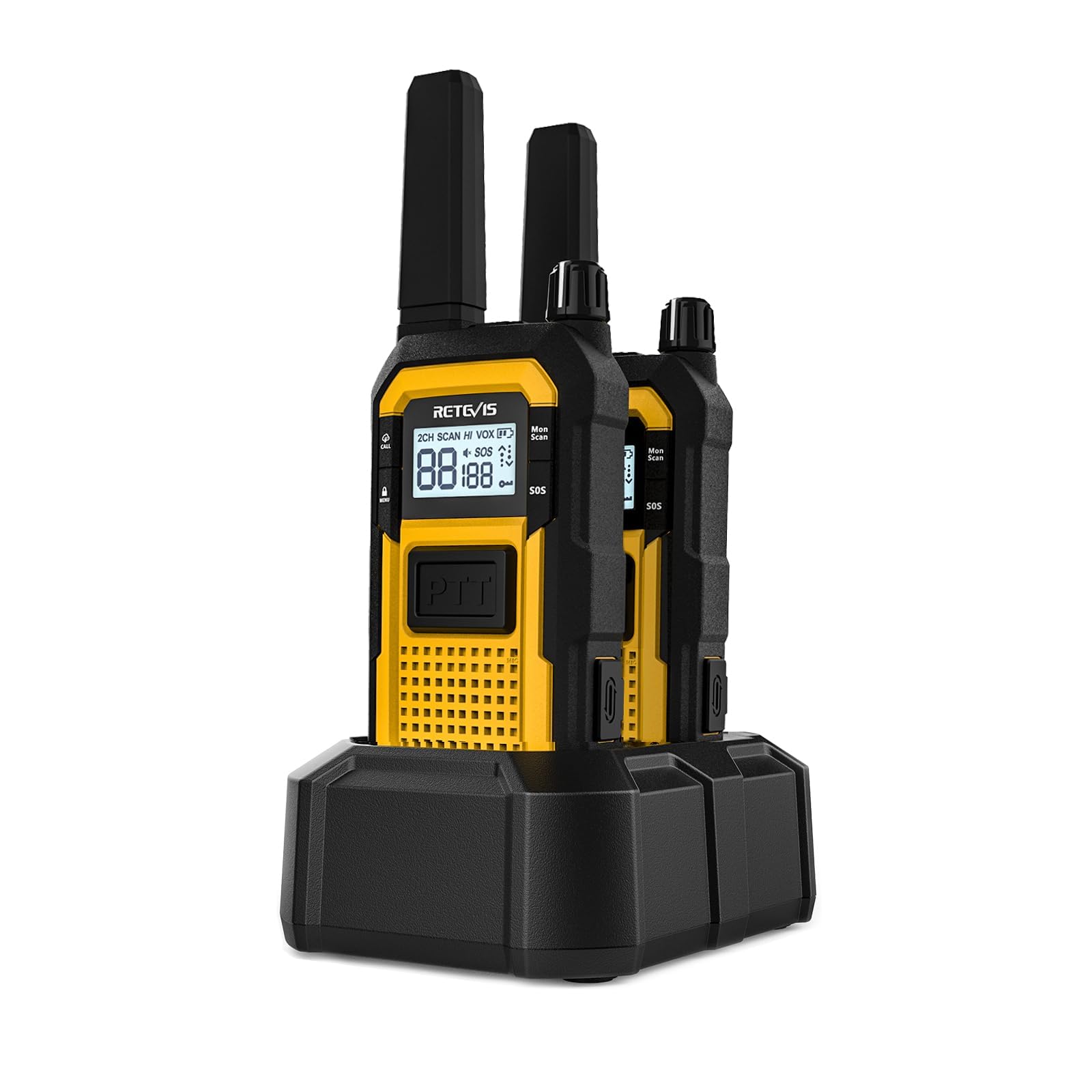
1. Retevis RB48 FRS Walkie Talkies
Our pick — 4.5+★ from 850+ verified ratings; the strongest balance of quality and price.
The one radio here that is built to be dropped on pavement and keep talking.
If your radios get handed to a rotating duty roster, survive being dropped, and still work at the far end of the parking lot, this is the set to start with. The chassis is tested to MIL-STD-810H — that is a military durability standard covering drops, dust, vibration, heat and cold — and it carries an IP67 rating, meaning it is sealed against dust and survives being submerged in water. It is also built to float, which matters more than you would think when a radio ends up in a sink or a puddle at a field day.
Where it separates from the rest of this list is raw staying power. The 2000mAh battery doubles the 1000mAh cell in the Retevis RT15, and the published run time follows: up to 18 hours here against 12 hours on the RT15. A single charge covering a full school day plus an after-hours event is the real reason to pay more. Charging is handled two ways — a USB-C dock that holds and charges both radios, or direct USB-C — so you are never stuck if the dock walks off.
Range is quoted at up to 300,000 square feet across 25 floors, which is the kind of indoor coverage figure that actually means something in a cinder-block building. Buyers report testing two cars a kilometer apart and getting clear conversation at 800 meters without line of sight, holding up even in heavy traffic at 600 meters. The yellow body is deliberate — a bright radio is easy to spot on a desk or a gym floor, and the silicone button covers shrug off wet hands. The roger beep confirms a transmission finished, which cuts down on walkie-talkie overlap when two people talk at once.
What holds up under daily abuse
- MIL-STD-810H testing covers drops, dust, vibration and temperature swings — it is tested to survive 2-meter drops onto hard surfaces.
- IP67 sealing plus a floating body means a knocked-over radio in a puddle is not a write-off.
- 2000mAh battery rated up to 20 hours, averaging 18 hours, charged by USB-C dock or cable.
- 80 dB audible output so it cuts through hallway and cafeteria noise.
The honest catches
- A two-pack covers a small office, not a whole staff — bigger buildings need two sets.
- At 730 g for the pair it is a heavier carry than the compact Retevis RT15.
- FRS band radios share airtime with other FRS traffic nearby, so busy sites may need to switch channels.
Reach for this if: you need a set that will physically survive a school year and still cover a large building on one charge.
Look at the RT15 instead if: you want the lightest possible carry and every staff member already works within shouting distance of the office.
2. Walkie Talkies for Kids 4 Pack
Four color-coded radios that let a class split into teams without a fight over who gets the blue one.
This is the set for classroom activities, library reading corners and recess duty, not for a teacher who needs to reach the far side of the parking lot. Each radio is 1 inch deep, 1.92 inches wide and 4.82 inches tall, which is genuinely pocket-sized for a smaller hand, and the shells are removable so students can swap to a favorite color. Four radios in the box — green, orange, blue and red — means a single teacher can run four groups at once without borrowing anything.
The standout is how well the kid-friendly design lands. It has a one-touch call button instead of a menu, volume that goes high, medium or low, and a backlit LCD with a built-in flashlight. Twelve channels keep the set off adult FRS traffic, so classroom chatter does not echo into the front office network. The 12 included AAA batteries are rechargeable, and quick top-ups are what most owners end up doing between activities rather than charging overnight.
Be honest about the distance limit before you buy. Indoor play — upstairs to downstairs, room to room, around the library — is this radio’s home turf and it does that well. Take it outside and the range shrinks fast. Owners mention it falling well short of the advertised 3 miles, with static setting in at roughly mailbox distance. The other recurring note is channel drift: students find the buttons and change channels mid-game, so the group splits across frequencies and the radios go quiet until someone re-sets them. A staff member who keeps the master channel written down solves that in ten seconds.
The classroom case for it: easiest set on this list for a substitute to hand out, with four radios, four colors, one button each — kids eight and up run these unsupervised within about a minute.
What it is not built for: adult staff communication across a building. If you need hall-duty range, this set will let you down; if you need a fun, cheap, genuinely durable activity radio, this is the one.
The right call for: elementary and middle-school classrooms running group activities indoors.
Not the right call for: staff needing reliable coverage between buildings or across a parking lot.
3. Retevis RT15 Walkie Talkies 3 Pack

A slim, hand-sized set that disappears into a lanyard and covers a big single floor cleanly.
For a school office that only needs to reach the gym, the library and the second-floor landing, this three-pack is the sensible fit. Each unit weighs 3.84 ounces and is 21 mm thick — roughly the thickness of a phone — so it clips to a lanyard and does not pull on a shirt collar through a full day. FRS band operation means no license is required, and the built-in short antenna keeps the whole thing genuinely miniature without adding a snagging point.
The headline feature is the VOX setting — that is voice-activated transmit, meaning you talk and the radio opens the channel without anyone pressing a button. Paired with the keypad lock, this set is close to impossible to accidentally knock off your assigned channel, which is the single biggest day-to-day failure in school radio use. Battery is a 1000mAh lithium cell rated for 8 to 12 hours of work, which comfortably covers a full school day. A squelch function filters ambient noise so the transmissions that do come through stay clear in a noisy corridor.
Two things to know. The 1000mAh battery gives up real staying power compared to the 2000mAh cell in the Retevis RB48 — this is a school-day radio, not a two-day-event radio. And the build leans light rather than armored: owners describe the plastic as having some flex, and the rarer reports mention it not taking a hard drop well. Range holds up better than you might expect indoors — customers note the set working well across a 250,000-square-foot warehouse and an 80,000-square-foot retail floor. Trees, buildings and forests are where it stops, as one reviewer noted about the range not overcoming obstacles.
Where this set wins: three radios, three colors, tiny enough to live in a pocket, with VOX and a channel lock that keep them working without babysitting.
One thing to plan around: charging runs on mini-USB, not USB-C — a cable you probably do not own a spare of, so label it and keep it in the office drawer with the radios.
Best suited to: a small office or campus team that needs light, hands-free radios with a locked channel.
Think twice if: your staff are hard on their equipment, or you rotate radios between school and weekend events.
4. NXGKET Walkie Talkies 5 Miles
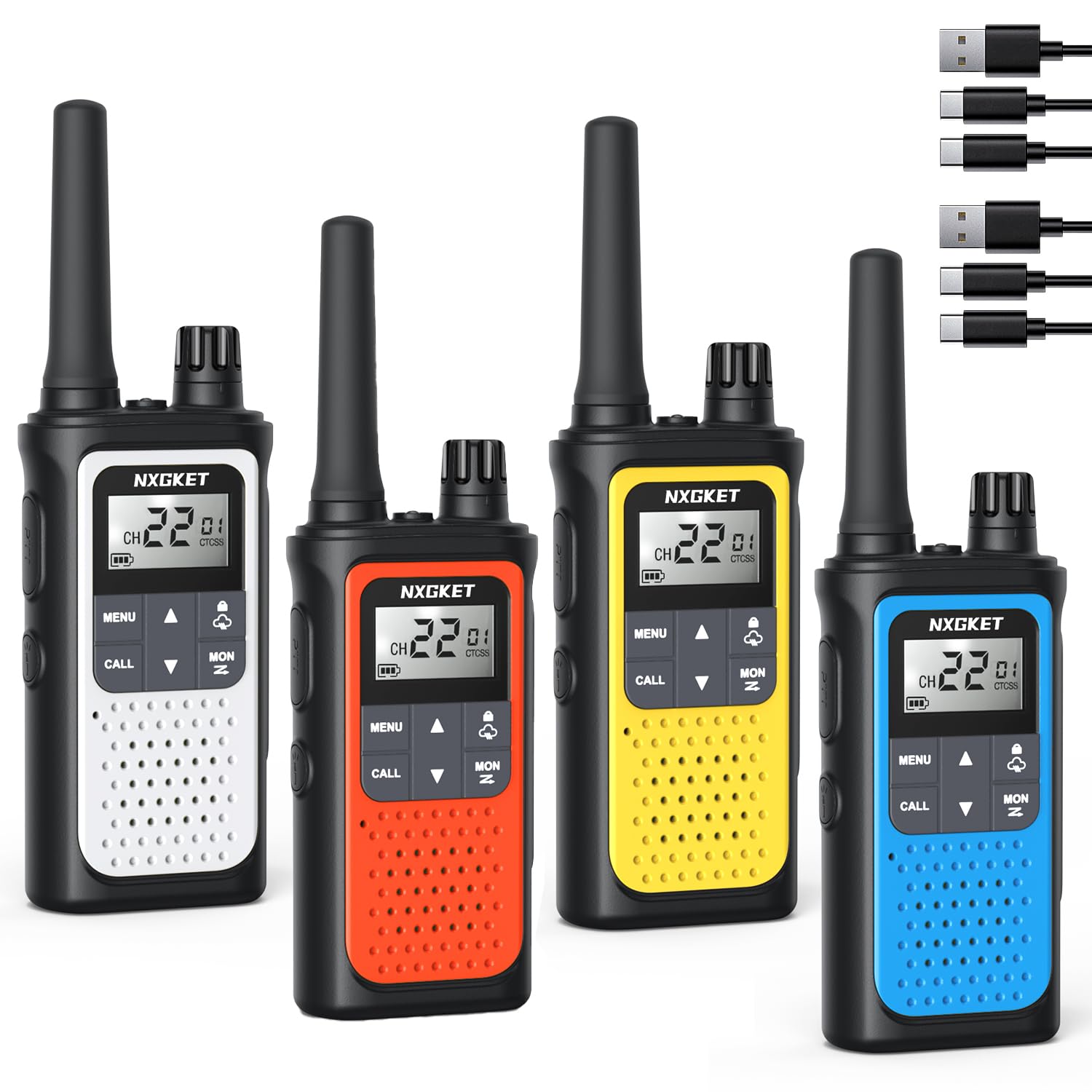
Four radios with NOAA weather alerts and privacy codes — the set that handles a whole staff group.
If your school runs a mix of duty staff and student groups on the same system, the channel math here matters. This set gives you 22 channels plus 121 privacy codes, which comes to 2,662 distinct combinations. That is a real advantage over the 12-channel classroom set — it lets the front office sit on one private code while the grounds crew uses another, and neither group hears the other. Pairing with other FRS radios is straightforward as long as both sides share a channel and code.
The NOAA weather scan and alert feature is the piece that is easy to overlook and hard to live without during storm season. It scans 10 NOAA radio channels broadcasting in your area and issues alerts, which means the same radio clipped to a duty belt covers both day-to-day communication and severe-weather warnings. The upgraded speaker raises maximum volume by 150% over the previous version., and a vibrate alert mode quietly buzzes a radio that is being carried in a pocket. Nine VOX levels let you tune hands-free sensitivity to your room acoustics.
Range is quoted up to 5 miles with the honest caveat that terrain and conditions change it. Real-world owners put this set in the short-range category — clear sound, useful around campus and on family camping trips, less reliable once obstacles stack up. The rechargeable lithium pack is 1800mAh and the included USB-C cable charges two radios at once, so a whole set cycles through the office outlet overnight without a drawer full of proprietary chargers. The IP65 rating covers dust and low-pressure water spray, so a morning dew or an accidental sprinkler tip is fine — heavy rain is not.
The most useful thing this set does: gives a whole staff group their own private code on a shared FRS band without licensing paperwork.
Where to set expectations: five-mile range is a best-case figure the way every FRS radio’s is — plan for campus-and-neighborhood distance rather than across-town coverage.
Worth it for: schools that want weather alerts and a private channel for each staff group in one set of four.
Less useful for: a team that already owns a set of Motorolas — FRS radios talk to each other, so you would be adding a second ecosystem instead of extending the one you have.
5. Motorola FRS T210TP Talkabout Two-Way Radios
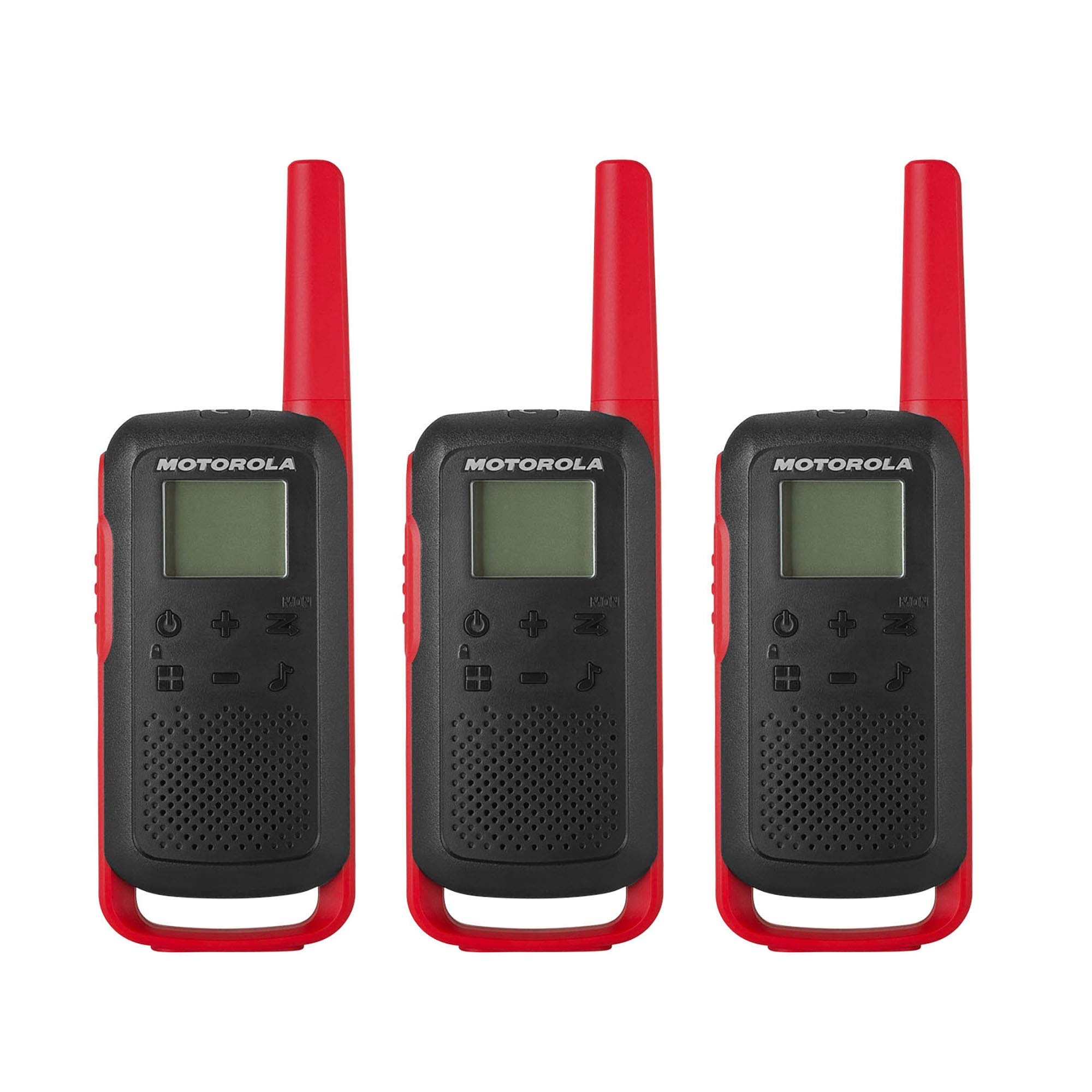
A three-pack that a brand-new staff member can pick up and use correctly on day one.
Anybody who has ever seen a Motorola radio already knows how this one works, and that familiarity is the whole pitch for a school rotating through subs, student teachers and volunteers. It runs 22 channels with 121 privacy codes, packs an automatic squelch to cut background hiss, and carries a backlit display so it stays readable in a darkened hallway or a supply closet. The 800mAh battery is rated for approximately 18 hours, and the included Y-cable charges all three radios from one adapter through dual micro-USB connectors.
Weight comes in at 4.8 ounces per radio, which is light enough to hang from a lanyard all day without pulling. Reliable job-site communication shows up again and again as the reason owners keep these on their belts, and the channel and privacy-code system means the set talks to any other FRS radio already in your building. The kit includes belt clips, 24 personalization stickers — genuinely useful for marking each radio with a room number — and a printed manual.
The honest reads are worth naming. Amazon’s own customer read flags the build quality as mixed — some owners love the feel, others find it basic — and range draws similar split notes, with reports running from impressed to unimpressed depending on the building. Motorola’s own box language is the most honest caveat: quoted range assumes unobstructed line-of-sight under optimum conditions, and actual range is often less. That is the case for every radio on this list, but it is the right expectation to set before purchase.
Reasons schools keep these on hand
- Instant familiarity for anyone who has ever handled a Motorola radio.
- Backlit display and automatic squelch keep it usable and quiet in dim, noisy areas.
- One Y-cable charges all three radios from a single adapter — no orphaned cables.
- Approximately 18 hours of battery life per charge from the included 800mAh pack.
Where expectations should flex
- Build quality draws mixed feedback — treated as office equipment, not field equipment, it holds up fine.
- Range varies heavily by building, matching the manufacturer’s own note that real range is often less than the maximum.
- Three radios is a small set for a whole-school roll-out.
The pick for: a front office that wants zero training time and a tidy single-cable charging routine.
Consider a larger set if: you need to hand a radio to every duty staffer at once rather than a rotating team of three.
6. JIANUA Walkie Talkies 6 Pack
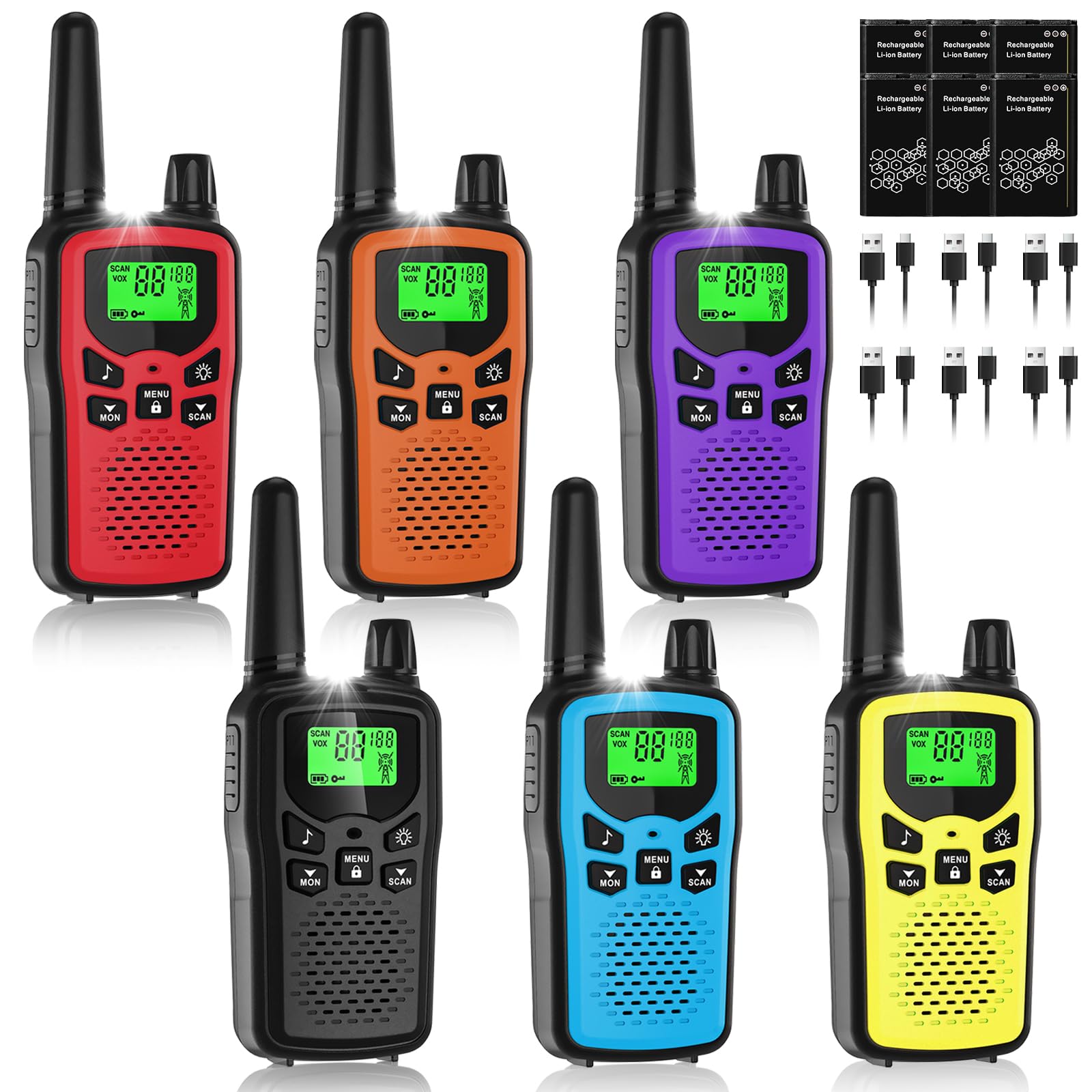
Six radios in one box, so a whole staff can be issued a unit without a second purchase.
A school with a front desk, a nurse, two duty aides and two custodians runs out of radios fast. This six-pack covers that roll-out in one shot, and each radio is deliberately pocket-sized — the body is 2.28 inches wide, 1.52 inches deep and 5.94 inches tall, smaller and lighter than a cellphone, with a wrap-around belt clip that snaps on and off in a second. All six run on the same 22-channel FRS band with 99 CTCSS/DCS privacy codes, so a single staffer can move between groups just by switching the code.
Battery life is the standout spec: up to 96 hours on a full charge in light use, dropping to 8 to 12 hours under continuous talk. Recharging from empty takes about an hour over the included USB-C cable, and the whole set uses the same 1200mAh lithium cell, so one spares pack covers every radio in the drawer. Adjustable VOX from 0 to 3 lets staff leave their hands free while working — a genuinely useful feature for a custodian carrying equipment or a teacher supervising a hallway. The rechargeable lithium-ion platform is the same reason the set is cheaper to run than one that eats alkaline cells.
Range is quoted at up to 5 miles in open rural ground, dropping to 0.6 to 1.2 miles in towns, cities and forested areas. That is a fair, honest number for a school — for a single-building campus with outdoor spaces, the inner figure is what you plan around. Build is compact, drop-proof and rainproof with an LED flashlight and a backlit LCD for darkened rooms. Reviewers point out the PTT feature working well for hands-free talking across car-to-car and campus distances, and the top aspects that keep coming up on the review pages are quality and day-to-day functionality.
The big-group case: six matched radios, one USB-C cable per unit, and a half-hour-or-so recharge catch-up routine between morning and afternoon sessions.
The honest caveat: range drops to the 0.6 to 1.2-mile window in obstructed environments — plan your channel assignment around building geometry, not the open-field number.
Suits: a school that needs to equip a whole staff roster with matching, rechargeable radios out of a single purchase.
Not the tightest fit if: you only need three or four radios — you will have spares sitting unused in a drawer.
7. Motorola Talkabout T475 Two-Way Radio
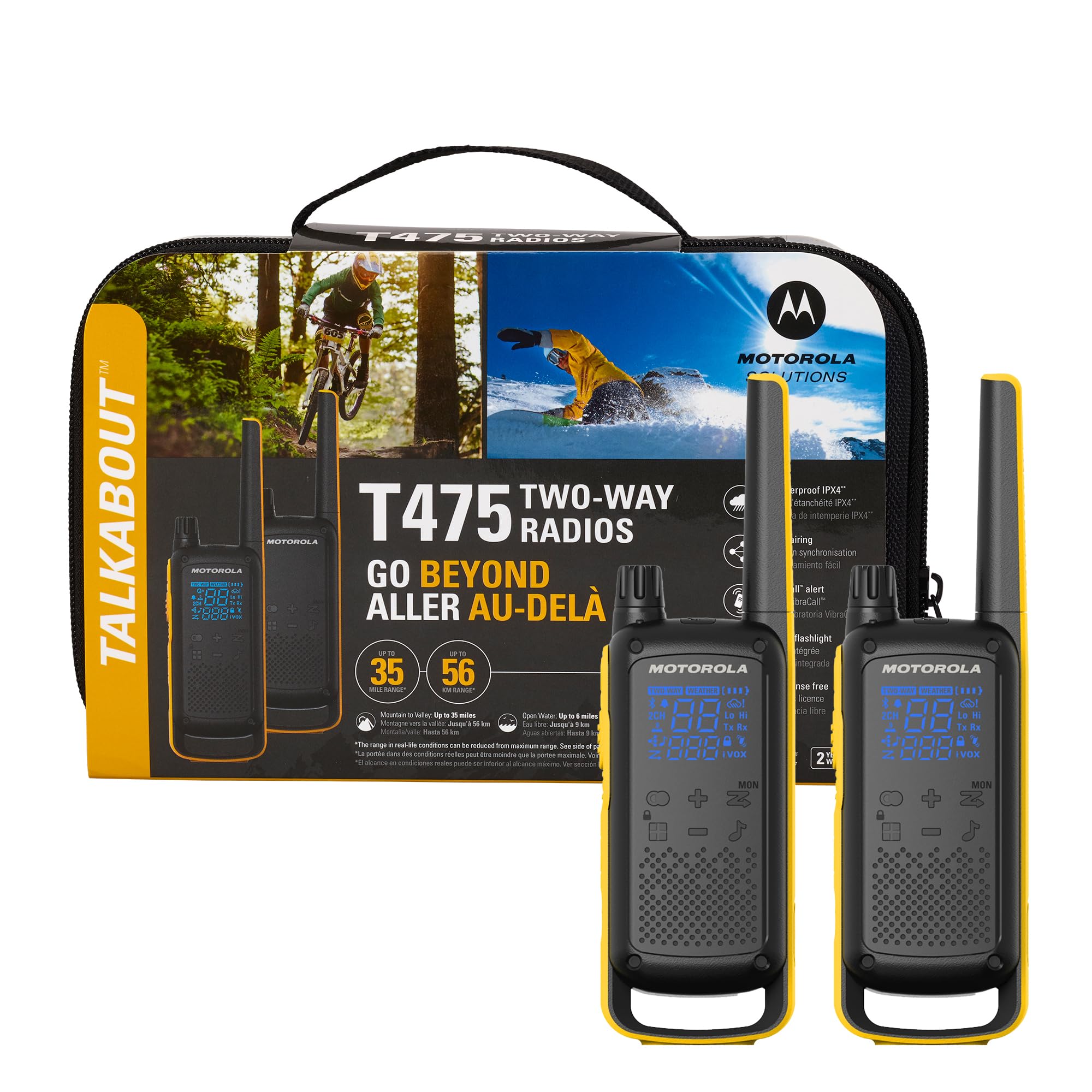
The set built for the day the power drops and the emergency plan has to work.
For a school safety officer or administrator who needs a radio that carries unusual weight in an emergency, the T475 kit is the most complete two-pack on this list. The box ships with a carry case, an earpiece and a lanyard alongside the two radios, eight reusable personalization stickers and a charger — enough accessory kit to kit out both a main office and a mobile patrol without buying anything extra.
The emergency-relevant features are the reason this earns its place. NOAA weather radio and alerts come built in, so a weather warning broadcasts straight to the radio clipped to your belt. Weather-proof to IPx4 means it shrugs off splashes and rain, and there is a built-in flashlight in the body, which is the kind of detail that only feels important the day the building loses power. Dual power is the other useful trick: the T475 can run on the included rechargeable battery or on standard AA cells, so a dead internal pack is not a dead radio on a day when no charger is nearby.
Set expectations on the numbers. The included NiMH pack is 800mAh and rated up to 12 hours, averaging 8 hours — a full school day, not a weekend. The emergency-use and ease-of-use aspects draw strong positive notes from owners, and quality is the top-scoring theme on the review pages. Buying two of these puts a pair of fully-accessorized radios in the hands of the two people who most need to reach each other on a bad day.
Emergency-ready right from the start: carry case, earpiece, lanyard, flashlight, weather alerts, and AA backup power for the day the charger is offline.
The fair warning: only two radios ship together and the runtime is a school day, so plan your radio lock-up and charger spot around those limits.
The pick for: the safety officer and the front-desk lead — the two roles that need the fullest accessory set when things go wrong.
Less of a fit for: a whole-staff comms system, where six or eight matched radios would serve better than two premium units.
Know the Specs
Battery capacity and runtime
Battery capacity is listed in mAh (milliamp-hours), which is a way of saying how much energy the pack stores — the higher the number, the longer it talks before it needs a charge. In this list the range runs from an 800mAh cell in the Motorola T210TP up to a 2000mAh unit in the Retevis RB48, and the gap between them shows up in the quoted runtimes. Capacity alone does not tell the whole story though: how you schedule charging matters just as much in a school. A set with a 12-hour rating works if it goes back on the dock every night. A set with a 96-hour rating gives you slack for snow days and long event weekends. Match the number to how often you can realistically plug the radios in.
IP ratings and drop standards, explained plainly
An IP rating like IP67 or IP65 has two numbers: the first digit is dust protection, the second is water protection. IP67 means the radio is sealed against dust and survives full submersion — that is the toughest rating on this list, on the Retevis RB48. IP65 handles dust and light water spray but not immersion, and IPx4 handles rain splashes only. Separately, MIL-STD-810H is a durability test covering drops, vibration, temperature swings and dust. A radio with an IP rating and a military drop standard is the safest bet for school equipment that will get knocked off desks and handled by whoever is on duty today.
Common Questions
Do these school radios need an FCC license to use?
Will two different brands of FRS radio talk to each other?
How far will these radios actually reach inside a school building?
What is a channel lock and why does a school need one?
Can teachers use the radios hands-free while working?
How do I keep a classroom of radios on the same setting?
Should I buy a set with an included charging dock or one with USB cables?
How long does a full charge last on a school day?
Can these radios clip to a lanyard or a belt for hands-free carrying?
What should I look at if the building has thick walls or multiple floors?
The Bottom Line
For most school offices, the winner is the Retevis RB48 FRS 2 Pack because it is the only set here that pairs a genuinely drop-proof, IP67 submersible build with the largest battery on the list and an indoor coverage figure quoted in real building terms. If you need four or six radios to hand out to a whole duty roster rather than a two-pack, the NXGKET ZX-808 4 Pack adds NOAA weather alerts and per-group privacy codes, while the JIANUA 6 Pack covers the biggest staff group in one purchase. For the safety officer who has to be reachable when the power drops, the Motorola Talkabout T475 two-pack brings weather alerts, AA backup power and a built-in flashlight. And if your radios are headed into classrooms for group activities rather than staff duty, the color-coded Walkie Talkies for Kids 4 Pack is the tool that fits that job.
One last thing worth doing before you order: decide your house channel and privacy code first, then buy the set that covers the staff you actually have on duty. Every radio on this list will do the basic job — the pair or pack that survives your building and your rota is the one worth owning.
How we choose
We do not accept paid placement. Every pick is matched to a real buyer and a real use-case; we do not hands-on test units.
Sources
Specifications: manufacturer listings and product documentation. Review insights: verified customer reviews, as of October 2026. Pricing: not shown on this page (it changes often); check the current price via the retailer link.
As an Amazon Associate, Aappliancez earns from qualifying purchases. This does not affect which products we feature.