Disclosure: Some links in this post are affiliate links. As an Amazon Associate I earn from qualifying purchases, at no extra cost to you. Learn more
Specs are compiled from manufacturer listings and verified buyer reviews and can change over time — please confirm the key details on the product page before buying.
MS changes the rules of walking. Fatigue arrives without warning, one foot can drop, and balance can quit on a patch of uneven pavement. That is why the walker that works for a hip replacement is often the wrong one for you — a walker for MS has to steady you, let you sit the moment your legs give out, and still fold small enough to live in the car.
This guide is built by comparing the manufacturers’ published specifications and the patterns across verified customer reviews, so you get each pick’s real strengths and trade-offs instead of marketing spin.
Below you will find every walker ranked by what actually matters for a wobbly day: wheel size, folding weight, brake type, and seat height. Each one is judged on the single question that counts — does it keep you upright and moving safely, or does it just look the part? The best walker for MS patients is the one you can trust on a bad balance day and still load into the car alone.
Top Picks

How To Choose The Best Walker for MS Patients
With MS, the walker is not replacing your legs — it is buying you time and confidence while you keep using them. That changes what you should look for. A heavy, rock-solid frame that never budges is great for a person recovering from surgery, but it can be a burden when fatigue hits and you need to load it into a trunk yourself. The right pick steadies your worst balance day without turning every car trip into a lifting job.
The seat is your safety net, not a luxury
A padded seat lets you stop and rest the instant your legs start to tremble, instead of pushing through and risking a fall. Check the seat height range — if it is adjustable from roughly 20 to 23 inches, most adults can sit without their knees riding above their hips. A seat that is too low makes standing back up harder, which is exactly the moment you do not want to struggle.
Brake type decides how much your hands do
Push-down parking brakes lock the wheels so the walker cannot roll away while you sit. Squeeze-to-slow brakes let you ease off speed on a downhill or a slope. For hands that fatigue quickly, a walker that stays parked without you having to hold the grips is genuinely easier to live with. Check that the brake levers are shaped for a soft grip — a slippery handle is the last thing you want with a shaky hand.
Wheel size and weight, side by side
Bigger wheels roll over cracks, gravel and tree roots with less jarring, which matters when your legs are unsteady on uneven ground. Smaller, lighter walkers fold tighter and lift more easily into a car. The trade-off is real: a heavier frame tends to feel more planted, and a very light one can feel twitchy if you lean on it hard. Decide which you value more — easy loading, or maximum steadiness under a lean.
Tall frames and wide seats are not vanity features
If you are tall, a walker with a low handle setting forces you to hunch, and hunching throws your balance forward. Look for handle height ranges that reach your wrist crease when you stand straight. A wider seat also matters for anyone with wider hips — a narrow seat you cannot sit squarely on is a fall risk in itself.
Side-by-Side Comparison
| Model | Best For | Wheel Size | Weight | Handle Height | Amazon |
|---|---|---|---|---|---|
| soundfuse Foldable Rollator★ Best Overall | Best overall balance | 8 in | 17.6 lbs | 33 in to 40 in | Amazon |
| Medline Aluminum RollatorBest Value | Simple, sturdy value | 8 in | 14 lbs | 31.5 in to 35.75 in | Amazon |
| Vive Mobility Lightweight WalkerBest for Travel | Smallest fold for the car | 6 in | 9.5 lbs | 33 in to 39 in | Amazon |
| HOMLAND 3 Wheel Walker | Tight indoor spaces | 8 in | 11 lbs | 34 in to 38 in | Amazon |
| HOMLAND Rollator with Seat | Seated rest on long walks | 8 in | 17.6 lbs | 33 in to 40 in | Amazon |
| FlyingJoy Foldable Rollator | Folding into a trunk solo | 8 in | 17.64 lbs | 32.7 in to 40.2 in | Amazon |
| WALK MATE Rollator | Tall users | 10 in | 17.2 lbs | 36.6 in to 40.5 in | Amazon |
| Helavo Upright Walker | Upright, straight-back walking | 10 in | 22.7 lbs | — | Amazon |
| byACRE Carbon Ultralight | Premium featherweight | — | 10.6 lbs | — | Amazon |
Detailed Reviews
1. soundfuse Foldable Rollator
Our pick — 4.5+★ from 500+ verified ratings; the strongest balance of quality and price.
The 300 lb frame that steadies a shaky day without turning into a two-person lift.
For a balance that can vanish mid-step, the reinforced aluminum frame here is rated to carry up to 300 lbs — a structural reserve that means it does not flex or shudder when you put your full weight through the handles. The double support bars are the reason it stays planted. Owners describe it as the walker that holds firm even when they lean hard, and one buyer put it plainly: “Sturdy, holds 245 lbs without collapse, large under-seat storage, maneuvers well.”
The two things that make this the top pick for MS are the seat and the brakes. The seat and handles both adjust — the seat from 20″ to 23″, the handles from 33″ to 40″ — so you can sit without your knees riding high and still stand straight. The braking runs in two modes: squeeze the grip to slow yourself on a slope, push down to lock it so the walker cannot roll away while you rest. Fully enclosed folding points remove the pinch risk that trips up cheaper frames, and reflective strips keep you visible at dusk.
What wins people over is how it rolls — the 8-inch PU (polyurethane, a dense rubber-like material) wheels soak up sidewalk vibration and turn independently, so tight corners in a store aisle do not need a three-point turn. The honest catch: at 17.6 lbs this is the heavy end of the light walkers here. Loading it into a car alone takes some arm strength, and the wide seat that fits broad hips can make doorway clearance tighter. If your arms tire easily, plan to keep it at home and let someone else lift it.
Where It Earns Its Keep
- 8-inch PU wheels glide over cracks and curb edges with less jarring
- Two-mode brakes: squeeze to slow, push down to park
- Adjusts for users from 4’7″ to 6’6″ without hunching
- Reflective strips and pinch-proof folding points for night and safety
Before You Click Buy
- 17.6 lbs is harder to lift into a trunk alone
- Wide seat can feel snug through narrow doorways
Reach for this if: you want the steadiest, most adjustable all-rounder and someone can help with car loading.
Think twice if: you live alone and lift the walker yourself every day.
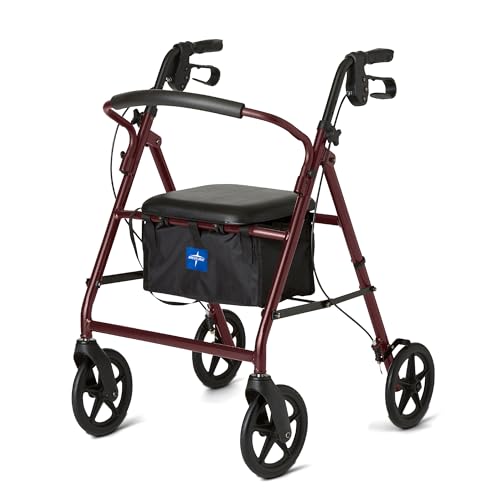
2. Medline Aluminum Rollator
A 14 lb aluminum frame that rolls smooth and asks very little of your arms.
The number that matters here is 14 lbs — noticeably lighter to hoist into a car than the 17.6 lb soundfuse above. It still supports up to 300 lbs, so the light build does not come at the cost of a shaky frame. For MS fatigue days, that gap in lifting effort is the difference between taking the walker out and leaving it in the garage.
The padded seat measures 12 by 12 inches, with a backrest and a storage pouch tucked underneath for a purse or phone. Handles are easy for fragile hands to grip without slipping — push up to brake, push down to lock the wheels. The 8-inch wheels are the same size as the soundfuse but sit on a lighter body. One thing to note: the handle range runs from 31.5 to 35.75 inches, which sits lower than the Vive and the soundfuse. If you are tall, the soundfuse’s 33-to-40-inch range will fit you better.
Where it falls short is folding. Buyers report it is awkward to collapse — you have to hold one side while pulling a narrow band under the seat, and it does not stay folded without a cord or strap. That is a small annoyance for a walker that mostly stays set up at home, but a real hassle if you fold and stow it several times a day. For a walker that stays unfolded at home for sitting and rolling room to room, the package holds up.
The everyday win: light enough to lift, sturdy enough to lean on, and the 8-inch wheels roll over uneven pavement and door thresholds without catching.
The honest snag: folding it takes two hands and a wrestling match, and it will not stay collapsed without a bungee or strap.
Suits you best if: you want a light, comfortable daily walker that mostly stays unfolded at home.
Pass it by if: you need a walker that folds in one motion for frequent car travel.
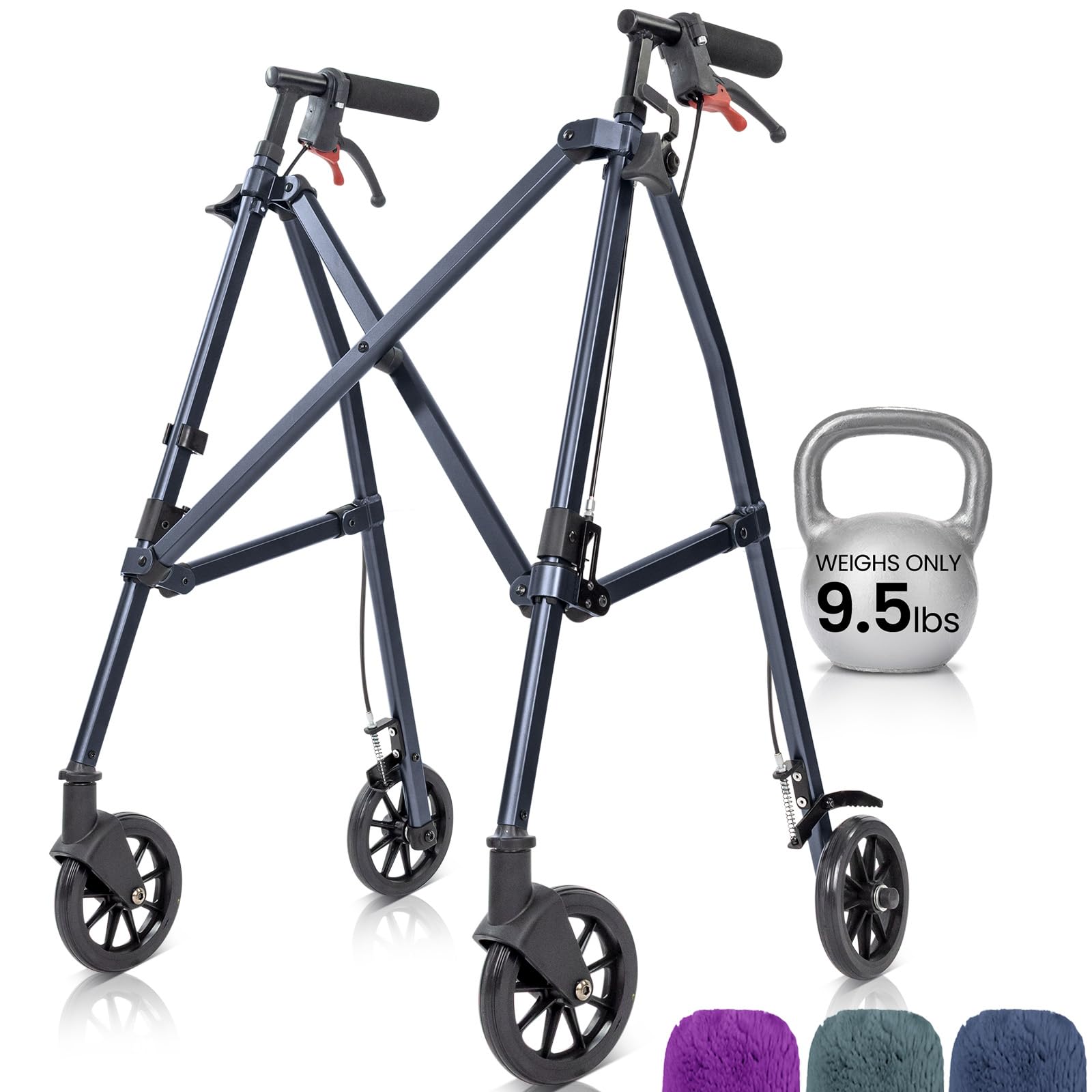
3. Vive Mobility Lightweight Walker
The one-step fold that lives in your back seat without a fight.
If your MS makes car trips hard, the 9.5 lb Vive earns its place by folding in a single step and locking shut — a patented system keeps it closed so it does not spring open in the trunk or slide around. It weighs 9.5 lbs versus the 22.7 lb Helavo below, and folds to a size that disappears into a small car or closet. Wheel size is the trade-off: 6-inch wheels versus the 8-inch wheels on the soundfuse and the Medline, so deep cracks and gravel will thump more through the frame.
Handles adjust from 33 to 39 inches — taller than the Medline’s 31.5 to 35.75 inches, which helps if you are on the taller side but want a lighter body. The open-frame design removes the rear bars you see on most rollators, so your stride is clear and nothing catches your shins. It supports up to 300 lbs on paper, though the frame is built to steady rather than to fully bear your weight — think of it as a hand to hold, not a chair to collapse onto.
The catch is that this is a walker, not a seat. There is no seat here, so on a long outing you need a bench or a chair to rest. A few owners also note the frame has some flex under full weight, and one points out the maximum handle height is 39 inches rather than any higher figure some listings imply. For errands and short trips, the one-step fold outweighs the missing seat.
Why travelers like it: light, compact, folds flat in seconds, and the hidden fold lock keeps it shut.
The missing piece: no seat, and the flex under weight means it is a steadying aid rather than a sit-down support.
Best matched to: people who need a walker that fits in the car and stores small between outings.
Look elsewhere if: you need a built-in seat for rest breaks or a truly rigid support frame.
4. HOMLAND 3 Wheel Walkers
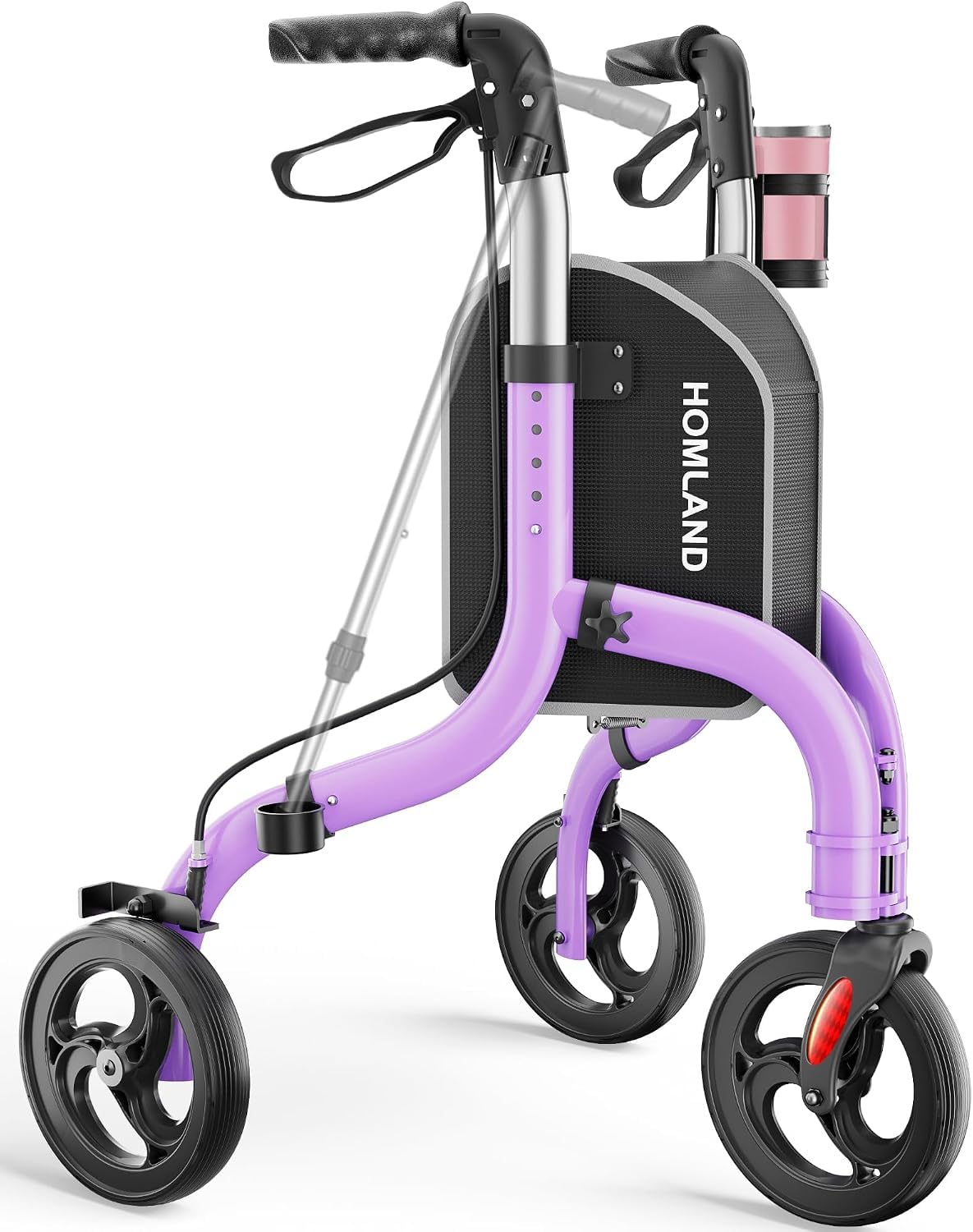
Three wheels that slip through crowded rooms where four would snag.
A three-wheel walker turns on a dime, and this 11 lb HOMLAND is built for the tight-apartment walker — hallways, furniture, bathroom thresholds. It folds flat on one side and stands on its own when stored, which is easier to live with than a frame that flops over in the corner. The 8-inch wheels handle indoor floors and light outdoor pavement, and height adjusts from 34 to 38 inches for users between 4’8″ and 6’1″.
Where it differs most from the four-wheel picks here is stability. Three wheels mean less ground contact, so it is best for steadying a fairly balanced walker, not for someone who might lean heavily. One buyer summed it up honestly: “It does not have a seat. Not the most stable walker so for extended use, or the ability to also sit on walker and long walks outdoors I’d use something sturdier.” Treat it as an indoor helper, not a full-support outdoor rollator.
On the practical side, it carries a cup holder, a cane holder, and a storage pouch — though a couple of owners note the cup holder is too narrow for a thermos. Setup is quick, no tools required. If you are mostly navigating a small apartment and want something light you can pick up one-handed, this does the job.
Strong On
- Three-wheel turning fits narrow hallways and cluttered rooms
- 11 lb frame lifts with one hand and stands when folded
- 8-inch casters handle indoor and light outdoor surfaces
Where It Falls Short
- No seat for resting breaks
- Less stable than four-wheel rollators under a heavy lean
- Cup holder too narrow for larger bottles
Go for it if: you want a light indoor walker that turns easily in a crowded apartment.
skip it if: you need a seat to rest or steady support for a heavy lean.
5. HOMLAND Rollator with Seat
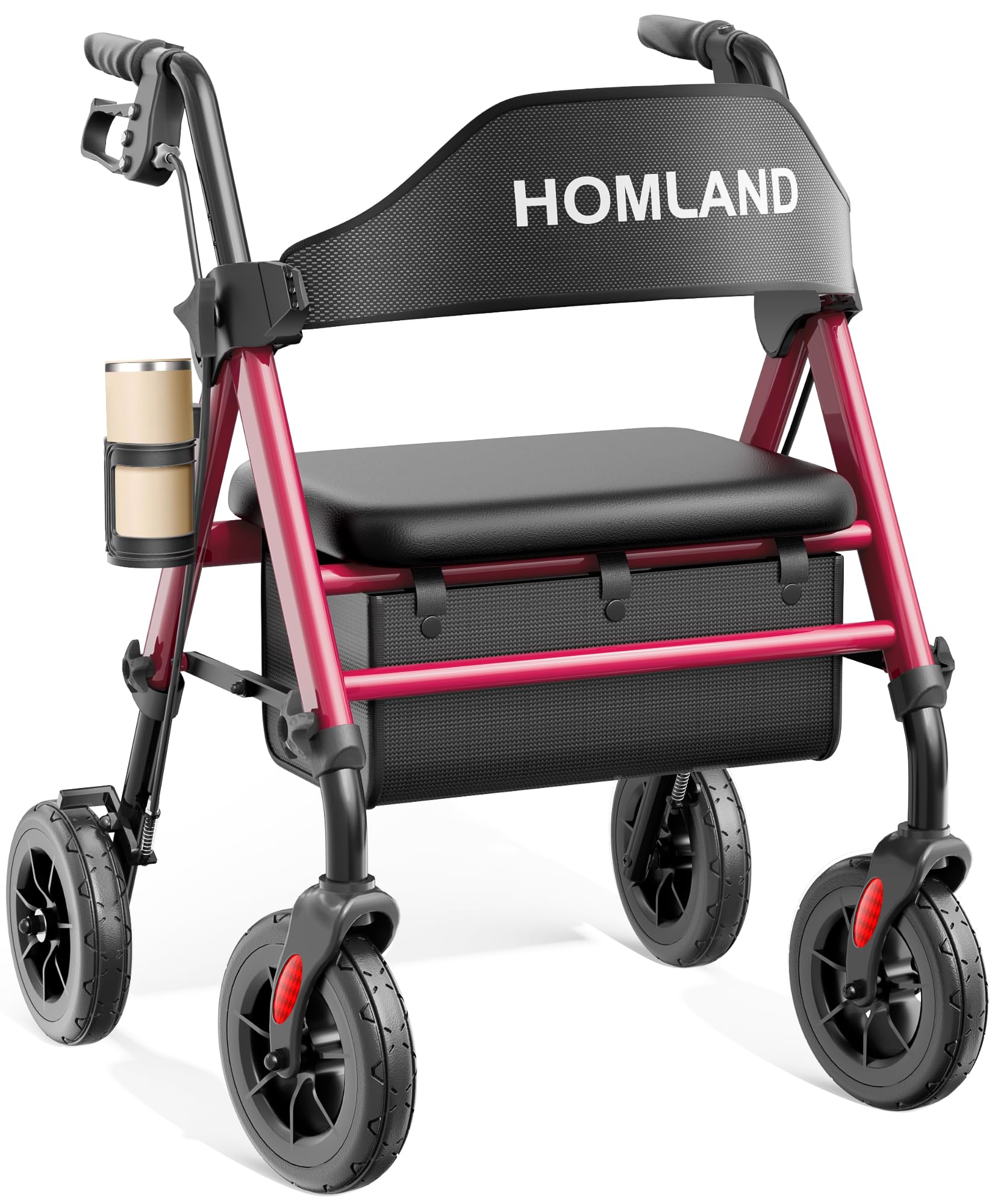
An extra-wide memory foam seat for the long-walk days when legs give out.
Here the seat is the whole point. The extra-wide memory foam seat with a widened, breathable backrest is built to take pressure off the hips during longer rests, and the 350 lb maximum user weight is the highest in this lineup. If you need a real place to sit on a park bench-free sidewalk, this is the frame that takes the job seriously. It rolls at 17.6 lbs with 8-inch premium rubber wheels that glide over sidewalk without the vibration you feel on harder wheels.
Handles and seat both adjust — handles from 33 to 40 inches, seat from 20 to 23 inches — fitting users from 4’7″ to 6’6″. Add a removable cup holder, a large storage pouch, reflective strips, and push-up brake with a push-down wheel lock, and the details are all there. Owners also point out you can tuck a portable oxygen tank under the seat, a nice bonus if you use one.
The trade-off is transport bulk. It folds in a quick three-second motion, but it is not compact once folded, and the seat needs someone with patience to assemble — one owner reports about two hours of careful work. The build quality is solid once together, and the sturdy frame is what keeps the comfort steady. It is not the one to buy if you fold and carry it daily.
The comfort payoff: extra-wide memory foam seat and a breathable backrest make a long rest feel like a real sit, not a perch.
The catch: 17.6 lbs and a bulky fold mean it stays put rather than riding shotgun in the car.
Made for you if: sitting comfortably mid-walk matters as much as walking itself.
Not your pick if: you need something light and compact to move in and out of a car daily.
6. FlyingJoy Foldable Rollator
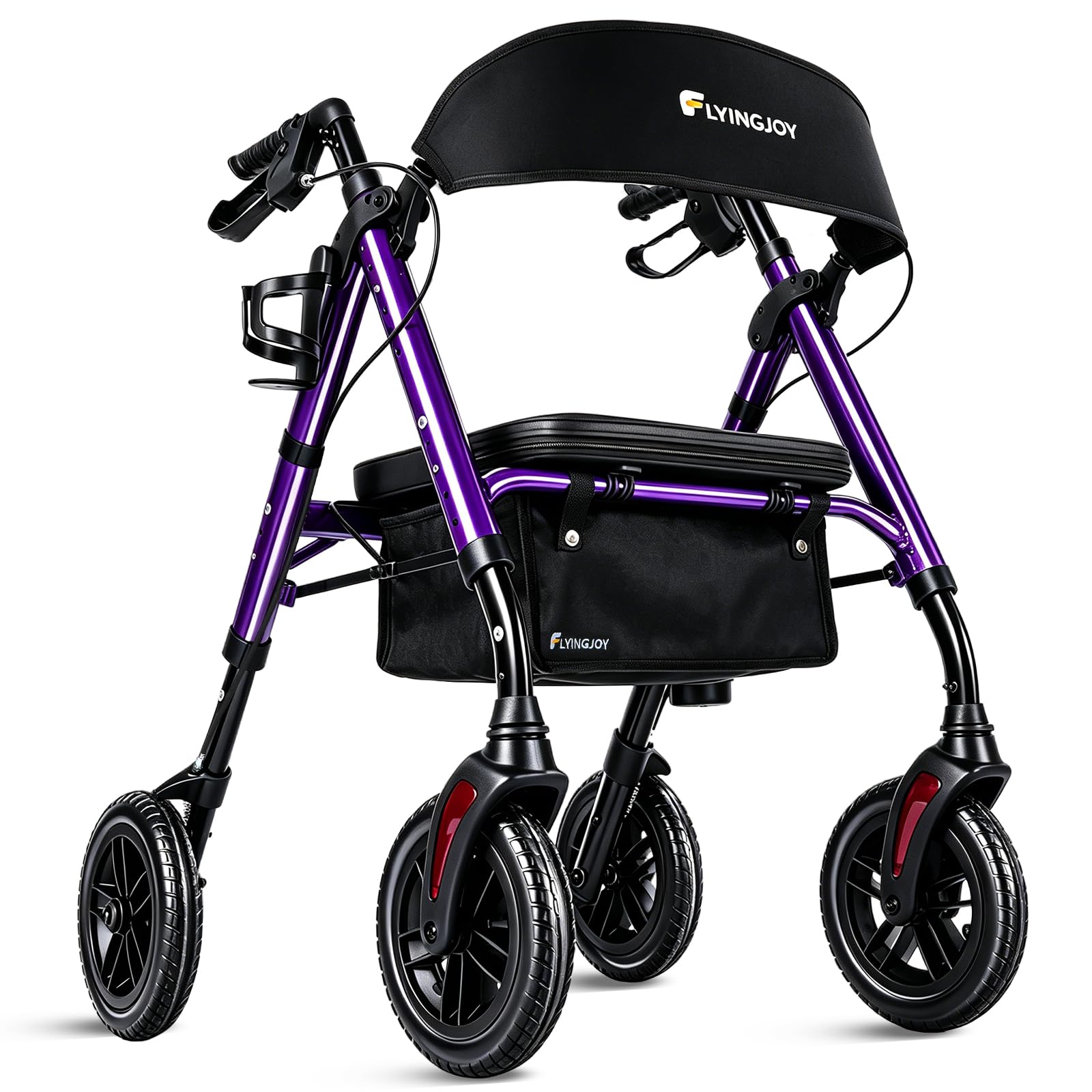
Folds one-handed and rolls into the trunk like a suitcase, no lifting.
The trick here is loading. This rollator folds in three seconds, and the tip is to leave all four wheels on the ground, lift the front slightly, and roll it into the trunk like a suitcase. At 17.64 lbs the lifting is nearly gone. For anyone whose arm strength fades fast, that motion is a smarter solution than hoisting a dead weight into the car. The reinforced triangular frame supports up to 300 lbs and stays stable on sidewalks, grass, and gravel.
Braking gets three modes: free-wheel to roll smoothly, deceleration to slow gradually, and a parking lock to stop completely. That range matters on a slope or while waiting for a ride. The 8-inch airless tires resist punctures and absorb shocks, and the 360° front wheels turn easily in tight aisles. Handles adjust from 32.7 to 40.2 inches for users from 5’3″ to 6’2″, and the 1.6-inch thick seat with backrest gives a real place to sit. The under-seat bag holds up to 11 lbs for groceries or a water bottle.
What to watch: this one is 25.6 inches wide, so it fits standard doorways but not the tightest ones, and a few owners find it too large or note it can feel off-balance if you lean hard. The brake cables on some units can snag and need a bungee to hold them clear. It is not the smallest or the steadiest — it is the one that makes getting it into the car the least work.
What It Does Well
- 3-second one-hand fold with a roll-into-trunk motion
- Three brake modes for flat ground, slopes, and parking
- Airless 8-inch tires resist punctures and absorb shocks
- Under-seat bag holds up to 11 lbs
Real-World Notes
- 25.6 in wide frame is tight in the narrowest doorways
- Brake cables on some units can snag without a tie
The right fit for: people who load the walker in and out of a trunk on their own.
Not ideal for: very narrow hallways or anyone who wants the most planted, wobble-free frame.
7. WALK MATE Rollator Walker with Seat for 5’3″ to 7′ Tall
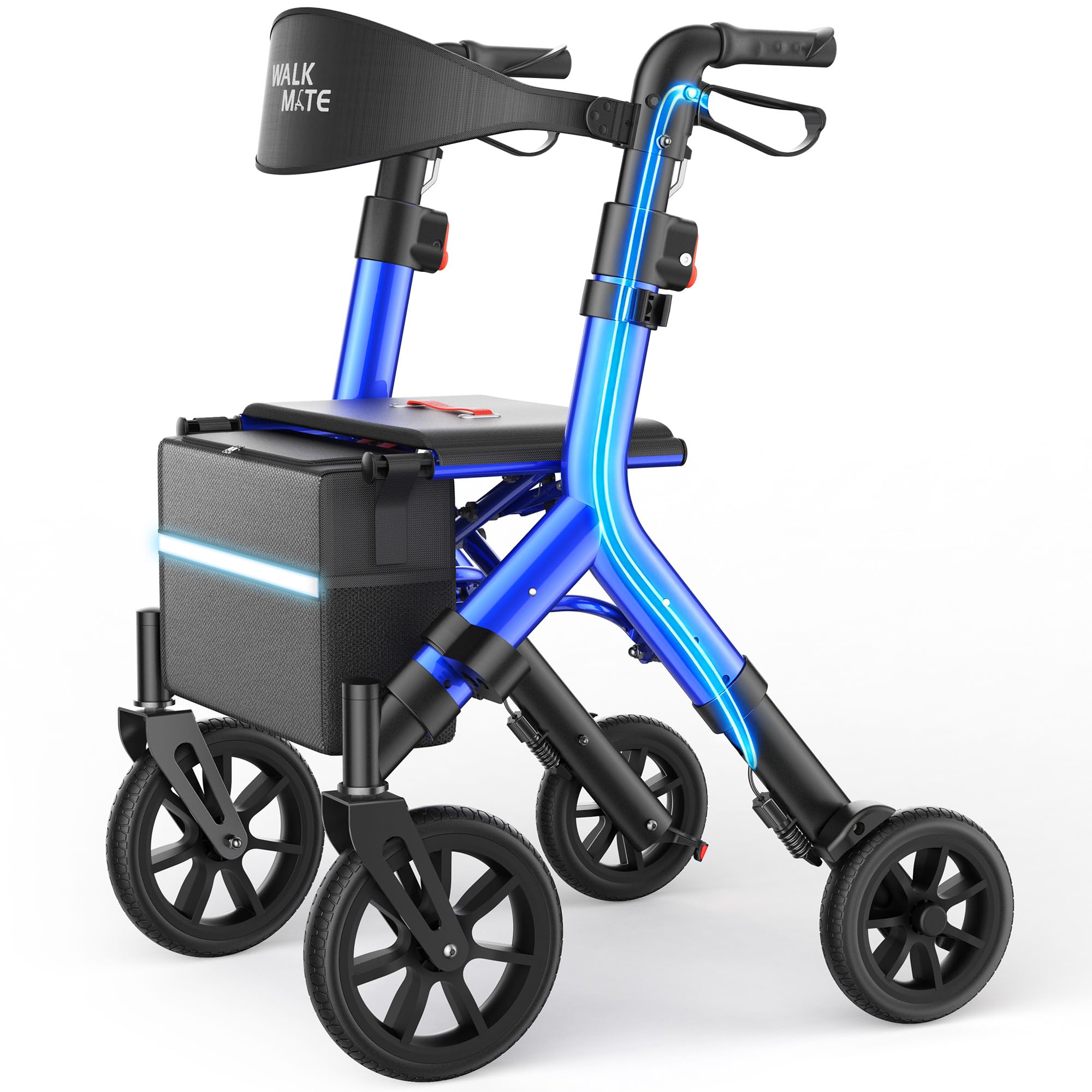
Ten-inch wheels and a tall seat so long legs never have to hunch.
If you are tall, most rollators force you to stoop, and stooping pushes your balance forward. The WALK MATE’s handle range reaches 36.6 to 40.5 inches, higher than the Medline’s 31.5 to 35.75 and the Vive’s 33 to 39, and its seat adjusts in three levels for users up to 7 ft. Add the 10-inch front wheels — versus the 8-inch wheels on the soundfuse and Medline — and you get more clearance over rough terrain and a smoother ride with each stride.
The wheels carry an anti-skid tread pattern for grip on uneven ground, and brake cables are hidden inside the frame for a cleaner look and fewer snag points. The seat and spongy backrest are widened and thick for comfortable rests, and the frame holds up to 300 lbs at 17.2 lbs of weight. There is a detachable storage bag and a cane or umbrella holder to free your hands, plus a fluorescent strip on the bag and a red strip on the wheels for visibility in low light.
The recurring gripe is the folding and the brakes. Opening a folded unit can take spreading the handlebars and front wheels apart, and some reports flag brake cables breaking, especially on units that see heavy use. For a tall or long-limbed walker who mostly leaves it set up, the height and wheel clearance are the selling point — just keep an eye on the brake cables.
Standout spec: 10-inch wheels and a handle that reaches 40.5 inches give tall users a straight-backed stance most rollators cannot match.
Worth knowing: unfolding takes a bit of wrestling and brake cables have been a weak point on a few units.
Pick this if: you are tall or long-legged and most walkers leave you hunched.
Think again if: you fold and unfold it constantly or are hard on brake cables.
8. Helavo Upright Walker with Seat, Foldable Stand Up Walker

Padded armrests and a stand-up frame that stop the forward hunch.
An upright walker is a different animal from a standard rollator. Instead of pushing a low handle, you rest your forearms on padded armrests and walk with your spine straight. For MS, where posture and balance feed each other, the armrests take weight off the shoulders so you can walk upright. The frame is aluminum and weighs 22.7 lbs, the heaviest here, but it is built to stay planted. It supports users up to 300 lbs, and the 10-inch rubber front wheels soak up rough surfaces with no risk of a flat.
The seat is 18.9 inches wide and 9.1 inches deep with a height up to 22 inches, and the backrest is height-adjustable and softly padded. There is a cup holder and an integrated cane holder, plus an easy-to-use brake system with a parking brake. The armrests are soft but durable. It is the most substantial frame on this list, and that bulk is what gives it the stability to keep an upright posture steady.
The honest limits are size and weight. At 22.7 lbs and a wide footprint, it is awkward to lift into a car, and the storage bag must be removed before it folds. A few owners find the armrests sit too far apart. It also suits a taller user who needs strong support — for a smaller, lighter person, it can be more walker than they need.
The reason to choose it: forearm armrests and a straight-back frame are the closest thing here to walking in a natural posture.
The weight of it: 22.7 lbs and a bulky footprint make it a home walker, not a daily car companion.
Worth it for: anyone whose balance suffers most from a hunched forward posture.
pass on it if: you lift your walker into a car often or are on the petite side.
9. byACRE Carbon Ultralight Rollator
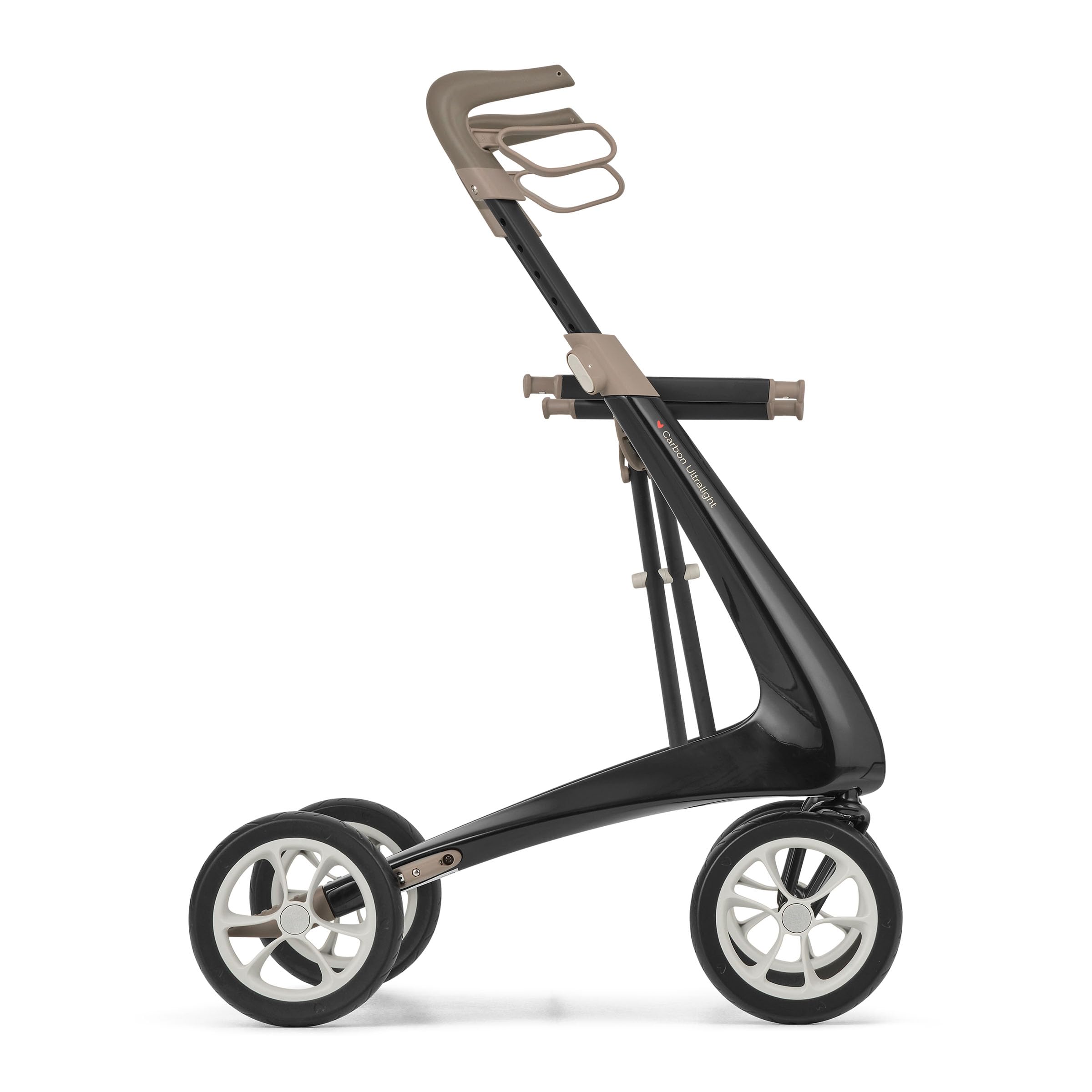
The carbon-frame featherweight that makes lifting a walker feel almost ordinary.
At 10.6 lbs the byACRE is the lightest walker in this whole line-up — a carbon frame that a caregiver can lift with two fingers and a user can hoist into a car without a second thought. It arrives fully assembled, so there is no tool work, and the puncture-proof wheels remove flat-tire worry. For someone managing fatigue, 10.6 lbs is the difference between taking it along and leaving it home.
Design is part of the appeal here, and it plays out in real use — smooth gliding on all surfaces, adjustable handles, and a curb-lift feature for stepping up onto sidewalks. The seat folds, and the frame accommodates users up to the stated capacity. It is the modern, good-looking option of the group, and the finish and construction feel refined.
The honest catch is stability at the extreme. Lightweight walkers can feel twitchy compared with heavier rollators, and this is no exception — a few owners note the wide model is more stable than the compact, and one owner with neck pain found the angled handles pushed weight into the shoulders. If your balance is mostly steady, that lightness works in your favor. For someone who leans hard, a heavier frame is safer. The seat is snug, and the regular seat is narrow — choose the wider model if you have wider hips.
Why It Stands Out
- 10.6 lb carbon frame is the lightest here
- Arrives assembled — no tool work
- Puncture-proof wheels and a curb-lift feature
What To Weigh
- Lightness means less planted support under a heavy lean
- Seat is narrow on smaller models
- Angled handles can be hard on neck strain
Choose this if: you are mostly steady and want the lightest, easiest-to-lift walker for everyday use.
it’s not for you if: you lean heavily for support or need the most planted frame available.
Know the Specs
Wheel Size and Terrain
Wheel size runs from 6 to 10 inches. Larger wheels — 10-inch on the WALK MATE and Helavo — roll over cracks, gravel and tree roots with less jolt, which matters when balance is unsteady on uneven ground. Smaller 6-inch wheels, like the Vive’s, fold tighter and suit smooth floors and short trips. If most of your walking is on cracked sidewalks or park paths, size up.
Seat and Handle Height
Seat height decides how easily you stand back up — a seat roughly 20 to 23 inches high keeps your knees from riding above your hips. Handle height should reach your wrist crease when you stand straight, so a range like 33 to 40 inches fits most adults, while 31.5 to 35.75 inches suits shorter users. Taller users should look for handles reaching well past 36 inches.
Brake Types
Push-down brakes lock the wheels so the walker cannot roll while you sit — crucial when a leg gives out. Squeeze-to-slow brakes let you ease speed on a slope. Three-mode brakes, like the ones on the FlyingJoy, add free-roll and gradual deceleration. For tired hands, a dependable parking lock is the feature that stops a walker becoming a hazard.
Weight and Folding
Lighter walkers — 9.5 to 11 lbs on the Vive and HOMLAND 3-wheel — lift easily into a car and fold small. Heavier frames — 17 to 22 lbs on the soundfuse, HOMLAND and Helavo — feel more planted but are harder to lift. A one-hand fold, or a roll-into-trunk motion, can do more for daily independence than a few pounds of weight savings.
Common Questions
What is the best walker for MS patients who tire after short walks?
Should I pick a 3-wheel or 4-wheel walker with MS?
How do I make sure a walker is tall enough for me?
Is a push-down parking brake better than a squeeze brake?
How much weight do these walkers carry?
Will a rollator fit through a standard doorway?
Can I lift a walker into a car myself with weak arms?
Is an upright walker better for posture than a standard rollator?
Do these walkers fold small enough for a small car trunk?
How long should a walker last with daily use?
The Bottom Line
For most people managing MS day to day, the strongest pick is the soundfuse Foldable Rollator — its 300 lb frame, dual-mode brakes, and 20-to-23-inch adjustable seat make it the steadiest, most adjustable all-rounder on this list. If you need the walker to travel with you, the Vive Mobility folds in one step and lifts at 9.5 lbs, though it has no seat. And if you want a real seat to rest on a long walk, the HOMLAND with Seat gives you an extra-wide memory foam cushion and a 350 lb rating.
One honest nudge: the soundfuse is the crowd favorite for good reason — 4.5+ stars across 500+ owners — but if lifting it into a car every day is the part that leaves you exhausted, the lighter Medline or the roll-into-trunk FlyingJoy will serve you better. Pick the walker that matches your weakest day, not your best one.
How we choose
We do not accept paid placement. Every pick is matched to a real buyer and a real use-case; we do not hands-on test units.
Sources
Specifications: manufacturer listings and product documentation. Review insights: verified customer reviews, as of October 2026. Pricing: not shown on this page (it changes often); check the current price via the retailer link.
As an Amazon Associate, Aappliancez earns from qualifying purchases. This does not affect which products we feature.