Disclosure: Some links in this post are affiliate links. As an Amazon Associate I earn from qualifying purchases, at no extra cost to you. Learn more
Specs are compiled from manufacturer listings and verified buyer reviews and can change over time — please confirm the key details on the product page before buying.
If your vocal keeps disappearing under the band, or your home recordings sound thin and jumpy, a compressor is the fix — and the right one is worth more than three wrong ones. The short answer: the MXR Dyna Comp is the safest all-round pick for guitar and keys, the Keeley Compressor Plus gives vocalists and bass players the most useful controls, and the dbx 286s is the one to buy if you are tracking a microphone into an interface. Everything below explains in plain words who each of these nine pedals and processors actually suits.
This guide is built by comparing the manufacturers’ published specifications and the patterns across verified customer reviews, so you get each pick’s real strengths and trade-offs instead of marketing spin.
You will learn what threshold, ratio, attack and release actually do to a voice, why a blend knob saves your consonants, and which units run on a battery. Read on for the full breakdown of the best vocal compressor for your rig.
Top Picks


How To Choose The Best Vocal Compressor
Start with the job, not the box. A pedal that clips your guitar signal before it hits the amp does something different from a rack unit that boosts a microphone up to a usable recording level. Decide whether your voice arrives already amplified or needs power first, because that single answer rules out half this list.
Pedal or rack unit?
A stompbox sits at your feet, runs off a 9 volt battery or an adapter, and takes a quarter-inch jack. These suit a live singer who already has a mixer or amp handling the microphone. A rack processor is mains powered, occupies 1U of space in a rack, and its XLR input feeds a microphone its phantom power — that is the world of home studios and podcast desks.
The controls that actually change how a voice sits
Threshold sets the level where squashing begins. Ratio decides how hard it squeezes once it starts. Attack is how quickly it reacts to a word’s first consonant, and release is how quickly it loosens its grip afterwards. Two knobs cover the basics on a classic design; more knobs mean more ways to tailor that behaviour to a specific voice.
Hands-on time versus plug-in-and-go
Some units are built to sound right within seconds of switching on. Others need a computer editor before they reveal their depth — a very different purchase. If you want to sing and hear results, pick the simple design. If you like programming, pick the deep one.
Side-by-Side Comparison
| Model | Best For | Power Draw | Format | Battery Option | Amazon |
|---|---|---|---|---|---|
| MXR® Dyna Comp® Compressor★ Best Overall | First compressor, any genre | 200 milliamps | Compact pedal | Single 9 volt | Amazon |
| TC Electronic HyperGravity CompressorDeepest Control | Deep multiband tweaking | — | Compact pedal | — | Amazon |
| BOSS CH-1 SUPER ChorusNot Compression | Widening a clean vocal or guitar | 13 milliamps | Compact pedal | — | Amazon |
| MXR® Super Comp | Dyna Comp fans who want attack control | 9 milliamps | Compact pedal | Single 9 volt | Amazon |
| Keeley Compressor Plus | Most control for guitar and bass | 10 milliamps | Compact pedal | Battery option | Amazon |
| Universal Audio 1176 Pedal | Studio-style compression on a board | 250 milliamps | Compact pedal | — | Amazon |
| dbx 266xs | Taming wild levels in a rack | 300 milliamps | 1U rack | — | Amazon |
| dbx 286s Channel Strip | Microphone into an interface | — | 1U rack | — | Amazon |
| Roland VT-4 Vocal Transformer | Creative vocal effects | 50 milliamps | Desktop | Five-hour battery life | Amazon |
Detailed Reviews
1. MXR® Dyna Comp® Compressor
Our pick — 4.5+★ from 650+ verified ratings; the strongest balance of quality and price.
The red box that has been evening out guitar signals for decades without asking for a manual.
This is the compressor to buy if you have never owned one and you want the sound you have heard on records for fifty years. MXR calls the M102 a Nashville studio standard, and what it does is simple: it evens out the signal going to your amp so quiet notes come up and loud notes come down. The payoff is sustain — a held note keeps ringing instead of dying — and a constant output level that makes your playing sound more even than your hands actually are.
Two knobs do the whole job. The compression circuit handles how hard the signal is squeezed, and the sensitivity control sets the trigger point, so you can dial in anything from a light polish to a full country squash. It is not fussy about rigs either. It runs from a Dunlop ECB003 AC adapter or a single 9 volt battery, which means you can audition it on the floor before you ever find a power strip. It weighs 1 ounce and draws 200 milliamps when it is plugged in — a meaningful pull next to the BOSS CH-1 at 13 milliamps, so it wants a proper isolated supply rather than a shared daisy chain.
What keeps it at the top is a consistent owner report: a slightly brighter clean tone, extra punch under gain, and a metal housing that survives gigging. The honest caveat is noise. Some rigs love it and some hiss, and the pattern in the feedback points at the power supply or a noisy chain rather than the pedal itself. Know that compression also flattens your dynamics — that is the effect working, not failing — and you will get on with it fine.
What earns it the top slot
- Sustain and even output from just two knobs — no menu, no editor, no learning curve.
- Works as a compressor, a sustainer and a mild clean boost in one red box.
- Runs on a single 9 volt battery or the Dunlop ECB003 adapter, so it travels easily.
- Metal housing that takes gigging abuse, per long-term owners.
Where it asks something of you
- Can add hiss depending on your power setup — try an isolated supply first.
- Compression reduces dynamics by design, so heavy settings feel squashed.
- 200 milliamps is a heavier draw than most compact pedals.
Buy it if: you play guitar or keys and want the reference compression sound with zero setup time.
Think twice if: you need to shape attack and release independently — the Super Comp or Keeley below give you those extra knobs.
2. TC Electronic HyperGravity Compressor
A pedal that only shows its real depth once you plug it into a computer.
Multiband compression means the pedal splits your signal into separate frequency bands and compresses each one on its own settings. On a voice that is genuinely useful: you can squeeze the boomy low end without touching the airy top, so the words stay clear and the chest stays controlled. TC Electronic’s TonePrint editor is where that happens, letting you set threshold, ratio, attack and release per band and remap the knobs to whatever you like. There is also a vintage compressor mode for a warmer, more traditional squeeze.
Owners who put in the time get a lot back — a synth player running a Roland TB-03 found it eliminated volume swings entirely during filter sweeps, and the same trick works for a singer whose level drifts. Budget a short session with the software; about ten minutes of learning is the realistic bar, and turning off the autogain is the single most repeated fix for hiss and latency. The blend knob then lets you keep as much dry signal as you want.
The trade-off is real and worth saying plainly. This is not a plug-in-and-play pedal. The included presets can arrive with more gain than you want, the graphic curve editing is not well documented, and some units need a power cycle when switching profiles. Feed it distortion downstream and the digital character can turn a fuzz box metallic. If you want to program, it is excellent. If you want to stomp and sing, look up the list.
Editor makes it or breaks it: everything you love about this pedal happens in the TonePrint software, not on the top face. Buy it as a computer-tuned compressor and the flexibility is enormous.
The honest limit: digital artifacts under heavy downstream gain and a fiddly profile switch mean it suits a patient tinkerer more than a plug-in-and-go player.
Worth the effort for: players and engineers who want per-band control and are happy to open an editor.
Not the one for: anyone who wants great tone in the first thirty seconds.
3. BOSS CH-1 SUPER Chorus
Straight talk first: this is a chorus, not a compressor. Here is where it still earns a place.
If you arrived looking for compression, keep scrolling — the CH-1 does something different. A chorus doubles your signal with a slightly delayed, pitch-wobbling copy, which thickens a voice or a clean guitar and pushes it forward in a mix. BOSS has built this one since 1989, and the current version sells with a five-year warranty, a metal chassis and four knobs: Effect Level, EQ, Rate and Depth. For a singer running through a PA, a light chorus is the cheapest way to make a single voice sound like two.
What wins people over is simply how it sounds — clean, brilliant, and subtle enough to sit under a vocal without smearing the words. Reliability matches the sound: buyers report leaving it on a gigging board for a decade without failure. It also draws only 13 milliamps, the gentlest power pull in this entire group, so it happily shares a supply. Mono input, stereo outputs, and it plays nicely with keyboards and electric pianos as well as guitar.
Four knobs do have a learning edge. A few players find the effect only wakes up with the controls pushed well round, then overshoots into too much. One owner also found their unit had clearly been opened before it shipped, which is a packaging issue rather than a design one. Note too that the AC adaptor is not included — the optional BOSS PSA is the recommended supply.
The pleasant surprise: run it after a drive pedal on a shared daisy chain rather than before, and the effect lands where you expect. Place it after your drive pedals and the stereo spread widens a single voice across the mix.
Set expectations: it will not even out a jumpy vocal level. Pair it with a real compressor if that is your problem.
Grab it if: you want to widen a clean vocal, guitar or keyboard with a proven circuit and a five-year warranty.
Keep looking if: your actual goal is controlling volume swings — that is the Dyna Comp’s job.
4. MXR® Super Comp

The Dyna Comp sound, plus the one knob players kept wishing for.
MXR built this as an update of the legendary Dyna Comp, and the headline addition is an attack level control. Attack is how much of a note’s opening punch survives before the compression clamps down. On a vocal that means the first consonant of a word stays crisp instead of being swallowed — the difference between a phrase sounding natural and sounding squashed flat. There is also a footswitch toggle and an output level to push your amp.
It comes with the AC adapter and a 9V battery in the box, which is genuinely handy for a first pedal. Weight is 16 ounces and it draws 9 milliamps, the lightest draw of any compressor here — compare that to the Dyna Comp’s 200 milliamps and you can see why some boards fit this one more easily on a shared supply. The heavy metal housing has convinced long-term owners to keep it on the board for years rather than trade up.
Where it gets interesting is the noise. Owners credit the attack control for the lower noise floor versus the Dyna Comp, and it sits happily after a wah or overdrive once you set the sensitivity. Still, push the output far and you will hear hiss, so most players keep it around 60 to 70 percent. It is a subtle effect by nature — set it expecting a gentle focus, not a dramatic transformation.
Why Dyna Comp fans upgrade to it
- The added attack control keeps initial volume intact while you pile on sustain.
- Adapter and 9V battery both included, so it is playable the day it arrives.
- True bypass keeps your signal clean when the pedal is off.
- Draws only 9 milliamps — no strain on a shared power supply.
What you should know before buying
- Hiss creeps in once the output is pushed high, so watch that knob.
- The effect is subtle; it focuses a signal rather than reshaping it.
- Best placed first in the chain, which limits where it can live on a crowded board.
Reach for this if: you loved the Dyna Comp but wanted one more control over the opening punch.
Look elsewhere if: you need a blend knob to keep your dry signal — that is the Keeley’s territory.
5. Keeley Compressor Plus
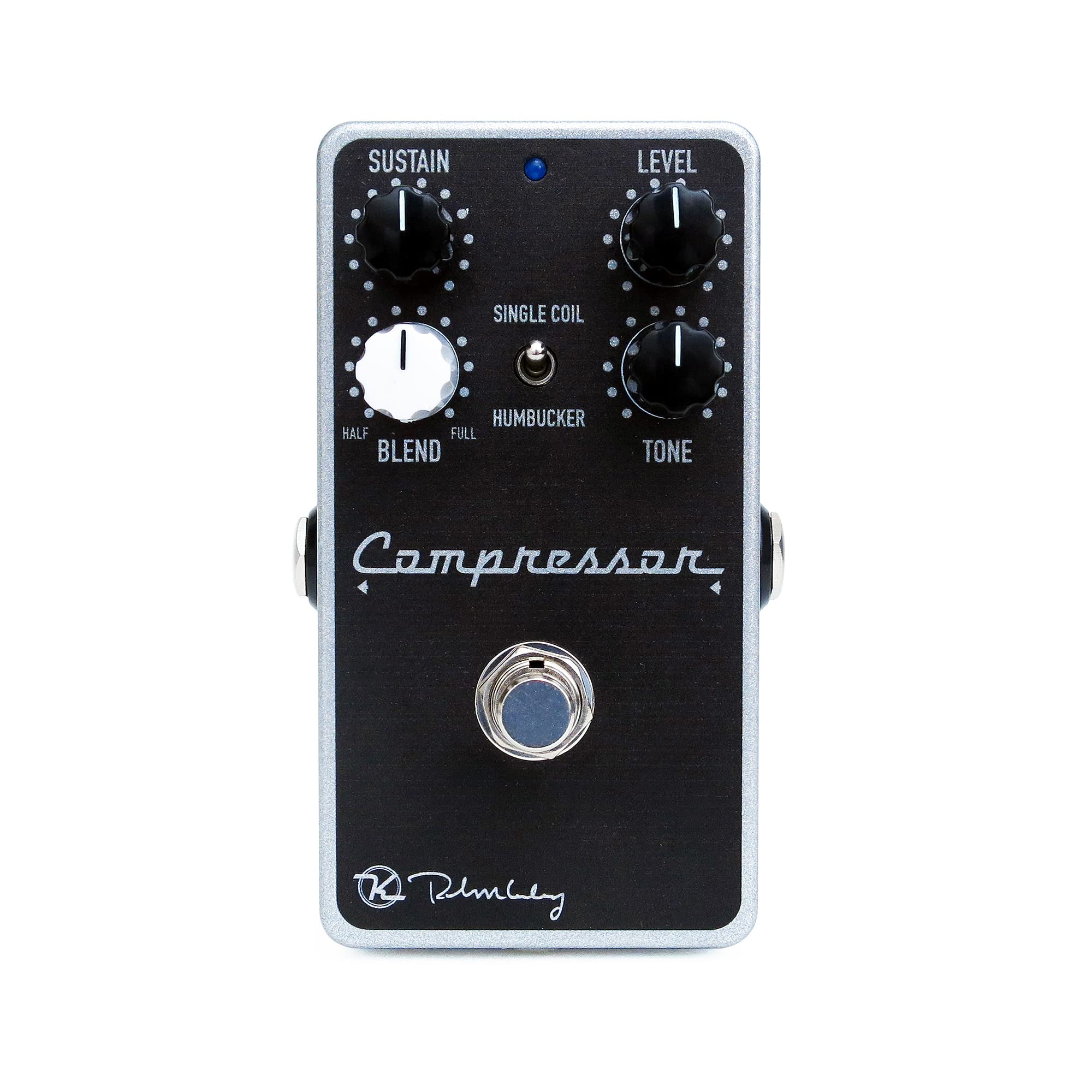
Four controls that let you keep the pick attack other compressors eat for breakfast.
Optical compression uses a light-dependent circuit to control the squeeze, which tends to sound smoother and more musical than a hard clamp. On a voice that matters, because a smoother squeeze keeps long notes swelling naturally instead of flapping. Keeley pairs that with a release switch tuned for single-coils or humbuckers, so the pedal lets go at the right speed for your pickups or your mic. The tone control restores the highs that compression tends to dull.
What makes this the most useful pedal here is the blend knob. It mixes your dry signal back in, so you can compress hard while the consonants of every word still cut through — the single control that turns a guitar pedal into something a singer can actually use. It is 100 percent analog, true bypass, USA-made, and it runs on 9VDC at only 10mA with a battery option. The range runs from light and transparent all the way to heavy country squash.
Performance is what owners praise most — guitarists in metal and chugging contexts say they would not swap it for another compressor. There are two practical notes. Bass players report real low-end loss unless they crank the level and roll the blend toward the dry side, so if you need sub-bass weight, plan to work the knobs or consider a bass-specific unit. And the pedal is sensitive to its power supply: a mismatched adapter can introduce a high whine, which is worth testing before blaming the pedal itself.
Why the blend matters most: it is the difference between a compressed signal that sounds distant and one that still has teeth. Set blend around a third dry and the words stay forward.
One caution worth repeating: if it hums from the start, swap the adapter before you return it.
Best matched to: a guitarist or singer who wants to shape compression precisely rather than accept one fixed flavour.
Less ideal for: a bassist chasing deep low end without extra EQ work.
6. Universal Audio 1176 Compressor Limiter Pedal

A recording-studio limiter shrunk onto a pedalboard, with one button that squashes everything.
The 1176 is the limiting amplifier that shaped decades of recorded vocals, and this pedal is Universal Audio’s compact emulation of the 1176LN. You get Input, Output, Attack and Release settings that mirror the original hardware layout, plus a ratio knob with an “all buttons in” mode for deliberately gritty, crushed textures. For vocals, the draw is that the single mode gives a classic, musical level ride that makes a performance sit forward in a mix.
Three modes do three jobs: single for the classic emulation, dual for something closer to overdrive, and sustain for long held notes. Parallel compression lets you blend the processed signal with the clean one, so you can lean hard on a word without losing the natural air. It is small — 259 grams and 4.75 inches long — and it adds a USB-C port for firmware updates, though the internal processing is digital rather than analog.
Two honest points keep it out of the top slot. The jack layout is cramped: input, output and power sit close enough that some power plugs will not fit alongside MXR patch cables, so plan your board accordingly. And although the unit is frequently praised for its quality and its ability to make an acoustic sound natural rather than processed, the ratio control steps between fixed values instead of sweeping smoothly. A unit has been known to freeze and recover after being unplugged.
The character you are buying: the 1176 feel — smooth output normalisation without the plastic sheen cheaper digital compressors add to an acoustic guitar or a close-miked voice.
Fit note: budget board space around the jacks, not just the enclosure.
Choose it for: studio-flavoured compression in a compact pedal, especially if you already know and love the 1176 sound.
Pass if: you want continuous ratio sweeps or a roomy jack layout.
7. dbx 266xs Compressor/Gate

The rack unit that stops a loud advert from blowing you out of your chair.
This is a two-channel dynamics processor in a single rack space, and the problem it solves is uneven level. OverEasy compression eases into the squeeze instead of hitting a wall, so a voice stays natural even when it is being pushed hard.
The gate side is program-adaptive, meaning it learns the shape of your material and releases cleanly instead of chopping the tail of a word. There is also a sidechain insert for triggering the compressor from another source, and channel linking via an RMS sum when you want both sides to move together. It draws 300 milliamps, weighs 6.6 pounds and measures 19 inches wide, so this is desk or rack furniture, not a pedalboard item.
Owners use it well beyond music — it has become a favourite for taming TV and film dialogue, where loud adverts and quiet speech sit in the same hour. One owner has a second unit on a police scanner. The recurring note is a rare hardware niggle: a button that fails to latch on an occasional unit. Given how consistent the quality reports are on this mature unit, treat a sticky button as something to check on arrival rather than a reason to skip it.
The practical win: it fixes the mismatch between quiet dialogue and loud effects without you touching the volume once.
The honest limit: it is a general-purpose compressor, not a vocal character piece — it controls level cleanly rather than adding warmth.
Pick this one for: a studio, home theatre or broadcast chain where levels jump around and you want to see them settle.
Not for: a guitarist who needs a stompbox at their feet.
8. dbx 286s Channel Strip

Four processors in one rack space between your microphone and your interface.
If the voice you want to compress arrives through a microphone, this is the box built for exactly that job. It is a full channel strip: a mic preamp with phantom power, then four independent processors — compression, a de-esser, an enhancer and an expander/gate — running in order. The de-esser is a specialised compressor that targets only the harsh highs and sibilance, the sharp “sss” sounds that make a close-miked vocal tiring. The enhancer adds definition to both the low and high ends.
The dbx compression here reduces the gap between the loud and quiet parts of a performance so both can be heard, which is the whole point of bringing a vocal to the front of a mix. Around the back you get a floating balanced XLR mic input, two quarter-inch TRS inputs and one TRS output, plus an insert jack to loop out to another processor. It fits one rack space, and it ships with a power cord, a manual, and rack screws and washers.
Owners mention broadcast-clean vocals straight from the start, and one recorded in an untreated room with a dehumidifier, fans and a fish tank without the noise reaching the track. Streamers have replaced software noise suppression with it for the same reason. The catch is a matter of taste: the compressor sits in a fixed spot in the chain, so you cannot reorder it the way you can on some rival units, and the de-esser occasionally lets a bright syllable slip past.
What makes it a studio staple
- Four separate processors — compression, de-essing, enhancement and gating — in one rack unit.
- Phantom-powered XLR input means a condenser mic plugs straight in.
- Low noise even at high gain, with a wide, pleasant frequency response.
- Each section can be switched off independently, so it is not all-or-nothing.
Where it gives ground
- The compressor cannot be repositioned in the chain without external patching.
- The de-esser lets an occasional bright frequency through.
- Heavy settings colour the tone more than a clean setting does.
The one to buy if: you record a microphone into an audio interface and want a cleaner, more even voice before the signal ever hits the computer.
Not necessary if: your voice already arrives at a mixer and you only want a foot pedal.
9. Roland VT-4 Vocal Transformer
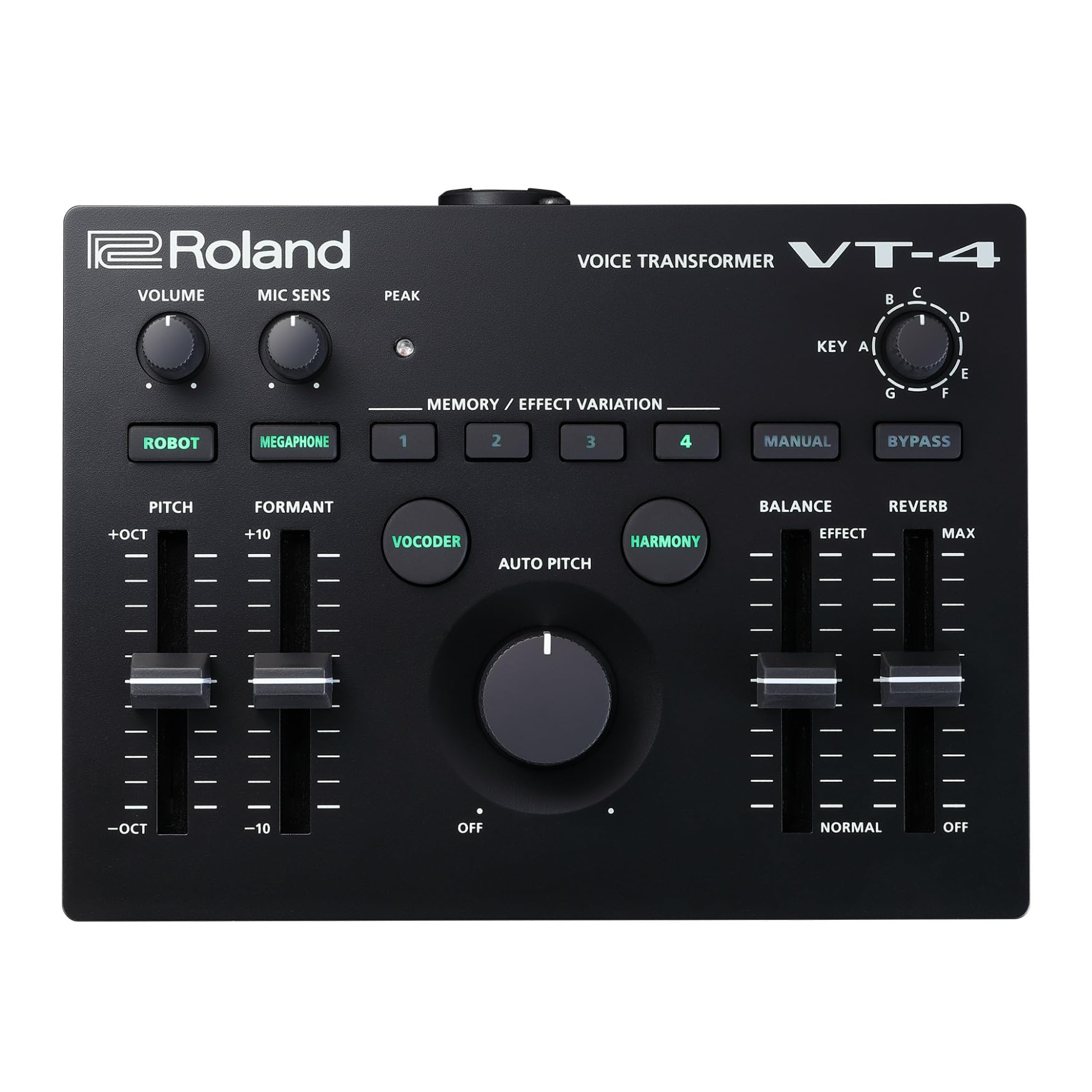
Not a compressor at all, and that is exactly why it belongs in this roundup.
Sometimes the vocal problem is not level — it is that the performance is boring. The Roland VT-4 is a voice transformer: it shifts pitch and formant (the character that makes a voice sound like a voice) in real time, and layers effects like delay, reverb and vocoding on top. You can chain several at once or use them separately. It gives a singer harmony, pitch correction with adjustable strength, vocoder tones and megaphone textures without opening a laptop.
Two things make it more practical than it looks. A condenser microphone plugs straight in thanks to a built-in phantom power switch, and it can run on batteries — Roland lists five-hour battery life, and the batteries are included, though the power cord is sold separately. It also has four variations each of echo, vocoder, harmony and megaphone, plus a USB audio interface for capturing the result directly.
Be realistic about the sound. It is a performance and effect unit, not a studio-grade compressor, and close listening reveals it is not designed for pristine capture. Running a phantom-powered mic drains the batteries noticeably faster than the rated figure — one owner got roughly three and a half hours before a change. The menu of preset combinations also frustrates people mid-show, and the build has shifted from metal to plastic over the generations. Accept those terms and it is a genuinely fun front-end for karaoke, streaming and character voices.
The genuinely useful part: the phantom power switch, which means the mic you already own works without an extra preamp in the chain.
The honest trade: this is a creative effect, not a level-control tool — pair it with one of the compressors above if your real problem is inconsistent volume.
Right for: streamers, karaoke nights and audiobook character work where effect variety is the point.
Wrong for: anyone hoping this alone will even out a live vocal level.
Know the Specs
Power Draw In Milliamps
Milliamps measure how much current a pedal pulls from its supply. It sounds like a technical curiosity until you split one adapter across six pedals and everything hums. A draw of 200 milliamps is a hungry pedal, while 9 or 13 milliamps is light enough to share. If a compressor starts hissing, check the supply before anything else — a mismatched adapter is the most common culprit, and one player traced a whine straight to a specific brand of power brick.
Attack And Release
Attack is how fast the unit clamps down when a signal gets loud; release is how fast it lets go afterwards. A fast attack catches the first consonant of a word but can flatten the punch of a sung note. A slower release keeps the swell natural. That is why a release switch tuned for single-coils or humbuckers matters, and why an attack control is the single most requested upgrade on a classic compressor design.
Blend And Parallel Compression
Blend mixes your unprocessed dry signal back in alongside the compressed one. On a voice, that preserves the crisp edges of consonants while the compressed copy adds weight and sustain. Parallel compression is the same idea in studio terms, and it is what lets you squeeze a word hard without it sounding distant or dulled.
Pedal Versus Rack Format
A pedal runs on a battery or a small adapter and takes a quarter-inch jack. A rack unit occupies 1U of space, plugs into mains power, and its XLR input can feed a microphone its phantom power. Choose the pedal if you are amplifying an already-live signal; choose the rack if the microphone itself needs to be brought up to a usable level.
Common Questions
Will a guitar compressor pedal work on a vocal?
Do I need phantom power to use a condenser mic with these units?
What is the difference between the Dyna Comp and the Super Comp?
Why does my compressor pedal hiss?
Can I run these pedals on a battery?
Is the Universal Audio 1176 pedal analog or digital?
Where in my signal chain should a compressor go?
What does a de-esser actually do to a voice?
Can I use the dbx 266xs for a home theatre instead of music?
Do I need a compressor if I already use effects plugins on my computer?
The Bottom Line
For most players, the vocal compressor that makes the most sense is the MXR Dyna Comp, because it delivers the reference sustain and constant output from two knobs and runs on a 9 volt battery when you need it to. If you want to keep your dry signal and shape the squeeze precisely, the Keeley Compressor Plus gives you the blend, tone and release controls to do it. And if your vocal arrives through a microphone rather than an amp, the dbx 286s is the one to reach for, since it handles the preamp, compression, de-essing and gating in a single rack space.
Whichever you pick, start with modest settings and let your ears adjust — compression rewards a light touch far more than a heavy one.
How we choose
We do not accept paid placement. Every pick is matched to a real buyer and a real use-case; we do not hands-on test units.
Sources
Specifications: manufacturer listings and product documentation. Review insights: verified customer reviews, as of October 2026. Pricing: not shown on this page (it changes often); check the current price via the retailer link.
As an Amazon Associate, Aappliancez earns from qualifying purchases. This does not affect which products we feature.