Disclosure: Some links in this post are affiliate links. As an Amazon Associate I earn from qualifying purchases, at no extra cost to you. Learn more
Specs are compiled from manufacturer listings and verified buyer reviews and can change over time — please confirm the key details on the product page before buying.
Most people shopping for a retro CD player are chasing one thing: the warm, full sound of a wooden cabinet instead of the thin, harsh output of a cheap plastic box. The picks below all deliver that, but they differ wildly in what else they add — cassette decks, Bluetooth streaming, built-in speakers, or a bare transport you feed into your own amp. If you just want the easiest all-rounder that plays your old discs and looks like furniture, the Victrola Quincy is the one to grab first.
This guide is built by comparing the manufacturers’ published specifications and the patterns across verified customer reviews, so you get each pick’s real strengths and trade-offs instead of marketing spin.
You will see how each unit handles CD-R discs, what its amplifier really pushes, and which ones need speakers you already own. This breakdown of the vintage cd players separates the warm wood cabinets from the harsh plastic boxes.
Top Picks


How To Choose A Retro CD Player
A retro CD player is really two products bolted together: a disc drive and a speaker system. How good your old discs sound depends almost entirely on which half you are paying for. The wrong assumption most buyers carry in is that “retro” means old technology. In this category it usually means a modern drive and amplifier wrapped in a vintage-looking wood or black cabinet, which is why they can play burned CD-Rs and pair with your phone.
Built-in speakers or a bare transport
An all-in-one unit like the Victrola Quincy or the Wiithink packs speakers inside the cabinet, so you set it on a shelf and press play. A bare transport like the syitren R300 has no speaker at all and sends the audio out to gear you already own. If you already run a receiver and floor speakers, a transport gives you cleaner separation between the spinning disc and the sound. If you do not, the all-in-one saves you buying anything else.
What the wattage number actually tells you
A watt is a unit of electrical power, and in these systems it is usually quoted twice: a rated figure for continuous output and a higher peak figure for short bursts. The LONPOO lists 40W rated and 60W peak, while the aiwa boombox lists 40W of output across its drivers. More watts generally means more headroom before the sound distorts, but cabinet size and wood thickness matter just as much for how full the bass feels in a small room.
Disc formats and the lid
Check the format list before you buy: some units read CD, CD-R and CD-RW, plus MP3 files burned to a disc or a USB stick. The lid design matters more than it sounds — a top-loading tray means the unit needs clearance above it, and a drawer-style front loader needs clear space in front. If your shelf is tight, measure the footprint first.
Side-by-Side Comparison
| Model | Best For | Output Power | Built-in Speakers | Connectivity | Amazon |
|---|---|---|---|---|---|
| Victrola Quincy★ Best Overall | All-format living room centerpiece | — | Yes | Bluetooth, Aux, RCA out | Amazon |
| Wiithink 797Best Value | Bedroom CD and radio | 30W | Yes (2 speakers) | Bluetooth, USB, Aux, 3.5mm | Amazon |
| WISCENT WTB-797Compact Pick | Small-space streaming and CDs | 15W RMS per speaker | Yes (2 speakers) | Bluetooth, USB, Aux | Amazon |
| LONPOO LP-816 | Big-room sound on a shelf | 40W rated / 60W peak | Yes (2 speakers) | Bluetooth, USB, Aux, 3.5mm | Amazon |
| syitren R300 | Pairing with your own amp | — | No | Bluetooth 5.3, SPDIF, 3.5mm | Amazon |
| Victrola Century | Streaming records to wireless speakers | — | Yes | Bluetooth, VINYLSTREAM, Aux, RCA | Amazon |
| FiiO DM15 R2R | Portable high-res listening | 1150mW + 1150mW | No | Bluetooth aptX Adaptive, USB, 3.5mm, RCA | Amazon |
| aiwa AI7012 | Portable retro boombox parties | 40W | Yes (2 speakers) | Bluetooth 5.0, USB, SD, Aux | Amazon |
| Yamaha CD-S303 | Hi-fi rack system disc playback | — | No | USB, optical, coaxial | Amazon |
Detailed Reviews
1. Victrola Quincy – 6-in-1 Bluetooth Record Player – Mahogany
Our pick — 4.5+★ from 27,000+ verified ratings; the strongest balance of quality and price.
One mahogany box that spins your CDs, cassettes, records and streamed playlists without a single extra cable.
If your old CD collection sits next to a stack of tapes and a few vinyl records, the Quincy takes all three in one cabinet. It plays CDs, cassettes, three-speed vinyl and AM/FM radio, and it also pairs with your phone over Bluetooth. The 14.9-pound cabinet is finished in mahogany, so it looks like a piece of furniture when the lid is shut.
What wins people over is the overall build and finish, which owners talk about most, with sound quality close behind. The sound is described as big, full and warm, and the volume goes louder than the old suitcase-style players it often replaces, filling an apartment at a quarter of the knob. The built-in speakers handle the low end decently, though a few notes suggest that if you want heavy bass you should add external speakers through the RCA line output at the back.
The honest catch is disc skipping and durability. A handful of units have arrived with a CD mechanism that fails within the first week, and some buyers see skipping on records. One specific quirk buyers report: the turntable arm stays slightly loose (about 8mm) even after you tighten the transport screw, which the seller confirms is normal. The CD tray also offers only limited track-order programming, so burning a custom play sequence is not really the Quincy’s strength. If you want a CD-first machine, a dedicated player will serve you better; if you want a warm-looking hub for everything, this is it.
Where the Quincy earns its keep
- Six sources in one 18.1″ x 13.4″ x 9.5″ cabinet: CD, cassette, vinyl, AM/FM, Bluetooth, aux
- Warm, full sound that outpaces suitcase players
- RCA line out lets you add external speakers for more bass
- Easy enough setup that a 12-year-old did it alone
What to weigh first
- CD tray has limited track-order programming
- Some units arrive with a failing disc mechanism
- Turntable arm sits slightly loose by design
Worth it if: you want one vintage-looking cabinet that plays CDs, tapes, vinyl and phone playlists, with sound that fills a living room.
Think twice if: CDs are your main format — a dedicated player gives you cleaner disc handling.
2. Vintage Style Home CD Player
A wooden 30W shelf system that does CDs, radio, USB sticks and Bluetooth without a single wire to your phone.
The Wiithink 797 is the simplest way to get a wooden cabinet and real stereo speakers on a bedroom shelf. It has two speakers delivering 30W, a top-loading CD tray that reads CD, CD-R, CD-RW, audiobook CDs and MP3 discs, five EQ modes and three repeat patterns (single, all, random). It also has an FM tuner from 87.5 to 108mHz, USB playback for MP3 and WMA files, an aux input, and a headphone jack for private listening.
What makes this a value pick is how much it covers for an entry-level price. Buyers consistently praise build quality and appearance first, with sound quality close behind, and the wood enclosure does more than look good: it reduces vibration and reverberation, so the low frequencies stay natural rather than boomy. One thing to plan for: the remote takes batteries, and those are not included.
The talking point you should hear straight: the sound can turn harsh when you sit right up against it, but owners mention it smooths out noticeably at about 10 feet away. That is normal for a compact two-speaker system with a bright tweeter, and it makes the Wiithink more of a room-filling player than a desk-side close-listener. The built-in antenna is soft and fixed, so hang it high for a clean radio signal. Reliability draws mixed reviews — several units work well for months, but a small number report faults, so give it a test run in the first week.
Sound stage: The wooden enclosure keeps the low end natural, and the FM tuner plus USB input make it a complete bedroom system. Five EQ modes give you room to tune the harshness away from a close seat.
Pick this for: a bedroom or kitchen player where you want wood looks and real stereo sound without extra speakers.
Set it up right: keep it a few feet from where you sit, hang the soft antenna high, and buy AAA batteries for the remote.
3. WISCENT Vintage Micro HiFi Systems CD Player
Two 3-inch full-range drivers push 15W each from a brown cabinet that fits on a bookshelf.
The WISCENT WTB-797 is the compact sibling of the Wiithink above — same brown-and-silver wood-veneer look, same 15.35 x 8.27 x 4.72 inch footprint, but the speaker count and power are spelled out clearly here. Each of the two 3-inch full-range drivers handles 15W RMS (continuous), with a 30W peak, so the system peaks at 30W total. The top-loading CD tray reads CD, CD-R/RW, MP3 CDs and audiobook CDs with three repeat modes and five EQ modes (flat, classic, rock, pop, jazz).
Sound quality is the standout, the thing owners praise most, with appearance a close second. One buyer says it fills an apartment with gospel music at comfortable volume, and the silver metallic front against the wood veneer is a look buyers mention by name. The FM tuner has a soft 90cm antenna on the back and can preset up to 30 stations for one-touch recall, which is handy when you cycle through local stations every morning.
Where the WISCENT gets choppy is the CD player performance and the remote control. Some units play homemade discs and USB sticks cleanly, while others act up when a phone is near or when you move your hand, and the remote is the most fragile piece — a few units fail within months. If you rely on the remote every day, treat it as the disposable part. The headphone jack and aux input give you fallbacks, and the system is a solid choice if you mostly press play on the front panel.
The small-room case: 15W per speaker is plenty for a bedroom or study, and the 30-station preset list means you never have to re-tune. The display lacks a track number for USB files, so you will hear a track before you know its number.
The remote caveat: a remote that dies turns a convenience feature into a chore, and a few buyers hit that. Buy a spare from a parts shop in advance if you depend on it.
Fits best: a small apartment or study where a bookshelf-sized wood system is the whole stereo.
Know before you buy: the remote is the weak link, so plan to use the panel buttons as your main control.
4. LONPOO Bluetooth Stereo System

Two 3-inch drivers, a 12mm-thick MDF cabinet and 40W rated power make this the loudest shelf system here.
The LONPOO LP-816 leans into the wood cabinet: a 12mm-thick MDF enclosure with a real wood grain finish and a solid-wood cabinet that absorbs vibration, paired with two 3-inch full-range drivers pushing 40W rated power (60W peak). It also has a built-in DSP chip — a digital signal processor that cleans up the audio for a wider soundstage and less listening fatigue, even at quiet night volumes. The 9.6-pound cabinet is larger than the micro systems, so check the 16.2 x 11 x 4.6 inch footprint before you commit shelf space.
What lands first is the sound. A buyer running it at 40W reports it is audible in other rooms, and the consensus is that it delivers rich, full sound for the money, with bass that is tight rather than muddy once you set the EQ to flat. That matches what most customers note about value, the second-strongest point of praise after the sound itself. It plays CDs, streams Bluetooth, tunes FM with 20 presets, and takes USB, aux and a 3.5mm headphone jack, so it covers every source in one retro box.
The honest part: the CD drawer is on the flimsy side, so handle it gently, and the EQ presets (rock, jazz, pop, classical) are largely useless — flat setting wins for every genre. FM reception is mixed, and a few units arrive with a non-working USB or CD function; the seller’s replacement path has worked for those cases. Voices can also run warm with excess bass on news and podcasts, so spoken-word listeners may want to nudge the treble up.
Room-filling power: 40W rated across two drivers is real stereo output, not a marketing number. The 12mm MDF cabinet is the reason the bass stays tight instead of rattling the shelf.
The trade-off to accept: a plastic CD drawer on a wooden body is a mismatch in build quality, so treat that tray as the fragile part and keep the remote handy for disc changes.
Reach for this if: you want the biggest, fullest sound from a single wooden box and you play CDs and Bluetooth roughly equally.
Look elsewhere if: you need a dependable FM tuner or a heavy-duty CD drawer — those are the soft spots.
5. syitren R300 Retro CD Player
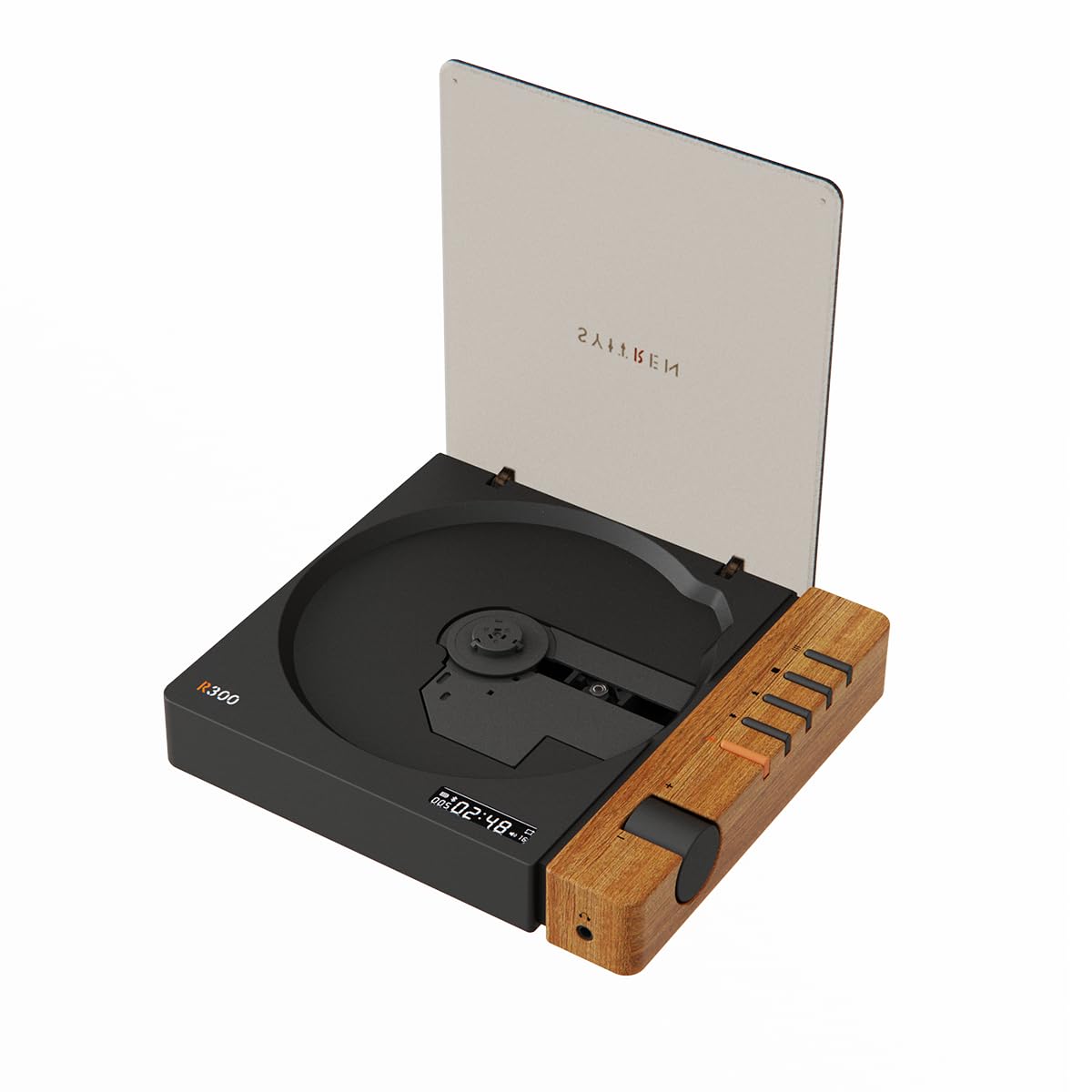
No speakers on purpose — this is a bare CD transport that feeds your own amp or wireless headphones.
The syitren R300 is for the buyer who already owns good audio gear. It has no built-in speaker at all, which is the whole point: with nothing vibrating inside the cabinet, the disc mechanism reads more cleanly, and you pick the speakers or amp that suit your ear. It transmits over Bluetooth 5.3 to speakers and headphones, outputs SPDIF optical for a clean digital handoff to a DAC, and has a 3.5mm jack. The 2000mAh battery is rated for 4 hours of playback, and the retro square cabinet in brown is a design-award piece that weighs just 14.08 ounces.
For buyers who feed a DAC or a vintage receiver, the result is excellent. It pairs easily with Sony amps, and through a good DAC the optical output gives clean, pure sound. Battery life runs long, though charging takes hours in some cases, and the manual is poor — the unit may need to stay powered on while it charges. The lid does not lock, the textured surface can obscure the display, and Bluetooth has to be re-enabled each time you power it on.
Do not buy this expecting it to drive bookshelf speakers on its own. Bluetooth here is a transmitter, not a receiver, so it cannot take audio from your phone — it sends audio out to compatible speakers and headphones, and some speakers and car systems will not pair because of protocol limits. A small number of units fail outright within days, so test yours carefully during the return window. For a careful buyer with an amp already on the shelf, the R300 gives you the cleanest signal path in this group.
Why a transport makes sense
- No internal speaker means less vibration on the disc
- SPDIF optical out plus 3.5mm and Bluetooth 5.3
- Light 14.08-ounce body and a design-award look
- 2000mAh battery rated at 4 hours
The fine print
- Zero built-in sound — you supply the speakers
- Bluetooth sends only; cannot receive from a phone
- Charging can take hours and the manual is weak
The right owner: someone with a receiver, DAC or good Bluetooth headphones who wants a clean, portable disc source.
The wrong owner: anyone who wants to press play and hear music without adding anything else.
6. Victrola Century – 6-in-1 Bluetooth Record Player – Walnut

Mid-century walnut, a 3-speed turntable, CD and cassette — plus a trick that streams your records to any Bluetooth speaker.
The Victrola Century is the more modern sibling of the Quincy, and the headline extra is VINYLSTREAM: it sends whatever is playing on the turntable out to Bluetooth speakers or headphones. That means you can drop a record on the platter and hear it through the wireless speaker across the room. Around that trick sit a 3-speed turntable (up to 78 rpm), a CD player, a cassette deck, a 3.5mm aux input, Bluetooth input from your phone, a headphone jack and an RCA output. Built-in custom-tuned stereo speakers mean you do not need a thing else to start.
Appearance and ease of use are where it shines brightest — sound quality and appearance dominate the praise, and setup is quick enough that buyers describe it as ready in about a minute. The mid-century walnut cabinet with clean lines earns its place in a living room, and built-in speakers are clear enough that many buyers never add external ones. Reviewers point out hearing records, CDs and cassette tapes they had not played in years.
The trade-off is the turntable side: some units skip on records and a few run at the wrong speed, so this is a system for casual vinyl rather than audiophile playback. On the CD side, one unit arrived with a non-working CD player, so check that tray in the first week. Overall the Century is the most feature-dense unit here — it beats the syitren R300 on built-in sound and matches the Quincy on formats while adding the record-streaming trick.
For the record collector: you want to stream vinyl to a wireless speaker and still play CDs and tapes from one walnut cabinet.
Caveat to note: casual vinyl only — a few units skip or run at the wrong speed, so test the platter early.
7. FiiO DM15 Portable Stereo CD Player with True 24Bit R2R DAC
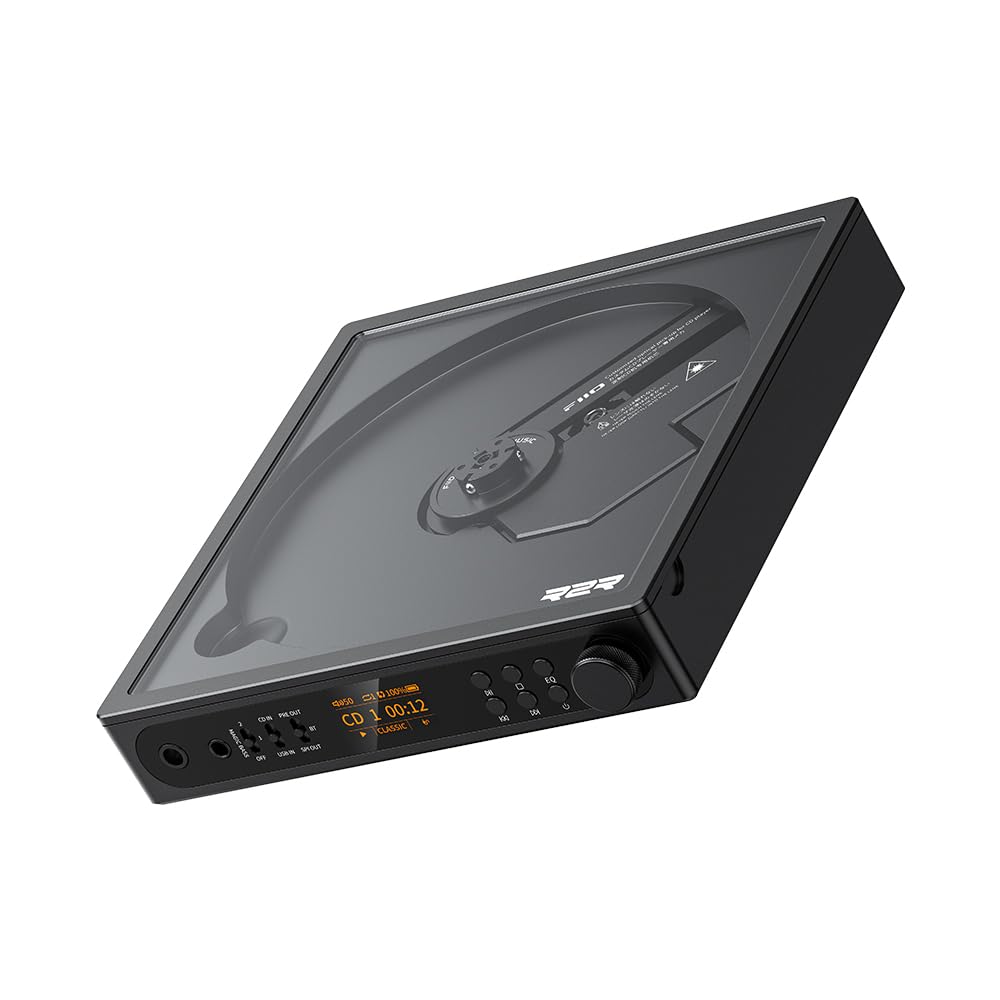
A portable with a full differential 24-bit R2R DAC inside — this is analog warmth from a modern disc transport.
The FiiO DM15 R2R is the most ambitious machine on this list. Its self-developed, fully differential complementary 24-bit R2R DAC — a resistor-array converter built from 192 pieces of 0.1% precision, low-temperature-drift resistors — restores the smooth, warm, natural analog character of classic portable CD players. It also drives demanding over-ear headphones with up to 1150mW per channel balanced output, and the Qualcomm QCC3095 Bluetooth chipset supports aptX, aptX HD, aptX Adaptive and SBC. There is a HiFi-grade USB DAC mode supporting up to 384kHz/32bit PCM and DSD256, plus 3-stage BASS boost, 8 EQ presets and a tuned RETRO mode.
Sound is the star here — the warmth is real, and buyers who feed it good headphones call it the best sound in this group, beating the syitren R300 on richness and detail. The 471.5-gram body is described as rugged and durable, and DC power means you can run it plugged in for long sessions. It is also a genuine USB sound card for a computer, which is a second life most CD players do not have.
The gotchas are real, though. Bluetooth pairing is the big one — connecting to a Bluetooth speaker can take about 20 minutes and turn erratic with multiple speakers, so wired or optical is the reliable path. Some units arrive skipping or buzzing on burned CD-Rs, and a firmware update through USB fixes that in many cases. The transport buttons are tiny and the display is cramped, so the remote (battery not included) is worth buying. Reliability and Bluetooth connectivity draw mixed reviews overall, which is why it lands below the simpler units for a first-time buyer.
For the headphone listener: 1150mW per channel is serious drive for high-impedance cans, and the 24-bit R2R DAC gives a warm, analog signature. The optical output and USB DAC mode make it a flexible desktop source too.
The pairing problem: treat Bluetooth as a bonus, not a main path. If you plan to stream to a wireless speaker, expect to fight the pairing process.
Top of the list for: headphone-first listeners and tinkerers who want vintage warmth with modern high-res features and a USB DAC mode.
Not the first pick for: anyone who wants a plug-and-play speaker system or a fuss-free Bluetooth link.
8. aiwa Retro Boombox CD Player with Cassette Recording

A yellow 19.6-pound boombox that plays CDs, records to cassette and SD, and pushes 40W through dual 5.25-inch woofers.
The aiwa AI7012 is for the buyer who wants the full 1980s experience, handle and all. It has dual 5.25-inch woofers and 1.2-inch tweeters delivering 40W, a CD player, an AM/FM radio, a cassette deck with recording capability, Bluetooth 5.0, USB and SD slots, aux inputs, dual microphone ports for karaoke, VU meters and an LCD display. The yellow cabinet has a carrying handle, and the power source is battery, so you can take it to a picnic or a patio without a cord. It plays MP3 data CDs, so burned playlists work.
Sound quality and build quality are the things buyers praise most, with appearance close behind. Shoppers say strong bass, clear stereo FM, and solid CD and Bluetooth playback, and the retro styling is nailed well enough to draw comparisons to the classic Sharp GF-575Z. The bass boost and the mic/echo controls work, and recording radio to SD is a favorite. It is loud indoors — 40W through those drivers has real presence — and the volume holds together well.
Two things temper the fun. Cassette recording is the weak spot: a few buyers call it useless, and the tape transport has minor wow and flutter that shows up on playback. The size is also a real commitment — around 20 pounds with 8 D-cell batteries installed, and the hollow plastic handle is the one part to treat gently. CD performance gets mixed reports: some units play old and burned discs cleanly, others knock or fail on certain discs. If cassette recording is your reason for buying, look elsewhere; if you want to play CDs loudly and record radio to SD, this is the party box.
The retro joy: 40W across dual woofers, VU meters, karaoke mic ports and SD recording give you the full boombox toolkit. The battery power makes it genuinely portable.
Set expectations: cassette recording and tape playback are the weak links, and the plastic handle is the one part to baby.
Best for: backyards, garages and anyone who wants a loud, portable CD boombox with real retro character.
Skip if: you need cassette recording or a desk-sized unit — this one is bulky and the tape deck is the compromise.
9. Yamaha CD-S303 Single CD Player, Black

No speakers, no Bluetooth, no fuss — a single-disc rack player built to feed a serious hi-fi system.
The Yamaha CD-S303 is a different animal from the all-in-ones above: a single-disc player with a high-performance DAC for high conversion precision and low noise, a laser pickup on a floating mechanism, and CD-R/RW compatibility. It plays MP3, WMA, LPCM, AAC and FLAC files from a USB stick through an easily accessible front-panel port, and it comes with a remote. It has optical and coaxial digital outputs, an output level of 2 plus/minus 0.3V, and a 17.12 x 10.25 x 3.38 inch footprint that fits a standard rack shelf. It weighs 7.7 pounds, and there is no headphone jack.
What makes this the pick for a rack system is the Pure Direct mode, which bypasses the display and internal conversion for a cleaner signal path. It loads discs quickly and solidly, it does not auto-play track one, and it does not mark your resume point, so you control the sequence. The build is rock-solid, the sound is warm, and buyers replacing a 40-year-old Sony deck call it an incredible improvement. Fed through an external DAC via optical or coaxial, the sound is described as clearer than some streaming setups, and a firmware update to version 1.53 fixed disc-reading problems for one buyer who had previously unplayable discs.
The limitation is that the internal DAC is only adequate — a bit muddy and unclear — so the front USB and digital outputs are there for a reason. Plan to pair it with a good outboard DAC if sound quality is your priority, and skip it entirely if you want a headphone jack, Bluetooth, or built-in speakers. It is a pure disc transport for a system that already has the rest of the chain, and that focus is exactly what its buyers want.
The case for a dedicated deck: quick, solid disc loading, a rock-solid build and Pure Direct mode make this a clean source for a rack system. The front USB port handles FLAC and WMA files from a stick.
What it will not do: no Bluetooth, no speakers, no headphone jack. The internal DAC is a weak point that an external one fixes.
Choose this: if you already own a receiver and speakers and want a dependable single-disc source that handles burned and unusual discs.
Pass on it: if you want an all-in-one with speakers or wireless streaming — this one needs the rest of a hi-fi system.
Know the Specs
Rated vs. peak wattage
A watt measures electrical power, and these systems quote two versions: rated (continuous, what the amp can hold) and peak (a short burst). The LONPOO lists 40W rated and 60W peak, while the WISCENT lists 15W RMS per speaker. Higher rated watts generally mean more clean volume before distortion, but a thicker wood cabinet matters just as much for how full the bass feels in a small room.
Built-in vs. bare transport
A built-in speaker system has the amp and drivers inside the cabinet, so you press play and hear music. A bare transport like the syitren R300 or the Yamaha CD-S303 has no speaker and sends the audio to gear you already own, which usually sounds cleaner because there is less internal vibration on the disc mechanism — but it needs an amplifier and speakers to work at all.
DAC and digital outputs
A DAC is the chip that turns the digital disc data into an analog signal your speakers can use. The FiiO’s 24-bit R2R DAC and the Yamaha’s high-performance DAC are the parts that shape the tone. If you want to upgrade later, look for optical or coaxial digital outputs — the Yamaha and the syitren both have them, which lets you bypass the internal DAC and use a better external one.
CD-R, MP3 and USB formats
Not every disc type plays on every player. CD-R and CD-RW are recordable and rewritable discs, and burned MP3 discs hold far more tracks than a standard audio CD. Check that the model reads CD-R/RW and MP3 before you load a homemade disc — the Wiithink and WISCENT list both, the Yamaha reads CD-R/RW plus MP3, WMA, LPCM, AAC and FLAC from USB, and the aiwa plays MP3 data CDs.
Common Questions
Will a vintage-style CD player play burned CD-R and MP3 discs?
Can I connect one of these to external speakers?
What does a 40W rating actually mean on a shelf system?
Do these retro CD players have Bluetooth, and does it work both ways?
Why does a wooden cabinet matter for sound quality?
How loud is the aiwa boombox, and how heavy is it to carry?
Is a bare transport like the Yamaha CD-S303 better than an all-in-one?
What is the difference between a CD player and a CD transport?
Do any of these units have a headphone jack?
What should I look for if I mostly play old CDs that skip?
The Bottom Line
For most people, the vintage cd players winner is the Victrola Quincy because it puts CD, cassette, vinyl, AM/FM and Bluetooth in one warm mahogany cabinet with sound that fills a room. If a wooden box and a proper stereo pair on a bedroom shelf is what you want, grab the Wiithink 30W system or the louder LONPOO LP-816. And if you already own an amp and good speakers, the Yamaha CD-S303 is the dependable disc source to reach for.
The one honest nudge: the Quincy and the Century stay near the top of this category because they cover the formats nobody else does, so look closely before you commit to a single-format deck.
How we choose
We do not accept paid placement. Every pick is matched to a real buyer and a real use-case; we do not hands-on test units.
Sources
Specifications: manufacturer listings and product documentation. Review insights: verified customer reviews, as of October 2026. Pricing: not shown on this page (it changes often); check the current price via the retailer link.
As an Amazon Associate, Aappliancez earns from qualifying purchases. This does not affect which products we feature.