Disclosure: Some links in this post are affiliate links. As an Amazon Associate I earn from qualifying purchases, at no extra cost to you. Learn more
Specs are compiled from manufacturer listings and verified buyer reviews and can change over time — please confirm the key details on the product page before buying.
You want a skillet that sears like a vintage Griswold but still releases eggs without a fight. The two specs that decide this are surface finish and pan weight. A smooth cooking surface (machined flat rather than left rough from the mold) releases food better and seasons faster. Weight decides whether you can actually lift a loaded pan with one hand. Below you’ll find seven real cast iron skillets, sorted by what each one is genuinely good at.
This guide is built by comparing the manufacturers’ published specifications and the patterns across verified customer reviews, so you get each pick’s real strengths and trade-offs instead of marketing spin.
Cast iron rewards patience and punishes shortcuts, so every pick below is judged on measurable specs: surface finish, weight, handle length, and seasoning. This breakdown covers seven cast iron skillets, from sand-cast workhorses to machined-smooth vintage reproductions, for cooks who want one pan that lasts decades.
Top Picks


How To Choose The Best Vintage Cast Iron Skillet
The vintage cast iron that collectors chase — Griswold and Wagner pieces from the early 1900s — earned their reputation on two things: a machined-smooth cooking surface and a lighter casting. Modern makers now reproduce both. You are choosing how smooth the metal is, how much it weighs, and whether the seasoning arrives ready or needs work.
Surface finish: smooth versus sand-cast
A polished or machined surface feels like glass and releases food with less oil. A rough sand-cast surface still cooks well, but it grips eggs until you build up layers of seasoning. If your goal is a skillet that behaves like a vintage pan on day one, look for the words “polished,” “machined,” or “smooth cooking surface” in the listing.
Weight and handle length together
Weight in pounds tells you how the pan feels loaded, but the handle decides whether that weight is manageable. A heavy skillet with a short handle puts all the leverage against your wrist. A longer handle gives you control and stays cooler over a burner. Check both numbers, not just the pan diameter.
Seasoning and what “pre-seasoned” means
Pre-seasoning is oil baked onto the iron at the factory so the pan arrives usable. It is a starting point, not a permanent coating. Every pan here improves with cooking, and a smooth surface builds its non-stick layer faster than a rough one. Expect the first few meals to stick more than any meal after them.
Side-by-Side Comparison
| Model | Best For | Diameter | Weight | Surface | Amazon |
|---|---|---|---|---|---|
| Lodge Yellowstone 10.25″★ Best Overall | Everyday searing and gifting | 10.25 inches | 5.3 pounds | Sand-cast, pre-seasoned | Amazon |
| Overmont 3.8 QT BraiserOne-Pot Champion | One-pot braises and serving at the table | 30 centimeters | — | Triple-layer enamel | Amazon |
| Tecor Polished 12″ | Eggs and delicate food on a budget | 12 inches | 7.2 pounds | Polished, pre-seasoned | Amazon |
| Lodge 12″ with Handle Holder | Big-batch family cooking | 12 inches | — | Sand-cast, pre-seasoned | Amazon |
| Backcountry Iron Wasatch 12″ | Vintage look with a glass-smooth base | 12 inches | 5 pounds | Machined smooth, quadruple seasoned | Amazon |
| Stargazer 12″ | Smooth surface plus a stay-cool handle | 12 inches | 6.5 pounds | Machined smooth, pre-seasoned | Amazon |
| Field Company No.10 | One-handed control for larger meals | 11⅝ inches | 6 pounds | Machined smooth, triple-seasoned | Amazon |
Detailed Reviews
1. Lodge Yellowstone Cast Iron Skillet 10.25 Inches
Our pick — 4.5+★ from 850+ verified ratings; the strongest balance of quality and price.
The 10.25-inch pan that arrives seasoned, heavy enough to sear, and ready to gift.
Start with the weight, because it’s the number that decides your relationship with this pan. At 5.3 pounds and 10.25 inches across, the Yellowstone edition sits in the range where you can still flip a steak one-handed but feel real mass under the food. That mass is why Lodge talks about edge-to-edge even cooking — the iron holds heat so the surface doesn’t drop when cold meat lands on it.
The seasoning is baked on with 100% natural vegetable oil, no synthetic coatings, and the listing is explicit that it contains no PFOA or PTFE. In practice that means you can cook on it the day it arrives. The brand also tells you upfront that a rust-looking spot from the start is just oil that hasn’t fully carbonized yet — scour it, wash it warm, dry it, oil it, and it disappears.
What wins people over is the build quality, and it’s also the thing that makes this the safest pick here. Owners use it daily, report it cleans well, and cook everything from searing to roasting on it. One buyer gifted it at Christmas and said the durability and weight were “the best thing about it because I was scared it was going to be just a decorative skillet” — that’s the Yellowstone logo doing its job without turning the pan into a wall ornament. The honest catch: cast iron is slow to heat and demands dry storage, so it’s not the pan for someone who wants to soak dishes in the sink.
What holds up over years of use
- 5.3 pounds of iron that sears without hot spots
- Pre-seasoned with natural vegetable oil — cook on day one
- Works on induction, oven, grill, and open flame
- Made in the USA and free of PFOA and PTFE
Where it asks something of you
- 10.25 inches is tight for a four-person batch of chicken
- Must be dried and oiled after every wash to keep rust away
- The Yellowstone branding is permanent, not a sticker you can peel
Go with this if: you want one dependable skillet for daily searing, roasting, and campfire cooking with no learning curve on delivery day.
Think twice if: you regularly cook for a crowd and need more surface than 10.25 inches provides.
2. Overmont Enameled Cast Iron Dutch Oven 3.8 QT
An enameled braiser that skips the seasoning ritual and carries dinner from burner to table.
Here’s the number that separates this pan from every bare-iron skillet on the list: a 3.8-quart capacity in a shallow, wide body. A wide base means more food touching hot metal, which is exactly what you want for browning short ribs before they braise. The triple-layer enamel coating means no seasoning, no rust, and no reaction to acidic tomatoes or wine — the three things that send most people back to non-stick.
The tight-fitting lid traps steam and returns moisture to the food, so chicken thighs and pot roast come out tender without you standing over the stove. It’s oven safe up to 500°F and works on gas, electric, ceramic, and induction. The set ships with a recipe book and heat-resistant handle caps, and the shallow shape doubles as a serving dish at the table.
The catch that comes up repeatedly is the extras, not the pan. The included recipe book is written for bare cast iron pans rather than this braiser, and the triangular handle pads run small — silicone mitts grip better. It’s also genuinely heavy, so anyone with lifting concerns should plan to use both hands. Hand washing is recommended to protect the enamel. What holds up is the cooking itself: as buyers put it, “Looks great and has performed very well the 3 times I have used it.”
Why the enamel matters: no seasoning maintenance, no rust, and acidic sauces won’t damage the surface — a real time-saver if you cook tomato-based braises often.
The size trade-off: the shallow design limits how much liquid it holds, so it’s better for braises and sautés than for deep-frying or a big batch of soup.
Worth it for: couples and small families who want one pot that sears, braises, and goes straight to the table without a seasoning routine.
Pass on it if: you want deep liquid capacity or you plan to cook with one hand — this vessel wants both arms.
3. Polished Cast Iron Skillet 12 Inch
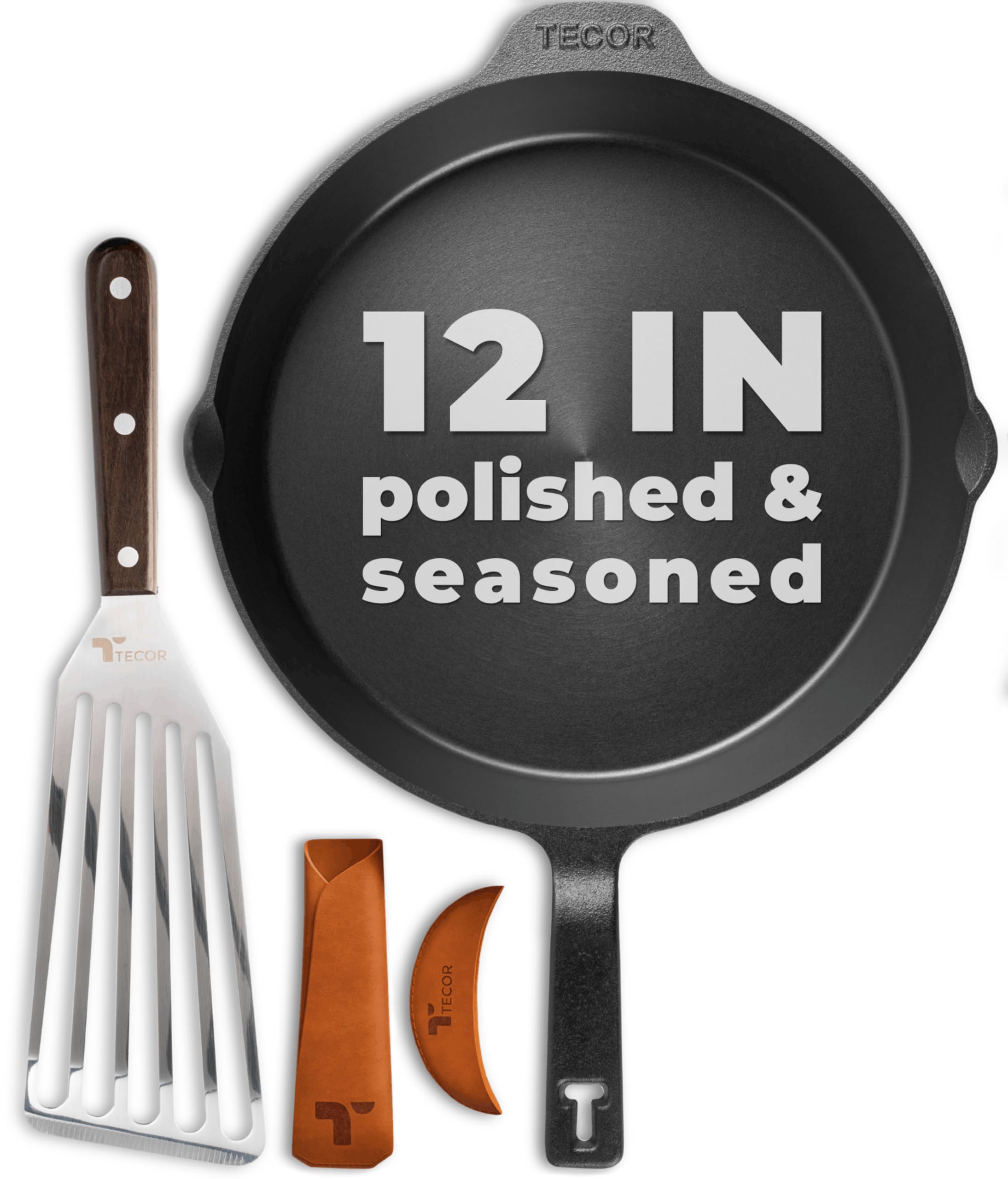
A polished 12-inch surface with real leather handle covers, built for eggs and fish.
Most cheap cast iron arrives rough, and you spend months fighting it before eggs slide. This Tecor pan is precision-polished at the factory, which gives you a smoother surface than standard cast iron sets and a faster path to a non-stick patina. That’s the whole point of the upgrade — delicate dishes like eggs, fish, and pancakes behave better on smooth metal than on a sand-cast finish.
At 12 inches and 7.2 pounds it’s the heaviest pan on this list, so plan on two hands when it’s loaded. What you get for that weight is 3.2 quarts of cooking volume, a pre-seasoned surface ready from the start, and a set that includes two genuine leather handle covers plus a stainless steel spatula. The seasoning is natural vegetable oil, with no PFAS, PTFE, or PFOA, and the listing states it was independently tested by Intertek.
Sizing is the honest friction point. A 12-inch pan takes longer to heat and can run uneven at the edges compared with a 10-inch, and the break-in period is real — expect to season it a couple of times before eggs stop clinging. Once it’s broken in, the smooth surface earns its keep. The leather covers are the sleeper feature: snug, better than silicone, and they make a hot handle genuinely safe to grab.
Reasons cooks keep reaching for it
- Polished surface develops non-stick faster than rough cast iron
- Two leather handle covers and a stainless spatula included
- No PFAS, PTFE, or PFOA — natural vegetable oil seasoning
- Dual pour spouts for draining fat cleanly
What to plan around
- 7.2 pounds is heavy — two hands when full
- Needs a couple of seasoning rounds before it’s truly non-stick
- Rim edges can feel slightly rough from the start
Best match for: cooks who want vintage-pan smoothness on a 12-inch surface without paying premium-tier money for it.
Look elsewhere if: wrist strength is a concern or you only ever cook for one — a 10-inch pan is easier to manage.
4. Lodge Cast Iron Skillet 12 inch

Twelve inches of American iron with a silicone sleeve that keeps your palm off the heat.
Compare this to the Yellowstone pan above and the difference is simple: same Lodge seasoning and American foundry heritage, but a full 12 inches of cooking surface instead of 10.25. That extra width is why size is the thing buyers praise here — it fits a whole chicken, several servings of steak, or a full pan of cornbread without crowding. If your current skillet makes you cook in batches, this is the fix.
The included silicone hot handle holder protects your hand up to 450°F and is dishwasher safe, which solves the one genuine hazard of cast iron — a handle that heats up with the pan. The skillet itself is seasoned with 100% vegetable oil, no synthetic coatings, and works on gas, in the oven, on the grill, and over a fire. Lodge has been casting in South Pittsburg, Tennessee since 1896.
Weight is the recurring trade-off, and it’s a fair one: a 12-inch iron pan is heavy by design, and you’ll want the silicone grip every time you move it. A few buyers also mention wanting the small assist handle — the pan does have one, and it helps when you’re carrying a full skillet to the table. The cast iron slow-heat rule applies too, so give it time to come up to temperature before the food goes in. What you’re buying is a 12-inch Lodge that will outlast most kitchens.
The real win: 12 inches of cooking surface means whole-chicken capacity and no more cooking in two batches — the size that keeps this pan on the stove nightly.
Honest weight note: this is a heavy pan and it knows it. The silicone holder isn’t a bonus accessory, it’s a necessity for safe handling.
Reach for this when: you cook for a family and want one pan large enough to sear a whole chicken or feed four without crowding.
skip it if: a heavy pan is a dealbreaker for your wrist — a 10-inch skillet will be easier to lift.
5. 12 Inch Smooth Wasatch Pre-Seasoned Round Cast Iron Skillet

Backcountry Iron’s take on the Griswold legend — machined smooth, quadruple seasoned, bronze-toned.
The Wasatch is the most explicit vintage tribute on this list. Backcountry Iron names Griswold and Wagner as its inspiration and machines both the cooking surface and the sides to match. That machined finish is what gives you a more uniform surface, better seasoning retention, and a sear that browns like enameled cast iron. At 5 pounds and 12 inches across, it’s remarkably light for its size — lighter than the Tecor 12-inch above by more than two pounds.
The pan ships quadruple seasoned with vegetable and grapeseed oil, which is what produces that signature bronze look. It’s rated for electric coil, gas, induction, BBQ, and open fire, and the listing notes it retains heat longer and more evenly than other cast iron skillets. A care card and a knit handle cover come in the box.
What’s worth knowing before you buy is the handle. A 12-inch pan with only 5 pounds of iron sounds easy to lift, but the handle is short, and that’s the one complaint that keeps coming up. The weight is fine; the leverage isn’t. Seasoning also divides people — some find it takes beautifully, others report the seasoning coming off again if they’re not diligent. Treat it like bare iron: no dishwasher, no overnight soaking, no air drying, and it will behave.
Where the Wasatch shines
- Machined cooking surface and sides for a glass-smooth sear
- Quadruple seasoned with vegetable and grapeseed oil
- 5 pounds — noticeably lighter than most 12-inch iron
- Bronze finish that looks like a hand-me-down heirloom
What you should expect
- Short handle makes a heavy loaded pan harder to control
- Seasoning needs consistent upkeep to stay non-stick
- Must be dried immediately and oiled after every wash
The right call for: anyone who wants the look and feel of antique American cast iron without hunting estate sales for a warped original.
Second-guess it if: you have large hands or wrist issues — the short handle is the one thing that consistently disappoints.
6. Stargazer 12-Inch Cast Iron Skillet, Made in USA

The machined pan with a stay-cool handle and a drip-free rim that pours from any angle.
The handle is the reason to pay attention here. Stargazer’s stay-cool design extends further from the cooking surface than a standard cast iron handle, so it doesn’t demand a mitt every time you flip a steak. Compare that to the Wasatch above, where a short handle is the main gripe — this solves the opposite problem. The flared rim also eliminates pour spouts entirely. You can pour grease or pan sauce from any point on the circumference without it flooding down the side.
Under the food is a flawlessly machined smooth surface at 3.4 quarts of volume and 6.5 pounds of iron. The pan arrives pre-seasoned and polished, made in the USA, with no toxic chemicals or space-age materials — just pure iron. There’s a lifetime warranty covering manufacturer defects, and it’s oven safe and compatible with induction, gas, and electric.
Two honest notes. First, this is very heavy compared with other cast iron brands, so it’s a two-hand pan when loaded. Second, the factory seasoning can come off slightly after the first use and the surface goes patchy for the first five to ten uses before it darkens into a real patina. That’s normal break-in for smooth cast iron — it just means the pan isn’t fully itself for the first week. Once it settles, eggs slide and cleanup is a wipe.
Standout feature: the extended stay-cool handle gives you leverage on 6.5 pounds of iron without a mitt — the single biggest quality-of-life upgrade over a sand-cast handle.
Break-in reality: the smooth surface takes five to ten cooks to darken fully. It’s smoother than the Lodge pans above but not instantly non-stick.
It suits: cooks who use one skillet for nearly every meal and want a smooth surface, a lid-free pour, and a handle that doesn’t fight back.
Not for: someone who wants a pan that’s fully non-stick on day one — this one asks for a week of use first.
7. Field Company No.10 Large Cast Iron Skillet – 11.6-Inch
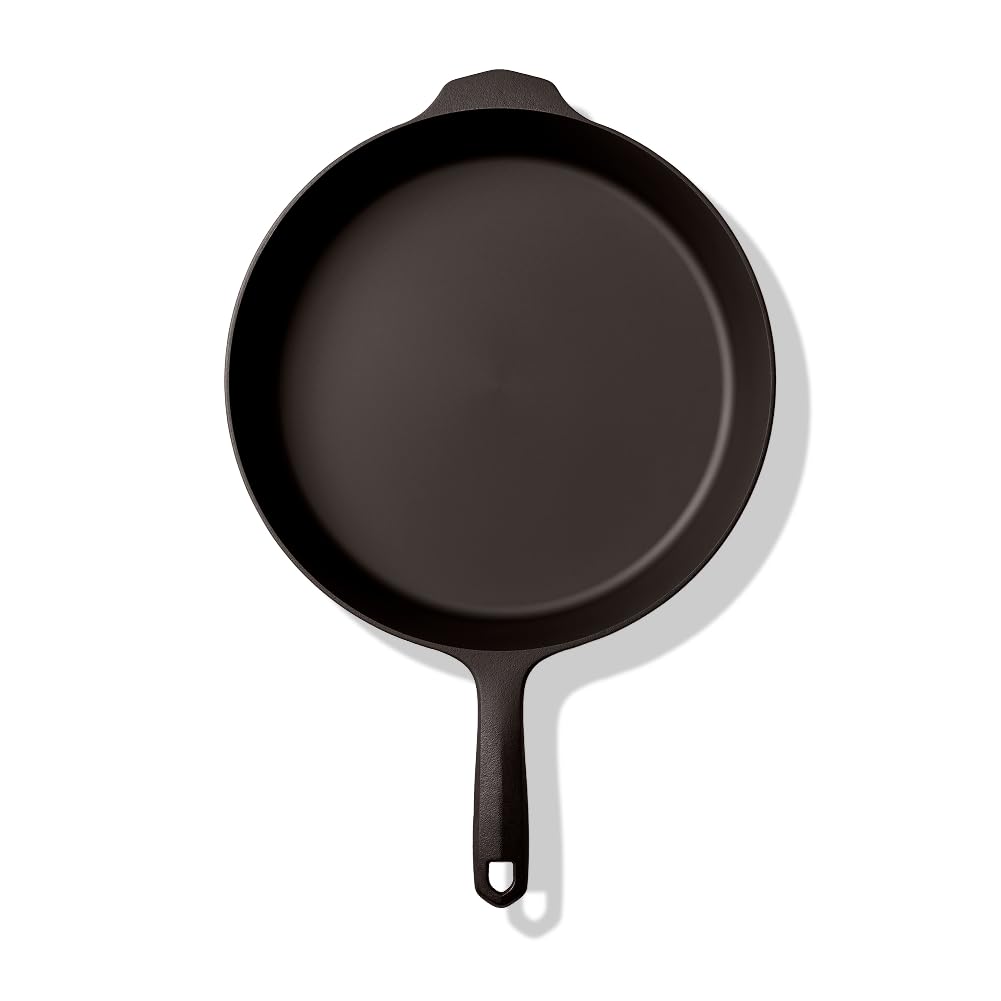
Vintage-weight iron with the longest handle here, built to move on and off the burner.
Field’s pitch is simple: replicate the lighter, smoother cast iron of the American golden age. At 6 pounds with an 11⅝-inch rim-to-rim diameter, this pan holds a 9¾-inch flat cooking surface — the actual space for food. That’s enough for 4-6 servings, whether that’s a whole roast chicken, 6-8 eggs, or a large pan of vegetables. It’s heavier than the Wasatch above and noticeably lighter than the Stargazer, which puts it in the range where the pan moves without feeling flimsy.
It arrives pre-seasoned with three coats of organic grapeseed oil, so it’s ready to cook from day one. There are no synthetic coatings, no PFOA, no PTFE. It’s made in the USA with green sand castings, the same method Griswold and Wagner used, and the iron and sand are cycled back into production. It’s compatible with all stovetop burner types, including glass and ceramic induction ranges.
Two things worth knowing that don’t show up in the marketing. The first is the factory finish — some pans arrive with an odd brownish-green coloring and a slightly matte texture that makes a spatula sound like a chalkboard until it smooths out with use. The second is warping: at least one buyer reports the pan wobbling during preheating on medium-low heat, which is a real concern on a lighter casting. Neither is universal, but both are worth watching for in the first week. Beyond that, this is the pan owners keep reaching for after they’ve given up on heavier iron.
The weight-to-size ratio: 6 pounds with 4-6 servings of capacity is the balance point where a large skillet stops being a chore to move — this is the lightest large pan here.
Watch for: a slightly rough factory texture and an occasional warp under preheating. Both settle or show up early, so you’ll know within a week.
Made for: cooks who downgraded from heavy modern iron and want a large pan they can actually manipulate around the stove, oven, and grill.
Think again if: you need instant non-stick performance — the grapeseed seasoning improves with every meal but won’t behave like a coated pan.
Know the Specs
Cooking surface diameter vs. overall diameter
The diameter printed on the pan is often the rim-to-rim measurement, not the space for food. Field is the clearest example on this list: 11⅝ inches rim to rim, but a 9¾-inch flat cooking surface. Always look for the flat-surface number if you’re judging how much food fits — that’s the dimension that decides whether a whole chicken lies flat or spills over the edge.
Weight and handle length as a pair
Weight in pounds is only half the story. A 5-pound pan with a short handle is harder to control than a 6.5-pound pan with an extended stay-cool grip, because leverage matters more than raw mass. Weigh the two numbers together: lighter is easier to move, but longer handle gives you the control to move it safely when it’s full and hot.
Seasoning: factory versus what you build
Pre-seasoning is baked-on oil that makes the pan usable on arrival — it is not a permanent coating. Smooth, machined surfaces build a non-stick patina faster than rough sand-cast ones because there’s less texture for oil to pool in. Expect the first few meals to be the least non-stick you’ll ever have, and treat each layer you add as an investment in the pan’s future.
Enamel versus bare iron
Enamel is a glass-like coating fused to the iron. It needs no seasoning, won’t rust, and shrugs off acidic foods like tomatoes and wine. Bare iron rewards you with a better sear but needs drying and oiling after every wash. If you cook braises and sauces often, enamel wins on convenience. If you want maximum browning and a surface that improves for decades, bare iron is the better tool.
Common Questions
Is a smooth cast iron skillet really better than a rough one?
Does a vintage-style skillet need to be seasoned before first use?
How heavy is too heavy for a cast iron skillet?
Can I use an enameled cast iron braiser the same way as a bare skillet?
Will these skillets work on an induction cooktop?
How do I stop my cast iron from rusting?
What does “green sand casting” mean on a Field skillet?
Is a 10-inch or 12-inch skillet the better first buy?
Do the silicone and leather handle covers make a difference?
What happens if my new pan arrives looking rusty?
The Bottom Line
For most cooks, the winner is the Lodge Yellowstone 10.25-inch — it’s pre-seasoned, 5.3 pounds, handles induction and open flame, and it’s the safest first cast iron pan you can buy. If one-pot braises are your weeknight default, the Overmont 3.8-quart braiser skips the seasoning routine entirely. For a smooth vintage-style surface with a stay-cool handle, the Stargazer 12-inch is the strongest pick. Just remember the trade-off every pan here shares: the smoother the surface, the more consistently you need to oil and dry it.
How we choose
We do not accept paid placement. Every pick is matched to a real buyer and a real use-case; we do not hands-on test units.
Sources
Specifications: manufacturer listings and product documentation. Review insights: verified customer reviews, as of October 2026. Pricing: not shown on this page (it changes often); check the current price via the retailer link.
As an Amazon Associate, Aappliancez earns from qualifying purchases. This does not affect which products we feature.