Disclosure: Some links in this post are affiliate links. As an Amazon Associate I earn from qualifying purchases, at no extra cost to you. Learn more
Specs are compiled from manufacturer listings and verified buyer reviews and can change over time — please confirm the key details on the product page before buying.
If you have low bone density, the machine you stand on needs to be steady, adjustable, and gentle enough to start — and the picks below are built around exactly that. The short answer: a low-amplitude platform with adjustable frequency and a grab handle you can lean on is the safer starting point than a high-powered shaker that rattles your whole body. This guide walks through eleven real machines and tells you plainly which one fits which body and which habits.
This guide is built by comparing the manufacturers’ published specifications and the patterns across verified customer reviews, so you get each pick’s real strengths and trade-offs instead of marketing spin.
You will see frequency numbers in hertz (how many shakes per second), amplitude (how far the plate travels), and weight limits — each explained in plain words where it first shows up. The right machine is the one you will actually stand on for ten minutes a day, so the picks below rank stability and control first, power second.
Top Picks

How To Choose The Best Vibration Plates for Osteoporosis
You are not shopping for the biggest motor. You are shopping for a platform you can step onto without wobbling, set to a gentle shake, and stand on for ten minutes while holding something steady. Four things decide that.
Frequency range and amplitude
Frequency is measured in hertz — how many times the plate pushes up and down each second. A range that starts low (the VT007 runs 10 to 40 Hz) lets you begin gently and work upward as your confidence grows. Amplitude is how far the plate travels; a low-amplitude machine gives a fine, quick buzz rather than a big rocking surge, which is easier to tolerate when your balance is not what it used to be.
Stability under your hands and feet
Grab handles, a wide non-slip plate, and a heavy base are not decoration — they are what stops a stumble. The Axis-Plate carries fixed handles and a strap, while most compact plates give you only a remote and expect you to hold a wall or chair. If you know your balance is shaky, that single difference matters more than any speed count.
Weight capacity and how you will move it
Every plate lists a maximum weight recommendation, and you want headroom above your own body weight. Heavier machines stay planted but are a chore to shift; the Axis-Plate weighs 65 pounds, while the Merach V33 Pro is 15.9 pounds. Decide whether the plate lives in one room or needs to slide under a bed before you pick.
Controls you can read while standing
A remote you can operate with your toe or a large touchscreen beats a row of tiny buttons you have to bend down to see. Several plates here let you set a manual speed and a timer, which is what a daily ten-minute routine actually needs.
Side-by-Side Comparison
| Model | Best For | Frequency / Speeds | Weight Capacity | Machine Weight | Amazon |
|---|---|---|---|---|---|
| VT007 Vibration Plate★ Best Overall | Adjustable low-amplitude training | 10–40 Hz, two amplitudes | 250 lbs | 30.5 lbs | Amazon |
| Axis-Plate Whole Body MachineBest for Balance Support | Handles for balance support | 99 speed settings | 265 lbs | 65 lbs | Amazon |
| Merach V33 ProBest Value | Touchscreen control at a low weight | 99 speeds | 350 lbs | 15.9 lbs | Amazon |
| Renoj 3D Whole Body Plate | Three-axis motion and music | 1–120 speeds | 455 lbs | 18 lbs | Amazon |
| Powerfit Vibration Plate | Simple senior-friendly remote use | 5 resistance levels | — | 6.5 kg | Amazon |
| Lifepro Waver Mini | Small spaces and travel | 99 speeds, 10 presets | — | 10 kg | Amazon |
| AXV Vibration Plate | Compression and swelling routines | 1–120 speeds | — | — | Amazon |
| Merach CV40 Curved Plate | Large amplitude, high capacity | 10 speeds, 1 preset | 440 lbs | 23.15 lbs | Amazon |
| EILISON FitMaxx 3D XL | Acupressure surface, many speeds | 120 speeds | 350 lbs | 8.3 kg | Amazon |
| Lifepro Waver | Widest user base, big platform | 99 speeds, 10 presets | 330 lbs | 27 lbs | Amazon |
| Lifepro Rumblex 4D | Multi-motor, wide heavy-duty platform | 60 speeds, 4–40 Hz | 500 lbs | 18.28 kg | Amazon |
Detailed Reviews
1. VT007 Vibration Plate
Our pick — 4.5+★ from 400+ verified ratings; the strongest balance of quality and price.
The plate that lets you dial the shake down to a whisper and up to a full buzz.
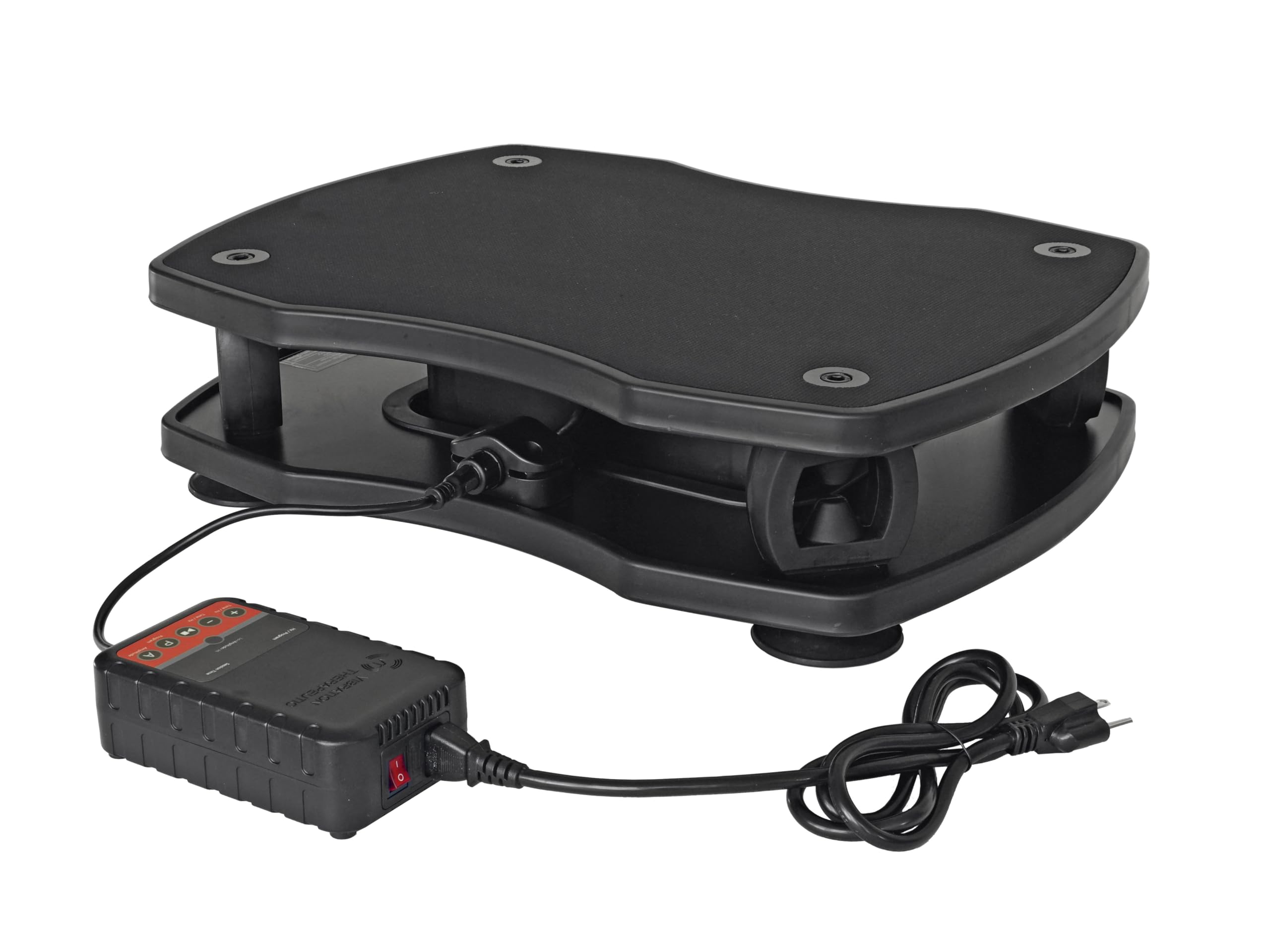
This is the pick that matches the osteoporosis shopping list most closely. You set the frequency yourself, anywhere from 10 to 40 Hz (Hz means shakes per second, so ten to forty shakes a second), plus two amplitude settings (how far the plate travels each shake), so it can move a little or a lot depending on how you feel that morning. It runs three programs, and the LED display shows what you have selected. Underneath is a linear vibration pattern, meaning the plate moves straight up and down rather than rocking — the easier motion to stand on when your balance is uncertain.
The build is where it earns its place. It weighs 30.5 pounds and handles up to 250 pounds, and it is made from metal, plastic, rubber, and high-density fiber board. Buyers report it is quiet enough that vibrations do not travel into walls or floors — a real consideration in an apartment or upstairs bedroom. A three-month owner finishing a ten-minute session twice a day at 35 Hz called it the balance, with the high amplitude feeling too strong at first and then settling into a high-amplitude morning, low-amplitude evening pattern. The frequency is adjustable from 15 Hz up to 40 Hz and beyond, and you set your own workout time rather than being locked to fixed intervals.
The comparison worth knowing: against the Axis-Plate, the VT007 is 30.5 pounds versus 65 pounds, so it moves room to room without a wrestle, and its footprint is 16.5″D x 22″W x 5.7″H versus the Axis-Plate’s 29″D x 27.5″W x 47.6″H. What you trade for that is a lower weight ceiling — 250 pounds here against the Axis-Plate’s 265 pounds — and a smaller plate. Support is the quiet standout: a 90-day free return and a straightforward 10-year warranty, and control-box replacements have been sent out free within days.
What holds up well
- Adjustable 10–40 Hz frequency with two amplitude settings — real control over intensity
- Low mechanical noise and no vibration bleeding into walls or floors
- 90-day free return and a 10-year warranty
- 30.5 pounds, so it is genuinely movable for home use
Where it asks something of you
- No handle — you will need a wall, chair, or counter to steady yourself
- 250-pound weight limit is the lowest ceiling of the premium picks
- High amplitude can feel strong on a first session
Settle on this: you want fine control over frequency and amplitude, a quiet machine, and a long warranty in a package you can carry.
Look elsewhere: you need built-in handles for balance, or you weigh above 250 pounds.
2. Axis-Plate Vibration Plate
Handles at hip height turn a wobble risk into a lean-on-and-go routine.
If you know your balance is the weak link, start here. This machine has fixed handles and a strap, an oversized non-slip base plate, and non-skid rubber feet — the physical supports that let you stand on a moving surface without gripping a kitchen counter. The framework is alloy steel, and it holds up to 265 pounds. A 500-watt motor drives 99 speed settings with three pre-programmed workouts and a manual mode, all through a touch-button LED panel, and built-in BMI sensors in the handles let you track progress.
Stability is the story owners tell. One long-term user started at speed 60 and now runs up to 87, doing ten minutes two to three times a day while holding the straps, and describes the machine as quiet and sturdy at those speeds. Assembly takes about 45 minutes solo — the hardware arrives pre-installed and the tools come in the box — though the carton is large and heavy enough that you want a second pair of hands to get it inside. Front-mounted wheels make it easier to shift once it is built.
Here is the honest arithmetic against the VT007. The Axis-Plate weighs 65 pounds versus the VT007’s 30.5 pounds, and its footprint is 29″D x 27.5″W x 47.6″H versus 16.5″D x 22″W x 5.7″H — it is a piece of furniture, not something you tuck away. The taller users in the reviews note the handles sit low, with a 5’9″ owner wishing they were adjustable. The preset buttons also drew complaints for displaying dashes rather than remembering your program, so plan on setting speed manually each time.
Balance-first build: the fixed handles, oversized non-slip plate, and 265-pound limit make this the steadiest thing here to hold onto mid-session.
Footprint reality: at 65 pounds and nearly four feet tall, it needs a permanent corner — and the preset memory is unreliable enough that manual speed entry is the reliable path.
Reach for this if… you want something to hold while the plate moves, and you have floor space to give it.
The trade-off: you give up portability and preset memory in exchange for that stability.
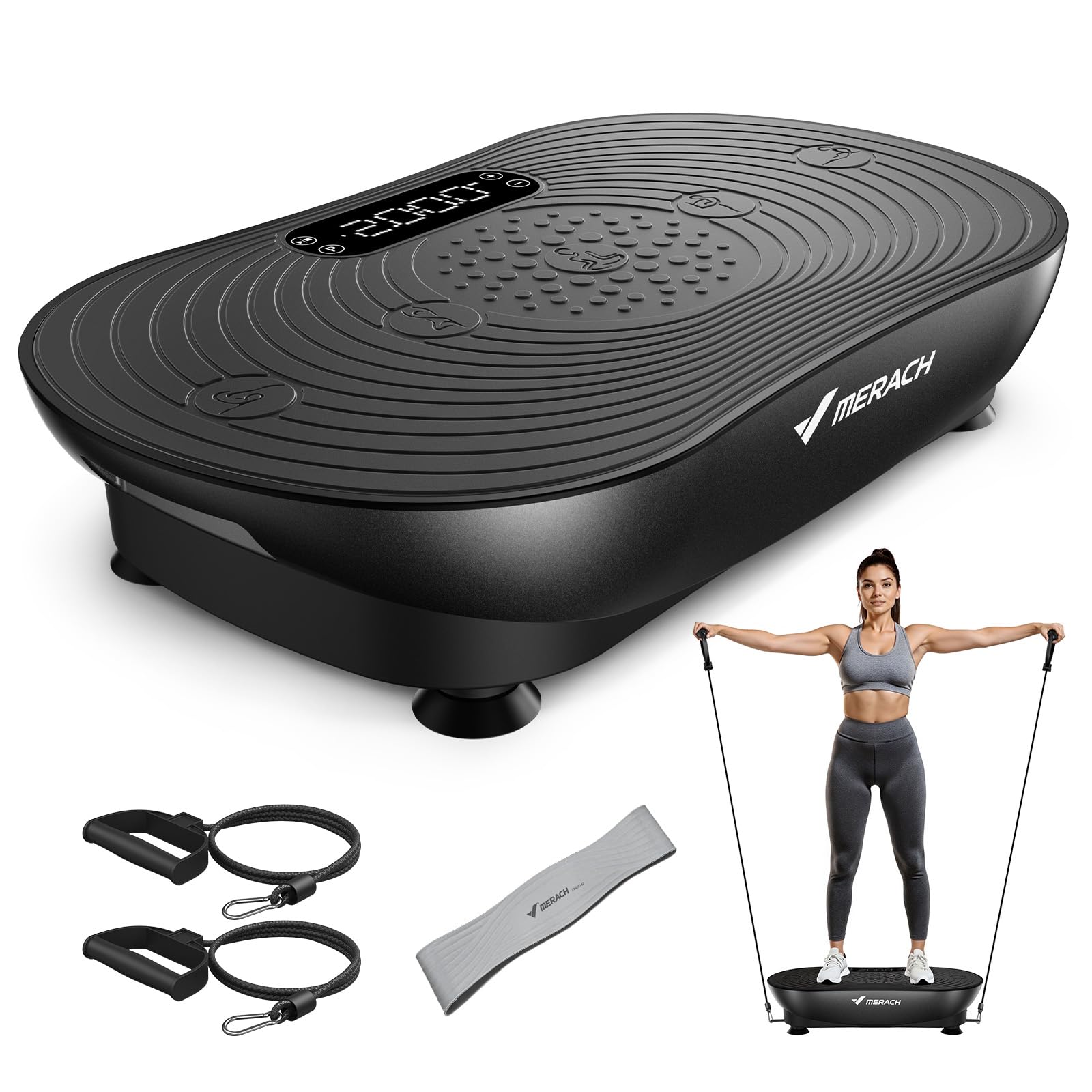
3. Merach V33 Pro Vibration Plate
A big readable screen and 99 speeds in a plate light enough to lift with one hand.
Standing on a vibration plate and bending to squint at tiny buttons is the wrong way round. This model puts an LED touchscreen at the top — larger and more sensitive than physical buttons, readable while you are upright — and adds a remote for when reaching down is not comfortable. You get 99 speed levels, a pull cord, and an assistance training belt, and the plate supports up to 350 pounds despite weighing 15.9 pounds. It runs on a 150-watt motor.
What wins people over is how quickly it fits a morning. Ten minutes is the suggested daily dose, and owners describe feeling circulation pick up within about five minutes even on a preset. The top surface is smooth rubber rather than metal studs, so barefoot standing is comfortable, and the setup is genuinely unbox, plug in, go. Pair it with your phone over Bluetooth and it plays music through a built-in speaker.
Compare the power and weight to the VT007: 150 watts here versus 80 watts there, in a body that weighs 15.9 pounds against the VT007’s 30.5 pounds. The catch is that a small, light plate moves more readily under you, and the speed count is the one point where owners diverge — some units have arrived that would not power on at all, and the remote has drawn mixed feedback with at least one unresolved issue when the unit was out of stock. Treat the light weight as a plus for storage and a caution for stability.
Why it earns its spot
- Large LED touchscreen you can read while standing
- 99 speed levels plus a 10-minute daily routine
- Smooth rubber top is comfortable barefoot
- 15.9 pounds — easy to store and move
What to watch for
- Functionality feedback is mixed, including units that failed to power on
- Remote control draws mixed reviews and support can lag
- Its low weight means it can shift underfoot more than a heavy plate
Best fit: a budget-conscious buyer who wants a bright touchscreen and a light plate to slide under the couch.
Think twice if: you want the steadiest possible base, or you expect flawless electronics from the start.
4. Renoj 3D Whole Body Vibration Plate Exercise Machine
Three axes of motion, a 455-pound ceiling, and a speaker for your playlist.
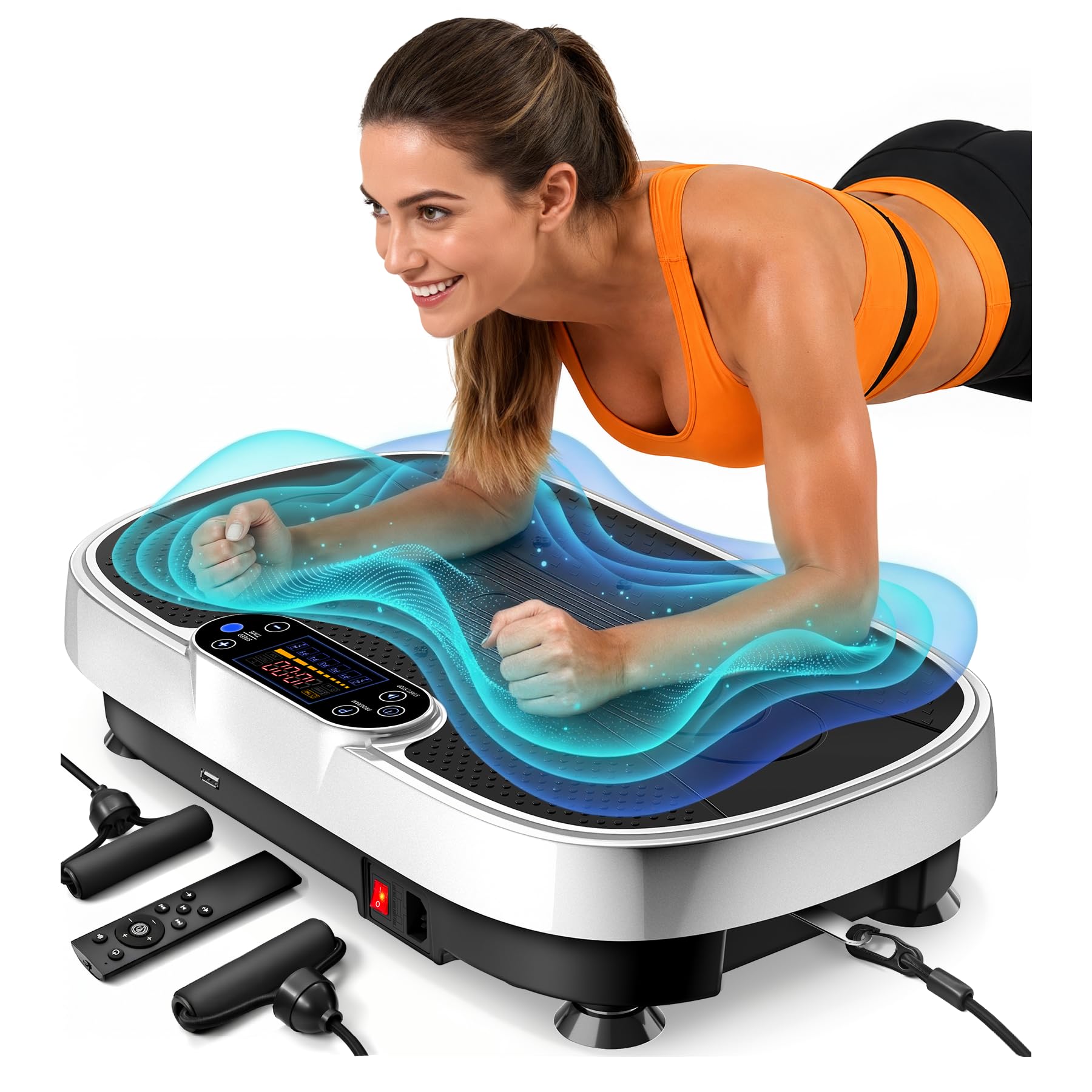
This plate moves in three directions at once — vertical, oscillating, and micro-vibration — which is what the “3D” label means. You set the intensity anywhere from 1 to 120 speeds, watch the LED touchscreen for time and level, and connect your phone to the built-in Bluetooth speaker if music helps you stay on for ten minutes. Two resistance bands come in the box. The motor is rated at 200 watts and the maximum speed is 120 rpm.
The strength is the weight ceiling and the footprint. It supports up to 455 pounds in a shell that weighs 18 pounds, with four anti-slip suction cups and a durable casing to keep it planted. The platform is 21″D x 13″W x 5″H, so it tucks away easily. What people talk about most is circulation — A 61-year-old on a daily ten-minute session reports relief from everyday aches and better lymphatic drainage, and a buyer with sciatica used it to keep moving while working their arms.
One point deserves a straight answer: durability feedback here is mixed, with some units reportedly stopping after about four weeks. That is not the majority experience, but on a machine you will use every day it is worth knowing before you buy, and it is the reason the generous weight limit and the low price do not automatically make it the default choice for a long-term routine.
Space and capacity: 455 pounds of support in an 18-pound shell that measures 21″D x 13″W x 5″H is the roomiest-to-size ratio on this list.
The honest caveat: mixed durability reports mean you should keep your receipt and check the return window.
Pick this one if you want multi-axis motion, a high weight capacity, and a compact footprint, and you are comfortable using the warranty if something fails.
Weigh instead: a machine with a longer track record if you want the fewest possible surprises over years of daily use.
5. Powerfit Vibration Plate Exercise Machine

A curved deck and a remote, aimed squarely at an older user who wants simple.
The design brief here is obvious: a curved standing surface that positions your body, five resistance levels, and a remote so you are not bending to change a setting. It runs on corded power and weighs 6.5 kg, so it is light enough to move with one hand. The frame mixes ABS plastic, alloy steel, and rubberwood, and two resistance bands come included along with the power cable and manual.
There is a smaller review base here than most of the list, which means less pattern to draw on. What is there points the same direction: daily use that feels good, a solid full-body session in a few minutes, a quiet platform, and relief in the legs and circulation after long workdays. For someone who wants to step on, press a button, and get ten gentle minutes, the curved deck and remote cover the essentials without a screen full of options.
What it will not do is give you a wide, deep platform for squat work or a heavy base that never shifts. At 6.5 kg it is portable, which cuts both ways. If your routine is standing still and letting the plate work, that is fine; if you plan to add resistance-band moves, a larger, heavier machine is the better partner.
Suits you when simple controls and light weight matter more than a big feature list.
The limitation: the smallest review base on this list, so you are buying on design intent more than on years of owner history.
6. Lifepro Waver Mini Vibration Plate

A 200-watt motor in a plate that slides under the bed.
Oscillation is the motion here — the plate rocks rather than driving straight up, and for some people that feels gentler than a vertical buzz. It packs 99 speed settings and 10 preset programs, so a beginner can pick a program and a confident user can set a manual level, all on a 200-watt motor. The package includes four loop bands, two resistance bands, a remote, and a user guide. The anti-slip rubber top and LED display round it out.
Longevity is the reason this one holds up in a shortlist. A buyer approaching two years of use reports it still working like new, and A 75-year-old using it for low-impact movement and fluid retention reports better balance, more tone, and more strength after five months. The compactness that makes it easy to store also describes the platform itself — it is a smaller surface than a full-size Waver, so a wide stance is not on the menu. One practical annoyance: the beep when changing settings is loud enough to be disruptive if someone else is sleeping, and it is somewhat heavy to lift for its size.
One safety note worth carrying into any routine: a buyer with a connective-tissue condition found the vibration rattled the head without strongly bent knees. The bent-knee stance is the standard advice, and it applies on this machine as much as any other.
Reasons it keeps a spot
- Oscillation motion that some users find easier to tolerate
- 99 speeds and 10 presets on a 200-watt motor
- Stores under a bed or in a closet
- Replacement remotes handled quickly by support, per reports
Costs of the small size
- Narrower platform limits a wide stance
- Loud beep on power-up and setting changes
- Heavier to lift than its compact look suggests
For you if your space is tight and you want oscillation rather than vertical vibration.
Not the one if you need a broad platform for stance work or a silent control panel.
7. AXV Vibration Plate Exercise Machine

A remote-controlled plate that pairs with your phone and ramps gently in and out.
You get 1 to 120 adjustable speeds, a remote, two resistance bands, and an LED display that shows time and speed. The shell is plastic with an anti-slip coating, and there is a magnet massage function on the deck. A ramp-up and ramp-down program is the feature that stands out for anyone easing into vibration work, because it starts soft and builds rather than jolting you at full intensity.
The clearest real-world use for it is fluid and swelling. A buyer managing lymphedema does two five-minute sessions a day after manual drainage to move fluid and ease leg swelling, and calls the machine sturdy. Another mature buyer with creaky knees found it easy on the joints while still feeling like a workout. The lower-body and upper-body bands let you work arms while you stand.
Two things to keep in mind. The instruction booklet drew criticism for illustrations that do not always match the written exercises and misspellings, so a first-timer should work out the routine rather than follow the pictures. And one buyer with knee trouble found the vibration uncomfortable rather than helpful — a reminder that vibration is not the right input for every pair of knees, and a lower amplitude is the adjustment to try.
Worth a look if swelling and fluid movement are your main reason for a plate, and you like the ramp-up setting.
Skip past if your knees react badly to vibration or you rely on a manual to learn the moves.
8. Merach CV40 Curved Vibration Plate
Deep, curved, and strong — a high-capacity plate with smart auto-pause.
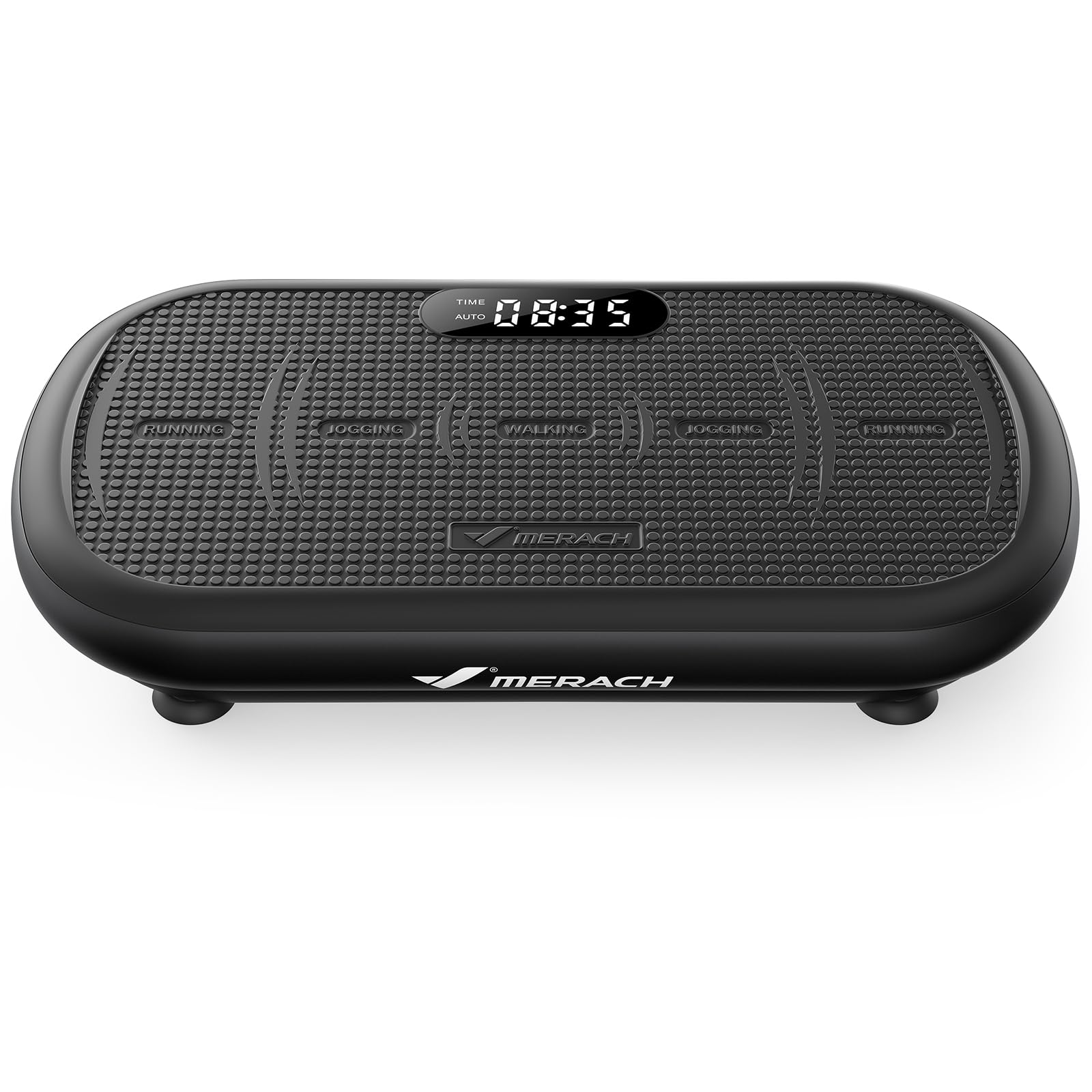
The defining number is 13 mm of amplitude — the distance the plate travels on each stroke — which is a deeper movement than most compact plates deliver. A 200-watt motor drives it, and the curved deck is designed to seat your stance. There are 10 speed modes plus one preset, a remote with LED display, textured silicone pedals for grip, and Bluetooth speakers. The capacity is 440 pounds in a body that weighs 23.15 pounds and measures 28.4″×15″×6.3″.
The smart bit is genuinely useful for a shaky balance. Sensors detect when you step on and start the plate automatically, then pause it after 30 seconds of inactivity — so if you step off, it does not keep running. Owners describe strong, adjustable vibration that helps loosen stiffness from long sitting, and several mention it being quiet and sturdy. One buyer with sinus and lower-back complaints uses it twice daily and would buy it again.
The practical catches: there are no onboard controls, so everything runs through the remote — lose it and you are stuck — and the remote itself feels inexpensive in the hand. The plug placement at the front is also awkward for some room layouts. It is a strong machine for a bigger user who wants a wide curved deck; it is not a machine for someone who misplaces remotes.
Big-user build: 440 pounds of capacity and 13 mm of amplitude in a 23.15-pound frame is a rare combination on this list.
The remote dependency: with no onboard controls, the remote is the machine — keep it in one place and treat it gently.
Best for: a heavier user who wants deep amplitude, a curved deck, and auto-pause safety.
Look past it if you dislike remote-only control or want a plate you can anchor with handles.
9. EILISON FitMaxx 3D XL Vibration Plate
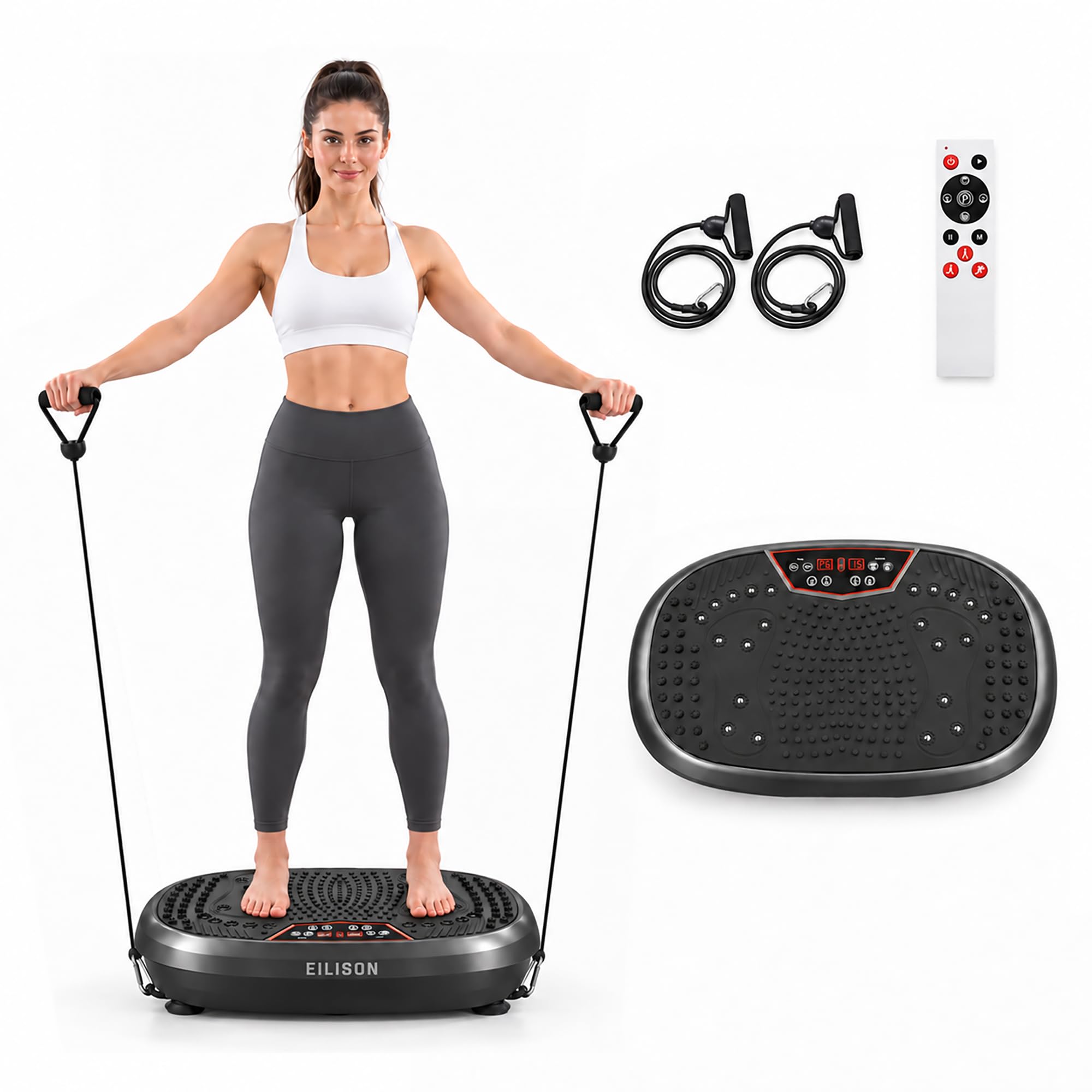
An acupressure deck under a three-axis shake, with 120 speeds to choose from.
The surface is the differentiator: an acupressure plate pattern that presses on the soles of your feet while the 3D vibration works. It runs 120 speeds on a push-button control with an LCD display, carries a 350-pound weight limit, and includes a remote and loop bands. It weighs 8.3 kg and is built from metal and plastic, in a brown finish that blends with dark flooring.
What comes through from owners is patience paying off. A 49-year-old woman at 5’3″ and 128 pounds used it daily for six months at level 110 with squats and planks, reporting firmer calves, less morning stiffness, better circulation, and a looser waistband — with no weight loss claimed. A buyer with neuropathy after spine surgery felt a change from the first session: better balance and more foot sensation. The flip side: the acupressure surface and the vibration can produce itchy skin at first, which subsided at a lower level or shortly after stopping.
One reviewer raises a fair flag: the spine-specific research behind vibration plates is thin, so treat this as a movement and circulation tool rather than a bone-building promise. The foot surface has three zones — mild in the center, lateral in the middle, strongest at the edges — which gives you a way to dial sensitivity with foot placement.
Your pick if you like the idea of foot stimulation layered onto vibration and you want a low, portable footprint.
Consider something else if your feet are sensitive or you want the simplest possible smooth deck.
10. Lifepro Waver Vibration Plate
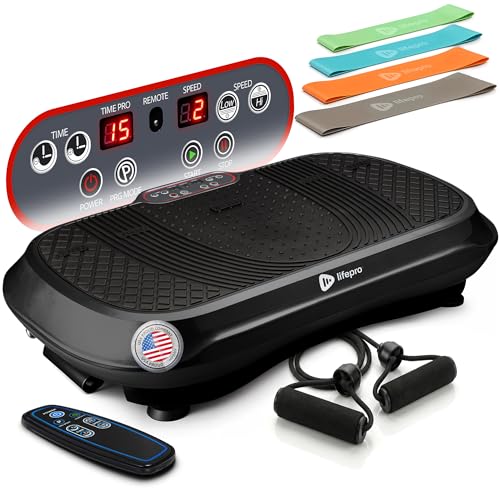
The full-size Waver: oscillation motion, ten presets, and a wide 330-pound platform.
This is the larger sibling of the Mini, and the extra platform is the point. It supports up to 330 pounds, measures 27″D x 15″W x 6″H, and weighs 27 pounds — big enough for a confident stance. You get 99 speed settings, 10 preset programs plus manual mode, oscillation movement, anti-slip rubber, and a remote with an LED panel. Loop bands and resistance bands are in the box, and it stores under furniture.
The reviews read like a long-running field test, because the machine has been around. A buyer using it two to four times a day reports lower-leg swelling gone within three days over ten sessions, plus better stamina. Another describes a stiff back feeling alive again after five minutes first thing in the morning. For apartment dwellers, one user specifically noted how quiet it runs for the neighbours below, and how the larger unit still fit in a small guest room.
Two cautions. The manual advises easing in seated or holding support if you feel dizzy at first — that is real for some people on any oscillation plate, and worth following.
Proven daily driver: a wide 330-pound platform, 10 presets, and a decade-plus of owner history make it the lowest-risk full-size option here.
Where it sits: numbered speeds, not hertz-level frequency tuning — precise frequency control is the Rumblex’s job.
Settle here if you want a full-size platform with presets, quiet operation, and a track record you can read before you buy.
Not your match if you need exact frequency settings rather than numbered speeds.
11. Lifepro Rumblex 4D Vibration Plate

Three motors, four to forty hertz, and a platform wide enough for squats.
This is the most capable machine on the list, and the numbers show why. Three independent quiet motors — oscillating, pulsating, and lateral — combine into a 4D motion, with seven training modes. You get 60 speed levels and a frequency range of 4 to 40 Hz, which is the closest thing here to dialing in a specific hertz value for a bone-and-muscle routine. The platform is 29.5 x 18 inches with a 500-pound weight capacity, the highest ceiling here.
For a bone-density shopper, the frequency control is the real draw: you can stay at the low end of 4 to 40 Hz and work up as your tolerance allows, and the wide deck means a stable stance. Circulation and quality are what owners value most, and the reviews echo it — a family of three uses it for joint and muscle complaints, stiff calves, and circulation, and post-class users report that it shakes out sore muscles. Sessions run up to ten minutes, and the transport wheels let you push it between rooms.
The honest limits: it is a large, heavy machine at 18.28 kg with a 29.6″D x 17.9″W x 5.8″H footprint, so it claims floor space. Some users report mild motion sickness at first and note you must power-cycle it to restart a session.
Where it pulls ahead
- 4–40 Hz frequency range — precise control
- 500-pound capacity and a 29.5 x 18 inch deck
- Three motors and seven modes for varied sessions
- Four non-slip feet and transport wheels
The cost of all that
- Large footprint and heavy at 18.28 kg
- Mild motion sickness reported by some first-time users
- Requires a power-cycle to restart a session
Step up to this if you want the widest frequency control and the highest weight ceiling, and you have room to spare.
Stay with a smaller plate if floor space or ease of movement outranks hertz-level tuning.
Know the Specs
Frequency in Hertz
Hertz means shakes per second. A machine that lets you set a low frequency lets you start gently and work up — the VT007 runs 10 to 40 Hz, and the Rumblex runs 4 to 40 Hz. For a bone-density routine, the ability to choose a low starting point matters more than the top-end number.
Amplitude
Amplitude is how far the plate travels on each stroke — the Merach CV40 lists 13 mm. A low-amplitude plate gives a fine, quick buzz; a deeper amplitude gives a bigger movement. If your joints are sensitive, lower amplitude is usually the gentler start.
Weight Capacity
This is the maximum body weight the plate is rated for. Always pick headroom above your own weight — 250 pounds on the VT007, 440 on the Merach CV40, and 500 on the Rumblex. A machine used close to its ceiling will feel less stable.
Machine Weight
A heavier plate stays planted but is a chore to move: the Axis-Plate is 65 pounds, while the Merach V33 Pro is 15.9 pounds. If you plan to slide it under a bed or carry it between rooms, machine weight is the number that decides whether you actually use it.
Common Questions
What frequency should I start at on a vibration plate?
Is a low-amplitude plate better for sensitive joints?
Do I need handles on a vibration plate if my balance is shaky?
How heavy a plate can I safely stand on if I am a larger person?
How long should a session last?
Can a vibration plate help with bone density?
Will the vibration travel through the floor to the room below?
Should I keep my knees bent while standing on the plate?
What is the difference between oscillation and vertical vibration?
Can I use a vibration plate while seated?
How much floor space does a vibration plate need?
The Bottom Line
Among these vibration plates for osteoporosis, the VT007 Vibration Plate is the one to beat, because it hands you adjustable frequency from 10 to 40 Hz, two amplitude settings, quiet operation, and a 10-year warranty in a 30.5-pound body you can actually move between rooms. If balance support is the deciding factor, the Axis-Plate gives you handles and a 265-pound frame to hold onto. And if you want the widest frequency control and the highest weight ceiling, the Lifepro Rumblex 4D covers 4 to 40 Hz with a 500-pound capacity. Pick the plate you will stand on for ten minutes tomorrow morning — that habit matters more than any single spec.
How we choose
We do not accept paid placement. Every pick is matched to a real buyer and a real use-case; we do not hands-on test units.
Sources
Specifications: manufacturer listings and product documentation. Review insights: verified customer reviews, as of October 2026. Pricing: not shown on this page (it changes often); check the current price via the retailer link.
As an Amazon Associate, Aappliancez earns from qualifying purchases. This does not affect which products we feature.