Disclosure: Some links in this post are affiliate links. As an Amazon Associate I earn from qualifying purchases, at no extra cost to you. Learn more
Specs are compiled from manufacturer listings and verified buyer reviews and can change over time — please confirm the key details on the product page before buying.
Most compression socks fail right when you need them — at the doorway, hopping on one foot, yanking a tight tube over a swollen ankle. Velcro compression socks work differently: you wrap a panel around your leg and set the tightness yourself with a hook-and-loop strap (a strap that sticks to itself). That changes who can wear them, how much pressure you get, and if you need a second pair of hands in the morning.
This guide is built by comparing the manufacturers’ published specifications and the patterns across verified customer reviews, so you get each pick’s real strengths and trade-offs instead of marketing spin.
Below you’ll find two true wrap-style braces, two zip-up and pull-on knee-highs, and one thigh-high option, ranked so you can match the design to your leg and your day. Every pick here earns its place for a different reason, and each one has a real limitation worth knowing before you buy a set of Velcro Compression Socks.
Top Picks

How To Choose The Best Velcro Compression Socks
Your first decision is not brand or color — it is if you want a wrap you tighten yourself or a sock you pull on. A true Velcro-style wrap is a flat panel with hook-and-loop straps that closes around your calf. A zipper sock is still a tube of fabric, just with a zip running up the side. Those are different tools, and they suit different legs.
Wrap Or Pull-On: Pick By Your Hands, Not Your Taste
If bending to your feet is hard, a wrap wins. You close it around the calf with one hand, then adjust the tension strap by strap. A pull-on or zip sock still has to travel over your heel and ankle, which is the tightest part of the garment. Zip socks make removal easy, but as owners of the Ailaka pair point out, the trick is to pull them on with the zipper already closed rather than zipping them up on your leg.
Match The Compression Level To The Job
Compression is measured in mmHg (millimeters of mercury, the pressure the fabric puts on your leg). The 15-20 mmHg band is moderate compression — the everyday level for tired, achy legs, long standing shifts, and travel. Firmer levels exist, but every product in this guide sits at 15-20 mmHg, so the real difference between them is fit and design, not pressure level.
Measure The Calf, Then Read The Chart Twice
A calf wrap is sized by circumference, not shoe size. The Sylong, for example, splits into S/M for 12-14.5 inch calves and L/XL for 15-17.5 inch calves. Knee-high socks are usually sized by shoe size or a letter range instead. When your measurement lands at the top of a range, sizing down is the safer call — a loose compression garment slides, and a sliding garment gives you no useful pressure.
Side-by-Side Comparison
| Model | Best For | Style | Compression | Sizing Basis | Amazon |
|---|---|---|---|---|---|
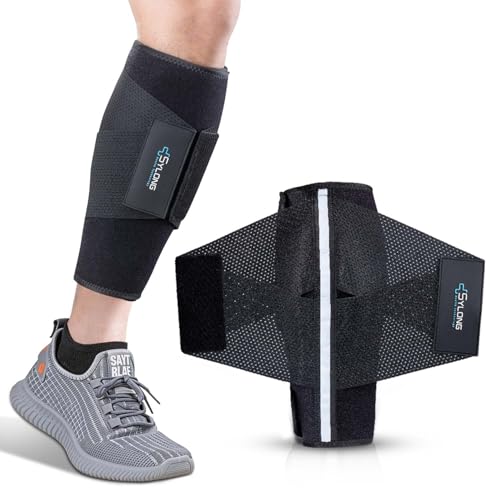
| Sylong Calf Compression Wrap Brace★ Best Overall | Adjustable wrap pressure on the calf | Hook & loop wrap | Adjustable, no mmHg rating listed | Calf circumference (12-14.5 in / 15-17.5 in) | Amazon |
| Ailaka Medical Zipper Compression SocksEasiest On And Off | Easy on and off for weak hands | Zip-up knee high, open toe | 15-20 mmHg | Size chart (go up between sizes) | Amazon |
| Copper Fit Energy Easy-On/Easy-Off | Standing all day in a colorful sock | Pull-on knee high | Graduated | Women’s shoe size 7-10 / 10-13 | Amazon |
| Doc Miller Thigh High Open Toe | Thigh coverage for travel and recovery | Thigh high, open toe | 15-20 mmHg | Small to 4XL | Amazon |
| JOBST Relief Knee High | Reliable day-in, day-out knee high | Pull-on knee high, closed toe | 15-20 mmHg | X-Large full calf | Amazon |
Detailed Reviews
1. Sylong Calf Compression Wrap Brace
Our pick — 4.5+★ from 550+ verified ratings; the strongest balance of quality and price.
Four straps pulling from four directions, tension set by your own hand.
If you want genuinely adjustable Velcro pressure rather than a fixed tube, this is the one. The Sylong puts four elastic bands, each 4 inches wide, into a diamond pattern around the calf so the squeeze comes from four directions instead of one wrap going round and round. You fasten it with hook-and-loop (the generic name for Velcro-style tape) and tighten each band until the pressure feels right. It weighs 7.2 ounces, which is 1.58 ounces lighter than the Ailaka zip socks at 8.78 ounces — a difference you notice on a long walk.
The design earns its keep on real legs. What wins people over is the compression itself, and the fit is the close second in owner feedback. One buyer with a 16.5-inch calf says the L/XL wraps fully around without the bulging that bigger-name braces produce., and A returning volleyball player who tore a soleus praised it as support that keeps the calf from cramping. A reader with a calf sprain that lingered a year could tighten it hard with no slide down the leg.
Two honest limits. The fabric is polyester with a stretchy middle layer and ventilation holes, but it is hand wash only, so it is not a throw-it-in-the-machine item. And staying in place splits opinion — many say it holds, some say it creeps down during use, so getting the tension right on the first close matters. The reflective strip on the back is a small bonus if you run or walk after dark.
What Sells This Brace
- Four 4-inch bands in a diamond pattern spread pressure evenly around the calf
- One-handed hook-and-loop fastening you can adjust band by band
- Nearly symmetrical sides so it works on either leg
- 7.2 ounces — the lightest wrap in this lineup
- Reflective strip on the back for evening walks and runs
Where It Asks More Of You
- Hand wash only, so no machine cycles
- Staying power is the one mixed note — tension has to be set carefully
- If you sit at the top of a size range, sizing down gives a tighter close
Reach for this if: you want to dial the pressure yourself and your calf measures within 12-14.5 or 15-17.5 inches.
Look elsewhere if: you want full knee-to-ankle sock coverage rather than a band around the calf.
2. Ailaka Medical 15-20 mmHg Zipper Compression Socks
The zip that gets a knee-high off without a fight — and three pairs of it.
The Ailaka earns its spot with a zipper running the length of the sock, so you can pull them on like a regular sock and unzip to remove them. You get three pairs, each rated 15-20 mmHg, made from 75% nylon and 25% spandex with an open toe that lets your toes breathe. Buyers report ease of use is the top praise, with fit a close second. The key trick, as owners mention, is to pull them on with the zipper already zipped up — the zip helps you peel them off, not close them on your leg.
Durability is where the picture gets realistic. One pair lasts about six weeks with daily wear, according to a buyer tracking her sets, and a nurse-type schedule of long standing shifts is exactly the use case the maker lists. Zipper failure is the known weak point: some owners run six pairs and lose one zip, others have no trouble at all. The fit earns praise from people who find ordinary compression socks impossible to pull on alone.
The catch is sizing. The negative reviews cluster around people who ordered the largest size and still found it too tight, with one describing a red mark on the lower leg after two wears. Go up a size if your measurements sit between sizes, and read the size chart in the product images rather than guessing by letter. Three pairs in the box softens the blow if one zip ever gives out.
The daily-standing case: if you are on your feet for a shift and need a knee-high you can remove without help, the zip and the open toe do exactly that. The 15-20 mmHg band is the moderate tier, the everyday level rather than the firm medical tier.
The sizing caution: the recurring gripe is that the largest size runs tight for some legs, and the zipper stop can feel coarse against skin. Measure first and size up when you are between sizes.
Built for: anyone with weak grip or limited reach who still needs a full knee-high sock.
Think twice if: your calf runs wide for the chart — the top size has disappointed a few broad-legged buyers.
3. Copper Fit Energy Knee High Compression Socks

Three colors in one box, plus a band that hugs the arch and ankle.
This is the pick for someone who wants compression socks that look like socks. Each box holds three pairs — taupe gray, cyan blue, and magenta pink — so you rotate through the week without doing laundry every night. The fabric blend is 85% nylon, 8% spandex, and 7% polyester, with a cushioned footbed under the sole and a targeted compression band that wraps the arch and ankle. Copper-infused yarn is there to manage odor between washes.
Durability is the standout. These socks hold their squeeze after a year of use, and quality is the thing owners praise most. Compression is the runner-up in feedback, and the colors draw steady compliments from people tired of medical beige. One long-time wearer with vein trouble says the socks ease the ache in her feet and ankles, and another calls them the pair that finally made her stop giving up on compression socks.
Be clear about one thing: these are pull-on, not Velcro, despite the Easy-On/Easy-Off name. The wide cuff is designed not to dig in below the knee, and the trade-off is that getting them over the heel takes some effort at first — read the directions and it gets easier. They also run warm, so they are a better fit for cooler months or air-conditioned offices than for a hot warehouse floor.
Why They Keep Getting Reordered
- Three pairs of knee-highs in three distinct colors
- Compression holds up after a year of wear
- Arch and ankle band adds targeted support
- Cushioned footbed under the sole for impact
- Copper-infused fabric to help with odor
The Honest Trade-Offs
- Pull-on design — not a hook-and-loop wrap
- Warm to wear in hot conditions
- First few wears can be a struggle to get over the heel
Right for: women who want a color choices and cushioning for long days on their feet in a shoe size 7-10 or 10-13 range.
Not the fit for: hot climates or anyone who specifically needs strap-adjusted pressure.
4. Doc Miller Thigh High Open Toe Compression Stockings

Coverage that climbs to the top of the thigh, sized all the way to 4XL.
The other picks in this list stop at the knee or the calf. The Doc Miller keeps going, with 15-20 mmHg graduated pressure that reaches the top of the leg — long enough, by one account, to come up to the bottom of the glutes. The open toe keeps toes free and lets air in, a help for anyone with swollen or sensitive toes and in warmer weather. Sizes run from Small to 4XL, so short and tall legs both have a shot at a real fit.
Buyers praise the compression most here, with comfort a close second. The soft, strong fabric resists running when snagged, which makes these a practical pick for travel — Owners describe a 16-hour flight, with one 5’7″ flyer feeling less shooting nerve pain and fewer spasms. Another traveler with a history of clots flew four hours with no swelling. They are also easy to remove alone, which matters on longer stockings.
The real question is staying power. Some customers note the stockings hold all day; others find they slide, especially if the size is too large for the leg. A 5’10” wearer had the stockings drop to the knee after ten minutes of walking, and a 5’3″ wearer at 140 lbs found that size L reached the top of the thigh and stayed there through 3-mile walks. Get the size right and the experience changes completely.
Why the open toe matters: it keeps your toes uncovered for breathability and for anyone with tender or swollen toes, and it makes these viable in warmer weather when a closed toe feels like a furnace.
The sizing reality: height and weight both drive the fit on a thigh-high, so a chart that works for one body can miss another. When in doubt, size down rather than up — loose stockings slide and lose their compression.
Choose these when: you need pressure above the knee for a flight or a recovery stretch, and you want an open toe.
Skip these if: your height puts you between the chart’s rows — a length mismatch will send them sliding.
5. JOBST Relief Knee High Compression Socks

The plain, latex-free closed-toe knee high that has been around for decades.
Some buyers want nothing clever — just a knee-high that puts steady pressure on the lower leg and survives the wash. The JOBST Relief is that pick. It delivers 15-20 mmHg graduated compression, meaning the squeeze is firm at the ankle and eases as it climbs the calf, in a 3-D knit structure using air-covered spandex yarn that feels soft against skin. The closed toe is cut with a roomy shape for extra wiggle room, and the whole sock is latex free.
Effectiveness keeps people coming back, with comfort a close second. Swelling in the foot and ankle is the specific complaint it answers — One buyer who broke an ankle and was advised by an orthopedic surgeon to wear them found the swelling eased, and another reports a father with large calves wearing them daily with no trouble fitting over them. The fabric is thick and sturdy with enough texture to grip, which helps the top hem hold its place and resist rolling down.
Getting them on is the honest cost. These are classic compression socks, and they fight back — owners describe them as hard to get on and off, and some find the size runs small. Stretch them on properly and the natural shortness of the sock causes a little sliding, while the top hem does its job of staying put. Air-dry them rather than spin them in a hot dryer to keep the elastic alive.
The Case For The Classic
- Graduated 15-20 mmHg pressure, firm at the ankle and easing up the calf
- Thick, sturdy knit that resists tearing
- Roomier closed toe for toe wiggle room
- Latex free construction
- Top hem cuts down on rolling
The Cost Of That Grip
- Hard to put on and take off, especially for weak hands
- Some find the fit runs small
- Natural short length means a little sliding while walking
Go with JOBST if: you want a no-frills closed-toe knee high with proven, steady pressure and room through the toe.
Look for a zip instead if: getting a sock over your heel and ankle by hand is already a daily struggle.
Know the Specs
Compression In mmHg
mmHg stands for millimeters of mercury, and it is the unit that describes how much pressure the fabric pushes into your leg. The 15-20 mmHg band used across these products is the moderate everyday tier — the level you find in travel socks and long-shift knee-highs. It is not the firmest pressure available, but matching the level to your routine matters more than chasing a higher number. A graduated sock puts more pressure low at the ankle and less as it climbs, which is what helps the leg move fluid back up.
Hook-And-Loop Versus Zipper
Hook-and-loop (commonly called Velcro) is a closure you set yourself, band by band, so the pressure is whatever you make it. A zipper is a different solution — the sock is still a fixed tube, but the zip helps you slide it on and off. Neither is better in the abstract. A wrap suits a variable calf or shaky hands and gives tunable pressure; a zip sock suits a person who wants the full-foot sock look with easy removal. Both styles in this lineup sit at the same 15-20 mmHg level.
Calf Circumference And Sizing
Wraps are sized by the distance around your calf at its widest point, not by your shoe size. The Sylong splits at 12-14.5 inches for S/M and 15-17.5 inches for L/XL. Knee-highs like the Copper Fit go by women’s shoe size — 7-10 for S/M and 10-13 for L/XL. When you sit at the top of a range, choose the smaller size so the garment keeps its grippy, useful fit instead of sliding.
Fabric, Ventilation, And Care
The material blend decides how the sock feels against skin and how it handles sweat. The Sylong is polyester with a stretchy middle layer and ventilation holes; the Ailaka is 75% nylon and 25% spandex; the Copper Fit is 85% nylon, 8% spandex, and 7% polyester with a cushioned footbed. Nylon and spandex give stretch and recovery; polyester adds softness. Care instructions vary — the Sylong is hand wash only, while others tolerate machine washing, and air-drying is the way to keep elastic from wearing out.
Common Questions
How do I measure my calf for a Velcro compression wrap?
Is a Velcro wrap better than a zipper compression sock?
What does 15-20 mmHg compression actually feel like?
Can I wear compression socks all day at work?
Will a thigh-high stocking stay up on its own?
How long should a pair of compression socks last?
What if the zipper on my compression socks fails?
Are these safe for someone with diabetes or foot sensitivity?
Why does the top of a compression sock feel tight for some and loose for others?
Should I put compression socks in the dryer?
The Bottom Line
The right pick depends on one question: do you want to set the pressure, or do you want a finished sock? If you want adjustable, four-direction squeeze you control with one hand, the Sylong Calf Compression Wrap Brace is the strongest wrap here, with its diamond strap layout and 7.2-ounce build. If getting a sock off has been the obstacle, the Ailaka 15-20 mmHg Zipper Compression Socks give you three pairs and a zip for easy removal. If you want full thigh coverage for a long flight, the Doc Miller Thigh High reaches higher than the rest. Whatever you choose, measure first — fit is what makes any compression garment work, and sizing down at the top of a range is the safest move.
How we choose
We do not accept paid placement. Every pick is matched to a real buyer and a real use-case; we do not hands-on test units.
Sources
Specifications: manufacturer listings and product documentation. Review insights: verified customer reviews, as of October 2026. Pricing: not shown on this page (it changes often); check the current price via the retailer link.
As an Amazon Associate, Aappliancez earns from qualifying purchases. This does not affect which products we feature.