Disclosure: Some links in this post are affiliate links. As an Amazon Associate I earn from qualifying purchases, at no extra cost to you. Learn more
Specs are compiled from manufacturer listings and verified buyer reviews and can change over time — please confirm the key details on the product page before buying.
You bought the produce, brought it home, and now you are staring at a sink wondering whether water alone is actually doing anything. It usually is not. The wax, the soil, and the handling residue on standard and organic fruit sit on the skin, and a quick rinse glides right over all of it. That is why a produce wash exists: the wrong one leaves a lingering taste on your grapes or clogs before the second week. Below are five washes that real kitchens actually keep on the counter, sorted by what each one does best.
This guide is built by comparing the manufacturers’ published specifications and the patterns across verified customer reviews, so you get each pick’s real strengths and trade-offs instead of marketing spin.
Some formulas are built for a fast spray-and-rinse on an apple, while others want a full soak for leafy greens and potatoes. The right pick depends on whether you snack on the go or cook from scratch nightly, and this guide to the best vegetable cleaner separates the sprayers from the soakers so you spend once.
Top Picks


How To Choose The Best Vegetable Cleaner
The bottle is not the hard part. What trips most people up is matching the format to the produce they eat most. A spray trigger is brilliant on a single apple and frustrating on a bundle of kale. A soak concentrate is the reverse — it wastes liquid on a lone plum but shines on a full sink of greens. Figure out your two most-eaten categories first, then let the format decide.
Spray, Foam, Or Soak — Pick By Produce
Trigger sprays suit firm, smooth produce: apples, potatoes, peppers, cucumbers. You spritz, rub, and rinse, and the whole job takes seconds. Foaming pumps put a thicker layer of wash on the surface, which helps on waxy citrus and melons where residue clings. Soak concentrates are made for soft or leafy produce — lettuce, spinach, berries, broccoli — where rubbing is not an option and you want the wash to reach into every fold while the produce sits in a bowl.
Read The Label For Wax And Residue Claims
Almost every bottle promises a clean rinse. The more useful words to hunt for are the specific ones: wax, soil, agricultural chemicals, handling residue. A formula that names what it removes is telling you how it is built. Look too for whether the maker states no aftertaste and no scent, because that is the single complaint that turns a good wash into a bottle you stop reaching for.
Do Not Overlook The Bottle And The Pump
A great liquid still fails if the pump sticks or the trigger mists unevenly. Pumps that stick or squeak, triggers that mist unevenly, and tops that leak in the cabinet all show up in owner feedback across this category. If you plan to rebuy the same brand, it is worth knowing whether the sprayer has a track record of holding up or whether you will end up pouring the wash into a bottle you already own.
Side-by-Side Comparison
| Model | Best For | Format | Volume | Scent | Amazon |
|---|---|---|---|---|---|
| Veggie Wash Fruit and Vegetable Wash, 16 Fl Oz (Pack of 2)★ Best Overall | Everyday spraying and soaking | Liquid spray | 16 fl oz each | Unscented | Amazon |
| Veggie Wash Foaming Fruit and Vegetable Wash 8 OunceBest for Snacking | Quick single-piece washing at the sink | Foaming pump | 8 oz | — | Amazon |
| Koala Eco Fruit & Vegetable Wash | Natural-formula buyers who soak | Liquid concentrate | 16 ounces | Australian Mandarin | Amazon |
| ECOS Organic Fruit & Veggie Wash, 22 FZ | Large-bottle households | Liquid | 22 FZ | — | Amazon |
| Fit Organic 32 Oz Soaker Produce Wash | Heavy produce households and refills | Soaker concentrate | 32 Oz | — | Amazon |
Detailed Reviews
1. Veggie Wash Fruit and Vegetable Wash 16 Fluid Ounce
Our pick — 4.5+★ from 14,000+ verified ratings; the strongest balance of quality and price.
The countertop standard: two big unscented bottles that handle everything you bring home.
Two 16-fluid-ounce bottles, a liquid form made with plant-derived ingredients, and no added scent — that combination is why this is the pick most kitchens land on. It is Kosher Certified and Vegan, alcohol free, and free of parabens and harsh surfactants, so you are not introducing a new set of chemicals while trying to remove the ones already on your food. You can spray it directly on firm produce, or pour it into a bowl and soak soft or leafy produce. Either way the instructions are the same: wash, rinse, eat.
What wins people over here is how the dirt actually shows up in the bowl. Soak a head of broccoli or a bunch of potatoes and the water goes visibly grimy, which is the moment most buyers realize a plain rinse was never doing the job. As owners put it: “Buyers report it lifts dirt and pesticide residue, rinses clean without film, and stays gentle on fruit skins.” Owners mention it running strong on potatoes and apples, with the residue lifting off without any film left behind.
The honest catch is the sprayer, not the wash. The liquid earns high marks; the included trigger bottles are the recurring gripe, with a few buyers finding they mist poorly and swapping the top for one they already own. That is a hardware annoyance, not a formula problem — and with two bottles, you still have plenty of liquid to decant into a trigger you trust. One quick note on size: at 2.4 pounds for the pair, this is a bottle you park on the counter rather than carry to the sink each time.
Why It Earns The Top Spot
- Two 16-fluid-ounce bottles cover spraying firm produce and soaking soft or leafy produce in one purchase
- Unscented, alcohol free, no parabens — and the zero-aftertaste claim is the thing buyers keep confirming
- Kosher Certified and Vegan, made with vegetable-derived ingredients, so nothing harsh goes on your food
Where It Falls Short
- The supplied trigger bottles are the weak link — a few owners find they mist unevenly and refill an old bottle instead
- Heavier on the counter than a single small spray bottle, so it suits a dedicated station rather than a drawer
Reach for this if: you want one unscented workhorse that handles a whole week of produce, from potatoes to spinach, without a lingering taste.
Look elsewhere if: you only ever wash a single apple at the sink and want a tiny pump bottle for that one job.
2. Veggie Wash Foaming Fruit and Vegetable Wash 8 Ounce
A pump bottle built for the moment you just want to eat an apple right now.
Think of scrubbing your hands, then apply the same motion to a piece of fruit. That is the entire premise of this 8-ounce foaming version — one pump lays down a thicker layer of wash than a trigger spray, you rub it over the skin with your hands, and you rinse. It is the same plant-derived, Kosher Certified and Vegan formula as the flagship pick, just delivered as foam and designed for quick single-piece jobs at the sink rather than a full soak.
The foam earns its keep on waxy citrus and melons, where a thin mist beads up and slides off. Customers note that the foaming action cleans better than regular sprays, leaving less wax residue, and that the foam is especially effective on citrus and melons where a thin mist tends to bead up and slide off. Grapes and apples get hand-scrubbed in a mesh colander, then rinsed and dried, and they come out ready to eat. The compact 8-ounce size means it lives on the counter without eating much space — and unlike the 2.4-pound two-pack above, this is the one you can keep right by the sink.
The trade-off worth knowing is the pump itself, which is where the mixed feedback lands. Some buyers find the pump sticks or squeaks a little while still working fine; others have had theirs fail outright, so treat the mechanism as the part to watch. There is also a small set of buyers who find the scent stronger than expected and prefer an odorless wash — if you are sensitive to fragrance on fruit skins, the unscented option is the safer call. For straight-up convenience on a single piece of fruit, though, nothing here beats one pump and a thirty-second scrub.
The foam advantage: A thicker layer of wash clings where a mist would run off, which is exactly why this shines on citrus, melons, and grapes instead of being a weaker version of the spray.
Suits the grazer: reach for it if you wash fruit one or two pieces at a time and want the job done in seconds without a bowl.
Not the pick for: anyone washing a full sink of leafy greens, where a soak concentrate does far more in one go.
3. Koala Eco Fruit & Vegetable Wash

The one for the sink-soak ritual, scented like fresh mandarin and poured from a recycled bottle.
At 16 ounces in a light 1-pound bottle, this is the concentrate you measure rather than spray. Pull up the push-pull top, add two or three squirts to half a sink of cold water, swish your fruit and vegetables through, then rinse under clean water and dry thoroughly to keep things firm and fresh. Drying matters more than people expect — it is what keeps berries from turning soft an hour after you wash them. The bottle itself is made from 100% post-consumer recycled plastic, so there is no new plastic in the packaging.
Where the Koala Eco earns its following is its formula. It is built to lift residual oils, waxes, and dirt without leaving any aftertaste, and the effect is that your produce tastes like produce again. The thing that gets praised most is right there in the numbers — effectiveness is the quality buyers keep coming back to. Ease of use and value for money follow closely behind, and the mandarin essential oil scent, which smells like something rather than nothing, is a genuine point of difference from the odorless competitors.
Two things to go in with your eyes open. The first is the scent — pleasant to most, but it is scented, and buyers who want zero fragrance on their food should pick the unscented wash instead. The second is surface care: the maker specifically advises keeping the bottle base dry, since moisture underneath can mark a countertop. Neither is a dealbreaker, but both are small habits worth adopting from day one. One more note on volume — at 16 ounces, this bottle holds twice what each 8-ounce foaming pump gives you, so it goes further on full loads.
Soak-and-rinse built: Two or three squirts per half sink is all the measuring you do, so a single bottle covers load after load of greens and root vegetables.
what separates it: you get a scent you actually notice, thanks to the mandarin essential oil (oil pressed from mandarin peel), and the bottle is made from recycled plastic. That pairing suits you if you want a natural formula and care where the packaging ends up.
The pick for you if: you soak big batches in the sink and want a formula that removes oils and waxes without any taste left behind.
Steer clear if: you insist on a completely unscented wash or want a ready-to-spray bottle with no measuring at all.
4. ECOS Organic Fruit & Veggie Wash, 22 FZ
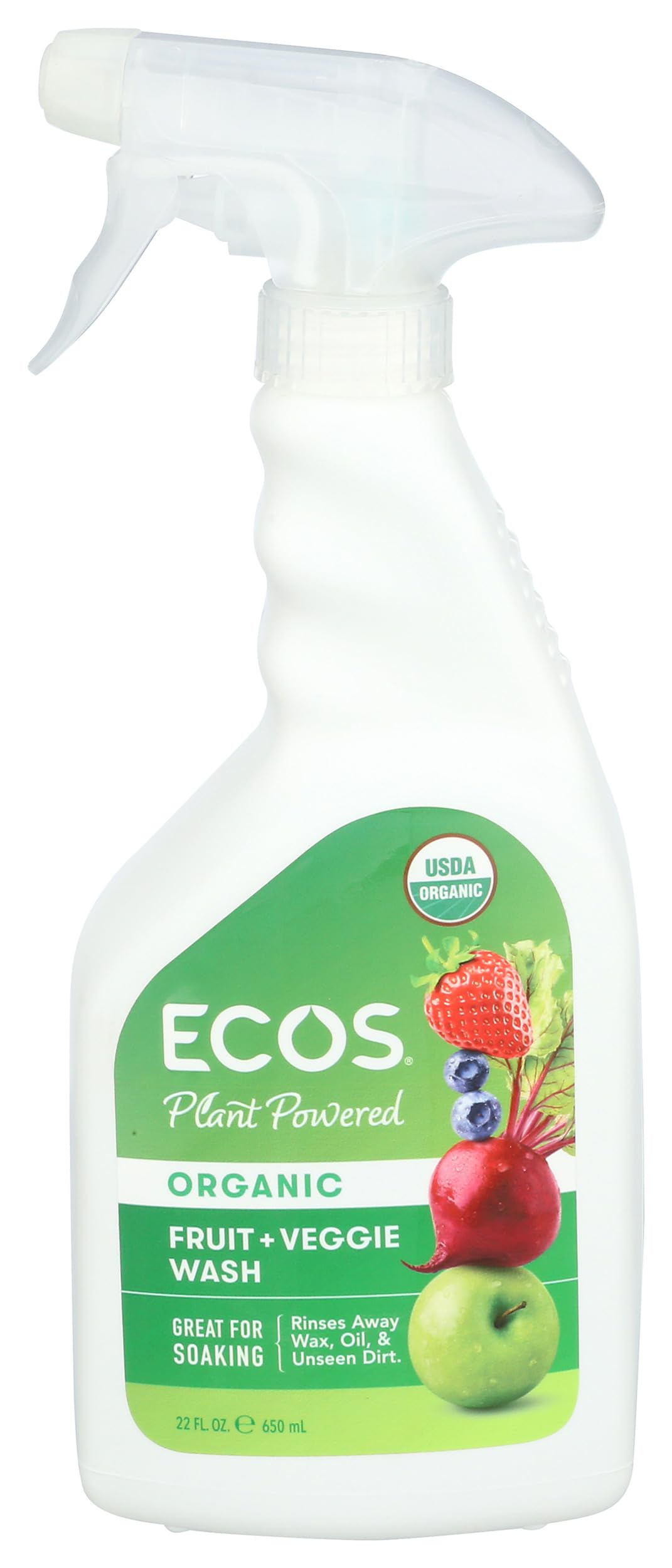
Go big or refill often — a single 22 FZ bottle with a sprayer in the cap.
If you are tired of running out mid-week, the math here is simple: 22 FZ in one bottle is the biggest single container on this list. It is the bottle to grab when your produce drawer gets emptied faster than your wash does. Pour a little into a spray bottle for firm produce or use it straight for a soak, and you have one refill that keeps the counter stocked for a long stretch.
Owners are clear on what works. Cleaning effectiveness is the strength that gets called out most, and effectiveness as a whole comes right behind it — this bottle earns its keep by doing the job on real produce, not just on a label. The sprayer design also gets praise in its own right; a sprayer that actually works is a real selling point in this category, where a bad trigger can undo an otherwise excellent formula. That is the strength of this pick. The formula does the cleaning and the sprayer conveys it without fighting you.
What you should plan for is the sniff test. Scent is the one point where buyer opinion splits — some find it pleasant, others describe a strong vinegar smell, and it is the single thing that keeps this from being an easy universal pick. It fades at the sink, but it is noticeable while you are spraying. If a vinegary note puts you off, the unscented flagship or the mandarin-scented Koala Eco will sit better with you. The 1.38-pound bottle, meanwhile, is light enough to lift comfortably with one hand, which is a small thing that adds up over a long fruit-washing session.
Size as strategy: At 22 FZ this is the largest single bottle here, which means fewer reorder interruptions if your household goes through produce quickly and you hate stopping mid-recipe.
The fit if: you want maximum volume per bottle and a sprayer you can count on for daily use.
Hesitate if: a distinct vinegary note on your food would bug you — the unscented pick sidesteps that entirely.
5. Fit Organic 32 Oz Soaker Produce Wash

The big refill jug for households that wash everything they bring home.
This is a 32-ounce soaker — the largest bottle in the lineup and the one built for a fixed routine rather than a quick spritz. You measure the recommended amount into a bowl of water, soak your fruit, vegetables, and leafy greens, then rinse everything off. That soak is the part that does the work on grapes, berries, and any produce with folds a rub would miss. For anyone washing produce several times a week, a jug this size means one fill lasts a long time.
Cleaning performance is the quality buyers notice most here, and effectiveness sits right beside it — together they tell you this is a formula people trust on the tough cases, not just easy ones. The details that come up again are the absence of any nasty taste and how straightforward it is to use: measure, soak, rinse, and your produce comes out feeling fresh and ready to eat. It also earns its place as a refill. Pour it into the spray bottle you already keep by the sink and you have stopped buying small bottles entirely.
The one habit worth building is consistency with the ratio. Because you are mixing it yourself, you need to actually measure the recommended amount rather than eyeballing a splash — too little and you are rinsing for nothing. It is also the largest bottle here, so it wants a spot in a cabinet rather than on a crowded counter. Get those two things right and this is the most economical way to wash produce at volume.
The Case For The Jug
- 32 ounces is the biggest bottle here, so a single refill covers weeks of produce washing
- Taste comes up as a strength — buyers wash and eat without any lingering flavor
- Soaker format reaches into folds, which suits grapes, berries, and leafy greens better than a spray
Small Things To Know
- You measure it yourself, so it only works as well as your ratio discipline
- The large bottle lives in a cabinet rather than on the counter — plan storage accordingly
Settle on this if: you have a standing soak routine and want the cheapest per-wash path with a jug that keeps refilling your spray bottle.
skip it if: you want a ready-to-use spray the moment you open the lid and have nowhere to store a bigger bottle.
Know the Specs
Format: Spray, Foam, Or Soak
The format decides how much effort each wash takes. A trigger spray is fastest on firm, smooth produce you can rub. A foaming pump lays down a thicker layer and suits waxy citrus and melons where a mist slides off. A soak concentrate is the only practical choice for soft or leafy produce you cannot scrub. Match the format to your two most-eaten categories — spray for apples and potatoes, soak for greens and berries — and the daily friction disappears.
Volume And Bottle Count
Volume decides how often you reorder. An 8-ounce pump covers single-piece snacking; a 16-ounce bottle handles week-to-week washing in most kitchens; a 22 FZ bottle or a 32-ounce soaker is for households that empty the produce drawer fast. Add the bottle count in a multi-pack and you have a rough sense of how long you go before the next order.
Common Questions
Can I use a vegetable wash on organic produce?
Is a foaming wash better than a regular spray?
Do I have to rinse produce after soaking it?
Will a vegetable wash leave a taste or smell behind?
How much wash do I add to a bowl of water?
Should I dry produce after washing it?
Can I refill my own spray bottle with a soaker wash?
What is the difference between a spray and a soak wash?
Does a vegetable wash go bad or lose strength over time?
Is a vegetable wash safe for produce I will feed to kids?
The Bottom Line
For most kitchens, the best vegetable cleaner is the Veggie Wash Fruit and Vegetable Wash 16-ounce two-pack. One purchase covers both jobs: spray the firm produce, soak the leafy produce. It is unscented, alcohol free, and plant-derived, so nothing lingers on your food. If you snack on fruit piece by piece at the sink, the Veggie Wash Foaming 8-ounce puts the wash on in one pump and finishes the job in seconds. And if your household already soaks produce on a routine, reach for the Fit Organic 32 Oz Soaker — a jug that size keeps refilling the spray bottle you already own.
How we choose
We do not accept paid placement. Every pick is matched to a real buyer and a real use-case; we do not hands-on test units.
Sources
Specifications: manufacturer listings and product documentation. Review insights: verified customer reviews, as of October 2026. Pricing: not shown on this page (it changes often); check the current price via the retailer link.
As an Amazon Associate, Aappliancez earns from qualifying purchases. This does not affect which products we feature.